Competing For Advantage
Part III – Creating Competitive Advantage
Chapter 6 – Competitive Rivalry and
Competitive Dynamics
The Strategic
Management
Process
Competitive Rivalry
 Key Terms
 Competitors – firms operating in the same
market, offering similar products and targeting
similar customers
 Competitive Rivalry – ongoing set of competitive
actions and competitive responses occurring
between competitors as they contend with each
other for an advantageous market position
 Competitive Behavior – set of competitive
actions and competitive responses the firm
takes to build or defend its competitive
advantages and to improve its market position
Competitive Rivalry
 Key Terms
 Competitive Dynamics – total set of actions and
responses of all firms competing within a market
 Multimarket Competition – firms competing
against one another in several product or
geographic markets
From Competitors to Competitive Dynamics
Model of
Competitive
Rivalry
Intensity of Rivalry
 The total number of competitors
 Market characteristics
 Quality of individual firms' strategies
 Drivers of competitive behavior
Competitor Determinants
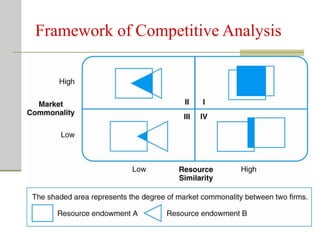
Market Commonality
Resource Similarity
Market Commonality
 Key Terms
 Market Commonality – number of
markets with which the firm and a
competitor are jointly involved, and
degree of importance of the individual
markets to each firm
Resource Similarity
 Key Terms
 Resource Similarity – extent to which the
firm's tangible and intangible resources
are comparable to competitors' resources
in terms of both type and amount
Framework of Competitive Analysis
Drivers of Competitive Actions and Responses
 Awareness
 Motivation
 Ability
 Resource Dissimilarity
Strategic and Tactical Actions
 Key Terms
 Competitive Action – strategic or tactical
action the firm takes to build or defend its
competitive advantages or improve its
market position
 Competitive Response – strategic or
tactical action the firm takes to counter the
effects of a competitor's action
 Tactical Action (or Response) – market-
based the firms takes in order to fine-tune
a strategy
Differences Between Strategic and
Tactical Actions/Responses
 Strategic actions/responses – market-based
moves (difficult to implement and reverse)
that signify a significant commitment of
organizational resources to pursue a specific
strategy
 Tactical actions/responses – market-based
moves (easy to implement and reverse) that
involve fewer resources to fine-tune a
strategy that is already in place
Likelihood of Attack
 First mover incentives
 Organizational size
 Quality
Timing of Competitive Behavior
 Key Terms
 First Mover – firm that takes an initial competitive
action to build or to defend its competitive
advantages or to improve its market position
 Second Mover – firm that responds to first mover's
competitive action, typically through imitation
 Late Mover – firm that responds to competitive
action, but only after time has elapsed since first
mover's action and second mover's response
Timing of Competitive Behavior
 Key Terms
 Slack – buffer or cushion provided by
actual or obtainable resources not
currently used by an organization,
resources in excess of the minimum
those needed to produce a given
level of output
First Mover – Characteristics
 Often builds upon a strategic foundation of
superior research and development skills
 Tends to be aggressive and willing to
experiment with innovation
 Tends to take higher, yet reasonable, risks
 Needs to have liquid resources (slack) that
can be quickly allocated to support actions
First Mover – Benefits
 Above-average returns
 Customer loyalty
 An early hold on market share
First Mover – Risks
 Difficulty in accurately estimating
potential returns
 Substantial costs of product innovation,
which reduce slack available for other
opportunities
 Lower likelihood of introducing (or
converting to) the product that becomes
the industry standard as the market
evolves
Second Mover – Characteristics
 Responds to first mover, typically through imitation
 Is more cautious than first movers
 Tends to study customer reactions to product
innovations
 Tends to learn from the mistakes of first movers,
reducing its risks
 Takes advantage of time to develop processes and
technologies that are more efficient than first
movers, reducing its costs
 Will not benefit from first mover advantages,
lowering potential returns
Late Mover – Characteristics
 Responds to market opportunities only
after considerable time has elapsed
since first and second movers have
taken action
 Has substantially reduced risks and
returns
Organizational Size
 Small firms
 Act as nimble and flexible competitors
 Rely on speed and surprise to defend
their competitive advantage
 Have greater variety of competitive
behavior options available
Organizational Size
 Large firms
 Often have greater slack
 Have greater likelihood to initiate
competitive and strategic actions over
time
 Tend to rely on a limited variety of
competitive actions, which can
ultimately reduce their competitive
success
Quality
 Key Terms
 Quality – customer perception that
the firm's goods or services perform
in ways that are important to
customers, meeting or exceeding
their expectations
Quality
Likelihood of Response
 Types and effectiveness of the
competitive action
 Reputation of the firm that takes
competitive actions
 Dependence on the market
 If the action significantly
strengthens or weakens the firm's
competitive position
Actor’s Reputation
 Key Terms
 Actor – firm taking an action or response
(in the context of competitive rivalry)
 Reputation – positive or negative
attribute ascribed by one rival to another
based on past competitive behavior
Dependence on the Market
 Key Terms
 Market Dependence – extent to
which a firm's revenues or profits
are derived from a particular
market
Competitive Dynamics
– Three Market Types
 Slow-cycle markets
 Fast-cycle markets
 Standard-cycle markets
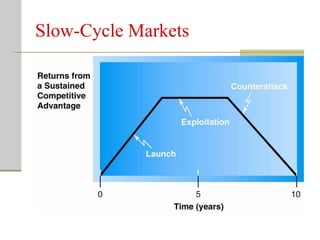
Slow-Cycle Markets
 Key Terms
 Slow-Cycle Markets – markets in
which the firm's competitive
advantages are shielded from
imitation for long periods of time,
and in which imitation is costly
Slow-Cycle Markets
 Build a one-of-a-kind competitive
advantage that is proprietary and difficult
for competitors to understand (creating
sustainability)
 Once a proprietary advantage is
developed, competitive behavior should
be oriented to protecting, maintaining, and
extending that advantage
 Organizational structure should be used
to effectively support strategic efforts
Slow-Cycle Markets
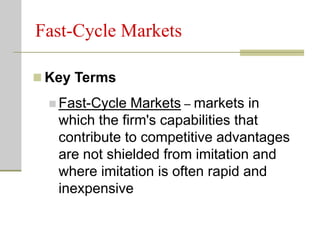
Fast-Cycle Markets
 Key Terms
 Fast-Cycle Markets – markets in
which the firm's capabilities that
contribute to competitive advantages
are not shielded from imitation and
where imitation is often rapid and
inexpensive
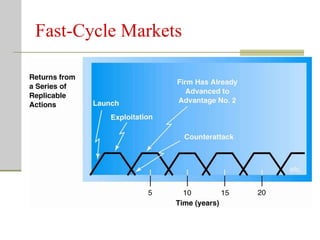
Fast-Cycle Markets
 Focus on learning how to rapidly and
continuously develop new competitive
advantages that are superior to those
they replace (creating innovation)
 Avoid loyalty to any of their products,
possibly cannibalizing their own current
products to launch new ones before
competitors learn how to do so through
successful imitation
 Continually try to move on to another
temporary competitive advantage before
competitors can respond to the first one
Fast-Cycle Markets
Standard-Cycle Markets
 Key Terms
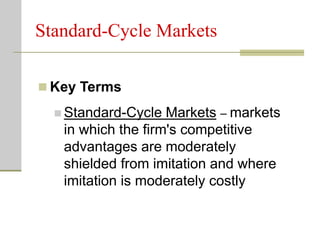
 Standard-Cycle Markets – markets
in which the firm's competitive
advantages are moderately
shielded from imitation and where
imitation is moderately costly
Standard-Cycle Markets
 Have competitive advantages that can be
partially sustained when their quality is
continuously upgraded
 Seek to serve many customers and gain
a large market share
 Gain brand loyalty through brand names
 Carefully control operations to manage a
consistent experience for the customer
Ethical Questions
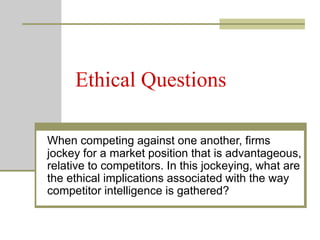
When competing against one another, firms
jockey for a market position that is advantageous,
relative to competitors. In this jockeying, what are
the ethical implications associated with the way
competitor intelligence is gathered?
Ethical Questions
Second movers often respond to a first mover’s
competitive actions through imitation. Is there
anything unethical about a company imitating a
competitor’s good or service as a means of
engaging in competition?
Ethical Questions
The standards for competitive rivalry differ in countries
throughout the world. What should firms do to cope with
these differences? What guidance should a firm give to
employees as they deal with competitive actions and
competitive responses that are ethical in one country but
unethical in others?
Ethical Questions
In slow-cycle markets, effective competitors are able to shield
their competitive advantages from imitation by competitors for
long periods of time. But this isn’t the case in fast-cycle markets.
Do these conditions have implications in terms of ethical business
practices? Can what is considered ethical in slow-cycle markets
be different from what is considered ethical in fast-cycle markets?
Ethical Questions
A firm competes against another organization in several
markets. Is it ethical for the firm to launch a competitive
response in a market that differs from the one in which that
competitor took a competitive action against the local firm?
Why or why not?

CA2e-PPT-Ch.6_R (2).ppt

  • 1.
    Competing For Advantage PartIII – Creating Competitive Advantage Chapter 6 – Competitive Rivalry and Competitive Dynamics
  • 2.
  • 3.
    Competitive Rivalry  KeyTerms  Competitors – firms operating in the same market, offering similar products and targeting similar customers  Competitive Rivalry – ongoing set of competitive actions and competitive responses occurring between competitors as they contend with each other for an advantageous market position  Competitive Behavior – set of competitive actions and competitive responses the firm takes to build or defend its competitive advantages and to improve its market position
  • 4.
    Competitive Rivalry  KeyTerms  Competitive Dynamics – total set of actions and responses of all firms competing within a market  Multimarket Competition – firms competing against one another in several product or geographic markets
  • 5.
    From Competitors toCompetitive Dynamics
  • 6.
  • 7.
    Intensity of Rivalry The total number of competitors  Market characteristics  Quality of individual firms' strategies  Drivers of competitive behavior
  • 8.
  • 9.
    Market Commonality  KeyTerms  Market Commonality – number of markets with which the firm and a competitor are jointly involved, and degree of importance of the individual markets to each firm
  • 10.
    Resource Similarity  KeyTerms  Resource Similarity – extent to which the firm's tangible and intangible resources are comparable to competitors' resources in terms of both type and amount
  • 11.
  • 12.
    Drivers of CompetitiveActions and Responses  Awareness  Motivation  Ability  Resource Dissimilarity
  • 13.
    Strategic and TacticalActions  Key Terms  Competitive Action – strategic or tactical action the firm takes to build or defend its competitive advantages or improve its market position  Competitive Response – strategic or tactical action the firm takes to counter the effects of a competitor's action  Tactical Action (or Response) – market- based the firms takes in order to fine-tune a strategy
  • 14.
    Differences Between Strategicand Tactical Actions/Responses  Strategic actions/responses – market-based moves (difficult to implement and reverse) that signify a significant commitment of organizational resources to pursue a specific strategy  Tactical actions/responses – market-based moves (easy to implement and reverse) that involve fewer resources to fine-tune a strategy that is already in place
  • 15.
    Likelihood of Attack First mover incentives  Organizational size  Quality
  • 16.
    Timing of CompetitiveBehavior  Key Terms  First Mover – firm that takes an initial competitive action to build or to defend its competitive advantages or to improve its market position  Second Mover – firm that responds to first mover's competitive action, typically through imitation  Late Mover – firm that responds to competitive action, but only after time has elapsed since first mover's action and second mover's response
  • 17.
    Timing of CompetitiveBehavior  Key Terms  Slack – buffer or cushion provided by actual or obtainable resources not currently used by an organization, resources in excess of the minimum those needed to produce a given level of output
  • 18.
    First Mover –Characteristics  Often builds upon a strategic foundation of superior research and development skills  Tends to be aggressive and willing to experiment with innovation  Tends to take higher, yet reasonable, risks  Needs to have liquid resources (slack) that can be quickly allocated to support actions
  • 19.
    First Mover –Benefits  Above-average returns  Customer loyalty  An early hold on market share
  • 20.
    First Mover –Risks  Difficulty in accurately estimating potential returns  Substantial costs of product innovation, which reduce slack available for other opportunities  Lower likelihood of introducing (or converting to) the product that becomes the industry standard as the market evolves
  • 21.
    Second Mover –Characteristics  Responds to first mover, typically through imitation  Is more cautious than first movers  Tends to study customer reactions to product innovations  Tends to learn from the mistakes of first movers, reducing its risks  Takes advantage of time to develop processes and technologies that are more efficient than first movers, reducing its costs  Will not benefit from first mover advantages, lowering potential returns
  • 22.
    Late Mover –Characteristics  Responds to market opportunities only after considerable time has elapsed since first and second movers have taken action  Has substantially reduced risks and returns
  • 23.
    Organizational Size  Smallfirms  Act as nimble and flexible competitors  Rely on speed and surprise to defend their competitive advantage  Have greater variety of competitive behavior options available
  • 24.
    Organizational Size  Largefirms  Often have greater slack  Have greater likelihood to initiate competitive and strategic actions over time  Tend to rely on a limited variety of competitive actions, which can ultimately reduce their competitive success
  • 25.
    Quality  Key Terms Quality – customer perception that the firm's goods or services perform in ways that are important to customers, meeting or exceeding their expectations
  • 26.
  • 27.
    Likelihood of Response Types and effectiveness of the competitive action  Reputation of the firm that takes competitive actions  Dependence on the market  If the action significantly strengthens or weakens the firm's competitive position
  • 28.
    Actor’s Reputation  KeyTerms  Actor – firm taking an action or response (in the context of competitive rivalry)  Reputation – positive or negative attribute ascribed by one rival to another based on past competitive behavior
  • 29.
    Dependence on theMarket  Key Terms  Market Dependence – extent to which a firm's revenues or profits are derived from a particular market
  • 30.
    Competitive Dynamics – ThreeMarket Types  Slow-cycle markets  Fast-cycle markets  Standard-cycle markets
  • 31.
    Slow-Cycle Markets  KeyTerms  Slow-Cycle Markets – markets in which the firm's competitive advantages are shielded from imitation for long periods of time, and in which imitation is costly
  • 32.
    Slow-Cycle Markets  Builda one-of-a-kind competitive advantage that is proprietary and difficult for competitors to understand (creating sustainability)  Once a proprietary advantage is developed, competitive behavior should be oriented to protecting, maintaining, and extending that advantage  Organizational structure should be used to effectively support strategic efforts
  • 33.
  • 34.
    Fast-Cycle Markets  KeyTerms  Fast-Cycle Markets – markets in which the firm's capabilities that contribute to competitive advantages are not shielded from imitation and where imitation is often rapid and inexpensive
  • 35.
    Fast-Cycle Markets  Focuson learning how to rapidly and continuously develop new competitive advantages that are superior to those they replace (creating innovation)  Avoid loyalty to any of their products, possibly cannibalizing their own current products to launch new ones before competitors learn how to do so through successful imitation  Continually try to move on to another temporary competitive advantage before competitors can respond to the first one
  • 36.
  • 37.
    Standard-Cycle Markets  KeyTerms  Standard-Cycle Markets – markets in which the firm's competitive advantages are moderately shielded from imitation and where imitation is moderately costly
  • 38.
    Standard-Cycle Markets  Havecompetitive advantages that can be partially sustained when their quality is continuously upgraded  Seek to serve many customers and gain a large market share  Gain brand loyalty through brand names  Carefully control operations to manage a consistent experience for the customer
  • 39.
    Ethical Questions When competingagainst one another, firms jockey for a market position that is advantageous, relative to competitors. In this jockeying, what are the ethical implications associated with the way competitor intelligence is gathered?
  • 40.
    Ethical Questions Second moversoften respond to a first mover’s competitive actions through imitation. Is there anything unethical about a company imitating a competitor’s good or service as a means of engaging in competition?
  • 41.
    Ethical Questions The standardsfor competitive rivalry differ in countries throughout the world. What should firms do to cope with these differences? What guidance should a firm give to employees as they deal with competitive actions and competitive responses that are ethical in one country but unethical in others?
  • 42.
    Ethical Questions In slow-cyclemarkets, effective competitors are able to shield their competitive advantages from imitation by competitors for long periods of time. But this isn’t the case in fast-cycle markets. Do these conditions have implications in terms of ethical business practices? Can what is considered ethical in slow-cycle markets be different from what is considered ethical in fast-cycle markets?
  • 43.
    Ethical Questions A firmcompetes against another organization in several markets. Is it ethical for the firm to launch a competitive response in a market that differs from the one in which that competitor took a competitive action against the local firm? Why or why not?