Strategic Management:
 Concepts and Cases 9e

    Part II: Strategic Actions:
          Strategy Formulation
Chapter 5: Competitive Rivalry
    and Competitive Dynamics


       ©2011 Cengage Learning. All Rights Reserved. May not be scanned,
        copied or duplicated, or posted to a publicly accessible website, in
                                                           whole or in part.
Chapter 5: Competitive Rivalry and
Competitive Dynamics

• Overview:
    – Competitors, competitive rivalry, competitive behavior
      and competitive dynamics
    – Market commonality and resource similarity: Building
      blocks of competitor analysis
    – Competitive actions: Awareness, motivation and ability
    – Factors driving competitor’s competitive actions
    – Competitor’s response to actions taken against it
    – Competitive dynamics in slow, fast and standard-cycle
      markets


 ©2011 Cengage Learning. All Rights Reserved. May not be scanned, copied or duplicated, or posted to a publicly accessible website, in whole or in part.
Introduction and Definitions

• Competitors
    – Firms operating in the same market, offering similar products and targeting
      similar customers


• Competitive Rivalry
    – Ongoing set of competitive actions and competitive responses occurring between
      competitors as they contend with each other for an advantageous market position


• Competitive Behavior
    – Set of competitive actions and competitive responses the firm takes to build or
      defend its competitive advantages and to improve its market position


• Multimarket Competition
    – Firms competing against one another in several product or geographic markets


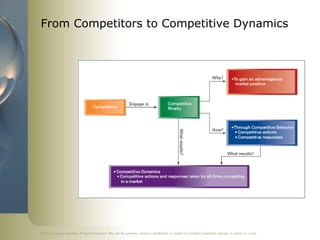
• Competitive Dynamics
    – Total set of actions and responses of all firms competing within a market


 ©2011 Cengage Learning. All Rights Reserved. May not be scanned, copied or duplicated, or posted to a publicly accessible website, in whole or in part.
From Competitors to Competitive Dynamics


©2011 Cengage Learning. All Rights Reserved. May not be scanned, copied or duplicated, or posted to a publicly accessible website, in whole or in part.
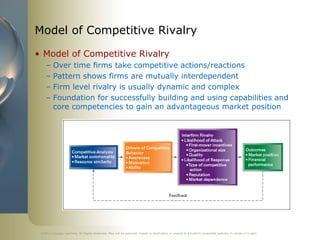
Model of Competitive Rivalry

• Model of Competitive Rivalry
    –    Over time firms take competitive actions/reactions
    –    Pattern shows firms are mutually interdependent
    –    Firm level rivalry is usually dynamic and complex
    –    Foundation for successfully building and using capabilities and
         core competencies to gain an advantageous market position


 ©2011 Cengage Learning. All Rights Reserved. May not be scanned, copied or duplicated, or posted to a publicly accessible website, in whole or in part.
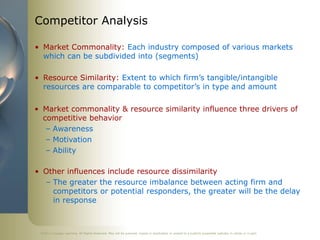
Competitor Analysis

• Market Commonality: Each industry composed of various markets
  which can be subdivided into (segments)

• Resource Similarity: Extent to which firm’s tangible/intangible
  resources are comparable to competitor’s in type and amount

• Market commonality & resource similarity influence three drivers of
  competitive behavior
   – Awareness
   – Motivation
   – Ability

• Other influences include resource dissimilarity
  – The greater the resource imbalance between acting firm and
    competitors or potential responders, the greater will be the delay
    in response


 ©2011 Cengage Learning. All Rights Reserved. May not be scanned, copied or duplicated, or posted to a publicly accessible website, in whole or in part.
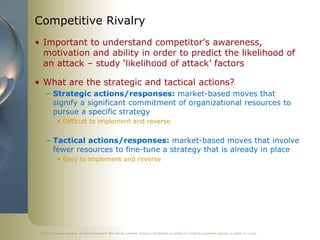
Competitive Rivalry
• Important to understand competitor’s awareness,
  motivation and ability in order to predict the likelihood of
  an attack – study ‘likelihood of attack’ factors

• What are the strategic and tactical actions?
    – Strategic actions/responses: market-based moves that
      signify a significant commitment of organizational resources to
      pursue a specific strategy
            • Difficult to implement and reverse


    – Tactical actions/responses: market-based moves that involve
      fewer resources to fine-tune a strategy that is already in place
            • Easy to implement and reverse


 ©2011 Cengage Learning. All Rights Reserved. May not be scanned, copied or duplicated, or posted to a publicly accessible website, in whole or in part.
Interfirm Rivalry: Likelihood of Attack
• Three possible ‘likelihood of response’ actions
    – 1. First Mover Incentives
    – 2. Organizational Size
    – 3. Quality

• Additional factors affect the likelihood a firm will
  competitively respond to a competitor’s actions:
    – 1. Types and effectiveness of the competitive action
    – 2. Actor’s Reputation
    – 3. Dependence on the Market


• Finally, if the action significantly strengthens or weakens
  the firm's competitive position


 ©2011 Cengage Learning. All Rights Reserved. May not be scanned, copied or duplicated, or posted to a publicly accessible website, in whole or in part.
Competitive Dynamics: 3 Market Cycles

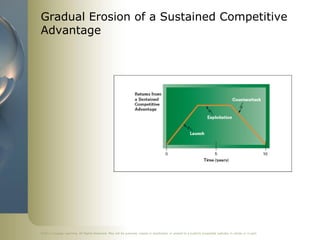
1. Slow-Cycle Markets
    – Markets in which the firm's competitive advantages are shielded
      from imitation for long periods of time, and in which imitation is
      costly
    – Build a one-of-a-kind competitive advantage which creates
      sustainability
    – Once a proprietary advantage is developed, competitive behavior
      should be oriented to protecting, maintaining, and extending that
      advantage
    – Organizational structure should be used to effectively support
      strategic efforts


 ©2011 Cengage Learning. All Rights Reserved. May not be scanned, copied or duplicated, or posted to a publicly accessible website, in whole or in part.
Gradual Erosion of a Sustained Competitive
Advantage


©2011 Cengage Learning. All Rights Reserved. May not be scanned, copied or duplicated, or posted to a publicly accessible website, in whole or in part.
Competitive Dynamics: 3 Market Cycles
(Cont’d)

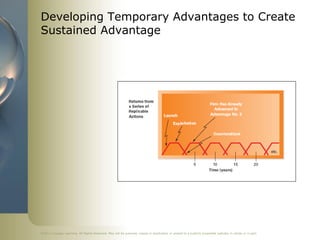
2. Fast-Cycle Markets
    – Markets in which the firm's capabilities that contribute to
      competitive advantages are not shielded from imitation and
      where imitation is often rapid and inexpensive
    – Focus: learning how to rapidly and continuously develop new
      competitive advantages that are superior to those they replace
      (creating innovation)
    – Avoid loyalty to any one product, possibly cannibalizing their own
      current products to launch new ones before competitors learn
      how to do so through successful imitation
    – Continually try to move on to another temporary competitive
      advantage before competitors can respond to the first one


 ©2011 Cengage Learning. All Rights Reserved. May not be scanned, copied or duplicated, or posted to a publicly accessible website, in whole or in part.
Developing Temporary Advantages to Create
Sustained Advantage


©2011 Cengage Learning. All Rights Reserved. May not be scanned, copied or duplicated, or posted to a publicly accessible website, in whole or in part.
Competitive Dynamics: 3 Market Cycles
(Cont’d)

3. Standard-Cycle Markets
    – Markets where firm’s competitive advantages are moderately
      shielded from imitation and where imitation is moderately costly
    – Competitive advantages partially sustained as quality is
      continuously upgraded
    – Seek to serve many customers and gain a large market share
    – Gain brand loyalty through brand names
    – Careful operational control / manage a consistent experience for
      the customer


 ©2011 Cengage Learning. All Rights Reserved. May not be scanned, copied or duplicated, or posted to a publicly accessible website, in whole or in part.

Chapter 5 competitive rivalry and com

  • 1.
    Strategic Management: Conceptsand Cases 9e Part II: Strategic Actions: Strategy Formulation Chapter 5: Competitive Rivalry and Competitive Dynamics ©2011 Cengage Learning. All Rights Reserved. May not be scanned, copied or duplicated, or posted to a publicly accessible website, in whole or in part.
  • 2.
    Chapter 5: CompetitiveRivalry and Competitive Dynamics • Overview: – Competitors, competitive rivalry, competitive behavior and competitive dynamics – Market commonality and resource similarity: Building blocks of competitor analysis – Competitive actions: Awareness, motivation and ability – Factors driving competitor’s competitive actions – Competitor’s response to actions taken against it – Competitive dynamics in slow, fast and standard-cycle markets ©2011 Cengage Learning. All Rights Reserved. May not be scanned, copied or duplicated, or posted to a publicly accessible website, in whole or in part.
  • 3.
    Introduction and Definitions •Competitors – Firms operating in the same market, offering similar products and targeting similar customers • Competitive Rivalry – Ongoing set of competitive actions and competitive responses occurring between competitors as they contend with each other for an advantageous market position • Competitive Behavior – Set of competitive actions and competitive responses the firm takes to build or defend its competitive advantages and to improve its market position • Multimarket Competition – Firms competing against one another in several product or geographic markets • Competitive Dynamics – Total set of actions and responses of all firms competing within a market ©2011 Cengage Learning. All Rights Reserved. May not be scanned, copied or duplicated, or posted to a publicly accessible website, in whole or in part.
  • 4.
    From Competitors toCompetitive Dynamics ©2011 Cengage Learning. All Rights Reserved. May not be scanned, copied or duplicated, or posted to a publicly accessible website, in whole or in part.
  • 5.
    Model of CompetitiveRivalry • Model of Competitive Rivalry – Over time firms take competitive actions/reactions – Pattern shows firms are mutually interdependent – Firm level rivalry is usually dynamic and complex – Foundation for successfully building and using capabilities and core competencies to gain an advantageous market position ©2011 Cengage Learning. All Rights Reserved. May not be scanned, copied or duplicated, or posted to a publicly accessible website, in whole or in part.
  • 6.
    Competitor Analysis • MarketCommonality: Each industry composed of various markets which can be subdivided into (segments) • Resource Similarity: Extent to which firm’s tangible/intangible resources are comparable to competitor’s in type and amount • Market commonality & resource similarity influence three drivers of competitive behavior – Awareness – Motivation – Ability • Other influences include resource dissimilarity – The greater the resource imbalance between acting firm and competitors or potential responders, the greater will be the delay in response ©2011 Cengage Learning. All Rights Reserved. May not be scanned, copied or duplicated, or posted to a publicly accessible website, in whole or in part.
  • 7.
    Competitive Rivalry • Importantto understand competitor’s awareness, motivation and ability in order to predict the likelihood of an attack – study ‘likelihood of attack’ factors • What are the strategic and tactical actions? – Strategic actions/responses: market-based moves that signify a significant commitment of organizational resources to pursue a specific strategy • Difficult to implement and reverse – Tactical actions/responses: market-based moves that involve fewer resources to fine-tune a strategy that is already in place • Easy to implement and reverse ©2011 Cengage Learning. All Rights Reserved. May not be scanned, copied or duplicated, or posted to a publicly accessible website, in whole or in part.
  • 8.
    Interfirm Rivalry: Likelihoodof Attack • Three possible ‘likelihood of response’ actions – 1. First Mover Incentives – 2. Organizational Size – 3. Quality • Additional factors affect the likelihood a firm will competitively respond to a competitor’s actions: – 1. Types and effectiveness of the competitive action – 2. Actor’s Reputation – 3. Dependence on the Market • Finally, if the action significantly strengthens or weakens the firm's competitive position ©2011 Cengage Learning. All Rights Reserved. May not be scanned, copied or duplicated, or posted to a publicly accessible website, in whole or in part.
  • 9.
    Competitive Dynamics: 3Market Cycles 1. Slow-Cycle Markets – Markets in which the firm's competitive advantages are shielded from imitation for long periods of time, and in which imitation is costly – Build a one-of-a-kind competitive advantage which creates sustainability – Once a proprietary advantage is developed, competitive behavior should be oriented to protecting, maintaining, and extending that advantage – Organizational structure should be used to effectively support strategic efforts ©2011 Cengage Learning. All Rights Reserved. May not be scanned, copied or duplicated, or posted to a publicly accessible website, in whole or in part.
  • 10.
    Gradual Erosion ofa Sustained Competitive Advantage ©2011 Cengage Learning. All Rights Reserved. May not be scanned, copied or duplicated, or posted to a publicly accessible website, in whole or in part.
  • 11.
    Competitive Dynamics: 3Market Cycles (Cont’d) 2. Fast-Cycle Markets – Markets in which the firm's capabilities that contribute to competitive advantages are not shielded from imitation and where imitation is often rapid and inexpensive – Focus: learning how to rapidly and continuously develop new competitive advantages that are superior to those they replace (creating innovation) – Avoid loyalty to any one product, possibly cannibalizing their own current products to launch new ones before competitors learn how to do so through successful imitation – Continually try to move on to another temporary competitive advantage before competitors can respond to the first one ©2011 Cengage Learning. All Rights Reserved. May not be scanned, copied or duplicated, or posted to a publicly accessible website, in whole or in part.
  • 12.
    Developing Temporary Advantagesto Create Sustained Advantage ©2011 Cengage Learning. All Rights Reserved. May not be scanned, copied or duplicated, or posted to a publicly accessible website, in whole or in part.
  • 13.
    Competitive Dynamics: 3Market Cycles (Cont’d) 3. Standard-Cycle Markets – Markets where firm’s competitive advantages are moderately shielded from imitation and where imitation is moderately costly – Competitive advantages partially sustained as quality is continuously upgraded – Seek to serve many customers and gain a large market share – Gain brand loyalty through brand names – Careful operational control / manage a consistent experience for the customer ©2011 Cengage Learning. All Rights Reserved. May not be scanned, copied or duplicated, or posted to a publicly accessible website, in whole or in part.