Competitive
Dynamics
November
2024
Presented by Omar Saeed & Rose khaled
Dr. Mahmoud Damaty
Overview
Competitor Analysis
Competitive Dynamics & Market Cycle Speed
Competitive Rivalry VS Dynamics Influences
Frameworks
Page04
Page09
Page 11
Drivers of Competitive Behavior Page19
Competitive Rivalry Actions Page21
Page27
Page28
Quick Recap Page29
Thank You Page33
02
Overview
Overview
“The world is a global battlefield, and only the
adaptable shall prevail.”
03
Hello!
Kenichi Ohmae, Japanese Organizational
Theorist
04
Competitive dynamics, in the context of strategic management, refers to the
total set of actions and responses taken by all firms competing within a market.
It's essentially to study how surrounding companies interact and react to each
other's actions in the marketplace.
What is Competitive Dynamics?
The Bigger Picture
05
Competitive rivalry, Ongoing competitive actions and responses between individual
competitors.
t's essentially to study how companies interact and react to each other's moves in the
marketplace. It is a narrower approach than competitive dynamics.
The One VS One Battle
What is Competitive Rivalry?
06
Hello Again!
“Keep your friends close, and your enemies
closer.”
Sun Tzu, Chinese General, Strategist, and
Philosopher
07
Competitors, In the world of business, a competitor is any individual,
company, or organization that offers similar products or services to the
same target audience as other businesses.
They essentially vie for the same customers and market share, posing a
challenge to business's growth and profitability.
What is a Competitor?
The Players
08
Competitive Environment
09
From Competitors to Competitive Dynamics
Competitive Analysis
Market Commonality
Resources Similarity
Drivers of Competitive Behavior
Awareness
Motivation
Capability
Competitive Rivalry
Likelihood of actions
1.
First mover benefits
a.
organizational size
b.
Likelihood of response
2.
Type of competitive action
a.
Actor Reputation
b.
Market Dependence
c.
Outcomes
Market Position
Financial Performance
Feedback
10
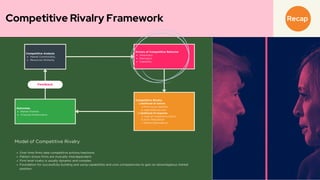
Competitive Rivalry Framework
Model of Competitive Rivalry
Over time firms take competitive actions/reactions.
Pattern shows firms are mutually interdependent.
Firm level rivalry is usually dynamic and complex.
Foundation for successfully building and using capabilities and core competencies to gain an advantageous market
position.
11
Competitor Analysis
Competitor analysis, is used to help a firm understand its competitors.
It is like scouting the opposing team. Businesses identify their main rivals, study their plays
(products, pricing, marketing), and figure out their strengths and weaknesses. This helps
businesses find their own edge, whether it's offering something unique, improving their game, or
reaching fans (customers) in a new way. Ultimately, it's about making smarter decisions to stay
ahead of the competition.
Identify your competitors: The first step is to identify the main competitors.
1.
Gather information about competitors: Once businesses identify their competitors, they need
to gather information about them.
2.
Analyze competitors' strengths and weaknesses: Once gathered information about
competitors, businesses need to analyze their strengths and weaknesses.
3.
Take action: The final step is to take action based on competitor analysis. This may involve
making changes to products or services, pricing, marketing strategies, or overall business
strategy.
4.
12
Quick Discussion A
Hi Omar, I am thinking of a
new meal package to gain
better market share, be
prepared!
Hi Rose, Let me think of my
chances.
Rose and Omar are two food
truck owners operating in the
same location. Rose's truck
specializes in classic American
fast food, while Omar's offers a
variety of sandwiches and
beverages.
To gain a competitive edge,
Rose has introduced a new
strategy: the value meal. This
package offers a sandwich and
a juice at a price point similar
to Omar's single sandwich.
How do you think Omar will
react?
13
The Game Theory
Game Theory:
Game theory provides a framework for
analyzing strategic interactions between
players (in this case, competing firms).
It helps predict how firms will behave in
different competitive scenarios, taking
into account their rivals' potential
actions and payoffs.
Implications for
Competitive Dynamics:
Game theory can be used to model
competitive interactions, analyze the
likely outcomes of different strategies,
and identify optimal courses of action. It
helps firms anticipate their rivals' moves
and make informed decisions.
John von Neumann and Oskar
Morgenstern (1944).
Market Commonality, is the number of markets in which a firm and competitor are
competing and involved.
Key Aspects of Market Commonality:
Overlapping Markets: Firms with high market commonality compete in many of the same
geographic regions, product categories, or customer segments. For example, Coca-Cola
and PepsiCo have high market commonality because they both sell similar beverages in
many of the same countries.
Intensity of Competition: High market commonality often leads to intense rivalry, as
companies try to capture market share. This can result in price wars, aggressive marketing
campaigns, and rapid product innovation.
Strategic Importance: Understanding market commonality is crucial for competitor
analysis. It helps companies anticipate how their rivals might react to their actions and
develop effective competitive strategies.
14
Market Commonality
15
Resource Similarity
Resource Similarity, is the extent to which a company's tangible and intangible
resources are comparable to a competitor's in terms of type and amount. Essentially, it's
about how alike your resources are to your rivals.
Types of Resources:
Tangible Resources: These are physical assets like manufacturing facilities, equipment,
financial capital, and human resources.
Intangible Resources: These are non-physical assets like brand reputation, patents,
trademarks, organizational culture, and knowledge.
Market
Commonality
LOW
High
LOW High
Resource
Similarity
16
Market Commonality and Resource Similarity Matrix
The shaded area represents the degree of market commonality and resource similarity between two firms.
Resource Endowment A Resource Endowment B
17
Quick Discussion B
I prefer Coke!
I prefer Pepsi!
Pepsi and Coca-Cola are the
two most popular carbonated
soft drink brands in the
world. They are both made
with carbonated water, sugar,
caffeine, phosphoric acid,
caramel color, and natural
flavors. However, there are
some subtle differences in
their formulas that give them
their unique tastes.
What do you think is their
market commonality and
resources similarity matrix?
Market
Commonality
High
High
Resource
Similarity
18
Pepsi and Cocacola Matrix
Competitive Analysis
Market Commonality
Resources Similarity
Drivers of Competitive Behavior
Awareness
Motivation
Capability
Competitive Rivalry
Likelihood of actions
1.
First mover benefits
a.
organizational size
b.
Likelihood of response
2.
Type of competitive action
a.
Actor Reputation
b.
Market Dependence
c.
Outcomes
Market Position
Financial Performance
Feedback
Recap
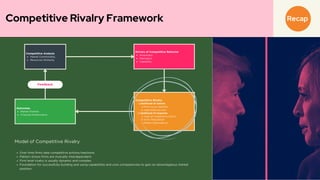
Competitive Rivalry Framework
Model of Competitive Rivalry
Over time firms take competitive actions/reactions.
Pattern shows firms are mutually interdependent.
Firm level rivalry is usually dynamic and complex.
Foundation for successfully building and using capabilities and core competencies to gain an advantageous market
position.
19
Drivers of Competitor Behavior
Drivers of Competitor Behavior, the factors that influence how companies act and react
within a competitive landscape.
Awareness: How well a company knows its rivals, their actions, and the competitive
landscape, including market commonality and resource similarity.
Motivation: The driving forces behind a company's competitive actions, such as
market share goals, profit motives, or the desire for first-mover advantage.
Capability: A company's resources, capabilities, and organizational structure that
enable it to take action and respond to competitors. Without available resources,
firms cannot either attack a competitor firm or respond for defense.
Competitive Analysis
Market Commonality
Resources Similarity
Drivers of Competitive Behavior
Awareness
Motivation
Capability
Competitive Rivalry
Likelihood of actions
1.
First mover benefits
a.
organizational size
b.
Likelihood of response
2.
Type of competitive action
a.
Actor Reputation
b.
Market Dependence
c.
Outcomes
Market Position
Financial Performance
Feedback
Recap
Competitive Rivalry Framework
Model of Competitive Rivalry
Over time firms take competitive actions/reactions.
Pattern shows firms are mutually interdependent.
Firm level rivalry is usually dynamic and complex.
Foundation for successfully building and using capabilities and core competencies to gain an advantageous market
position.
20
Competitor Rivalry Action Factors
First-Mover Incentives: A firm that takes an initial competitive action, in order to build or
defend its competitive position.
First movers allocate funds for:
Product innovation and development
Aggressive advertising
Advanced research and development
First movers can gain:
The loyalty of customers who may become committed to the firm's goods or
services.
Market share can be difficult for competitors to take during future competitive rivalry.
21
Competitor Rivalry Action Factors
Second Mover Incentives: A firm that responds to the first mover's competitive action,
typically through imitation.
It studies customers' reactions to product innovations.
Tries to find any mistakes the first mover made and avoid them.
This allows them to avoid both the mistakes and the huge spending of the first-
movers.
May develop more efficient processes and technologies.
Late Mover: A firm that responds to a competitive action only after considerable time
has elapsed.
Any success achieved will be slow in coming and much less than that achieved by
first and second movers.
Late mover’s competitive action allows it to earn only average returns and delays its
understanding of how to create value for customers.
22
Competitor Rivalry Action Factors
Organizational Size: Refers to the magnitude or scale of an organization.
It's a way to understand how large or small a company is, and this size significantly
influences various aspects of its structure, operations, and even its behavior in the
market.
Small Firm:
Rely on speed and surprise to defend competitive advantages or develop new
ones while engaged in competitive rivalry.
Have the flexibility needed to launch a greater variety of competitive actions.
More likely to launch competitive actions and be faster doing so.
Large Firm:
Likely to initiate more competitive actions during a given time period due to
having slack (extra unused) resources.
Usually slower to respond to strategic actions due to greater bureaucracy.
“Think and act big and we'll get smaller. Think and
act small and we'll get bigger.”
23
Hello there!
Herb Kelleher, Former CEO, Southwest
Airlines
A reactor firm that responds to a competitive action
initiated by another firm (the actor). They are essentially
forced to react to maintain their market position.
Characteristics:
Defensive: Their actions are primarily driven by
the need to protect their market share and
competitive position.
Adaptive: They adjust their strategies and tactics
in response to the actor's moves.
Cautious: They may be more risk-averse than
actors.
Resource-constrained: Their ability to respond
may be limited by their resources and capabilities.
24
Competitive Actions
An actor is a firm that takes the initiative to make a
significant competitive move. They are the first movers,
proactively shaping the competitive landscape.
Characteristics:
Proactive: They anticipate opportunities or threats
and act decisively.
Innovative: They often introduce new products,
services, or business models.
Risk-taking: They are willing to take calculated risks
to gain a competitive advantage.
Resourceful: They possess the resources and
capabilities to support their actions.
ACTOR RESPONDER
25
Competitor Rivalry Response Factors
Competitive Actions, a strategic or tactical action taken by a firm to build or defend its
competitive advantages or increase its market share.
Competitive Response, a strategic or tactical action taken by a firm to counter the effect of a
competitor’s competitive action.
Strategic Action or Response, market based move that involves a significant commitment of
organizational resources and is difficult to implement or reverse.
Tactical Action or Response, market based move that is taken to fine tune a strategy, that
involves fewer resources and easy to implement or reverse.
Actions Response
26
Competitor Rivalry Response Factors
Firm's Reputation: Reputation is also any positive or negative attribute ascribed by
one rival to another based on past competitive behavior. The firm studies responses
that a competitor has taken previously when attacked to predict likely responses.
Market Dependence: The extent to which a firm’s revenues or profits are derived
from a particular market. Competitors with high market dependence are likely to
respond strongly to attacks threatening their market position.
Competitive Analysis
Market Commonality
Resources Similarity
Drivers of Competitive Behavior
Awareness
Motivation
Capability
Competitive Rivalry
Likelihood of actions
1.
First mover benefits
a.
organizational size
b.
Likelihood of response
2.
Type of competitive action
a.
Actor Reputation
b.
Market Dependence
c.
Outcomes
Market Position
Financial Performance
Feedback
Recap
Competitive Rivalry Framework
Model of Competitive Rivalry
Over time firms take competitive actions/reactions.
Pattern shows firms are mutually interdependent.
Firm level rivalry is usually dynamic and complex.
Foundation for successfully building and using capabilities and core competencies to gain an advantageous market
position.
27
Competitive Dynamics & Market Cycle Speed
Market Cycle Speed, refers to the time it takes for a market to complete a full cycle, moving from
a peak (bull market) to a trough (bear market) and back to a new peak.
Slow: Imitation takes long periods of time and is very costly. (e.g., utilities).
Firms concentrate on competitive actions and responses to protect, maintain, and extend
proprietary competitive advantage.
Standard: Imitation takes moderate periods of time and is costly. (e.g., automotive).
Firms Seek large market shares, gain customer loyalty through brand names, and carefully
control operations.
Fast: Imitation happens quickly and is less costly. (e.g., apps).
Competitors use reverse engineering to quickly imitate or improve products.
Firms are in a constant race where a lead can quickly disappear.
28
Competitive Rivalry VS Dynamics Influences
Competitive Rivalry: is between two firms, Influenced by:
Market commonality and resource similarity
Awareness, Motivation and Capability
First mover incentives and firm size
Competitive Dynamics: is industry level, Influenced by:
Aggregate of all firm rivalries in the industry
Market cycle speed
29
Quick Recap
COMPETITIVE
DYNAMICS
COMPETITIVE
RIVALRY
COMPETITIVE
ADVANTAGES
Scope: Broad
Focus: Actions and
responses of all
firms in a market
Scope: Narrow, Two
Firms
Focus: Direct interaction
between two specific
competitors
Scope: Internal innovation
Focus: Internal to the
company – its resources,
capabilities, and strategic
choices
Competitive Analysis
Market Commonality
Resources Similarity
Drivers of Competitive Behavior
Awareness
Motivation
Capability
Competitive Rivalry
Likelihood of actions
1.
First mover benefits
a.
organizational size
b.
Likelihood of response
2.
Type of competitive action
a.
Actor Reputation
b.
Market Dependence
c.
Outcomes
Market Position
Financial Performance
Feedback
30
Quick Recap
Model of Competitive Rivalry
Over time firms take competitive actions/reactions.
Pattern shows firms are mutually interdependent.
Firm level rivalry is usually dynamic and complex.
Foundation for successfully building and using capabilities and core competencies to gain an advantageous market position.
31
Quick Recap
32
Wake up!
Do you know who is this?
Ray Kroc, McDonald’s Founder
33
Wake up!
Thank You

Competitive Dynamics and Competitive Rivalry.pdf

  • 1.
    Competitive Dynamics November 2024 Presented by OmarSaeed & Rose khaled Dr. Mahmoud Damaty
  • 2.
    Overview Competitor Analysis Competitive Dynamics& Market Cycle Speed Competitive Rivalry VS Dynamics Influences Frameworks Page04 Page09 Page 11 Drivers of Competitive Behavior Page19 Competitive Rivalry Actions Page21 Page27 Page28 Quick Recap Page29 Thank You Page33 02 Overview Overview
  • 3.
    “The world isa global battlefield, and only the adaptable shall prevail.” 03 Hello! Kenichi Ohmae, Japanese Organizational Theorist
  • 4.
    04 Competitive dynamics, inthe context of strategic management, refers to the total set of actions and responses taken by all firms competing within a market. It's essentially to study how surrounding companies interact and react to each other's actions in the marketplace. What is Competitive Dynamics? The Bigger Picture
  • 5.
    05 Competitive rivalry, Ongoingcompetitive actions and responses between individual competitors. t's essentially to study how companies interact and react to each other's moves in the marketplace. It is a narrower approach than competitive dynamics. The One VS One Battle What is Competitive Rivalry?
  • 6.
    06 Hello Again! “Keep yourfriends close, and your enemies closer.” Sun Tzu, Chinese General, Strategist, and Philosopher
  • 7.
    07 Competitors, In theworld of business, a competitor is any individual, company, or organization that offers similar products or services to the same target audience as other businesses. They essentially vie for the same customers and market share, posing a challenge to business's growth and profitability. What is a Competitor? The Players
  • 8.
  • 9.
    09 From Competitors toCompetitive Dynamics
  • 10.
    Competitive Analysis Market Commonality ResourcesSimilarity Drivers of Competitive Behavior Awareness Motivation Capability Competitive Rivalry Likelihood of actions 1. First mover benefits a. organizational size b. Likelihood of response 2. Type of competitive action a. Actor Reputation b. Market Dependence c. Outcomes Market Position Financial Performance Feedback 10 Competitive Rivalry Framework Model of Competitive Rivalry Over time firms take competitive actions/reactions. Pattern shows firms are mutually interdependent. Firm level rivalry is usually dynamic and complex. Foundation for successfully building and using capabilities and core competencies to gain an advantageous market position.
  • 11.
    11 Competitor Analysis Competitor analysis,is used to help a firm understand its competitors. It is like scouting the opposing team. Businesses identify their main rivals, study their plays (products, pricing, marketing), and figure out their strengths and weaknesses. This helps businesses find their own edge, whether it's offering something unique, improving their game, or reaching fans (customers) in a new way. Ultimately, it's about making smarter decisions to stay ahead of the competition. Identify your competitors: The first step is to identify the main competitors. 1. Gather information about competitors: Once businesses identify their competitors, they need to gather information about them. 2. Analyze competitors' strengths and weaknesses: Once gathered information about competitors, businesses need to analyze their strengths and weaknesses. 3. Take action: The final step is to take action based on competitor analysis. This may involve making changes to products or services, pricing, marketing strategies, or overall business strategy. 4.
  • 12.
    12 Quick Discussion A HiOmar, I am thinking of a new meal package to gain better market share, be prepared! Hi Rose, Let me think of my chances. Rose and Omar are two food truck owners operating in the same location. Rose's truck specializes in classic American fast food, while Omar's offers a variety of sandwiches and beverages. To gain a competitive edge, Rose has introduced a new strategy: the value meal. This package offers a sandwich and a juice at a price point similar to Omar's single sandwich. How do you think Omar will react?
  • 13.
    13 The Game Theory GameTheory: Game theory provides a framework for analyzing strategic interactions between players (in this case, competing firms). It helps predict how firms will behave in different competitive scenarios, taking into account their rivals' potential actions and payoffs. Implications for Competitive Dynamics: Game theory can be used to model competitive interactions, analyze the likely outcomes of different strategies, and identify optimal courses of action. It helps firms anticipate their rivals' moves and make informed decisions. John von Neumann and Oskar Morgenstern (1944).
  • 14.
    Market Commonality, isthe number of markets in which a firm and competitor are competing and involved. Key Aspects of Market Commonality: Overlapping Markets: Firms with high market commonality compete in many of the same geographic regions, product categories, or customer segments. For example, Coca-Cola and PepsiCo have high market commonality because they both sell similar beverages in many of the same countries. Intensity of Competition: High market commonality often leads to intense rivalry, as companies try to capture market share. This can result in price wars, aggressive marketing campaigns, and rapid product innovation. Strategic Importance: Understanding market commonality is crucial for competitor analysis. It helps companies anticipate how their rivals might react to their actions and develop effective competitive strategies. 14 Market Commonality
  • 15.
    15 Resource Similarity Resource Similarity,is the extent to which a company's tangible and intangible resources are comparable to a competitor's in terms of type and amount. Essentially, it's about how alike your resources are to your rivals. Types of Resources: Tangible Resources: These are physical assets like manufacturing facilities, equipment, financial capital, and human resources. Intangible Resources: These are non-physical assets like brand reputation, patents, trademarks, organizational culture, and knowledge.
  • 16.
    Market Commonality LOW High LOW High Resource Similarity 16 Market Commonalityand Resource Similarity Matrix The shaded area represents the degree of market commonality and resource similarity between two firms. Resource Endowment A Resource Endowment B
  • 17.
    17 Quick Discussion B Iprefer Coke! I prefer Pepsi! Pepsi and Coca-Cola are the two most popular carbonated soft drink brands in the world. They are both made with carbonated water, sugar, caffeine, phosphoric acid, caramel color, and natural flavors. However, there are some subtle differences in their formulas that give them their unique tastes. What do you think is their market commonality and resources similarity matrix?
  • 18.
  • 19.
    Competitive Analysis Market Commonality ResourcesSimilarity Drivers of Competitive Behavior Awareness Motivation Capability Competitive Rivalry Likelihood of actions 1. First mover benefits a. organizational size b. Likelihood of response 2. Type of competitive action a. Actor Reputation b. Market Dependence c. Outcomes Market Position Financial Performance Feedback Recap Competitive Rivalry Framework Model of Competitive Rivalry Over time firms take competitive actions/reactions. Pattern shows firms are mutually interdependent. Firm level rivalry is usually dynamic and complex. Foundation for successfully building and using capabilities and core competencies to gain an advantageous market position.
  • 20.
    19 Drivers of CompetitorBehavior Drivers of Competitor Behavior, the factors that influence how companies act and react within a competitive landscape. Awareness: How well a company knows its rivals, their actions, and the competitive landscape, including market commonality and resource similarity. Motivation: The driving forces behind a company's competitive actions, such as market share goals, profit motives, or the desire for first-mover advantage. Capability: A company's resources, capabilities, and organizational structure that enable it to take action and respond to competitors. Without available resources, firms cannot either attack a competitor firm or respond for defense.
  • 21.
    Competitive Analysis Market Commonality ResourcesSimilarity Drivers of Competitive Behavior Awareness Motivation Capability Competitive Rivalry Likelihood of actions 1. First mover benefits a. organizational size b. Likelihood of response 2. Type of competitive action a. Actor Reputation b. Market Dependence c. Outcomes Market Position Financial Performance Feedback Recap Competitive Rivalry Framework Model of Competitive Rivalry Over time firms take competitive actions/reactions. Pattern shows firms are mutually interdependent. Firm level rivalry is usually dynamic and complex. Foundation for successfully building and using capabilities and core competencies to gain an advantageous market position.
  • 22.
    20 Competitor Rivalry ActionFactors First-Mover Incentives: A firm that takes an initial competitive action, in order to build or defend its competitive position. First movers allocate funds for: Product innovation and development Aggressive advertising Advanced research and development First movers can gain: The loyalty of customers who may become committed to the firm's goods or services. Market share can be difficult for competitors to take during future competitive rivalry.
  • 23.
    21 Competitor Rivalry ActionFactors Second Mover Incentives: A firm that responds to the first mover's competitive action, typically through imitation. It studies customers' reactions to product innovations. Tries to find any mistakes the first mover made and avoid them. This allows them to avoid both the mistakes and the huge spending of the first- movers. May develop more efficient processes and technologies. Late Mover: A firm that responds to a competitive action only after considerable time has elapsed. Any success achieved will be slow in coming and much less than that achieved by first and second movers. Late mover’s competitive action allows it to earn only average returns and delays its understanding of how to create value for customers.
  • 24.
    22 Competitor Rivalry ActionFactors Organizational Size: Refers to the magnitude or scale of an organization. It's a way to understand how large or small a company is, and this size significantly influences various aspects of its structure, operations, and even its behavior in the market. Small Firm: Rely on speed and surprise to defend competitive advantages or develop new ones while engaged in competitive rivalry. Have the flexibility needed to launch a greater variety of competitive actions. More likely to launch competitive actions and be faster doing so. Large Firm: Likely to initiate more competitive actions during a given time period due to having slack (extra unused) resources. Usually slower to respond to strategic actions due to greater bureaucracy.
  • 25.
    “Think and actbig and we'll get smaller. Think and act small and we'll get bigger.” 23 Hello there! Herb Kelleher, Former CEO, Southwest Airlines
  • 26.
    A reactor firmthat responds to a competitive action initiated by another firm (the actor). They are essentially forced to react to maintain their market position. Characteristics: Defensive: Their actions are primarily driven by the need to protect their market share and competitive position. Adaptive: They adjust their strategies and tactics in response to the actor's moves. Cautious: They may be more risk-averse than actors. Resource-constrained: Their ability to respond may be limited by their resources and capabilities. 24 Competitive Actions An actor is a firm that takes the initiative to make a significant competitive move. They are the first movers, proactively shaping the competitive landscape. Characteristics: Proactive: They anticipate opportunities or threats and act decisively. Innovative: They often introduce new products, services, or business models. Risk-taking: They are willing to take calculated risks to gain a competitive advantage. Resourceful: They possess the resources and capabilities to support their actions. ACTOR RESPONDER
  • 27.
    25 Competitor Rivalry ResponseFactors Competitive Actions, a strategic or tactical action taken by a firm to build or defend its competitive advantages or increase its market share. Competitive Response, a strategic or tactical action taken by a firm to counter the effect of a competitor’s competitive action. Strategic Action or Response, market based move that involves a significant commitment of organizational resources and is difficult to implement or reverse. Tactical Action or Response, market based move that is taken to fine tune a strategy, that involves fewer resources and easy to implement or reverse. Actions Response
  • 28.
    26 Competitor Rivalry ResponseFactors Firm's Reputation: Reputation is also any positive or negative attribute ascribed by one rival to another based on past competitive behavior. The firm studies responses that a competitor has taken previously when attacked to predict likely responses. Market Dependence: The extent to which a firm’s revenues or profits are derived from a particular market. Competitors with high market dependence are likely to respond strongly to attacks threatening their market position.
  • 29.
    Competitive Analysis Market Commonality ResourcesSimilarity Drivers of Competitive Behavior Awareness Motivation Capability Competitive Rivalry Likelihood of actions 1. First mover benefits a. organizational size b. Likelihood of response 2. Type of competitive action a. Actor Reputation b. Market Dependence c. Outcomes Market Position Financial Performance Feedback Recap Competitive Rivalry Framework Model of Competitive Rivalry Over time firms take competitive actions/reactions. Pattern shows firms are mutually interdependent. Firm level rivalry is usually dynamic and complex. Foundation for successfully building and using capabilities and core competencies to gain an advantageous market position.
  • 30.
    27 Competitive Dynamics &Market Cycle Speed Market Cycle Speed, refers to the time it takes for a market to complete a full cycle, moving from a peak (bull market) to a trough (bear market) and back to a new peak. Slow: Imitation takes long periods of time and is very costly. (e.g., utilities). Firms concentrate on competitive actions and responses to protect, maintain, and extend proprietary competitive advantage. Standard: Imitation takes moderate periods of time and is costly. (e.g., automotive). Firms Seek large market shares, gain customer loyalty through brand names, and carefully control operations. Fast: Imitation happens quickly and is less costly. (e.g., apps). Competitors use reverse engineering to quickly imitate or improve products. Firms are in a constant race where a lead can quickly disappear.
  • 31.
    28 Competitive Rivalry VSDynamics Influences Competitive Rivalry: is between two firms, Influenced by: Market commonality and resource similarity Awareness, Motivation and Capability First mover incentives and firm size Competitive Dynamics: is industry level, Influenced by: Aggregate of all firm rivalries in the industry Market cycle speed
  • 32.
    29 Quick Recap COMPETITIVE DYNAMICS COMPETITIVE RIVALRY COMPETITIVE ADVANTAGES Scope: Broad Focus:Actions and responses of all firms in a market Scope: Narrow, Two Firms Focus: Direct interaction between two specific competitors Scope: Internal innovation Focus: Internal to the company – its resources, capabilities, and strategic choices
  • 33.
    Competitive Analysis Market Commonality ResourcesSimilarity Drivers of Competitive Behavior Awareness Motivation Capability Competitive Rivalry Likelihood of actions 1. First mover benefits a. organizational size b. Likelihood of response 2. Type of competitive action a. Actor Reputation b. Market Dependence c. Outcomes Market Position Financial Performance Feedback 30 Quick Recap Model of Competitive Rivalry Over time firms take competitive actions/reactions. Pattern shows firms are mutually interdependent. Firm level rivalry is usually dynamic and complex. Foundation for successfully building and using capabilities and core competencies to gain an advantageous market position.
  • 34.
  • 35.
    32 Wake up! Do youknow who is this? Ray Kroc, McDonald’s Founder
  • 36.
  • 37.