Competitive Rivalry and Competitive Dynamics Robert E. Hoskisson Michael A. Hitt R. Duane Ireland Chapter 6
Chapter 2 Strategic Leadership Chapter 4 The Internal Organization Chapter 6 Competitive Rivalry and Competitive Dynamics Chapter 9 International Strategy Chapter 1 Introduction to Strategic Management Chapter 3 The External Environment Chapter 5 Business-Level Strategy Chapter 8 Acquisition and Restructuring Strategies Chapter 11 Corporate Governance Strategic Intent Strategic Mission Chapter 7 Corporate-Level Strategy Chapter 10 Cooperative Strategy Chapter 12 Strategic Entrepreneurship Strategic Analysis Strategic Thinking Creating Competitive Advantage Monitoring And Creating Entrepreneurial Opportunities The Strategic Management Process Chapter 5 Business-Level Strategy Chapter 6 Competitive Rivalry and Competitive Dynamics
Discussion Questions What is competitive dynamics and why is it important? What are the reasons why rivalry increases or decreases between firms? What factors drive awareness of the potential for increased rivalry and competitive attack and response? Click Here Click Here Click Here More discussion questions Click Here
Discussion Questions (cont.) What factors lead to motivation and ability for competitive attack and response?  Besides market commonality and resource similarity, what additional factors might lead a firm to attack? Once competitive action is taken, what factors increase the likelihood of competitive response?  Click Here Click Here Click Here Click Here More discussion questions
Discussion Questions (cont.) What strategic approach is necessary to compete in slow versus fast cycle or hyper-competitive markets?  Click Here
Discussion Question 1 What is competitive dynamics and why is it important?
Definitions Competitors firms operating in the same market, offering similar products and targeting similar customers Competitive rivalry the ongoing set of competitive actions and responses occurring between competitors  competitive rivalry influences an individual firm’s ability to gain and sustain competitive advantages
Definitions Competitive behavior the set of competitive actions and competitive responses the firm takes to build or defend its competitive advantages and to improve its market position Competitive dynamics the total set of actions and responses taken by all firms competing within a market
From Competitors to Competitive Dynamics Engage in Why? How? Competitors Through competitive behavior Competitive actions Competitive responses To gain an advantageous market position Competitive Dynamics Competitive actions and responses taken by all firms competing in a market Competitive rivalry What results? What results?
Effect of Competitive Rivalry on a Firm’s Strategies  Success of a strategy is determined by: the firm’s initial competitive actions  how well it anticipates competitors’ responses to them  how well the firm anticipates and responds to its competitors’ initial actions  Competitive rivalry affects all types of strategies  most dominant influence is on the firm’s business-level strategy or strategies.   Click Here Return to Discussion Questions
Discussion Question 2 What are the reasons why rivalry increases or decreases between firms?
A Model of Competitive Rivalry feedback Competitive Analysis Market commonality Resource similarity Drivers of Competitive Behavior Awareness Motivation Ability Interfirm Rivalry Likelihood of Attack First mover incentives Organizational size Quality Likelihood of Response Type of competitive action Reputation Market dependence Outcomes Market position Financial performance
Competitive Rivalry Firms are mutually interdependent  one firm’s competitive actions have noticeable effects on competitors one firm’s competitive actions elicit competitive responses from competitors competitors feel each other’s actions and responses Marketplace success is a function of both individual strategies and the consequences of their use
Competitor Analysis Competitor analysis a technique firms use to understand their competitive environment. Along with the general and industry environments, the competitive environment comprises the firm’s external environment a technique used to help the firm  understand  its competitors the first step to being able to  predict  competitors’ behavior in the form of its competitive actions and responses Click Here Return to Discussion Questions
Discussion Question 3 What factors drive awareness of the potential for increased rivalry and competitive attack and response?
Market Commonality Market Commonality is concerned with the number of markets with which a firm and a competitor are jointly involved the degree of importance of the individual markets to each competitor Most industries’ markets are somewhat related in terms of technologies core competencies Multimarket competition Firms competing in several markets
Resource Similarity Resource similarity the extent to which the firm’s tangible and intangible resources are comparable to a competitor’s in terms of both type and amount  Firms with similar types and amounts of resources are likely to have similar strengths and weaknesses use similar strategies Assessing resource similarity can be difficult if critical resources are intangible rather than tangible
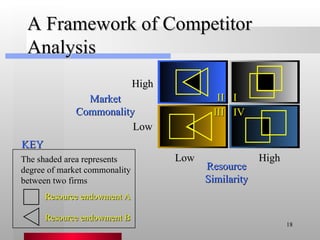
A Framework of Competitor Analysis Market Commonality High Low Low High Resource Similarity The shaded area represents degree of market commonality between two firms Resource endowment B Resource endowment A KEY I II III IV
Drivers of Competitive Actions and Responses: Awareness is the extent to which competitors recognize the degree of their mutual interdependence mutual interdependence results from market commonality resource similarity Awareness Drivers of competitive behavior Click Here Return to Discussion Questions Awareness
Discussion Question 4 What factors lead to motivation and ability for competitive attack and response?
Drivers of Competitive Actions and Responses: Motivation concerns the firm’s incentive to take action or to respond to a competitor’s attack and relates to perceived gains and losses Drivers of competitive behavior Motivation Motivation Awareness
Drivers of Competitive Actions and Responses: Ability relates to each firm’s resources the flexibility these resources provide Without available resources the firm lacks the ability to attack a competitor  to respond to the competitor’s actions Drivers of competitive behavior Ability Ability Awareness Motivation
Drivers of Competitive Actions and Responses: Dissimilarity refers to the resource imblance between the acting firm and competitors potential responders The greater the imbalance, the greater will be the delay in response by the firm with the resource disadvantage Drivers of competitive behavior Dissimilarity Ability Awareness Motivation Dissimilarity
Drivers of Competitive Actions and Responses: A firm is more likely to attack the rival with whom it has low market commonality than the one with whom it competes in multiple markets Because of the high stakes of competition under the condition of market commonality, there is a high probability that the attacked firm will respond to its competitor’s action in an effort to protect its position in one or more markets Drivers of competitive behavior influenced by Market Commonality Market commonality
Drivers of Competitive Actions and Responses: The greater the resource imbalance between the acting firm and competitors or potential responders, the greater will be the delay in response by the firm with a resource disadvantage When facing competitors with greater resources or more attractive market positions, firms should eventually respond, no matter how challenging the response Drivers of competitive behavior influenced by Resource Similarity Click Here Return to Discussion Questions Resource similarity Market commonality
Discussion Question 5 Besides market commonality and resource similarity, what additional factors might lead a firm to attack?
Factors Affecting Likelihood of Attack: First movers allocate funds for product innovation and development aggressive advertising advanced research and development First movers can gain  the loyalty of customers who may become committed to the firm’s goods or services market share that can be difficult for competitors to take during future competitive rivalry First Mover Incentives First mover incentives
Factors Affecting Likelihood of Attack: Small firms are more likely to launch competitive actions  to be quicker in doing so Small firms are perceived as nimble and flexible competitors  relying on speed and surprise to defend their competitive advantages or develop new ones while engaged in competitive rivalry Small firms have the flexibility needed to launch a greater variety of competitive actions Size Size First mover incentives
Factors Affecting Likelihood of Attack: Large firms are likely to initiate more competitive actions as well as strategic actions during a given time period Large organizations commonly have the slack resources required to launch a larger number of total competitive actions Size First mover incentives Size “ Think and act big and we’ll get smaller.  Think and act small and we’ll get bigger.” -  Herb Kelleher, Former CEO, Southwest Airlines
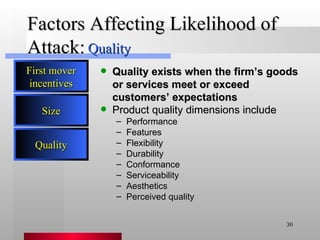
Factors Affecting Likelihood of Attack: Quality exists when the firm’s goods or services meet or exceed customers’ expectations Quality Product quality dimensions include Performance Features Flexibility Durability Conformance Serviceability Aesthetics Perceived quality Quality First mover incentives Size
Factors Affecting Likelihood of Attack: Quality exists when the firm’s goods or services meet or exceed customers’ expectations Click Here Return to Discussion Questions Quality Service quality dimensions include Timeliness Courtesy Consistency Convenience Completeness Accuracy Quality First mover incentives Size
Discussion Question 6 Once competitive action is taken, what factors increase the likelihood of competitive response?
Factors Affecting Likelihood of Response Firms study three factors to predict how a competitor is likely to respond to competitive actions type of competitive action reputation market dependence
Strategic and Tactical Actions Strategic action or a strategic response a market-based move that involves a significant commitment of organizational resources and is difficult to implement and reverse Tactical action or a tactical response a market-based move that is taken to fine-tune a strategy; it involves fewer resources and is relatively easy to implement and reverse
Factors Affecting Likelihood of Response: Strategic actions receive strategic responses Tactical responses are taken to counter the effects of tactical actions Strategic actions elicit fewer total competitive responses A competitor likely will respond quickly to a tactical action The time needed to implement and assess a strategic action delays competitors’ responses Type of Competitive Action Type of competitive action
Factors Affecting Likelihood of Response: An actor is the firm taking an action or response Reputation is the positive or negative attribute ascribed by one rival to another based on past competitive behavior The firm studies responses that a competitor has taken previously when attacked to predict likely responses Reputation Reputation Type of competitive action
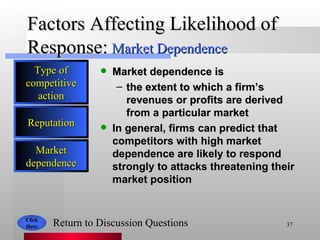
Factors Affecting Likelihood of Response: Market dependence is the extent to which a firm’s revenues or profits are derived from a particular market In general, firms can predict that competitors with high market dependence are likely to respond strongly to attacks threatening their market position Market Dependence Click Here Return to Discussion Questions Market dependence Type of competitive action Reputation
Discussion Question 7 What strategic approach is necessary to compete in slow versus fast cycle or hyper-competitive markets?
Competitive Dynamics: Slow-cycle markets the firm’s competitive advantages are shielded from imitation for long periods of time imitation is costly Competitive advantages are sustainable in slow-cycle markets A proprietary, one-of-a-kind competitive advantage leads to competitive success in a slow-cycle market Slow-Cycle Markets Slow-cycle markets
Gradual Erosion of a Sustainable Competitive Advantage Returns from a Sustainable Competitive Advantage Time (Years) Launch Exploitation Counterattack 0 5 10
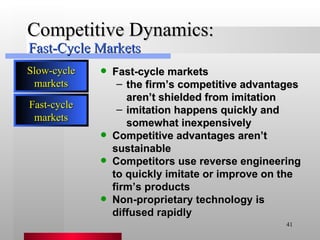
Competitive Dynamics: Fast-cycle markets the firm’s competitive advantages aren’t shielded from imitation  imitation happens quickly and somewhat inexpensively Competitive advantages aren’t sustainable Competitors use reverse engineering to quickly imitate or improve on the firm’s products Non-proprietary technology is diffused rapidly Fast-Cycle Markets Fast-cycle markets Slow-cycle markets
Obtaining Temporary Advantages to Create Sustained Advantage Returns from a Series of Replicable Actions Time (Years) Launch Exploitation Counterattack Firm has already moved to next advantage 0 5 10 15
Competitive Dynamics: Standard-cycle markets  the firm’s competitive advantages may be shielded from imitation imitation is moderately costly Competitive advantages are partially sustainable if the firm is able to continuously upgrade the quality of its competitive advantages Firms seek large market shares gain customer loyalty through brand names carefully control operations Standard-Cycle Markets Slow-cycle markets Fast-cycle markets Standard-cycle markets

Ch06 Discussion Light

  • 1.
    Competitive Rivalry andCompetitive Dynamics Robert E. Hoskisson Michael A. Hitt R. Duane Ireland Chapter 6
  • 2.
    Chapter 2 StrategicLeadership Chapter 4 The Internal Organization Chapter 6 Competitive Rivalry and Competitive Dynamics Chapter 9 International Strategy Chapter 1 Introduction to Strategic Management Chapter 3 The External Environment Chapter 5 Business-Level Strategy Chapter 8 Acquisition and Restructuring Strategies Chapter 11 Corporate Governance Strategic Intent Strategic Mission Chapter 7 Corporate-Level Strategy Chapter 10 Cooperative Strategy Chapter 12 Strategic Entrepreneurship Strategic Analysis Strategic Thinking Creating Competitive Advantage Monitoring And Creating Entrepreneurial Opportunities The Strategic Management Process Chapter 5 Business-Level Strategy Chapter 6 Competitive Rivalry and Competitive Dynamics
  • 3.
    Discussion Questions Whatis competitive dynamics and why is it important? What are the reasons why rivalry increases or decreases between firms? What factors drive awareness of the potential for increased rivalry and competitive attack and response? Click Here Click Here Click Here More discussion questions Click Here
  • 4.
    Discussion Questions (cont.)What factors lead to motivation and ability for competitive attack and response? Besides market commonality and resource similarity, what additional factors might lead a firm to attack? Once competitive action is taken, what factors increase the likelihood of competitive response? Click Here Click Here Click Here Click Here More discussion questions
  • 5.
    Discussion Questions (cont.)What strategic approach is necessary to compete in slow versus fast cycle or hyper-competitive markets? Click Here
  • 6.
    Discussion Question 1What is competitive dynamics and why is it important?
  • 7.
    Definitions Competitors firmsoperating in the same market, offering similar products and targeting similar customers Competitive rivalry the ongoing set of competitive actions and responses occurring between competitors competitive rivalry influences an individual firm’s ability to gain and sustain competitive advantages
  • 8.
    Definitions Competitive behaviorthe set of competitive actions and competitive responses the firm takes to build or defend its competitive advantages and to improve its market position Competitive dynamics the total set of actions and responses taken by all firms competing within a market
  • 9.
    From Competitors toCompetitive Dynamics Engage in Why? How? Competitors Through competitive behavior Competitive actions Competitive responses To gain an advantageous market position Competitive Dynamics Competitive actions and responses taken by all firms competing in a market Competitive rivalry What results? What results?
  • 10.
    Effect of CompetitiveRivalry on a Firm’s Strategies Success of a strategy is determined by: the firm’s initial competitive actions how well it anticipates competitors’ responses to them how well the firm anticipates and responds to its competitors’ initial actions Competitive rivalry affects all types of strategies most dominant influence is on the firm’s business-level strategy or strategies. Click Here Return to Discussion Questions
  • 11.
    Discussion Question 2What are the reasons why rivalry increases or decreases between firms?
  • 12.
    A Model ofCompetitive Rivalry feedback Competitive Analysis Market commonality Resource similarity Drivers of Competitive Behavior Awareness Motivation Ability Interfirm Rivalry Likelihood of Attack First mover incentives Organizational size Quality Likelihood of Response Type of competitive action Reputation Market dependence Outcomes Market position Financial performance
  • 13.
    Competitive Rivalry Firmsare mutually interdependent one firm’s competitive actions have noticeable effects on competitors one firm’s competitive actions elicit competitive responses from competitors competitors feel each other’s actions and responses Marketplace success is a function of both individual strategies and the consequences of their use
  • 14.
    Competitor Analysis Competitoranalysis a technique firms use to understand their competitive environment. Along with the general and industry environments, the competitive environment comprises the firm’s external environment a technique used to help the firm understand its competitors the first step to being able to predict competitors’ behavior in the form of its competitive actions and responses Click Here Return to Discussion Questions
  • 15.
    Discussion Question 3What factors drive awareness of the potential for increased rivalry and competitive attack and response?
  • 16.
    Market Commonality MarketCommonality is concerned with the number of markets with which a firm and a competitor are jointly involved the degree of importance of the individual markets to each competitor Most industries’ markets are somewhat related in terms of technologies core competencies Multimarket competition Firms competing in several markets
  • 17.
    Resource Similarity Resourcesimilarity the extent to which the firm’s tangible and intangible resources are comparable to a competitor’s in terms of both type and amount Firms with similar types and amounts of resources are likely to have similar strengths and weaknesses use similar strategies Assessing resource similarity can be difficult if critical resources are intangible rather than tangible
  • 18.
    A Framework ofCompetitor Analysis Market Commonality High Low Low High Resource Similarity The shaded area represents degree of market commonality between two firms Resource endowment B Resource endowment A KEY I II III IV
  • 19.
    Drivers of CompetitiveActions and Responses: Awareness is the extent to which competitors recognize the degree of their mutual interdependence mutual interdependence results from market commonality resource similarity Awareness Drivers of competitive behavior Click Here Return to Discussion Questions Awareness
  • 20.
    Discussion Question 4What factors lead to motivation and ability for competitive attack and response?
  • 21.
    Drivers of CompetitiveActions and Responses: Motivation concerns the firm’s incentive to take action or to respond to a competitor’s attack and relates to perceived gains and losses Drivers of competitive behavior Motivation Motivation Awareness
  • 22.
    Drivers of CompetitiveActions and Responses: Ability relates to each firm’s resources the flexibility these resources provide Without available resources the firm lacks the ability to attack a competitor to respond to the competitor’s actions Drivers of competitive behavior Ability Ability Awareness Motivation
  • 23.
    Drivers of CompetitiveActions and Responses: Dissimilarity refers to the resource imblance between the acting firm and competitors potential responders The greater the imbalance, the greater will be the delay in response by the firm with the resource disadvantage Drivers of competitive behavior Dissimilarity Ability Awareness Motivation Dissimilarity
  • 24.
    Drivers of CompetitiveActions and Responses: A firm is more likely to attack the rival with whom it has low market commonality than the one with whom it competes in multiple markets Because of the high stakes of competition under the condition of market commonality, there is a high probability that the attacked firm will respond to its competitor’s action in an effort to protect its position in one or more markets Drivers of competitive behavior influenced by Market Commonality Market commonality
  • 25.
    Drivers of CompetitiveActions and Responses: The greater the resource imbalance between the acting firm and competitors or potential responders, the greater will be the delay in response by the firm with a resource disadvantage When facing competitors with greater resources or more attractive market positions, firms should eventually respond, no matter how challenging the response Drivers of competitive behavior influenced by Resource Similarity Click Here Return to Discussion Questions Resource similarity Market commonality
  • 26.
    Discussion Question 5Besides market commonality and resource similarity, what additional factors might lead a firm to attack?
  • 27.
    Factors Affecting Likelihoodof Attack: First movers allocate funds for product innovation and development aggressive advertising advanced research and development First movers can gain the loyalty of customers who may become committed to the firm’s goods or services market share that can be difficult for competitors to take during future competitive rivalry First Mover Incentives First mover incentives
  • 28.
    Factors Affecting Likelihoodof Attack: Small firms are more likely to launch competitive actions to be quicker in doing so Small firms are perceived as nimble and flexible competitors relying on speed and surprise to defend their competitive advantages or develop new ones while engaged in competitive rivalry Small firms have the flexibility needed to launch a greater variety of competitive actions Size Size First mover incentives
  • 29.
    Factors Affecting Likelihoodof Attack: Large firms are likely to initiate more competitive actions as well as strategic actions during a given time period Large organizations commonly have the slack resources required to launch a larger number of total competitive actions Size First mover incentives Size “ Think and act big and we’ll get smaller. Think and act small and we’ll get bigger.” - Herb Kelleher, Former CEO, Southwest Airlines
  • 30.
    Factors Affecting Likelihoodof Attack: Quality exists when the firm’s goods or services meet or exceed customers’ expectations Quality Product quality dimensions include Performance Features Flexibility Durability Conformance Serviceability Aesthetics Perceived quality Quality First mover incentives Size
  • 31.
    Factors Affecting Likelihoodof Attack: Quality exists when the firm’s goods or services meet or exceed customers’ expectations Click Here Return to Discussion Questions Quality Service quality dimensions include Timeliness Courtesy Consistency Convenience Completeness Accuracy Quality First mover incentives Size
  • 32.
    Discussion Question 6Once competitive action is taken, what factors increase the likelihood of competitive response?
  • 33.
    Factors Affecting Likelihoodof Response Firms study three factors to predict how a competitor is likely to respond to competitive actions type of competitive action reputation market dependence
  • 34.
    Strategic and TacticalActions Strategic action or a strategic response a market-based move that involves a significant commitment of organizational resources and is difficult to implement and reverse Tactical action or a tactical response a market-based move that is taken to fine-tune a strategy; it involves fewer resources and is relatively easy to implement and reverse
  • 35.
    Factors Affecting Likelihoodof Response: Strategic actions receive strategic responses Tactical responses are taken to counter the effects of tactical actions Strategic actions elicit fewer total competitive responses A competitor likely will respond quickly to a tactical action The time needed to implement and assess a strategic action delays competitors’ responses Type of Competitive Action Type of competitive action
  • 36.
    Factors Affecting Likelihoodof Response: An actor is the firm taking an action or response Reputation is the positive or negative attribute ascribed by one rival to another based on past competitive behavior The firm studies responses that a competitor has taken previously when attacked to predict likely responses Reputation Reputation Type of competitive action
  • 37.
    Factors Affecting Likelihoodof Response: Market dependence is the extent to which a firm’s revenues or profits are derived from a particular market In general, firms can predict that competitors with high market dependence are likely to respond strongly to attacks threatening their market position Market Dependence Click Here Return to Discussion Questions Market dependence Type of competitive action Reputation
  • 38.
    Discussion Question 7What strategic approach is necessary to compete in slow versus fast cycle or hyper-competitive markets?
  • 39.
    Competitive Dynamics: Slow-cyclemarkets the firm’s competitive advantages are shielded from imitation for long periods of time imitation is costly Competitive advantages are sustainable in slow-cycle markets A proprietary, one-of-a-kind competitive advantage leads to competitive success in a slow-cycle market Slow-Cycle Markets Slow-cycle markets
  • 40.
    Gradual Erosion ofa Sustainable Competitive Advantage Returns from a Sustainable Competitive Advantage Time (Years) Launch Exploitation Counterattack 0 5 10
  • 41.
    Competitive Dynamics: Fast-cyclemarkets the firm’s competitive advantages aren’t shielded from imitation imitation happens quickly and somewhat inexpensively Competitive advantages aren’t sustainable Competitors use reverse engineering to quickly imitate or improve on the firm’s products Non-proprietary technology is diffused rapidly Fast-Cycle Markets Fast-cycle markets Slow-cycle markets
  • 42.
    Obtaining Temporary Advantagesto Create Sustained Advantage Returns from a Series of Replicable Actions Time (Years) Launch Exploitation Counterattack Firm has already moved to next advantage 0 5 10 15
  • 43.
    Competitive Dynamics: Standard-cyclemarkets the firm’s competitive advantages may be shielded from imitation imitation is moderately costly Competitive advantages are partially sustainable if the firm is able to continuously upgrade the quality of its competitive advantages Firms seek large market shares gain customer loyalty through brand names carefully control operations Standard-Cycle Markets Slow-cycle markets Fast-cycle markets Standard-cycle markets

Editor's Notes

  • #2 Competitive Rivalry and Competitive Dynamics Instructor notes contained here for Chapter 6 include: • Competitive Rivalry, which begins on the slide titled “From Competitors to Competitive Dynamics” • Competitor Analysis, which begins on the slide titled “A Model of Competitive Rivalry” and includes discussions of • Market Commonality • Resource Similarity • Resource Dissimilarity • Reputation • Competitive Dynamics, which begins on the slide titled “Competitive Dynamics: Slow- Cycle Markets.” This discussion includes both slow-cycle and fast-cycle markets.
  • #10 From Competitors to Competitive Dynamics Competitive Rivalry (Supplements discussion of rivalry on pp. 174ff) Firms use a variety of tactics to draw out and assess the competition. For example, rivals frequently signal their “rules of engagement,” which involves letting the competition know one’s intentions and to draw the competition out and examine how it responds. To examine how the competition responds, or to test its counter moves, a firm can always bluff. Signaling and rules of engagement in the airlines industry are rather clear and common. As an example, Delta was known for briefly lowering fares significantly on a particular route, say Atlanta to Los Angeles, in response to another carrier lowering the fares on the same route. The signal: “If you want to lower fares on this route, you are in for a bloody battle.” The other airline most often responded by raising fares along this route because Delta had the resources to enter into a long and grueling fare war on the route. If, on the other hand, rivals reacted by lowering fares even further, Delta had to interpret this signal as “they wished to compete with us for business along this route.” Of course, not all types of signaling are legal, but here are a couple of common signals: price movements, prior announcements (“we’ll meet or beat any competitor’s price”), media (press releases), counter attacks/moves, announcement of results, and litigation. (Continued on next slide.)
  • #11 From Competitors to Competitive Dynamics (cont.) Competitive Rivalry (Supplements discussion of rivalry on pp. 174ff) (cont.) Strategists must also note that firms might get into competitions that are not economically driven, but rather are personality driven. These competitive rivalries are based on an initial competition for resources or revenues—but that over time can become personal battles between CEOs. Sony and Matsushita have been battling for world dominance in the consumer electronics industry for decades. The rivalry has become so personal between the two CEOs that they refuse to attend the same dinner parties or events. It escalated to the point where in 1989, after Sony’s Akio Morita closed the deal to purchase Columbia Pictures for $3.4 billion, Matsushita’s Masaharu Matsushita, not willing to be one-upped by his rival, responded by purchasing MCA for $6.1 billion less than a year later. Understanding competition is important as research shows that intensified rivalry within an industry may results in decreased industry average profitability. As discussed in the textbook, in 2001, Dell launched an intense price war in the PC and server business, causing prices to drop by as much as 50%. Profit margins declined for all firms, including Dell. CEO Michael Dell believed that his direct sales model would enable Dell to better endure its own reduced profitability than rivals who seek economies of scale could. Competitors, however, responded to Dell’s pricing competitive action. For example, to increase their advantage from economies of scale and scope, Hewlett-Packard’s merged with Compaq Computer Corporation. While it remains to be seen whether the new HP would be able to sustain the intense rivalry Dell’s strategy may contribute to its ability to outperform its rivals. Indeed, it has been suggested that Dell sets the pace for the PC industry, reflecting the strength of its direct sales strategy, and its superior cash flow management.
  • #13 A Model of Competitive Rivalry Competitor Analysis (p. 175) Firms with high market commonality and highly similar resources are direct and mutually acknowledged competitors. However, direct rivals do not always intensify their competition. The drivers of competitive behavior—as well as the likelihood that a competitor will initiate competitive actions or reactions—influence the intensity of rivalry, even for direct competitors. Market Commonality is concerned with the number of markets with which the firm and a competitor are jointly involved and the degree of importance of the individual markets to each. For example, McDonalds and Burger King compete against each other in multiple global fast-food markets, while Prudential and Cigna (financial/insurance) compete against each other in several market segments (institutional and retail) as well as product markets such as life insurance and health insurance. Airlines, chemicals, and pharmaceuticals are other industries in which firms often simultaneously engage each other in multiple market competitions. More recently AOL and Microsoft entered into a stiff competition for Internet Service Provider (ISP) dominance. The key to ISP profits is in selling add-ons and auxiliary products and services to its customers. AOL has a significant size advantage with 31 million subscribers to Microsoft’s 7 million. The rivalry between the two firms for customers is becoming increasingly intense. When AOL increased rates Microsoft responded by holding its rates and offering three free months to new subscribers. AOL responded by initiating negotiations with PC manufacturers to install AOL on new PC desktops. The two firms also compete for the instant messaging application market. While AOL pioneered the concept, Microsoft developed many added features and optimized its application. In an effort to capture even greater market share Microsoft began to bundle MSN Messenger with its newest Windows operating system, Windows XP. While research suggests that market commonality and multimarket competition may occur by chance, once it begins, the rivalry becomes intentional and oftentimes intense. (Continued on next slide.)
  • #14 Competitive Rivalry Resource Similarity Resource Similarity is the extent to which the firm’s resources are comparable to a rival’s in terms of both type and amount. Firms with similar types and amounts of resources tend to have similar strengths and weaknesses—and use similar strategies. The rivalry between CVS and Walgreen demonstrates these expectations in the retail pharmacy business. These firms are using the integrated cost leadership/differentiation strategy to offer relatively low-cost goods with some differentiated features, such as services. Resource similarity (net income of $746 million for CVS vs. $776.9 million for Walgreen; 4,133 CVS stores in 34 states vs. 3,165 Walgreen stores in 43 states) suggests that the firms might suffer from strategy convergence and industry orthodoxy. Resource Dissimilarity Resource Dissimilarity also influences competitive actions and responses between firms. For example, Wal-Mart initially used its cost leadership strategy to compete only in small communities (population of 25,000 or less). Using logistics systems and extremely efficient purchasing practices as competitive advantages, Wal-Mart created what was at that time a new type of value—wide selections of products at the lowest competitive prices— for customers in small retail markets. Local stores lacked the ability to marshal resources at the pace required to respond quickly and effectively. However, even when facing competitors with greater resources or ability, firms should respond, no matter how daunting doing so seems. Choosing not to respond can ultimately result in failure (or greater failure), as happened with many local retailers who didn’t respond to Wal-Mart’s competitive actions.
  • #15 Competitive Analysis Reputation (p. 187) Competitors are more likely to respond to strategic and tactical actions taken by market leaders. For example, Home Depot—the world’s largest home improvement retailer and the second largest U.S. retailer (behind Wal-Mart)—is known as an innovator in the home improvement market and for its ability to develop new store formats (EXPO Design Centers and Villager’s Hardware Stores). As such, Home Depot knows that its rivals study its strategic actions and respond to them. For example, watching Home Depot, Lowe’s has transformed from a chain of small stores into a chain of home improvement warehouses, thus increasing the similarity of its store design with Home Depot’s. Similarly, evidence shows that successful strategic actions are quickly imitated, almost regardless of the actor’s reputation. For example, although a second mover, IBM committed significant resources to enter the PC market. When IBM succeeded in this endeavor, rivals (Dell, Compaq, and Gateway) responded with strategic actions (imitation) to enter the market. IBM’s reputation as well as its successful strategic action strongly influenced entry by these competitors. Thus, in terms of competitive rivalry, IBM could predict that responses would follow its entry to a market if that entry proved successful. In addition, IBM could predict that those competitors would try to create value in slightly different ways, such as Dell’s direct sales and built-to-order rather than to use storefronts as a distribution channel.
  • #40 Competitive Dynamics Slow-Cycle Markets (p. 189) Slow-Cycle Markets are markets in which competitive advantages are shielded from imitation for longer periods of time and/or where imitation is costly. Historical conditions, causal ambiguity, social complexity, copyrights, location, patents, and proprietary information could all lead to one-of-a-kind advantages. Walt Disney Co. continues to extend its proprietary characters, such as Mickey Mouse, Minnie Mouse, and Goofy. These characters have a unique historical development. Because patents shield it, the proprietary nature of Disney’s advantage in terms of animated characters protects the firm from imitation by competitors (e.g., the company once sued a day-care center, forcing it to remove the likeness of Mickey Mouse from a wall of the facility). Once a patent expires, a firm is no longer shielded from competition. For example, in 2002 Merck got rocked by the loss of revenue as the patent protection for leading drugs, such as gastroesophageal reflux soother Prilosec, cholesterol drug Mevacor, and hypertension medication Prinivil, expired.
  • #42 Competitive Dynamics (cont.) Fast-Cycle Markets (p. 189) Fast-Cycle Markets are markets in which competitive advantages are not shielded from imitation and where imitation happens quickly and somewhat inexpensively. Competitive advantages are not sustainable in fast-cycle markets. The pace of competition in fastcycle markets is almost frenzied as companies rely on ideas and the innovations resulting from them as the engines of their growth. Because prices fall quickly in these markets, companies need to introduce new or improved product faster. For example, rapid declines in the prices of Intel’s and Advanced Micro Devices’ (AMD) microprocessor chips made it possible for PC manufacturers to continuously reduce their prices to end users. Imitation of many fast-cycle products is relatively easy. Dell and Gateway have imitated IBM’s initial PC design to create their own PCs. Continuous declines in the costs of parts, as well as the fact that the information and knowledge required to assemble a PC isn’t complicated and is readily available, made it possible for additional competitors to enter this market without significant difficulty.