Copyright ©2017 Pearson Education, Limited
Strategy
Implementation
Chapter Nine
9-1
Learning Objectives
1. Identify and describe strategic marketing issues vital for
strategy implementation.
2. Explain why social media marketing is an important strategy-
implementation tool.
3. Explain why market segmentation is an important strategy-
implementation tool.
4. Explain how to use product positioning (perceptual mapping)
as a strategy-implementation tool.
5. Identify and describe strategic finance/accounting issues vital
for strategy implementation.
6. Perform EPS/EBIT analysis to evaluate the attractiveness of
debt versus stock as a source of capital to implement
strategies.
Copyright ©2017 Pearson Education, Limited 9-2
Learning Objectives (cont.)
7. Develop projected financial statements to reveal the
impact of strategy recommendations.
8. Determine the cash value of any business using four
corporate evaluation methods.
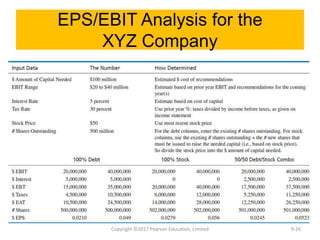
9. Discuss IPOs, keeping cash offshore, and issuing
corporate bonds as strategic decisions that face many
firms.
10.Discuss the nature and role of research and
development (R&D) in strategy implementation.
11.Explain how management information systems (MISs)
impact strategy-implementation efforts.
Copyright ©2017 Pearson Education, Limited 9-3
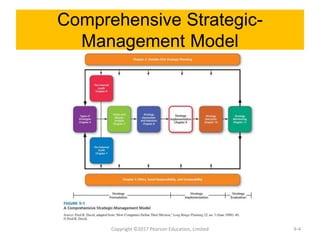
Comprehensive Strategic-
Management Model
Copyright ©2017 Pearson Education, Limited 9-4
Strategic Marketing Issues
1. How to make advertisements more
interactive to be more effective
2. How to best take advantage of Facebook
and Twitter conservations about the
company and industry
3. To use exclusive dealerships or multiple
channels of distribution
4. To use heavy, light, or no TV advertising
versus online advertising
Copyright ©2017 Pearson Education, Limited 9-5
Strategic Marketing Issues
5. To limit (or not) the share of business done
with a single customer
6. To be a price leader or a price follower
7. To offer a complete or limited warranty
8. To reward salespeople based on straight
salary, straight commission, or a
combination salary/commission
Copyright ©2017 Pearson Education, Limited 9-6
Social Media Marketing
Marketers must get customers involved in the company
website and solicit suggestions in terms of product
development, customer service, and ideas.
The company should enable customers to interact with
the firm on the following social media networks:
Facebook
Google Plus
Twitter
LinkedIn
Instagram
Pinterest
Foursquare
Copyright ©2017 Pearson Education, Limited 9-7
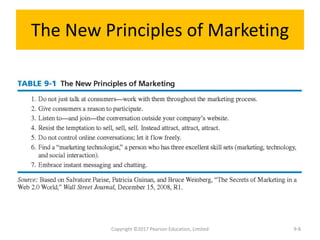
The New Principles of Marketing
Copyright ©2017 Pearson Education, Limited 9-8
Market Segmentation
Market Segmentation
subdividing of a market into distinct
subsets of customers according to
needs and buying habits
widely used in implementing
strategies
Copyright ©2017 Pearson Education, Limited 9-9
Market Segmentation
Strategies such as market development,
product development, market penetration,
and diversification require increased sales
through new markets and products.
Market segmentation allows a firm to operate
with limited resources because mass
production, mass distribution, and mass
advertising are not required.
Copyright ©2017 Pearson Education, Limited 9-10
Market Segmentation
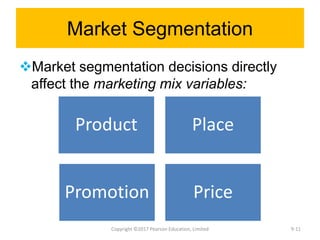
Market segmentation decisions directly
affect the marketing mix variables:
Copyright ©2017 Pearson Education, Limited
Product Place
Promotion Price
9-11
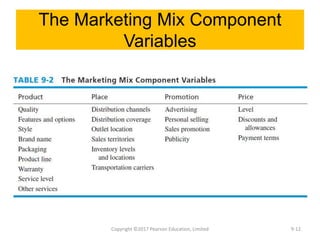
The Marketing Mix Component
Variables
Copyright ©2017 Pearson Education, Limited 9-12
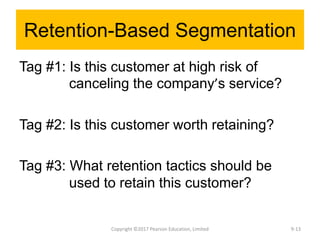
Retention-Based Segmentation
Tag #1: Is this customer at high risk of
canceling the company’s service?
Tag #2: Is this customer worth retaining?
Tag #3: What retention tactics should be
used to retain this customer?
Copyright ©2017 Pearson Education, Limited 9-13
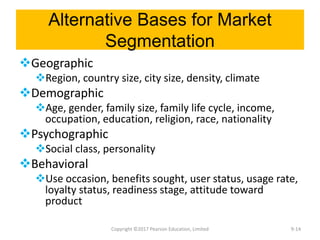
Alternative Bases for Market
Segmentation
Geographic
Region, country size, city size, density, climate
Demographic
Age, gender, family size, family life cycle, income,
occupation, education, religion, race, nationality
Psychographic
Social class, personality
Behavioral
Use occasion, benefits sought, user status, usage rate,
loyalty status, readiness stage, attitude toward
product
Copyright ©2017 Pearson Education, Limited 9-14
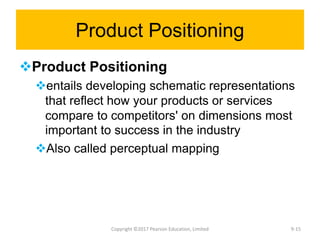
Product Positioning
Product Positioning
entails developing schematic representations
that reflect how your products or services
compare to competitors' on dimensions most
important to success in the industry
Also called perceptual mapping
Copyright ©2017 Pearson Education, Limited 9-15
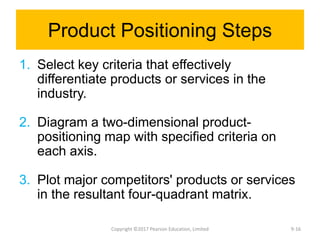
Product Positioning Steps
1. Select key criteria that effectively
differentiate products or services in the
industry.
2. Diagram a two-dimensional product-
positioning map with specified criteria on
each axis.
3. Plot major competitors' products or services
in the resultant four-quadrant matrix.
Copyright ©2017 Pearson Education, Limited 9-16
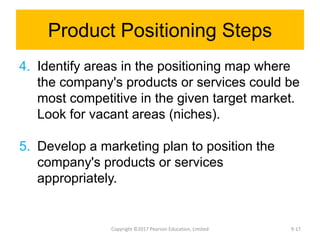
Product Positioning Steps
4. Identify areas in the positioning map where
the company's products or services could be
most competitive in the given target market.
Look for vacant areas (niches).
5. Develop a marketing plan to position the
company's products or services
appropriately.
Copyright ©2017 Pearson Education, Limited 9-17
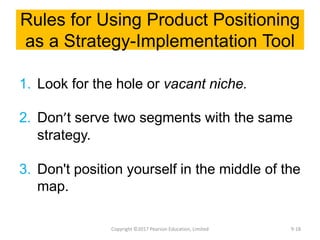
Rules for Using Product Positioning
as a Strategy-Implementation Tool
1. Look for the hole or vacant niche.
2. Don’t serve two segments with the same
strategy.
3. Don't position yourself in the middle of the
map.
Copyright ©2017 Pearson Education, Limited 9-18
Product Positioning
An effective product positioning strategy
meets two criteria:
it uniquely distinguishes a company from
the competition
it leads customers to expect slightly less
service than a company can deliver
Copyright ©2017 Pearson Education, Limited 9-19
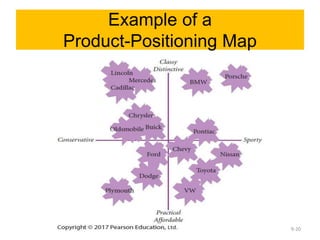
Example of a
Product-Positioning Map
Copyright ©2017 Pearson Education, Limited 9-20
Finance/Accounting Issues
1. To raise capital with short-term debt, long-
term debt, preferred stock, or common stock
2. To lease or buy fixed assets
3. To determine an appropriate dividend payout
ratio
4. To use LIFO (Last-in, First-out), FIFO (First-
in, First-out), or a market-value accounting
approach
Copyright ©2017 Pearson Education, Limited 9-21
Finance/Accounting Issues
5. To extend the time of accounts
receivable
6. To establish a certain percentage
discount on accounts within a specified
period of time
7. To determine the amount of cash that
should be kept on hand
Copyright ©2017 Pearson Education, Limited 9-22
Finance/Accounting Issues
1. Acquire needed capital to implement strategies.
2. Develop projected financial statements to show
expected impact of strategies implemented.
3. Determine the firm’s value (corporate valuation)
in the event an offer is received.
4. Decide whether to go public with an Initial
Public Offering (IPO).
5. Decide whether to keep cash offshore that was
earned offshore.
Copyright ©2017 Pearson Education, Limited 9-23
Acquiring Capital to
Implement Strategies
Successful strategy implementation often
requires additional capital.
Besides net profit from operations and the
sale of assets, two basic sources of capital
for an organization are debt and equity.
Copyright ©2017 Pearson Education, Limited 9-24
Acquiring Capital to
Implement Strategies
EPS = Earnings Per Share, which is Net Income
divided by # of Shares Outstanding
Another term for Shares Outstanding is Shares
Issued
EBIT = Earnings Before Interest and Taxes (also
called operating income)
EBT = Earnings Before Tax
EAT = Earnings After Tax
Copyright ©2017 Pearson Education, Limited 9-25
EPS/EBIT Analysis for the
XYZ Company
Copyright ©2017 Pearson Education, Limited 9-26
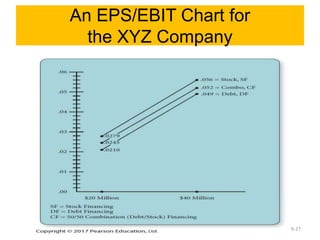
An EPS/EBIT Chart for
the XYZ Company
Copyright ©2017 Pearson Education, Limited 9-27
Projected Financial Statements
Projected Financial Statements
allows an organization to examine the
expected results of various actions and
approaches
allows an organization to compute projected
financial ratios under various strategy-
implementation decisions
Copyright ©2017 Pearson Education, Limited 9-28
Performing Projected
Financial Analysis
1. Prepare the projected income statement
before the balance sheet.
2. Use the percentage-of-sales method to
project cost of goods sold (CGS) and the
expense items in the income statement.
3. Calculate the projected net income.
4. Subtract from the net income any dividends
to be paid for that year.
Copyright ©2017 Pearson Education, Limited 9-29
Performing Projected
Financial Analysis
5. Project the balance sheet items, beginning
with retained earnings and then forecasting
stockholders' equity, long-term liabilities,
current liabilities, total liabilities, total assets,
fixed assets, and current assets (in that
order).
6. Use the cash account as the plug figure.
7. List commentary (remarks) on the projected
statements.
Copyright ©2017 Pearson Education, Limited 9-30
Corporate Valuation
Methods:
The Net Worth Method
Total Shareholders’ Equity (SE) minus (Goodwill +
Intangibles)
The Net Income Method
Net Income x Five
Price-Earnings Ratio Method
(Stock Price / EPS) x NI
Outstanding Shares Method
# of Shares Outstanding x Stock Price
Copyright ©2017 Pearson Education, Limited 9-31
IPOs, Cash Management, and
Corporate Bonds
Go public with an IPO?
Keep cash offshore if earned offshore?
Issue corporate bonds for what purpose?
Copyright ©2017 Pearson Education, Limited 9-32
Research and Development (R&D)
Issues
1. Emphasize product or process improvements.
2. Stress basic or applied research.
3. Be leaders or followers in R&D.
4. Develop robotics or manual-type processes.
5. Spend a high, average, or low amount of money on
R&D.
6. Perform R&D within the firm or contract R&D to
outside firms.
7. Use university researchers or private-sector
researchers.
Copyright ©2017 Pearson Education, Limited 9-33
R&D Approaches for Implementing
Strategies
Be the first firm to market new technological
products.
Be an innovative imitator of successful
products, thus minimizing the risks and costs
of start-up.
Be a low-cost producer by mass-producing
products similar to but less expensive than
products recently introduced.
Copyright ©2017 Pearson Education, Limited 9-34
Management Information System
(MIS) Issues
Having an effective management
information system (MIS) may be the most
important factor in differentiating
successful from unsuccessful firms.
The process of strategic management is
facilitated immensely in firms that have an
effective information system.
Copyright ©2017 Pearson Education, Limited 9-35
Mobile Computing
Mobile tracking of employees
Mobile apps for customers
Copyright ©2017 Pearson Education, Limited 9-36

SM CH 8 STRATEGY IMPLEMENTATION

  • 1.
    Copyright ©2017 PearsonEducation, Limited Strategy Implementation Chapter Nine 9-1
  • 2.
    Learning Objectives 1. Identifyand describe strategic marketing issues vital for strategy implementation. 2. Explain why social media marketing is an important strategy- implementation tool. 3. Explain why market segmentation is an important strategy- implementation tool. 4. Explain how to use product positioning (perceptual mapping) as a strategy-implementation tool. 5. Identify and describe strategic finance/accounting issues vital for strategy implementation. 6. Perform EPS/EBIT analysis to evaluate the attractiveness of debt versus stock as a source of capital to implement strategies. Copyright ©2017 Pearson Education, Limited 9-2
  • 3.
    Learning Objectives (cont.) 7.Develop projected financial statements to reveal the impact of strategy recommendations. 8. Determine the cash value of any business using four corporate evaluation methods. 9. Discuss IPOs, keeping cash offshore, and issuing corporate bonds as strategic decisions that face many firms. 10.Discuss the nature and role of research and development (R&D) in strategy implementation. 11.Explain how management information systems (MISs) impact strategy-implementation efforts. Copyright ©2017 Pearson Education, Limited 9-3
  • 4.
    Comprehensive Strategic- Management Model Copyright©2017 Pearson Education, Limited 9-4
  • 5.
    Strategic Marketing Issues 1.How to make advertisements more interactive to be more effective 2. How to best take advantage of Facebook and Twitter conservations about the company and industry 3. To use exclusive dealerships or multiple channels of distribution 4. To use heavy, light, or no TV advertising versus online advertising Copyright ©2017 Pearson Education, Limited 9-5
  • 6.
    Strategic Marketing Issues 5.To limit (or not) the share of business done with a single customer 6. To be a price leader or a price follower 7. To offer a complete or limited warranty 8. To reward salespeople based on straight salary, straight commission, or a combination salary/commission Copyright ©2017 Pearson Education, Limited 9-6
  • 7.
    Social Media Marketing Marketersmust get customers involved in the company website and solicit suggestions in terms of product development, customer service, and ideas. The company should enable customers to interact with the firm on the following social media networks: Facebook Google Plus Twitter LinkedIn Instagram Pinterest Foursquare Copyright ©2017 Pearson Education, Limited 9-7
  • 8.
    The New Principlesof Marketing Copyright ©2017 Pearson Education, Limited 9-8
  • 9.
    Market Segmentation Market Segmentation subdividingof a market into distinct subsets of customers according to needs and buying habits widely used in implementing strategies Copyright ©2017 Pearson Education, Limited 9-9
  • 10.
    Market Segmentation Strategies suchas market development, product development, market penetration, and diversification require increased sales through new markets and products. Market segmentation allows a firm to operate with limited resources because mass production, mass distribution, and mass advertising are not required. Copyright ©2017 Pearson Education, Limited 9-10
  • 11.
    Market Segmentation Market segmentationdecisions directly affect the marketing mix variables: Copyright ©2017 Pearson Education, Limited Product Place Promotion Price 9-11
  • 12.
    The Marketing MixComponent Variables Copyright ©2017 Pearson Education, Limited 9-12
  • 13.
    Retention-Based Segmentation Tag #1:Is this customer at high risk of canceling the company’s service? Tag #2: Is this customer worth retaining? Tag #3: What retention tactics should be used to retain this customer? Copyright ©2017 Pearson Education, Limited 9-13
  • 14.
    Alternative Bases forMarket Segmentation Geographic Region, country size, city size, density, climate Demographic Age, gender, family size, family life cycle, income, occupation, education, religion, race, nationality Psychographic Social class, personality Behavioral Use occasion, benefits sought, user status, usage rate, loyalty status, readiness stage, attitude toward product Copyright ©2017 Pearson Education, Limited 9-14
  • 15.
    Product Positioning Product Positioning entailsdeveloping schematic representations that reflect how your products or services compare to competitors' on dimensions most important to success in the industry Also called perceptual mapping Copyright ©2017 Pearson Education, Limited 9-15
  • 16.
    Product Positioning Steps 1.Select key criteria that effectively differentiate products or services in the industry. 2. Diagram a two-dimensional product- positioning map with specified criteria on each axis. 3. Plot major competitors' products or services in the resultant four-quadrant matrix. Copyright ©2017 Pearson Education, Limited 9-16
  • 17.
    Product Positioning Steps 4.Identify areas in the positioning map where the company's products or services could be most competitive in the given target market. Look for vacant areas (niches). 5. Develop a marketing plan to position the company's products or services appropriately. Copyright ©2017 Pearson Education, Limited 9-17
  • 18.
    Rules for UsingProduct Positioning as a Strategy-Implementation Tool 1. Look for the hole or vacant niche. 2. Don’t serve two segments with the same strategy. 3. Don't position yourself in the middle of the map. Copyright ©2017 Pearson Education, Limited 9-18
  • 19.
    Product Positioning An effectiveproduct positioning strategy meets two criteria: it uniquely distinguishes a company from the competition it leads customers to expect slightly less service than a company can deliver Copyright ©2017 Pearson Education, Limited 9-19
  • 20.
    Example of a Product-PositioningMap Copyright ©2017 Pearson Education, Limited 9-20
  • 21.
    Finance/Accounting Issues 1. Toraise capital with short-term debt, long- term debt, preferred stock, or common stock 2. To lease or buy fixed assets 3. To determine an appropriate dividend payout ratio 4. To use LIFO (Last-in, First-out), FIFO (First- in, First-out), or a market-value accounting approach Copyright ©2017 Pearson Education, Limited 9-21
  • 22.
    Finance/Accounting Issues 5. Toextend the time of accounts receivable 6. To establish a certain percentage discount on accounts within a specified period of time 7. To determine the amount of cash that should be kept on hand Copyright ©2017 Pearson Education, Limited 9-22
  • 23.
    Finance/Accounting Issues 1. Acquireneeded capital to implement strategies. 2. Develop projected financial statements to show expected impact of strategies implemented. 3. Determine the firm’s value (corporate valuation) in the event an offer is received. 4. Decide whether to go public with an Initial Public Offering (IPO). 5. Decide whether to keep cash offshore that was earned offshore. Copyright ©2017 Pearson Education, Limited 9-23
  • 24.
    Acquiring Capital to ImplementStrategies Successful strategy implementation often requires additional capital. Besides net profit from operations and the sale of assets, two basic sources of capital for an organization are debt and equity. Copyright ©2017 Pearson Education, Limited 9-24
  • 25.
    Acquiring Capital to ImplementStrategies EPS = Earnings Per Share, which is Net Income divided by # of Shares Outstanding Another term for Shares Outstanding is Shares Issued EBIT = Earnings Before Interest and Taxes (also called operating income) EBT = Earnings Before Tax EAT = Earnings After Tax Copyright ©2017 Pearson Education, Limited 9-25
  • 26.
    EPS/EBIT Analysis forthe XYZ Company Copyright ©2017 Pearson Education, Limited 9-26
  • 27.
    An EPS/EBIT Chartfor the XYZ Company Copyright ©2017 Pearson Education, Limited 9-27
  • 28.
    Projected Financial Statements ProjectedFinancial Statements allows an organization to examine the expected results of various actions and approaches allows an organization to compute projected financial ratios under various strategy- implementation decisions Copyright ©2017 Pearson Education, Limited 9-28
  • 29.
    Performing Projected Financial Analysis 1.Prepare the projected income statement before the balance sheet. 2. Use the percentage-of-sales method to project cost of goods sold (CGS) and the expense items in the income statement. 3. Calculate the projected net income. 4. Subtract from the net income any dividends to be paid for that year. Copyright ©2017 Pearson Education, Limited 9-29
  • 30.
    Performing Projected Financial Analysis 5.Project the balance sheet items, beginning with retained earnings and then forecasting stockholders' equity, long-term liabilities, current liabilities, total liabilities, total assets, fixed assets, and current assets (in that order). 6. Use the cash account as the plug figure. 7. List commentary (remarks) on the projected statements. Copyright ©2017 Pearson Education, Limited 9-30
  • 31.
    Corporate Valuation Methods: The NetWorth Method Total Shareholders’ Equity (SE) minus (Goodwill + Intangibles) The Net Income Method Net Income x Five Price-Earnings Ratio Method (Stock Price / EPS) x NI Outstanding Shares Method # of Shares Outstanding x Stock Price Copyright ©2017 Pearson Education, Limited 9-31
  • 32.
    IPOs, Cash Management,and Corporate Bonds Go public with an IPO? Keep cash offshore if earned offshore? Issue corporate bonds for what purpose? Copyright ©2017 Pearson Education, Limited 9-32
  • 33.
    Research and Development(R&D) Issues 1. Emphasize product or process improvements. 2. Stress basic or applied research. 3. Be leaders or followers in R&D. 4. Develop robotics or manual-type processes. 5. Spend a high, average, or low amount of money on R&D. 6. Perform R&D within the firm or contract R&D to outside firms. 7. Use university researchers or private-sector researchers. Copyright ©2017 Pearson Education, Limited 9-33
  • 34.
    R&D Approaches forImplementing Strategies Be the first firm to market new technological products. Be an innovative imitator of successful products, thus minimizing the risks and costs of start-up. Be a low-cost producer by mass-producing products similar to but less expensive than products recently introduced. Copyright ©2017 Pearson Education, Limited 9-34
  • 35.
    Management Information System (MIS)Issues Having an effective management information system (MIS) may be the most important factor in differentiating successful from unsuccessful firms. The process of strategic management is facilitated immensely in firms that have an effective information system. Copyright ©2017 Pearson Education, Limited 9-35
  • 36.
    Mobile Computing Mobile trackingof employees Mobile apps for customers Copyright ©2017 Pearson Education, Limited 9-36

Editor's Notes

  • #3 After studying this chapter, you should be able to do the following: 8-1. Identify and describe strategic marketing issues vital for strategy implementation. 8-2. Explain why social media marketing is an important strategy-implementation tool. 8-3. Explain why market segmentation is an important strategy-implementation tool. 8-4. Explain how to use product positioning (perceptual mapping) as a strategy-implementation tool. 8-5. Identify and describe strategic finance/accounting issues vital for strategy implementation. 8-6. Perform EPS/EBIT analysis to evaluate the attractiveness of debt versus stock as a source of capital to implement strategies. 8-7. Develop projected financial statements to reveal the impact of strategy recommendations. 8-8. Determine the cash value of any business using four corporate evaluation methods. 8-9. Discuss IPOs, keeping cash offshore, and issuing corporate bonds as strategic decisions that face many firms. 8-10. Discuss the nature and role of research and development (R&D) in strategy implementation. 8-11. Explain how management information systems (MISs) impact strategy-implementation efforts.
  • #5 This chapter is highlighted in the strategic management model.
  • #6 Countless marketing variables affect the success or failure of strategy implementation efforts. Some strategic marketing issues or decisions are on the next two slides.
  • #8 Social media marketing has become an important strategic issue. Marketing has evolved to be more about building a two-way relationship with consumers than just informing consumers about a product or service.
  • #9 Customers must not feel like they are a captive audience for advertising at a firm’s website. Table 8-1 provides new principles of marketing according to Parise, Guinan, and Weinberg.
  • #10 Market segmentation enables a small firm to compete successfully with a large firm by maximizing per-unit profits and per-segment sales.
  • #11 To implement these strategies successfully, new or improved market-segmentation approaches are required.
  • #12 Geographic and demographic bases for segmenting markets are the most commonly employed.
  • #13 Evaluating potential market segments requires strategists to determine the characteristics and needs of consumers, to analyze consumer similarities and differences, and to develop consumer group profiles.
  • #14 Tag #1: Is this customer at high risk of canceling the company's service? One of the most common indicators of high-risk customers is a drop off in usage of the company's service. For example, in the credit card industry this could be signaled through a customer's decline in spending on his or her card. Tag #2: Is this customer worth retaining? This determination boils down to whether the post-retention profit generated from the customer is predicted to be greater than the cost incurred to retain the customer. Customers need to be managed as investments. Tag #3: What retention tactics should be used to retain this customer? For customers who are deemed “save-worthy,” it's essential for the company to know which save tactics are most likely to be successful. Tactics commonly used range from providing “special” customer discounts to sending customers communications that reinforce the value proposition of the given service.
  • #15 Market segmentation on these characteristics is possible with the use of business analytics or data mining.
  • #16 Product positioning is widely used for deciding how to meet the needs and wants of particular consumer groups.
  • #17 Product positioning can be summarized in five steps.
  • #19 Some rules for using product positioning as a strategy-implementation tool are on this slide.
  • #20 Firms need to inform customers about what to expect and then exceed the promise. Underpromise and overdeliver! That is a key for excellent strategy implementation.
  • #21 This is an example of a product positioning map for the auto industry.
  • #22 Several finance and accounting concepts central to strategy implementation are acquiring needed capital, developing projected financial statements, preparing financial budgets, and evaluating the worth of a business. Some examples of decisions that may require finance and accounting policies are included on the next two slides.
  • #24 Five especially important finance and accounting activities central to strategy implementation are listed on this slide and explained on later slides.
  • #25 When a firm needs additional capital, the choice is often made between debt or equity financing.
  • #26 Successful strategy implementation often requires additional capital. Besides net profit from operations and the sale of assets, two basic sources of capital for an organization are debt and equity.
  • #27 The best way to explain EPS/EBIT analysis is by working through an example for the XYZ Company, as provided in Table 8-4. Note that 100 percent stock is the best financing alternative as indicated by the EPS values of 0.0279 and 0.056.
  • #28 As noted in Figure 8-6, the top row (EBIT) on the x-axis is graphed with the bottom row (EPS) on the y-axis, and the highest plotted line reveals the best method. Sometimes the plotted lines will interact, so a graph is especially helpful in making the capital acquisition decision, rather than solely relying on a table of numbers.
  • #29 Most financial institutions require at least three years of projected financial statements whenever a business seeks capital.
  • #30 Projected financial analysis can be explained in seven steps.
  • #32 Four methods are often used to determine the monetary value of a company.
  • #33 This slide lists important financial decisions that companies must make.
  • #34 Research and development (R&D) personnel can play an integral part in strategy implementation. These individuals are generally charged with developing new products and improving old products effectively.
  • #35 There are at least three major R&D approaches for implementing strategies.
  • #36 Firms that gather, assimilate, and evaluate external and internal information most effectively are gaining competitive advantages over other firms.
  • #37 Mobile devices and inexpensive monitoring software now enable companies to know where employees are, eavesdrop on their phone calls, and do other things such as know whether or not a driver is wearing his/her seatbelt. Companies are increasingly developing mobile apps for customers and using resultant data to devise improved strategies for attracting customers.