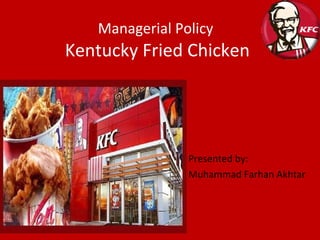
Managerial Policy  Kentucky Fried Chicken Presented by: Muhammad Farhan Akhtar
The Evolution of KFC 1939 – Colonel Sanders develops his original recipe chicken  1952 – Kentucky Fried Chicken is Formed 1952 – 1997 KFC grows into national Restaurant Chain –  Many owners and stake holders along the way. 1986 – PepsiCo’s acquisition of KFC 1997 – Tricon Global Restaurants Inc is formed as a spin-off from PepsiCo 2002 – Tricon changes its corporate name to YUM! Brands 2007 – KFC introduces its Zero grams Trans Fat recipe
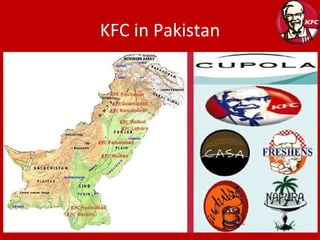
KFC in Pakistan
Vision / Mission Statement Vision To sell food in a fast, friendly environment that appeals to pride conscious, health minded customers Mission Our passion, as a restaurant company, is to put a  YUM  on people’s faces around the world,  SATISFYING CUSTOMERS  every time they eat our food and  DOING IT BETTER  than any other restaurant company. The  UNIQUE EATING EXPERIENCE  at each of our restaurants  MAKE OUR CUSTOMER SMILE  and inspire their loyalty for lift. Toward that end, our associates around the world are trained to be  CUSTOMER MANIACS .
Goals  Build an organization dedicated to excellence. Consistently deliver superior quality, and value in our products and services. Maintain a commitment to innovation for continuous improvement and growth, striving always to be the leader the market place changes. Generate consistently superior financial returns and benefit our owners and employees.
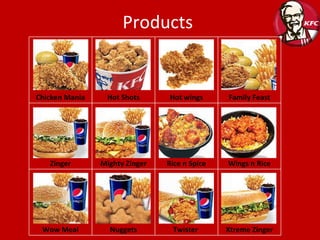
Products  Chicken Mania Hot Shots Hot wings Family Feast Zinger Mighty Zinger Rice n Spice Wings n Rice Wow Meal Nuggets Twister  Xtreme Zinger
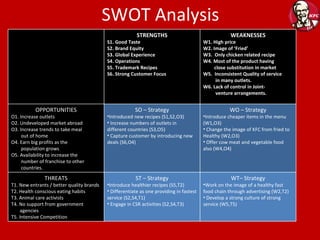
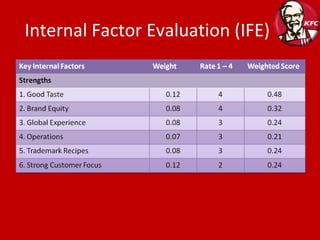
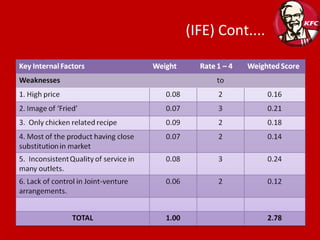
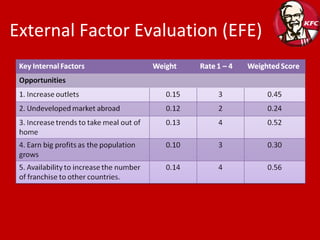
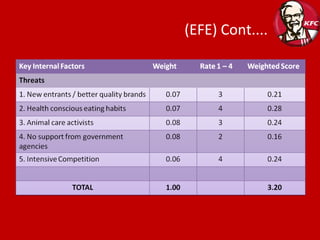
SWOT Analysis STRENGTHS S1. Good Taste S2. Brand Equity S3. Global Experience S4. Operations S5. Trademark Recipes S6. Strong Customer Focus WEAKNESSES W1. High price W2. Image of ‘Fried’ W3.  Only chicken related recipe  W4. Most of the product having  close substitution in market W5.  Inconsistent Quality of service  in many outlets. W6. Lack of control in Joint- venture arrangements. OPPORTUNITIES O1. Increase outlets O2. Undeveloped market abroad O3. Increase trends to take meal  out of home O4. Earn big profits as the  population grows O5. Availability to increase the  number of franchise to other  countries. SO – Strategy Introduced new recipes (S1,S2,O3) Increase numbers of outlets in different countries (S3,O5) Capture customer by introducing new deals (S6,O4) WO – Strategy Introduce cheaper items in the menu (W1,O3) Change the image of KFC from fried to Healthy (W2,O3) Offer cow meat and vegetable food also (W4,O4) THREATS T1. New entrants / better quality brands T2. Health conscious eating habits T3. Animal care activists T4. No support from government  agencies T5. Intensive Competition ST – Strategy Introduce healthier recipes (S5,T2) Differentiate as one providing in fastest service (S2,S4,T1) Engage in CSR activities (S2,S4,T3) WT– Strategy Work on the image of a healthy fast food chain through advertising (W2,T2) Develop a strong culture of strong service (W5,T5)
Recommendations Short Term Introduce new recipes suited to local taste Introduce cheaper items in the menu Introduce healthier recipes Differentiate through good services Work on the image of a healthy fast food chain through advertising Long Term Change the image of KFC from fried to ‘healthy’ Open up new outlets Engage in CSR activities related to animals & environment Develop a strong culture of good service
Internal Factor Evaluation (IFE)
(IFE) Cont....
External Factor Evaluation (EFE)
(EFE) Cont....
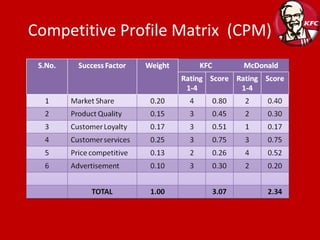
Competitive Profile Matrix  (CPM)
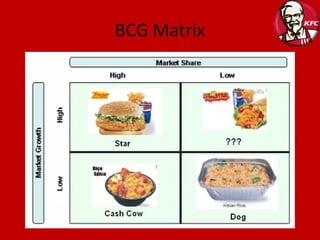
BCG Matrix
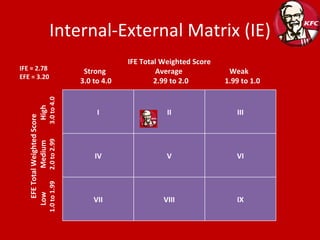
Internal-External Matrix (IE) I II III IV V VI VII VIII IX IFE Total Weighted Score Strong   Average   Weak 3.0 to 4.0  2.99 to 2.0  1.99 to 1.0 EFE Total Weighted Score Low  Medium  High 1.0 to 1.99  2.0 to 2.99  3.0 to 4.0  IFE = 2.78 EFE = 3.20
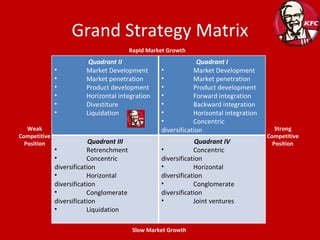
Grand Strategy Matrix Weak Competitive Position Strong Competitive Position Rapid Market Growth  Slow Market Growth  Quadrant II Market Development Market penetration Product development Horizontal integration Divestiture Liquidation Quadrant I Market Development Market penetration Product development Forward integration Backward integration Horizontal integration Concentric  diversification Quadrant III Retrenchment Concentric  diversification Horizontal  diversification Conglomerate  diversification Liquidation Quadrant IV Concentric  diversification Horizontal  diversification Conglomerate  diversification Joint ventures
THANK YOU

KFC Matrixes Analysis

  • 1.
    Managerial Policy Kentucky Fried Chicken Presented by: Muhammad Farhan Akhtar
  • 2.
    The Evolution ofKFC 1939 – Colonel Sanders develops his original recipe chicken 1952 – Kentucky Fried Chicken is Formed 1952 – 1997 KFC grows into national Restaurant Chain – Many owners and stake holders along the way. 1986 – PepsiCo’s acquisition of KFC 1997 – Tricon Global Restaurants Inc is formed as a spin-off from PepsiCo 2002 – Tricon changes its corporate name to YUM! Brands 2007 – KFC introduces its Zero grams Trans Fat recipe
  • 3.
  • 4.
    Vision / MissionStatement Vision To sell food in a fast, friendly environment that appeals to pride conscious, health minded customers Mission Our passion, as a restaurant company, is to put a YUM on people’s faces around the world, SATISFYING CUSTOMERS every time they eat our food and DOING IT BETTER than any other restaurant company. The UNIQUE EATING EXPERIENCE at each of our restaurants MAKE OUR CUSTOMER SMILE and inspire their loyalty for lift. Toward that end, our associates around the world are trained to be CUSTOMER MANIACS .
  • 5.
    Goals Buildan organization dedicated to excellence. Consistently deliver superior quality, and value in our products and services. Maintain a commitment to innovation for continuous improvement and growth, striving always to be the leader the market place changes. Generate consistently superior financial returns and benefit our owners and employees.
  • 6.
    Products ChickenMania Hot Shots Hot wings Family Feast Zinger Mighty Zinger Rice n Spice Wings n Rice Wow Meal Nuggets Twister Xtreme Zinger
  • 7.
    SWOT Analysis STRENGTHSS1. Good Taste S2. Brand Equity S3. Global Experience S4. Operations S5. Trademark Recipes S6. Strong Customer Focus WEAKNESSES W1. High price W2. Image of ‘Fried’ W3. Only chicken related recipe W4. Most of the product having close substitution in market W5. Inconsistent Quality of service in many outlets. W6. Lack of control in Joint- venture arrangements. OPPORTUNITIES O1. Increase outlets O2. Undeveloped market abroad O3. Increase trends to take meal out of home O4. Earn big profits as the population grows O5. Availability to increase the number of franchise to other countries. SO – Strategy Introduced new recipes (S1,S2,O3) Increase numbers of outlets in different countries (S3,O5) Capture customer by introducing new deals (S6,O4) WO – Strategy Introduce cheaper items in the menu (W1,O3) Change the image of KFC from fried to Healthy (W2,O3) Offer cow meat and vegetable food also (W4,O4) THREATS T1. New entrants / better quality brands T2. Health conscious eating habits T3. Animal care activists T4. No support from government agencies T5. Intensive Competition ST – Strategy Introduce healthier recipes (S5,T2) Differentiate as one providing in fastest service (S2,S4,T1) Engage in CSR activities (S2,S4,T3) WT– Strategy Work on the image of a healthy fast food chain through advertising (W2,T2) Develop a strong culture of strong service (W5,T5)
  • 8.
    Recommendations Short TermIntroduce new recipes suited to local taste Introduce cheaper items in the menu Introduce healthier recipes Differentiate through good services Work on the image of a healthy fast food chain through advertising Long Term Change the image of KFC from fried to ‘healthy’ Open up new outlets Engage in CSR activities related to animals & environment Develop a strong culture of good service
  • 9.
  • 10.
  • 11.
  • 12.
  • 13.
  • 14.
  • 15.
    Internal-External Matrix (IE)I II III IV V VI VII VIII IX IFE Total Weighted Score Strong Average Weak 3.0 to 4.0 2.99 to 2.0 1.99 to 1.0 EFE Total Weighted Score Low Medium High 1.0 to 1.99 2.0 to 2.99 3.0 to 4.0 IFE = 2.78 EFE = 3.20
  • 16.
    Grand Strategy MatrixWeak Competitive Position Strong Competitive Position Rapid Market Growth Slow Market Growth Quadrant II Market Development Market penetration Product development Horizontal integration Divestiture Liquidation Quadrant I Market Development Market penetration Product development Forward integration Backward integration Horizontal integration Concentric diversification Quadrant III Retrenchment Concentric diversification Horizontal diversification Conglomerate diversification Liquidation Quadrant IV Concentric diversification Horizontal diversification Conglomerate diversification Joint ventures
  • 17.