Amal R Unnithan
Balam Lova Raju
Hari Prasad K P
Swetha Suresh Babu
Vijish Madhavan
Vishnu CK
CHAPTER 6
STRENGTHENING
A COMPANY’S
COMPETITIVE
POSITION
Presented by
Group No 1
CHAPTER ROADMAP
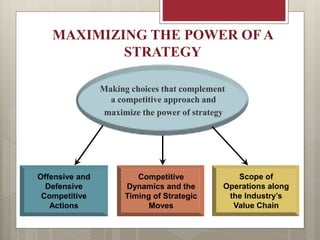
MAXIMIZING THE POWER OF A
STRATEGY
Making choices that complement
a competitive approach and
maximize the power of strategy
Offensive and
Defensive
Competitive
Actions
Competitive
Dynamics and the
Timing of Strategic
Moves
Scope of
Operations along
the Industry’s
Value Chain
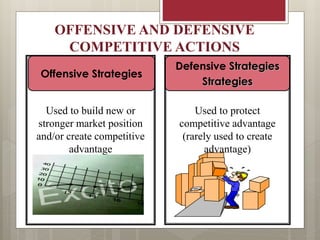
OFFENSIVE AND DEFENSIVE
COMPETITIVE ACTIONS
Used to build new or
stronger market position
and/or create competitive
advantage
Used to protect
competitive advantage
(rarely used to create
advantage)
Offensive Strategies
Defensive Strategies
Strategies
GOING ON THE OFFENSIVE STRATEGIC
OPTIONS TO IMPROVE A FIRM’S
MARKET POSITION
 Strategic Offensive Principles:
 Relentlessly build competitive advantage and
then convert it into sustainable advantage.
 Create and deploy resources in ways that cause
rivals to struggle to defend themselves.
 Employ the element of surprise as opposed to
doing what rivals expect and are prepared for.
 Display a strong bias for swift, decisive, and
overwhelming actions to overpower rivals
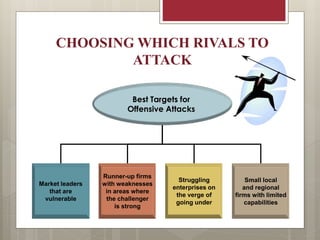
CHOOSING WHICH RIVALS TO
ATTACK
Market leaders
that are
vulnerable
Runner-up firms
with weaknesses
in areas where
the challenger
is strong
Struggling
enterprises on
the verge of
going under
Small local
and regional
firms with limited
capabilities
Best Targets for
Offensive Attacks
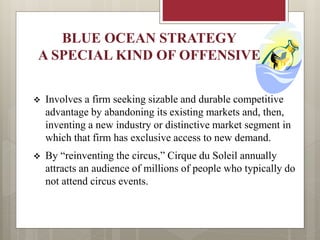
BLUE OCEAN STRATEGY
A SPECIAL KIND OF OFFENSIVE
 Involves a firm seeking sizable and durable competitive
advantage by abandoning its existing markets and, then,
inventing a new industry or distinctive market segment in
which that firm has exclusive access to new demand.
 By “reinventing the circus,” Cirque du Soleil annually
attracts an audience of millions of people who typically do
not attend circus events.
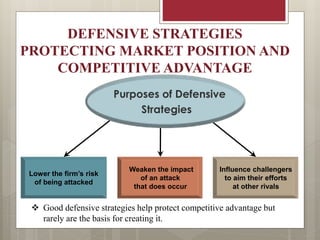
DEFENSIVE STRATEGIES
PROTECTING MARKET POSITION AND
COMPETITIVE ADVANTAGE
Purposes of Defensive
Strategies
Lower the firm’s risk
of being attacked
Weaken the impact
of an attack
that does occur
Influence challengers
to aim their efforts
at other rivals
 Good defensive strategies help protect competitive advantage but
rarely are the basis for creating it.
SIGNALING CHALLENGERS THAT
RETALIATION IS LIKELY
 Publicly announce management’s strong
commitment to maintain the firm’s present
market share
 Publicly commit firm to policy of
matching rivals’ terms or prices
 Maintain war chest of cash reserves
 Make occasional counter response
to moves of weaker rivals
TIMING A FIRM’S OFFENSIVE
AND DEFENSIVE STRATEGIC
MOVES
 Timing’s Importance:
 Knowing when to make a strategic move is as
crucial as knowing what move to make.
 Moving first is no guarantee of success or
competitive advantage.
 The risks of moving first to stake out a
monopoly position must be carefully
weighted.
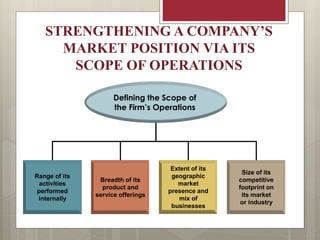
STRENGTHENING A COMPANY’S
MARKET POSITION VIA ITS
SCOPE OF OPERATIONS
Range of its
activities
performed
internally
Breadth of its
product and
service offerings
Extent of its
geographic
market
presence and
mix of
businesses
Size of its
competitive
footprint on
its market
or industry
Defining the Scope of
the Firm’s Operations
HORIZONTAL MERGER AND
ACQUISITION STRATEGIES
 Merger
 Is the combining of two or more firms into a
single corporate entity that often takes on a
new name.
 Acquisition
 Is a combination in which one firm, the
acquirer, purchases and absorbs the operations
of another firm, the acquired.
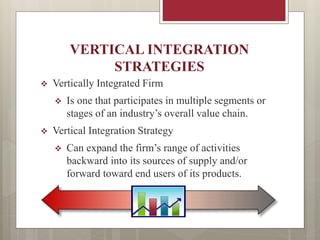
VERTICAL INTEGRATION
STRATEGIES
 Vertically Integrated Firm
 Is one that participates in multiple segments or
stages of an industry’s overall value chain.
 Vertical Integration Strategy
 Can expand the firm’s range of activities
backward into its sources of supply and/or
forward toward end users of its products.
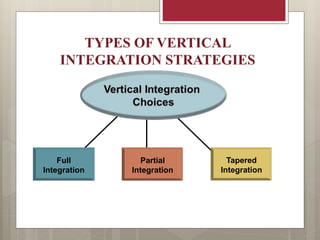
TYPES OF VERTICAL
INTEGRATION STRATEGIES
Full
Integration
Partial
Integration
Tapered
Integration
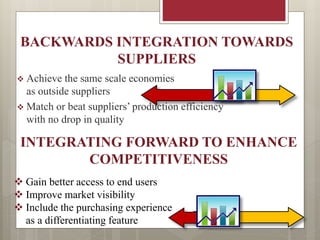
BACKWARDS INTEGRATION TOWARDS
SUPPLIERS
 Achieve the same scale economies
as outside suppliers
 Match or beat suppliers’ production efficiency
with no drop in quality
INTEGRATING FORWARD TO ENHANCE
COMPETITIVENESS
 Gain better access to end users
 Improve market visibility
 Include the purchasing experience
as a differentiating feature
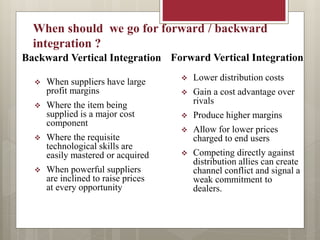
Backward Vertical Integration
 When suppliers have large
profit margins
 Where the item being
supplied is a major cost
component
 Where the requisite
technological skills are
easily mastered or acquired
 When powerful suppliers
are inclined to raise prices
at every opportunity
 Lower distribution costs
 Gain a cost advantage over
rivals
 Produce higher margins
 Allow for lower prices
charged to end users
 Competing directly against
distribution allies can create
channel conflict and signal a
weak commitment to
dealers.
Forward Vertical Integration
When should we go for forward / backward
integration ?
DISADVANTAGES OF A VERTICAL
INTEGRATION STRATEGY
 Boosts capital investment in the industry
 Increases business risk if industry growth and
profits sour
 May slow technological advances if the vertically
integrated company is saddled with older
technology
 Poses all types of capacity-matching problems
 May require radically different skills and
business capabilities
Outsourcing an activity is a
consideration when:
 It can be done cheaply by
outside specialists.
 It is not crucial to achieve a
sustainable competitive
advantage
 Improves organizational
flexibility and speeds time to
market.
 It reduces a firm’s risk exposure
to changing technology and/or
buyer preferences.
 It allows a firm to concentrate
on its core business.
The Big Risk of Outsourcing:
 Farming out the wrong types of
activities
 Hollowing out strategically
important capabilities
ultimately damages a firm’s
competitiveness and long-term
success in the marketplace
OUTSOURCING
STRATEGIC ALLIANCES AND
PARTNERSHIPS
 Strategic Alliance
 Is a formal agreement between two or more
separate firms in which they agree to work
cooperatively toward common objectives.
 Joint Venture
 Is a type of strategic alliance in which the
partners set up an independent corporate
entity that they own and control jointly,
sharing in its revenues and expenses.
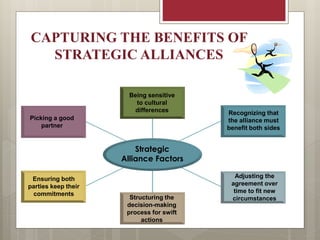
CAPTURING THE BENEFITS OF
STRATEGIC ALLIANCES
Picking a good
partner
Being sensitive
to cultural
differences Recognizing that
the alliance must
benefit both sides
Adjusting the
agreement over
time to fit new
circumstancesStructuring the
decision-making
process for swift
actions
Ensuring both
parties keep their
commitments
Strategic
Alliance Factors
THE DRAWBACKS OF STRATEGIC
ALLIANCES AND PARTNERSHIPS
 Culture clash and integration problems due to different
management styles and business practices.
 Anticipated gains do not materialize due to an overly
optimistic view of the synergies or a poor fit of partners’
resources and capabilities.
 Risk of becoming dependent on partner firms for
essential expertise and capabilities.
 Protection of proprietary technologies, knowledge bases,
or trade secrets from partners who are rivals.
PRINCIPLE ADVANTAGES OF
STRATEGIC ALLIANCES
 They lower investment costs and risks for each
partner by facilitating resource pooling and risk
sharing.
 They are more flexible organizational forms and
allow for a more adaptive response to changing
conditions.
 They are more rapidly deployed—a critical factor
when speed is of the essence.
THANK YOU

Strategic Managemnt Chapter 6

  • 1.
    Amal R Unnithan BalamLova Raju Hari Prasad K P Swetha Suresh Babu Vijish Madhavan Vishnu CK CHAPTER 6 STRENGTHENING A COMPANY’S COMPETITIVE POSITION Presented by Group No 1
  • 2.
  • 3.
    MAXIMIZING THE POWEROF A STRATEGY Making choices that complement a competitive approach and maximize the power of strategy Offensive and Defensive Competitive Actions Competitive Dynamics and the Timing of Strategic Moves Scope of Operations along the Industry’s Value Chain
  • 4.
    OFFENSIVE AND DEFENSIVE COMPETITIVEACTIONS Used to build new or stronger market position and/or create competitive advantage Used to protect competitive advantage (rarely used to create advantage) Offensive Strategies Defensive Strategies Strategies
  • 5.
    GOING ON THEOFFENSIVE STRATEGIC OPTIONS TO IMPROVE A FIRM’S MARKET POSITION  Strategic Offensive Principles:  Relentlessly build competitive advantage and then convert it into sustainable advantage.  Create and deploy resources in ways that cause rivals to struggle to defend themselves.  Employ the element of surprise as opposed to doing what rivals expect and are prepared for.  Display a strong bias for swift, decisive, and overwhelming actions to overpower rivals
  • 6.
    CHOOSING WHICH RIVALSTO ATTACK Market leaders that are vulnerable Runner-up firms with weaknesses in areas where the challenger is strong Struggling enterprises on the verge of going under Small local and regional firms with limited capabilities Best Targets for Offensive Attacks
  • 7.
    BLUE OCEAN STRATEGY ASPECIAL KIND OF OFFENSIVE  Involves a firm seeking sizable and durable competitive advantage by abandoning its existing markets and, then, inventing a new industry or distinctive market segment in which that firm has exclusive access to new demand.  By “reinventing the circus,” Cirque du Soleil annually attracts an audience of millions of people who typically do not attend circus events.
  • 8.
    DEFENSIVE STRATEGIES PROTECTING MARKETPOSITION AND COMPETITIVE ADVANTAGE Purposes of Defensive Strategies Lower the firm’s risk of being attacked Weaken the impact of an attack that does occur Influence challengers to aim their efforts at other rivals  Good defensive strategies help protect competitive advantage but rarely are the basis for creating it.
  • 9.
    SIGNALING CHALLENGERS THAT RETALIATIONIS LIKELY  Publicly announce management’s strong commitment to maintain the firm’s present market share  Publicly commit firm to policy of matching rivals’ terms or prices  Maintain war chest of cash reserves  Make occasional counter response to moves of weaker rivals
  • 10.
    TIMING A FIRM’SOFFENSIVE AND DEFENSIVE STRATEGIC MOVES  Timing’s Importance:  Knowing when to make a strategic move is as crucial as knowing what move to make.  Moving first is no guarantee of success or competitive advantage.  The risks of moving first to stake out a monopoly position must be carefully weighted.
  • 11.
    STRENGTHENING A COMPANY’S MARKETPOSITION VIA ITS SCOPE OF OPERATIONS Range of its activities performed internally Breadth of its product and service offerings Extent of its geographic market presence and mix of businesses Size of its competitive footprint on its market or industry Defining the Scope of the Firm’s Operations
  • 12.
    HORIZONTAL MERGER AND ACQUISITIONSTRATEGIES  Merger  Is the combining of two or more firms into a single corporate entity that often takes on a new name.  Acquisition  Is a combination in which one firm, the acquirer, purchases and absorbs the operations of another firm, the acquired.
  • 13.
    VERTICAL INTEGRATION STRATEGIES  VerticallyIntegrated Firm  Is one that participates in multiple segments or stages of an industry’s overall value chain.  Vertical Integration Strategy  Can expand the firm’s range of activities backward into its sources of supply and/or forward toward end users of its products.
  • 14.
    TYPES OF VERTICAL INTEGRATIONSTRATEGIES Full Integration Partial Integration Tapered Integration
  • 15.
    BACKWARDS INTEGRATION TOWARDS SUPPLIERS Achieve the same scale economies as outside suppliers  Match or beat suppliers’ production efficiency with no drop in quality INTEGRATING FORWARD TO ENHANCE COMPETITIVENESS  Gain better access to end users  Improve market visibility  Include the purchasing experience as a differentiating feature
  • 16.
    Backward Vertical Integration When suppliers have large profit margins  Where the item being supplied is a major cost component  Where the requisite technological skills are easily mastered or acquired  When powerful suppliers are inclined to raise prices at every opportunity  Lower distribution costs  Gain a cost advantage over rivals  Produce higher margins  Allow for lower prices charged to end users  Competing directly against distribution allies can create channel conflict and signal a weak commitment to dealers. Forward Vertical Integration When should we go for forward / backward integration ?
  • 17.
    DISADVANTAGES OF AVERTICAL INTEGRATION STRATEGY  Boosts capital investment in the industry  Increases business risk if industry growth and profits sour  May slow technological advances if the vertically integrated company is saddled with older technology  Poses all types of capacity-matching problems  May require radically different skills and business capabilities
  • 18.
    Outsourcing an activityis a consideration when:  It can be done cheaply by outside specialists.  It is not crucial to achieve a sustainable competitive advantage  Improves organizational flexibility and speeds time to market.  It reduces a firm’s risk exposure to changing technology and/or buyer preferences.  It allows a firm to concentrate on its core business. The Big Risk of Outsourcing:  Farming out the wrong types of activities  Hollowing out strategically important capabilities ultimately damages a firm’s competitiveness and long-term success in the marketplace OUTSOURCING
  • 19.
    STRATEGIC ALLIANCES AND PARTNERSHIPS Strategic Alliance  Is a formal agreement between two or more separate firms in which they agree to work cooperatively toward common objectives.  Joint Venture  Is a type of strategic alliance in which the partners set up an independent corporate entity that they own and control jointly, sharing in its revenues and expenses.
  • 20.
    CAPTURING THE BENEFITSOF STRATEGIC ALLIANCES Picking a good partner Being sensitive to cultural differences Recognizing that the alliance must benefit both sides Adjusting the agreement over time to fit new circumstancesStructuring the decision-making process for swift actions Ensuring both parties keep their commitments Strategic Alliance Factors
  • 21.
    THE DRAWBACKS OFSTRATEGIC ALLIANCES AND PARTNERSHIPS  Culture clash and integration problems due to different management styles and business practices.  Anticipated gains do not materialize due to an overly optimistic view of the synergies or a poor fit of partners’ resources and capabilities.  Risk of becoming dependent on partner firms for essential expertise and capabilities.  Protection of proprietary technologies, knowledge bases, or trade secrets from partners who are rivals.
  • 22.
    PRINCIPLE ADVANTAGES OF STRATEGICALLIANCES  They lower investment costs and risks for each partner by facilitating resource pooling and risk sharing.  They are more flexible organizational forms and allow for a more adaptive response to changing conditions.  They are more rapidly deployed—a critical factor when speed is of the essence.
  • 23.