1
Definitions
• Competitors
– firms operating in the same market,
offering similar products and targeting
similar customers
• Competitive rivalry
– the ongoing set of competitive actions and
responses occurring between competitors
– rivalry affects a firm’s ability to gain and
sustain competitive advantages
2
Definitions
• Competitive behavior
– the actions and responses the firm takes to build
or defend its competitive advantages and to
increase market power
• Competitive dynamics
– the total of actions and responses taken by all
firms competing within a market
3
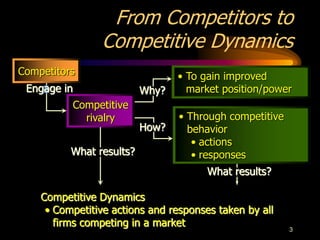
From Competitors to
Competitive Dynamics
Competitors
• Through competitive
behavior
• actions
• responses
• To gain improved
market position/power
Competitive Dynamics
• Competitive actions and responses taken by all
firms competing in a market
Competitive
rivalry
Engage in
What results?
What results?
Why?
How?
4
Effect of Competitive Rivalry
on a Firm’s Strategies
• Success of a competitive move is determined by:
– the firm’s initial competitive actions
– how well the firm anticipates competitors’ responses
– how well the firm responds to its competitors’ initial
actions
• Competitive rivalry
– affects all types of strategies
– most dominant influence is on the firm’s business-level
strategy or strategies.
– Is primarily concerned with capabilities/resources
5
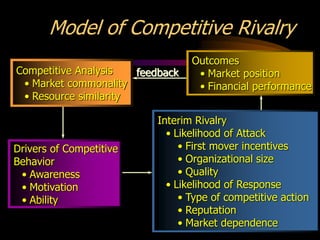
Model of Competitive Rivalry
Competitive Analysis
• Market commonality
• Resource similarity
Drivers of Competitive
Behavior
• Awareness
• Motivation
• Ability
Interim Rivalry
• Likelihood of Attack
• First mover incentives
• Organizational size
• Quality
• Likelihood of Response
• Type of competitive action
• Reputation
• Market dependence
Outcomes
• Market position
• Financial performance
feedback
6
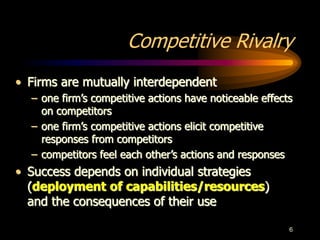
Competitive Rivalry
• Firms are mutually interdependent
– one firm’s competitive actions have noticeable effects
on competitors
– one firm’s competitive actions elicit competitive
responses from competitors
– competitors feel each other’s actions and responses
• Success depends on individual strategies
(deployment of capabilities/resources)
and the consequences of their use
7
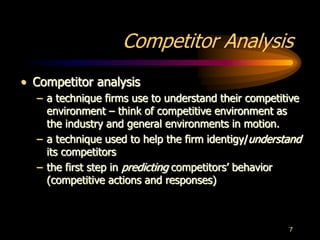
Competitor Analysis
• Competitor analysis
– a technique firms use to understand their competitive
environment – think of competitive environment as
the industry and general environments in motion.
– a technique used to help the firm identigy/understand
its competitors
– the first step in predicting competitors’ behavior
(competitive actions and responses)
8
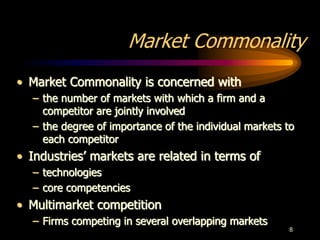
Market Commonality
• Market Commonality is concerned with
– the number of markets with which a firm and a
competitor are jointly involved
– the degree of importance of the individual markets to
each competitor
• Industries’ markets are related in terms of
– technologies
– core competencies
• Multimarket competition
– Firms competing in several overlapping markets
9
Resource Similarity
• Resource similarity
– How comparable are the resources deployed by a firm
and the resources deployed by that firm’s competitors (in
both type and amount)?
• Firms with similar types/amounts of resources are
likely to:
– have similar strengths and weaknesses
– use similar strategies (deploy resources in the same way)
• Assessing resource similarity can be difficult if
critical resources are intangible rather than tangible
10
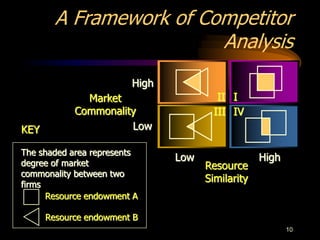
A Framework of Competitor
Analysis
Market
Commonality
High
Low
Low High
Resource
Similarity
The shaded area represents
degree of market
commonality between two
firms
Resource endowment B
Resource endowment A
KEY
I
II
III IV
11
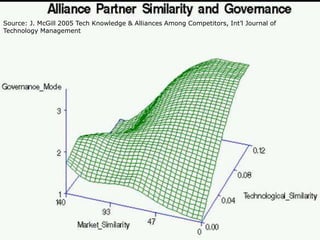
Source: J. McGill 2005 Tech Knowledge & Alliances Among Competitors, Int’l Journal of
Technology Management
12
Drivers of Competitive Behavior
• Awareness is the extent to which
competitors recognize the degree of
their mutual interdependence
– mutual interdependence results from
• market commonality
• resource similarity
• current & future!
Awareness
13
Motivation
Drivers of Competitive Behavior
• Motivation concerns the firm’s incentive
– to take action
– or to respond to a competitor’s
attack
– and relates to perceived gains and
losses
Awareness
14
Ability
Drivers of Competitive Behavior
• Ability relates
– to each firm’s resources
– the flexibility these resources provide
• Without available resources the firm
lacks the ability
– to attack a competitor
– to respond to the competitor’s
actions
Awareness
Motivation
15
Drivers of Competitive Behavior
• A firm is more likely to attack the
rival with whom it has low market
commonality than the one with
whom it competes in multiple
markets
• Because of the potential loss of
market power under market
commonality, there is a high
probability that the attacked firm
will respond to its competitor’s
action to protect its position
Market
commonality
16
Resource
similarity
Drivers of Competitive Behavior
• The greater the resource imbalance
between the acting firm and
competitors, the greater the delay in
response by the firm with a resource
disadvantage
• So, when facing competitors with
greater resources or more attractive
market positions, firms should
eventually respond, no matter how
challenging the response
Market
commonality
17
Strategic and Tactical Actions
• Strategic action or a strategic response
– a market-based move that involves a significant
commitment of organizational resources and is
difficult to implement and reverse
• Tactical action or a tactical response
– market-based move that is taken to fine-tune a
strategy; it involves fewer resources and is
relatively easy to implement and reverse
18
Likelihood of Attack:
• First movers’ resources
– product innovation and development
– aggressive advertising
– R&D
• First movers can gain
– customer loyalty
– Network effects market share that
can be difficult for competitors to take
during future competitive rivalry
First mover
incentives
19
Size
Likelihood of Attack:
• Small firms are more likely
– to launch competitive actions
– to be quicker in doing so
• Small firms -
– nimble and flexible
– use speed and surprise to defend
their competitive advantages or
develop new ones
– Potentially launch a greater variety of
competitive actions
First mover
incentives
20
Likelihood of Attack:
• Large firms are likely to initiate
more strategic & tactical actions
• Large firms often have slack
resources required to launch a
larger number of total competitive
actions
First mover
incentives
Size
“Think and act big and we’ll get smaller. Think and
act small and we’ll get bigger.”
- Herb Kelleher,
Former CEO, Southwest Airlines
21
Likelihood of Response
• Firms study three factors to predict how a
competitor is likely to respond to competitive
actions
– type of competitive action
– reputation
– market dependence
22
Likelihood of Response:
• Strategic actions receive strategic
responses
• Tactical responses are taken to counter
the effects of tactical actions
• Strategic actions elicit fewer total
competitive responses
• A competitor likely will respond quickly
to a tactical action
• The time needed to implement and
assess a strategic action delays
competitors’ responses
Type of
competitive
action
23
Reputation
Likelihood of Response:
• An actor is the firm taking an action or
response
• Reputation is the positive or negative
attribute ascribed by one rival to another
based on past competitive behavior
• The firm studies responses that a
competitor has taken previously when
attacked to predict likely responses
Type of
competitive
action
24
Market
dependence
Likelihood of Response:
• Market dependence is
– the extent to which a firm’s revenues
or profits are derived from a
particular market
• Firms can assume that competitors with
high market dependence are likely to
respond strongly to attacks threatening
their market position
Type of
competitive
action
Reputation
25
Competitive Dynamics:
• Slow-cycle markets
– the firm’s competitive advantages are
shielded from imitation for long
periods of time
– imitation is costly
• Competitive advantages are sustainable
in slow-cycle markets
• A proprietary, one-of-a-kind competitive
advantage leads to competitive success
in a slow-cycle market
Slow-cycle
markets
26
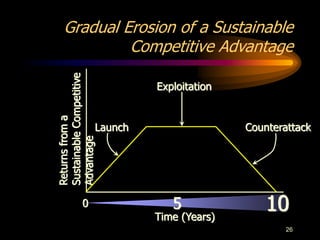
Gradual Erosion of a Sustainable
Competitive Advantage
Returns
from
a
Sustainable
Competitive
Advantage
Time (Years)
0 5 10
Launch
Exploitation
Counterattack
27
Fast-cycle
markets
Competitive Dynamics:
• Fast-cycle markets
– the firm’s competitive advantages
aren’t shielded from imitation
– imitation happens quickly and
somewhat inexpensively
• Competitive advantages aren’t
sustainable
• Competitors use reverse engineering to
quickly imitate or improve on the firm’s
products
• Non-proprietary technology is diffused
rapidly
Slow-cycle
markets
28
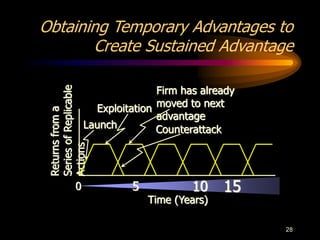
Obtaining Temporary Advantages to
Create Sustained Advantage
Returns
from
a
Series
of
Replicable
Actions
Time (Years)
0 5 10 15
Launch
Exploitation
Counterattack
Firm has already
moved to next
advantage
29
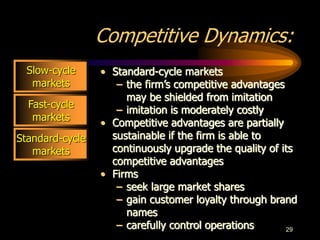
Competitive Dynamics:
• Standard-cycle markets
– the firm’s competitive advantages
may be shielded from imitation
– imitation is moderately costly
• Competitive advantages are partially
sustainable if the firm is able to
continuously upgrade the quality of its
competitive advantages
• Firms
– seek large market shares
– gain customer loyalty through brand
names
– carefully control operations
Slow-cycle
markets
Fast-cycle
markets
Standard-cycle
markets

strategic mngmnt

  • 1.
    1 Definitions • Competitors – firmsoperating in the same market, offering similar products and targeting similar customers • Competitive rivalry – the ongoing set of competitive actions and responses occurring between competitors – rivalry affects a firm’s ability to gain and sustain competitive advantages
  • 2.
    2 Definitions • Competitive behavior –the actions and responses the firm takes to build or defend its competitive advantages and to increase market power • Competitive dynamics – the total of actions and responses taken by all firms competing within a market
  • 3.
    3 From Competitors to CompetitiveDynamics Competitors • Through competitive behavior • actions • responses • To gain improved market position/power Competitive Dynamics • Competitive actions and responses taken by all firms competing in a market Competitive rivalry Engage in What results? What results? Why? How?
  • 4.
    4 Effect of CompetitiveRivalry on a Firm’s Strategies • Success of a competitive move is determined by: – the firm’s initial competitive actions – how well the firm anticipates competitors’ responses – how well the firm responds to its competitors’ initial actions • Competitive rivalry – affects all types of strategies – most dominant influence is on the firm’s business-level strategy or strategies. – Is primarily concerned with capabilities/resources
  • 5.
    5 Model of CompetitiveRivalry Competitive Analysis • Market commonality • Resource similarity Drivers of Competitive Behavior • Awareness • Motivation • Ability Interim Rivalry • Likelihood of Attack • First mover incentives • Organizational size • Quality • Likelihood of Response • Type of competitive action • Reputation • Market dependence Outcomes • Market position • Financial performance feedback
  • 6.
    6 Competitive Rivalry • Firmsare mutually interdependent – one firm’s competitive actions have noticeable effects on competitors – one firm’s competitive actions elicit competitive responses from competitors – competitors feel each other’s actions and responses • Success depends on individual strategies (deployment of capabilities/resources) and the consequences of their use
  • 7.
    7 Competitor Analysis • Competitoranalysis – a technique firms use to understand their competitive environment – think of competitive environment as the industry and general environments in motion. – a technique used to help the firm identigy/understand its competitors – the first step in predicting competitors’ behavior (competitive actions and responses)
  • 8.
    8 Market Commonality • MarketCommonality is concerned with – the number of markets with which a firm and a competitor are jointly involved – the degree of importance of the individual markets to each competitor • Industries’ markets are related in terms of – technologies – core competencies • Multimarket competition – Firms competing in several overlapping markets
  • 9.
    9 Resource Similarity • Resourcesimilarity – How comparable are the resources deployed by a firm and the resources deployed by that firm’s competitors (in both type and amount)? • Firms with similar types/amounts of resources are likely to: – have similar strengths and weaknesses – use similar strategies (deploy resources in the same way) • Assessing resource similarity can be difficult if critical resources are intangible rather than tangible
  • 10.
    10 A Framework ofCompetitor Analysis Market Commonality High Low Low High Resource Similarity The shaded area represents degree of market commonality between two firms Resource endowment B Resource endowment A KEY I II III IV
  • 11.
    11 Source: J. McGill2005 Tech Knowledge & Alliances Among Competitors, Int’l Journal of Technology Management
  • 12.
    12 Drivers of CompetitiveBehavior • Awareness is the extent to which competitors recognize the degree of their mutual interdependence – mutual interdependence results from • market commonality • resource similarity • current & future! Awareness
  • 13.
    13 Motivation Drivers of CompetitiveBehavior • Motivation concerns the firm’s incentive – to take action – or to respond to a competitor’s attack – and relates to perceived gains and losses Awareness
  • 14.
    14 Ability Drivers of CompetitiveBehavior • Ability relates – to each firm’s resources – the flexibility these resources provide • Without available resources the firm lacks the ability – to attack a competitor – to respond to the competitor’s actions Awareness Motivation
  • 15.
    15 Drivers of CompetitiveBehavior • A firm is more likely to attack the rival with whom it has low market commonality than the one with whom it competes in multiple markets • Because of the potential loss of market power under market commonality, there is a high probability that the attacked firm will respond to its competitor’s action to protect its position Market commonality
  • 16.
    16 Resource similarity Drivers of CompetitiveBehavior • The greater the resource imbalance between the acting firm and competitors, the greater the delay in response by the firm with a resource disadvantage • So, when facing competitors with greater resources or more attractive market positions, firms should eventually respond, no matter how challenging the response Market commonality
  • 17.
    17 Strategic and TacticalActions • Strategic action or a strategic response – a market-based move that involves a significant commitment of organizational resources and is difficult to implement and reverse • Tactical action or a tactical response – market-based move that is taken to fine-tune a strategy; it involves fewer resources and is relatively easy to implement and reverse
  • 18.
    18 Likelihood of Attack: •First movers’ resources – product innovation and development – aggressive advertising – R&D • First movers can gain – customer loyalty – Network effects market share that can be difficult for competitors to take during future competitive rivalry First mover incentives
  • 19.
    19 Size Likelihood of Attack: •Small firms are more likely – to launch competitive actions – to be quicker in doing so • Small firms - – nimble and flexible – use speed and surprise to defend their competitive advantages or develop new ones – Potentially launch a greater variety of competitive actions First mover incentives
  • 20.
    20 Likelihood of Attack: •Large firms are likely to initiate more strategic & tactical actions • Large firms often have slack resources required to launch a larger number of total competitive actions First mover incentives Size “Think and act big and we’ll get smaller. Think and act small and we’ll get bigger.” - Herb Kelleher, Former CEO, Southwest Airlines
  • 21.
    21 Likelihood of Response •Firms study three factors to predict how a competitor is likely to respond to competitive actions – type of competitive action – reputation – market dependence
  • 22.
    22 Likelihood of Response: •Strategic actions receive strategic responses • Tactical responses are taken to counter the effects of tactical actions • Strategic actions elicit fewer total competitive responses • A competitor likely will respond quickly to a tactical action • The time needed to implement and assess a strategic action delays competitors’ responses Type of competitive action
  • 23.
    23 Reputation Likelihood of Response: •An actor is the firm taking an action or response • Reputation is the positive or negative attribute ascribed by one rival to another based on past competitive behavior • The firm studies responses that a competitor has taken previously when attacked to predict likely responses Type of competitive action
  • 24.
    24 Market dependence Likelihood of Response: •Market dependence is – the extent to which a firm’s revenues or profits are derived from a particular market • Firms can assume that competitors with high market dependence are likely to respond strongly to attacks threatening their market position Type of competitive action Reputation
  • 25.
    25 Competitive Dynamics: • Slow-cyclemarkets – the firm’s competitive advantages are shielded from imitation for long periods of time – imitation is costly • Competitive advantages are sustainable in slow-cycle markets • A proprietary, one-of-a-kind competitive advantage leads to competitive success in a slow-cycle market Slow-cycle markets
  • 26.
    26 Gradual Erosion ofa Sustainable Competitive Advantage Returns from a Sustainable Competitive Advantage Time (Years) 0 5 10 Launch Exploitation Counterattack
  • 27.
    27 Fast-cycle markets Competitive Dynamics: • Fast-cyclemarkets – the firm’s competitive advantages aren’t shielded from imitation – imitation happens quickly and somewhat inexpensively • Competitive advantages aren’t sustainable • Competitors use reverse engineering to quickly imitate or improve on the firm’s products • Non-proprietary technology is diffused rapidly Slow-cycle markets
  • 28.
    28 Obtaining Temporary Advantagesto Create Sustained Advantage Returns from a Series of Replicable Actions Time (Years) 0 5 10 15 Launch Exploitation Counterattack Firm has already moved to next advantage
  • 29.
    29 Competitive Dynamics: • Standard-cyclemarkets – the firm’s competitive advantages may be shielded from imitation – imitation is moderately costly • Competitive advantages are partially sustainable if the firm is able to continuously upgrade the quality of its competitive advantages • Firms – seek large market shares – gain customer loyalty through brand names – carefully control operations Slow-cycle markets Fast-cycle markets Standard-cycle markets