The Highway of Change


 A Framework Approach
      to Change ©
       developed by

       Ron Leeman
     “Your Chauffeur”
on the Highway of Change
IT Implementations & Change                                          The Highway of Change


The implementation of any new IT solution/application can represent a major
change for an organisation and consequently will need to be well managed to
ensure that there is a smooth transition not only from the technical solution to
business ownership but also to a different way of working for the organisation.
The change effort needed is both resource hungry and complex and will require a
focus on getting the business ready to work with the proposed solution.
Over the last 15-years I have developed and implemented many bespoke
Business Change/Transformation approaches & strategies for organisations to
enable them to drive through efficiency programmes and achieve considerable
ROI/business benefit from their IT solution/application implementations.
These bespoke approaches have used as their basis my Framework Approach to
Change which is described in a bit more detail in the following slides. These slides
is not intended to describe a comprehensive nor prescriptive approach to
Business Change/Transformation, rather the intention is to give you a flavour of
some of the more necessary change components and associated tools &
techniques that will require consideration during the implementation.
Framework Approach to Change                                  The Highway of Change


Modular …
This means that the framework can be used in its totality or you can “pick
and chose” which modules you want to use dependant on the change
initiative
People Side of Change …
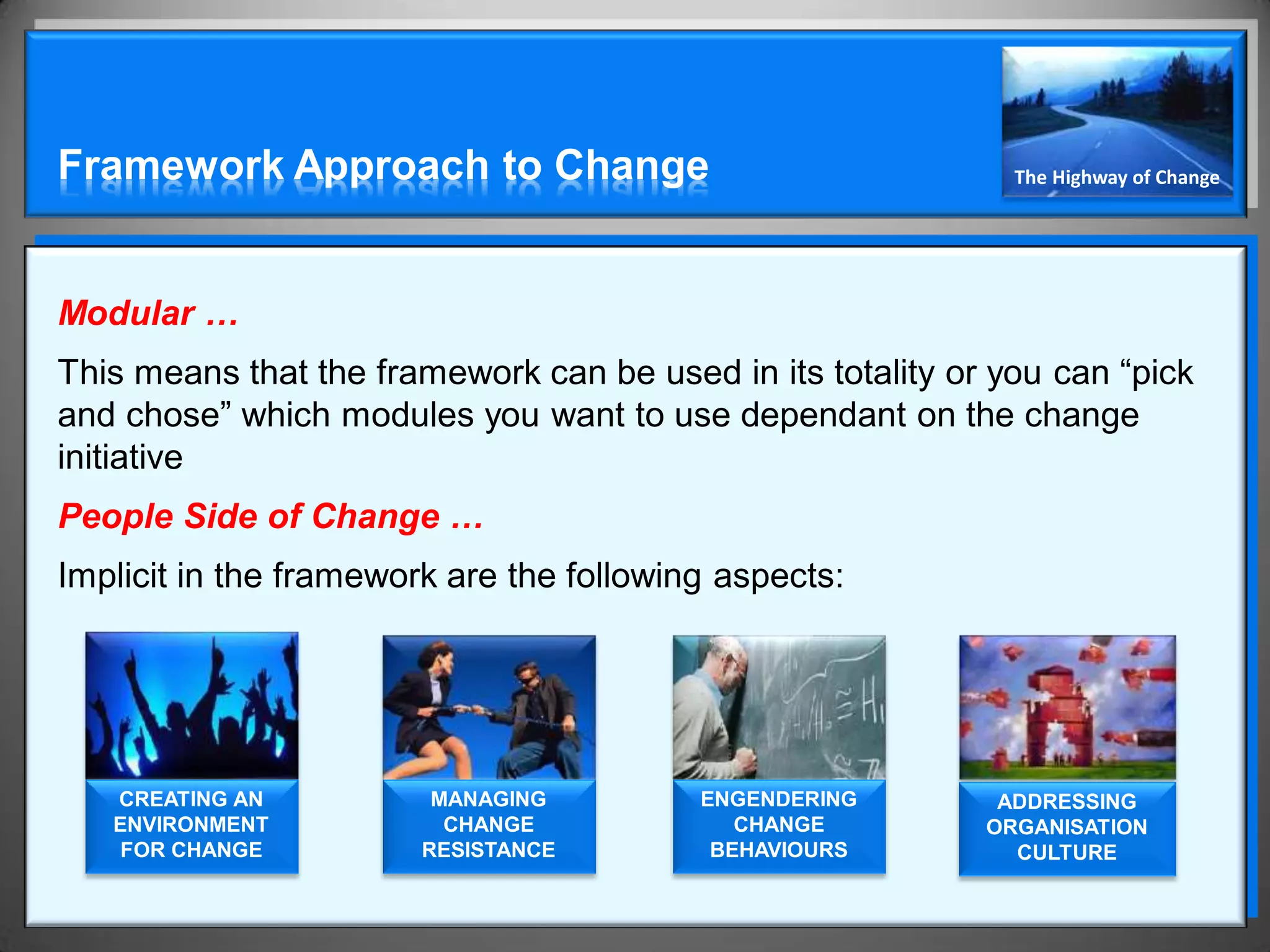
Implicit in the framework are the following aspects:


   CREATING AN           MANAGING         ENGENDERING        ADDRESSING
   ENVIRONMENT            CHANGE             CHANGE         ORGANISATION
    FOR CHANGE          RESISTANCE         BEHAVIOURS         CULTURE
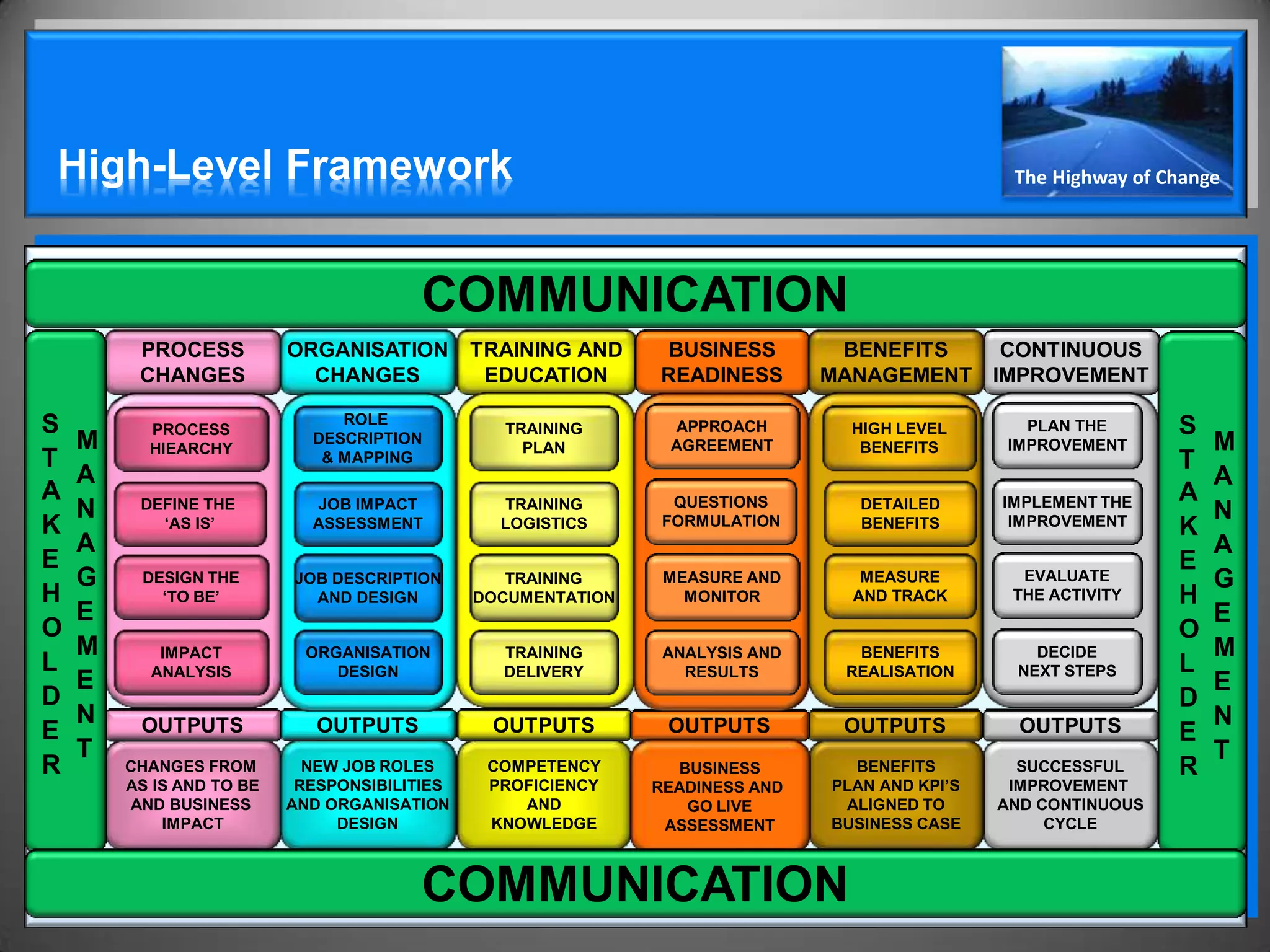
High-Level Framework                                                                            The Highway of Change


                                        COMMUNICATION
         PROCESS          ORGANISATION        TRAINING AND    BUSINESS         BENEFITS   CONTINUOUS
         CHANGES            CHANGES            EDUCATION      READINESS       MANAGEMENT IMPROVEMENT

S                              ROLE
          PROCESS                               TRAINING       APPROACH         HIGH LEVEL       PLAN THE       S
    M     HIEARCHY
                            DESCRIPTION
                                                  PLAN         AGREEMENT         BENEFITS      IMPROVEMENT          M
T                            & MAPPING                                                                          T
    A                                                                                                               A
A        DEFINE THE         JOB IMPACT          TRAINING        QUESTIONS        DETAILED      IMPLEMENT THE    A
    N      ‘AS IS’
                                                                                                                    N
K                           ASSESSMENT          LOGISTICS      FORMULATION       BENEFITS       IMPROVEMENT
                                                                                                                K
    A                                                                                                               A
E                                                                                                               E
    G    DESIGN THE       JOB DESCRIPTION        TRAINING      MEASURE AND       MEASURE         EVALUATE           G
H          ‘TO BE’          AND DESIGN        DOCUMENTATION      MONITOR        AND TRACK       THE ACTIVITY    H
    E                                                                                                               E
O                                                                                                               O
    M      IMPACT           ORGANISATION        TRAINING       ANALYSIS AND     BENEFITS          DECIDE            M
L         ANALYSIS             DESIGN           DELIVERY         RESULTS       REALISATION      NEXT STEPS      L
    E                                                                                                               E
D                                                                                                               D
    N    OUTPUTS             OUTPUTS           OUTPUTS         OUTPUTS         OUTPUTS           OUTPUTS            N
E                                                                                                               E
    T                                                                                                               T
R       CHANGES FROM        NEW JOB ROLES      COMPETENCY       BUSINESS        BENEFITS         SUCCESSFUL     R
        AS IS AND TO BE    RESPONSIBILITIES    PROFICIENCY    READINESS AND   PLAN AND KPI’S    IMPROVEMENT
        AND BUSINESS      AND ORGANISATION        AND            GO LIVE       ALIGNED TO      AND CONTINUOUS
            IMPACT             DESIGN          KNOWLEDGE       ASSESSMENT     BUSINESS CASE         CYCLE


                                        COMMUNICATION
Stakeholder Management & Communication                            The Highway of Change


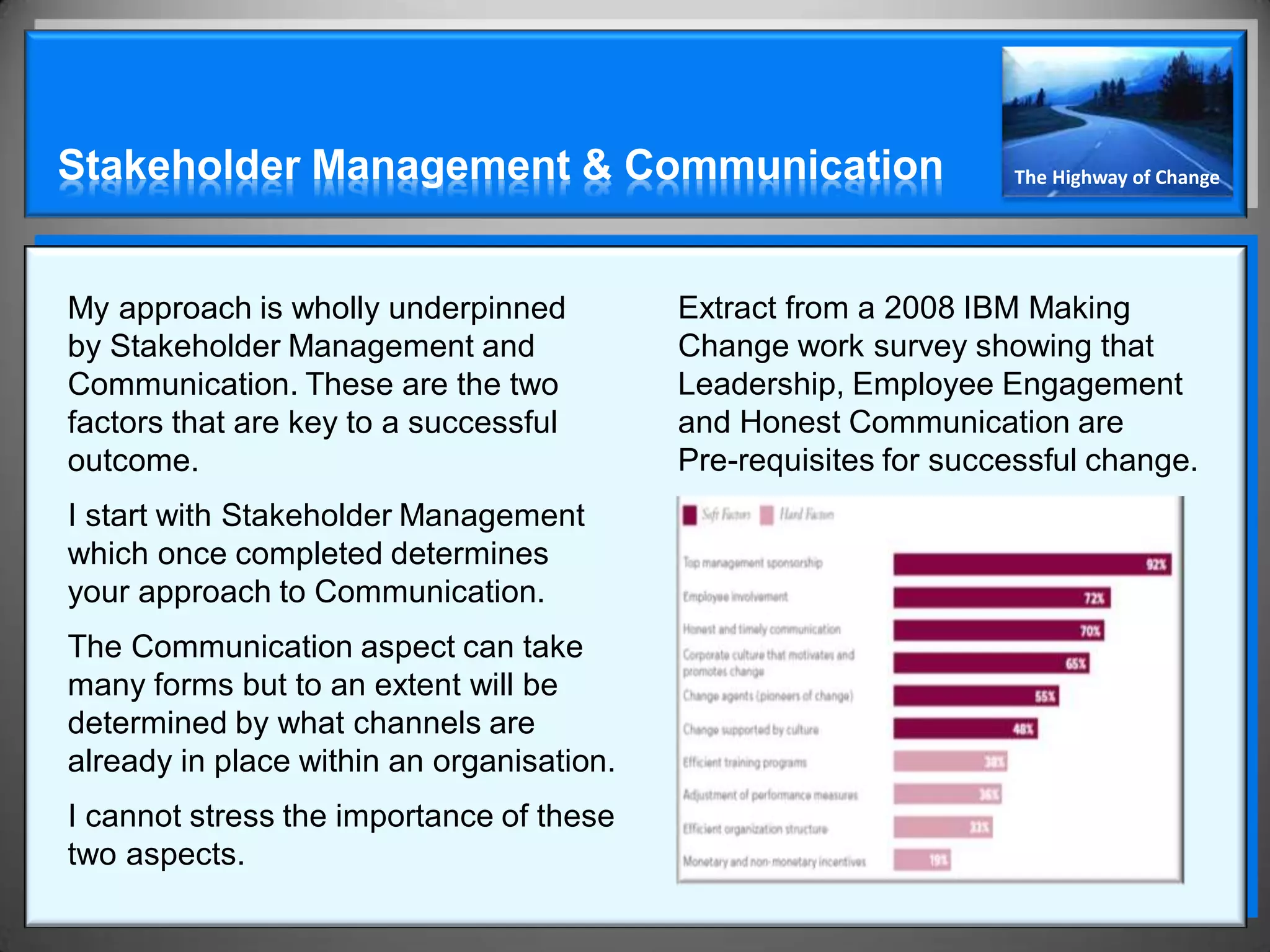
My approach is wholly underpinned          Extract from a 2008 IBM Making
by Stakeholder Management and              Change work survey showing that
Communication. These are the two           Leadership, Employee Engagement
factors that are key to a successful       and Honest Communication are
outcome.                                   Pre-requisites for successful change.
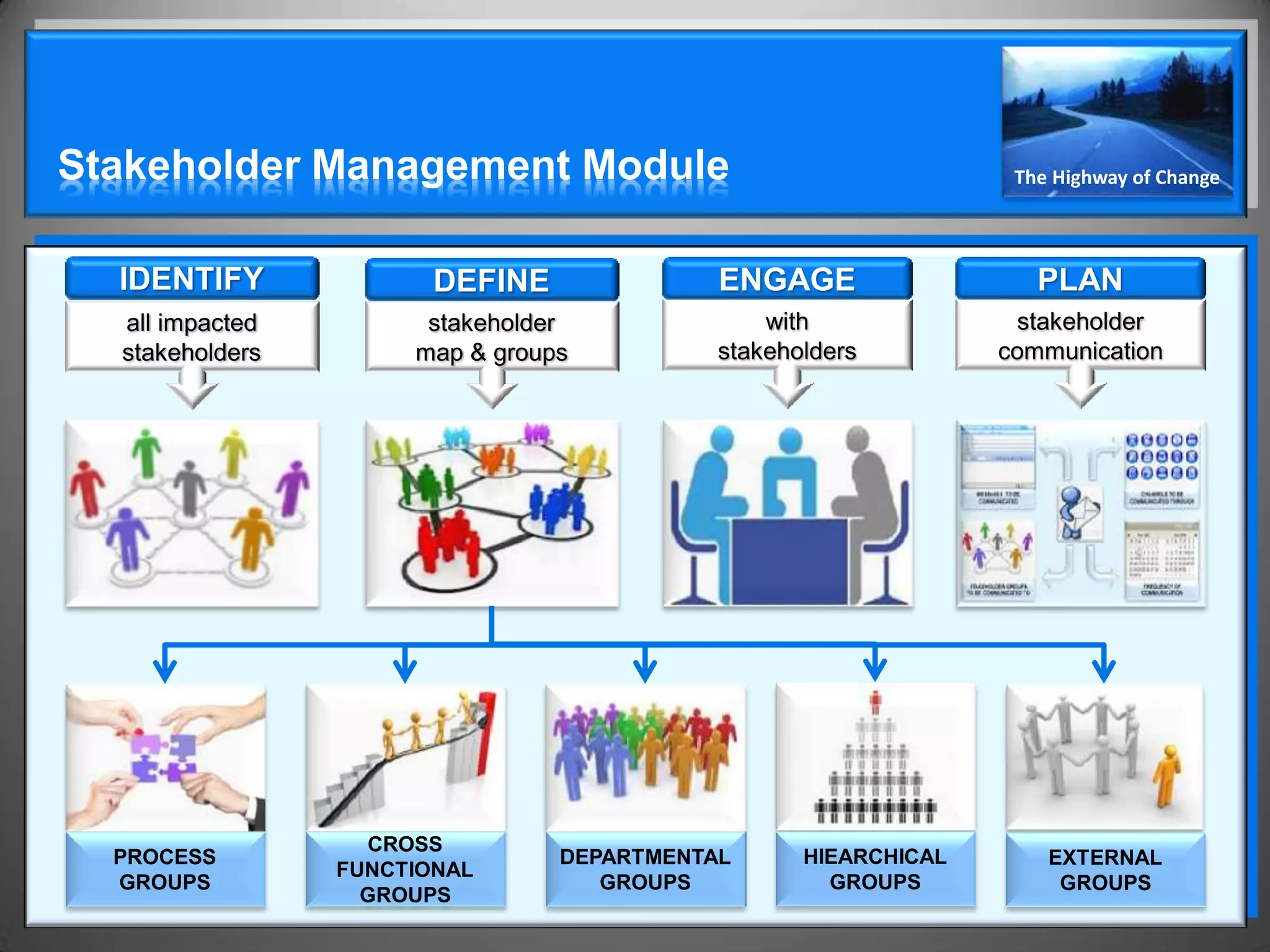
I start with Stakeholder Management
which once completed determines
your approach to Communication.
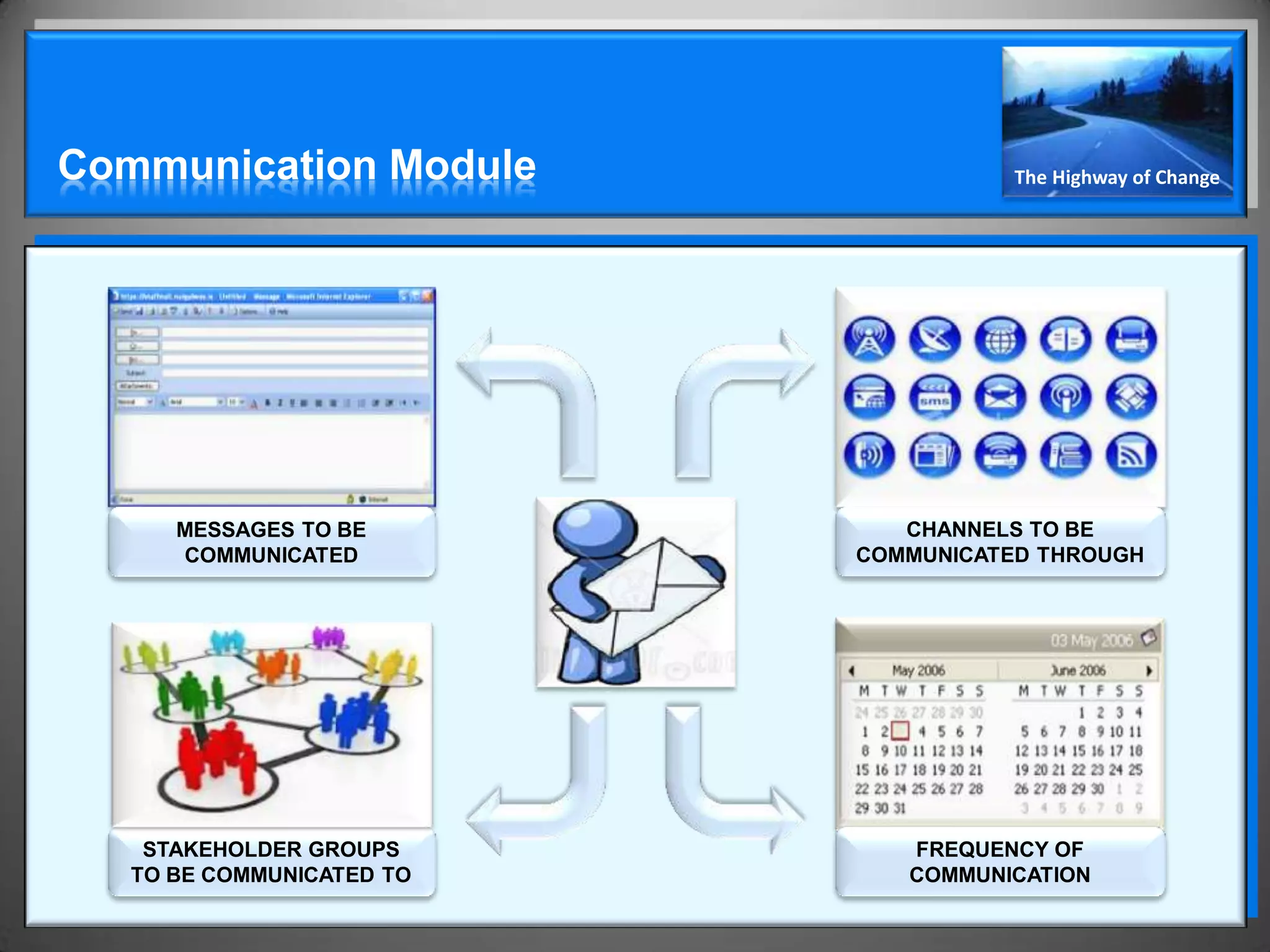
The Communication aspect can take
many forms but to an extent will be
determined by what channels are
already in place within an organisation.
I cannot stress the importance of these
two aspects.
Stakeholder Management Module                                     The Highway of Change


  IDENTIFY              DEFINE              ENGAGE                  PLAN
  all impacted         stakeholder              with              stakeholder
  stakeholders        map & groups          stakeholders         communication


                   CROSS
  PROCESS                        DEPARTMENTAL      HIEARCHICAL       EXTERNAL
                 FUNCTIONAL
  GROUPS                            GROUPS           GROUPS           GROUPS
                   GROUPS
Communication Module                 The Highway of Change


      MESSAGES TO BE          CHANNELS TO BE
      COMMUNICATED         COMMUNICATED THROUGH


    STAKEHOLDER GROUPS        FREQUENCY OF
   TO BE COMMUNICATED TO      COMMUNICATION
Process Change Module                                                 The Highway of Change


Once the Stakeholder Analysis has been completed and the Communications
Plan has bee determined the next stage is to start work on the processes that are
going to be impacted.
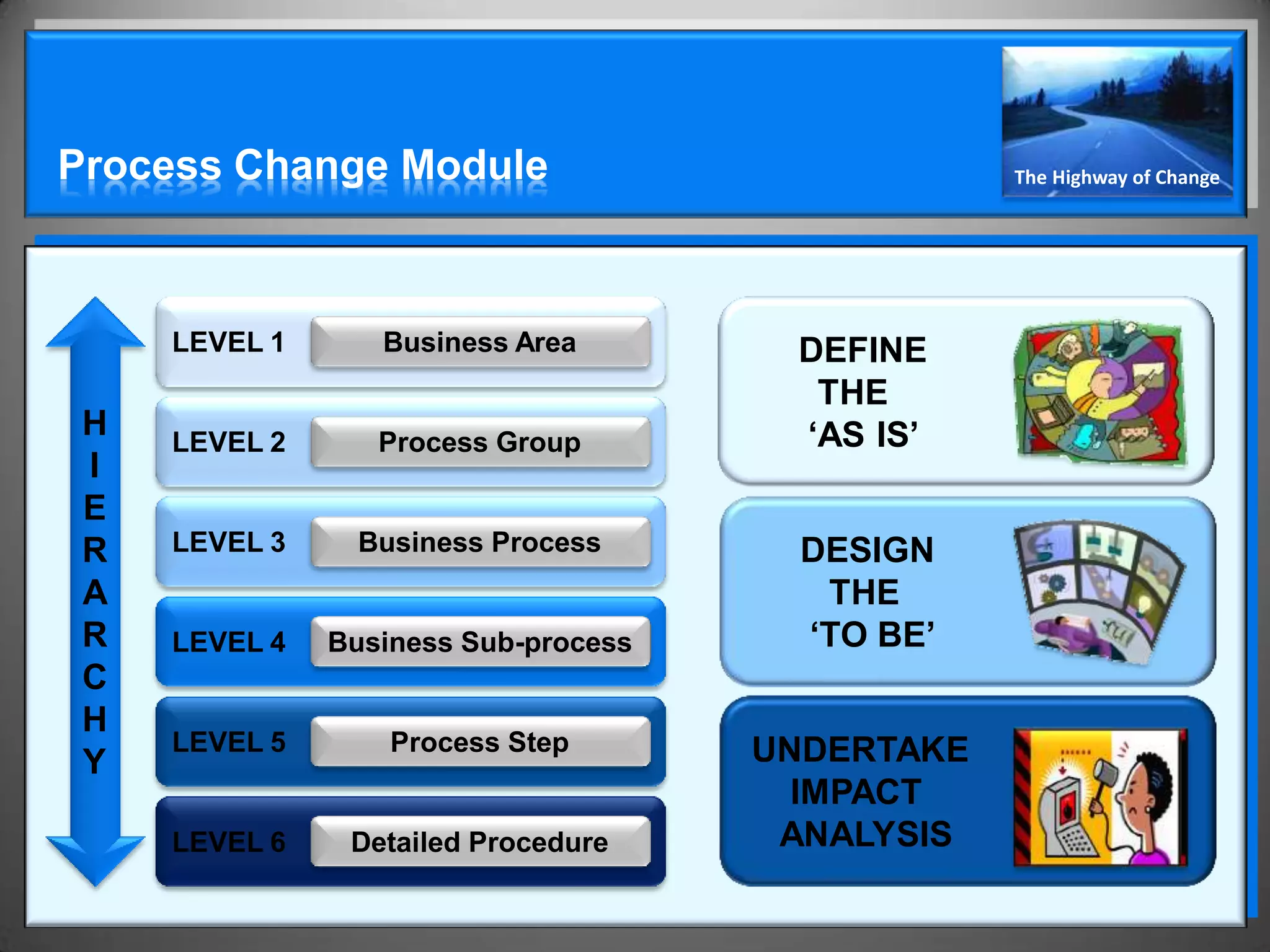
This is about initially creating a Process Hierarchy and determining at which level
process information needs to be captured. Once this is done then processes need
to be mapped. First the "As Is" and then following a period of critical analysis the
recommended "To Be“ processes.
It is helpful for end-users to get involved in the design stage of the new processes
so that they can provide their input and will be able to be involved and learn first
hand.
Comparing the “As Is” and the “To Be” will enable you to undertake an Impact
Analysis and identify where the major impacts are going to be and the associated
Stakeholder Groups that will be affected. This Impact Analysis will then need to be
communicated to the relevant Stakeholder Groups.
Process Change Module                             The Highway of Change


     LEVEL 1      Business Area        DEFINE
                                        THE
 H   LEVEL 2      Process Group        ‘AS IS’
 I
 E
 R   LEVEL 3    Business Process        DESIGN
 A                                       THE
 R   LEVEL 4   Business Sub-process     ‘TO BE’
 C
 H
     LEVEL 5       Process Step       UNDERTAKE
 Y
                                        IMPACT
     LEVEL 6    Detailed Procedure     ANALYSIS
Organisational Change Module                                           The Highway of Change


The next stage is the Organisational Change that results from the Process
Changes. This refers to the way tasks are divided up and the patterns of
coordination, communication, power distribution and workflow associated with
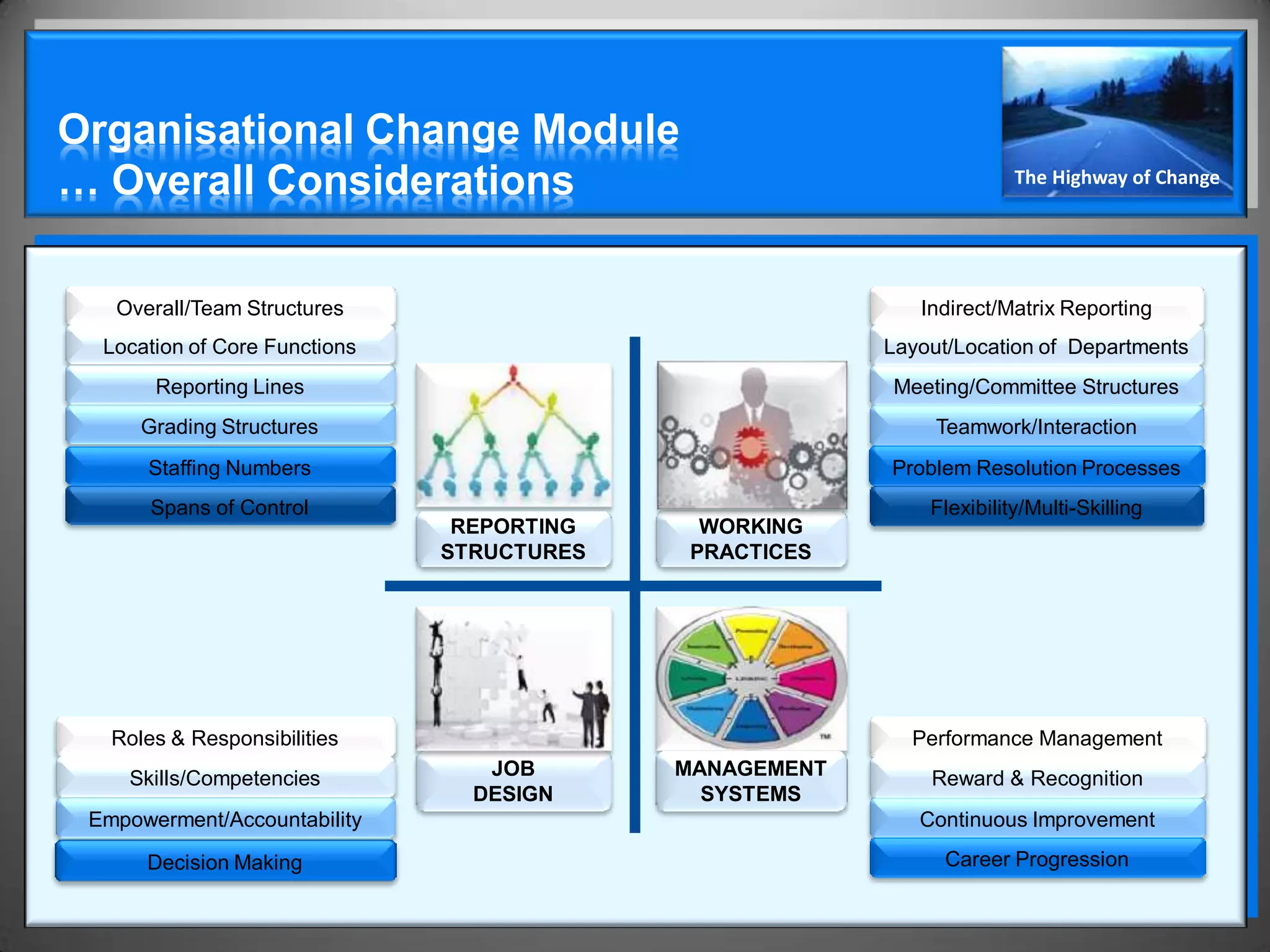
this. There are four basic elements to consider when looking at this aspect:
•   Reporting Structures.
•   Working Practices.
•   Job Design.
•   Management Systems.
This aspect will have to be carefully managed and again input from your key
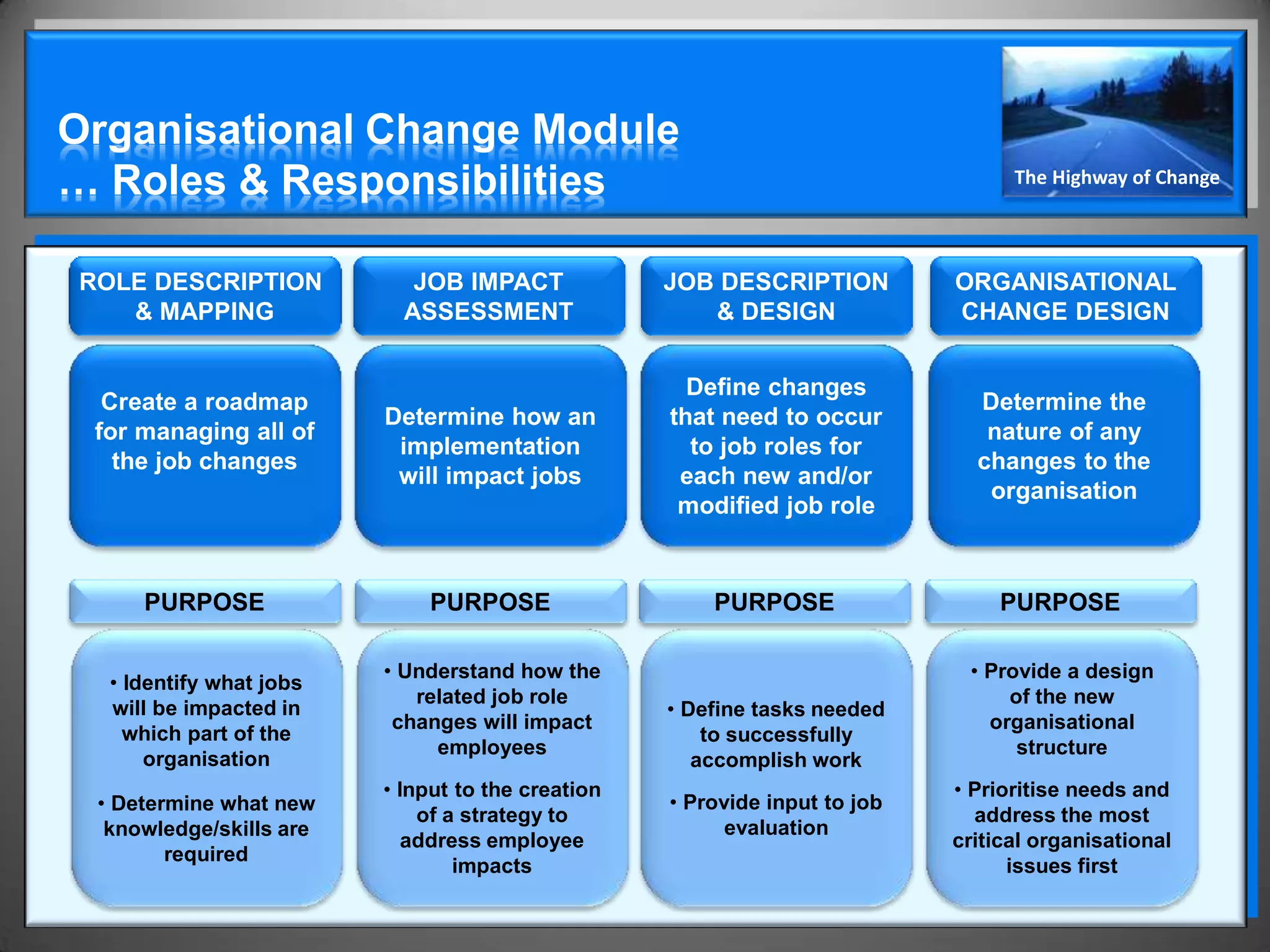
Stakeholder Groups is essential in the design of Job Roles & Responsibilities and
new Organisation Structure. The best structure is influenced by many factors
including company size, technology, and environment BUT ultimately strategy not
contingencies shape the structure (for better or worse).
This is the one aspect that people are most interested in as it involves "their jobs"
so cannot be underestimated.
Organisational Change Module
… Overall Considerations                                               The Highway of Change


   Overall/Team Structures                                  Indirect/Matrix Reporting
  Location of Core Functions                             Layout/Location of Departments
       Reporting Lines                                   Meeting/Committee Structures
      Grading Structures                                      Teamwork/Interaction
      Staffing Numbers                                   Problem Resolution Processes
       Spans of Control                                      Flexibility/Multi-Skilling
                                REPORTING     WORKING
                               STRUCTURES    PRACTICES


   Roles & Responsibilities                                Performance Management
    Skills/Competencies           JOB       MANAGEMENT       Reward & Recognition
                                 DESIGN       SYSTEMS
 Empowerment/Accountability                                 Continuous Improvement

      Decision Making                                          Career Progression
Organisational Change Module
… Roles & Responsibilities                                                        The Highway of Change


ROLE DESCRIPTION            JOB IMPACT             JOB DESCRIPTION          ORGANISATIONAL
   & MAPPING               ASSESSMENT                 & DESIGN              CHANGE DESIGN


                                                     Define changes
  Create a roadmap                                                            Determine the
                         Determine how an          that need to occur
 for managing all of                                                           nature of any
                          implementation             to job roles for
   the job changes                                                            changes to the
                          will impact jobs          each new and/or
                                                                               organisation
                                                    modified job role


     PURPOSE                 PURPOSE                   PURPOSE                   PURPOSE

                         • Understand how the                                • Provide a design
  • Identify what jobs
                            related job role                                     of the new
  will be impacted in                              • Define tasks needed
                          changes will impact                                  organisational
    which part of the                                  to successfully
                              employees                                           structure
      organisation                                    accomplish work
                         • Input to the creation                            • Prioritise needs and
 • Determine what new                              • Provide input to job
                             of a strategy to                                 address the most
  knowledge/skills are                                   evaluation
                            address employee                                critical organisational
        required
                                 impacts                                          issues first
Training & Education Module                                          The Highway of Change


The next logical stage is Training & Education which is all about training key
Stakeholder Groups on the new processes in relation to their new Roles &
Responsibilities.
Long before any actual training occurs it must be determined who, what, when,
where, why and how of training. This will invariably come from information from
the work on Process and Organisation changes and will reflect the following:
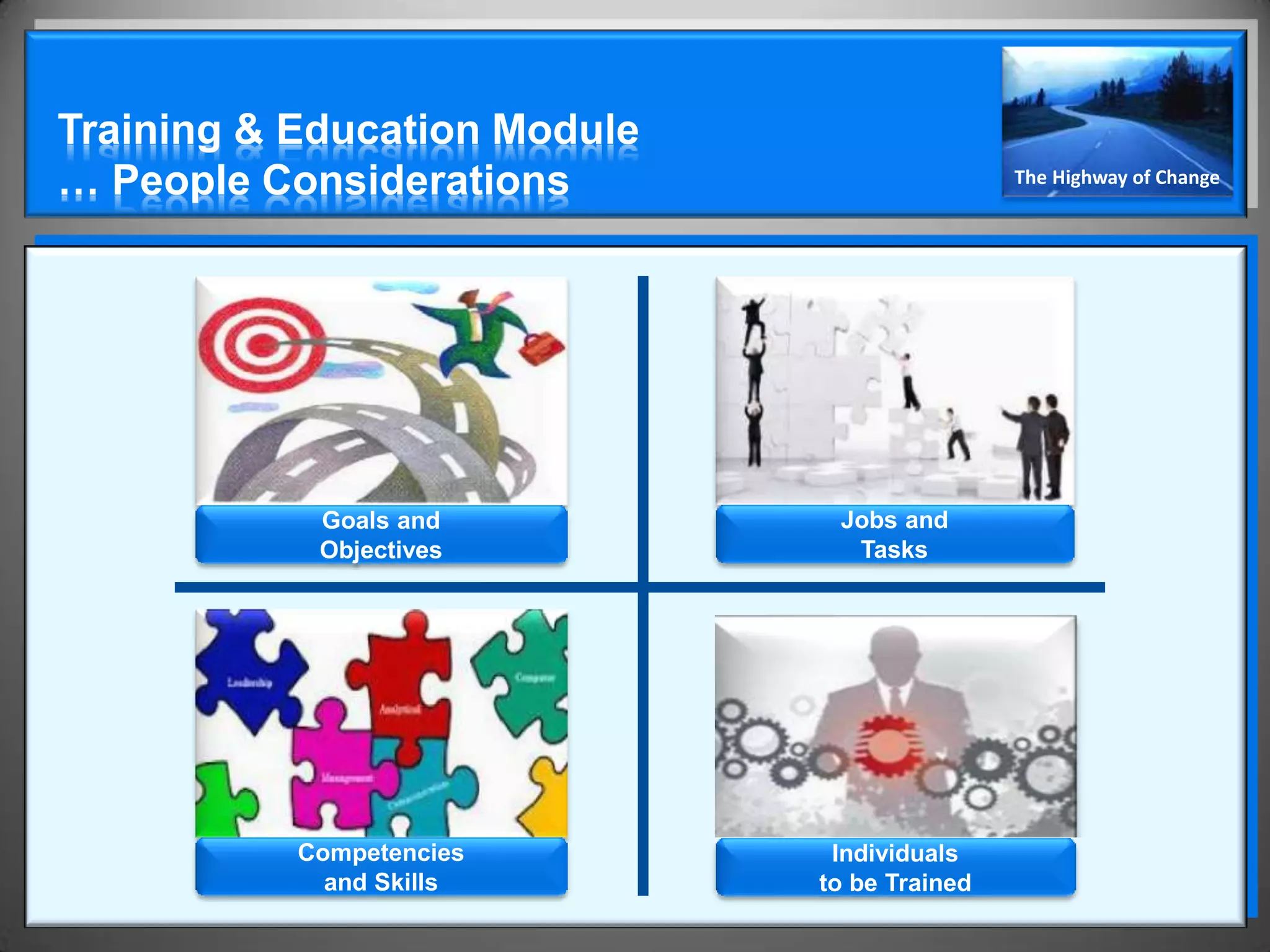
•   Organisation and its goals and objectives.
•   Jobs and related tasks that need to be learned.
•   Competencies and skills that are need to perform the job.
•   Individuals who are to be trained.
The final phase in the training and development program is evaluation of the
program to determine whether the training objectives were met. The end result
of this will be a competent and ready workforce.
Training & Education Module
… People Considerations                       The Highway of Change


            Goals and          Jobs and
            Objectives          Tasks


           Competencies        Individuals
             and Skills       to be Trained
Training & Education Module
… Logistical Considerations                                                      The Highway of Change


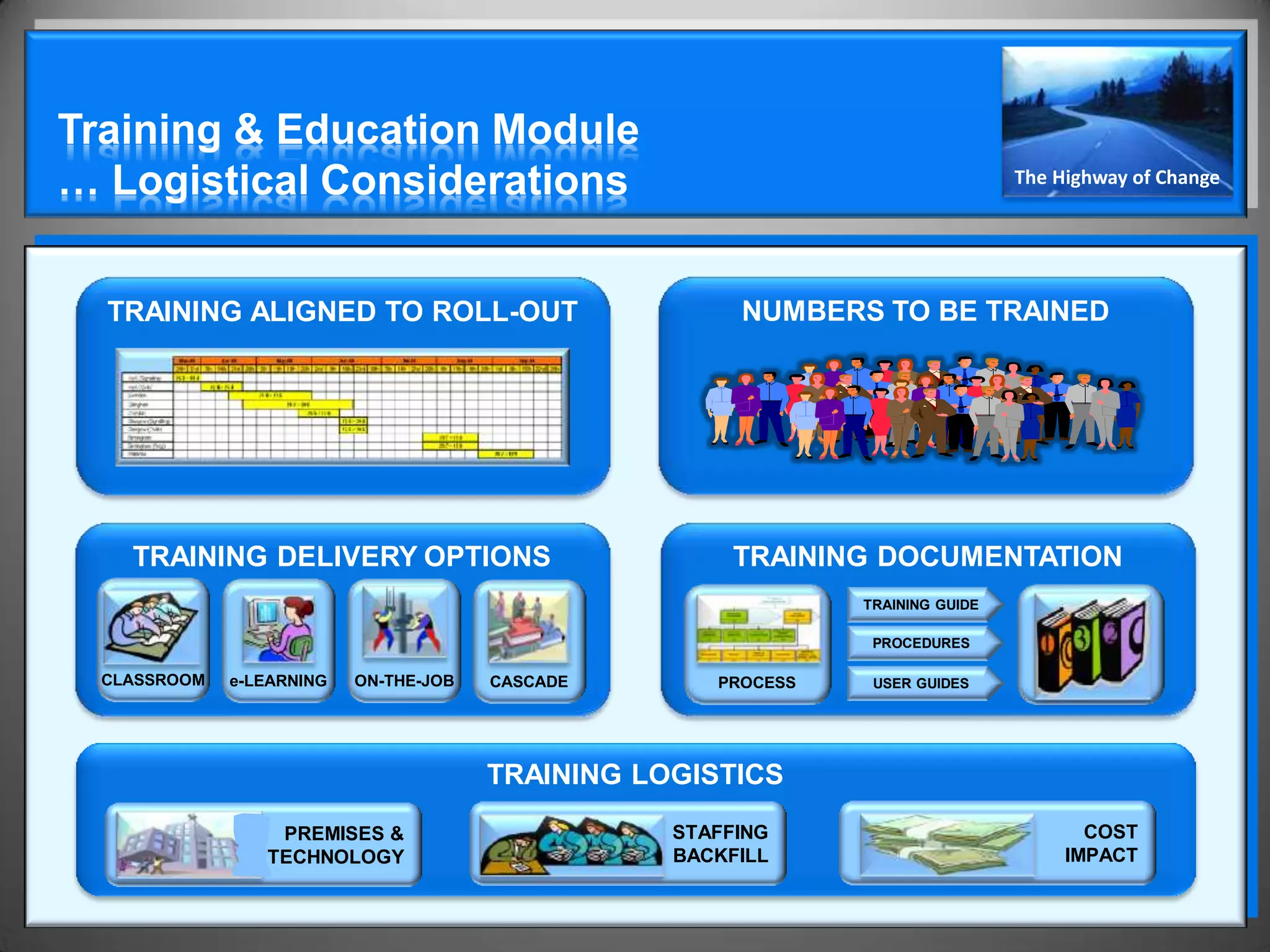
  TRAINING ALIGNED TO ROLL-OUT                          NUMBERS TO BE TRAINED


    TRAINING DELIVERY OPTIONS                           TRAINING DOCUMENTATION
                                                                TRAINING GUIDE

                                                                 PROCEDURES

  CLASSROOM   e-LEARNING   ON-THE-JOB   CASCADE       PROCESS    USER GUIDES


                                        TRAINING LOGISTICS
                  PREMISES &                       STAFFING                             COST
                 TECHNOLOGY                        BACKFILL                           IMPACT
Business Readiness Module                                             The Highway of Change


Business Readiness is a term that means the Business’s ability to take on or adopt
what a project delivers so in effect anything that involves a change to Business
Operations requires an organisation to be ready for and adopt the change.
The following are the key stages of this component:
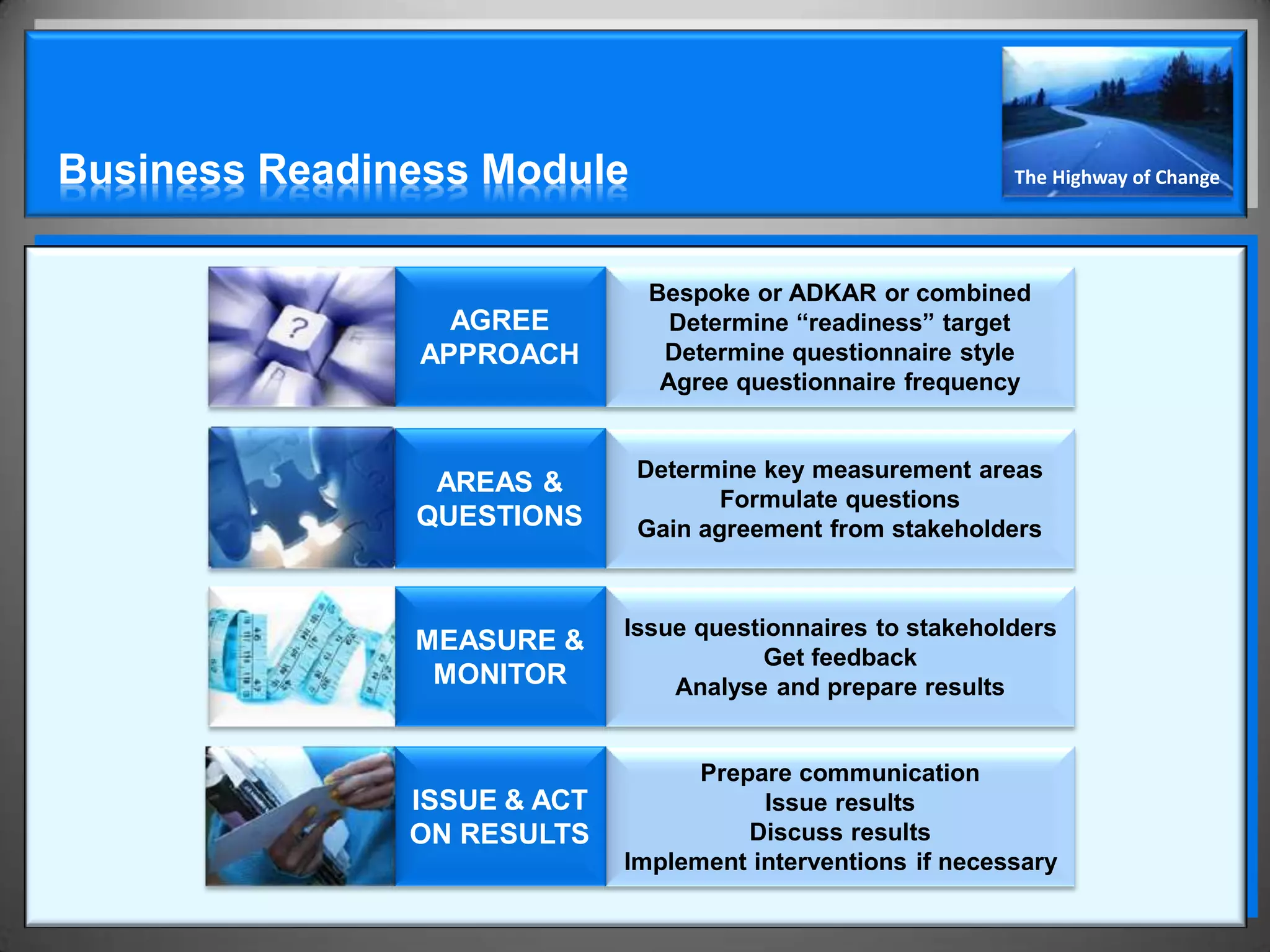
•   Agree approach.
•   Determine measurement areas, the key questions that need to be asked and
    determine how each question will be scored.
•   Issue questionnaires to the selected impacted community, receive feedback and
    analyse.
•   Issue results and take action as necessary.
This is a key aspect of the change process and it is extremely important that all key
project stakeholders input to this process and agree all relevant actions and
outcomes including any remedial change interventions resulting from the output of
the measurement process.
Business Readiness Module                                    The Highway of Change


                               Bespoke or ADKAR or combined
                 AGREE           Determine “readiness” target
               APPROACH         Determine questionnaire style
                                Agree questionnaire frequency


                              Determine key measurement areas
                AREAS &
                                     Formulate questions
               QUESTIONS      Gain agreement from stakeholders


                             Issue questionnaires to stakeholders
               MEASURE &
                                         Get feedback
                MONITOR          Analyse and prepare results


                                   Prepare communication
               ISSUE & ACT              Issue results
               ON RESULTS              Discuss results
                             Implement interventions if necessary
Business Benefits Module                                             The Highway of Change


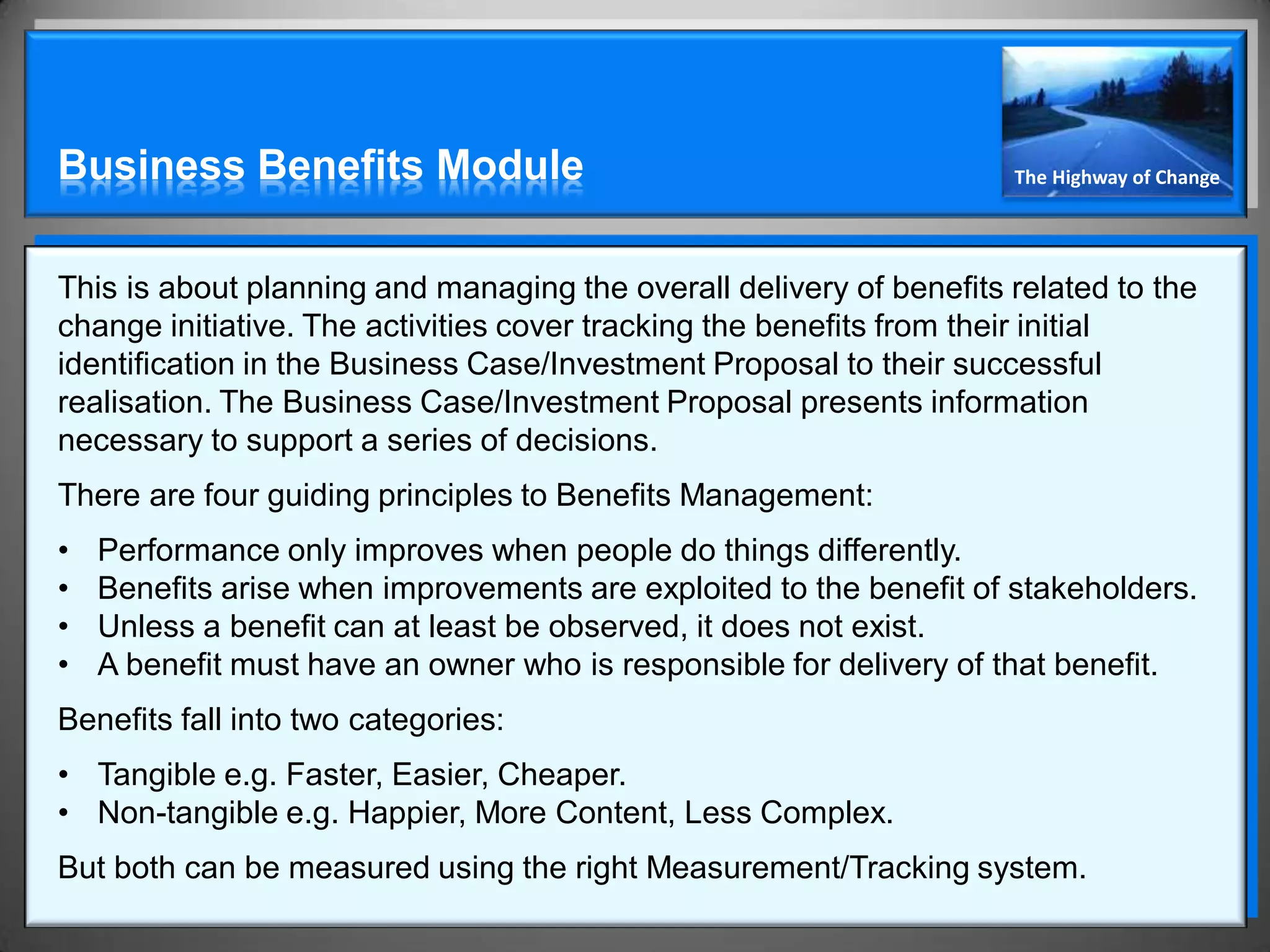
This is about planning and managing the overall delivery of benefits related to the
change initiative. The activities cover tracking the benefits from their initial
identification in the Business Case/Investment Proposal to their successful
realisation. The Business Case/Investment Proposal presents information
necessary to support a series of decisions.
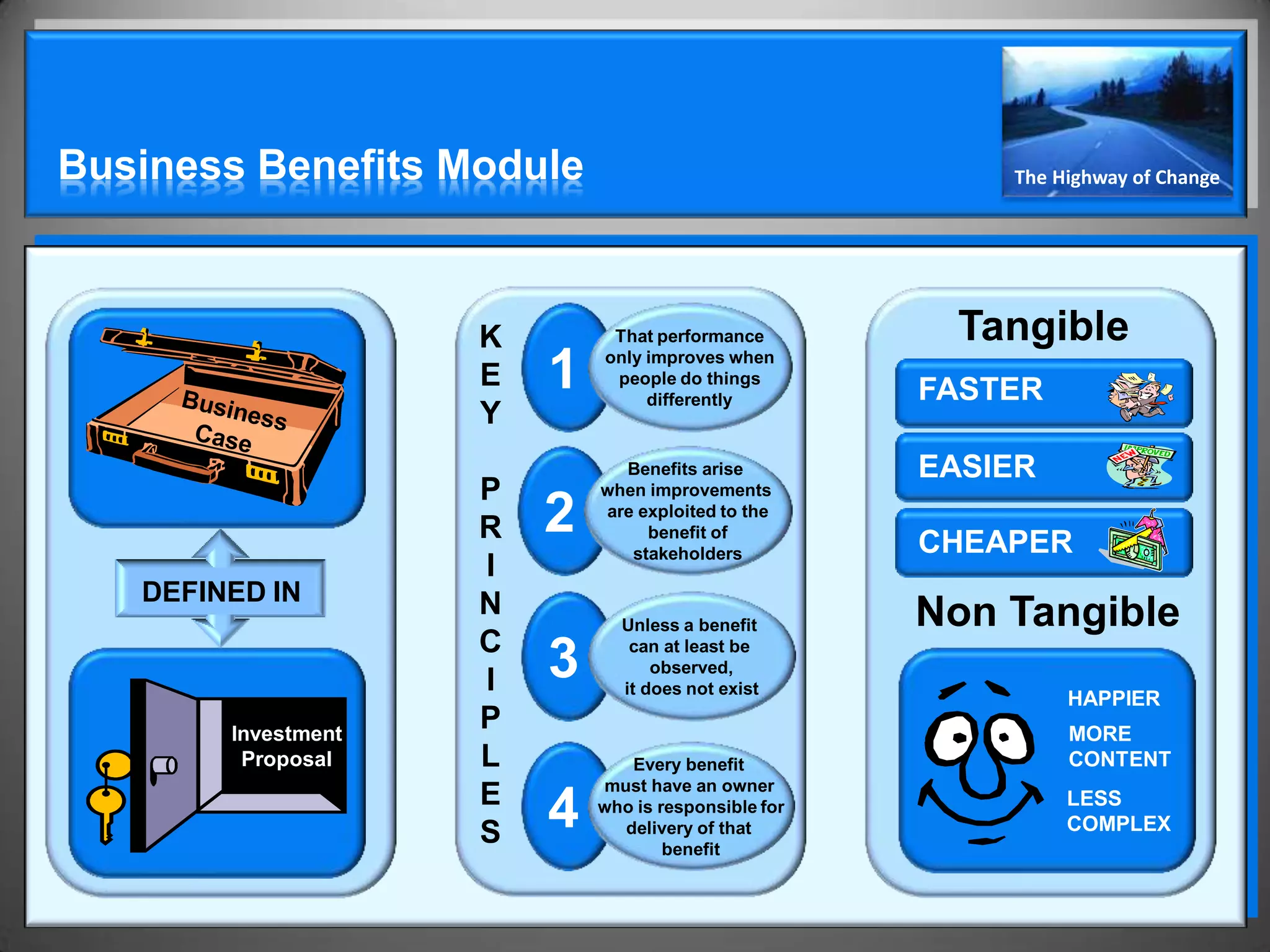
There are four guiding principles to Benefits Management:
•   Performance only improves when people do things differently.
•   Benefits arise when improvements are exploited to the benefit of stakeholders.
•   Unless a benefit can at least be observed, it does not exist.
•   A benefit must have an owner who is responsible for delivery of that benefit.
Benefits fall into two categories:
• Tangible e.g. Faster, Easier, Cheaper.
• Non-tangible e.g. Happier, More Content, Less Complex.
But both can be measured using the right Measurement/Tracking system.
Business Benefits Module                                  The Highway of Change


                     K        That performance          Tangible
                     E   1   only improves when
                              people do things
                                  differently         FASTER
                     Y
                               Benefits arise         EASIER
                     P       when improvements

                     R   2   are exploited to the
                                  benefit of
                                stakeholders          CHEAPER
                     I
   DEFINED IN        N
                               Unless a benefit       Non Tangible
                     C
                     I   3      can at least be
                                   observed,
                               it does not exist
                                                               HAPPIER
        Investment
                     P                                         MORE
         Proposal    L          Every benefit                  CONTENT
                             must have an owner
                     E
                     S   4   who is responsible for
                               delivery of that
                                     benefit
                                                               LESS
                                                               COMPLEX
Continuous Improvement Module                                           The Highway of Change


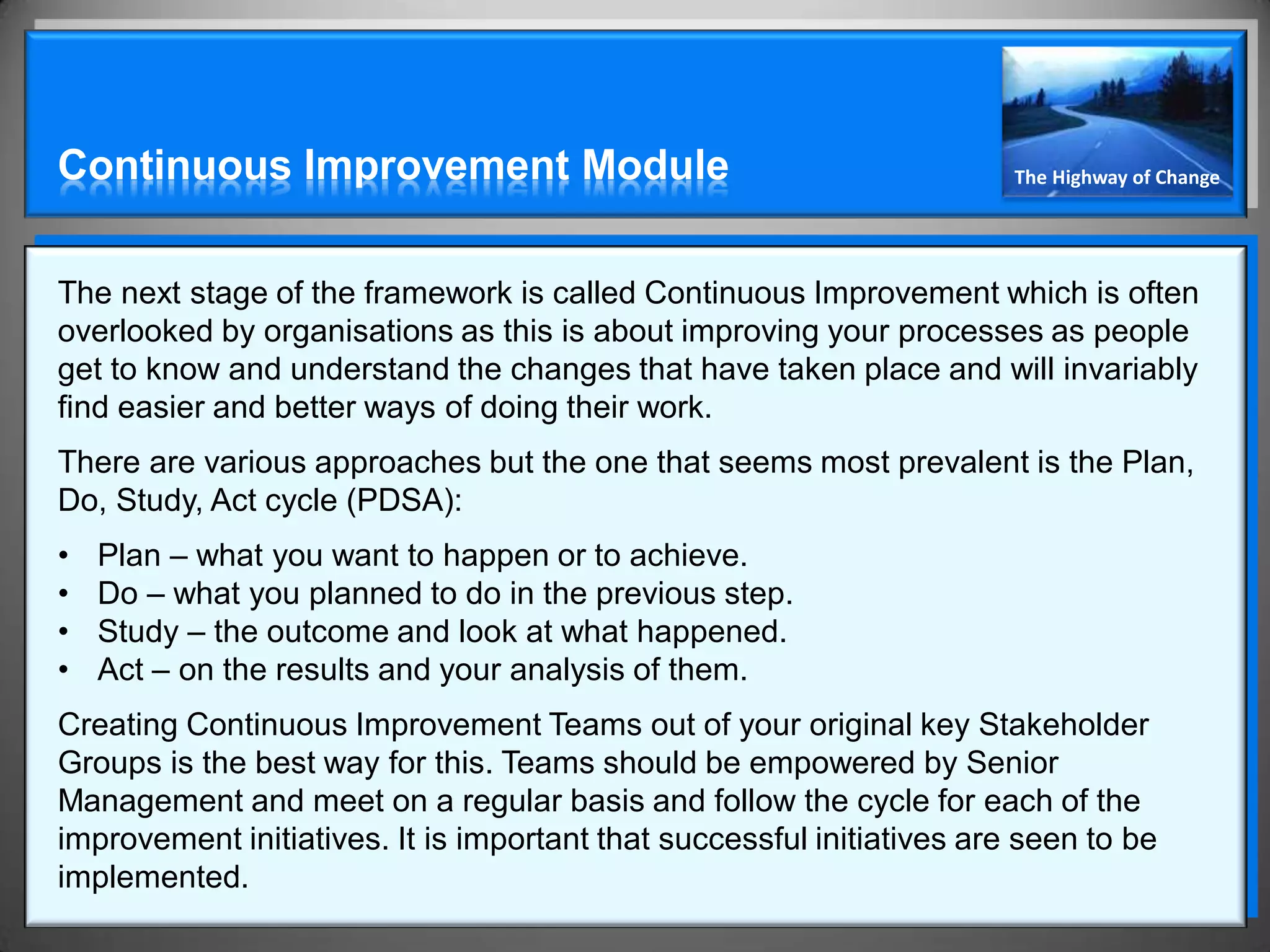
The next stage of the framework is called Continuous Improvement which is often
overlooked by organisations as this is about improving your processes as people
get to know and understand the changes that have taken place and will invariably
find easier and better ways of doing their work.
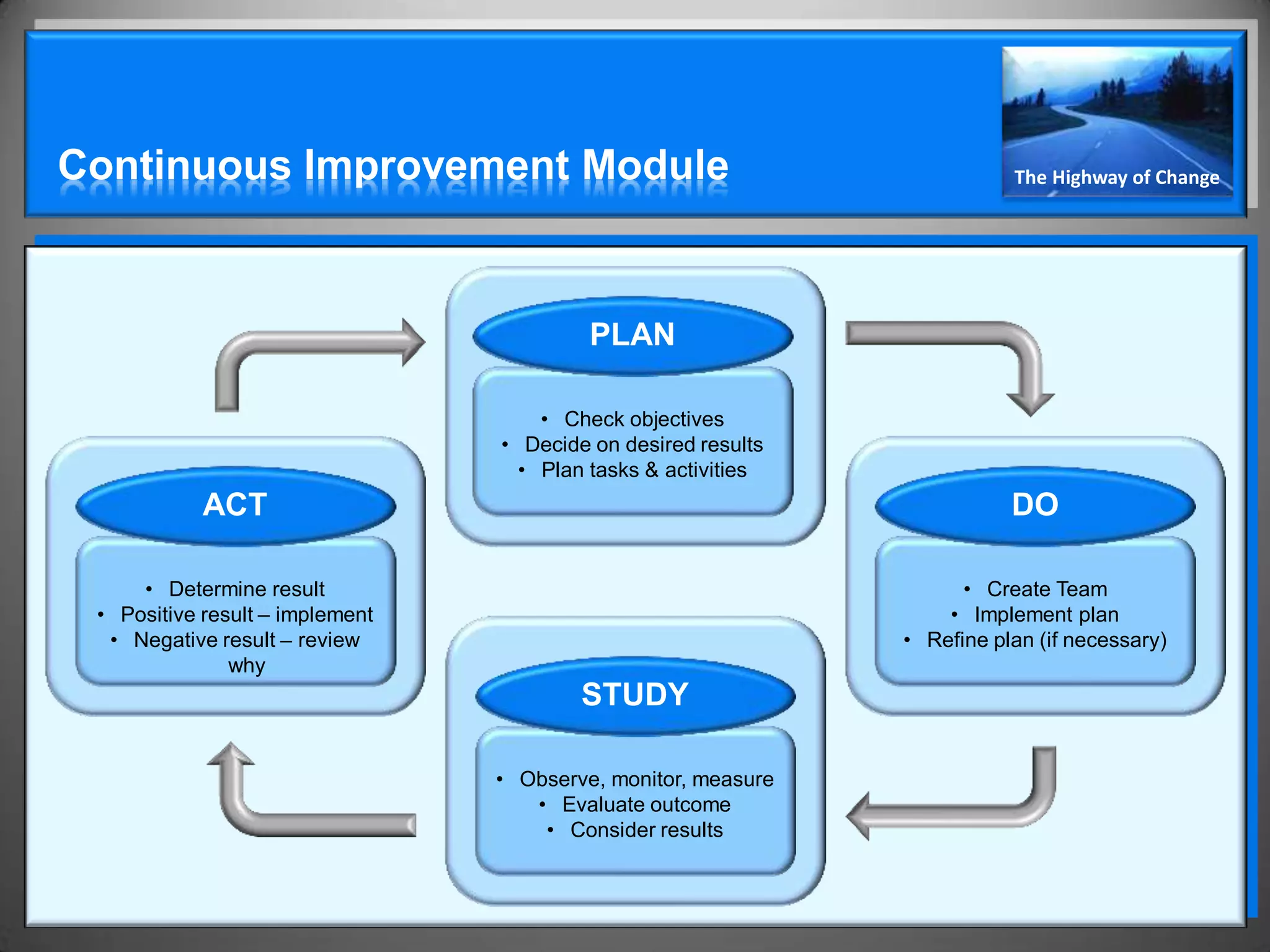
There are various approaches but the one that seems most prevalent is the Plan,
Do, Study, Act cycle (PDSA):
•   Plan – what you want to happen or to achieve.
•   Do – what you planned to do in the previous step.
•   Study – the outcome and look at what happened.
•   Act – on the results and your analysis of them.
Creating Continuous Improvement Teams out of your original key Stakeholder
Groups is the best way for this. Teams should be empowered by Senior
Management and meet on a regular basis and follow the cycle for each of the
improvement initiatives. It is important that successful initiatives are seen to be
implemented.
Continuous Improvement Module                                             The Highway of Change


                                          PLAN

                                     • Check objectives
                                 • Decide on desired results
                                   • Plan tasks & activities
            ACT                                                           DO

     • Determine result                                              • Create Team
 • Positive result – implement                                     • Implement plan
  • Negative result – review                                   • Refine plan (if necessary)
               why
                                         STUDY

                                 • Observe, monitor, measure
                                    • Evaluate outcome
                                     • Consider results

THofC - A Framework Approach to Change

  • 1.
    The Highway ofChange A Framework Approach to Change © developed by Ron Leeman “Your Chauffeur” on the Highway of Change
  • 2.
    IT Implementations &Change The Highway of Change The implementation of any new IT solution/application can represent a major change for an organisation and consequently will need to be well managed to ensure that there is a smooth transition not only from the technical solution to business ownership but also to a different way of working for the organisation. The change effort needed is both resource hungry and complex and will require a focus on getting the business ready to work with the proposed solution. Over the last 15-years I have developed and implemented many bespoke Business Change/Transformation approaches & strategies for organisations to enable them to drive through efficiency programmes and achieve considerable ROI/business benefit from their IT solution/application implementations. These bespoke approaches have used as their basis my Framework Approach to Change which is described in a bit more detail in the following slides. These slides is not intended to describe a comprehensive nor prescriptive approach to Business Change/Transformation, rather the intention is to give you a flavour of some of the more necessary change components and associated tools & techniques that will require consideration during the implementation.
  • 3.
    Framework Approach toChange The Highway of Change Modular … This means that the framework can be used in its totality or you can “pick and chose” which modules you want to use dependant on the change initiative People Side of Change … Implicit in the framework are the following aspects: CREATING AN MANAGING ENGENDERING ADDRESSING ENVIRONMENT CHANGE CHANGE ORGANISATION FOR CHANGE RESISTANCE BEHAVIOURS CULTURE
  • 4.
    High-Level Framework The Highway of Change COMMUNICATION PROCESS ORGANISATION TRAINING AND BUSINESS BENEFITS CONTINUOUS CHANGES CHANGES EDUCATION READINESS MANAGEMENT IMPROVEMENT S ROLE PROCESS TRAINING APPROACH HIGH LEVEL PLAN THE S M HIEARCHY DESCRIPTION PLAN AGREEMENT BENEFITS IMPROVEMENT M T & MAPPING T A A A DEFINE THE JOB IMPACT TRAINING QUESTIONS DETAILED IMPLEMENT THE A N ‘AS IS’ N K ASSESSMENT LOGISTICS FORMULATION BENEFITS IMPROVEMENT K A A E E G DESIGN THE JOB DESCRIPTION TRAINING MEASURE AND MEASURE EVALUATE G H ‘TO BE’ AND DESIGN DOCUMENTATION MONITOR AND TRACK THE ACTIVITY H E E O O M IMPACT ORGANISATION TRAINING ANALYSIS AND BENEFITS DECIDE M L ANALYSIS DESIGN DELIVERY RESULTS REALISATION NEXT STEPS L E E D D N OUTPUTS OUTPUTS OUTPUTS OUTPUTS OUTPUTS OUTPUTS N E E T T R CHANGES FROM NEW JOB ROLES COMPETENCY BUSINESS BENEFITS SUCCESSFUL R AS IS AND TO BE RESPONSIBILITIES PROFICIENCY READINESS AND PLAN AND KPI’S IMPROVEMENT AND BUSINESS AND ORGANISATION AND GO LIVE ALIGNED TO AND CONTINUOUS IMPACT DESIGN KNOWLEDGE ASSESSMENT BUSINESS CASE CYCLE COMMUNICATION
  • 5.
    Stakeholder Management &Communication The Highway of Change My approach is wholly underpinned Extract from a 2008 IBM Making by Stakeholder Management and Change work survey showing that Communication. These are the two Leadership, Employee Engagement factors that are key to a successful and Honest Communication are outcome. Pre-requisites for successful change. I start with Stakeholder Management which once completed determines your approach to Communication. The Communication aspect can take many forms but to an extent will be determined by what channels are already in place within an organisation. I cannot stress the importance of these two aspects.
  • 6.
    Stakeholder Management Module The Highway of Change IDENTIFY DEFINE ENGAGE PLAN all impacted stakeholder with stakeholder stakeholders map & groups stakeholders communication CROSS PROCESS DEPARTMENTAL HIEARCHICAL EXTERNAL FUNCTIONAL GROUPS GROUPS GROUPS GROUPS GROUPS
  • 7.
    Communication Module The Highway of Change MESSAGES TO BE CHANNELS TO BE COMMUNICATED COMMUNICATED THROUGH STAKEHOLDER GROUPS FREQUENCY OF TO BE COMMUNICATED TO COMMUNICATION
  • 8.
    Process Change Module The Highway of Change Once the Stakeholder Analysis has been completed and the Communications Plan has bee determined the next stage is to start work on the processes that are going to be impacted. This is about initially creating a Process Hierarchy and determining at which level process information needs to be captured. Once this is done then processes need to be mapped. First the "As Is" and then following a period of critical analysis the recommended "To Be“ processes. It is helpful for end-users to get involved in the design stage of the new processes so that they can provide their input and will be able to be involved and learn first hand. Comparing the “As Is” and the “To Be” will enable you to undertake an Impact Analysis and identify where the major impacts are going to be and the associated Stakeholder Groups that will be affected. This Impact Analysis will then need to be communicated to the relevant Stakeholder Groups.
  • 9.
    Process Change Module The Highway of Change LEVEL 1 Business Area DEFINE THE H LEVEL 2 Process Group ‘AS IS’ I E R LEVEL 3 Business Process DESIGN A THE R LEVEL 4 Business Sub-process ‘TO BE’ C H LEVEL 5 Process Step UNDERTAKE Y IMPACT LEVEL 6 Detailed Procedure ANALYSIS
  • 10.
    Organisational Change Module The Highway of Change The next stage is the Organisational Change that results from the Process Changes. This refers to the way tasks are divided up and the patterns of coordination, communication, power distribution and workflow associated with this. There are four basic elements to consider when looking at this aspect: • Reporting Structures. • Working Practices. • Job Design. • Management Systems. This aspect will have to be carefully managed and again input from your key Stakeholder Groups is essential in the design of Job Roles & Responsibilities and new Organisation Structure. The best structure is influenced by many factors including company size, technology, and environment BUT ultimately strategy not contingencies shape the structure (for better or worse). This is the one aspect that people are most interested in as it involves "their jobs" so cannot be underestimated.
  • 11.
    Organisational Change Module …Overall Considerations The Highway of Change Overall/Team Structures Indirect/Matrix Reporting Location of Core Functions Layout/Location of Departments Reporting Lines Meeting/Committee Structures Grading Structures Teamwork/Interaction Staffing Numbers Problem Resolution Processes Spans of Control Flexibility/Multi-Skilling REPORTING WORKING STRUCTURES PRACTICES Roles & Responsibilities Performance Management Skills/Competencies JOB MANAGEMENT Reward & Recognition DESIGN SYSTEMS Empowerment/Accountability Continuous Improvement Decision Making Career Progression
  • 12.
    Organisational Change Module …Roles & Responsibilities The Highway of Change ROLE DESCRIPTION JOB IMPACT JOB DESCRIPTION ORGANISATIONAL & MAPPING ASSESSMENT & DESIGN CHANGE DESIGN Define changes Create a roadmap Determine the Determine how an that need to occur for managing all of nature of any implementation to job roles for the job changes changes to the will impact jobs each new and/or organisation modified job role PURPOSE PURPOSE PURPOSE PURPOSE • Understand how the • Provide a design • Identify what jobs related job role of the new will be impacted in • Define tasks needed changes will impact organisational which part of the to successfully employees structure organisation accomplish work • Input to the creation • Prioritise needs and • Determine what new • Provide input to job of a strategy to address the most knowledge/skills are evaluation address employee critical organisational required impacts issues first
  • 13.
    Training & EducationModule The Highway of Change The next logical stage is Training & Education which is all about training key Stakeholder Groups on the new processes in relation to their new Roles & Responsibilities. Long before any actual training occurs it must be determined who, what, when, where, why and how of training. This will invariably come from information from the work on Process and Organisation changes and will reflect the following: • Organisation and its goals and objectives. • Jobs and related tasks that need to be learned. • Competencies and skills that are need to perform the job. • Individuals who are to be trained. The final phase in the training and development program is evaluation of the program to determine whether the training objectives were met. The end result of this will be a competent and ready workforce.
  • 14.
    Training & EducationModule … People Considerations The Highway of Change Goals and Jobs and Objectives Tasks Competencies Individuals and Skills to be Trained
  • 15.
    Training & EducationModule … Logistical Considerations The Highway of Change TRAINING ALIGNED TO ROLL-OUT NUMBERS TO BE TRAINED TRAINING DELIVERY OPTIONS TRAINING DOCUMENTATION TRAINING GUIDE PROCEDURES CLASSROOM e-LEARNING ON-THE-JOB CASCADE PROCESS USER GUIDES TRAINING LOGISTICS PREMISES & STAFFING COST TECHNOLOGY BACKFILL IMPACT
  • 16.
    Business Readiness Module The Highway of Change Business Readiness is a term that means the Business’s ability to take on or adopt what a project delivers so in effect anything that involves a change to Business Operations requires an organisation to be ready for and adopt the change. The following are the key stages of this component: • Agree approach. • Determine measurement areas, the key questions that need to be asked and determine how each question will be scored. • Issue questionnaires to the selected impacted community, receive feedback and analyse. • Issue results and take action as necessary. This is a key aspect of the change process and it is extremely important that all key project stakeholders input to this process and agree all relevant actions and outcomes including any remedial change interventions resulting from the output of the measurement process.
  • 17.
    Business Readiness Module The Highway of Change Bespoke or ADKAR or combined AGREE Determine “readiness” target APPROACH Determine questionnaire style Agree questionnaire frequency Determine key measurement areas AREAS & Formulate questions QUESTIONS Gain agreement from stakeholders Issue questionnaires to stakeholders MEASURE & Get feedback MONITOR Analyse and prepare results Prepare communication ISSUE & ACT Issue results ON RESULTS Discuss results Implement interventions if necessary
  • 18.
    Business Benefits Module The Highway of Change This is about planning and managing the overall delivery of benefits related to the change initiative. The activities cover tracking the benefits from their initial identification in the Business Case/Investment Proposal to their successful realisation. The Business Case/Investment Proposal presents information necessary to support a series of decisions. There are four guiding principles to Benefits Management: • Performance only improves when people do things differently. • Benefits arise when improvements are exploited to the benefit of stakeholders. • Unless a benefit can at least be observed, it does not exist. • A benefit must have an owner who is responsible for delivery of that benefit. Benefits fall into two categories: • Tangible e.g. Faster, Easier, Cheaper. • Non-tangible e.g. Happier, More Content, Less Complex. But both can be measured using the right Measurement/Tracking system.
  • 19.
    Business Benefits Module The Highway of Change K That performance Tangible E 1 only improves when people do things differently FASTER Y Benefits arise EASIER P when improvements R 2 are exploited to the benefit of stakeholders CHEAPER I DEFINED IN N Unless a benefit Non Tangible C I 3 can at least be observed, it does not exist HAPPIER Investment P MORE Proposal L Every benefit CONTENT must have an owner E S 4 who is responsible for delivery of that benefit LESS COMPLEX
  • 20.
    Continuous Improvement Module The Highway of Change The next stage of the framework is called Continuous Improvement which is often overlooked by organisations as this is about improving your processes as people get to know and understand the changes that have taken place and will invariably find easier and better ways of doing their work. There are various approaches but the one that seems most prevalent is the Plan, Do, Study, Act cycle (PDSA): • Plan – what you want to happen or to achieve. • Do – what you planned to do in the previous step. • Study – the outcome and look at what happened. • Act – on the results and your analysis of them. Creating Continuous Improvement Teams out of your original key Stakeholder Groups is the best way for this. Teams should be empowered by Senior Management and meet on a regular basis and follow the cycle for each of the improvement initiatives. It is important that successful initiatives are seen to be implemented.
  • 21.
    Continuous Improvement Module The Highway of Change PLAN • Check objectives • Decide on desired results • Plan tasks & activities ACT DO • Determine result • Create Team • Positive result – implement • Implement plan • Negative result – review • Refine plan (if necessary) why STUDY • Observe, monitor, measure • Evaluate outcome • Consider results