Strategic Planning Sales Planning Strategies and Resource Management Prepared by Larry Podgorny
Why Plan? Alice: Which way should I go? Cheshire Cat: That depends on where you are going. Alice: I don’t know where I am going. Cheshire Cat: Then it doesn’t matter which way you go!! Lewis Carroll 1872 Through the Looking-Glass
The Plan In the beginning was the plan. And then came the assumptions. And the assumptions were with out form. And the plan was completely without substance. And darkness was upon the face of the workers.
Definition of Strategy/Strategic A careful plan or method  The art of devising or employing plans or stratagems toward a goal Of great importance within an integrated whole or to a planned effect  Necessary to or important in the initiation, conduct, or completion of a strategic plan
What Strategic Planning is Not Strategic planning is not forecasting Strategic planning is not the simple application of quantitative techniques to business planning. Strategic planning is concerned with making decisions today that will affect the organization (product line) and it’s future. Strategic planning does not eliminate risk, it helps managers access the risks they must take by gaining a better understanding of the parameters involved in their decisions.
Simplified Process of Strategic Planning The process of strategic planning is a step-by-step approach three key questions that lie at the heart of any business strategy: What are you going to sell? Who are your target customers? How can you beat or avoid your competition? If you can answer these three questions well, you have a strategy.
Simplified Process of Strategic Planning (Cont.) There’s no denying that a simplified process involves complex issues. The process involves digesting a lot of information and requires some fairly difficult analysis. Good strategic planning should be simplified not simplistic. Good intentions alone does not get the job done.
Simplified Process of Strategic Planning (Cont.) You need to see it big at first. Start at a high level. Sift through all of the noise to get to the important details The next step is do the things that matter very well. Occasionally, go back up to the high level to make sure everything is still on course.
Simplified Process Of Strategic Planning- Start By Studying The Way It Is Now You need to gather basic information and facts without making any judgments. Based on this information you build some assumptions, again without making judgments. This process is the central part of the planning process and needs to be reviewed in detail because this information is the foundation for all further strategy discussions and decisions.
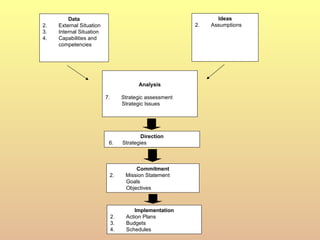
Data External Situation Internal Situation Capabilities and competencies Ideas Assumptions Analysis Strategic assessment Strategic Issues Direction 6.  Strategies Commitment Mission Statement Goals Objectives Implementation Action Plans Budgets Schedules
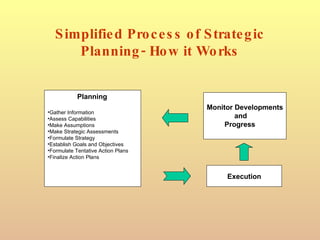
Simplified Process of Strategic Planning- How it Works Planning Gather Information Assess Capabilities Make Assumptions Make Strategic Assessments Formulate Strategy Establish Goals and Objectives Formulate Tentative Action Plans Finalize Action Plans Execution Monitor Developments and Progress
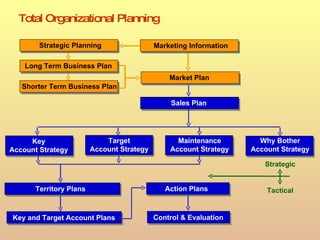
Total Organizational Planning Sales Plan Target Account Strategy Key Account Strategy Maintenance Account Strategy Why Bother Account Strategy Territory Plans Key and Target Account Plans Action Plans Control & Evaluation Shorter Term Business Plan Market Plan Strategic Planning Marketing Information Long Term Business Plan Strategic Tactical
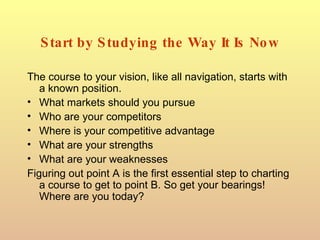
Start by Studying the Way It Is Now The course to your vision, like all navigation, starts with a known position. What markets should you pursue Who are your competitors Where is your competitive advantage What are your strengths What are your weaknesses Figuring out point A is the first essential step to charting a course to get to point B. So get your bearings! Where are you today?
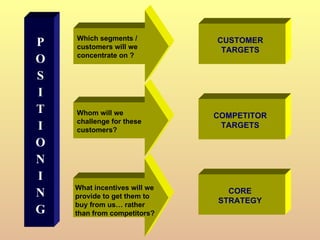
P O S I T I O N I N G Which segments / customers will we concentrate on ? Whom will we challenge for these customers? What incentives will we provide to get them to buy from us… rather than from competitors? CUSTOMER TARGETS COMPETITOR TARGETS CORE STRATEGY
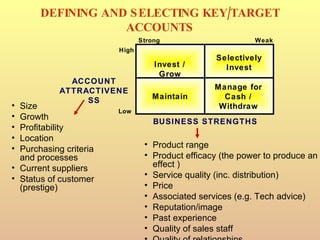
BUSINESS STRENGTHS ACCOUNT ATTRACTIVENESS High Low Strong Weak DEFINING AND SELECTING KEY/TARGET ACCOUNTS Size Growth Profitability Location Purchasing criteria and processes Current suppliers Status of customer (prestige) Product range Product efficacy (the power to produce an effect ) Service quality (inc. distribution) Price Associated services (e.g. Tech advice) Reputation/image Past experience Quality of sales staff Quality of relationships Invest / Grow Selectively Invest Maintain Manage for Cash / Withdraw
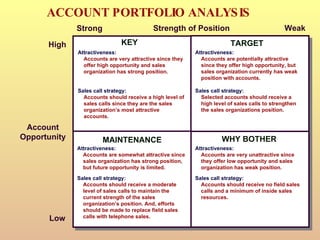
ACCOUNT PORTFOLIO ANALYSIS Attractiveness: Accounts are very attractive since they offer high opportunity and sales organization has strong position. Sales call strategy: Accounts should receive a high level of sales calls since they are the sales organization’s most attractive accounts. Attractiveness: Accounts are potentially attractive since they offer high opportunity, but sales organization currently has weak position with accounts. Sales call strategy: Selected accounts should receive a high level of sales calls to strengthen the sales organizations position. Attractiveness: Accounts are somewhat attractive since sales organization has strong position, but future opportunity is limited. Sales call strategy: Accounts should receive a moderate level of sales calls to maintain the current strength of the sales organization’s position. And, efforts should be made to replace field sales calls with telephone sales. Attractiveness: Accounts are very unattractive since they offer low opportunity and sales organization has weak position. Sales call strategy: Accounts should receive no field sales calls and a minimum of inside sales resources. Strong Strength of Position Weak High Account Opportunity Low KEY TARGET MAINTENANCE WHY BOTHER
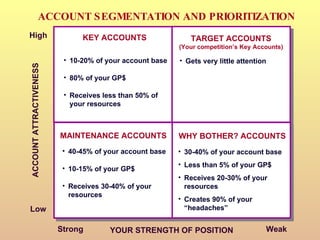
ACCOUNT SEGMENTATION AND PRIORITIZATION KEY ACCOUNTS 10-20% of your account base 80% of your GP$ Receives less than 50% of your resources TARGET ACCOUNTS (Your competition’s Key Accounts) MAINTENANCE ACCOUNTS WHY BOTHER? ACCOUNTS Gets very little attention 40-45% of your account base 10-15% of your GP$ Receives 30-40% of your resources 30-40% of your account base Less than 5% of your GP$ Receives 20-30% of your resources Creates 90% of your “headaches” High ACCOUNT ATTRACTIVENESS Low Strong Weak YOUR STRENGTH OF POSITION
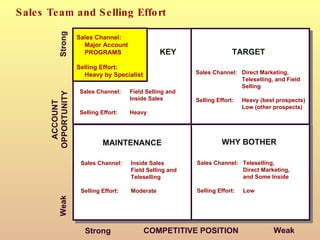
Sales Team and Selling Effort Sales Channel: Field Selling and Inside Sales Selling Effort: Heavy Sales Channel: Major Account PROGRAMS Selling Effort: Heavy by Specialist Sales Channel: Direct Marketing, Teleselling, and Field Selling Selling Effort: Heavy (best prospects) Low (other prospects) Sales Channel: Inside Sales Field Selling and Teleselling Selling Effort: Moderate Sales Channel: Teleselling, Direct Marketing, and Some Inside Selling Effort: Low Strong Weak ACCOUNT OPPORTUNITY Strong COMPETITIVE POSITION Weak KEY TARGET MAINTENANCE WHY BOTHER
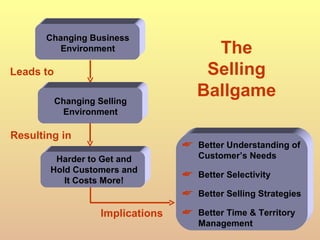
Better Understanding of Customer’s Needs Better Selectivity Better Selling Strategies Better Time & Territory Management The Selling Ballgame Changing Business Environment Leads to Changing Selling Environment Resulting in Harder to Get and Hold Customers and It Costs More! Implications
PRIORITIES Time Management
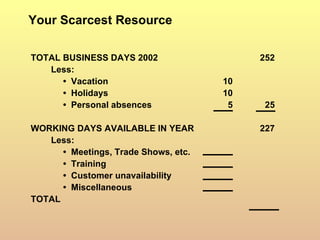
Your Scarcest Resource TOTAL BUSINESS DAYS 2002 252 Less: •  Vacation 10 •  Holidays 10 •  Personal absences 5 25 WORKING DAYS AVAILABLE IN YEAR 227 Less: •  Meetings, Trade Shows, etc. •  Training •  Customer unavailability •  Miscellaneous TOTAL
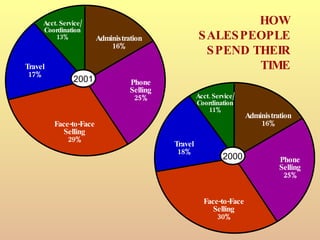
Administration 16% Administration 16% HOW SALESPEOPLE SPEND THEIR TIME Acct. Service/ Coordination 13% Acct. Service/ Coordination 11% Face-to-Face Selling 29% Face-to-Face Selling 30% Phone Selling 25% Phone Selling 25% Travel 17% Travel 18% 2001 2000
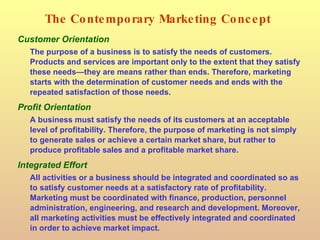
The Contemporary Marketing Concept Customer Orientation The purpose of a business is to satisfy the needs of customers. Products and services are important only to the extent that they satisfy these needs—they are means rather than ends. Therefore, marketing starts with the determination of customer needs and ends with the repeated satisfaction of those needs. Profit Orientation A business must satisfy the needs of its customers at an acceptable level of profitability. Therefore, the purpose of marketing is not simply to generate sales or achieve a certain market share, but rather to produce profitable sales and a profitable market share. Integrated Effort All activities or a business should be integrated and coordinated so as to satisfy customer needs at a satisfactory rate of profitability. Marketing must be coordinated with finance, production, personnel administration, engineering, and research and development. Moreover, all marketing activities must be effectively integrated and coordinated in order to achieve market impact.
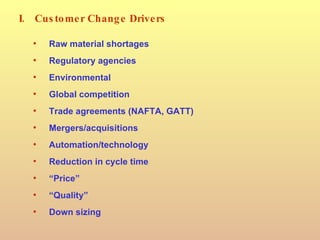
I. Customer Change Drivers Raw material shortages Regulatory agencies Environmental Global competition Trade agreements (NAFTA, GATT) Mergers/acquisitions Automation/technology Reduction in cycle time “ Price” “ Quality” Down sizing
Customer Change Drivers  (cont’d.) Reengineering Out-sourcing Systems versus products Out-sourcing of engineering and R&D to vendors Long term contracts (5 years) Sharing of warranty costs by suppliers EDI Vendor reduction
II. Purchasing Behavior/Buying Relationships Manage supply channel –  strategic alliances –  partnering –  customer linked strategies –  integrated supply National account programs Single source –  product breadth –  product depth EDI –  seamless order and delivery –  automation –  paperless Removal / reduction in any redundancy Vendor reduction
Purchasing Behavior/Buying Relationships   (cont’d.) Broader offering of “true” value added services Proof of performance—vendor score cards provided by vendors Vendor as a business consultant to account Problem solving vendors will be chosen Reduction of in-house expertise by customers Require modular / systems, global vendors with total quality Purchase “packages” of integrated components (systems) versus single components Better P.O.P. merchandising
III. Role of the Sales Team Increased speed of response Technical value-added sales calls Greater knowledge of customer, competition and sellers company Ability to make decisions (empowerment) Relationship selling at higher level—sell the “whole” customer Empathy for the customer Functional sellers –  sales teams/sellers focused on opening accounts through “selling” creative solutions to problems –  account managers on accounts to “service”
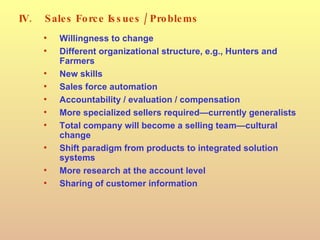
IV. Sales Force Issues / Problems Willingness to change Different organizational structure, e.g., Hunters and Farmers New skills Sales force automation Accountability / evaluation / compensation More specialized sellers required—currently generalists Total company will become a selling team—cultural change Shift paradigm from products to integrated solution systems More research at the account level Sharing of customer information
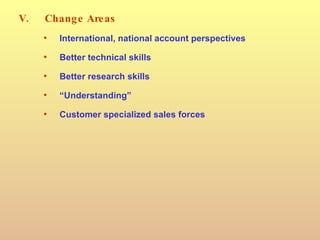
V. Change Areas International, national account perspectives Better technical skills Better research skills “ Understanding” Customer specialized sales forces
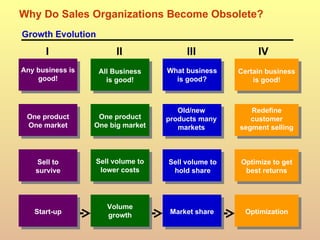
Why Do Sales Organizations Become Obsolete? Growth Evolution I II III IV Any business is good! All Business is good! What business is good? Certain business is good! One product One market One product One big market Old/new products many markets Redefine customer segment selling Sell to survive Sell volume to lower costs Sell volume to hold share Optimize to get best returns Start-up Volume growth Market share Optimization
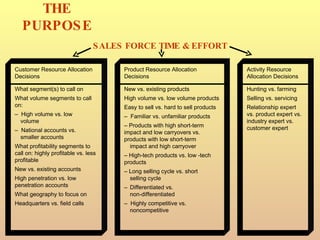
THE PURPOSE Customer Resource Allocation Decisions What segment(s) to call on What volume segments to call on: –  High volume vs. low  volume –  National accounts vs.  smaller accounts What profitability segments to call on: highly profitable vs. less profitable New vs. existing accounts High penetration vs. low penetration accounts What geography to focus on Headquarters vs. field calls Product Resource Allocation Decisions New vs. existing products High volume vs. low volume products Easy to sell vs. hard to sell products –  Familiar vs. unfamiliar products –  Products with high short-term  impact and low carryovers vs.  products with low short-term  impact and high carryover –  High-tech products vs. low -tech  products –  Long selling cycle vs. short  selling cycle – Differentiated vs.  non-differentiated –  Highly competitive vs.  noncompetitive Activity Resource Allocation Decisions Hunting vs. farming Selling vs. servicing Relationship expert vs. product expert vs. industry expert vs. customer expert SALES FORCE TIME & EFFORT
SELLING PROCESSES
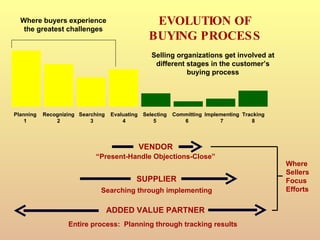
EVOLUTION OF BUYING PROCESS Selling organizations get involved at different stages in the customer’s buying process Where buyers experience the greatest challenges Planning 1 Recognizing 2 Searching 3 Evaluating 4 Selecting 5 Committing 6 Implementing 7 Tracking 8 VENDOR “ Present-Handle Objections-Close” SUPPLIER Searching through implementing ADDED VALUE PARTNER Entire process:  Planning through tracking results Where Sellers Focus Efforts
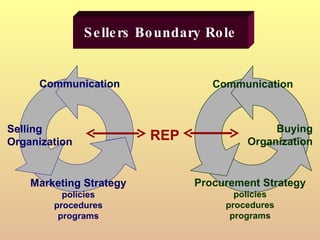
Sellers Boundary Role Communication Selling Organization Marketing Strategy policies procedures programs REP Communication Buying Organization Procurement Strategy policies procedures programs
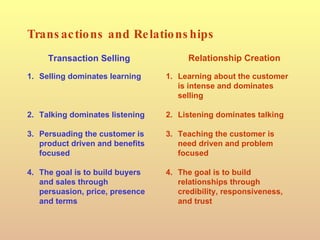
Transactions and Relationships 1. Selling dominates learning 2. Talking dominates listening 3. Persuading the customer is product driven and benefits focused 4. The goal is to build buyers and sales through persuasion, price, presence and terms 1. Learning about the customer is intense and dominates selling 2. Listening dominates talking 3. Teaching the customer is need driven and problem focused 4. The goal is to build relationships through credibility, responsiveness, and trust Transaction Selling Relationship Creation
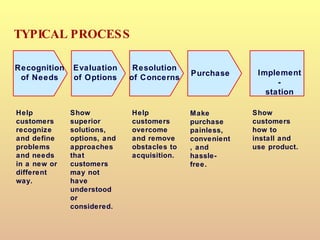
TYPICAL PROCESS Help customers recognize and define problems and needs in a new or different way.  Show superior solutions, options, and approaches that customers may not have understood or considered. Help customers overcome and remove obstacles to acquisition. Make purchase painless, convenient, and hassle-free. Show customers how to install and use product. Implement- station Recognition of Needs Evaluation of Options Resolution of Concerns Purchase
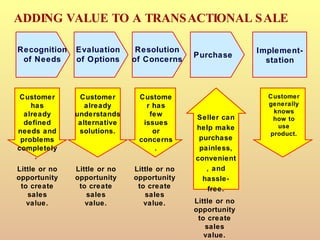
ADDING VALUE TO A TRANSACTIONAL SALE Customer generally knows how to use product. Recognition of Needs Evaluation of Options Resolution of Concerns Purchase Implement- station Little or no opportunity to create sales value. Seller can help make purchase painless, convenient, and hassle-free. Little or no opportunity to create sales value. Customer has few issues or concerns. Customer already understands alternative solutions. Little or no opportunity to create sales value. Customer has already defined needs and problems completely.  Little or no opportunity to create sales value.
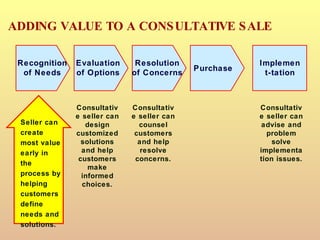
Consultative seller can design customized solutions and help customers make informed choices. Consultative seller can counsel customers and help resolve concerns. Consultative seller can advise and problem solve implementation issues. ADDING VALUE TO A CONSULTATIVE SALE Seller can create most value early in the process by helping customers define needs and solutions. Recognition of Needs Evaluation of Options Resolution of Concerns Purchase Implement-tation
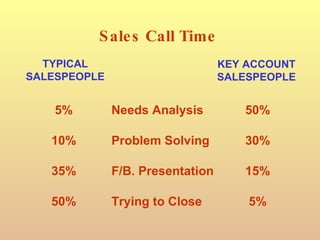
Sales Call Time 5% Needs Analysis 50% 10% Problem Solving 30% 35% F/B. Presentation 15% 50% Trying to Close 5% TYPICAL SALESPEOPLE KEY ACCOUNT SALESPEOPLE
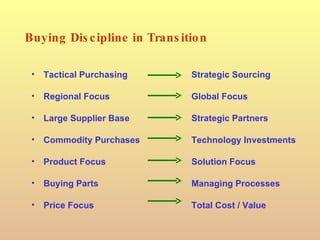
Buying Discipline in Transition Tactical Purchasing Strategic Sourcing Regional Focus Global Focus Large Supplier Base Strategic Partners Commodity Purchases Technology Investments Product Focus Solution Focus Buying Parts Managing Processes Price Focus Total Cost / Value
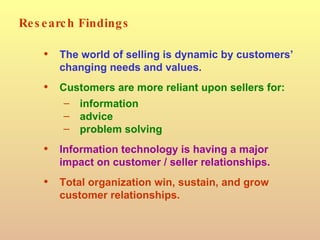
Research Findings The world of selling is dynamic by customers’ changing needs and values. Customers are more reliant upon sellers for: information advice problem solving Information technology is having a major impact on customer / seller relationships. Total organization win, sustain, and grow customer relationships.
Implications for Salespeople Salespeople need to understand how to: Respond to the needs customers have for information, advice and problem solving. Create value beyond their products and services in a way that differentiates the selling organization from its competition. Create and manage the organization-to-organization relationship.
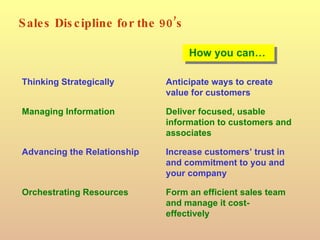
Sales Discipline for the 90’s Thinking Strategically Anticipate ways to create value for customers Managing Information Deliver focused, usable information to customers and associates Advancing the Relationship Increase customers’ trust in and commitment to you and your company Orchestrating Resources Form an efficient sales team and manage it cost-effectively How you can…
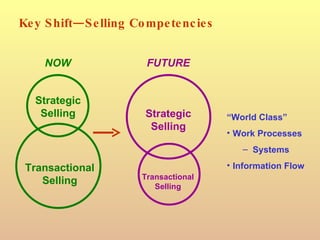
Key Shift—Selling Competencies “ World Class” Work Processes Systems Information Flow Transactional Selling Strategic Selling FUTURE Strategic Selling Transactional Selling NOW
“ Bottom Line” A business can no longer rely on the uniqueness of their products to retain customers or grow new sales revenue. Customers will align their business with strategic suppliers who understand their business and bring a unique offering which adds value— impacts their “bottom line” through increased sales revenue or reduced costs
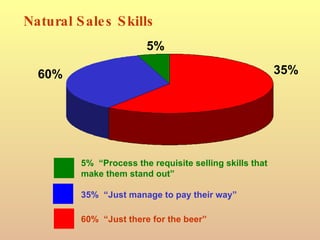
Natural Sales Skills 60% 5% 35% 5%  “Process the requisite selling skills that make them stand out” 35%  “Just manage to pay their way” 60%  “Just there for the beer”
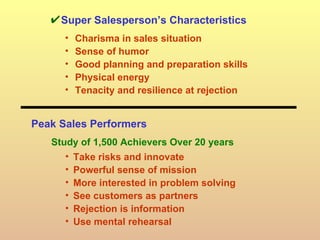
Super Salesperson’s Characteristics Charisma in sales situation Sense of humor Good planning and preparation skills Physical energy Tenacity and resilience at rejection Peak Sales Performers Study of 1,500 Achievers Over 20 years Take risks and innovate Powerful sense of mission More interested in problem solving See customers as partners Rejection is information Use mental rehearsal
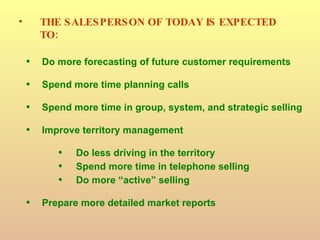
THE SALESPERSON OF TODAY IS EXPECTED TO: Do more forecasting of future customer requirements Spend more time planning calls Spend more time in group, system, and strategic selling Improve territory management Do less driving in the territory Spend more time in telephone selling Do more “active” selling Prepare more detailed market reports
PROFITS
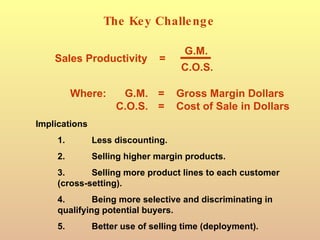
The Key Challenge Implications 1. Less discounting. 2. Selling higher margin products. 3. Selling more product lines to each customer (cross-setting). 4. Being more selective and discriminating in qualifying potential buyers. 5. Better use of selling time (deployment). Sales Productivity  = G.M. C.O.S. Where: G.M. = Gross Margin Dollars C.O.S. = Cost of Sale in Dollars
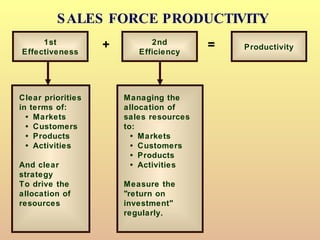
SALES FORCE PRODUCTIVITY 1st Effectiveness 2nd Efficiency Productivity Clear priorities in terms of: • Markets • Customers • Products • Activities And clear strategy To drive the allocation of resources Managing the allocation of sales resources to: • Markets • Customers • Products • Activities Measure the "return on investment" regularly. = +
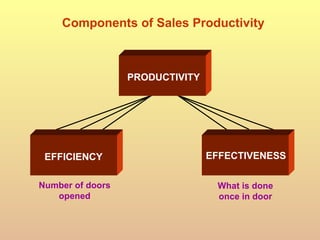
EFFICIENCY EFFECTIVENESS PRODUCTIVITY Number of doors opened What is done once in door Components of Sales Productivity
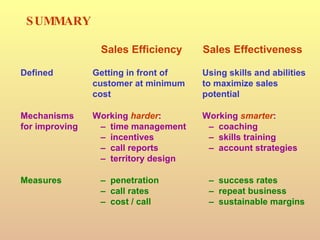
SUMMARY Defined Getting in front of Using skills and abilities customer at minimum to maximize sales cost potential Mechanisms Working  harder : Working  smarter : for improving –  time management –  coaching –  incentives –  skills training –  call reports –  account strategies –  territory design Measures –  penetration –  success rates –  call rates –  repeat business –  cost / call –  sustainable margins Sales Efficiency Sales Effectiveness

Strategic Planning PowerPoint Presentation

  • 1.
    Strategic Planning SalesPlanning Strategies and Resource Management Prepared by Larry Podgorny
  • 2.
    Why Plan? Alice:Which way should I go? Cheshire Cat: That depends on where you are going. Alice: I don’t know where I am going. Cheshire Cat: Then it doesn’t matter which way you go!! Lewis Carroll 1872 Through the Looking-Glass
  • 3.
    The Plan Inthe beginning was the plan. And then came the assumptions. And the assumptions were with out form. And the plan was completely without substance. And darkness was upon the face of the workers.
  • 4.
    Definition of Strategy/StrategicA careful plan or method The art of devising or employing plans or stratagems toward a goal Of great importance within an integrated whole or to a planned effect Necessary to or important in the initiation, conduct, or completion of a strategic plan
  • 5.
    What Strategic Planningis Not Strategic planning is not forecasting Strategic planning is not the simple application of quantitative techniques to business planning. Strategic planning is concerned with making decisions today that will affect the organization (product line) and it’s future. Strategic planning does not eliminate risk, it helps managers access the risks they must take by gaining a better understanding of the parameters involved in their decisions.
  • 6.
    Simplified Process ofStrategic Planning The process of strategic planning is a step-by-step approach three key questions that lie at the heart of any business strategy: What are you going to sell? Who are your target customers? How can you beat or avoid your competition? If you can answer these three questions well, you have a strategy.
  • 7.
    Simplified Process ofStrategic Planning (Cont.) There’s no denying that a simplified process involves complex issues. The process involves digesting a lot of information and requires some fairly difficult analysis. Good strategic planning should be simplified not simplistic. Good intentions alone does not get the job done.
  • 8.
    Simplified Process ofStrategic Planning (Cont.) You need to see it big at first. Start at a high level. Sift through all of the noise to get to the important details The next step is do the things that matter very well. Occasionally, go back up to the high level to make sure everything is still on course.
  • 9.
    Simplified Process OfStrategic Planning- Start By Studying The Way It Is Now You need to gather basic information and facts without making any judgments. Based on this information you build some assumptions, again without making judgments. This process is the central part of the planning process and needs to be reviewed in detail because this information is the foundation for all further strategy discussions and decisions.
  • 10.
    Data External SituationInternal Situation Capabilities and competencies Ideas Assumptions Analysis Strategic assessment Strategic Issues Direction 6. Strategies Commitment Mission Statement Goals Objectives Implementation Action Plans Budgets Schedules
  • 11.
    Simplified Process ofStrategic Planning- How it Works Planning Gather Information Assess Capabilities Make Assumptions Make Strategic Assessments Formulate Strategy Establish Goals and Objectives Formulate Tentative Action Plans Finalize Action Plans Execution Monitor Developments and Progress
  • 12.
    Total Organizational PlanningSales Plan Target Account Strategy Key Account Strategy Maintenance Account Strategy Why Bother Account Strategy Territory Plans Key and Target Account Plans Action Plans Control & Evaluation Shorter Term Business Plan Market Plan Strategic Planning Marketing Information Long Term Business Plan Strategic Tactical
  • 13.
    Start by Studyingthe Way It Is Now The course to your vision, like all navigation, starts with a known position. What markets should you pursue Who are your competitors Where is your competitive advantage What are your strengths What are your weaknesses Figuring out point A is the first essential step to charting a course to get to point B. So get your bearings! Where are you today?
  • 14.
    P O SI T I O N I N G Which segments / customers will we concentrate on ? Whom will we challenge for these customers? What incentives will we provide to get them to buy from us… rather than from competitors? CUSTOMER TARGETS COMPETITOR TARGETS CORE STRATEGY
  • 15.
    BUSINESS STRENGTHS ACCOUNTATTRACTIVENESS High Low Strong Weak DEFINING AND SELECTING KEY/TARGET ACCOUNTS Size Growth Profitability Location Purchasing criteria and processes Current suppliers Status of customer (prestige) Product range Product efficacy (the power to produce an effect ) Service quality (inc. distribution) Price Associated services (e.g. Tech advice) Reputation/image Past experience Quality of sales staff Quality of relationships Invest / Grow Selectively Invest Maintain Manage for Cash / Withdraw
  • 16.
    ACCOUNT PORTFOLIO ANALYSISAttractiveness: Accounts are very attractive since they offer high opportunity and sales organization has strong position. Sales call strategy: Accounts should receive a high level of sales calls since they are the sales organization’s most attractive accounts. Attractiveness: Accounts are potentially attractive since they offer high opportunity, but sales organization currently has weak position with accounts. Sales call strategy: Selected accounts should receive a high level of sales calls to strengthen the sales organizations position. Attractiveness: Accounts are somewhat attractive since sales organization has strong position, but future opportunity is limited. Sales call strategy: Accounts should receive a moderate level of sales calls to maintain the current strength of the sales organization’s position. And, efforts should be made to replace field sales calls with telephone sales. Attractiveness: Accounts are very unattractive since they offer low opportunity and sales organization has weak position. Sales call strategy: Accounts should receive no field sales calls and a minimum of inside sales resources. Strong Strength of Position Weak High Account Opportunity Low KEY TARGET MAINTENANCE WHY BOTHER
  • 17.
    ACCOUNT SEGMENTATION ANDPRIORITIZATION KEY ACCOUNTS 10-20% of your account base 80% of your GP$ Receives less than 50% of your resources TARGET ACCOUNTS (Your competition’s Key Accounts) MAINTENANCE ACCOUNTS WHY BOTHER? ACCOUNTS Gets very little attention 40-45% of your account base 10-15% of your GP$ Receives 30-40% of your resources 30-40% of your account base Less than 5% of your GP$ Receives 20-30% of your resources Creates 90% of your “headaches” High ACCOUNT ATTRACTIVENESS Low Strong Weak YOUR STRENGTH OF POSITION
  • 18.
    Sales Team andSelling Effort Sales Channel: Field Selling and Inside Sales Selling Effort: Heavy Sales Channel: Major Account PROGRAMS Selling Effort: Heavy by Specialist Sales Channel: Direct Marketing, Teleselling, and Field Selling Selling Effort: Heavy (best prospects) Low (other prospects) Sales Channel: Inside Sales Field Selling and Teleselling Selling Effort: Moderate Sales Channel: Teleselling, Direct Marketing, and Some Inside Selling Effort: Low Strong Weak ACCOUNT OPPORTUNITY Strong COMPETITIVE POSITION Weak KEY TARGET MAINTENANCE WHY BOTHER
  • 19.
    Better Understanding ofCustomer’s Needs Better Selectivity Better Selling Strategies Better Time & Territory Management The Selling Ballgame Changing Business Environment Leads to Changing Selling Environment Resulting in Harder to Get and Hold Customers and It Costs More! Implications
  • 20.
  • 21.
    Your Scarcest ResourceTOTAL BUSINESS DAYS 2002 252 Less: • Vacation 10 • Holidays 10 • Personal absences 5 25 WORKING DAYS AVAILABLE IN YEAR 227 Less: • Meetings, Trade Shows, etc. • Training • Customer unavailability • Miscellaneous TOTAL
  • 22.
    Administration 16% Administration16% HOW SALESPEOPLE SPEND THEIR TIME Acct. Service/ Coordination 13% Acct. Service/ Coordination 11% Face-to-Face Selling 29% Face-to-Face Selling 30% Phone Selling 25% Phone Selling 25% Travel 17% Travel 18% 2001 2000
  • 23.
    The Contemporary MarketingConcept Customer Orientation The purpose of a business is to satisfy the needs of customers. Products and services are important only to the extent that they satisfy these needs—they are means rather than ends. Therefore, marketing starts with the determination of customer needs and ends with the repeated satisfaction of those needs. Profit Orientation A business must satisfy the needs of its customers at an acceptable level of profitability. Therefore, the purpose of marketing is not simply to generate sales or achieve a certain market share, but rather to produce profitable sales and a profitable market share. Integrated Effort All activities or a business should be integrated and coordinated so as to satisfy customer needs at a satisfactory rate of profitability. Marketing must be coordinated with finance, production, personnel administration, engineering, and research and development. Moreover, all marketing activities must be effectively integrated and coordinated in order to achieve market impact.
  • 24.
    I. Customer ChangeDrivers Raw material shortages Regulatory agencies Environmental Global competition Trade agreements (NAFTA, GATT) Mergers/acquisitions Automation/technology Reduction in cycle time “ Price” “ Quality” Down sizing
  • 25.
    Customer Change Drivers (cont’d.) Reengineering Out-sourcing Systems versus products Out-sourcing of engineering and R&D to vendors Long term contracts (5 years) Sharing of warranty costs by suppliers EDI Vendor reduction
  • 26.
    II. Purchasing Behavior/BuyingRelationships Manage supply channel – strategic alliances – partnering – customer linked strategies – integrated supply National account programs Single source – product breadth – product depth EDI – seamless order and delivery – automation – paperless Removal / reduction in any redundancy Vendor reduction
  • 27.
    Purchasing Behavior/Buying Relationships (cont’d.) Broader offering of “true” value added services Proof of performance—vendor score cards provided by vendors Vendor as a business consultant to account Problem solving vendors will be chosen Reduction of in-house expertise by customers Require modular / systems, global vendors with total quality Purchase “packages” of integrated components (systems) versus single components Better P.O.P. merchandising
  • 28.
    III. Role ofthe Sales Team Increased speed of response Technical value-added sales calls Greater knowledge of customer, competition and sellers company Ability to make decisions (empowerment) Relationship selling at higher level—sell the “whole” customer Empathy for the customer Functional sellers – sales teams/sellers focused on opening accounts through “selling” creative solutions to problems – account managers on accounts to “service”
  • 29.
    IV. Sales ForceIssues / Problems Willingness to change Different organizational structure, e.g., Hunters and Farmers New skills Sales force automation Accountability / evaluation / compensation More specialized sellers required—currently generalists Total company will become a selling team—cultural change Shift paradigm from products to integrated solution systems More research at the account level Sharing of customer information
  • 30.
    V. Change AreasInternational, national account perspectives Better technical skills Better research skills “ Understanding” Customer specialized sales forces
  • 31.
    Why Do SalesOrganizations Become Obsolete? Growth Evolution I II III IV Any business is good! All Business is good! What business is good? Certain business is good! One product One market One product One big market Old/new products many markets Redefine customer segment selling Sell to survive Sell volume to lower costs Sell volume to hold share Optimize to get best returns Start-up Volume growth Market share Optimization
  • 32.
    THE PURPOSE CustomerResource Allocation Decisions What segment(s) to call on What volume segments to call on: – High volume vs. low volume – National accounts vs. smaller accounts What profitability segments to call on: highly profitable vs. less profitable New vs. existing accounts High penetration vs. low penetration accounts What geography to focus on Headquarters vs. field calls Product Resource Allocation Decisions New vs. existing products High volume vs. low volume products Easy to sell vs. hard to sell products – Familiar vs. unfamiliar products – Products with high short-term impact and low carryovers vs. products with low short-term impact and high carryover – High-tech products vs. low -tech products – Long selling cycle vs. short selling cycle – Differentiated vs. non-differentiated – Highly competitive vs. noncompetitive Activity Resource Allocation Decisions Hunting vs. farming Selling vs. servicing Relationship expert vs. product expert vs. industry expert vs. customer expert SALES FORCE TIME & EFFORT
  • 33.
  • 34.
    EVOLUTION OF BUYINGPROCESS Selling organizations get involved at different stages in the customer’s buying process Where buyers experience the greatest challenges Planning 1 Recognizing 2 Searching 3 Evaluating 4 Selecting 5 Committing 6 Implementing 7 Tracking 8 VENDOR “ Present-Handle Objections-Close” SUPPLIER Searching through implementing ADDED VALUE PARTNER Entire process: Planning through tracking results Where Sellers Focus Efforts
  • 35.
    Sellers Boundary RoleCommunication Selling Organization Marketing Strategy policies procedures programs REP Communication Buying Organization Procurement Strategy policies procedures programs
  • 36.
    Transactions and Relationships1. Selling dominates learning 2. Talking dominates listening 3. Persuading the customer is product driven and benefits focused 4. The goal is to build buyers and sales through persuasion, price, presence and terms 1. Learning about the customer is intense and dominates selling 2. Listening dominates talking 3. Teaching the customer is need driven and problem focused 4. The goal is to build relationships through credibility, responsiveness, and trust Transaction Selling Relationship Creation
  • 37.
    TYPICAL PROCESS Helpcustomers recognize and define problems and needs in a new or different way. Show superior solutions, options, and approaches that customers may not have understood or considered. Help customers overcome and remove obstacles to acquisition. Make purchase painless, convenient, and hassle-free. Show customers how to install and use product. Implement- station Recognition of Needs Evaluation of Options Resolution of Concerns Purchase
  • 38.
    ADDING VALUE TOA TRANSACTIONAL SALE Customer generally knows how to use product. Recognition of Needs Evaluation of Options Resolution of Concerns Purchase Implement- station Little or no opportunity to create sales value. Seller can help make purchase painless, convenient, and hassle-free. Little or no opportunity to create sales value. Customer has few issues or concerns. Customer already understands alternative solutions. Little or no opportunity to create sales value. Customer has already defined needs and problems completely. Little or no opportunity to create sales value.
  • 39.
    Consultative seller candesign customized solutions and help customers make informed choices. Consultative seller can counsel customers and help resolve concerns. Consultative seller can advise and problem solve implementation issues. ADDING VALUE TO A CONSULTATIVE SALE Seller can create most value early in the process by helping customers define needs and solutions. Recognition of Needs Evaluation of Options Resolution of Concerns Purchase Implement-tation
  • 40.
    Sales Call Time5% Needs Analysis 50% 10% Problem Solving 30% 35% F/B. Presentation 15% 50% Trying to Close 5% TYPICAL SALESPEOPLE KEY ACCOUNT SALESPEOPLE
  • 41.
    Buying Discipline inTransition Tactical Purchasing Strategic Sourcing Regional Focus Global Focus Large Supplier Base Strategic Partners Commodity Purchases Technology Investments Product Focus Solution Focus Buying Parts Managing Processes Price Focus Total Cost / Value
  • 42.
    Research Findings Theworld of selling is dynamic by customers’ changing needs and values. Customers are more reliant upon sellers for: information advice problem solving Information technology is having a major impact on customer / seller relationships. Total organization win, sustain, and grow customer relationships.
  • 43.
    Implications for SalespeopleSalespeople need to understand how to: Respond to the needs customers have for information, advice and problem solving. Create value beyond their products and services in a way that differentiates the selling organization from its competition. Create and manage the organization-to-organization relationship.
  • 44.
    Sales Discipline forthe 90’s Thinking Strategically Anticipate ways to create value for customers Managing Information Deliver focused, usable information to customers and associates Advancing the Relationship Increase customers’ trust in and commitment to you and your company Orchestrating Resources Form an efficient sales team and manage it cost-effectively How you can…
  • 45.
    Key Shift—Selling Competencies“ World Class” Work Processes Systems Information Flow Transactional Selling Strategic Selling FUTURE Strategic Selling Transactional Selling NOW
  • 46.
    “ Bottom Line”A business can no longer rely on the uniqueness of their products to retain customers or grow new sales revenue. Customers will align their business with strategic suppliers who understand their business and bring a unique offering which adds value— impacts their “bottom line” through increased sales revenue or reduced costs
  • 47.
    Natural Sales Skills60% 5% 35% 5% “Process the requisite selling skills that make them stand out” 35% “Just manage to pay their way” 60% “Just there for the beer”
  • 48.
    Super Salesperson’s CharacteristicsCharisma in sales situation Sense of humor Good planning and preparation skills Physical energy Tenacity and resilience at rejection Peak Sales Performers Study of 1,500 Achievers Over 20 years Take risks and innovate Powerful sense of mission More interested in problem solving See customers as partners Rejection is information Use mental rehearsal
  • 49.
    THE SALESPERSON OFTODAY IS EXPECTED TO: Do more forecasting of future customer requirements Spend more time planning calls Spend more time in group, system, and strategic selling Improve territory management Do less driving in the territory Spend more time in telephone selling Do more “active” selling Prepare more detailed market reports
  • 50.
  • 51.
    The Key ChallengeImplications 1. Less discounting. 2. Selling higher margin products. 3. Selling more product lines to each customer (cross-setting). 4. Being more selective and discriminating in qualifying potential buyers. 5. Better use of selling time (deployment). Sales Productivity = G.M. C.O.S. Where: G.M. = Gross Margin Dollars C.O.S. = Cost of Sale in Dollars
  • 52.
    SALES FORCE PRODUCTIVITY1st Effectiveness 2nd Efficiency Productivity Clear priorities in terms of: • Markets • Customers • Products • Activities And clear strategy To drive the allocation of resources Managing the allocation of sales resources to: • Markets • Customers • Products • Activities Measure the "return on investment" regularly. = +
  • 53.
    EFFICIENCY EFFECTIVENESS PRODUCTIVITYNumber of doors opened What is done once in door Components of Sales Productivity
  • 54.
    SUMMARY Defined Gettingin front of Using skills and abilities customer at minimum to maximize sales cost potential Mechanisms Working harder : Working smarter : for improving – time management – coaching – incentives – skills training – call reports – account strategies – territory design Measures – penetration – success rates – call rates – repeat business – cost / call – sustainable margins Sales Efficiency Sales Effectiveness