By: lorelyn t. dumaugPPBS IN DEPARTMENT OF BUDGET AND MANAGEMENT (DBM)
Department of Budget and Management (DBM)(Filipino: KagawaranngPagbabadyet at Pamamahala) is an executive body under the Office of the President of the Philippines. It is responsible for the sound and efficient use of government resources for national development and also as an instrument for the meeting of national socio-economic and political development goals.
Incumbent SecretaryFlorencio "Butch" Barsana Abad is the current Philippine Secretary of Budget and Management.[1] On June 29, 2010, President Benigno Aquino III picked him as his Secretary of Budget and Management. He held the education secretary post before in the administration of Gloria Macapagal-Arroyobefore he resigned amid the president's alleged involvement in the 2005 Hello Garci Scandal.t Secretary of DBM
BRIEF HISTORY OF DBMThe Budget Commission was established by Executive Order (EO) No. 25 on April 25, 1936. Became a Ministry by virtue of Presidential Decree (PD) No. 1405, signed on June 11, 1978.First Budget Law was passed on December 17, 1937 as Commonwealth Act (CA) No. 246. It took effect on January 1, 1938
BRIEF HISTORY OF DBMOn June 4, 1954, RA No. 992, otherwise called the Revised Budget Act, was enacted providing for an enhanced role of the Budget Commission as the fiscal arm and budgeting adviser of the President. Parliamentary form of government was instituted by the 1973 Constitution.  The minister in charge of the budget, chairing the Committee on Appropriations and Reorganization. Through the Budget Reform Decree of 1977, the planning, programming and budgeting linkages of the Ministry was further strengthened.
BRIEF HISTORY OF DBMUnder  President Corazon C. Aquino. The legislative power was temporarily reposed on the President. Budgetary functions once more were exercised by the Office of Budget and Management. EO No. 292, issued pursuant to the 1987 Constitution, provided for major organizational subdivisions of the Department of Budget and Management
BRIEF HISTORY OF DBMIn 1992, under Fidel V. Ramos, government budgeting aimed to make the National Budget an instrument for breaking the boom and bustcycle that had characterized the Philippine economy in the past. Beyond sustaining the operations of government and its projects, the budget became an economic stimulus and a means to disperse the gains of economic development
BRIEF HISTORY OF DBMAt the outset of Joseph Estrada’s presidency, the Asian financial crisis came.     To maintain macroeconomic stability in light of the effects of the economic turmoil the government had to raise domestic demand by sustaining expenditures and pump-priming the areas of public infrastructure and social services.  	Expansionary fiscal policy by allowing a reasonable level of cyclical deficit to be financed largely through foreign borrowing while offsetting the negative impact of deficit by introducing structural reforms in the budget process.
BRIEF HISTORY OF DBMPresident Gloria Macapagal-Arroyo, the DBM focused its efforts on deepening fiscal responsibility, enhancing the efficiency of public expenditures, and promoting good governance.
Major areas of concernin PGMAit intensified efforts at strengthening inter-governmental relations, eliciting increased participation from the private sector in the overall budget process
in intensifying public information on the administration’s fiscal policy, thrusts, and budget policies and procedures.
 Stepped up efforts at enhancing internal management in line with its vision to be seen as an organization that influences the spending behavior and management of resources of agencies towards transparency, equity and accountabilityVision : What Does DBM Aspire to Be?The DBM shall be the premier economic and financial manager of government expenditures that is responsive to national development needs.
Mission : What is DBM's Guiding Mission? The DBM shall lead public expenditure management towards national development.
DBM’SMajor Final Outputs
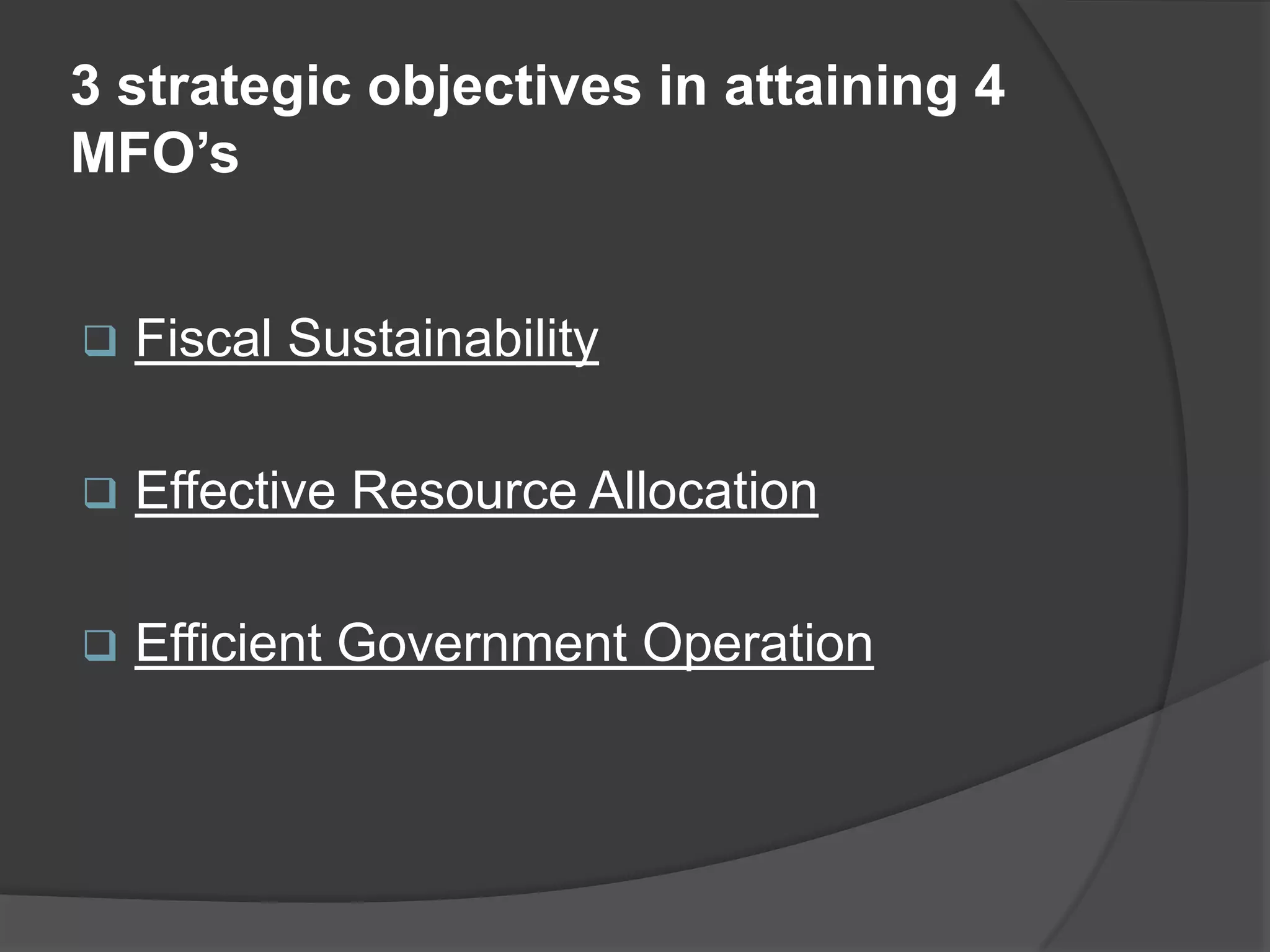
3 strategic objectives in attaining 4 MFO’sFiscal Sustainability
Effective Resource Allocation
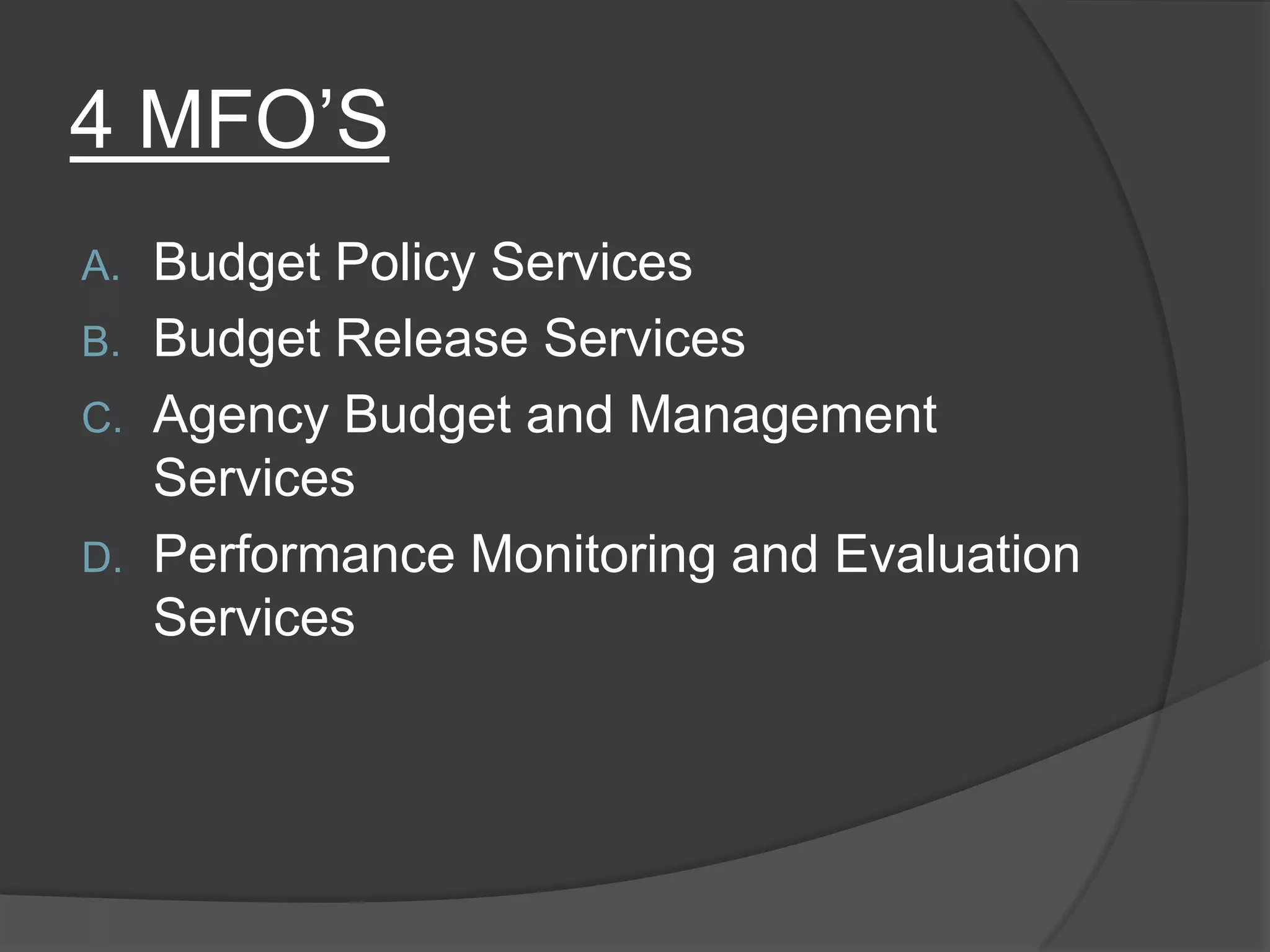
Efficient Government Operation4 MFO’SBudget Policy ServicesBudget Release ServicesAgency Budget and Management ServicesPerformance Monitoring and Evaluation Services
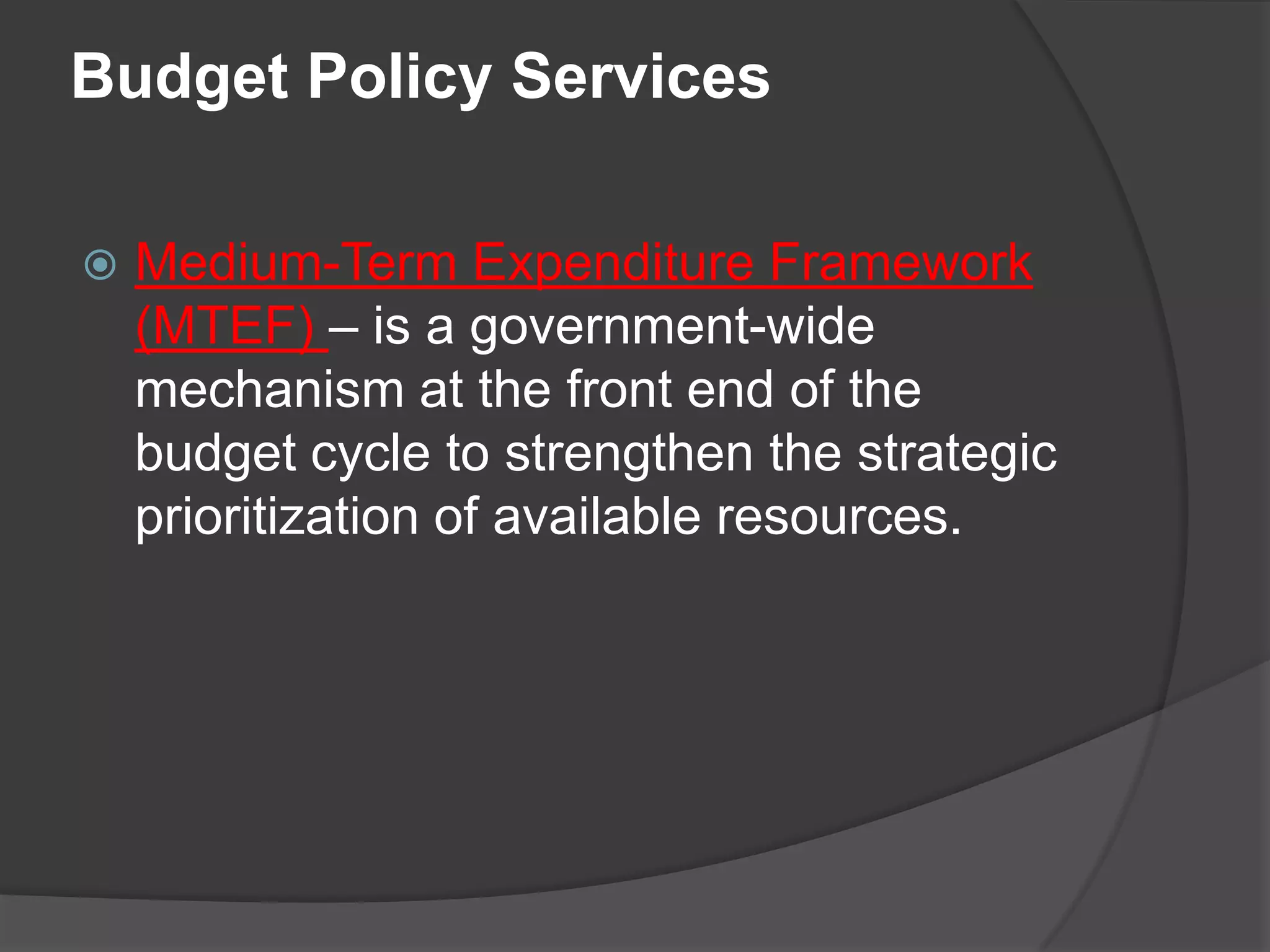
Budget Policy ServicesMedium-Term Expenditure Framework (MTEF) – is a government-wide mechanism at the front end of the budget cycle to strengthen the strategic prioritization of available resources.
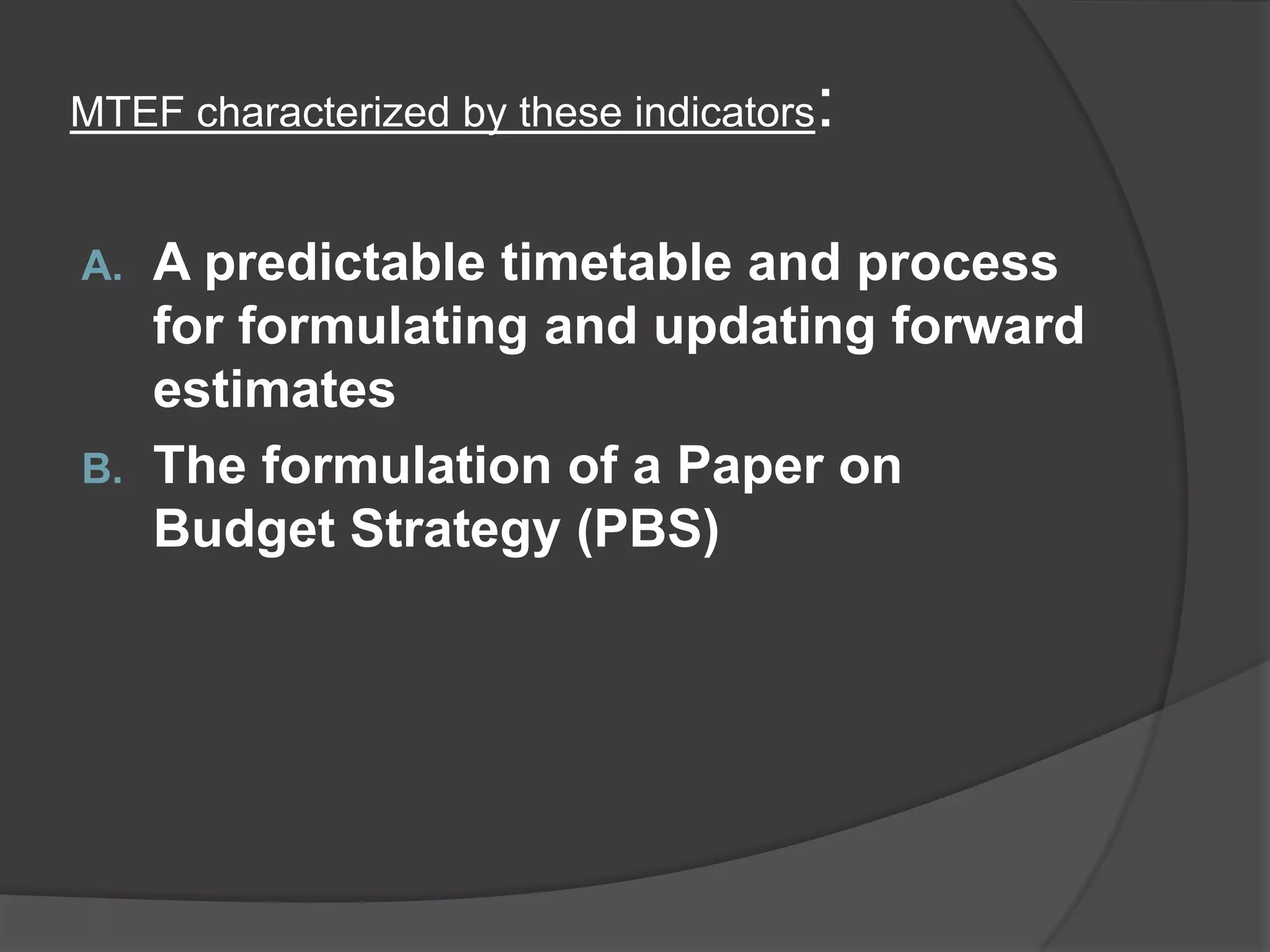
MTEF characterized by these indicators:A predictable timetable and process for formulating and updating forward estimatesThe formulation of a Paper on Budget Strategy (PBS) 
MTEF characterized by these indicators:C. A budget process that incorporates information on the resourcing requirements of programs and projectsD. a strengthened DBM in its role as economic adviser to the President and the Cabinet
Budget Release ServicesThe DBM shall introduce improvements in its expenditure programming and budget releasing (both for allotments and cash allocations) to provide funding predictability and minimize disruptions to agency operations, and to assist agencies to accomplish their operational targets.
IN ATTAINING THE GOAL, IT HAS TO:Provide workable allotment and cash release programs Operationalize a computerized budget execution and cash disbursement moni­toring systems 
IN ATTAINING THE GOAL, IT HAS TO:Develop, implement, and review cash expenditure management policy   
Agency Budget and Management ServicesIn this MFO, it has five(5) inter-related operational objectives/target.
Agency Budget and Management Services1. Implement and embed current reform initiatives, particualrly MTEF, Results-based Budgeting and Performance Management under OPIF (Organizational Performance Indicator Framework), and Procurement Reform in the GOP.
Agency Budget and Management Services2 . Provide high quality and timely advice to the DBCC, the Cabinet, and the President on Budget estimates and expenditure policy proposals to support informed budgetary decisions.
Agency Budget and Management Services3 . Be a well-regarded development partner and adviser to line departments and agencies on all budget and management-related matters, including budget processes, and policies and project/program development.
Agency Budget and Management Services4 . Review and reform service delivery and support systems, organization, staffing and compensation arrangements to encourage better results-based performance by allowing departments to have greater control over their resource deployment and management.
Agency Budget and Management Services5 . Ensure a strong accountability framework as a quid-pro-quo for the relaxation of control on inputs (allotments and cash, staffing and compensation).

DBM PPBS

  • 1.
    By: lorelyn t.dumaugPPBS IN DEPARTMENT OF BUDGET AND MANAGEMENT (DBM)
  • 2.
    Department of Budgetand Management (DBM)(Filipino: KagawaranngPagbabadyet at Pamamahala) is an executive body under the Office of the President of the Philippines. It is responsible for the sound and efficient use of government resources for national development and also as an instrument for the meeting of national socio-economic and political development goals.
  • 3.
    Incumbent SecretaryFlorencio "Butch"Barsana Abad is the current Philippine Secretary of Budget and Management.[1] On June 29, 2010, President Benigno Aquino III picked him as his Secretary of Budget and Management. He held the education secretary post before in the administration of Gloria Macapagal-Arroyobefore he resigned amid the president's alleged involvement in the 2005 Hello Garci Scandal.t Secretary of DBM
  • 4.
    BRIEF HISTORY OFDBMThe Budget Commission was established by Executive Order (EO) No. 25 on April 25, 1936. Became a Ministry by virtue of Presidential Decree (PD) No. 1405, signed on June 11, 1978.First Budget Law was passed on December 17, 1937 as Commonwealth Act (CA) No. 246. It took effect on January 1, 1938
  • 5.
    BRIEF HISTORY OFDBMOn June 4, 1954, RA No. 992, otherwise called the Revised Budget Act, was enacted providing for an enhanced role of the Budget Commission as the fiscal arm and budgeting adviser of the President. Parliamentary form of government was instituted by the 1973 Constitution. The minister in charge of the budget, chairing the Committee on Appropriations and Reorganization. Through the Budget Reform Decree of 1977, the planning, programming and budgeting linkages of the Ministry was further strengthened.
  • 6.
    BRIEF HISTORY OFDBMUnder  President Corazon C. Aquino. The legislative power was temporarily reposed on the President. Budgetary functions once more were exercised by the Office of Budget and Management. EO No. 292, issued pursuant to the 1987 Constitution, provided for major organizational subdivisions of the Department of Budget and Management
  • 7.
    BRIEF HISTORY OFDBMIn 1992, under Fidel V. Ramos, government budgeting aimed to make the National Budget an instrument for breaking the boom and bustcycle that had characterized the Philippine economy in the past. Beyond sustaining the operations of government and its projects, the budget became an economic stimulus and a means to disperse the gains of economic development
  • 8.
    BRIEF HISTORY OFDBMAt the outset of Joseph Estrada’s presidency, the Asian financial crisis came. To maintain macroeconomic stability in light of the effects of the economic turmoil the government had to raise domestic demand by sustaining expenditures and pump-priming the areas of public infrastructure and social services. Expansionary fiscal policy by allowing a reasonable level of cyclical deficit to be financed largely through foreign borrowing while offsetting the negative impact of deficit by introducing structural reforms in the budget process.
  • 9.
    BRIEF HISTORY OFDBMPresident Gloria Macapagal-Arroyo, the DBM focused its efforts on deepening fiscal responsibility, enhancing the efficiency of public expenditures, and promoting good governance.
  • 10.
    Major areas ofconcernin PGMAit intensified efforts at strengthening inter-governmental relations, eliciting increased participation from the private sector in the overall budget process
  • 11.
    in intensifying publicinformation on the administration’s fiscal policy, thrusts, and budget policies and procedures.
  • 12.
    Stepped upefforts at enhancing internal management in line with its vision to be seen as an organization that influences the spending behavior and management of resources of agencies towards transparency, equity and accountabilityVision : What Does DBM Aspire to Be?The DBM shall be the premier economic and financial manager of government expenditures that is responsive to national development needs.
  • 13.
    Mission : Whatis DBM's Guiding Mission? The DBM shall lead public expenditure management towards national development.
  • 14.
  • 15.
    3 strategic objectivesin attaining 4 MFO’sFiscal Sustainability
  • 16.
  • 17.
    Efficient Government Operation4MFO’SBudget Policy ServicesBudget Release ServicesAgency Budget and Management ServicesPerformance Monitoring and Evaluation Services
  • 18.
    Budget Policy ServicesMedium-TermExpenditure Framework (MTEF) – is a government-wide mechanism at the front end of the budget cycle to strengthen the strategic prioritization of available resources.
  • 19.
    MTEF characterized bythese indicators:A predictable timetable and process for formulating and updating forward estimatesThe formulation of a Paper on Budget Strategy (PBS) 
  • 20.
    MTEF characterized bythese indicators:C. A budget process that incorporates information on the resourcing requirements of programs and projectsD. a strengthened DBM in its role as economic adviser to the President and the Cabinet
  • 21.
    Budget Release ServicesTheDBM shall introduce improvements in its expenditure programming and budget releasing (both for allotments and cash allocations) to provide funding predictability and minimize disruptions to agency operations, and to assist agencies to accomplish their operational targets.
  • 22.
    IN ATTAINING THEGOAL, IT HAS TO:Provide workable allotment and cash release programs Operationalize a computerized budget execution and cash disbursement moni­toring systems 
  • 23.
    IN ATTAINING THEGOAL, IT HAS TO:Develop, implement, and review cash expenditure management policy   
  • 24.
    Agency Budget andManagement ServicesIn this MFO, it has five(5) inter-related operational objectives/target.
  • 25.
    Agency Budget andManagement Services1. Implement and embed current reform initiatives, particualrly MTEF, Results-based Budgeting and Performance Management under OPIF (Organizational Performance Indicator Framework), and Procurement Reform in the GOP.
  • 26.
    Agency Budget andManagement Services2 . Provide high quality and timely advice to the DBCC, the Cabinet, and the President on Budget estimates and expenditure policy proposals to support informed budgetary decisions.
  • 27.
    Agency Budget andManagement Services3 . Be a well-regarded development partner and adviser to line departments and agencies on all budget and management-related matters, including budget processes, and policies and project/program development.
  • 28.
    Agency Budget andManagement Services4 . Review and reform service delivery and support systems, organization, staffing and compensation arrangements to encourage better results-based performance by allowing departments to have greater control over their resource deployment and management.
  • 29.
    Agency Budget andManagement Services5 . Ensure a strong accountability framework as a quid-pro-quo for the relaxation of control on inputs (allotments and cash, staffing and compensation).
  • 30.
    Performance Monitoring andEvaluation ServicesThe DBM shall develop an effective government-wide system of monitoring agency performance to provide a sound basis for fiscal planning and expenditure management.
  • 31.