Strategic Implementation
Unit IV
ACTIVATING STRATEGIES
Strategic Implementation
Aspects of Strategic Implementation
• Project implementation
• Procedural implementation
• Resource allocation
• Structural Implementation
• Behavioural Implementation
• Functional Implementation
• Operational implementation
STRUCTURAL IMPLEMENTATION
Aspects of Strategic Implementation
Structures for Strategy
• Major types of structures:
– Entrepreneurial
– Functional
– Divisional
– Strategic Business Unit
– Matrix
– Network
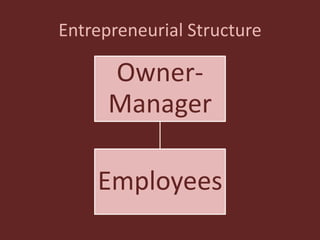
Entrepreneurial Structure
Owner-
Manager
Employees
Entrepreneurial Structure
• Advantages:
– Quick decision-making, as power is centralised.
– Timely response to environmental changes.
– Informal and simple organisation systems.
Entrepreneurial Structure
• Disadvantages:
– Excessive reliance on the owner-manager and so
proves to be demanding for the owner-manager.
– May divert the attention of owner-manager to
day-to-day operational matters and ignore
strategic decision.
– Increasingly inadequate for future requirements if
volume of business expands.
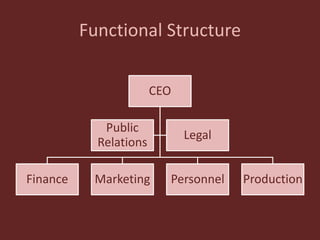
Functional Structure
CEO
Finance Marketing Personnel Production
Public
Relations
Legal
Functional Structure
• Advantages:
– Efficient distribution of work through
specialisation.
– Delegation of day-to-day operational functions.
– Providing time for the top management to focus
on strategic decisions.
Functional Structure
• Disadvantages:
– Creates difficulty in coordination among different
functional areas.
– Creates specialists, which results in narrow
specialisation, often at the cost of the overall
benefit of the organisation.
– Leads to functional, and line and staff conflicts.
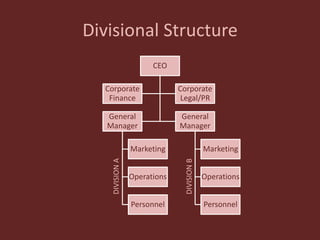
Divisional Structure
CEO
Corporate
Finance
Corporate
Legal/PR
General
Manager
Marketing
Operations
Personnel
General
Manager
Marketing
Operations
Personnel
DIVISIONA
DIVISIONB
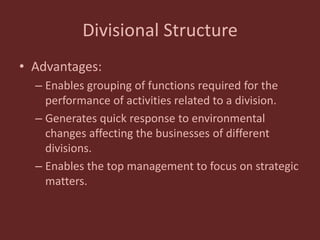
Divisional Structure
• Advantages:
– Enables grouping of functions required for the
performance of activities related to a division.
– Generates quick response to environmental
changes affecting the businesses of different
divisions.
– Enables the top management to focus on strategic
matters.
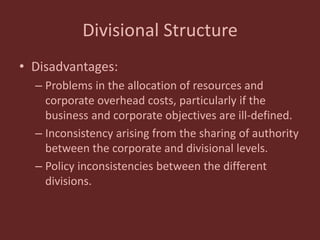
Divisional Structure
• Disadvantages:
– Problems in the allocation of resources and
corporate overhead costs, particularly if the
business and corporate objectives are ill-defined.
– Inconsistency arising from the sharing of authority
between the corporate and divisional levels.
– Policy inconsistencies between the different
divisions.
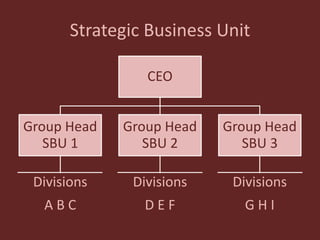
Strategic Business Unit
CEO
Group Head
SBU 1
Divisions
A B C
Group Head
SBU 2
Divisions
D E F
Group Head
SBU 3
Divisions
G H I
Strategic Business Unit
• Advantages:
– Establishes coordination between divisions having
common strategic interests.
– Facilitates strategic management and control of
large, diverse organisations.
– Fixes accountability at the level of distinct
business units.
Strategic Business Unit
• Disadvantages:
– There are too many different SBUs to handle
effectively in a large, diverse organisation.
– Difficulty in assigning responsibility and defining
autonomy for SBU heads.
– Addition of another layer of management
between corporate and divisional management.
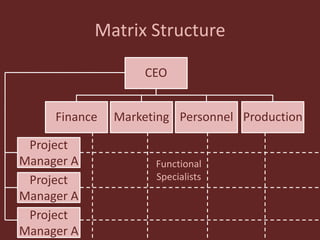
Matrix Structure
CEO
Finance Marketing Personnel Production
Project
Manager A
Project
Manager A
Project
Manager A
Functional
Specialists
Matrix Structure
• Advantages:
– Allows individual specialists to be assigned where
their talent is the most needed.
– Fosters creativity because of the pooling of diverse
talents.
– Provides good exposure to specialists in general
management.
Matrix Structure
• Disadvantages:
– Dual accountability creates confusion and
difficulty for individual team members.
– Requires a high level of vertical and horizontal
combination.
– Shared authority may create communication
problems.
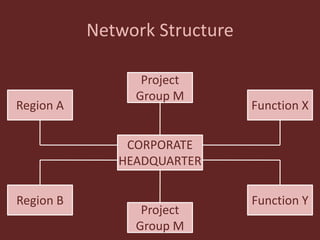
Network Structure
CORPORATE
HEADQUARTER
Project
Group M
Project
Group M
Region A
Region B
Function X
Function Y
Network Structure
• Advantages:
– High level of flexibility to change structural
arrangements in line with business requirements.
– Permits concentration on core competencies of
the firm.
– Adaptability to cope with rapid environmental
change.
Network Structure
• Disadvantages:
– Loss of control and lack of coordination as there
are several partners.
– Risks of over-specialisation as most tasks are
performed by others.
– High costs as duplication of resources could be
there.
Other types of Structures
• Product-based
• Customer-based
• Geographic
• Intrapreneurial
Product-Based Structure
• Grouping of activities on the basis of product
or product lines is followed by organisations
where there is a need to delegate to a division
all functions related to that particular product
or product line.
Customer-Based Structure
• Divisions on the basis of customer groups
served.
• The rationale: the grouping of activities on the
basis of customers would enable the
organisation to provide exclusive attention to
separate and distinct customer groups.
Geographic Structure
• Multi-plant or multiunit organisations which
have several factories and offices dispersed
geographically are usually organised on this
basis.
• Evolves in the process of expansion or
diversification.
Intrapreneurial Structure
• Evolution of organisational structure often
starts with the entrepreneurial structure.
• At the other extreme, a state is reached when
the organisation becomes too large, diverse
and complex.
• They become slow-moving, bureaucratic and
resistant to change.
BEHAVIOURAL IMPLEMENTATION
Aspects of Strategic Implementation
Behavioural Implementation
• Major issues:
– Leadership
– Corporate culture
– Corporate politics and use of power
–Personal Values and Business Ethics
– Social responsibility
STRATEGY IMPLEMENTATION
THROUGH VALUES AND ETHICS
Aspects of Strategic Implementation
Strategy Implementation through
Values and Ethics
• The meaning of values and ethics
• Importance of values and ethics
• Values, ethics and strategy
Values
• Personal values refer to a conception of what
an individual or a group regards as desirable.
• A values is a view of life and a judgement of
what is desirable which is very much a part of
a person’s personality and a group’s morale.
• Personal values are imbibed from parents,
teachers and elders, and as an individual
grows, values are adapted and refined in the
light of new knowledge and experiences.
Values
• Within organisations, values are imparted by
the founder-entrepreneur or a dominant chief
executive, and these remain in some form a
long time after that person is not there.
Ethics
• In the discipline of management studies
business ethics is the study of how personal
moral norms apply to activities and goals of a
commercial enterprise.
• It is not a separate moral standard, but the
study of how the business context poses its
own unique problems for the moral person
who acts as the agent of this system.
Ethics
• Practically, business ethics operates as a
system of values and is concerned primarily
with the relationship of business goals and
techniques to specifically human ends.
• Ethics is concerned with viewing the needs
and aspirations of individuals not merely as
individuals but as a part of the society.
• It also means realisation of the personal
dignity of human beings.
Values and Ethics: Importance
• The twin issues of values and business ethics
have come to occupy the centre stage in
management.
• International organisations such as WB and
IMF are concerned about whether the aid
provided by them is used for the intended
purpose.
Values and Ethics: Importance
• Within India, there are significant social, cultural,
political, technological, and economic factors affecting
the state of personal values and business ethics within
industry.
• Corporate governance has attracted worldwide
attention as a means to induce ethical behaviour in
business.
• According to CII, corporate governance deals with laws,
procedures, practices and implicit rules that determine
a company’s ability to take managerial decisions vis-à-
vis its claimants – in particular, its shareholders,
creditors, the State and employees.
Values and Ethics: Importance
• A typical dilemma faced by strategists is to
somehow reconcile the pragmatic demands of
work to an ethical framework.
Values and Ethics and Strategy
• Personal values and ethics are specially
important for strategists as they are
custodians of immense economic power
vested in business organisations by society.
• The possession of personal values by
strategists is good, but the important issue is
whether it is right to let them affect the
considerations for strategy formulation and
implementation.
Values and Ethics and Strategy
• A relevant question: Can strategists prevent
their personal values from affecting strategy
formulation and implementation?
• Executives in charge of company destinies do
not look exclusively to what a company might
or can do – they sometimes seem heavily
influenced by what they personally want to
do.
Values and Ethics and Strategy
• There has to be a right connection between
values, ethics and strategy.
• It is imperative that strategists take strategic
decisions not only on the basis of purely
economic reasons but also consider values and
ethics.
• Business ethics has traditionally been considered
to integrate core values, such as, honesty, trust,
respect and fairness into strategic management,
policy-making, practising management and
decision-making.
Values and Ethics and Strategy
• A significant change is occurring in considering
business ethics as central to managing
organisations.
• Companies are formulating value-based,
globally-consistent codes for ethical
understanding and appropriate decision-
making at all levels even as they face immense
external challenges.
FUNCTIONAL IMPLEMENTATION
Aspects of Strategic Implementation
Functional Strategies
• Vertical fit
• Horizontal fit
Vertical Fit
• A key task of strategy implementation is to
align or fit the activities and capabilities of an
organisation with its strategies.
• Strategies operate at different levels and there
has to be congruence and coordination among
these strategies. Such a congruence is the
vertical fit.
Vertical Fit
• The consideration of vertical fit leads us to define
functional strategies in terms of their capability
to contribute to the creation of a strategic
advantage for the organisation.
• The above results in the following types of
functional strategies:
– Strategic marketing management
– Strategic financial management
– Strategic operations management
– Strategic human resource management
– Strategic information management
Horizontal Fit
• There has to be congruence and coordination
among the different activities taking place at
the same level.
• This is the horizontal fit.
Horizontal Fit
• The consideration of horizontal fit means that
there has to be an integration of the
operational activities undertaken to provide a
product or service to a customer.
• These have to take place in the course of
operational implementation.
• Operational implementation is the approach
adopted by an organisation to achieve
operational effectiveness.
Functional Plans and Policies
• Nature of functional plans and policies
• Need for functional plans and policies
• Development of functional plans and policies
Nature of Functional Plans and Policies
• Functional strategies operate on a level below
the business strategies.
• There might be several sub-functional areas
within functional strategies.
• Functional strategies, defined in terms of
functional plans and policies – plans or tactics
to implement business strategies, are made
within the guidelines which have been set at
higher levels.
Nature of Functional Plans and Policies
• Plans are formulated to select a course of
action, while policies are required to act as
guidelines to those actions.
• Functional plans and policies, are therefore, in
the nature of the tactics which make a
strategy work.
Nature of Functional Plans and Policies
• Functional managers need guidance from the
corporate and business strategies in order to
make decisions.
• In simple terms, functional plans tell the
functional managers what has to be done,
while functional policies state how the plans
are to be implemented.
Need for Functional Plans and Policies
• According to Glueck functional plans and policies are
developed to ensure that:
– The strategic decisions are implemented by all the parts of an
organisation.
– There is a basis available for controlling activities in the different
functional areas of a business.
– The time spent by functional managers on decision-making may
be reduced as the plans lay down clearly what has to be done
and the policies provide the discretionary framework within
which decisions need to be taken.
– Similar situations occurring in different functional areas are
handled by the functional managers in a consistent manner.
– Coordination across the different functions takes place where
necessary.
Development of Functional Plans and
Policies
• The development of functional plans and policies
is aimed at making the strategies formulated at
the top management level practically feasible at
the functional level.
• The process of development of functional plans
and policies may range from the formal to the
informal.
• The process of developing functional plans and
policies – formal or informal – is similar to that of
strategy formulation.
Development of Functional Plans and
Policies
• Functional areas have been traditionally
segregated into finance, marketing,
production and personnel.
• Information management has emerged as a
significant function within organisations.
• But not all organisations divide functional
areas traditionally – they do it on the basis of
what they actually need.
Functional Plans and Policies
• Financial plans and policies
• Marketing plans and policies
• Operations plans and policies
• Personnel plans and policies
• Information management plans and policies
Personnel Plans and Policies
• Personnel system
• Organisational and employee characteristics
• Industrial relations

Strategic implementation

  • 1.
  • 2.
  • 3.
    Aspects of StrategicImplementation • Project implementation • Procedural implementation • Resource allocation • Structural Implementation • Behavioural Implementation • Functional Implementation • Operational implementation
  • 4.
    STRUCTURAL IMPLEMENTATION Aspects ofStrategic Implementation
  • 5.
    Structures for Strategy •Major types of structures: – Entrepreneurial – Functional – Divisional – Strategic Business Unit – Matrix – Network
  • 6.
  • 7.
    Entrepreneurial Structure • Advantages: –Quick decision-making, as power is centralised. – Timely response to environmental changes. – Informal and simple organisation systems.
  • 8.
    Entrepreneurial Structure • Disadvantages: –Excessive reliance on the owner-manager and so proves to be demanding for the owner-manager. – May divert the attention of owner-manager to day-to-day operational matters and ignore strategic decision. – Increasingly inadequate for future requirements if volume of business expands.
  • 9.
    Functional Structure CEO Finance MarketingPersonnel Production Public Relations Legal
  • 10.
    Functional Structure • Advantages: –Efficient distribution of work through specialisation. – Delegation of day-to-day operational functions. – Providing time for the top management to focus on strategic decisions.
  • 11.
    Functional Structure • Disadvantages: –Creates difficulty in coordination among different functional areas. – Creates specialists, which results in narrow specialisation, often at the cost of the overall benefit of the organisation. – Leads to functional, and line and staff conflicts.
  • 12.
  • 13.
    Divisional Structure • Advantages: –Enables grouping of functions required for the performance of activities related to a division. – Generates quick response to environmental changes affecting the businesses of different divisions. – Enables the top management to focus on strategic matters.
  • 14.
    Divisional Structure • Disadvantages: –Problems in the allocation of resources and corporate overhead costs, particularly if the business and corporate objectives are ill-defined. – Inconsistency arising from the sharing of authority between the corporate and divisional levels. – Policy inconsistencies between the different divisions.
  • 15.
    Strategic Business Unit CEO GroupHead SBU 1 Divisions A B C Group Head SBU 2 Divisions D E F Group Head SBU 3 Divisions G H I
  • 16.
    Strategic Business Unit •Advantages: – Establishes coordination between divisions having common strategic interests. – Facilitates strategic management and control of large, diverse organisations. – Fixes accountability at the level of distinct business units.
  • 17.
    Strategic Business Unit •Disadvantages: – There are too many different SBUs to handle effectively in a large, diverse organisation. – Difficulty in assigning responsibility and defining autonomy for SBU heads. – Addition of another layer of management between corporate and divisional management.
  • 18.
    Matrix Structure CEO Finance MarketingPersonnel Production Project Manager A Project Manager A Project Manager A Functional Specialists
  • 19.
    Matrix Structure • Advantages: –Allows individual specialists to be assigned where their talent is the most needed. – Fosters creativity because of the pooling of diverse talents. – Provides good exposure to specialists in general management.
  • 20.
    Matrix Structure • Disadvantages: –Dual accountability creates confusion and difficulty for individual team members. – Requires a high level of vertical and horizontal combination. – Shared authority may create communication problems.
  • 21.
  • 22.
    Network Structure • Advantages: –High level of flexibility to change structural arrangements in line with business requirements. – Permits concentration on core competencies of the firm. – Adaptability to cope with rapid environmental change.
  • 23.
    Network Structure • Disadvantages: –Loss of control and lack of coordination as there are several partners. – Risks of over-specialisation as most tasks are performed by others. – High costs as duplication of resources could be there.
  • 24.
    Other types ofStructures • Product-based • Customer-based • Geographic • Intrapreneurial
  • 25.
    Product-Based Structure • Groupingof activities on the basis of product or product lines is followed by organisations where there is a need to delegate to a division all functions related to that particular product or product line.
  • 26.
    Customer-Based Structure • Divisionson the basis of customer groups served. • The rationale: the grouping of activities on the basis of customers would enable the organisation to provide exclusive attention to separate and distinct customer groups.
  • 27.
    Geographic Structure • Multi-plantor multiunit organisations which have several factories and offices dispersed geographically are usually organised on this basis. • Evolves in the process of expansion or diversification.
  • 28.
    Intrapreneurial Structure • Evolutionof organisational structure often starts with the entrepreneurial structure. • At the other extreme, a state is reached when the organisation becomes too large, diverse and complex. • They become slow-moving, bureaucratic and resistant to change.
  • 29.
    BEHAVIOURAL IMPLEMENTATION Aspects ofStrategic Implementation
  • 30.
    Behavioural Implementation • Majorissues: – Leadership – Corporate culture – Corporate politics and use of power –Personal Values and Business Ethics – Social responsibility
  • 31.
    STRATEGY IMPLEMENTATION THROUGH VALUESAND ETHICS Aspects of Strategic Implementation
  • 32.
    Strategy Implementation through Valuesand Ethics • The meaning of values and ethics • Importance of values and ethics • Values, ethics and strategy
  • 33.
    Values • Personal valuesrefer to a conception of what an individual or a group regards as desirable. • A values is a view of life and a judgement of what is desirable which is very much a part of a person’s personality and a group’s morale. • Personal values are imbibed from parents, teachers and elders, and as an individual grows, values are adapted and refined in the light of new knowledge and experiences.
  • 34.
    Values • Within organisations,values are imparted by the founder-entrepreneur or a dominant chief executive, and these remain in some form a long time after that person is not there.
  • 35.
    Ethics • In thediscipline of management studies business ethics is the study of how personal moral norms apply to activities and goals of a commercial enterprise. • It is not a separate moral standard, but the study of how the business context poses its own unique problems for the moral person who acts as the agent of this system.
  • 36.
    Ethics • Practically, businessethics operates as a system of values and is concerned primarily with the relationship of business goals and techniques to specifically human ends. • Ethics is concerned with viewing the needs and aspirations of individuals not merely as individuals but as a part of the society. • It also means realisation of the personal dignity of human beings.
  • 37.
    Values and Ethics:Importance • The twin issues of values and business ethics have come to occupy the centre stage in management. • International organisations such as WB and IMF are concerned about whether the aid provided by them is used for the intended purpose.
  • 38.
    Values and Ethics:Importance • Within India, there are significant social, cultural, political, technological, and economic factors affecting the state of personal values and business ethics within industry. • Corporate governance has attracted worldwide attention as a means to induce ethical behaviour in business. • According to CII, corporate governance deals with laws, procedures, practices and implicit rules that determine a company’s ability to take managerial decisions vis-à- vis its claimants – in particular, its shareholders, creditors, the State and employees.
  • 39.
    Values and Ethics:Importance • A typical dilemma faced by strategists is to somehow reconcile the pragmatic demands of work to an ethical framework.
  • 40.
    Values and Ethicsand Strategy • Personal values and ethics are specially important for strategists as they are custodians of immense economic power vested in business organisations by society. • The possession of personal values by strategists is good, but the important issue is whether it is right to let them affect the considerations for strategy formulation and implementation.
  • 41.
    Values and Ethicsand Strategy • A relevant question: Can strategists prevent their personal values from affecting strategy formulation and implementation? • Executives in charge of company destinies do not look exclusively to what a company might or can do – they sometimes seem heavily influenced by what they personally want to do.
  • 42.
    Values and Ethicsand Strategy • There has to be a right connection between values, ethics and strategy. • It is imperative that strategists take strategic decisions not only on the basis of purely economic reasons but also consider values and ethics. • Business ethics has traditionally been considered to integrate core values, such as, honesty, trust, respect and fairness into strategic management, policy-making, practising management and decision-making.

  • 43.
    Values and Ethicsand Strategy • A significant change is occurring in considering business ethics as central to managing organisations. • Companies are formulating value-based, globally-consistent codes for ethical understanding and appropriate decision- making at all levels even as they face immense external challenges.
  • 44.
    FUNCTIONAL IMPLEMENTATION Aspects ofStrategic Implementation
  • 45.
    Functional Strategies • Verticalfit • Horizontal fit
  • 46.
    Vertical Fit • Akey task of strategy implementation is to align or fit the activities and capabilities of an organisation with its strategies. • Strategies operate at different levels and there has to be congruence and coordination among these strategies. Such a congruence is the vertical fit.
  • 47.
    Vertical Fit • Theconsideration of vertical fit leads us to define functional strategies in terms of their capability to contribute to the creation of a strategic advantage for the organisation. • The above results in the following types of functional strategies: – Strategic marketing management – Strategic financial management – Strategic operations management – Strategic human resource management – Strategic information management
  • 48.
    Horizontal Fit • Therehas to be congruence and coordination among the different activities taking place at the same level. • This is the horizontal fit.
  • 49.
    Horizontal Fit • Theconsideration of horizontal fit means that there has to be an integration of the operational activities undertaken to provide a product or service to a customer. • These have to take place in the course of operational implementation. • Operational implementation is the approach adopted by an organisation to achieve operational effectiveness.
  • 50.
    Functional Plans andPolicies • Nature of functional plans and policies • Need for functional plans and policies • Development of functional plans and policies
  • 51.
    Nature of FunctionalPlans and Policies • Functional strategies operate on a level below the business strategies. • There might be several sub-functional areas within functional strategies. • Functional strategies, defined in terms of functional plans and policies – plans or tactics to implement business strategies, are made within the guidelines which have been set at higher levels.
  • 52.
    Nature of FunctionalPlans and Policies • Plans are formulated to select a course of action, while policies are required to act as guidelines to those actions. • Functional plans and policies, are therefore, in the nature of the tactics which make a strategy work.
  • 53.
    Nature of FunctionalPlans and Policies • Functional managers need guidance from the corporate and business strategies in order to make decisions. • In simple terms, functional plans tell the functional managers what has to be done, while functional policies state how the plans are to be implemented.
  • 54.
    Need for FunctionalPlans and Policies • According to Glueck functional plans and policies are developed to ensure that: – The strategic decisions are implemented by all the parts of an organisation. – There is a basis available for controlling activities in the different functional areas of a business. – The time spent by functional managers on decision-making may be reduced as the plans lay down clearly what has to be done and the policies provide the discretionary framework within which decisions need to be taken. – Similar situations occurring in different functional areas are handled by the functional managers in a consistent manner. – Coordination across the different functions takes place where necessary.
  • 55.
    Development of FunctionalPlans and Policies • The development of functional plans and policies is aimed at making the strategies formulated at the top management level practically feasible at the functional level. • The process of development of functional plans and policies may range from the formal to the informal. • The process of developing functional plans and policies – formal or informal – is similar to that of strategy formulation.
  • 56.
    Development of FunctionalPlans and Policies • Functional areas have been traditionally segregated into finance, marketing, production and personnel. • Information management has emerged as a significant function within organisations. • But not all organisations divide functional areas traditionally – they do it on the basis of what they actually need.
  • 57.
    Functional Plans andPolicies • Financial plans and policies • Marketing plans and policies • Operations plans and policies • Personnel plans and policies • Information management plans and policies
  • 58.
    Personnel Plans andPolicies • Personnel system • Organisational and employee characteristics • Industrial relations