4-3 Functions
โ€ขA relation is a function provided there is exactly
one output for each input.
โ€ขIt is NOT a function if one input has more than
one output
INPUT
(DOMAIN)
OUTPUT (RANGE)
FUNCTION
MACHINE
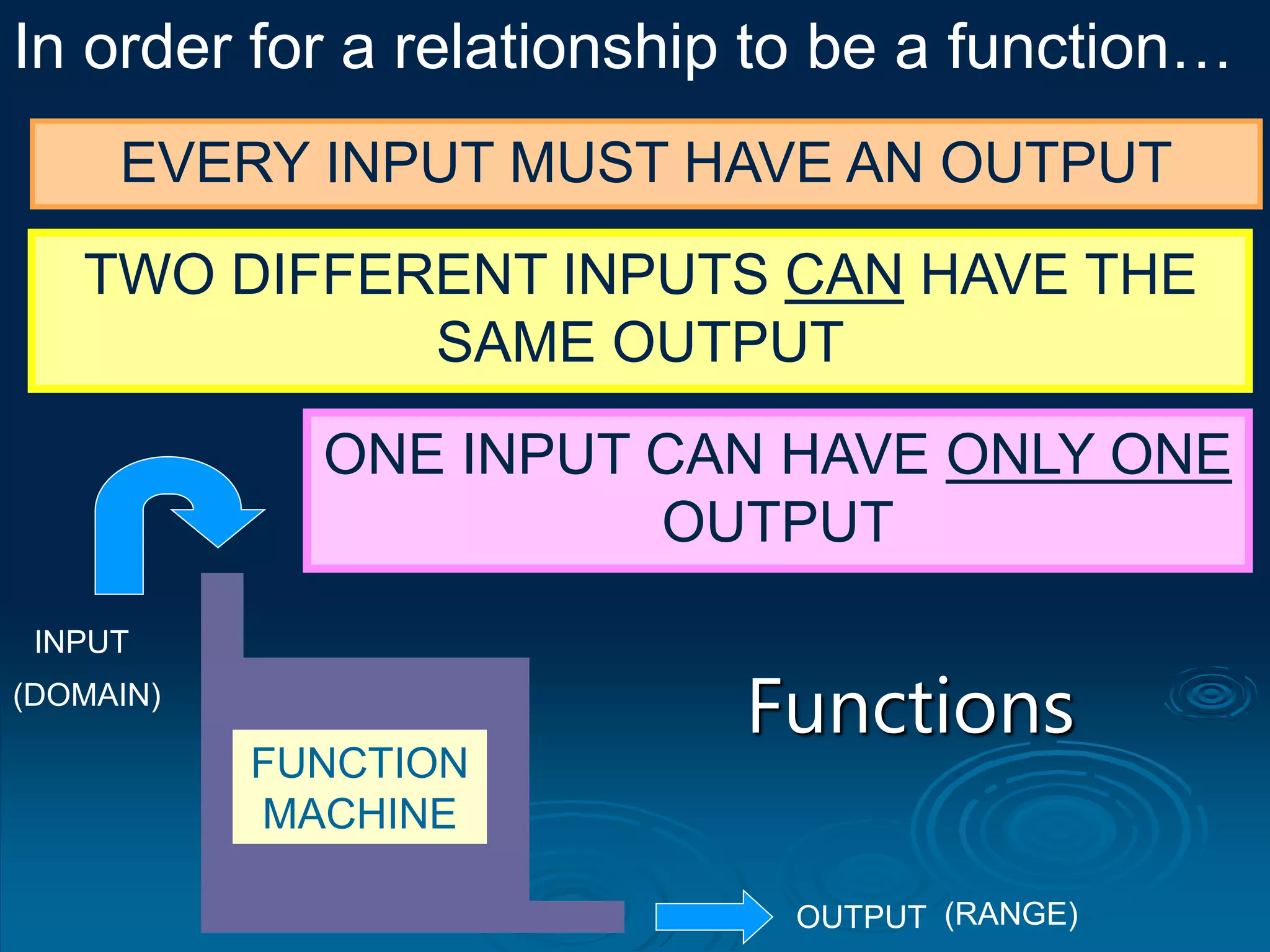
In order for a relationship to be a functionโ€ฆ
EVERY INPUT MUST HAVE AN OUTPUT
TWO DIFFERENT INPUTS CAN HAVE THE
SAME OUTPUT
Functions
ONE INPUT CAN HAVE ONLY ONE
OUTPUT
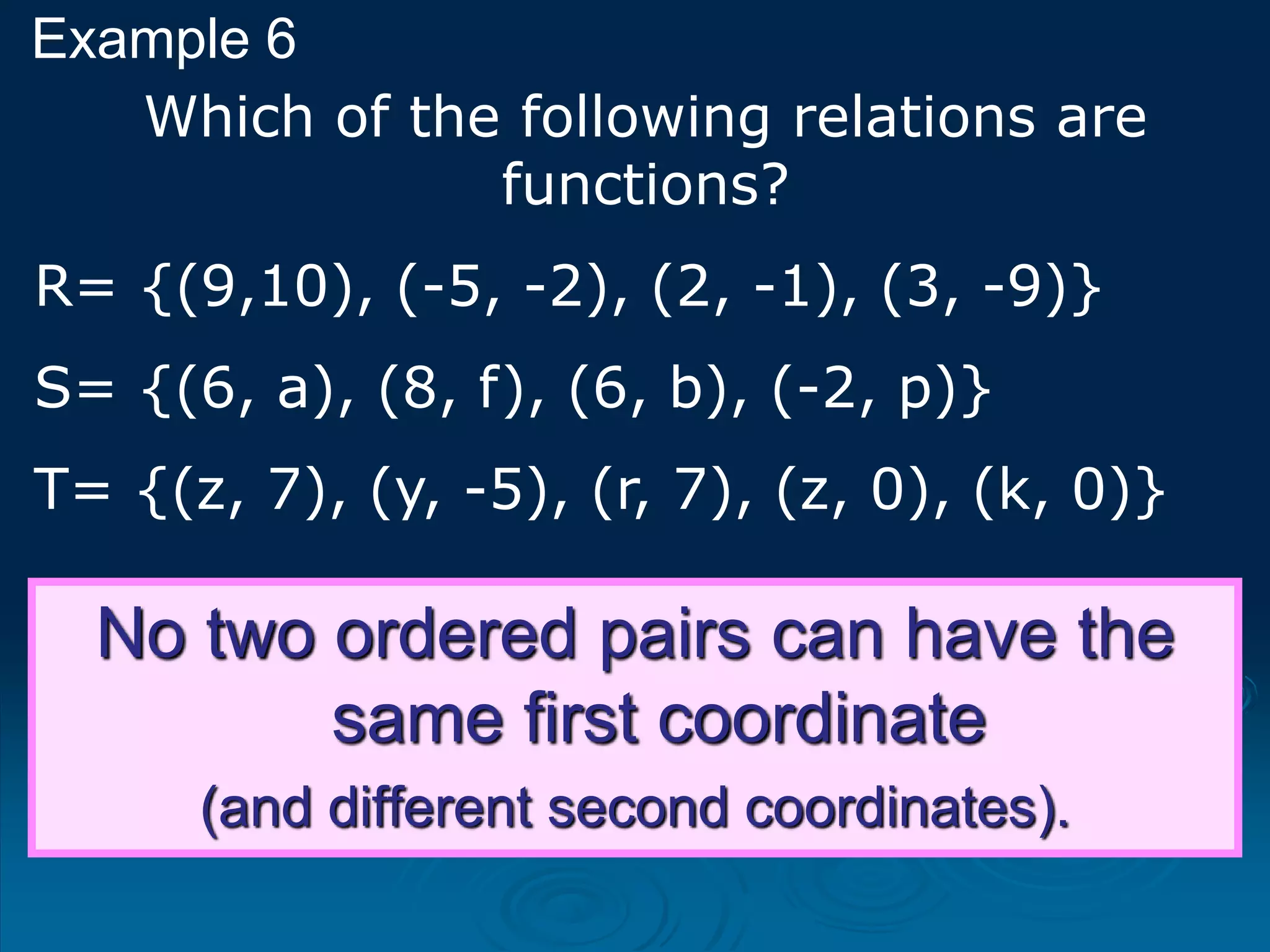
Example 6
No two ordered pairs can have the
same first coordinate
(and different second coordinates).
Which of the following relations are
functions?
R= {(9,10), (-5, -2), (2, -1), (3, -9)}
S= {(6, a), (8, f), (6, b), (-2, p)}
T= {(z, 7), (y, -5), (r, 7), (z, 0), (k, 0)}
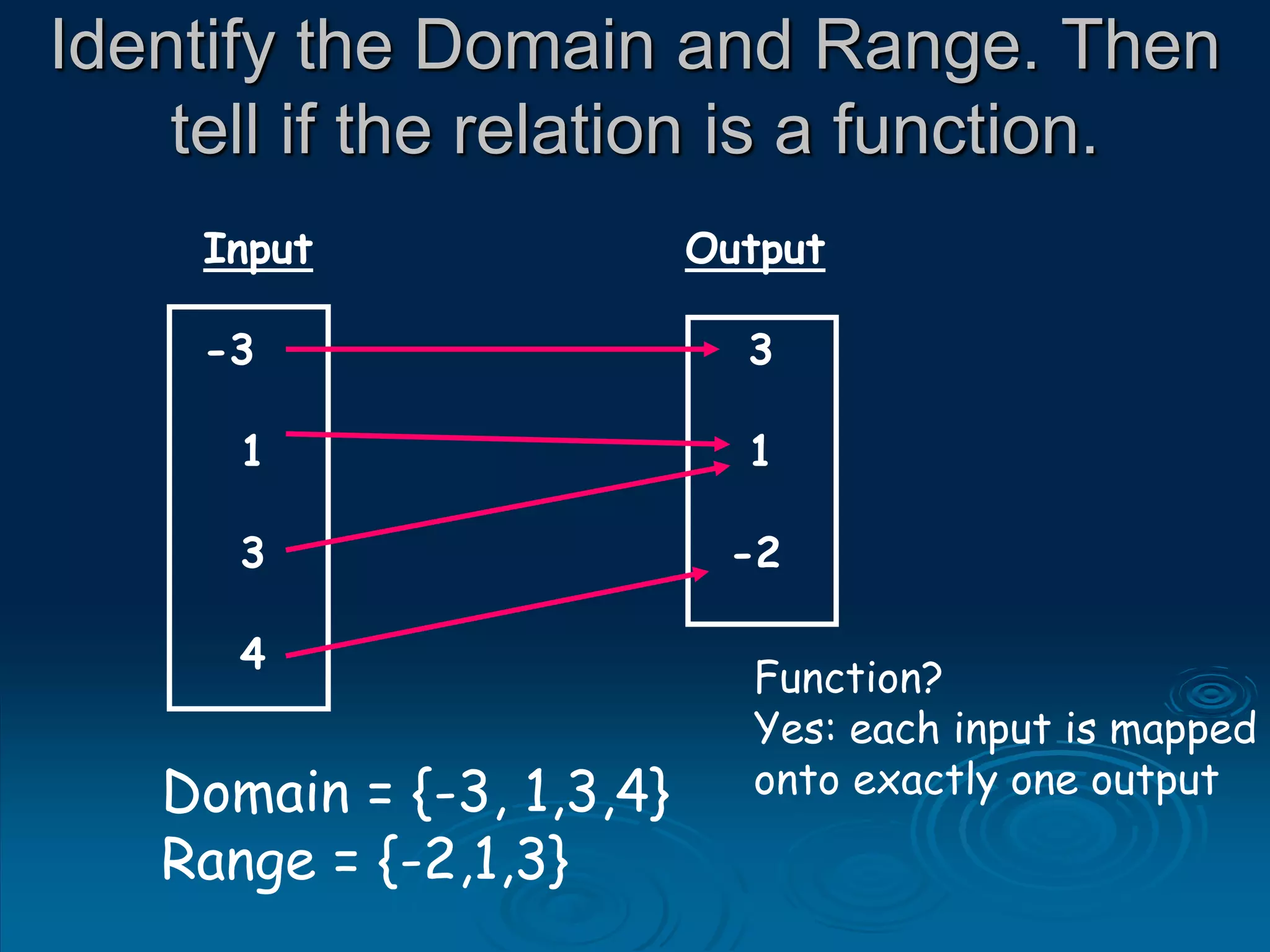
Identify the Domain and Range. Then
tell if the relation is a function.
Input Output
-3 3
1 1
3 -2
4
Domain = {-3, 1,3,4}
Range = {-2,1,3}
Function?
Yes: each input is mapped
onto exactly one output
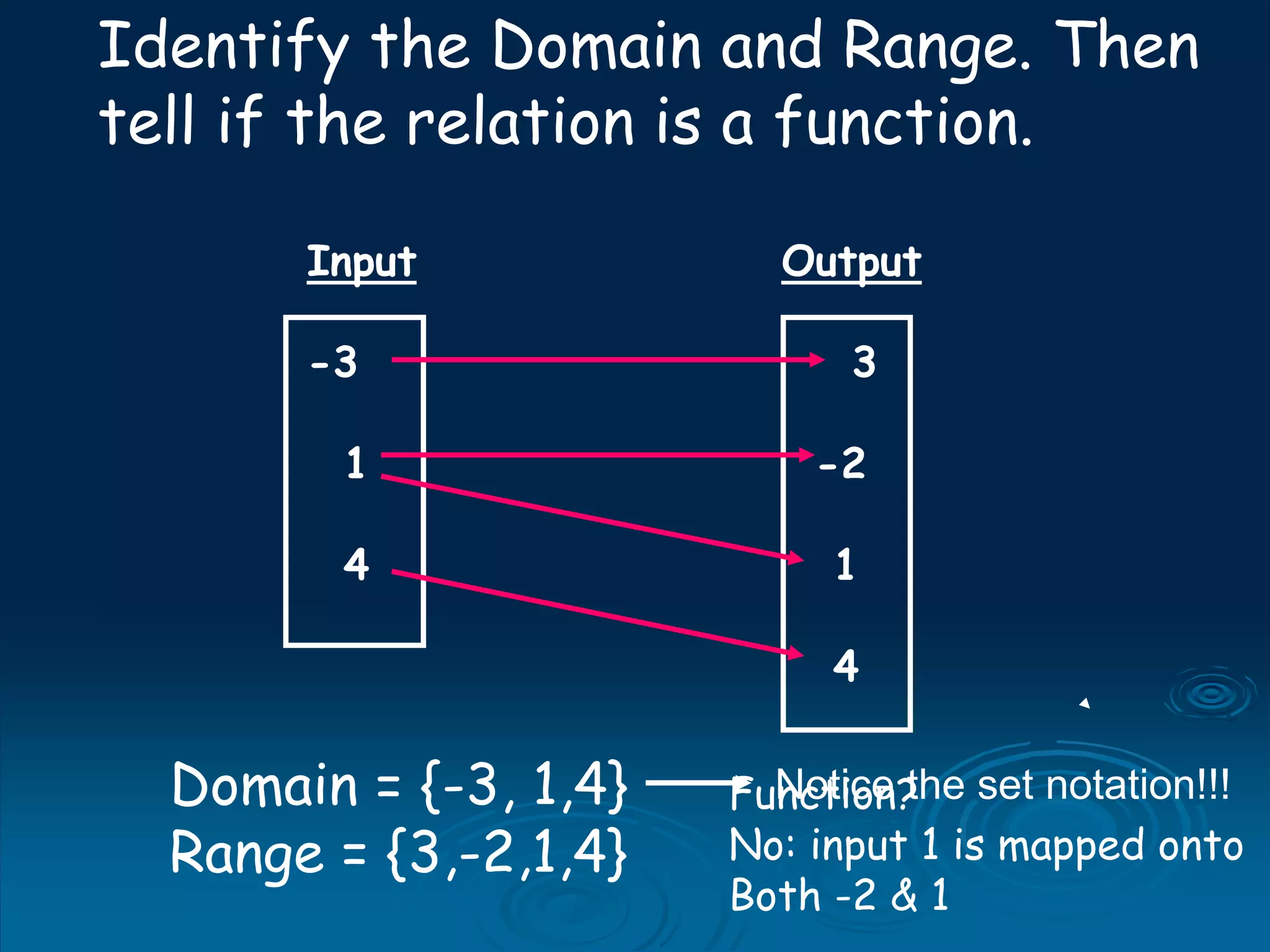
Input Output
-3 3
1 -2
4 1
4
Identify the Domain and Range. Then
tell if the relation is a function.
Domain = {-3, 1,4}
Range = {3,-2,1,4}
Function?
No: input 1 is mapped onto
Both -2 & 1
Notice the set notation!!!
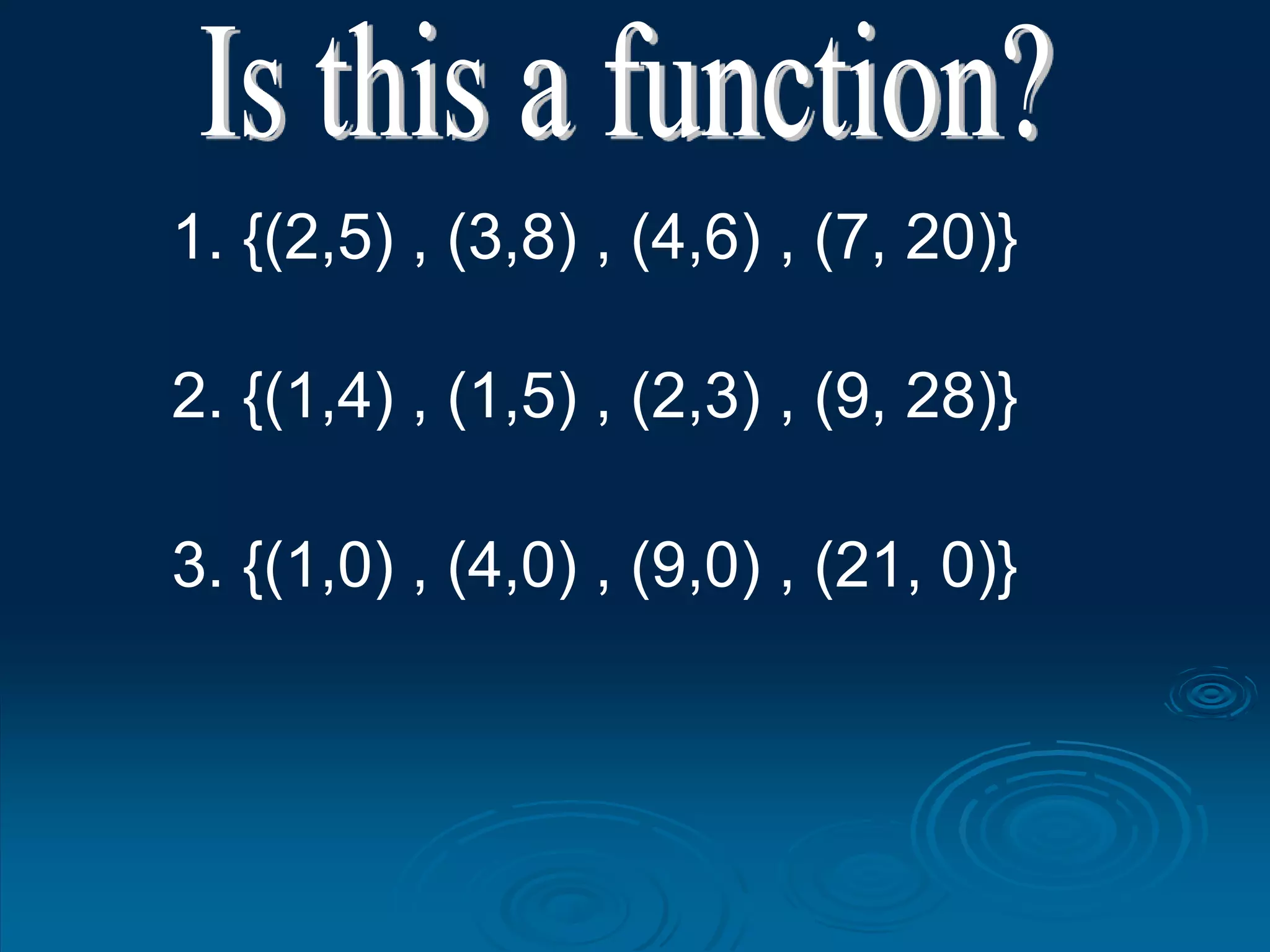
1. {(2,5) , (3,8) , (4,6) , (7, 20)}
2. {(1,4) , (1,5) , (2,3) , (9, 28)}
3. {(1,0) , (4,0) , (9,0) , (21, 0)}
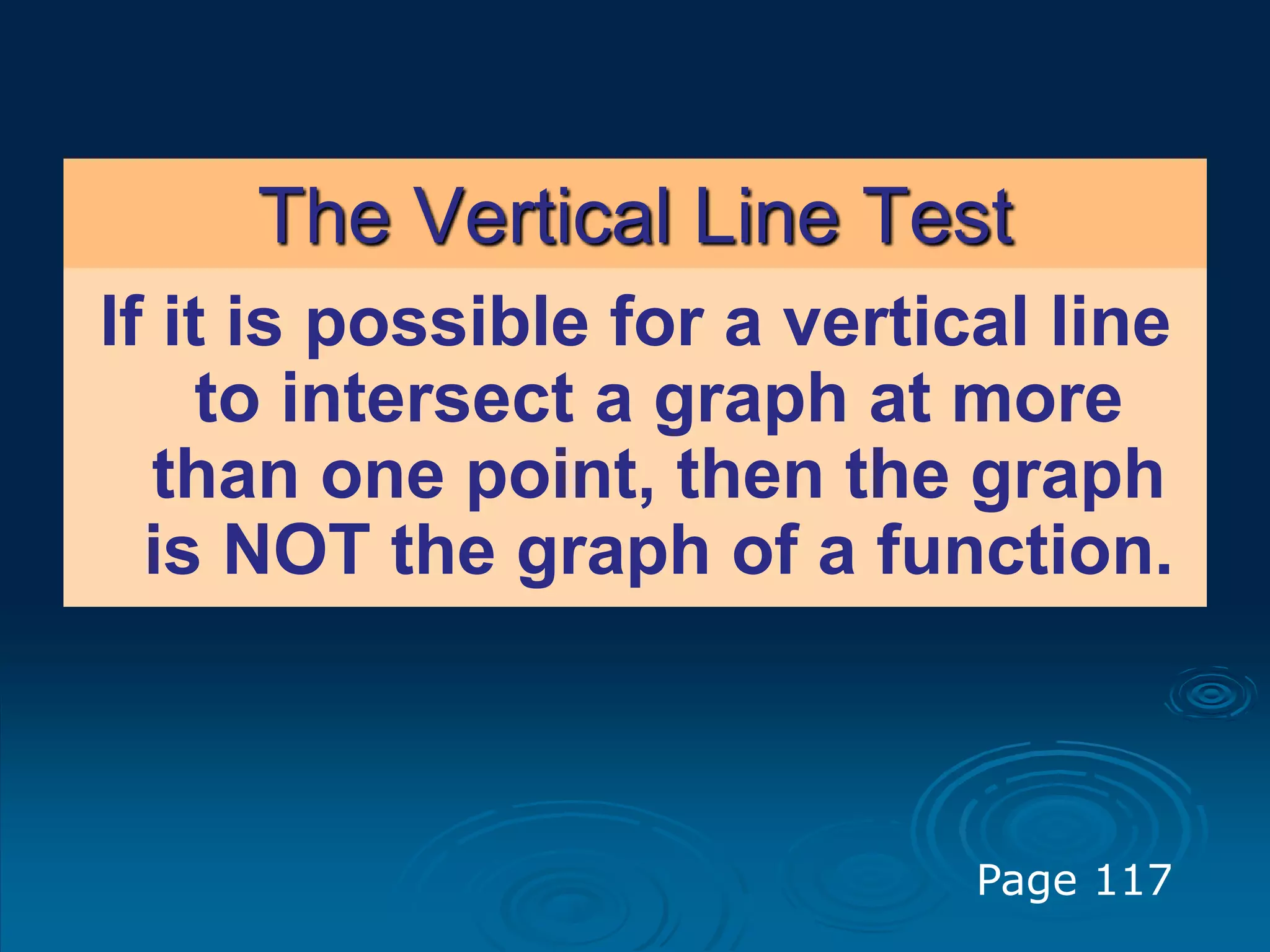
The Vertical Line Test
If it is possible for a vertical line
to intersect a graph at more
than one point, then the graph
is NOT the graph of a function.
Page 117
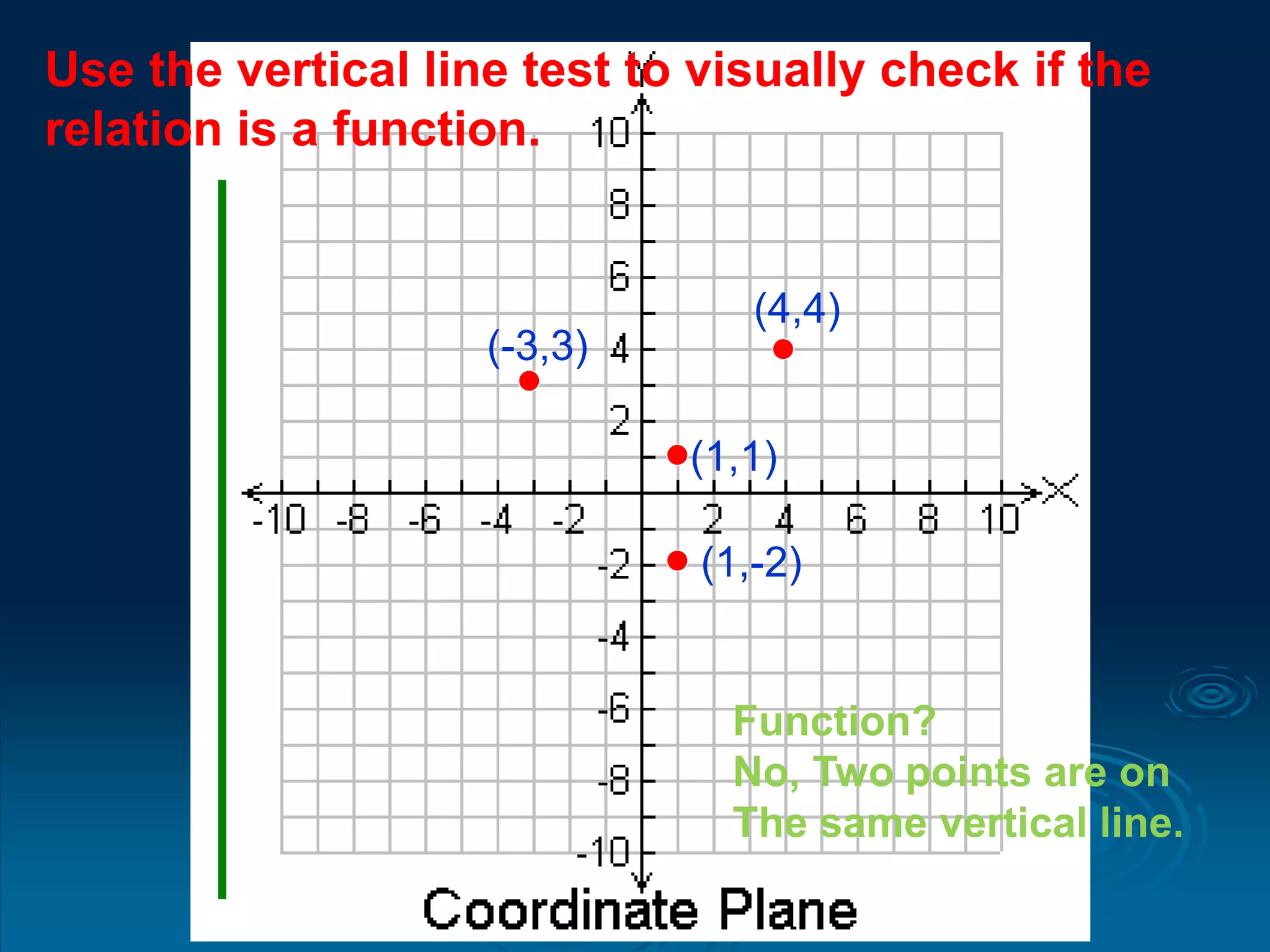
(-3,3)
(4,4)
(1,1)
(1,-2)
Function?
No, Two points are on
The same vertical line.
Use the vertical line test to visually check if the
relation is a function.
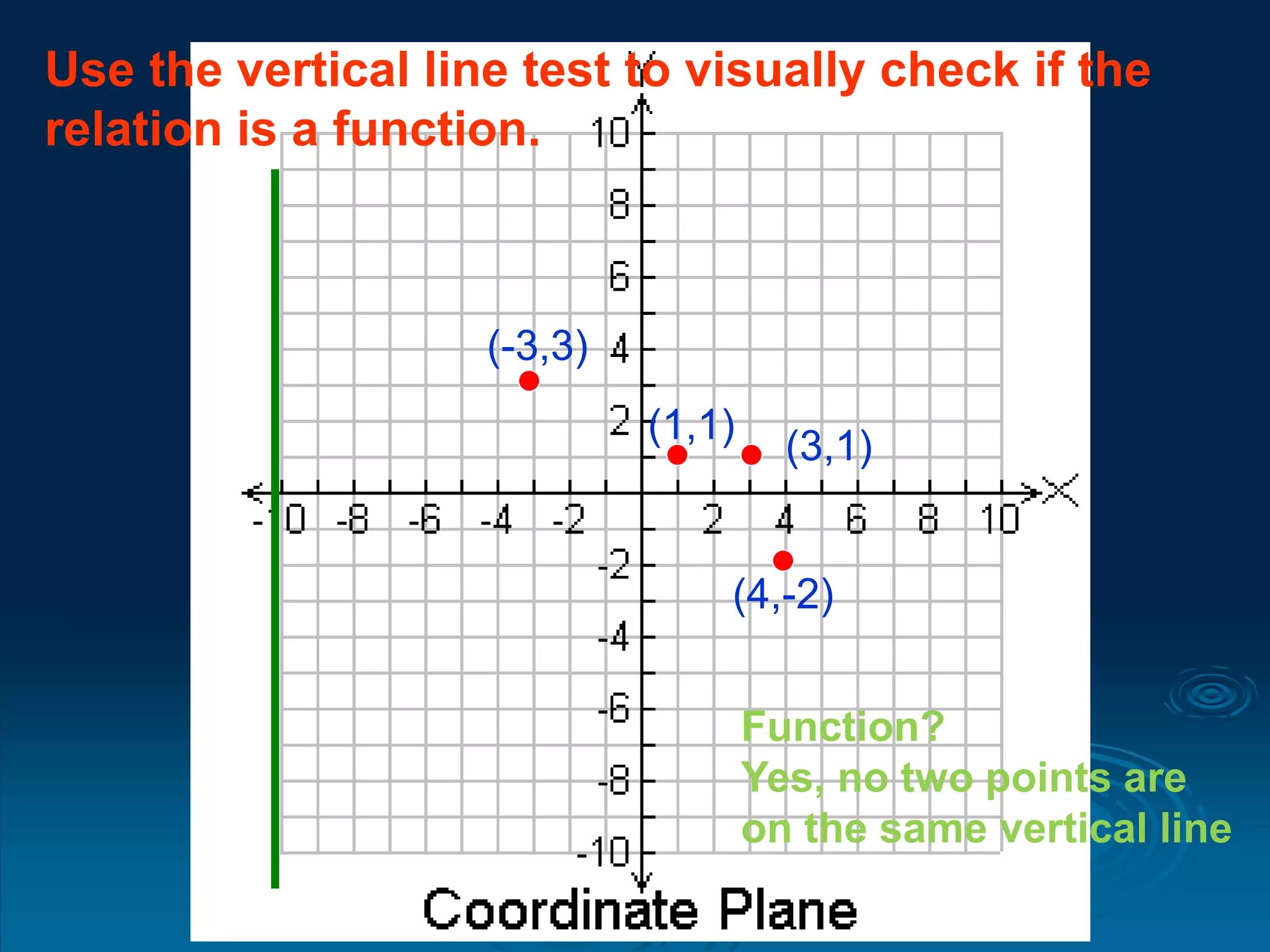
(-3,3)
(4,-2)
(1,1)
(3,1)
Use the vertical line test to visually check if the
relation is a function.
Function?
Yes, no two points are
on the same vertical line
Examples
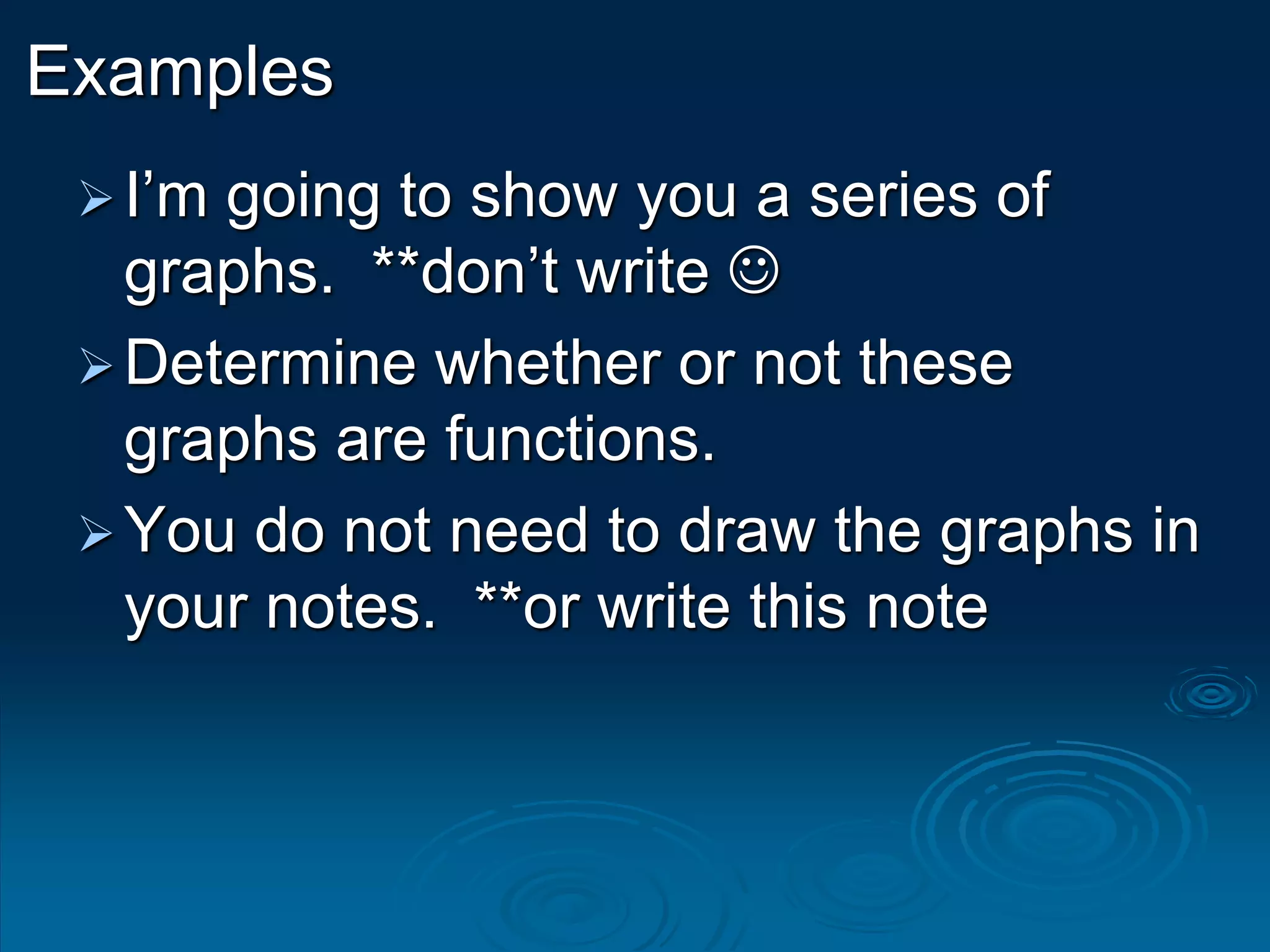
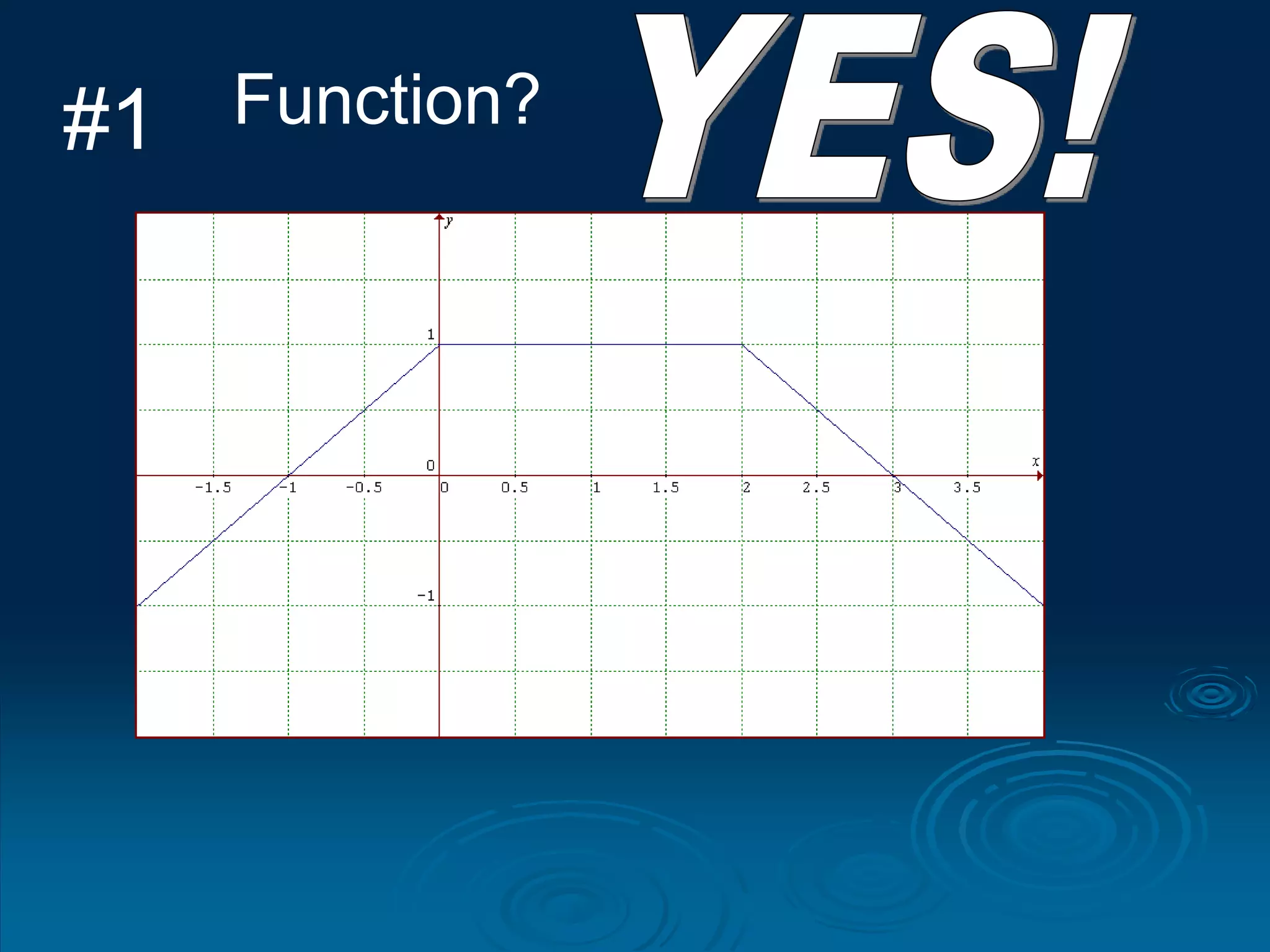
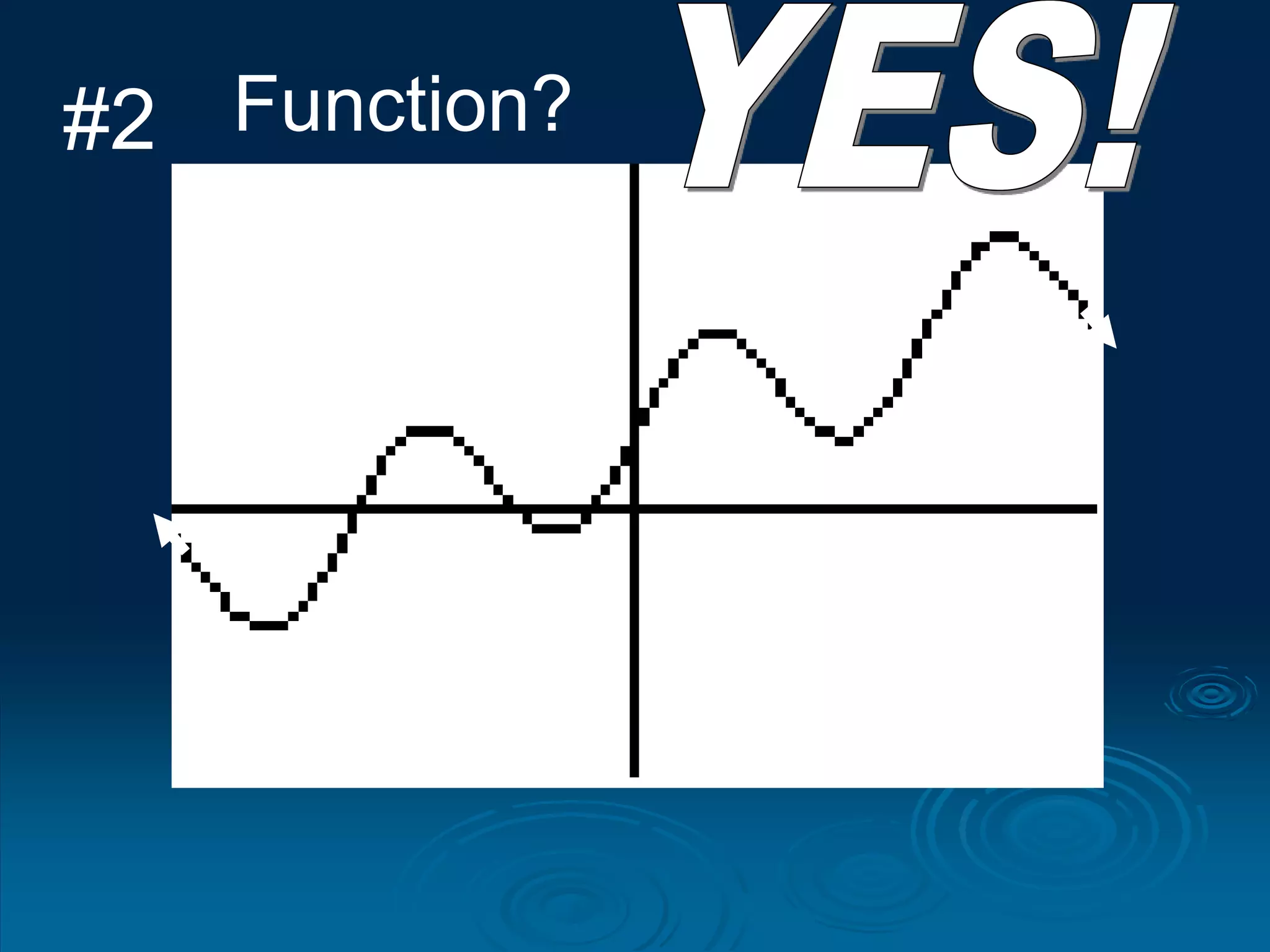
๏ƒ˜Iโ€™m going to show you a series of
graphs. **donโ€™t write ๏Š
๏ƒ˜Determine whether or not these
graphs are functions.
๏ƒ˜You do not need to draw the graphs in
your notes. **or write this note
#1 Function?
Function?
#2
Function?
#3
Function?
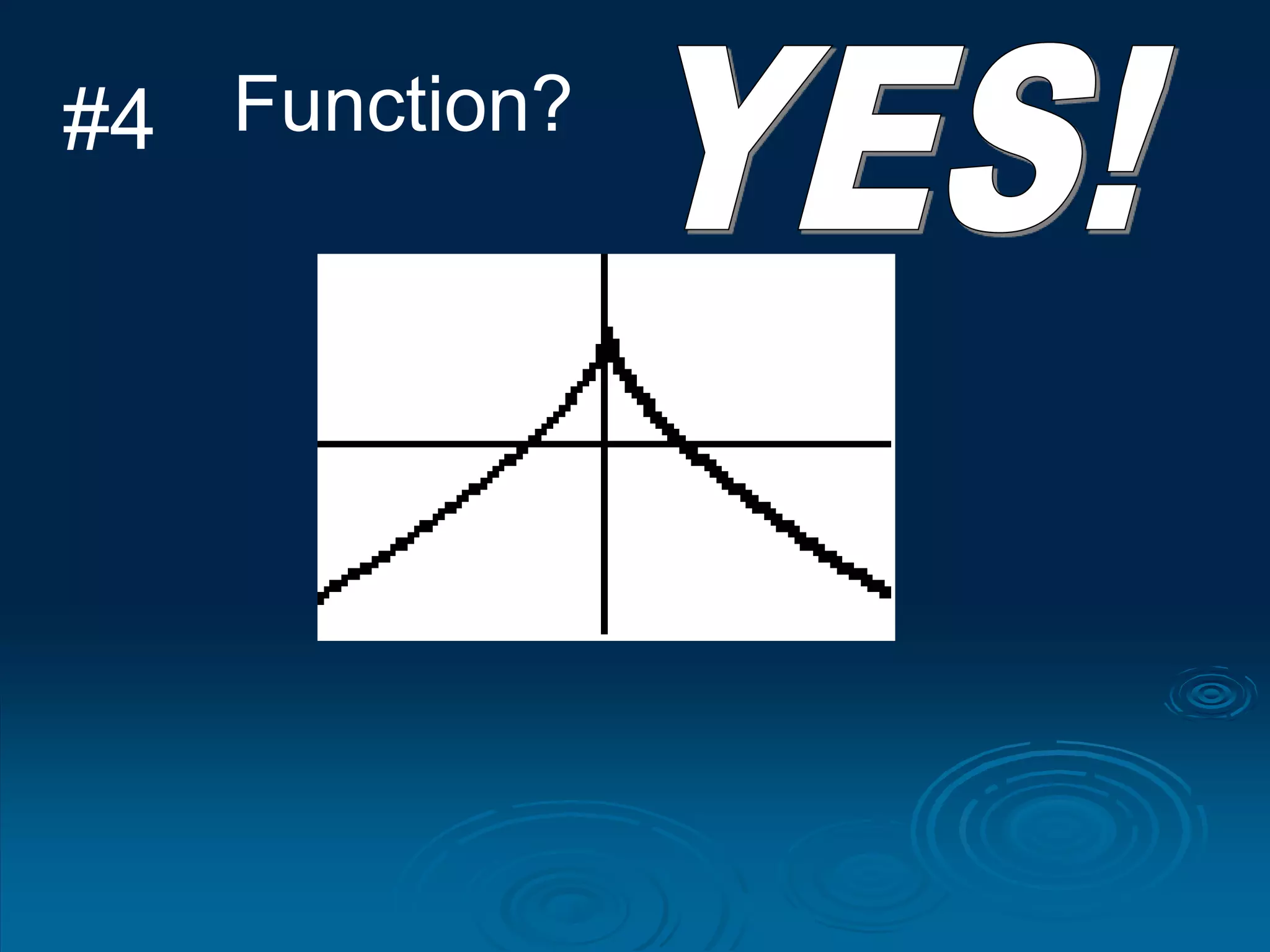
#4
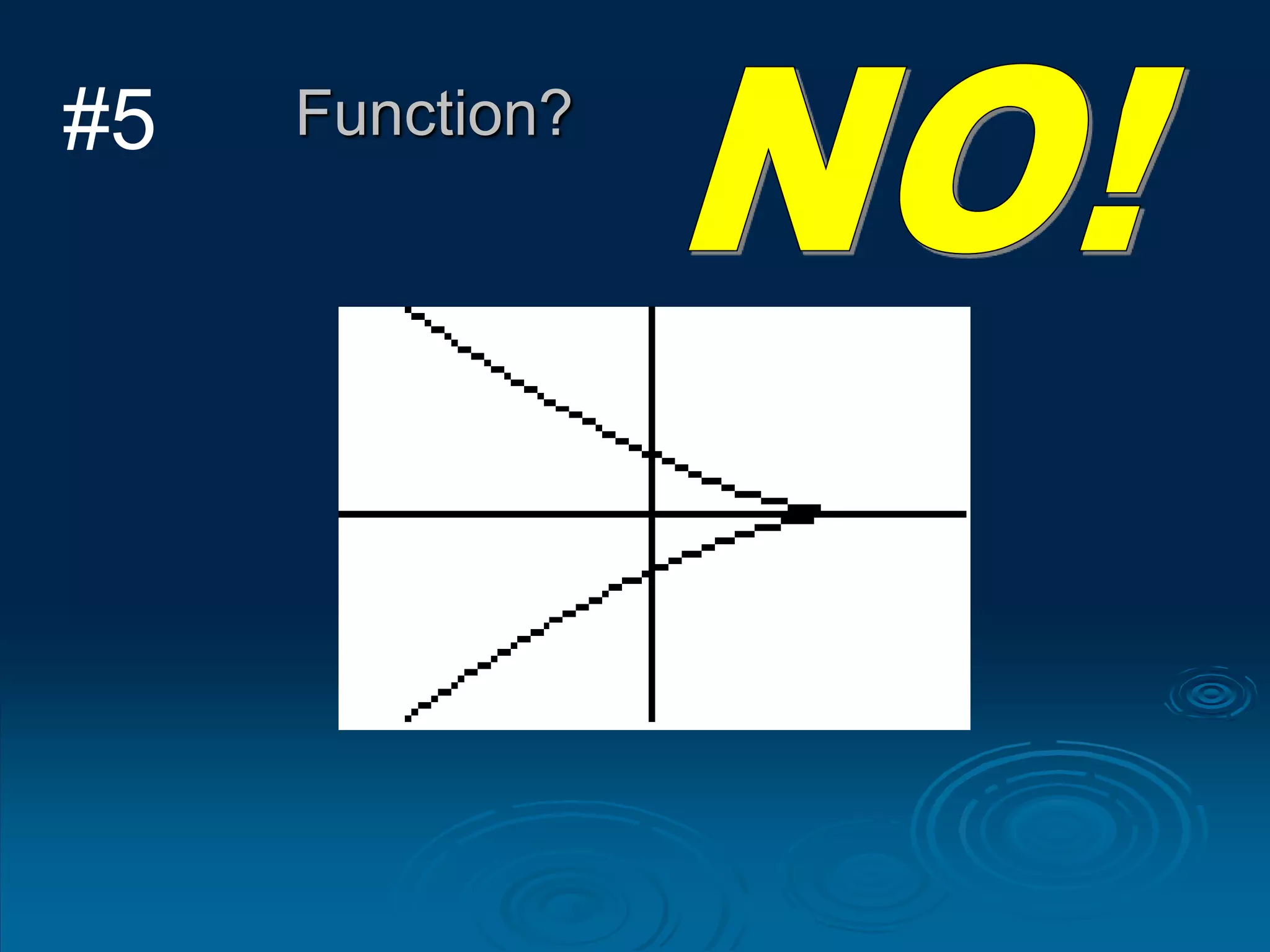
Function?
#5
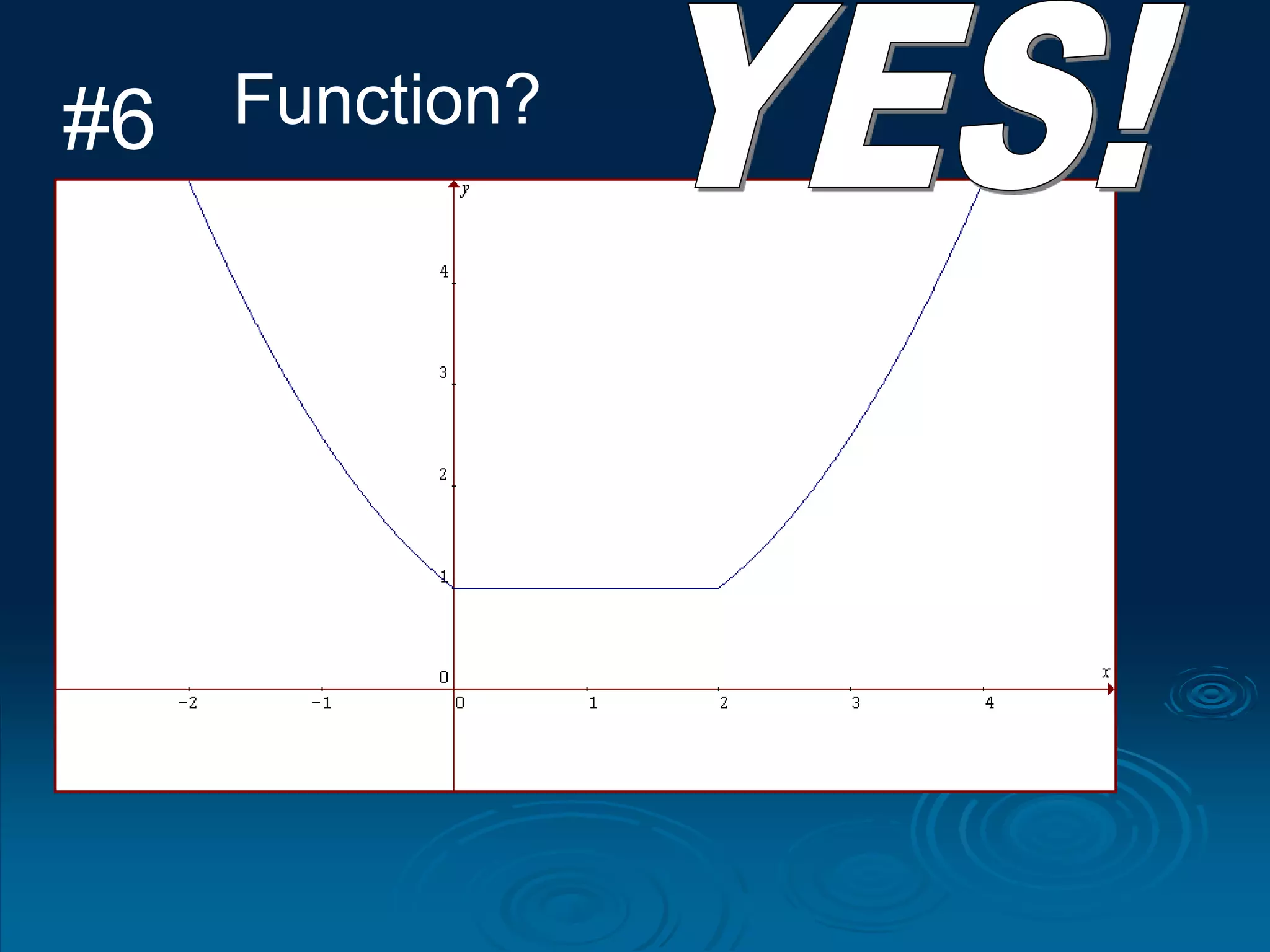
#6 Function?
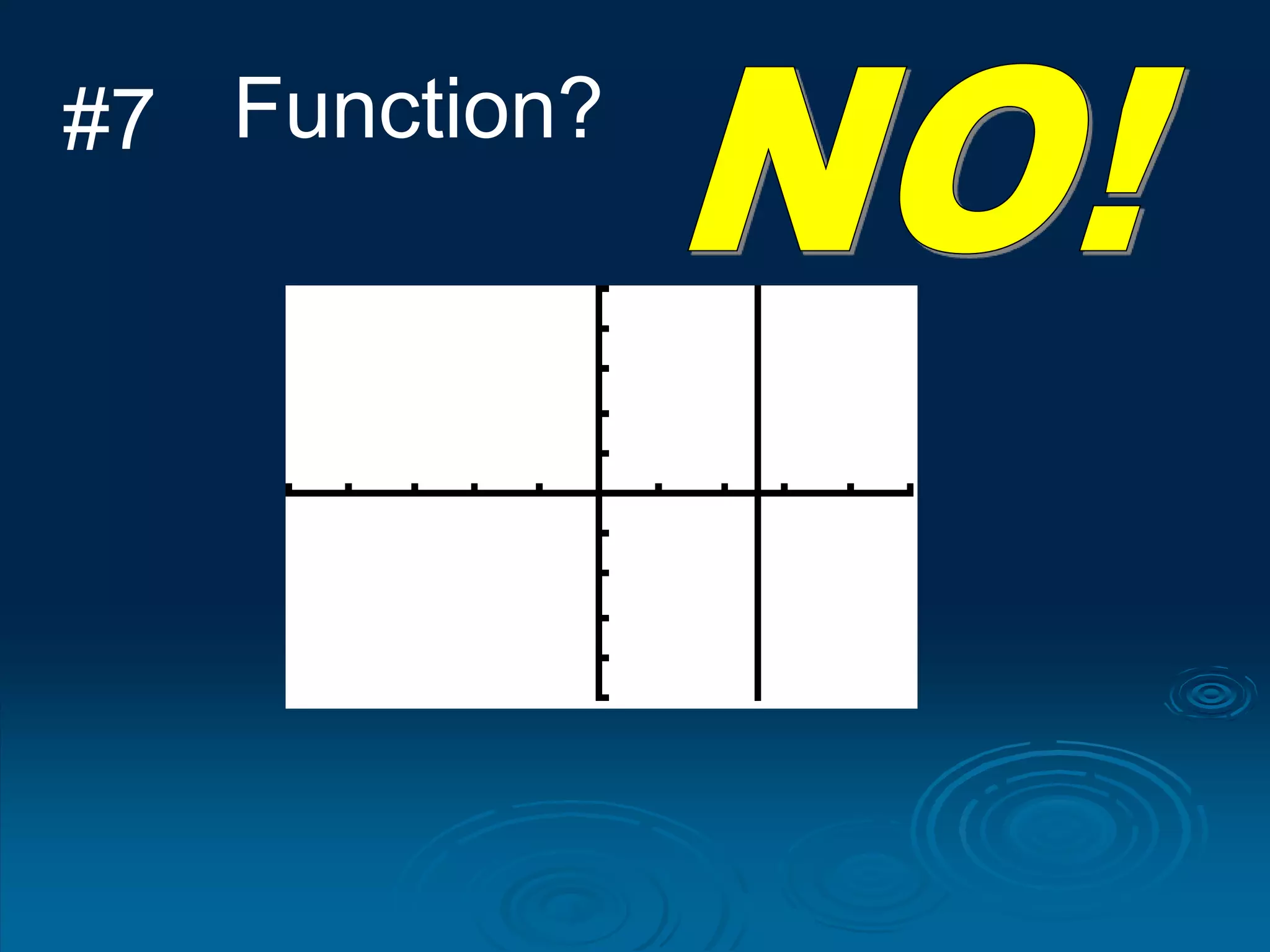
Function?
#7
Function?
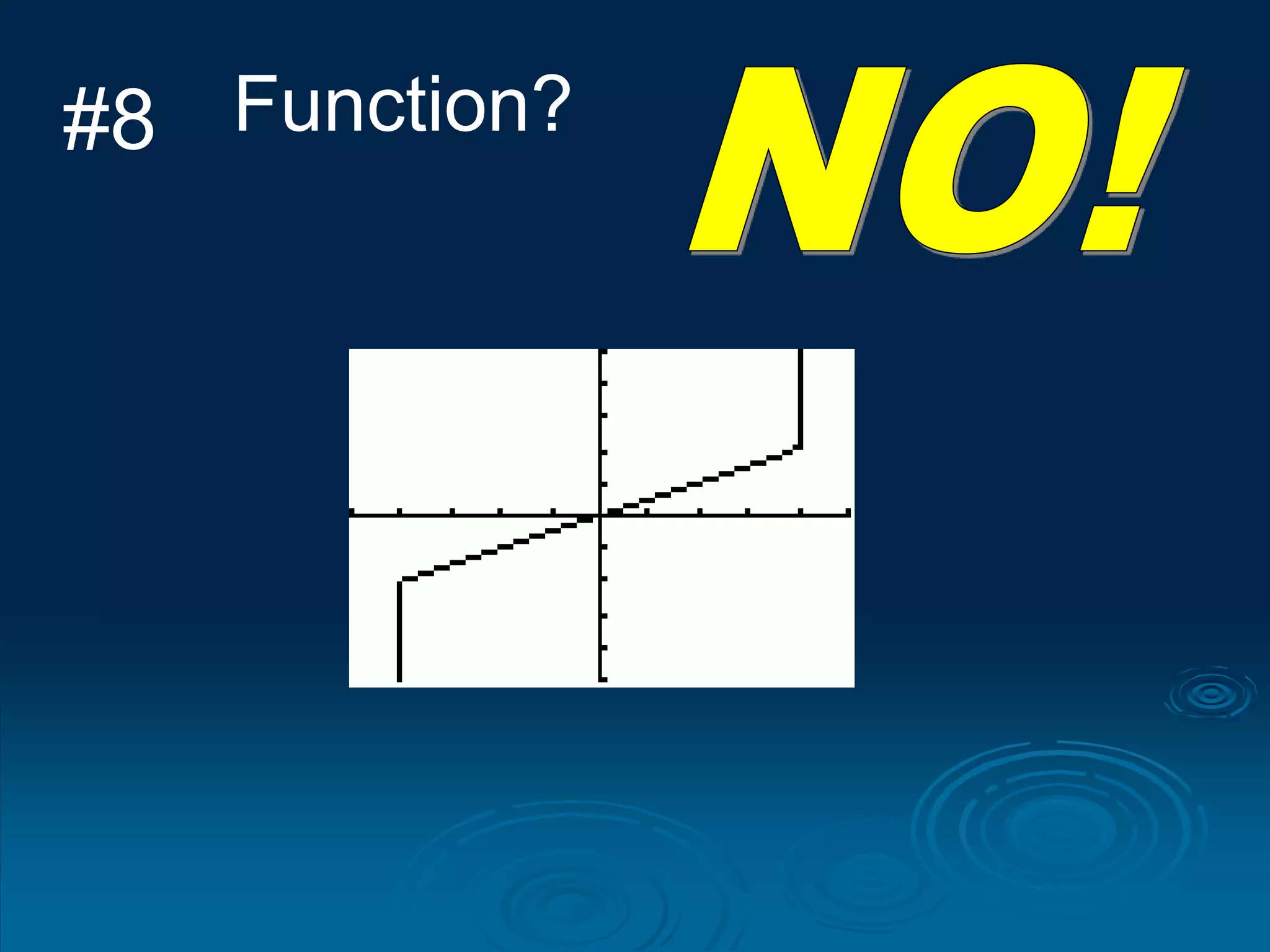
#8
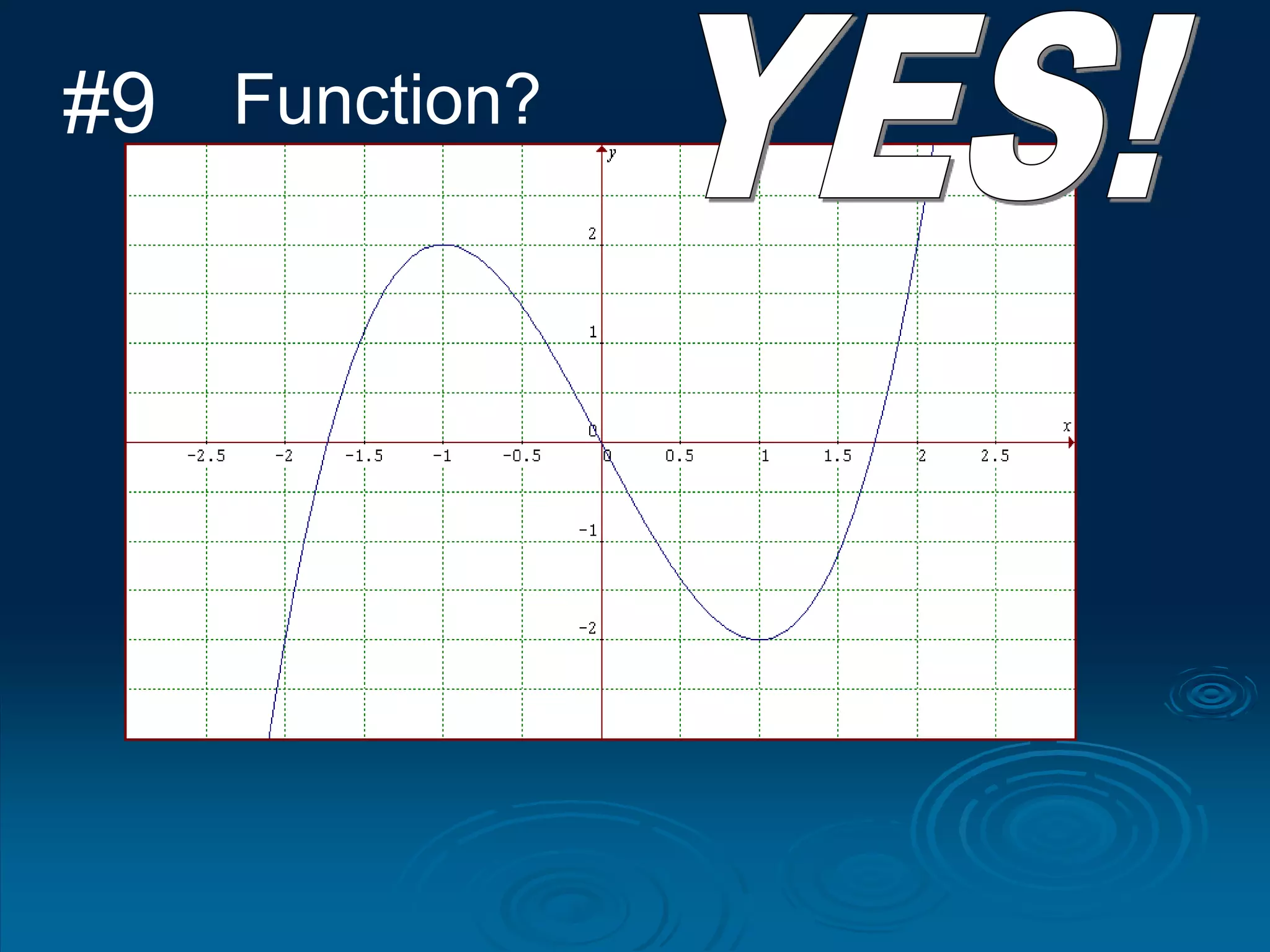
#9 Function?
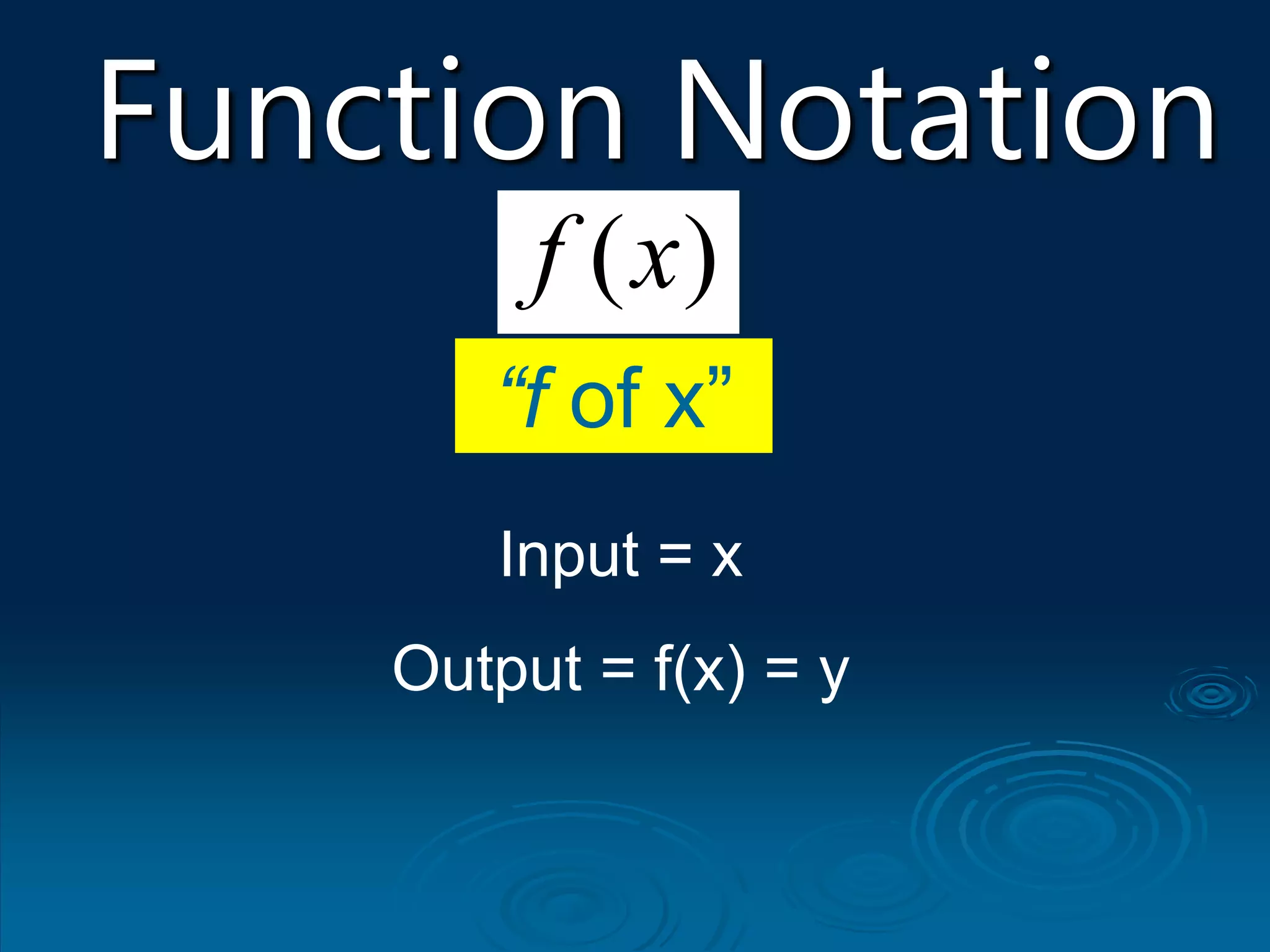
)
(x
f
โ€œf of xโ€
Input = x
Output = f(x) = y
Function Notation
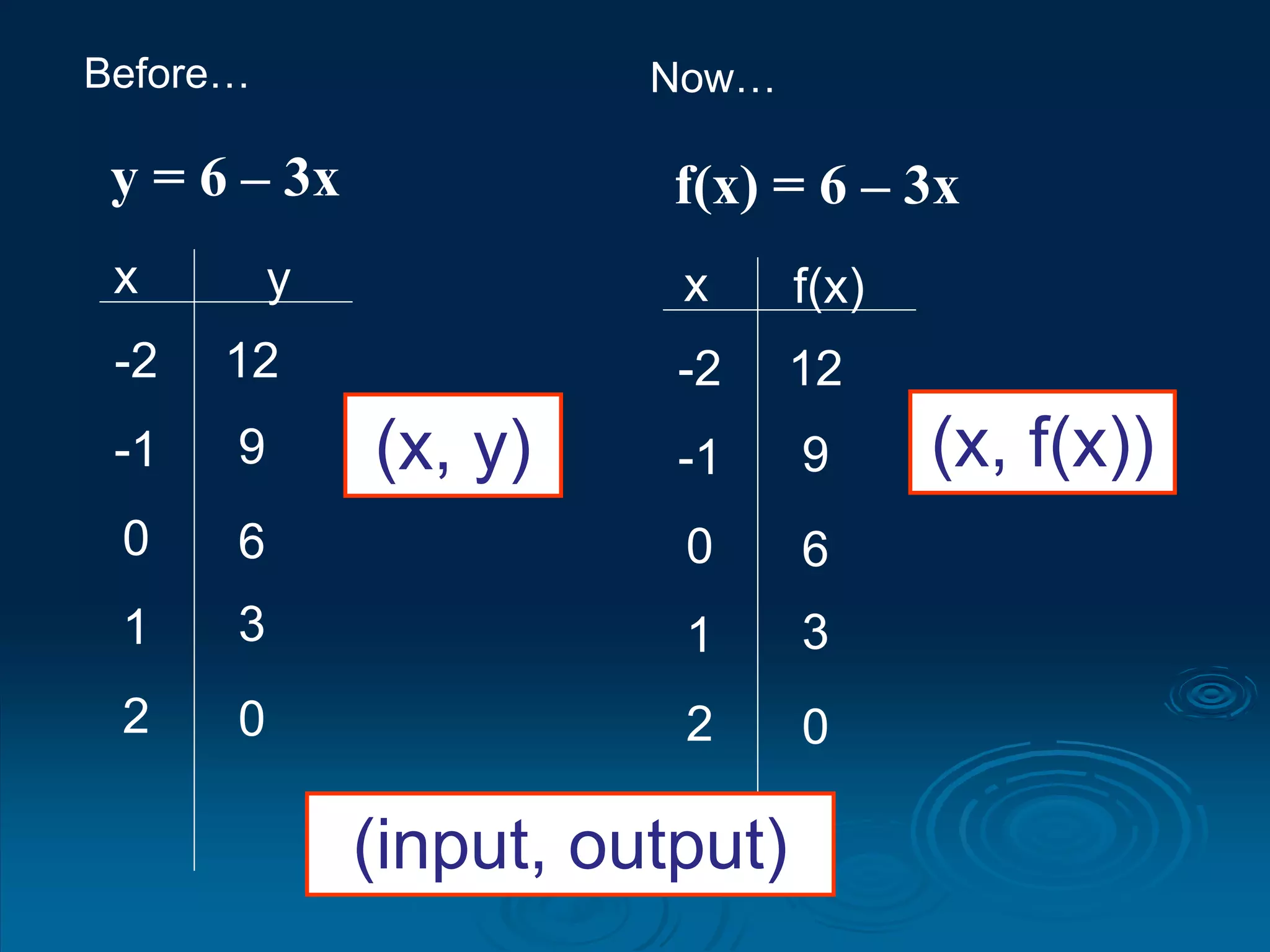
y = 6 โ€“ 3x
-2
-1
0
1
2
12
9
6
0
3
x y
f(x) = 6 โ€“ 3x
-2
-1
0
1
2
12
9
6
0
3
x f(x)
Beforeโ€ฆ Nowโ€ฆ
(x, y)
(input, output)
(x, f(x))
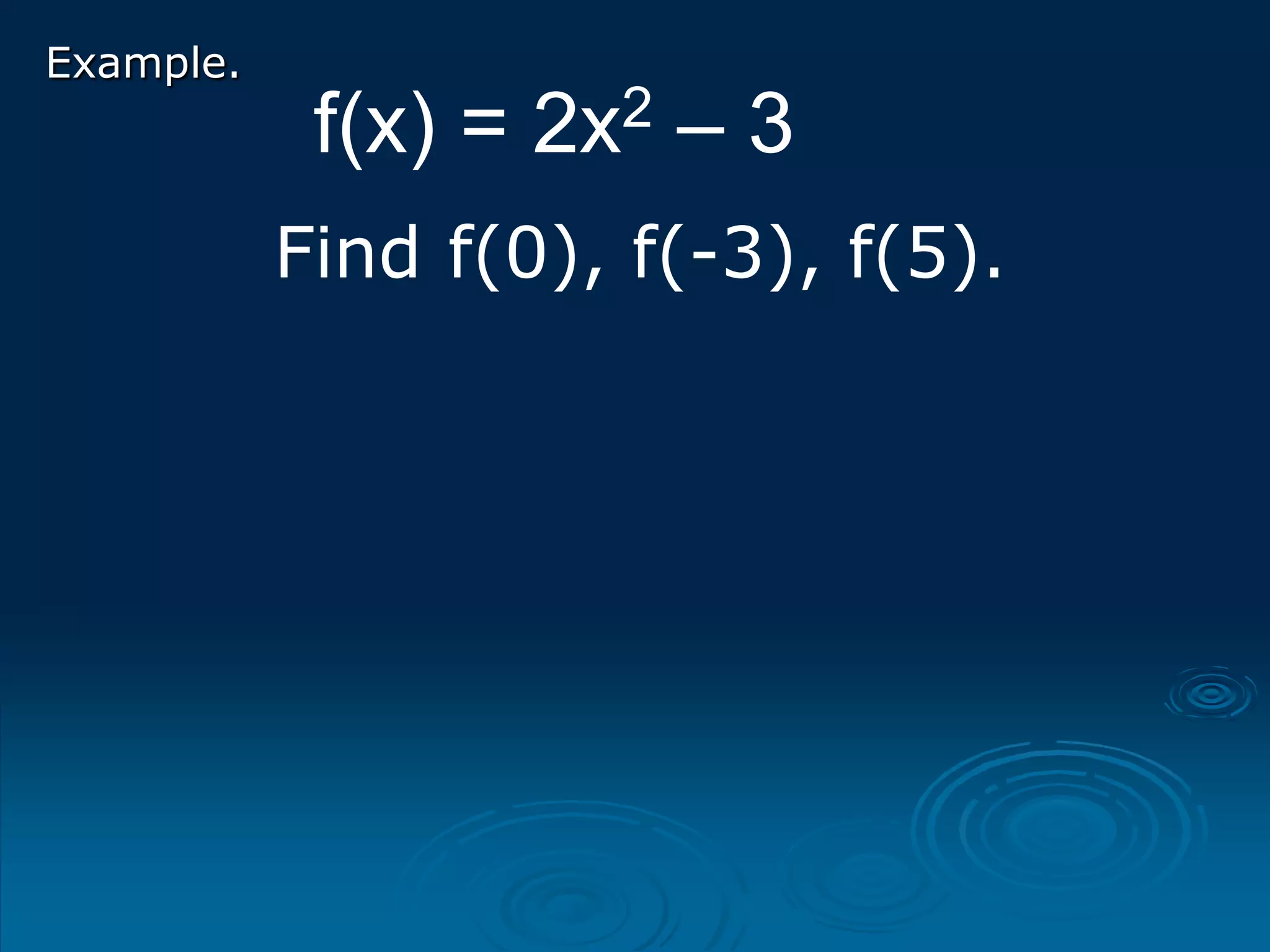
Example.
f(x) = 2x2 โ€“ 3
Find f(0), f(-3), f(5).
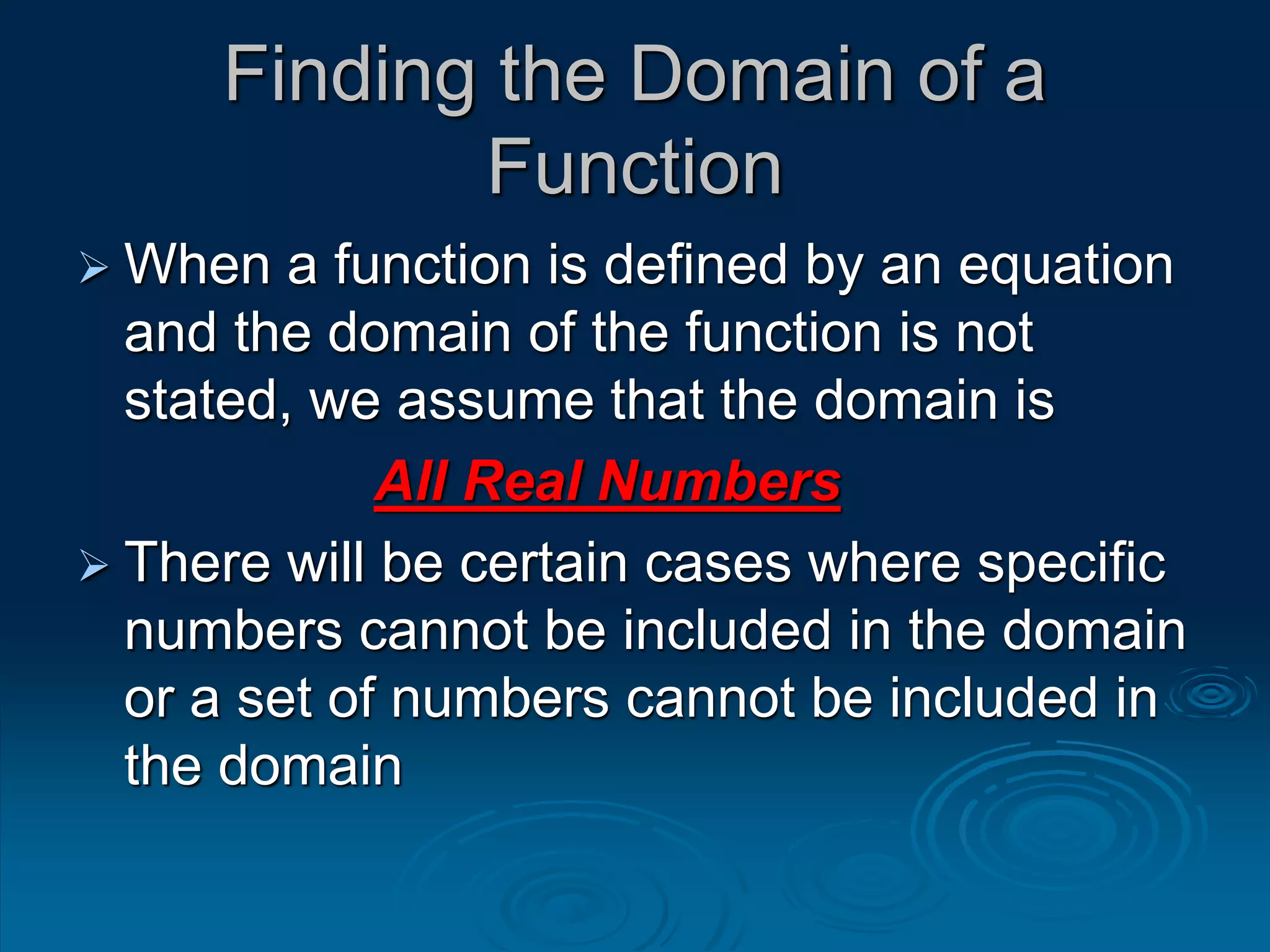
Finding the Domain of a
Function
๏ƒ˜ When a function is defined by an equation
and the domain of the function is not
stated, we assume that the domain is
All Real Numbers
๏ƒ˜ There will be certain cases where specific
numbers cannot be included in the domain
or a set of numbers cannot be included in
the domain
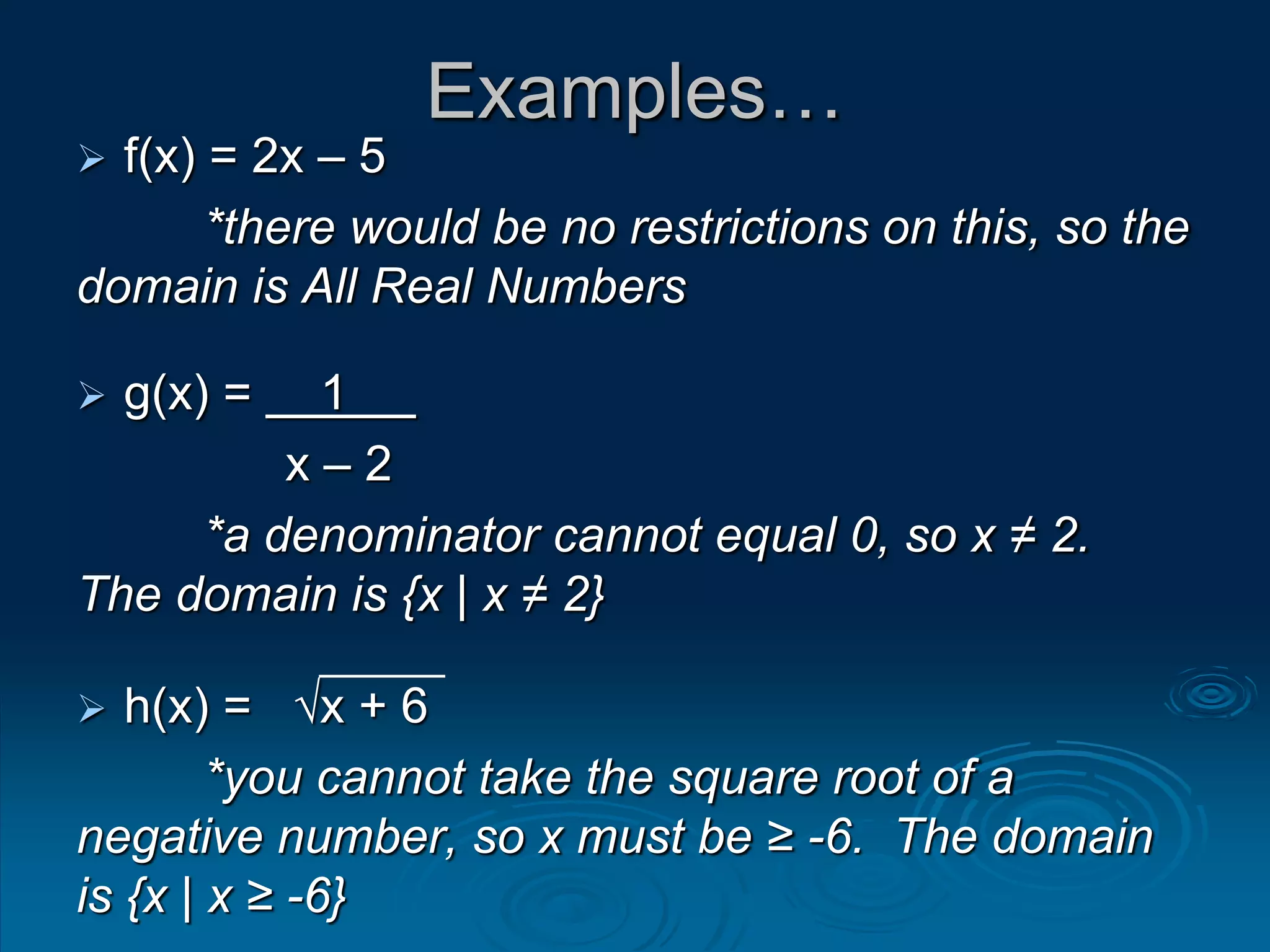
Examplesโ€ฆ
๏ƒ˜ f(x) = 2x โ€“ 5
*there would be no restrictions on this, so the
domain is All Real Numbers
๏ƒ˜ g(x) = 1
x โ€“ 2
*a denominator cannot equal 0, so x โ‰  2.
The domain is {x | x โ‰  2}
๏ƒ˜ h(x) = โˆšx + 6
*you cannot take the square root of a
negative number, so x must be โ‰ฅ -6. The domain
is {x | x โ‰ฅ -6}
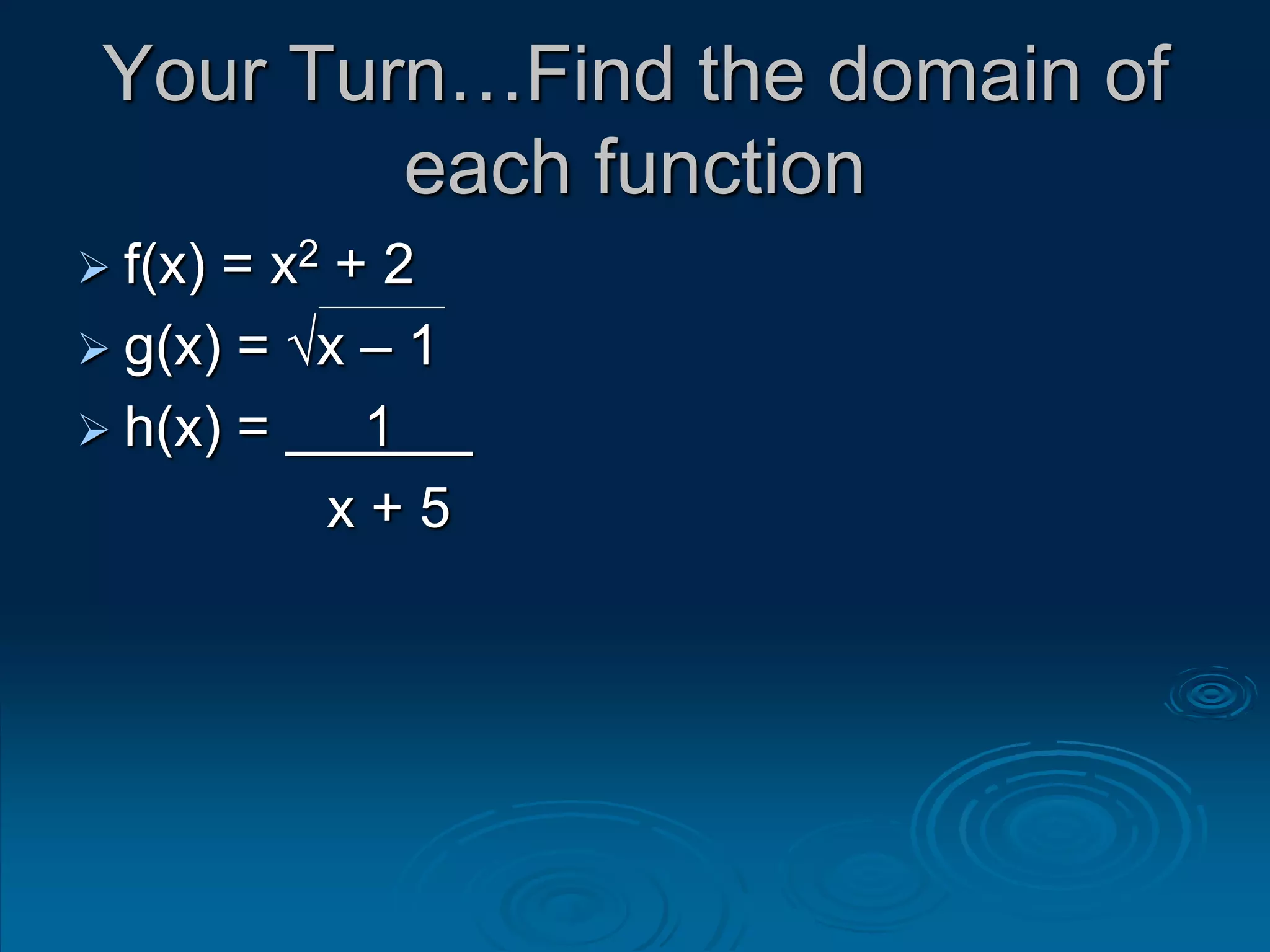
Your Turnโ€ฆFind the domain of
each function
๏ƒ˜ f(x) = x2 + 2
๏ƒ˜ g(x) = โˆšx โ€“ 1
๏ƒ˜ h(x) = 1
x + 5

Functions.ppt

  • 1.
    4-3 Functions โ€ขA relationis a function provided there is exactly one output for each input. โ€ขIt is NOT a function if one input has more than one output
  • 2.
    INPUT (DOMAIN) OUTPUT (RANGE) FUNCTION MACHINE In orderfor a relationship to be a functionโ€ฆ EVERY INPUT MUST HAVE AN OUTPUT TWO DIFFERENT INPUTS CAN HAVE THE SAME OUTPUT Functions ONE INPUT CAN HAVE ONLY ONE OUTPUT
  • 3.
    Example 6 No twoordered pairs can have the same first coordinate (and different second coordinates). Which of the following relations are functions? R= {(9,10), (-5, -2), (2, -1), (3, -9)} S= {(6, a), (8, f), (6, b), (-2, p)} T= {(z, 7), (y, -5), (r, 7), (z, 0), (k, 0)}
  • 4.
    Identify the Domainand Range. Then tell if the relation is a function. Input Output -3 3 1 1 3 -2 4 Domain = {-3, 1,3,4} Range = {-2,1,3} Function? Yes: each input is mapped onto exactly one output
  • 5.
    Input Output -3 3 1-2 4 1 4 Identify the Domain and Range. Then tell if the relation is a function. Domain = {-3, 1,4} Range = {3,-2,1,4} Function? No: input 1 is mapped onto Both -2 & 1 Notice the set notation!!!
  • 6.
    1. {(2,5) ,(3,8) , (4,6) , (7, 20)} 2. {(1,4) , (1,5) , (2,3) , (9, 28)} 3. {(1,0) , (4,0) , (9,0) , (21, 0)}
  • 7.
    The Vertical LineTest If it is possible for a vertical line to intersect a graph at more than one point, then the graph is NOT the graph of a function. Page 117
  • 8.
    (-3,3) (4,4) (1,1) (1,-2) Function? No, Two pointsare on The same vertical line. Use the vertical line test to visually check if the relation is a function.
  • 9.
    (-3,3) (4,-2) (1,1) (3,1) Use the verticalline test to visually check if the relation is a function. Function? Yes, no two points are on the same vertical line
  • 10.
    Examples ๏ƒ˜Iโ€™m going toshow you a series of graphs. **donโ€™t write ๏Š ๏ƒ˜Determine whether or not these graphs are functions. ๏ƒ˜You do not need to draw the graphs in your notes. **or write this note
  • 11.
  • 12.
  • 13.
  • 14.
  • 15.
  • 16.
  • 17.
  • 18.
  • 19.
  • 20.
    ) (x f โ€œf of xโ€ Input= x Output = f(x) = y Function Notation
  • 21.
    y = 6โ€“ 3x -2 -1 0 1 2 12 9 6 0 3 x y f(x) = 6 โ€“ 3x -2 -1 0 1 2 12 9 6 0 3 x f(x) Beforeโ€ฆ Nowโ€ฆ (x, y) (input, output) (x, f(x))
  • 22.
    Example. f(x) = 2x2โ€“ 3 Find f(0), f(-3), f(5).
  • 23.
    Finding the Domainof a Function ๏ƒ˜ When a function is defined by an equation and the domain of the function is not stated, we assume that the domain is All Real Numbers ๏ƒ˜ There will be certain cases where specific numbers cannot be included in the domain or a set of numbers cannot be included in the domain
  • 24.
    Examplesโ€ฆ ๏ƒ˜ f(x) =2x โ€“ 5 *there would be no restrictions on this, so the domain is All Real Numbers ๏ƒ˜ g(x) = 1 x โ€“ 2 *a denominator cannot equal 0, so x โ‰  2. The domain is {x | x โ‰  2} ๏ƒ˜ h(x) = โˆšx + 6 *you cannot take the square root of a negative number, so x must be โ‰ฅ -6. The domain is {x | x โ‰ฅ -6}
  • 25.
    Your Turnโ€ฆFind thedomain of each function ๏ƒ˜ f(x) = x2 + 2 ๏ƒ˜ g(x) = โˆšx โ€“ 1 ๏ƒ˜ h(x) = 1 x + 5