   The World Trade Organization (WTO) is an
    organization that intends to supervise and
    liberalize international trade.
   The organization deals with regulation of trade between
    participating countries; it provides a framework for
    negotiating and formalizing trade agreements, and a
    dispute resolution.
   The organization officially commenced on January
    1, 1995 under the Marrakech Agreement, replacing
    the General Agreement on Tariffs and Trade
    (GATT), which commenced in 1948.
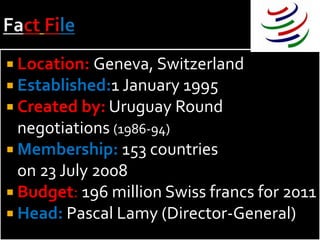
 Location: Geneva, Switzerland
 Established:1 January 1995
 Created by: Uruguay Round
  negotiations (1986-94)
 Membership: 153 countries
  on 23 July 2008
 Budget: 196 million Swiss francs for 2011
 Head: Pascal Lamy (Director-General)
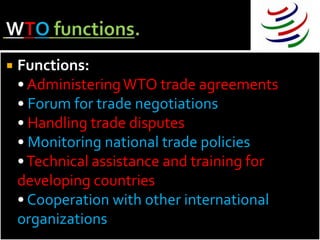
   Functions:
    • Administering WTO trade agreements
    • Forum for trade negotiations
    • Handling trade disputes
    • Monitoring national trade policies
    • Technical assistance and training for
    developing countries
    • Cooperation with other international
    organizations
   The WTO is the only international organization
    dealing with the global rules of trade between
    nations.
   Its main function is to ensure that trade flows as
    smoothly, predictably and freely as possible.
   The goal is to improve the welfare of the peoples
    of the member countries
   By lowering trade barriers, the WTO’s system also
    breaks down other barriers between peoples and
    nations.
   The WTO agreements are lengthy and complex
    because they are legal texts covering a wide range of
    activities. But a number of simple, fundamental
    principles run throughout all of these documents.
    These principles are the foundation of the multilateral
    trading system.
   Non-discrimination
   More open
   Predictable and transparent
   More competitive
   More beneficial for less developed countries
   Protect the environment
   More open : Lowering trade barriers is one of the most
  obvious ways of encouraging trade; these barriers include
  customs duties and measures such as import bans or
  quotas that restrict quantities selectively.
 More beneficial for less developed countries : Giving them
    more time to adjust, greater flexibility and special privileges; over
    three-quarters of WTO members are developing countries and
    countries in transition to market economies.
   Non-discrimination : A country should not discriminate
    between its trading partners and it should not discriminate between
    its own and foreign products, services or nationals.
   The WTO is run by its member governments. All major
    decisions are made by the membership as a whole, either
    by ministers or by their ambassadors or delegates
   While the WTO is driven by its member states, it could not
    function without its Secretariat to coordinate the
    activities.
   Trade negotiations
   Implementation and monitoring
   Dispute settlement
   Building trade capacity
   Outreach
 Trade negotiations : They include individual countries’
  commitments to lower customs tariffs and other trade
  barriers, and to open and keep open services markets.
  They set procedures for settling disputes. These
  agreements are not static; they are renegotiated from
  time to time and new agreements can be added to the
  package.
 Dispute settlement : The WTO’s procedure for resolving
  trade quarrels under the Dispute Settlement
  Understanding is vital for enforcing the rules and
  therefore for ensuring that trade flows smoothly.
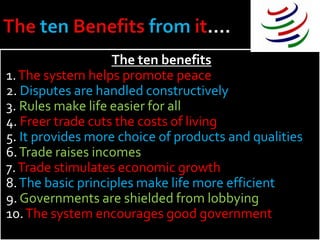
The ten benefits
1. The system helps promote peace
2. Disputes are handled constructively
3. Rules make life easier for all
4. Freer trade cuts the costs of living
5. It provides more choice of products and qualities
6. Trade raises incomes
7. Trade stimulates economic growth
8. The basic principles make life more efficient
9. Governments are shielded from lobbying
10. The system encourages good government
   In 1994, the WTO members agreed on the
    Understanding on Rules and Procedures Governing
    the Settlement of Disputes (DSU) annexed to the
    "Final Act" signed in Marrakesh in 1994.
    Dispute settlement is regarded by the WTO as the
    central pillar of the multilateral trading
    system, and as a "unique contribution to the
    stability of the global economy“
   WTO members have agreed that, if they believe
    fellow-members are violating trade rules, they will
    use the multilateral system of settling disputes
    instead of taking action unilaterally.
   The operation of the WTO dispute settlement
    process involves the DSB panels, the Appellate
    Body, the WTO
    Secretariat, arbitrators, independent experts and
    several specialized institutions. Bodies involved in
    the dispute settlement process, World Trade
    Organization.
   Disputes chronologically
   Disputes by country/territory
   Disputes by agreement
   Disputes by subject
   Find disputes cases
   Dispute Settlement Body
   Appellate Body
   The Doha Round is the latest round of trade
    negotiations among the WTO membership.
   Its aim is to achieve major reform of the
    international trading system through the
    introduction of lower trade barriers and revised
    trade rules.
   The work programme covers about 20 areas of
    trade. The Round is also known semi-officially as
    the Doha Development Agenda as a fundamental
    objective is to improve the trading prospects of
    developing countries.
   The Round was officially launched at the WTO’s
    Fourth Ministerial Conference in Doha, Qatar, in
    November 2001.
   The Doha Ministerial Declaration provided the
    mandate for the negotiations, including on
    agriculture, services and an intellectual property
    topic, which began earlier.
   In Doha, ministers also approved a decision on how
    to address the problems developing countries face
    in implementing the current WTO agreements.
   The WTO oversees about 60 different agreements
    which have the status of international legal texts.
    Member countries must sign and ratify all WTO
    agreements on accession.
   A discussion of some of the most important
    agreements follows. The Agreement on
    Agriculture came into effect with the
    establishment of the WTO at the beginning of 1995
   The AoA has three central concepts, or "pillars":
    domestic support, market access and export
    subsidies
   The General Agreement on Trade in Services was
    created to extend the multilateral trading system
    to service sector, in the same way the General
    Agreement on Tariffs and Trade (GATT) provides such
    a system for merchandise trade.
   The Agreement on Trade-Related Aspects of
    Intellectual Property Rights sets down minimum
    standards for many forms of intellectual property (IP)
    regulation.
   The Agreement on the Application of Sanitary and
    Phytosanitary Measures — also known as the SPS
    Agreement was negotiated during the Uruguay Round
    of the General Agreement on Tariffs and Trade
  Agriculture                   Subsidies & countervail
· Agriculture negotiations        measures
· Cotton Sub-Committee           Tariffs
 Balance of payments            Technical barriers to trade
 Customs valuation              Textiles
 GATT & the Goods Council       Trade facilitation
 Goods schedules
 Import licensing
 Information Technology
   Agreement
 Safeguard measures
 State trading enterprises
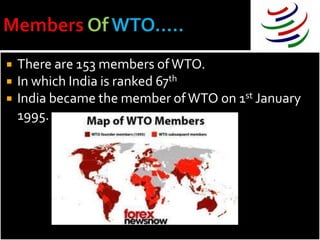
   There are 153 members of WTO.
   In which India is ranked 67th
   India became the member of WTO on 1st January
    1995.
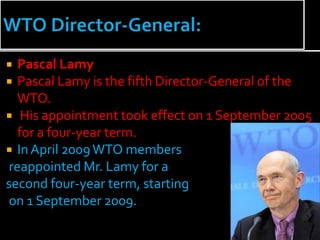
 Pascal Lamy
 Pascal Lamy is the fifth Director-General of the
  WTO.
 His appointment took effect on 1 September 2005
  for a four-year term.
 In April 2009 WTO members
reappointed Mr. Lamy for a
second four-year term, starting
on 1 September 2009.
   There is so much more about this organization

If interested please visit the site
www.wto.org
Information from:
 WTO web site
Google
Forex News show
 Akib Siddiqui
 Zohaib Najam
 Pritesh Patel
 Ron Charles
 Hiren Sapra
 Avin Thomas.
            THANK YOU//////

world trade organization

  • 2.
    The World Trade Organization (WTO) is an organization that intends to supervise and liberalize international trade.  The organization deals with regulation of trade between participating countries; it provides a framework for negotiating and formalizing trade agreements, and a dispute resolution.  The organization officially commenced on January 1, 1995 under the Marrakech Agreement, replacing the General Agreement on Tariffs and Trade (GATT), which commenced in 1948.
  • 3.
     Location: Geneva,Switzerland  Established:1 January 1995  Created by: Uruguay Round negotiations (1986-94)  Membership: 153 countries on 23 July 2008  Budget: 196 million Swiss francs for 2011  Head: Pascal Lamy (Director-General)
  • 4.
    Functions: • Administering WTO trade agreements • Forum for trade negotiations • Handling trade disputes • Monitoring national trade policies • Technical assistance and training for developing countries • Cooperation with other international organizations
  • 5.
    The WTO is the only international organization dealing with the global rules of trade between nations.  Its main function is to ensure that trade flows as smoothly, predictably and freely as possible.  The goal is to improve the welfare of the peoples of the member countries  By lowering trade barriers, the WTO’s system also breaks down other barriers between peoples and nations.
  • 6.
    The WTO agreements are lengthy and complex because they are legal texts covering a wide range of activities. But a number of simple, fundamental principles run throughout all of these documents. These principles are the foundation of the multilateral trading system.  Non-discrimination  More open  Predictable and transparent  More competitive  More beneficial for less developed countries  Protect the environment
  • 7.
    More open : Lowering trade barriers is one of the most obvious ways of encouraging trade; these barriers include customs duties and measures such as import bans or quotas that restrict quantities selectively.  More beneficial for less developed countries : Giving them more time to adjust, greater flexibility and special privileges; over three-quarters of WTO members are developing countries and countries in transition to market economies.  Non-discrimination : A country should not discriminate between its trading partners and it should not discriminate between its own and foreign products, services or nationals.
  • 8.
    The WTO is run by its member governments. All major decisions are made by the membership as a whole, either by ministers or by their ambassadors or delegates  While the WTO is driven by its member states, it could not function without its Secretariat to coordinate the activities.  Trade negotiations  Implementation and monitoring  Dispute settlement  Building trade capacity  Outreach
  • 9.
     Trade negotiations: They include individual countries’ commitments to lower customs tariffs and other trade barriers, and to open and keep open services markets. They set procedures for settling disputes. These agreements are not static; they are renegotiated from time to time and new agreements can be added to the package.  Dispute settlement : The WTO’s procedure for resolving trade quarrels under the Dispute Settlement Understanding is vital for enforcing the rules and therefore for ensuring that trade flows smoothly.
  • 10.
    The ten benefits 1.The system helps promote peace 2. Disputes are handled constructively 3. Rules make life easier for all 4. Freer trade cuts the costs of living 5. It provides more choice of products and qualities 6. Trade raises incomes 7. Trade stimulates economic growth 8. The basic principles make life more efficient 9. Governments are shielded from lobbying 10. The system encourages good government
  • 11.
    In 1994, the WTO members agreed on the Understanding on Rules and Procedures Governing the Settlement of Disputes (DSU) annexed to the "Final Act" signed in Marrakesh in 1994.  Dispute settlement is regarded by the WTO as the central pillar of the multilateral trading system, and as a "unique contribution to the stability of the global economy“
  • 12.
    WTO members have agreed that, if they believe fellow-members are violating trade rules, they will use the multilateral system of settling disputes instead of taking action unilaterally.  The operation of the WTO dispute settlement process involves the DSB panels, the Appellate Body, the WTO Secretariat, arbitrators, independent experts and several specialized institutions. Bodies involved in the dispute settlement process, World Trade Organization.
  • 13.
    Disputes chronologically  Disputes by country/territory  Disputes by agreement  Disputes by subject  Find disputes cases  Dispute Settlement Body  Appellate Body
  • 14.
    The Doha Round is the latest round of trade negotiations among the WTO membership.  Its aim is to achieve major reform of the international trading system through the introduction of lower trade barriers and revised trade rules.  The work programme covers about 20 areas of trade. The Round is also known semi-officially as the Doha Development Agenda as a fundamental objective is to improve the trading prospects of developing countries.
  • 15.
    The Round was officially launched at the WTO’s Fourth Ministerial Conference in Doha, Qatar, in November 2001.  The Doha Ministerial Declaration provided the mandate for the negotiations, including on agriculture, services and an intellectual property topic, which began earlier.  In Doha, ministers also approved a decision on how to address the problems developing countries face in implementing the current WTO agreements.
  • 16.
    The WTO oversees about 60 different agreements which have the status of international legal texts. Member countries must sign and ratify all WTO agreements on accession.  A discussion of some of the most important agreements follows. The Agreement on Agriculture came into effect with the establishment of the WTO at the beginning of 1995  The AoA has three central concepts, or "pillars": domestic support, market access and export subsidies
  • 17.
    The General Agreement on Trade in Services was created to extend the multilateral trading system to service sector, in the same way the General Agreement on Tariffs and Trade (GATT) provides such a system for merchandise trade.  The Agreement on Trade-Related Aspects of Intellectual Property Rights sets down minimum standards for many forms of intellectual property (IP) regulation.  The Agreement on the Application of Sanitary and Phytosanitary Measures — also known as the SPS Agreement was negotiated during the Uruguay Round of the General Agreement on Tariffs and Trade
  • 18.
     Agriculture  Subsidies & countervail · Agriculture negotiations measures · Cotton Sub-Committee  Tariffs  Balance of payments  Technical barriers to trade  Customs valuation  Textiles  GATT & the Goods Council  Trade facilitation  Goods schedules  Import licensing  Information Technology Agreement  Safeguard measures  State trading enterprises
  • 19.
    There are 153 members of WTO.  In which India is ranked 67th  India became the member of WTO on 1st January 1995.
  • 20.
     Pascal Lamy Pascal Lamy is the fifth Director-General of the WTO.  His appointment took effect on 1 September 2005 for a four-year term.  In April 2009 WTO members reappointed Mr. Lamy for a second four-year term, starting on 1 September 2009.
  • 21.
    There is so much more about this organization If interested please visit the site www.wto.org Information from: WTO web site Google Forex News show
  • 22.
     Akib Siddiqui Zohaib Najam  Pritesh Patel  Ron Charles  Hiren Sapra  Avin Thomas. THANK YOU//////