
5 Year Plan in
India
The Fourth Year Plan.
What is a 5 year Plan?
 The economy of India is based in part
  on planning through its five-year plan, which are
  developed, executed and monitored by
  the planning commission.
 The tenth plan completed its term in March 2007
  and the eleventh plan is currently underway.
 Prior to the fourth plan, the allocation of state
  resources was based on schematic patterns
  rather than a transparent and objective
  mechanism, which led to the adoption of
  the Gadgil Formula in 1969.
 Revised versions of the formula have been used
  since then to determine the allocation of central
  assistance for state plans.
Planning Commission.
The Planning commission is an institution in the Government
of India, which formulates India’s Five-year Plan, among other
functions.
Functions:- 1) To formulate a plan for the most effective and
   balanced utilization of country's resources.
2) To define the stages, on the basis of priority, in which the
   plan should be carried out and propose the allocation of
   resources for the due completion of each stage.
3) To indicate the factors that tend to retard economic
   development.
4) To determine the conditions which need to be established for
   the successful execution of the plan within the incumbent
   socio-political situation of the country.
5) To make necessary recommendations from time to time
   regarding those things which are deemed necessary for
   facilitating the execution of these functions.
The Fourth Year Plan. (1969–
1974) time Indira Gandhi was the Prime minister of
  At this
     India.
    The Indira Gandhi government nationalized 14 major
     Indian banks and the Green Revolution in
     India advanced agriculture.
    Funds earmarked for the industrial development had to
     be diverted for the war effort. India also performed
     the Smiling Buddha undergone unclear test in
     1974, partially in response to the .United states of
     the seventh fleet in the Bay of Bengal.
     The fleet had been deployed to warn India against
     attacking West Pakistan and extending the war. Target
     Growth: 5.7% Actual Growth: 3.30%
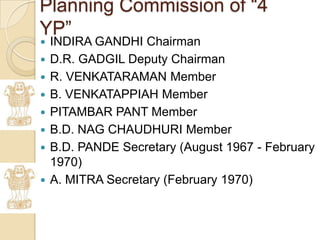
Planning Commission of “4
YP”
   INDIRA GANDHI Chairman
   D.R. GADGIL Deputy Chairman
   R. VENKATARAMAN Member
   B. VENKATAPPIAH Member
   PITAMBAR PANT Member
   B.D. NAG CHAUDHURI Member
   B.D. PANDE Secretary (August 1967 - February
    1970)
   A. MITRA Secretary (February 1970)
Gadgil Formula
 The   Gadgil formula is due to D.R.
  Gadgil, the social scientist and the
  first critic of Indian Planning.
 It was evolved in 1969 for
  determining the allocation of central
  assistance for state plans in India.
 Gadgil formula was adopted for
  distribution of plan assistance
  during Fourth and fifth year plan
Objectives in Gadgil
Formula.
 Population
In India population acts as an apt measure to represent the
   requirements of the people because a major portion of the
   population lives below the poverty line.
 Tax effort
This is an important factor to measure the potential of the state
   as far as its own resources are concerned. This relative
   measure incentivizes the states to undertake measures to
   increase their own potential through various tax measures.
 State per capita income
A problem regarding unequal development amongst the states
   was faced in the earlier plans because of larger states with
   their large plans were able to get a larger share of resources
   from the centre. This led to increased inequalities amongst
   the states.
 Irrigation and power projects
These projects have been in the process of implementation
   before the fourth plan was formulated.
Green Revolution India.
   The introduction of high yielding varieties
    of seeds in India. and the increased use
    of fertilizers and irrigation are known
    collectively as the Green revolution, which
    provided the increase in production
    needed to make India self-sufficient in
    food grains, thus improving agriculture of
    India.
Important Topic considered.
   Approach and Policy.          Village and small
   The long term                  Industries.
    perspective                   Industry and Minerals
   Plan in outline .             Transport and
   Financing the plan             Communication
   Foreign Trade.                Education & Manpower
   Implementation.               Scientific Research
   Agriculture.                  Health & Family Planning
   Animal                        Regional Development
    Husbandry, Dairying, Fis      Housing & water Supply
    hing and forests..            Social Welfare
   Cooperation and               Welfare & Development
    community building.            Of Backward Classes
   Food and Nutrition            Labor & Employment
   Irrigation and Flood          Other Programmes.
    Control.
   Power.
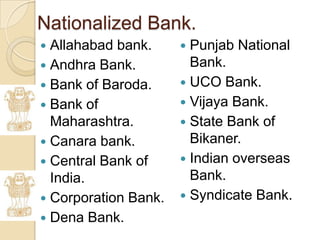
Nationalized Bank.
 Allahabad bank.      Punjab National
 Andhra Bank.          Bank.
 Bank of Baroda.      UCO Bank.
 Bank of              Vijaya Bank.
  Maharashtra.         State Bank of
 Canara bank.          Bikaner.
 Central Bank of      Indian overseas
  India.                Bank.
 Corporation Bank.    Syndicate Bank.
 Dena Bank.
THANK YOU!.
 Information Collected From the
   Following sources:-
  Wikipedia.
  Planningcommission.nic.in
  Google For Images.

5 year plan in india

  • 1.
    5 Year Planin India The Fourth Year Plan.
  • 2.
    What is a5 year Plan?  The economy of India is based in part on planning through its five-year plan, which are developed, executed and monitored by the planning commission.  The tenth plan completed its term in March 2007 and the eleventh plan is currently underway.  Prior to the fourth plan, the allocation of state resources was based on schematic patterns rather than a transparent and objective mechanism, which led to the adoption of the Gadgil Formula in 1969.  Revised versions of the formula have been used since then to determine the allocation of central assistance for state plans.
  • 3.
    Planning Commission. The Planningcommission is an institution in the Government of India, which formulates India’s Five-year Plan, among other functions. Functions:- 1) To formulate a plan for the most effective and balanced utilization of country's resources. 2) To define the stages, on the basis of priority, in which the plan should be carried out and propose the allocation of resources for the due completion of each stage. 3) To indicate the factors that tend to retard economic development. 4) To determine the conditions which need to be established for the successful execution of the plan within the incumbent socio-political situation of the country. 5) To make necessary recommendations from time to time regarding those things which are deemed necessary for facilitating the execution of these functions.
  • 4.
    The Fourth YearPlan. (1969– 1974) time Indira Gandhi was the Prime minister of  At this India.  The Indira Gandhi government nationalized 14 major Indian banks and the Green Revolution in India advanced agriculture.  Funds earmarked for the industrial development had to be diverted for the war effort. India also performed the Smiling Buddha undergone unclear test in 1974, partially in response to the .United states of the seventh fleet in the Bay of Bengal.  The fleet had been deployed to warn India against attacking West Pakistan and extending the war. Target Growth: 5.7% Actual Growth: 3.30%
  • 5.
    Planning Commission of“4 YP”  INDIRA GANDHI Chairman  D.R. GADGIL Deputy Chairman  R. VENKATARAMAN Member  B. VENKATAPPIAH Member  PITAMBAR PANT Member  B.D. NAG CHAUDHURI Member  B.D. PANDE Secretary (August 1967 - February 1970)  A. MITRA Secretary (February 1970)
  • 6.
    Gadgil Formula  The Gadgil formula is due to D.R. Gadgil, the social scientist and the first critic of Indian Planning.  It was evolved in 1969 for determining the allocation of central assistance for state plans in India.  Gadgil formula was adopted for distribution of plan assistance during Fourth and fifth year plan
  • 7.
    Objectives in Gadgil Formula. Population In India population acts as an apt measure to represent the requirements of the people because a major portion of the population lives below the poverty line.  Tax effort This is an important factor to measure the potential of the state as far as its own resources are concerned. This relative measure incentivizes the states to undertake measures to increase their own potential through various tax measures.  State per capita income A problem regarding unequal development amongst the states was faced in the earlier plans because of larger states with their large plans were able to get a larger share of resources from the centre. This led to increased inequalities amongst the states.  Irrigation and power projects These projects have been in the process of implementation before the fourth plan was formulated.
  • 8.
    Green Revolution India.  The introduction of high yielding varieties of seeds in India. and the increased use of fertilizers and irrigation are known collectively as the Green revolution, which provided the increase in production needed to make India self-sufficient in food grains, thus improving agriculture of India.
  • 9.
    Important Topic considered.  Approach and Policy.  Village and small  The long term Industries. perspective  Industry and Minerals  Plan in outline .  Transport and  Financing the plan Communication  Foreign Trade.  Education & Manpower  Implementation.  Scientific Research  Agriculture.  Health & Family Planning  Animal  Regional Development Husbandry, Dairying, Fis  Housing & water Supply hing and forests..  Social Welfare  Cooperation and  Welfare & Development community building. Of Backward Classes  Food and Nutrition  Labor & Employment  Irrigation and Flood  Other Programmes. Control.  Power.
  • 10.
    Nationalized Bank.  Allahabadbank.  Punjab National  Andhra Bank. Bank.  Bank of Baroda.  UCO Bank.  Bank of  Vijaya Bank. Maharashtra.  State Bank of  Canara bank. Bikaner.  Central Bank of  Indian overseas India. Bank.  Corporation Bank.  Syndicate Bank.  Dena Bank.
  • 11.
    THANK YOU!. InformationCollected From the Following sources:-  Wikipedia.  Planningcommission.nic.in  Google For Images.