
G
rain aeration is a popular grain
storage tool used in Australia by
farmers, offering harvest flexibility,
increased marketing opportunities
and better control of grain quality.
As the range of chemical control
options is reduced, grain aeration
provides a powerful non-chemical
stored grain insect management
option.
Through manipulating grain temperature and moisture,
aeration cools the grain stack and achieves a more uniform bulk,
delivering an optimal storage environment. Not only does this
inhibit insect activity, but also maintains grain quality. Aeration
of stored grain has four main purposes - preventing mould,
inhibiting insect development, maintaining seed viability and
reducing grain moisture. Without aeration grain is an effective
insulator and will maintain its warm harvest temperature for a
long time. Like housing insulation, grain holds many tiny pockets
of air within a stack - for example 100 tonnes of barley requires
a silo with a volume of about 130 cubic metres, 80m3
is taken
up by the grain and the remaining 50m3
(38 per cent) is air space
around each grain.
Without circulation, the air surrounding the grain will reach a
moisture (relative humidity) and temperature equilibrium within
a few days. These conditions provide an ideal environment for
insects and mould to thrive and without aeration the grain is
likely to maintain that temperature and moisture for months.
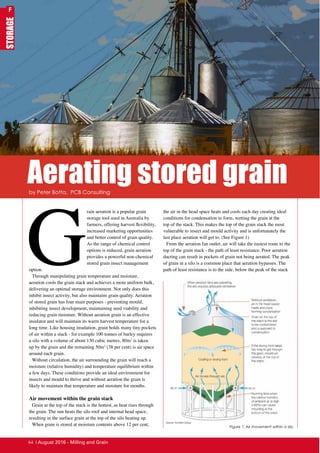
Air movement within the grain stack
Grain at the top of the stack is the hottest, as heat rises through
the grain. The sun heats the silo roof and internal head space,
resulting in the surface grain at the top of the silo heating up.
When grain is stored at moisture contents above 12 per cent,
the air in the head space heats and cools each day creating ideal
conditions for condensation to form, wetting the grain at the
top of the stack. This makes the top of the grain stack the most
vulnerable to insect and mould activity and is unfortunately the
last place aeration will get to. (See Figure 1)
From the aeration fan outlet, air will take the easiest route to the
top of the grain stack - the path of least resistance. Poor aeration
ducting can result in pockets of grain not being aerated. The peak
of grain in a silo is a common place that aeration bypasses. The
path of least resistance is to the side, below the peak of the stack
Aerating stored grain
STORAGE
by Peter Botta, PCB Consulting
Figure 1: Air movement within a silo
F
64 | August 2016 - Milling and Grain
as it is a shorter distance from the aeration ducting.
Considering silo size – height and width, grain types stored,
ducting type and configuration and fan size output needed are all
important factors. The system must be fit for purpose to ensure
successful results.
Cooling or drying
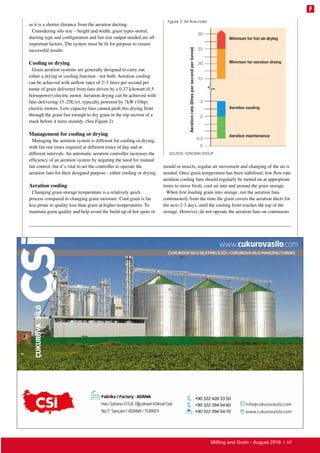
Grain aeration systems are generally designed to carry out
either a drying or cooling function - not both. Aeration cooling
can be achieved with airflow rates of 2–3 litres per second per
tonne of grain delivered from fans driven by a 0.37 kilowatt (0.5
horsepower) electric motor. Aeration drying can be achieved with
fans delivering 15–25L/s/t, typically powered by 7kW (10hp)
electric motors. Low-capacity fans cannot push this drying front
through the grain fast enough to dry grain in the top section of a
stack before it turns mouldy. (See Figure 2)
Management for cooling or drying
Managing the aeration system is different for cooling or drying,
with fan run times required at different times of day and at
different intervals. An automatic aeration controller increases the
efficiency of an aeration system by negating the need for manual
fan control, but it’s vital to set the controller to operate the
aeration fans for their designed purpose - either cooling or drying.
Aeration cooling
Changing grain storage temperature is a relatively quick
process compared to changing grain moisture. Cool grain is far
less prone to quality loss than grain at higher temperatures. To
maintain grain quality and help avoid the build-up of hot spots or
mould or insects, regular air movement and changing of the air is
needed. Once grain temperature has been stabilised, low flow-rate
aeration cooling fans should regularly be turned on at appropriate
times to move fresh, cool air into and around the grain storage.
When first loading grain into storage, run the aeration fans
continuously from the time the grain covers the aeration ducts for
the next 2-3 days, until the cooling front reaches the top of the
storage. However, do not operate the aeration fans on continuous
Figure 2: Air flow rates
F
Milling and Grain - August 2016 | 65
STORAGE
mode if the ambient relative humidity is higher than
85 percent for extended periods of time as this can wet
the grain. After the aeration fans have been running
continuously for 2–3 days to flush out any warm, humid
air, reduce run time to 9–12 hours per day during the
coolest period, for the next seven days.
The goal is to quickly reduce the grain temperature
from mid 30°Ct down near to low 20°C. An initial
reduction in grain temperature of 10°C ensures grain
is less prone to damage and insect attack, while further
cooling becomes a more precise task. During this final
stage, automated aeration controllers generally run
fans during the coolest periods of the day, averaging
100 hours per month. (See Table 2) Grain temperature
is gradually reduced as low as possible and then
maintained throughout the storage period. In Australia
it’s quite achievable to get grain down to 16-18 degrees
Celsius where many insect pest can no longer breed.
Aeration drying
Ambient air can also be used to dry grain. Here, high
flow rates of air at a temperature and humidity that will remove
water from the grain (see grain equilibrium moistures) is pumped
through the grain bulk. Providing the air is of a quality that will
dry and not re-wet the grain, the grain will dry from the bottom
of the silo, with a drying front moving upwards through the grain
stack.
Aeration drying is a much slower process than aeration cooling
or hot-air drying. The time it takes and the moisture content of
grain after a drying front has reached the top of the grain stack
is highly dependent on the quality of the air available for drying.
Several drying fronts may be needed to dry grain to receival
standards. If aeration is to be used for drying, check with your
aeration supplier that the fan and ducting have sufficient flow rate
and pressure to force a moisture change front through the grain
in the silo quickly enough to prevent mould development. It is
also critical to ensure that flow fronts are even and grain depth
is not too deep. Air with greatest capacity to dry, occurs most
during the day when temperatures are high and relative humidity
low, but this is not always the case. (See Table 1) Very hot dry air
can overdry and crack grain. The average quality of the inlet air
determines the final grain moisture content.
Table 1: Air for drying grain
Table 2 Air for cooling grain
F
66 | August 2016 - Milling and Grain
STORAGE: Aerating stored grain

STORAGE: Aerating stored grain

  • 1.
    G rain aeration isa popular grain storage tool used in Australia by farmers, offering harvest flexibility, increased marketing opportunities and better control of grain quality. As the range of chemical control options is reduced, grain aeration provides a powerful non-chemical stored grain insect management option. Through manipulating grain temperature and moisture, aeration cools the grain stack and achieves a more uniform bulk, delivering an optimal storage environment. Not only does this inhibit insect activity, but also maintains grain quality. Aeration of stored grain has four main purposes - preventing mould, inhibiting insect development, maintaining seed viability and reducing grain moisture. Without aeration grain is an effective insulator and will maintain its warm harvest temperature for a long time. Like housing insulation, grain holds many tiny pockets of air within a stack - for example 100 tonnes of barley requires a silo with a volume of about 130 cubic metres, 80m3 is taken up by the grain and the remaining 50m3 (38 per cent) is air space around each grain. Without circulation, the air surrounding the grain will reach a moisture (relative humidity) and temperature equilibrium within a few days. These conditions provide an ideal environment for insects and mould to thrive and without aeration the grain is likely to maintain that temperature and moisture for months. Air movement within the grain stack Grain at the top of the stack is the hottest, as heat rises through the grain. The sun heats the silo roof and internal head space, resulting in the surface grain at the top of the silo heating up. When grain is stored at moisture contents above 12 per cent, the air in the head space heats and cools each day creating ideal conditions for condensation to form, wetting the grain at the top of the stack. This makes the top of the grain stack the most vulnerable to insect and mould activity and is unfortunately the last place aeration will get to. (See Figure 1) From the aeration fan outlet, air will take the easiest route to the top of the grain stack - the path of least resistance. Poor aeration ducting can result in pockets of grain not being aerated. The peak of grain in a silo is a common place that aeration bypasses. The path of least resistance is to the side, below the peak of the stack Aerating stored grain STORAGE by Peter Botta, PCB Consulting Figure 1: Air movement within a silo F 64 | August 2016 - Milling and Grain
  • 2.
    as it isa shorter distance from the aeration ducting. Considering silo size – height and width, grain types stored, ducting type and configuration and fan size output needed are all important factors. The system must be fit for purpose to ensure successful results. Cooling or drying Grain aeration systems are generally designed to carry out either a drying or cooling function - not both. Aeration cooling can be achieved with airflow rates of 2–3 litres per second per tonne of grain delivered from fans driven by a 0.37 kilowatt (0.5 horsepower) electric motor. Aeration drying can be achieved with fans delivering 15–25L/s/t, typically powered by 7kW (10hp) electric motors. Low-capacity fans cannot push this drying front through the grain fast enough to dry grain in the top section of a stack before it turns mouldy. (See Figure 2) Management for cooling or drying Managing the aeration system is different for cooling or drying, with fan run times required at different times of day and at different intervals. An automatic aeration controller increases the efficiency of an aeration system by negating the need for manual fan control, but it’s vital to set the controller to operate the aeration fans for their designed purpose - either cooling or drying. Aeration cooling Changing grain storage temperature is a relatively quick process compared to changing grain moisture. Cool grain is far less prone to quality loss than grain at higher temperatures. To maintain grain quality and help avoid the build-up of hot spots or mould or insects, regular air movement and changing of the air is needed. Once grain temperature has been stabilised, low flow-rate aeration cooling fans should regularly be turned on at appropriate times to move fresh, cool air into and around the grain storage. When first loading grain into storage, run the aeration fans continuously from the time the grain covers the aeration ducts for the next 2-3 days, until the cooling front reaches the top of the storage. However, do not operate the aeration fans on continuous Figure 2: Air flow rates F Milling and Grain - August 2016 | 65
  • 3.
    STORAGE mode if theambient relative humidity is higher than 85 percent for extended periods of time as this can wet the grain. After the aeration fans have been running continuously for 2–3 days to flush out any warm, humid air, reduce run time to 9–12 hours per day during the coolest period, for the next seven days. The goal is to quickly reduce the grain temperature from mid 30°Ct down near to low 20°C. An initial reduction in grain temperature of 10°C ensures grain is less prone to damage and insect attack, while further cooling becomes a more precise task. During this final stage, automated aeration controllers generally run fans during the coolest periods of the day, averaging 100 hours per month. (See Table 2) Grain temperature is gradually reduced as low as possible and then maintained throughout the storage period. In Australia it’s quite achievable to get grain down to 16-18 degrees Celsius where many insect pest can no longer breed. Aeration drying Ambient air can also be used to dry grain. Here, high flow rates of air at a temperature and humidity that will remove water from the grain (see grain equilibrium moistures) is pumped through the grain bulk. Providing the air is of a quality that will dry and not re-wet the grain, the grain will dry from the bottom of the silo, with a drying front moving upwards through the grain stack. Aeration drying is a much slower process than aeration cooling or hot-air drying. The time it takes and the moisture content of grain after a drying front has reached the top of the grain stack is highly dependent on the quality of the air available for drying. Several drying fronts may be needed to dry grain to receival standards. If aeration is to be used for drying, check with your aeration supplier that the fan and ducting have sufficient flow rate and pressure to force a moisture change front through the grain in the silo quickly enough to prevent mould development. It is also critical to ensure that flow fronts are even and grain depth is not too deep. Air with greatest capacity to dry, occurs most during the day when temperatures are high and relative humidity low, but this is not always the case. (See Table 1) Very hot dry air can overdry and crack grain. The average quality of the inlet air determines the final grain moisture content. Table 1: Air for drying grain Table 2 Air for cooling grain F 66 | August 2016 - Milling and Grain