Paddy Drying Systems
By:
M Gummert
J Rickman
Agricultural Engineering Unit
IRRI, Los Baños , Philippines
Content
• Why drying
• Drying and quality
• Drying methods
• Mechanical drying systems
• Drying strategies
Why Drying?
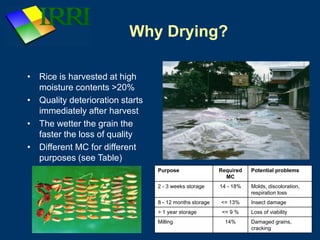
• Rice is harvested at high
moisture contents >20%
• Quality deterioration starts
immediately after harvest
• The wetter the grain the
faster the loss of quality
• Different MC for different
purposes (see Table)
Purpose Required
MC
Potential problems
2 - 3 weeks storage 14 - 18% Molds, discoloration,
respiration loss
8 - 12 months storage <= 13% Insect damage
> 1 year storage <= 9 % Loss of viability
Milling 14% Damaged grains,
cracking
Improper drying, 1
• Heat build-up
– from natural respiration
– excellent growth conditions for molds and
insects
• Mold development
– propagate diseases in the grain
– may release toxins into the grain
– proper drying and storage can reduce
propagation of molds
• Insect infestation
– insects are always a problem in stored
grain
– at lower moisture content insect activities
are lower
– proper drying helps keeping insects at
acceptable level (4 insects per kg)
Improper drying, 2
• Discoloration/Yellowing
– heat build-up in the paddy grain
before drying
– drastically reduces the market
value of rice
• Loss of germination and vigor
– active respiration depletes the
nutrition reserves
– molds and diseases can reduce
the ability of the seed to
germinate
– the lower the MC at the beginning
of storage, the longer the seed
remains viable
Improper drying, 3
• Loss of freshness/odor development
– Heat build up -> musty odor in rice.
– Reduces the market value of rice.
– If from mycotoxin-producing fungi rice
might become unusable.
• Reduced head rice yield
– moisture adsorption of individual dry
grains with moisture contents below
16% - fissuring
 mixing dry with wet grains
 Exposing dry grains to humid air
– Fissures cause cracking in milling
process -> reduced the head rice
recovery.
Equilibrium moisture content (EMC)
• Rice is hygroscopic
• Equilibrium moisture
content (EMC)
– If grain is exposed to
air for a longer time it
will reach EMC
– Dry grain will adsorb
water from humid air
– Wet grain will dry
• Grain properties
– Moisture Content, MC
– Temperature
• Air properties
– Relative Humidity, RH
– Temperature
Purpose Required
MC
Potential problems
2 - 3 weeks storage 14 - 18% Molds, discoloration,
respiration loss
8 - 12 months storage <= 13% Insect damage
> 1 year storage <= 9 % Loss of viability
Milling 14% Damaged grains,
cracking
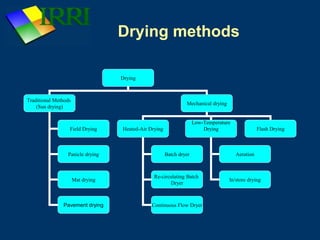
Drying methods
Drying
Traditional Methods
(Sun drying)
Mechanical drying
Field Drying
Panicle drying
Mat drying
Heated-Air Drying
Low-Temperature
Drying
Batch dryer
Re-circulating Batch
Dryer
Continuous Flow Dryer
Flash Drying
Aeration
In/store drying
Pavement drying
Field drying
• Why field drying?
– Waiting for the thresher
– Manual threshing
• How?
– Spreading the crop in the field
– Stacking/piling
• Advantages
– Can reduce MC by 1% per day
• Disadvantages
– Rapid quality deterioration
– Shattering
– Losses to bird and rodents when spread in
the field
– Heat build up and rapid quality deterioration
in piles
– Re-wetting from straw in piles
It is impossible to produce good quality grains
with field drying practices.
Field drying should therefore be avoided.
Panicle drying
• Traditional method
– harvested with a small knife (ani ani)
– paddy grains that are still attached
to the panicles
– for drying small amounts of paddy.
– stored in farmers’ houses, e.g. under
the roof for protection from rodents.
• Problems
– low capacity
– grains inside the panicle dry slower
than the grains that are exposed
directly to the sun.
• Tips
– turning of the panicles improves the
drying process
Mat drying
• Paddy can be placed on nets,
mats or plastic sheets
(canvas).
• Advantages
– Most hygienic method.
– less contamination with
stones and other dirt
– Easy collection in case of
sudden rainfalls.
– Easy mixing
• Disadvantages of nets
– danger of re-wetting of the
bottom grains from soil
moisture
Pavement drying
• Better-off farmers, grain collectors,
traders and millers use drying
pavements
– specifically constructed for drying
– multi purposes (basketball court)
• Advantages
– high capacity / economics of scale
– can be partially mechanized
– tools for mixing and grain
collection
– larger mills often use two or four
wheel tractors
• Disadvantages
– capital requirements for the
pavement
– pollution with stones and dirt
Sundrying and quality
Layer thickness
• Spread the grains in thin layers,
ideally 2-4 cm.
• Too thin layers -> heat up very
quickly
• Too thick result in a large
moisture gradient
Mixing interval
• mixing the grain is the most
important activity for maintaining
good quality
• Turn or stir the grain at least
once per hour, better every 30
minutes to achieve uniform MC.
60
65
70
75
80
85
90
0 1 2 3 4 5 6 7
Mixing interval, h
Recovery,
%
5
5.25
5.5
5.75
6
6.25
6.5
Drying
Time,
h
Head rice
Milled rice
Drying time
Source: IRRI, (Gayanilo)
Location: Philippines
Intital M.C. = 24%
Final M.C. = 14%
74
76
78
80
82
84
86
88
90
0 1 2 3 4 5 6 7
Layer thickness, cm
Recovery,
%
3
3.5
4
4.5
5
5.5
6
6.5
7
7.5
8
Drying
Time,
h
Head rice
Milled rice
Drying time
Source: IRRI, (Gayanilo)
Location: Philippines
Intital M.C. = 24%
Final M.C. = 14%
Tips for better sundrying
• Management
– Layer depth of 4cm
– Mixing every 30 minutes
– Monitor moisture content
– Monitor temperature
• Protection
– Cover the grain when
temperature rise above 50-
60ºC
– Cover during rain.
– Prevent contamination
– keep animals off the grain Use tools to improve sundrying
Heated air drying
Components of a dryer
• Main components
– Drying bin
– Air distribution system
– Fan
– Air heater
• Optional
– Conveyors
• Accessories
– Moisture meter
– Dust separator
Options for heated air drying
Fixed bed batch dryer Re-circulating batch dryer Continuous flow drying plant
Tempering
Section
Drying
Section
Dryer Tempering bins
In
Out
Air
Grain
Fixed bed batch dryer (1)
Flat bed dryer
• Key features
– Batch Capacity: 1-10t
– Drying time 6-8h
– Approximate prices: US$ 1000-
2000
– Kerosene or rice hull fired
• Advantages
– Simple and affordable
• Disadvantage
– Labor intensive
– Moisture gradient
– Temperature control
Fixed bed batch dryer (2)
Low cost batch dryer
• Key features
– Batch Capacity: 0.2-2t
– Drying time: 1-2 days
– Approximate prices:
US$ 100-200
– Wood, coal or rice hull fired
• Advantages
– Simple and affordable
– Very cheap
– Uses local storage structures
• Disadvantage
– Labor intensive
– Moisture gradient
– Temperature control
Fixed bed batch dryer (3)
Reversible air flow dryer
• Key features
– Same as flat bed dryer
– Airflow is reversed after ½ to ¾
of drying time was completed
• Advantages
– Minimized moisture gradient
– Less labor intensive since
mixing is eliminated
• Disadvantage
– Additional cost
Re-circulating batch dryer
• Key features
– Batch Capacity: 4-12t
– Drying time: 8 hours
– Approximate prices:
US$ 8,000-10,000
– Kerosene fired
• Advantages
– Automatic operation
– Produces excellent quality
– Little floor area
• Disadvantage
– Wear of conveying elements
– Problems with very wet paddy
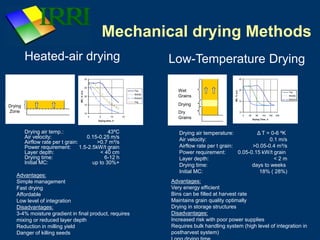
Mechanical drying Methods
Drying air temp.: 43ºC
Air velocity: 0.15-0.25 m/s
Airflow rate per t grain: >0.7 m³/s
Power requirement: 1.5-2.5kW/t grain
Layer depth: < 40 cm
Drying time: 6-12 h
Initial MC: up to 30%+
Drying
Zone 10
15
20
25
30
0 5 10 15
Drying time, h
MC,
%
w.b.
Top
Middle
Bottom
Avg.
Drying
Zone
Dry
Grains
Wet
Grains
10
15
20
25
0 48 96 144 192 240
Drying Time, h
MC,
%
w.b.
Top
Middle
Bottom
Heated-air drying Low-Temperature Drying
Drying air temperature: Δ T = 0-6 ºK
Air velocity: 0.1 m/s
Airflow rate per t grain: >0.05-0.4 m³/s
Power requirement: 0.05-0.15 kW/t grain
Layer depth: < 2 m
Drying time: days to weeks
Initial MC: 18% ( 28%)
Advantages:
Simple management
Fast drying
Affordable
Low level of integration
Disadvantages:
3-4% moisture gradient in final product, requires
mixing or reduced layer depth
Reduction in milling yield
Danger of killing seeds
Advantages:
Very energy efficient
Bins can be filled at harvest rate
Maintains grain quality optimally
Drying in storage structures
Disadvantages:
Increased risk with poor power supplies
Requires bulk handling system (high level of integration in
postharvest system)
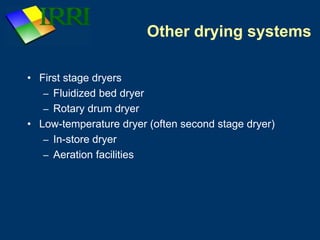
Other drying systems
• First stage dryers
– Fluidized bed dryer
– Rotary drum dryer
• Low-temperature dryer (often second stage dryer)
– In-store dryer
– Aeration facilities
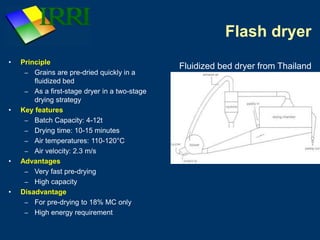
Flash dryer
• Principle
– Grains are pre-dried quickly in a
fluidized bed
– As a first-stage dryer in a two-stage
drying strategy
• Key features
– Batch Capacity: 4-12t
– Drying time: 10-15 minutes
– Air temperatures: 110-120°C
– Air velocity: 2.3 m/s
• Advantages
– Very fast pre-drying
– High capacity
• Disadvantage
– For pre-drying to 18% MC only
– High energy requirement
Fluidized bed dryer from Thailand
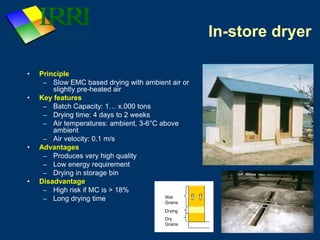
In-store dryer
Drying
Zone
Dry
Grains
Wet
Grains
• Principle
– Slow EMC based drying with ambient air or
slightly pre-heated air
• Key features
– Batch Capacity: 1… x.000 tons
– Drying time: 4 days to 2 weeks
– Air temperatures: ambient, 3-6°C above
ambient
– Air velocity: 0.1 m/s
• Advantages
– Produces very high quality
– Low energy requirement
– Drying in storage bin
• Disadvantage
– High risk if MC is > 18%
– Long drying time
Drying Strategies
• Decentralized on-farm drying
– Requires quality incentive
– Low utilization of equipment
– Training and technical support service
• Centralized drying
– Contractors (service providers)
– Mills
– Economics of scale
• Two-stage drying
– Ideal process to produce best quality
– Two machines are needed for one operation
– First stage dryer dries only to 18%
Thank you

paddy-drying-systems.ppt

  • 1.
    Paddy Drying Systems By: MGummert J Rickman Agricultural Engineering Unit IRRI, Los Baños , Philippines
  • 2.
    Content • Why drying •Drying and quality • Drying methods • Mechanical drying systems • Drying strategies
  • 3.
    Why Drying? • Riceis harvested at high moisture contents >20% • Quality deterioration starts immediately after harvest • The wetter the grain the faster the loss of quality • Different MC for different purposes (see Table) Purpose Required MC Potential problems 2 - 3 weeks storage 14 - 18% Molds, discoloration, respiration loss 8 - 12 months storage <= 13% Insect damage > 1 year storage <= 9 % Loss of viability Milling 14% Damaged grains, cracking
  • 4.
    Improper drying, 1 •Heat build-up – from natural respiration – excellent growth conditions for molds and insects • Mold development – propagate diseases in the grain – may release toxins into the grain – proper drying and storage can reduce propagation of molds • Insect infestation – insects are always a problem in stored grain – at lower moisture content insect activities are lower – proper drying helps keeping insects at acceptable level (4 insects per kg)
  • 5.
    Improper drying, 2 •Discoloration/Yellowing – heat build-up in the paddy grain before drying – drastically reduces the market value of rice • Loss of germination and vigor – active respiration depletes the nutrition reserves – molds and diseases can reduce the ability of the seed to germinate – the lower the MC at the beginning of storage, the longer the seed remains viable
  • 6.
    Improper drying, 3 •Loss of freshness/odor development – Heat build up -> musty odor in rice. – Reduces the market value of rice. – If from mycotoxin-producing fungi rice might become unusable. • Reduced head rice yield – moisture adsorption of individual dry grains with moisture contents below 16% - fissuring  mixing dry with wet grains  Exposing dry grains to humid air – Fissures cause cracking in milling process -> reduced the head rice recovery.
  • 7.
    Equilibrium moisture content(EMC) • Rice is hygroscopic • Equilibrium moisture content (EMC) – If grain is exposed to air for a longer time it will reach EMC – Dry grain will adsorb water from humid air – Wet grain will dry • Grain properties – Moisture Content, MC – Temperature • Air properties – Relative Humidity, RH – Temperature Purpose Required MC Potential problems 2 - 3 weeks storage 14 - 18% Molds, discoloration, respiration loss 8 - 12 months storage <= 13% Insect damage > 1 year storage <= 9 % Loss of viability Milling 14% Damaged grains, cracking
  • 8.
    Drying methods Drying Traditional Methods (Sundrying) Mechanical drying Field Drying Panicle drying Mat drying Heated-Air Drying Low-Temperature Drying Batch dryer Re-circulating Batch Dryer Continuous Flow Dryer Flash Drying Aeration In/store drying Pavement drying
  • 9.
    Field drying • Whyfield drying? – Waiting for the thresher – Manual threshing • How? – Spreading the crop in the field – Stacking/piling • Advantages – Can reduce MC by 1% per day • Disadvantages – Rapid quality deterioration – Shattering – Losses to bird and rodents when spread in the field – Heat build up and rapid quality deterioration in piles – Re-wetting from straw in piles It is impossible to produce good quality grains with field drying practices. Field drying should therefore be avoided.
  • 10.
    Panicle drying • Traditionalmethod – harvested with a small knife (ani ani) – paddy grains that are still attached to the panicles – for drying small amounts of paddy. – stored in farmers’ houses, e.g. under the roof for protection from rodents. • Problems – low capacity – grains inside the panicle dry slower than the grains that are exposed directly to the sun. • Tips – turning of the panicles improves the drying process
  • 11.
    Mat drying • Paddycan be placed on nets, mats or plastic sheets (canvas). • Advantages – Most hygienic method. – less contamination with stones and other dirt – Easy collection in case of sudden rainfalls. – Easy mixing • Disadvantages of nets – danger of re-wetting of the bottom grains from soil moisture
  • 12.
    Pavement drying • Better-offfarmers, grain collectors, traders and millers use drying pavements – specifically constructed for drying – multi purposes (basketball court) • Advantages – high capacity / economics of scale – can be partially mechanized – tools for mixing and grain collection – larger mills often use two or four wheel tractors • Disadvantages – capital requirements for the pavement – pollution with stones and dirt
  • 13.
    Sundrying and quality Layerthickness • Spread the grains in thin layers, ideally 2-4 cm. • Too thin layers -> heat up very quickly • Too thick result in a large moisture gradient Mixing interval • mixing the grain is the most important activity for maintaining good quality • Turn or stir the grain at least once per hour, better every 30 minutes to achieve uniform MC. 60 65 70 75 80 85 90 0 1 2 3 4 5 6 7 Mixing interval, h Recovery, % 5 5.25 5.5 5.75 6 6.25 6.5 Drying Time, h Head rice Milled rice Drying time Source: IRRI, (Gayanilo) Location: Philippines Intital M.C. = 24% Final M.C. = 14% 74 76 78 80 82 84 86 88 90 0 1 2 3 4 5 6 7 Layer thickness, cm Recovery, % 3 3.5 4 4.5 5 5.5 6 6.5 7 7.5 8 Drying Time, h Head rice Milled rice Drying time Source: IRRI, (Gayanilo) Location: Philippines Intital M.C. = 24% Final M.C. = 14%
  • 14.
    Tips for bettersundrying • Management – Layer depth of 4cm – Mixing every 30 minutes – Monitor moisture content – Monitor temperature • Protection – Cover the grain when temperature rise above 50- 60ºC – Cover during rain. – Prevent contamination – keep animals off the grain Use tools to improve sundrying
  • 15.
    Heated air drying Componentsof a dryer • Main components – Drying bin – Air distribution system – Fan – Air heater • Optional – Conveyors • Accessories – Moisture meter – Dust separator
  • 16.
    Options for heatedair drying Fixed bed batch dryer Re-circulating batch dryer Continuous flow drying plant Tempering Section Drying Section Dryer Tempering bins In Out Air Grain
  • 17.
    Fixed bed batchdryer (1) Flat bed dryer • Key features – Batch Capacity: 1-10t – Drying time 6-8h – Approximate prices: US$ 1000- 2000 – Kerosene or rice hull fired • Advantages – Simple and affordable • Disadvantage – Labor intensive – Moisture gradient – Temperature control
  • 18.
    Fixed bed batchdryer (2) Low cost batch dryer • Key features – Batch Capacity: 0.2-2t – Drying time: 1-2 days – Approximate prices: US$ 100-200 – Wood, coal or rice hull fired • Advantages – Simple and affordable – Very cheap – Uses local storage structures • Disadvantage – Labor intensive – Moisture gradient – Temperature control
  • 19.
    Fixed bed batchdryer (3) Reversible air flow dryer • Key features – Same as flat bed dryer – Airflow is reversed after ½ to ¾ of drying time was completed • Advantages – Minimized moisture gradient – Less labor intensive since mixing is eliminated • Disadvantage – Additional cost
  • 20.
    Re-circulating batch dryer •Key features – Batch Capacity: 4-12t – Drying time: 8 hours – Approximate prices: US$ 8,000-10,000 – Kerosene fired • Advantages – Automatic operation – Produces excellent quality – Little floor area • Disadvantage – Wear of conveying elements – Problems with very wet paddy
  • 21.
    Mechanical drying Methods Dryingair temp.: 43ºC Air velocity: 0.15-0.25 m/s Airflow rate per t grain: >0.7 m³/s Power requirement: 1.5-2.5kW/t grain Layer depth: < 40 cm Drying time: 6-12 h Initial MC: up to 30%+ Drying Zone 10 15 20 25 30 0 5 10 15 Drying time, h MC, % w.b. Top Middle Bottom Avg. Drying Zone Dry Grains Wet Grains 10 15 20 25 0 48 96 144 192 240 Drying Time, h MC, % w.b. Top Middle Bottom Heated-air drying Low-Temperature Drying Drying air temperature: Δ T = 0-6 ºK Air velocity: 0.1 m/s Airflow rate per t grain: >0.05-0.4 m³/s Power requirement: 0.05-0.15 kW/t grain Layer depth: < 2 m Drying time: days to weeks Initial MC: 18% ( 28%) Advantages: Simple management Fast drying Affordable Low level of integration Disadvantages: 3-4% moisture gradient in final product, requires mixing or reduced layer depth Reduction in milling yield Danger of killing seeds Advantages: Very energy efficient Bins can be filled at harvest rate Maintains grain quality optimally Drying in storage structures Disadvantages: Increased risk with poor power supplies Requires bulk handling system (high level of integration in postharvest system)
  • 22.
    Other drying systems •First stage dryers – Fluidized bed dryer – Rotary drum dryer • Low-temperature dryer (often second stage dryer) – In-store dryer – Aeration facilities
  • 23.
    Flash dryer • Principle –Grains are pre-dried quickly in a fluidized bed – As a first-stage dryer in a two-stage drying strategy • Key features – Batch Capacity: 4-12t – Drying time: 10-15 minutes – Air temperatures: 110-120°C – Air velocity: 2.3 m/s • Advantages – Very fast pre-drying – High capacity • Disadvantage – For pre-drying to 18% MC only – High energy requirement Fluidized bed dryer from Thailand
  • 24.
    In-store dryer Drying Zone Dry Grains Wet Grains • Principle –Slow EMC based drying with ambient air or slightly pre-heated air • Key features – Batch Capacity: 1… x.000 tons – Drying time: 4 days to 2 weeks – Air temperatures: ambient, 3-6°C above ambient – Air velocity: 0.1 m/s • Advantages – Produces very high quality – Low energy requirement – Drying in storage bin • Disadvantage – High risk if MC is > 18% – Long drying time
  • 25.
    Drying Strategies • Decentralizedon-farm drying – Requires quality incentive – Low utilization of equipment – Training and technical support service • Centralized drying – Contractors (service providers) – Mills – Economics of scale • Two-stage drying – Ideal process to produce best quality – Two machines are needed for one operation – First stage dryer dries only to 18%
  • 26.