STUDY ON STORAGE OF RICE
Presented by
Swapna Sagarika Sahoo (38E/10)
Ramya Ranjan Mishra(64E/10)
Content
Introduction
Objective
Materials
Methodology
Results and discussion
Conclusion
INTRODUCTION
 Rice is one of the most important food crops of India
in term of both area, production and consumer
preference.
 India is the second largest producer and consumer of
rice in the world.
 Rice production in India crossed the mark of 100 million
MTnes in 2011-12 accounting for 22.81% of global
production in that year.
Natural contamination of food
grains is greatly influenced by
environmental factors such as
type of storage structure,
temperature, RH, moisture
INTRODUCTION(Contd..)
 The indigenous storage structures are not suitable for
storing grains for longer periods. Metallic bins are used as a
convenient means for storage of rice to prevent loss due to
rodents.
 But loss of rice due to moisture accumulation & infestation
occurs in the metallic bin storage .
 Provision of Insulation & aeration may help in preventing
uneven temperature distribution and moisture accumulation
in rice during storage .
 Thus, we need some scientific intervention for storage of
milled rice in metallic bin providing insulation and aeration
to prevent enormous storage losses.
What is storage?
 Storage may be defined as a thermodynamic system which
includes a groups of interacting organisms and their
surrounding environment and characterized by set of bio-
physio-chemical properties.
Advantages of Storage
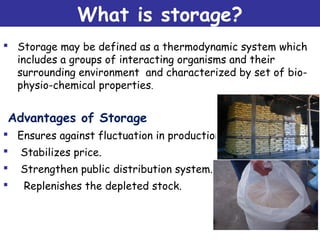
 Ensures against fluctuation in production.
 Stabilizes price.
 Strengthen public distribution system.
 Replenishes the depleted stock.
Controls measures for safe storage of rice
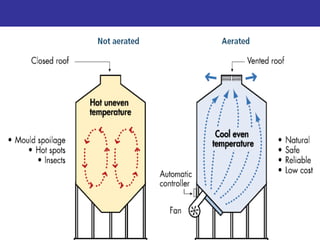
Aeration
It is the practice of forcing small quantities of air through
stored grain to maintain quality.
To accomplish this,  
 It is used to reduce temperature & also moisture content.
 It also helps prevent hot spots from developing and there by
reducing insect and microbial growth.
 Maintain uniformity in grain moisture content & temp.
 Removing odors from grain
 Equalizing grain moisture  
 Fumigant application
 
Insulation & relative humidity
Insulation
 Insulation of product storage is done to reduce the flow
of heat from the warmer exterior ,through the walls,
roofs, & floor of the storage.
Relative humidity
 For safe storage the RH of grain is less then 60% . So
it is very important to reduce the RH.
 RH is reduced by reducing the m.c. which is done by
using dehumidified refrigeration system.
 
OBJECTIVE
The present study was undertaken with the
following objectives.
 To study the effect of insulation & aeration
on temperature of rice stored in metallic bin
 
 To study the effect of insulation & aeration
on Moisture content of rice stored in
metallic bin.
MATERIALS
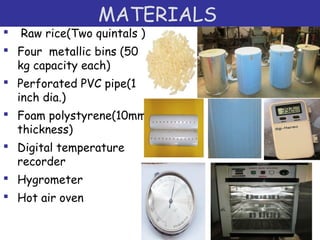
 Raw rice(Two quintals )
 Four metallic bins (50
kg capacity each)
 Perforated PVC pipe(1
inch dia.)
 Foam polystyrene(10mm
thickness)
 Digital temperature
recorder
 Hygrometer
 Hot air oven
Providing aeration
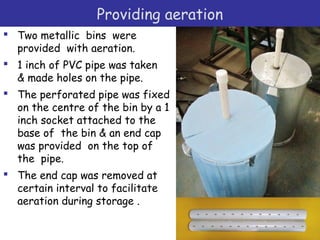
 Two metallic bins were
provided with aeration.
 1 inch of PVC pipe was taken
& made holes on the pipe.
 The perforated pipe was fixed
on the centre of the bin by a 1
inch socket attached to the
base of the bin & an end cap
was provided on the top of
the pipe.
 The end cap was removed at
certain interval to facilitate
aeration during storage .
Providing insulation
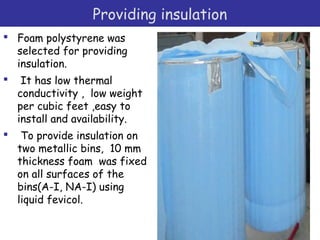
 Foam polystyrene was
selected for providing
insulation.
 It has low thermal
conductivity , low weight
per cubic feet ,easy to
install and availability.
 To provide insulation on
two metallic bins, 10 mm
thickness foam was fixed
on all surfaces of the
bins(A-I, NA-I) using
liquid fevicol.
A-NI,A-I,I-NA,NA-NI
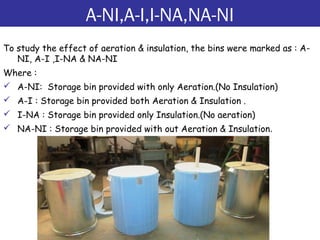
To study the effect of aeration & insulation, the bins were marked as : A-
NI, A-I ,I-NA & NA-NI
Where :
 A-NI: Storage bin provided with only Aeration.(No Insulation)
 A-I : Storage bin provided both Aeration & Insulation .
 I-NA : Storage bin provided only Insulation.(No aeration)
 NA-NI : Storage bin provided with out Aeration & Insulation.
METHODOLOGY
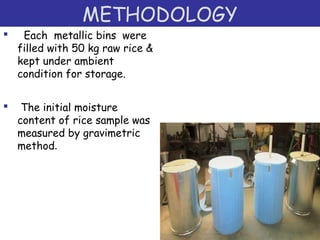
 Each metallic bins were
filled with 50 kg raw rice &
kept under ambient
condition for storage.
 The initial moisture
content of rice sample was
measured by gravimetric
method.
Measuring temperature and relative
humidity 
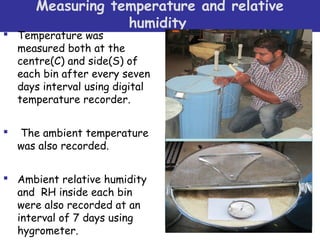
 Temperature was
measured both at the
centre(C) and side(S) of
each bin after every seven
days interval using digital
temperature recorder.
 The ambient temperature
was also recorded.
 Ambient relative humidity
and RH inside each bin
were also recorded at an
interval of 7 days using
hygrometer.
 
Determination of Moisture Content
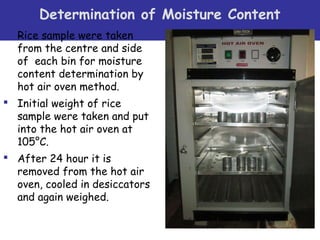
 Rice sample were taken
from the centre and side
of each bin for moisture
content determination by
hot air oven method.
 Initial weight of rice
sample were taken and put
into the hot air oven at
105°C.
 After 24 hour it is
removed from the hot air
oven, cooled in desiccators
and again weighed.
Insect infestation
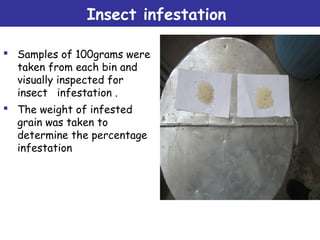
 Samples of 100grams were
taken from each bin and
visually inspected for
insect infestation .
 The weight of infested
grain was taken to
determine the percentage
infestation
RESULTS AND DISCUSSION
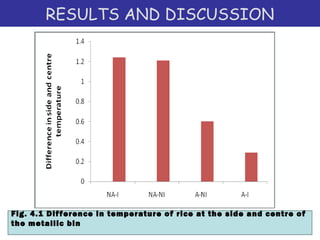
Fig. 4.1 Difference in temperature of rice at the side and centre of
the metallic bin
 The difference in temperatures of rice at the side and
centre of the bin were found to be higher under no aeration
condition (Fig. 4.1).
 This indicated that aeration helped in uniform temperature
difference inside the bin during storage.
 However, insulation was observed to be having no effect on
the temperature profile.
Relative humidity
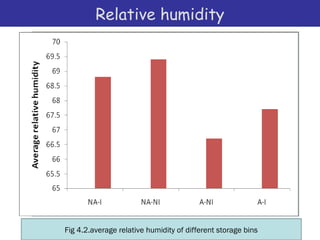
Fig 4.2.average relative humidity of different storage bins
 The average RH values ranged from 66.7% to 69.4 % with
ambient value of 66.8 %.
 The average relative humidity values were found to be
higher inside the bin under no aeration condition (Fig. 4.2).
 This might be due to moisture migration due to uneven
temperature distribution.
moisture content
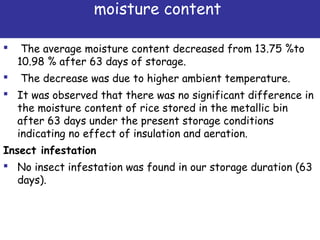
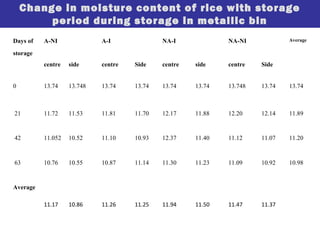
 The average moisture content decreased from 13.75 %to
10.98 % after 63 days of storage.
 The decrease was due to higher ambient temperature.
 It was observed that there was no significant difference in
the moisture content of rice stored in the metallic bin
after 63 days under the present storage conditions
indicating no effect of insulation and aeration.
Insect infestation
 No insect infestation was found in our storage duration (63
days).
Change in moisture content of rice with storage
period during storage in metallic bin
Days of
storage
A-NI A-I NA-I NA-NI Average
centre side centre Side centre side centre Side
0 13.74 13.748 13.74 13.74 13.74 13.74 13.748 13.74 13.74
21 11.72 11.53 11.81 11.70 12.17 11.88 12.20 12.14 11.89
42 11.052 10.52 11.10 10.93 12.37 11.40 11.12 11.07 11.20
63 10.76 10.55 10.87 11.14 11.30 11.23 11.09 10.92 10.98
Average
11.17 10.86 11.26 11.25 11.94 11.50 11.47 11.37
Conclusion
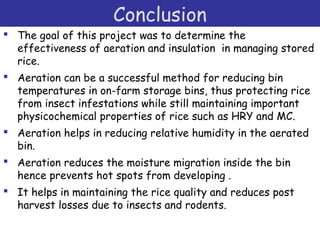
 The goal of this project was to determine the
effectiveness of aeration and insulation in managing stored
rice.
 Aeration can be a successful method for reducing bin
temperatures in on-farm storage bins, thus protecting rice
from insect infestations while still maintaining important
physicochemical properties of rice such as HRY and MC.
 Aeration helps in reducing relative humidity in the aerated
bin.
 Aeration reduces the moisture migration inside the bin
hence prevents hot spots from developing .
 It helps in maintaining the rice quality and reduces post
harvest losses due to insects and rodents.
THANK YOU

Storage of rice ppt

  • 1.
    STUDY ON STORAGEOF RICE Presented by Swapna Sagarika Sahoo (38E/10) Ramya Ranjan Mishra(64E/10)
  • 2.
  • 3.
    INTRODUCTION  Rice isone of the most important food crops of India in term of both area, production and consumer preference.  India is the second largest producer and consumer of rice in the world.  Rice production in India crossed the mark of 100 million MTnes in 2011-12 accounting for 22.81% of global production in that year. Natural contamination of food grains is greatly influenced by environmental factors such as type of storage structure, temperature, RH, moisture
  • 4.
    INTRODUCTION(Contd..)  The indigenousstorage structures are not suitable for storing grains for longer periods. Metallic bins are used as a convenient means for storage of rice to prevent loss due to rodents.  But loss of rice due to moisture accumulation & infestation occurs in the metallic bin storage .  Provision of Insulation & aeration may help in preventing uneven temperature distribution and moisture accumulation in rice during storage .  Thus, we need some scientific intervention for storage of milled rice in metallic bin providing insulation and aeration to prevent enormous storage losses.
  • 5.
    What is storage? Storage may be defined as a thermodynamic system which includes a groups of interacting organisms and their surrounding environment and characterized by set of bio- physio-chemical properties. Advantages of Storage  Ensures against fluctuation in production.  Stabilizes price.  Strengthen public distribution system.  Replenishes the depleted stock.
  • 6.
    Controls measures forsafe storage of rice Aeration It is the practice of forcing small quantities of air through stored grain to maintain quality. To accomplish this,    It is used to reduce temperature & also moisture content.  It also helps prevent hot spots from developing and there by reducing insect and microbial growth.  Maintain uniformity in grain moisture content & temp.  Removing odors from grain  Equalizing grain moisture    Fumigant application  
  • 8.
    Insulation & relativehumidity Insulation  Insulation of product storage is done to reduce the flow of heat from the warmer exterior ,through the walls, roofs, & floor of the storage. Relative humidity  For safe storage the RH of grain is less then 60% . So it is very important to reduce the RH.  RH is reduced by reducing the m.c. which is done by using dehumidified refrigeration system.  
  • 9.
    OBJECTIVE The present studywas undertaken with the following objectives.  To study the effect of insulation & aeration on temperature of rice stored in metallic bin    To study the effect of insulation & aeration on Moisture content of rice stored in metallic bin.
  • 10.
    MATERIALS  Raw rice(Twoquintals )  Four metallic bins (50 kg capacity each)  Perforated PVC pipe(1 inch dia.)  Foam polystyrene(10mm thickness)  Digital temperature recorder  Hygrometer  Hot air oven
  • 11.
    Providing aeration  Twometallic bins were provided with aeration.  1 inch of PVC pipe was taken & made holes on the pipe.  The perforated pipe was fixed on the centre of the bin by a 1 inch socket attached to the base of the bin & an end cap was provided on the top of the pipe.  The end cap was removed at certain interval to facilitate aeration during storage .
  • 12.
    Providing insulation  Foampolystyrene was selected for providing insulation.  It has low thermal conductivity , low weight per cubic feet ,easy to install and availability.  To provide insulation on two metallic bins, 10 mm thickness foam was fixed on all surfaces of the bins(A-I, NA-I) using liquid fevicol.
  • 13.
    A-NI,A-I,I-NA,NA-NI To study theeffect of aeration & insulation, the bins were marked as : A- NI, A-I ,I-NA & NA-NI Where :  A-NI: Storage bin provided with only Aeration.(No Insulation)  A-I : Storage bin provided both Aeration & Insulation .  I-NA : Storage bin provided only Insulation.(No aeration)  NA-NI : Storage bin provided with out Aeration & Insulation.
  • 14.
    METHODOLOGY  Each metallicbins were filled with 50 kg raw rice & kept under ambient condition for storage.  The initial moisture content of rice sample was measured by gravimetric method.
  • 15.
    Measuring temperature andrelative humidity   Temperature was measured both at the centre(C) and side(S) of each bin after every seven days interval using digital temperature recorder.  The ambient temperature was also recorded.  Ambient relative humidity and RH inside each bin were also recorded at an interval of 7 days using hygrometer.
  • 16.
      Determination of MoistureContent  Rice sample were taken from the centre and side of each bin for moisture content determination by hot air oven method.  Initial weight of rice sample were taken and put into the hot air oven at 105°C.  After 24 hour it is removed from the hot air oven, cooled in desiccators and again weighed.
  • 17.
    Insect infestation  Samplesof 100grams were taken from each bin and visually inspected for insect infestation .  The weight of infested grain was taken to determine the percentage infestation
  • 18.
    RESULTS AND DISCUSSION Fig.4.1 Difference in temperature of rice at the side and centre of the metallic bin
  • 19.
     The differencein temperatures of rice at the side and centre of the bin were found to be higher under no aeration condition (Fig. 4.1).  This indicated that aeration helped in uniform temperature difference inside the bin during storage.  However, insulation was observed to be having no effect on the temperature profile.
  • 20.
    Relative humidity Fig 4.2.averagerelative humidity of different storage bins
  • 21.
     The averageRH values ranged from 66.7% to 69.4 % with ambient value of 66.8 %.  The average relative humidity values were found to be higher inside the bin under no aeration condition (Fig. 4.2).  This might be due to moisture migration due to uneven temperature distribution.
  • 22.
    moisture content  Theaverage moisture content decreased from 13.75 %to 10.98 % after 63 days of storage.  The decrease was due to higher ambient temperature.  It was observed that there was no significant difference in the moisture content of rice stored in the metallic bin after 63 days under the present storage conditions indicating no effect of insulation and aeration. Insect infestation  No insect infestation was found in our storage duration (63 days).
  • 23.
    Change in moisturecontent of rice with storage period during storage in metallic bin Days of storage A-NI A-I NA-I NA-NI Average centre side centre Side centre side centre Side 0 13.74 13.748 13.74 13.74 13.74 13.74 13.748 13.74 13.74 21 11.72 11.53 11.81 11.70 12.17 11.88 12.20 12.14 11.89 42 11.052 10.52 11.10 10.93 12.37 11.40 11.12 11.07 11.20 63 10.76 10.55 10.87 11.14 11.30 11.23 11.09 10.92 10.98 Average 11.17 10.86 11.26 11.25 11.94 11.50 11.47 11.37
  • 24.
    Conclusion  The goalof this project was to determine the effectiveness of aeration and insulation in managing stored rice.  Aeration can be a successful method for reducing bin temperatures in on-farm storage bins, thus protecting rice from insect infestations while still maintaining important physicochemical properties of rice such as HRY and MC.  Aeration helps in reducing relative humidity in the aerated bin.  Aeration reduces the moisture migration inside the bin hence prevents hot spots from developing .  It helps in maintaining the rice quality and reduces post harvest losses due to insects and rodents.
  • 25.