YAKINDRA P. TIMILSENA ID No. 111332 STORAGE DESIGN FOR CORN
DESIGN OF AERATION OF BULK STORAGE Given : Corn moisture 13 %  ( wet basis ) Bin dimension: 6 m x 5m x 4 m (height). Ambient temperature 30 °C
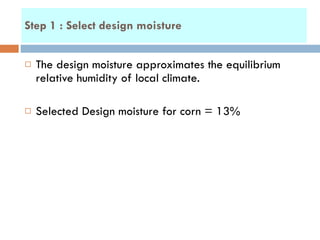
Step 1 : Select design moisture The design moisture approximates the equilibrium relative humidity of local climate. Selected Design moisture for corn = 13%
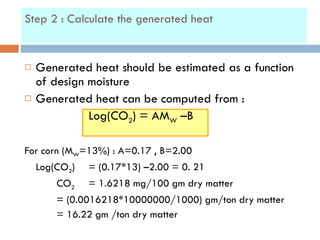
Step 2 : Calculate   the generated heat Generated heat should be estimated as a function of design moisture Generated heat can be computed from : Log(CO 2 ) = AM W  –B For corn (M W =13%) : A=0.17 , B=2.00 Log(CO 2 )  = (0.17*13) –2.00 = 0. 21 CO 2 = 1.6218 mg/100 gm dry matter = (0.0016218*10000000/1000) gm/ton dry matter = 16.22 gm /ton dry matter
For Corn with 13% MC  Dry matter = 100 – 13 = 87 % = 0.87   Dry matter  1  ton  release  CO 2  16.22  g Dry matter 0.87   ton  release  CO 2  14.1114  g CO 2  264  g is equivalent to Heat  2800  kJ CO 2  14.1114  g is equivalent to  Heat  149.6664  kJ Thus, Generated heat = 149.6664 kJ/ton day Deterioration equation : C 6 H 12 O 6  + 6O 2   6H 2 O + 6CO 2  + Heat (2800 kJ/mol C 6 H 12 O 6  ) (180)  (192)  (108)  (264)
Table1   Rate of deterioration constants for some common cereal  grains.  ( To compute CO 2  generation ) Grain A B 10-13.2% 13.3-17% 10-13.2% 13.3-17% Corn, yellow dent 0.17 0.27 2.00 3.33 Sorghum 0.125 0.32 1.65 4.19 Rough rice 0.21 0.44 3.04 6.08 10-14% 14-17% 10-14% 14-17% Wheat , soft 0.090 0.36 1.35 5.14
Step 3  : Select a design day In selecting the design day, local weather data must be used and as much as possible, these data should have information on local weather at least for the last 10 years.  The wettest month appearing in the data should be selected.
From Figure ,the design day for Jakarta would be in February, it being the wettest month as shown in the graph. Fig.5 Relative humidity and temperature data for Jakarta, Indonesia, latitude 6 ° 11’ S. The curves represent monthly averages.
Step 4 : Calculate equilibrium relative humidity Equilibrium relative humidity or reciprocally, grain moisture in equilibrium with air, may be computed using the information from Table with the following equations : M D  = E – F * ln [-R*(T+C) ln(RH)] Where  M D = decimal moisture, dry basis R  = universal gas constant = 1.987 T  = Temperature,  °C RH  = Relative humidity, decimal EXP  = “e” to the power, “e” = 2.71828   A,B,C,E,F  =  equilibrium constants
M D   =0.13/0.87 = 0.1494 From table : A = 620.56 , B = 16.958 , C = 30.205 T = 30  °C RH = 0.6625 or 66.25% 0.1494)] * 16.958 EXP( * 30.205) (30 * 1.987 620.56 EXP[ RH    
Table2 Chung-Pfost equilibrium constants for grain. Grain Constant A B C E F Beans, Edible 1334.93 14.964 120.098 .480920 .066826 Peanut, Kernel 506.65 29.243 33.892 .212966 .034196 Peanut, Pod 1037.19 37.093 12.354 .183212 .026383 Rice, Rough 1181.57 21.733 35.703 .325535 .046015 Corn, Yellow dent 620.56 16.958 30.205 .379212 .058970 Soybean 275.11 14.967 24.576 .375314 .066816 Wheat, Durum 1831.40 18.077 112.350 .415593 .055318 Wheat, Hard 1052.01 17.609 50.998 .395155 .056788 Wheat, Soft 1442.54 23.607 35.662 .308163 .042360
Step 5  : Determine hours of operation per day Hours of operation must be those hours in the design day that fall below the equilibrium relative humidity. Hours of operation = 17.75 – 11.25 = 6.5 hours per day RH = 66.25%
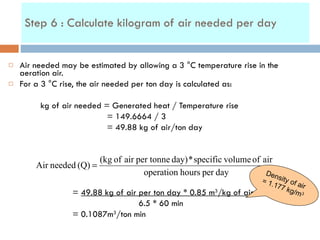
Step 6 : Calculate kilogram of air needed per day Air needed may be estimated by allowing a 3  °C temperature rise in the aeration air. For a  3  °C rise, the air needed per ton day is calculated as: kg of air needed = Generated heat / Temperature rise   = 149.6664 / 3    = 49.88 kg of air/ton day =  49.88 kg of air per ton day * 0.85 m 3 /kg of air 6.5 * 60 min = 0.1087m 3 /ton min Density of air = 1.177 kg/m 3
Step 7 :  Determine air volume and pressure Volume of  bin   = l*b * h   =  6 * 5*4 =120 m 3 From table ; Maize/corn 1 m 3  is occupied by 1.39 ton of grain Amount of corn =  120 m 3   = 86.33 tonnes   1.39 m 3 /tonne Air deliver (Q) = amount of corn (tonne) * air needed (m 3 /tonne min)   = 86.33 tonne * 0.1087 m 3 /tonne min   = 9.384  m 3 /min   From step 6
Table3   Cubic meters occupied by a tonne of grain Grain Cubic meters/Tonne Rough rice 1.72 Maize 1.39 Wheat 1.30 Oats 2.43 Peanuts (Virginia) 4.27 Sorghum 1.37 Barley 1.55
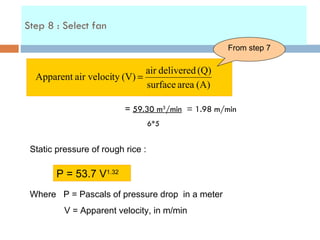
Step 8 : Select fan   =  59.30 m 3 /min   = 1.98 m/min 6*5 P = 53.7 V 1.32 Where  P = Pascals of pressure drop   in a meter   V = Apparent velocity, in m/min Static pressure of rough rice : From step 7
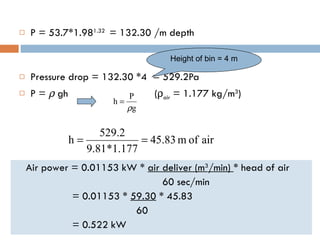
P = 53.7*1.98 1.32   = 132.30 /m depth Pressure drop = 132.30 *4  = 529.2Pa P =    gh     (  air  = 1.177 kg/m 3 )   Height of bin = 4 m Air power = 0.01153 kW *  air deliver (m 3 /min)  * head of air   60 sec/min   = 0.01153 *  59.30  * 45.83   60   = 0.522 kW
Step 8  :  Select fan Fans should be selected on the basis of air flow required and static pressure. System consists of 2 fans : Air deliver (Q) = 59.30 / 2  = 29.65 m 3 /min Static pressure = 132.30 Pa ; Pressure loss = 529.2 Pa Total pressure change = 132.30 + 529.20 = 661.50 Pa Power = Q∆P = (29.65/60) * 529.2 = 261.51 W = 0.262 kW From step 7 Step 8 : Select fan
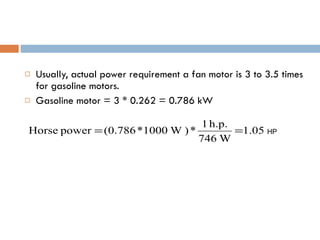
Usually, actual power requirement a fan motor is 3 to 3.5 times for gasoline motors. Gasoline motor = 3 * 0.262 = 0.786 kW HP
Fan A :  20 inch diameter, 3.0 HP,  2050 RPM,  Air deliver (Q) = 45.5 m 3 /min US$ 250 Specifications of possible fan Fan B :  15 inch diameter, 4.5 HP,  3000 RPM,  Air deliver (Q) = 55.2 m 3 /min US$ 400 Fan A is preferable because of the larger wheel, slower speed, lower power and lower cost.
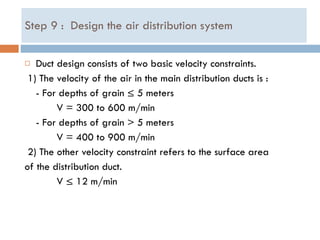
Step 9 :  Design the air distribution system Duct design consists of two basic velocity constraints. 1) The velocity of the air in the main distribution ducts is :  - For depths of grain ≤ 5 meters V = 300 to 600 m/min - For depths of grain > 5 meters V = 400 to 900 m/min 2) The other velocity constraint refers to the surface area  of the distribution duct. V ≤ 12 m/min
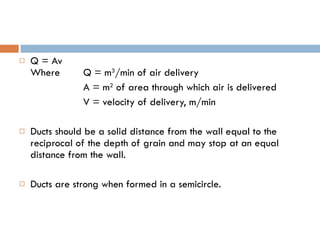
Q = Av  Where  Q = m 3 /min of air delivery A = m 2  of area through which air is delivered V = velocity of delivery, m/min  Ducts should be a solid distance from the wall equal to the reciprocal of the depth of grain and may stop at an equal distance from the wall. Ducts are strong when formed in a semicircle.
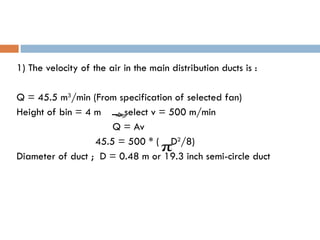
1) The velocity of the air in the main distribution ducts is :  Q = 45.5 m 3 /min (From specification of selected fan) Height of bin = 4 m  select v = 500 m/min   Q = Av   45.5 = 500 * (  D 2 /8) Diameter of duct ;  D = 0.48 m or 19.3 inch semi-circle duct
2) The velocity of surface area of distribution duct   The length must be long enough to take in the air at the  surface without exceeding 12 m/min velocity. Q = Av Q = (2  rL)*v Length of duct;  L = 2.52 m
Step 10 : Design the power and controls Humidistatic controls such as hygrometer and pshychrometer require frequent calibration for accuracy.
… THANK YOU…

Storage design for corn yp

  • 1.
    YAKINDRA P. TIMILSENAID No. 111332 STORAGE DESIGN FOR CORN
  • 2.
    DESIGN OF AERATIONOF BULK STORAGE Given : Corn moisture 13 % ( wet basis ) Bin dimension: 6 m x 5m x 4 m (height). Ambient temperature 30 °C
  • 3.
    Step 1 :Select design moisture The design moisture approximates the equilibrium relative humidity of local climate. Selected Design moisture for corn = 13%
  • 4.
    Step 2 :Calculate the generated heat Generated heat should be estimated as a function of design moisture Generated heat can be computed from : Log(CO 2 ) = AM W –B For corn (M W =13%) : A=0.17 , B=2.00 Log(CO 2 ) = (0.17*13) –2.00 = 0. 21 CO 2 = 1.6218 mg/100 gm dry matter = (0.0016218*10000000/1000) gm/ton dry matter = 16.22 gm /ton dry matter
  • 5.
    For Corn with13% MC Dry matter = 100 – 13 = 87 % = 0.87 Dry matter 1 ton release CO 2 16.22 g Dry matter 0.87 ton release CO 2 14.1114 g CO 2 264 g is equivalent to Heat 2800 kJ CO 2 14.1114 g is equivalent to Heat 149.6664 kJ Thus, Generated heat = 149.6664 kJ/ton day Deterioration equation : C 6 H 12 O 6 + 6O 2 6H 2 O + 6CO 2 + Heat (2800 kJ/mol C 6 H 12 O 6 ) (180) (192) (108) (264)
  • 6.
    Table1 Rate of deterioration constants for some common cereal grains. ( To compute CO 2 generation ) Grain A B 10-13.2% 13.3-17% 10-13.2% 13.3-17% Corn, yellow dent 0.17 0.27 2.00 3.33 Sorghum 0.125 0.32 1.65 4.19 Rough rice 0.21 0.44 3.04 6.08 10-14% 14-17% 10-14% 14-17% Wheat , soft 0.090 0.36 1.35 5.14
  • 7.
    Step 3 : Select a design day In selecting the design day, local weather data must be used and as much as possible, these data should have information on local weather at least for the last 10 years. The wettest month appearing in the data should be selected.
  • 8.
    From Figure ,thedesign day for Jakarta would be in February, it being the wettest month as shown in the graph. Fig.5 Relative humidity and temperature data for Jakarta, Indonesia, latitude 6 ° 11’ S. The curves represent monthly averages.
  • 9.
    Step 4 :Calculate equilibrium relative humidity Equilibrium relative humidity or reciprocally, grain moisture in equilibrium with air, may be computed using the information from Table with the following equations : M D = E – F * ln [-R*(T+C) ln(RH)] Where M D = decimal moisture, dry basis R = universal gas constant = 1.987 T = Temperature, °C RH = Relative humidity, decimal EXP = “e” to the power, “e” = 2.71828 A,B,C,E,F = equilibrium constants
  • 10.
    M D =0.13/0.87 = 0.1494 From table : A = 620.56 , B = 16.958 , C = 30.205 T = 30 °C RH = 0.6625 or 66.25% 0.1494)] * 16.958 EXP( * 30.205) (30 * 1.987 620.56 EXP[ RH    
  • 11.
    Table2 Chung-Pfost equilibriumconstants for grain. Grain Constant A B C E F Beans, Edible 1334.93 14.964 120.098 .480920 .066826 Peanut, Kernel 506.65 29.243 33.892 .212966 .034196 Peanut, Pod 1037.19 37.093 12.354 .183212 .026383 Rice, Rough 1181.57 21.733 35.703 .325535 .046015 Corn, Yellow dent 620.56 16.958 30.205 .379212 .058970 Soybean 275.11 14.967 24.576 .375314 .066816 Wheat, Durum 1831.40 18.077 112.350 .415593 .055318 Wheat, Hard 1052.01 17.609 50.998 .395155 .056788 Wheat, Soft 1442.54 23.607 35.662 .308163 .042360
  • 12.
    Step 5 : Determine hours of operation per day Hours of operation must be those hours in the design day that fall below the equilibrium relative humidity. Hours of operation = 17.75 – 11.25 = 6.5 hours per day RH = 66.25%
  • 13.
    Step 6 :Calculate kilogram of air needed per day Air needed may be estimated by allowing a 3 °C temperature rise in the aeration air. For a 3 °C rise, the air needed per ton day is calculated as: kg of air needed = Generated heat / Temperature rise = 149.6664 / 3 = 49.88 kg of air/ton day = 49.88 kg of air per ton day * 0.85 m 3 /kg of air 6.5 * 60 min = 0.1087m 3 /ton min Density of air = 1.177 kg/m 3
  • 14.
    Step 7 : Determine air volume and pressure Volume of bin = l*b * h = 6 * 5*4 =120 m 3 From table ; Maize/corn 1 m 3 is occupied by 1.39 ton of grain Amount of corn = 120 m 3 = 86.33 tonnes 1.39 m 3 /tonne Air deliver (Q) = amount of corn (tonne) * air needed (m 3 /tonne min) = 86.33 tonne * 0.1087 m 3 /tonne min = 9.384 m 3 /min From step 6
  • 15.
    Table3 Cubic meters occupied by a tonne of grain Grain Cubic meters/Tonne Rough rice 1.72 Maize 1.39 Wheat 1.30 Oats 2.43 Peanuts (Virginia) 4.27 Sorghum 1.37 Barley 1.55
  • 16.
    Step 8 :Select fan = 59.30 m 3 /min = 1.98 m/min 6*5 P = 53.7 V 1.32 Where P = Pascals of pressure drop in a meter V = Apparent velocity, in m/min Static pressure of rough rice : From step 7
  • 17.
    P = 53.7*1.981.32 = 132.30 /m depth Pressure drop = 132.30 *4 = 529.2Pa P =  gh (  air = 1.177 kg/m 3 ) Height of bin = 4 m Air power = 0.01153 kW * air deliver (m 3 /min) * head of air 60 sec/min = 0.01153 * 59.30 * 45.83 60 = 0.522 kW
  • 18.
    Step 8 : Select fan Fans should be selected on the basis of air flow required and static pressure. System consists of 2 fans : Air deliver (Q) = 59.30 / 2 = 29.65 m 3 /min Static pressure = 132.30 Pa ; Pressure loss = 529.2 Pa Total pressure change = 132.30 + 529.20 = 661.50 Pa Power = Q∆P = (29.65/60) * 529.2 = 261.51 W = 0.262 kW From step 7 Step 8 : Select fan
  • 19.
    Usually, actual powerrequirement a fan motor is 3 to 3.5 times for gasoline motors. Gasoline motor = 3 * 0.262 = 0.786 kW HP
  • 20.
    Fan A : 20 inch diameter, 3.0 HP, 2050 RPM, Air deliver (Q) = 45.5 m 3 /min US$ 250 Specifications of possible fan Fan B : 15 inch diameter, 4.5 HP, 3000 RPM, Air deliver (Q) = 55.2 m 3 /min US$ 400 Fan A is preferable because of the larger wheel, slower speed, lower power and lower cost.
  • 21.
    Step 9 : Design the air distribution system Duct design consists of two basic velocity constraints. 1) The velocity of the air in the main distribution ducts is : - For depths of grain ≤ 5 meters V = 300 to 600 m/min - For depths of grain > 5 meters V = 400 to 900 m/min 2) The other velocity constraint refers to the surface area of the distribution duct. V ≤ 12 m/min
  • 22.
    Q = Av Where Q = m 3 /min of air delivery A = m 2 of area through which air is delivered V = velocity of delivery, m/min Ducts should be a solid distance from the wall equal to the reciprocal of the depth of grain and may stop at an equal distance from the wall. Ducts are strong when formed in a semicircle.
  • 23.
    1) The velocityof the air in the main distribution ducts is : Q = 45.5 m 3 /min (From specification of selected fan) Height of bin = 4 m select v = 500 m/min Q = Av 45.5 = 500 * ( D 2 /8) Diameter of duct ; D = 0.48 m or 19.3 inch semi-circle duct
  • 24.
    2) The velocityof surface area of distribution duct The length must be long enough to take in the air at the surface without exceeding 12 m/min velocity. Q = Av Q = (2 rL)*v Length of duct; L = 2.52 m
  • 25.
    Step 10 :Design the power and controls Humidistatic controls such as hygrometer and pshychrometer require frequent calibration for accuracy.
  • 26.