
GOODMORNING
PHYSIOLOGY OF
PAIN
“PAIN A PERCEPTION,
NOT
REALLY A
SENSATION”
PRESENTED BY
KHUSHBOO BARJATYA
PG STUDENT
DEPT OF PEDODONTICS
CONTENTS
• Introduction.
• History.
• Definition.
• Classification.
• Mechanism of pain perception.
• Pain control theory.
• Factors affecting pain.
• Electrophysiology of pain.
• Pain of unborn
• Conclusion.
• References.
ELUSIVE NATURE
OF PAIN
PAIN A PROTECTIVE
MECHANISM OF BODY
HISTORICALLY
• Arrow shot by god
•Magic, Evils, Demons.
•The Greeks and Romans first
who gave theory of sensation and
idea that brain responsible for
perception of pain.
WHAT IS
PAIN ?
The Latin word "poena" meaning a fine, a
penalty.
• First given as early as 1968 by Margo
McCaffery:
• “Pain is whatever the experiencing person
says it is, existing whenever he says it
does”
• WHO has defined pain as
“An unpleasant sensory or
emotional experience associated with
actual or potential tissue damage, or
described in terms of such damage”.
The International Association for the Study of Pain
• The American Academy of
Pain Medicine defines pain as –
“An unpleasant sensation and
emotional response to that
sensation
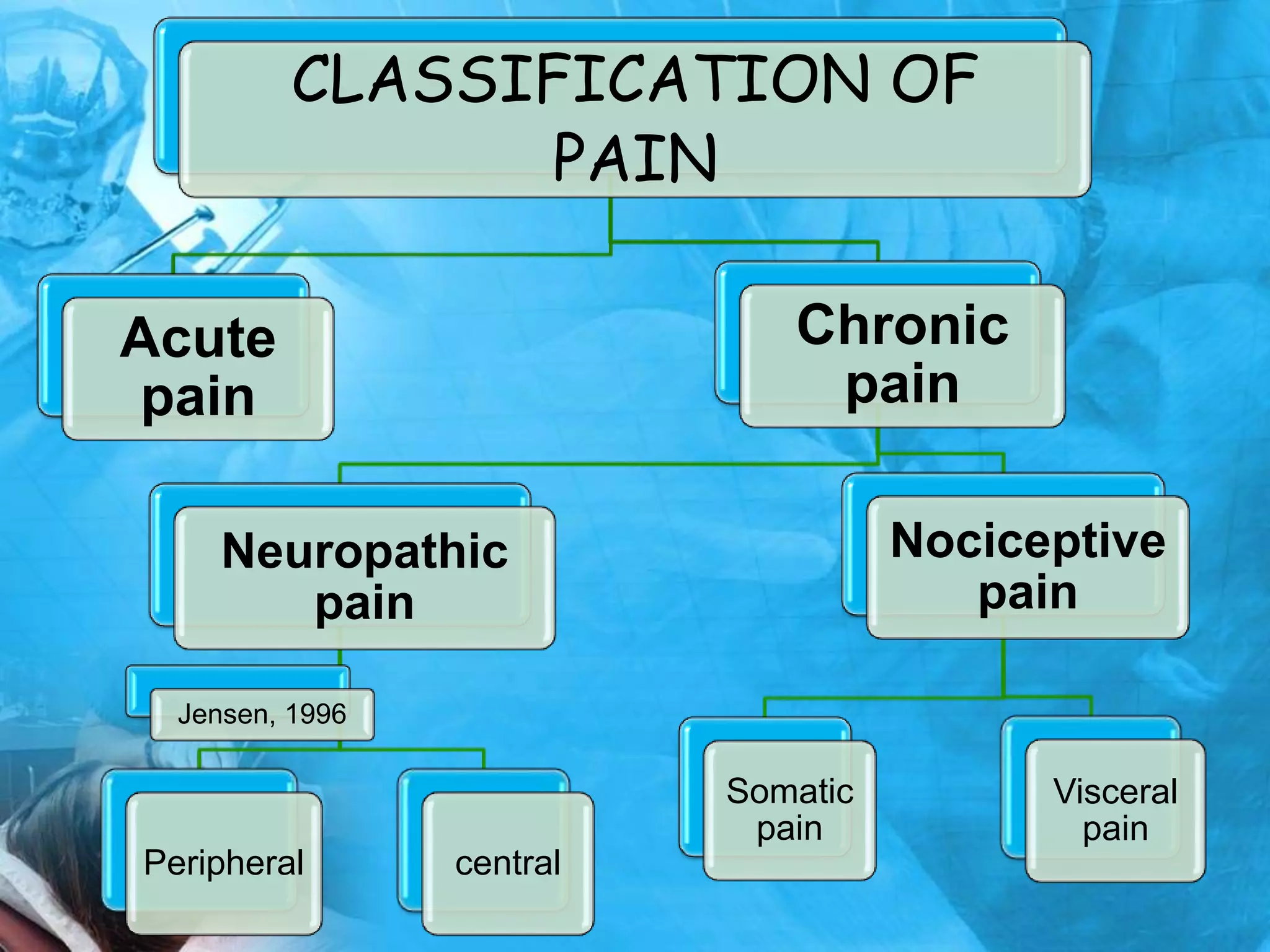
CLASSIFICATION OF
PAIN
Acute
pain
Chronic
pain
Neuropathic
pain
Peripheral central
Nociceptive
pain
Somatic
pain
Visceral
pain
Jensen, 1996
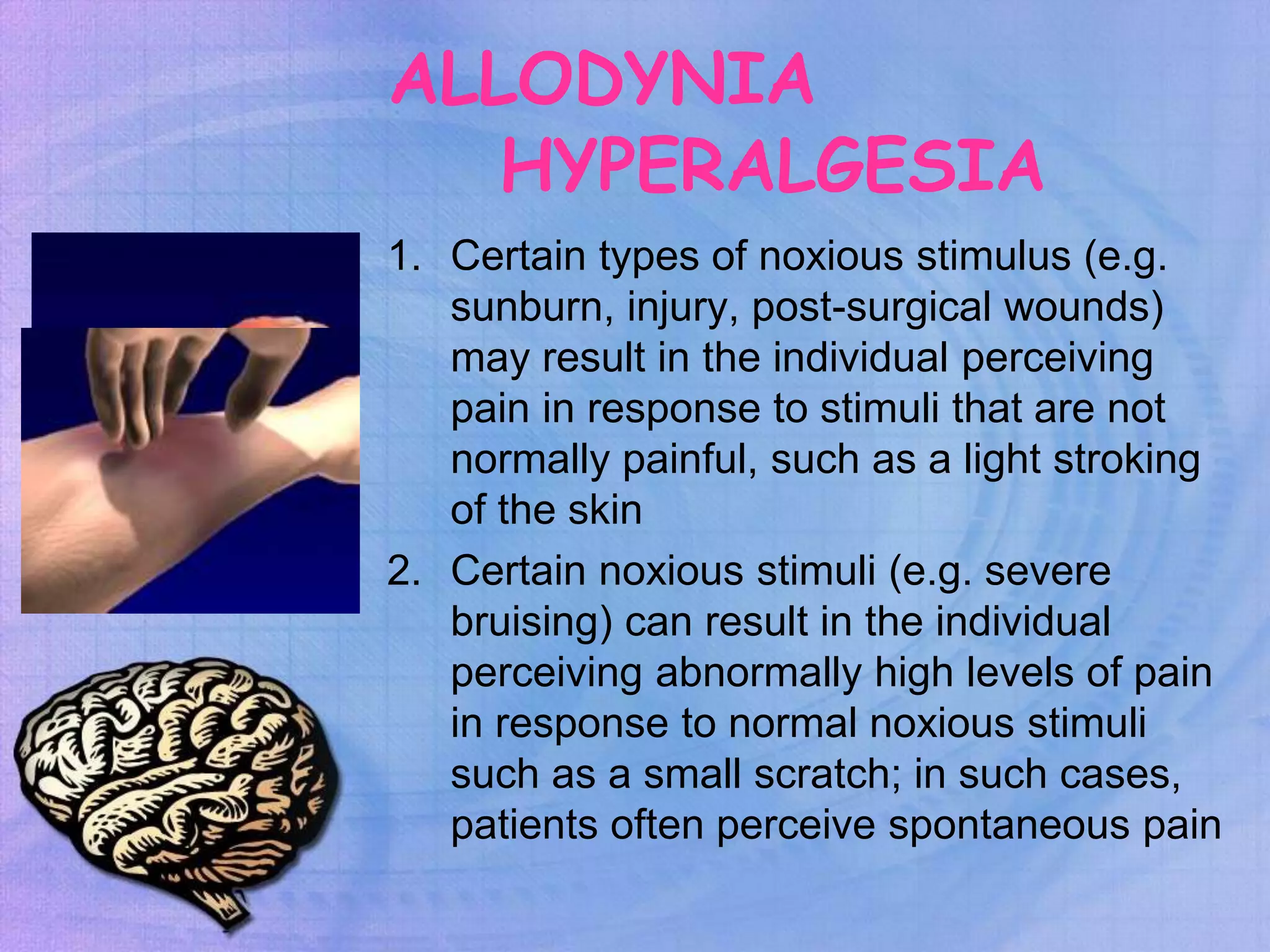
ALLODYNIA
1. Certain types of noxious stimulus (e.g.
sunburn, injury, post-surgical wounds)
may result in the individual perceiving
pain in response to stimuli that are not
normally painful, such as a light stroking
of the skin
2. Certain noxious stimuli (e.g. severe
bruising) can result in the individual
perceiving abnormally high levels of pain
in response to normal noxious stimuli
such as a small scratch; in such cases,
patients often perceive spontaneous pain
HYPERALGESIA
• PARESTHESIA:
• It is abnormal sensation which is described as
“pins and needles”. It can occur either
spontaneously or evoked by certain stimuli.
• DYSESTHESIA:
• An unpleasant abnormal sensation, whether spontaneous
or evoke.
• Note: difference being paresthesia is not
unpleasant while dysthesia is!
• .
• HYPERPATHIA:
• It is painful syndrome resulting from abnormally
painful reaction to stimulus. The stimulus is repetitive
with an increased pain threshold.
• PAIN THRESHOLD:
• Amount of pain required before individual feel the
pain. the higher the threshold, the more pain one can
endure.
• PAIN TOLERANCE LEVEL
• The greatest level of pain which a subject can
tolerate.
Complex Regional Pain Syndrome I:
Complex Regional Pain Syndrome II
Causalgia, Damaged nerve
.
PHANTOM LIMB PAIN:
MECHANISM OF PAIN
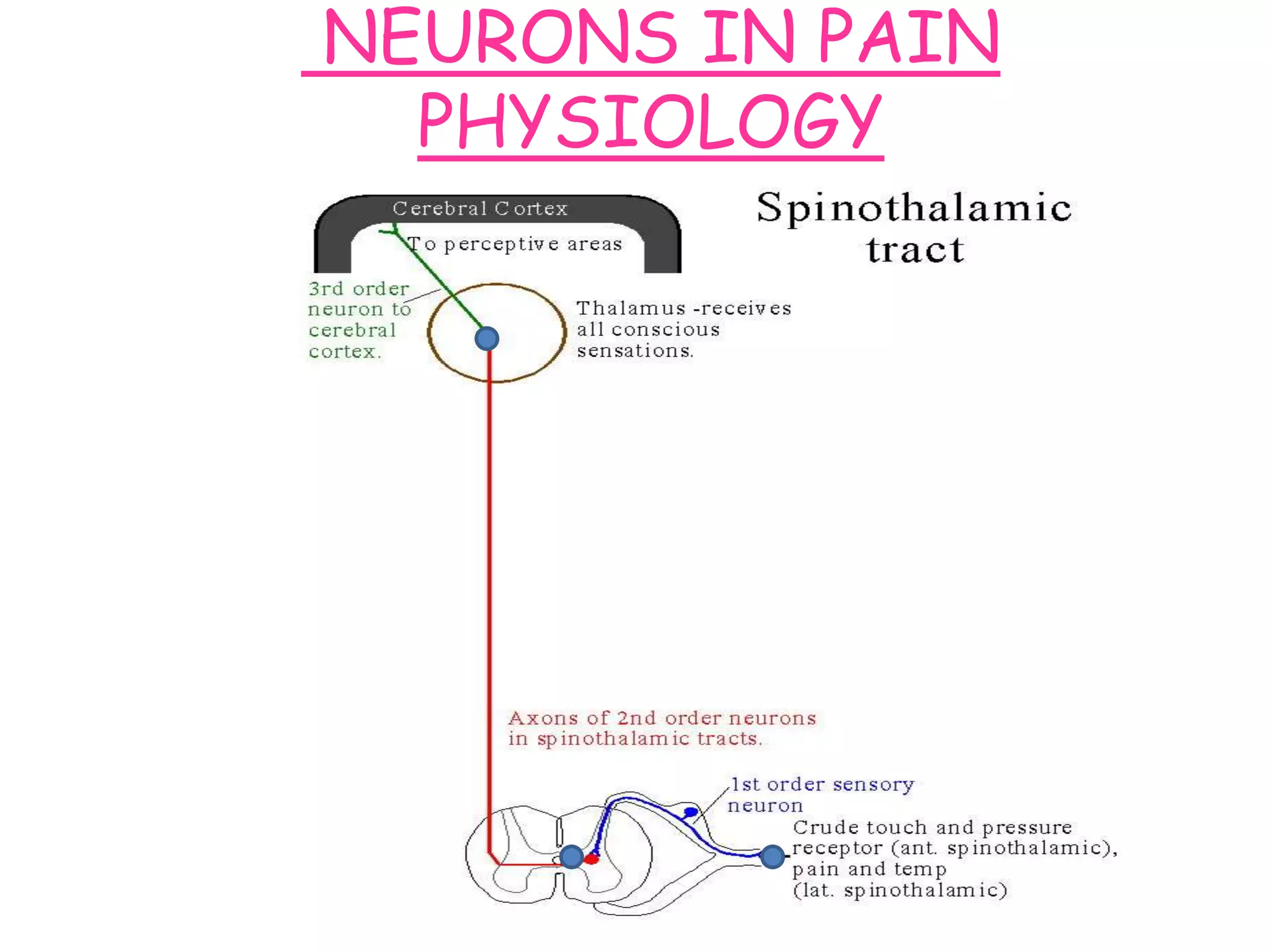
NEURONS IN PAIN
PHYSIOLOGY
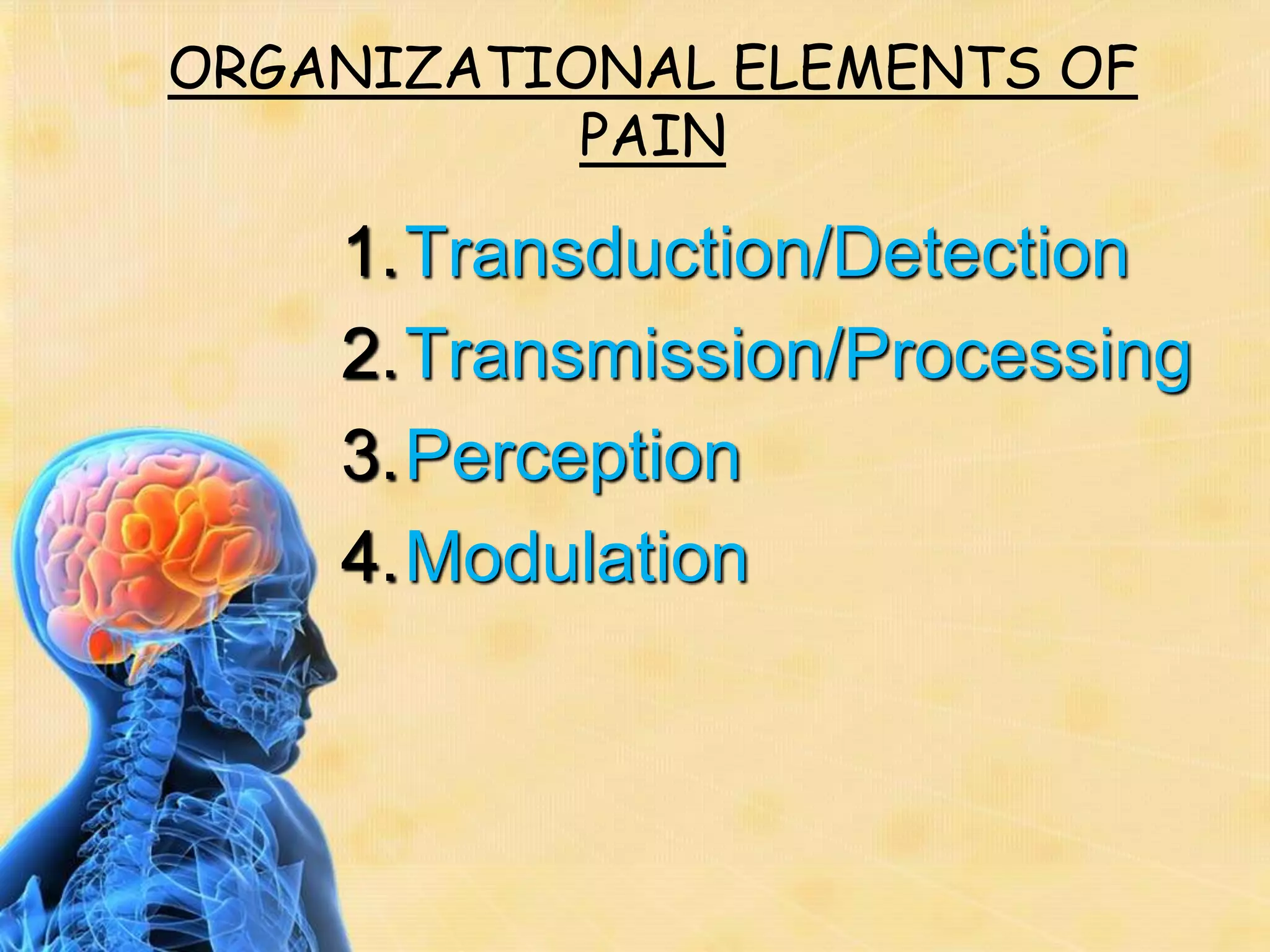
ORGANIZATIONAL ELEMENTS OF
PAIN
1.Transduction/Detection
2.Transmission/Processing
3.Perception
4.Modulation
SENSORY RECEPTORS
Free nerve endings,are referred to as nociceptors.
• C-fiber mechano/heat-sensitive nociceptors (CMH)
• A-fiber mechano/heat –sensitive nociceptors (AMH).
• A-delta fibers are thinly myelinated fibers which
conduct in the range of 2 m/s to 20 m/s. are termed high
threshold mechanoreceptors.(first pain)
• C-fibers are non-myelinated fibers that conduct in the
range of 0.5 m/s to 2 m/s and transmit noxious
information from a variety of modalities including
mechanical, thermal, and chemical so, they are termed
C-polymodal nociceptors.(second pain)
DETECTION
Classification of nerve fibres
Fibre type Function Axon diameter mm Conduction
/ Myelin + - velocity, m per s
Aα (I) motor a - fibres 9-18/+ 70-120
spindle afferents
(Ia)
tendon organs (Ib)
Aβ(II) touch and
pressure
5-12/+ 30-75
Aγ (II) motor to muscle
spindles
3-6/+ 18-36
Aδ(III) pain, pressure,
temperature
1-5/- 4-30
B (III) Preganglionic ANS 3/- 3-12
C (IV) pain, sympathetic 1/- 1-2
INNERVATION OF DENTAL
PULP
immunohistochemistry
PROCESSING
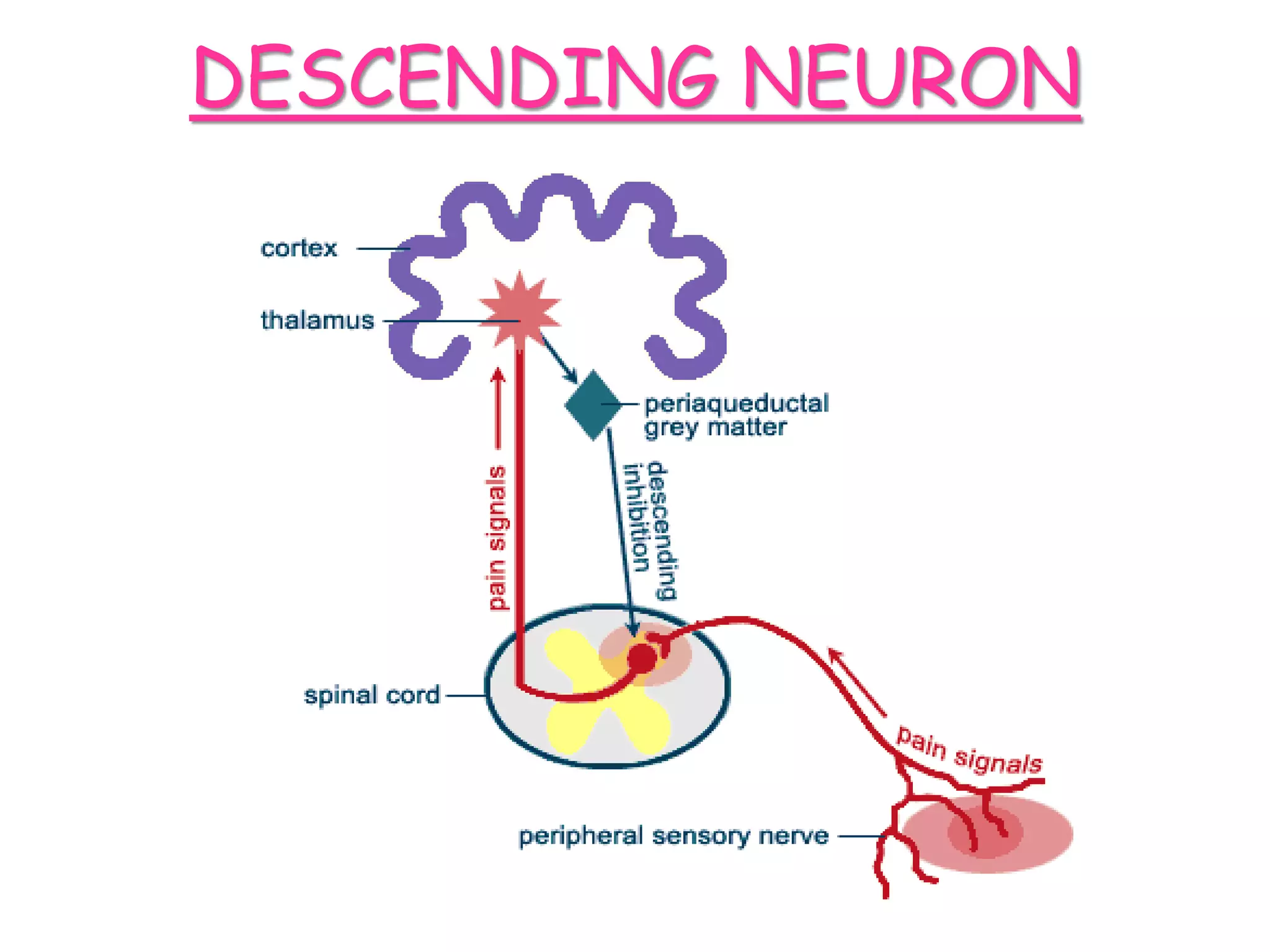
DESCENDING NEURON
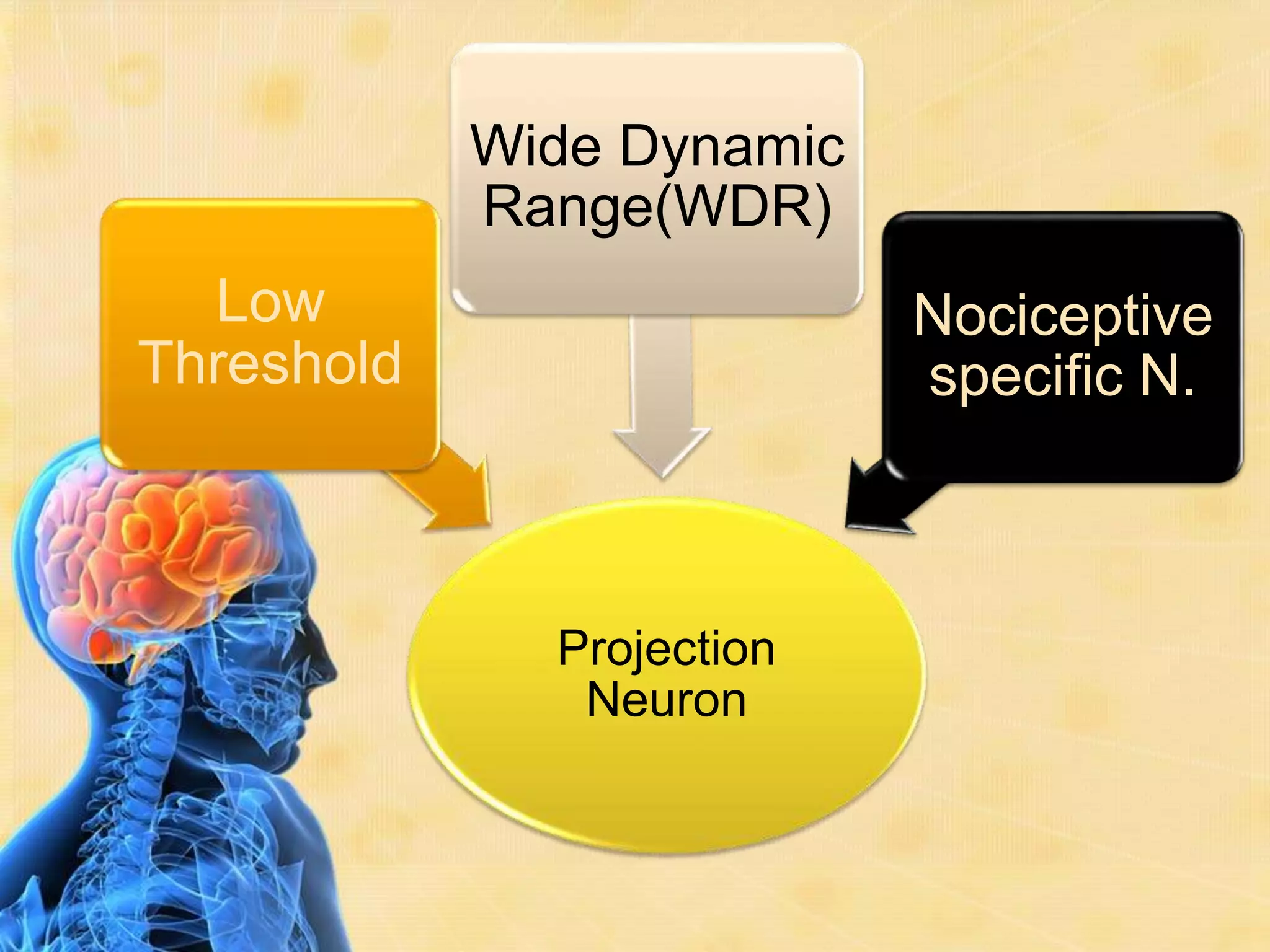
Projection
Neuron
Low
Threshold
Wide Dynamic
Range(WDR)
Nociceptive
specific N.
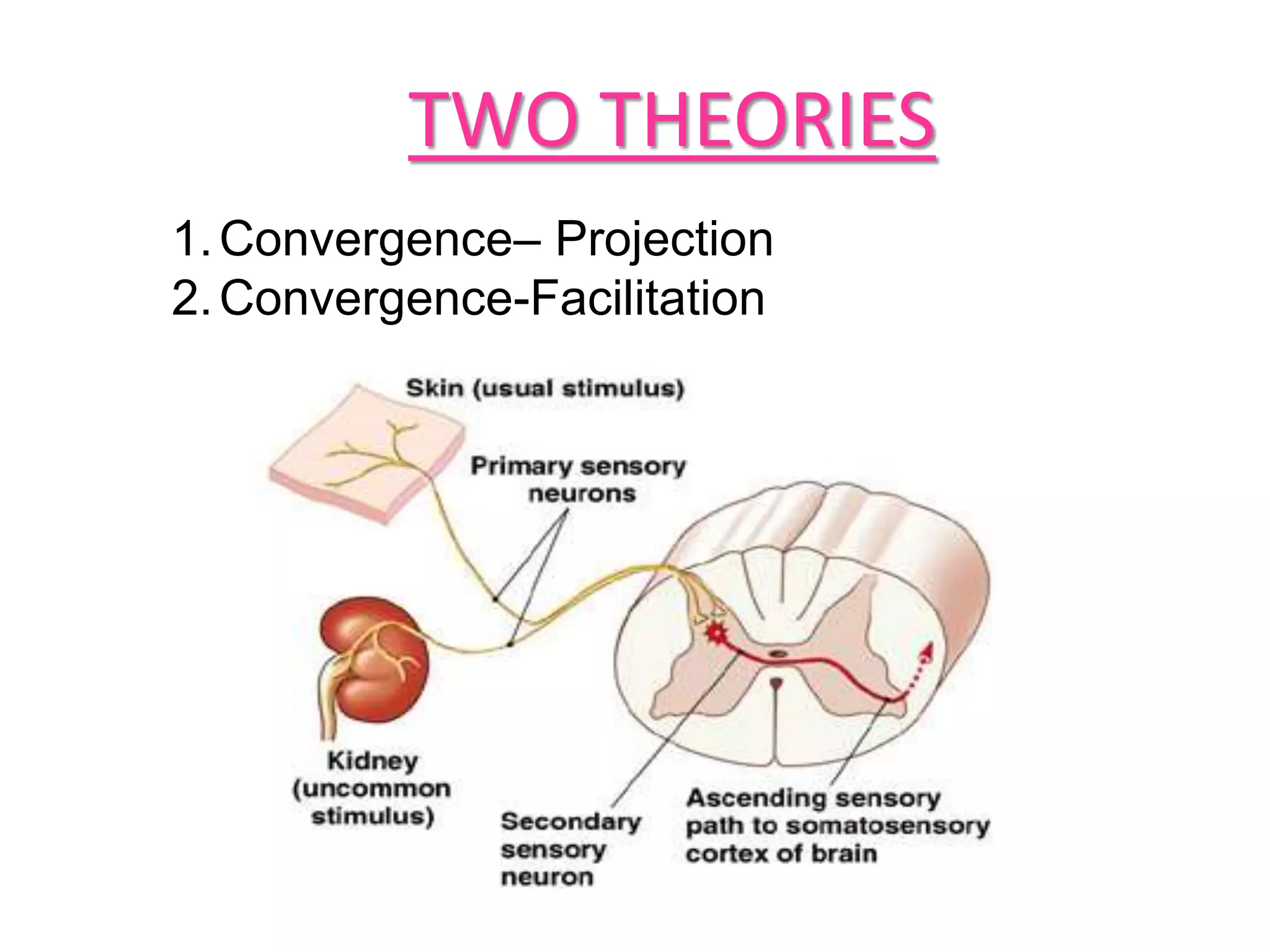
REFFERED
PAIN
QUESTIONS ?
• Why Anginal pain felt in left arm?
• Is pain from one Tooth transferred
to another?
• Why pain in Neck leads to
Headache?
TWO THEORIES
1.Convergence– Projection
2.Convergence-Facilitation
INFLAMED DENTAL PULP
• Normally nociceptors remain quiescent, but
activated by modest temperature change or stimuli
leads to pain.
• Process involve complex neuro-immune
interactions.
• Both pheripheral and central projections are
important.
Peripheral Nerve Sensitivity
• Tissue damage results in a drop in pH and
release of chemicals, e.g. histamines and
bradykinin, to which small non-myelinated C
fibers are sensitive.
• Substance P may also be released peripherally
with resultant increase in peripheral vasodilation
and further sensitization of the C fibre's
peripheral ending.
Altered nerve activity
Allodynia in Irreversible Pulpitis
PAIN PATHWAYS
Spinocerebral
Ascending
Pathways
Spinoreticular
pathway
Spinothalamic
pathway
Spinohypothalamic
pathway
Spino
mesencephalic
tract
Dorsal
column
pathway
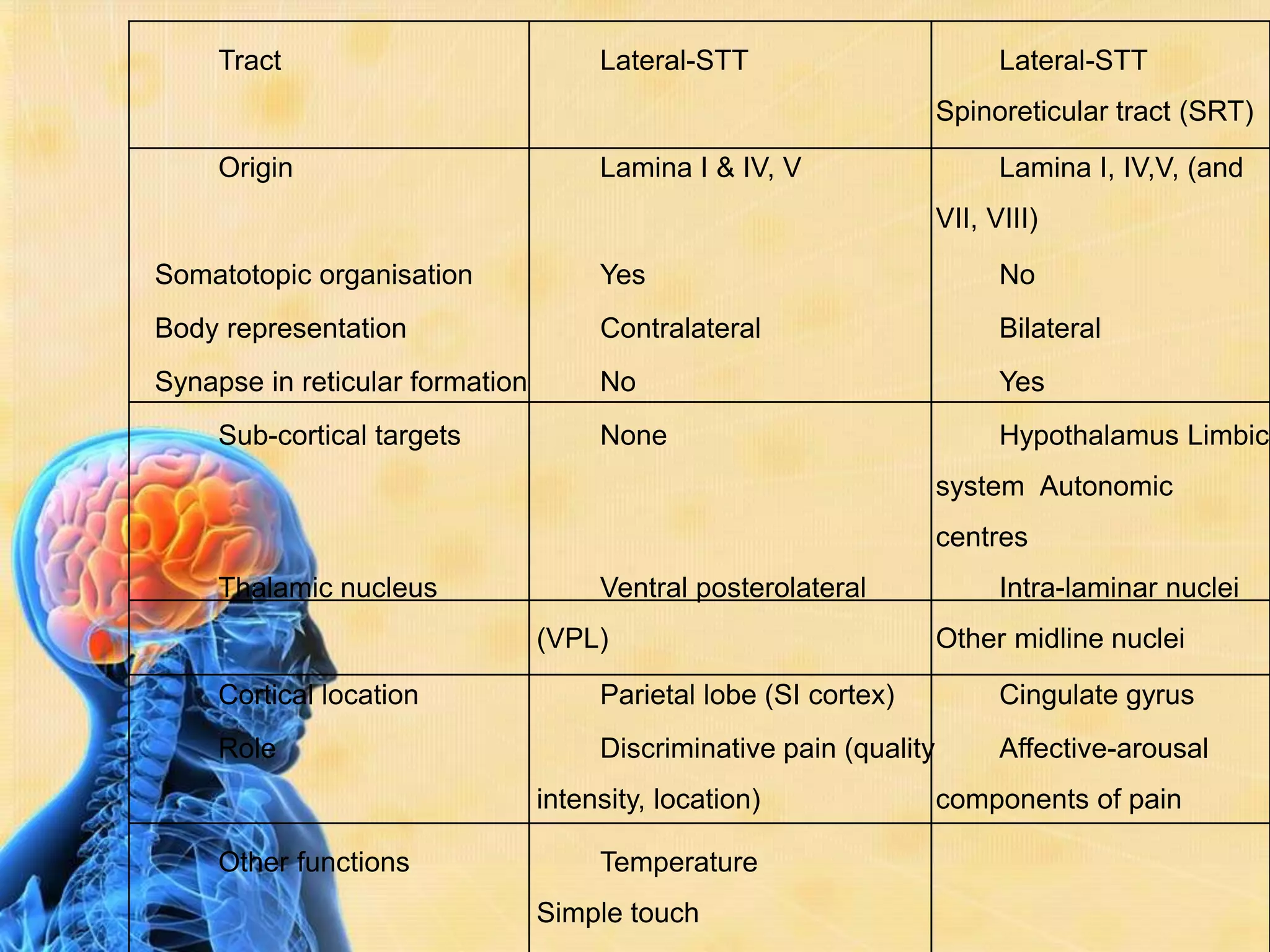
Spinothalamic pathway
Ventral posterolateral Nucleus
Intra-laminar nuclei
Tract Lateral-STT Lateral-STT
Spinoreticular tract (SRT)
Origin Lamina I & IV, V Lamina I, IV,V, (and
VII, VIII)
Somatotopic organisation Yes No
Body representation Contralateral Bilateral
Synapse in reticular formation No Yes
Sub-cortical targets None Hypothalamus Limbic
system Autonomic
centres
Thalamic nucleus Ventral posterolateral
(VPL)
Intra-laminar nuclei
Other midline nuclei
Cortical location Parietal lobe (SI cortex) Cingulate gyrus
Role Discriminative pain (quality
intensity, location)
Affective-arousal
components of pain
Other functions Temperature
Simple touch
Temporal summation. If a stimulus arrives at the
synapse in the dorsal horn more frequently than once
every 3 seconds, the post-synaptic electrical discharge
becomes more prolonged, with consequent increase in
the severity of the pain. This temporal summation is
termed "windup"
IS THERE A
“CORTICAL PAIN”
CENTER?
Brodmann's tissue classification
Dennis Turk's claim that "the
reign of pain is mainly in the
brain". But there is no one
centre "in control".
PAIN THEORIES
SPECIFICITY THEORY
• Pain and touch sensors on the skin are wired
to a pain centre in the brain.
• This theory does not account for pain when
there is no organic basis for the pain.
BY DESCARTE
IN 1644
SENSORY DECISION THEORY
This theory relies heavily on the psychological
perception of a painful stimulus.
Painful stimuli is perceived according to the
individuals cognitive processesPATTERN THEORIES
By Goldscheider in 1894
Pain conducting nerves are shared with
other sensory nerves- pattern of activity
from the nerve cells dictates how the
pattern is interpreted.
GATE CONTROL THEORY
• The idea that the perception of pain is not a
direct result of activation of nociceptors, but
instead is modulated by interaction between
different neurons, both pain-transmitting and
non-pain-transmitting. The theory asserts that
activation of nerves that do not transmit pain
signals can interfere with signals from pain
fibers and inhibit an individual's perception of
pain.
Ronald Melzack (a Canadian psychologist) and Patrick David
Wall (a British physician) in 1962,
Inhibition is in blue, excitation in yellow
FACTORS AFFECTING
PAIN
AGE
• Children and elderly are of concern. Children, more sensitive
than adults.
• As-
• Show more inflammatory response to
pain.
•The pain signals reach brain in full
intensity without getting modified by
the dorsal horn of spinal cord.
•Their descending pain inhibiting
pathways are less developed than in
adults.
Sex
Women are more prone, than males, due to difference in
hormonal levels
Emotional status
People in general suffering from depression and anxiety
pain
Smoking
• nicotine reduces body stores of vitamin C,
adversely affects the pain processing
mechanisms of the brain and interacts with
opioid pain medications.
• Trauma
• People who have experienced childhood
injuries and trauma show more pain sensitivity.
FACTORS :-
• Weather
• People experience arthritic pain more
during winter season.
• Sleep
• Sleep deprivation increases pain
perception.
ELECTROPHYSIOLOGY OF
PAIN
Step 1
•Nerve possess resting potential of – 70
mV that exists across the nerve membrane,
produced by ions on either side of the
membrane.
Sodium Potassium pump keeps the
potential by pump in K+ in and Na+ out.
Step 2
INITIAL PHASE OF SLOW DEPOLARIZATION. The electrical
potential within the nerve becomes slightly less negative.
• Rapid phase of depolarization
This phase results in a reversal of the electrical
potential across the nerve membrane. Nerve
becomes positive in relation to the outside. An
electrical potential of +40 mV exists inside of the
nerve . Termed as threshold potential or firing
threshold.
Step 3
• PHASE OF REPOLARIZATION .
• The electrical potential gradually becomes more negative
inside – 70 m V is again achieved.
• Time required 1 millisecond (msec) depolarization takes 0.3
msec; repolarization takes 0.7 msec
PAIN OF UNBORN
• An unborn child at 20 weeks gestation “is fully
capable of experiencing pain. ( EEG Shows) ”
CONCLUSION
REFRENCES
• INGLE ENDODONTICS 6TH EDITION
• PRINCIPLES OF ANATOMY AND
PHYSIOLOGY,TORTORA,8TH EDITION
• SEMULINGUM PHYSIOLOGY.
• MONHEIMS LOCAL ANESTHETICS AND
PAIN CONTROL IN DENTAL PRACTICE.
REFRENCES
• P.D. Wall, R. Melzack, "On nature of cutaneous
sensory mechanisms," Brain, 85:331, 1962.
• R. Melzack, P.D. Wall, "Pain mechanisms: A new
theory," Science, 150:171-9, 1965.
• Kandel, Eric R.; James H. Schwartz, Thomas M.
Jessell (2000). Principles of Neural Science, 4th
edition, New York: McGraw-Hill, 482–486
THANKYOU

Physiology of pain2003

  • 1.
  • 2.
  • 3.
    “PAIN A PERCEPTION, NOT REALLYA SENSATION” PRESENTED BY KHUSHBOO BARJATYA PG STUDENT DEPT OF PEDODONTICS
  • 4.
    CONTENTS • Introduction. • History. •Definition. • Classification. • Mechanism of pain perception. • Pain control theory. • Factors affecting pain. • Electrophysiology of pain. • Pain of unborn • Conclusion. • References.
  • 5.
  • 6.
  • 7.
    HISTORICALLY • Arrow shotby god •Magic, Evils, Demons. •The Greeks and Romans first who gave theory of sensation and idea that brain responsible for perception of pain.
  • 8.
  • 9.
    The Latin word"poena" meaning a fine, a penalty. • First given as early as 1968 by Margo McCaffery: • “Pain is whatever the experiencing person says it is, existing whenever he says it does” • WHO has defined pain as “An unpleasant sensory or emotional experience associated with actual or potential tissue damage, or described in terms of such damage”. The International Association for the Study of Pain • The American Academy of Pain Medicine defines pain as – “An unpleasant sensation and emotional response to that sensation
  • 10.
  • 11.
    ALLODYNIA 1. Certain typesof noxious stimulus (e.g. sunburn, injury, post-surgical wounds) may result in the individual perceiving pain in response to stimuli that are not normally painful, such as a light stroking of the skin 2. Certain noxious stimuli (e.g. severe bruising) can result in the individual perceiving abnormally high levels of pain in response to normal noxious stimuli such as a small scratch; in such cases, patients often perceive spontaneous pain HYPERALGESIA
  • 12.
    • PARESTHESIA: • Itis abnormal sensation which is described as “pins and needles”. It can occur either spontaneously or evoked by certain stimuli. • DYSESTHESIA: • An unpleasant abnormal sensation, whether spontaneous or evoke. • Note: difference being paresthesia is not unpleasant while dysthesia is! • .
  • 13.
    • HYPERPATHIA: • Itis painful syndrome resulting from abnormally painful reaction to stimulus. The stimulus is repetitive with an increased pain threshold. • PAIN THRESHOLD: • Amount of pain required before individual feel the pain. the higher the threshold, the more pain one can endure. • PAIN TOLERANCE LEVEL • The greatest level of pain which a subject can tolerate.
  • 14.
  • 15.
    Complex Regional PainSyndrome II Causalgia, Damaged nerve
  • 16.
  • 17.
  • 18.
  • 19.
  • 20.
    SENSORY RECEPTORS Free nerveendings,are referred to as nociceptors. • C-fiber mechano/heat-sensitive nociceptors (CMH) • A-fiber mechano/heat –sensitive nociceptors (AMH). • A-delta fibers are thinly myelinated fibers which conduct in the range of 2 m/s to 20 m/s. are termed high threshold mechanoreceptors.(first pain) • C-fibers are non-myelinated fibers that conduct in the range of 0.5 m/s to 2 m/s and transmit noxious information from a variety of modalities including mechanical, thermal, and chemical so, they are termed C-polymodal nociceptors.(second pain) DETECTION
  • 21.
    Classification of nervefibres Fibre type Function Axon diameter mm Conduction / Myelin + - velocity, m per s Aα (I) motor a - fibres 9-18/+ 70-120 spindle afferents (Ia) tendon organs (Ib) Aβ(II) touch and pressure 5-12/+ 30-75 Aγ (II) motor to muscle spindles 3-6/+ 18-36 Aδ(III) pain, pressure, temperature 1-5/- 4-30 B (III) Preganglionic ANS 3/- 3-12 C (IV) pain, sympathetic 1/- 1-2
  • 22.
  • 23.
  • 25.
  • 27.
  • 28.
  • 29.
    QUESTIONS ? • WhyAnginal pain felt in left arm? • Is pain from one Tooth transferred to another? • Why pain in Neck leads to Headache?
  • 30.
  • 33.
    INFLAMED DENTAL PULP •Normally nociceptors remain quiescent, but activated by modest temperature change or stimuli leads to pain. • Process involve complex neuro-immune interactions. • Both pheripheral and central projections are important.
  • 34.
    Peripheral Nerve Sensitivity •Tissue damage results in a drop in pH and release of chemicals, e.g. histamines and bradykinin, to which small non-myelinated C fibers are sensitive. • Substance P may also be released peripherally with resultant increase in peripheral vasodilation and further sensitization of the C fibre's peripheral ending.
  • 35.
  • 36.
  • 37.
  • 38.
  • 39.
  • 41.
  • 42.
    Tract Lateral-STT Lateral-STT Spinoreticulartract (SRT) Origin Lamina I & IV, V Lamina I, IV,V, (and VII, VIII) Somatotopic organisation Yes No Body representation Contralateral Bilateral Synapse in reticular formation No Yes Sub-cortical targets None Hypothalamus Limbic system Autonomic centres Thalamic nucleus Ventral posterolateral (VPL) Intra-laminar nuclei Other midline nuclei Cortical location Parietal lobe (SI cortex) Cingulate gyrus Role Discriminative pain (quality intensity, location) Affective-arousal components of pain Other functions Temperature Simple touch
  • 43.
    Temporal summation. Ifa stimulus arrives at the synapse in the dorsal horn more frequently than once every 3 seconds, the post-synaptic electrical discharge becomes more prolonged, with consequent increase in the severity of the pain. This temporal summation is termed "windup"
  • 44.
    IS THERE A “CORTICALPAIN” CENTER?
  • 45.
  • 46.
    Dennis Turk's claimthat "the reign of pain is mainly in the brain". But there is no one centre "in control".
  • 47.
  • 48.
    SPECIFICITY THEORY • Painand touch sensors on the skin are wired to a pain centre in the brain. • This theory does not account for pain when there is no organic basis for the pain. BY DESCARTE IN 1644
  • 49.
    SENSORY DECISION THEORY Thistheory relies heavily on the psychological perception of a painful stimulus. Painful stimuli is perceived according to the individuals cognitive processesPATTERN THEORIES By Goldscheider in 1894 Pain conducting nerves are shared with other sensory nerves- pattern of activity from the nerve cells dictates how the pattern is interpreted.
  • 50.
    GATE CONTROL THEORY •The idea that the perception of pain is not a direct result of activation of nociceptors, but instead is modulated by interaction between different neurons, both pain-transmitting and non-pain-transmitting. The theory asserts that activation of nerves that do not transmit pain signals can interfere with signals from pain fibers and inhibit an individual's perception of pain. Ronald Melzack (a Canadian psychologist) and Patrick David Wall (a British physician) in 1962,
  • 51.
    Inhibition is inblue, excitation in yellow
  • 52.
    Inhibition is inblue, excitation in yellow
  • 53.
  • 54.
    AGE • Children andelderly are of concern. Children, more sensitive than adults. • As- • Show more inflammatory response to pain. •The pain signals reach brain in full intensity without getting modified by the dorsal horn of spinal cord. •Their descending pain inhibiting pathways are less developed than in adults.
  • 55.
    Sex Women are moreprone, than males, due to difference in hormonal levels Emotional status People in general suffering from depression and anxiety pain Smoking • nicotine reduces body stores of vitamin C, adversely affects the pain processing mechanisms of the brain and interacts with opioid pain medications. • Trauma • People who have experienced childhood injuries and trauma show more pain sensitivity.
  • 56.
    FACTORS :- • Weather •People experience arthritic pain more during winter season. • Sleep • Sleep deprivation increases pain perception.
  • 57.
  • 58.
    Step 1 •Nerve possessresting potential of – 70 mV that exists across the nerve membrane, produced by ions on either side of the membrane. Sodium Potassium pump keeps the potential by pump in K+ in and Na+ out.
  • 59.
    Step 2 INITIAL PHASEOF SLOW DEPOLARIZATION. The electrical potential within the nerve becomes slightly less negative. • Rapid phase of depolarization This phase results in a reversal of the electrical potential across the nerve membrane. Nerve becomes positive in relation to the outside. An electrical potential of +40 mV exists inside of the nerve . Termed as threshold potential or firing threshold.
  • 60.
    Step 3 • PHASEOF REPOLARIZATION . • The electrical potential gradually becomes more negative inside – 70 m V is again achieved. • Time required 1 millisecond (msec) depolarization takes 0.3 msec; repolarization takes 0.7 msec
  • 61.
    PAIN OF UNBORN •An unborn child at 20 weeks gestation “is fully capable of experiencing pain. ( EEG Shows) ”
  • 62.
  • 63.
    REFRENCES • INGLE ENDODONTICS6TH EDITION • PRINCIPLES OF ANATOMY AND PHYSIOLOGY,TORTORA,8TH EDITION • SEMULINGUM PHYSIOLOGY. • MONHEIMS LOCAL ANESTHETICS AND PAIN CONTROL IN DENTAL PRACTICE.
  • 64.
    REFRENCES • P.D. Wall,R. Melzack, "On nature of cutaneous sensory mechanisms," Brain, 85:331, 1962. • R. Melzack, P.D. Wall, "Pain mechanisms: A new theory," Science, 150:171-9, 1965. • Kandel, Eric R.; James H. Schwartz, Thomas M. Jessell (2000). Principles of Neural Science, 4th edition, New York: McGraw-Hill, 482–486
  • 65.

Editor's Notes

  • #15 Complex Regional Pain syndrome I also called as Reflex Sympathetic Dystrophy is a continuous pain in the form of either allodynia or hyperalgesia in the extremities resulting from trauma which is associated with sympathetic hyperactivity. The pain does not correspond to the distribution of a single nerve and it is worsened by movement. The person affected usually complains of cool, clammy skin which later becomes pale, cold, stiff and atrophied Schematic diagram summarizing the sensory, autonomic and somatomotor changes in complex regional pain syndrome I (CRPS I) patients. The figure symbolizes the CNS (forebrain, brain stem and spinal cord). Changes occur in the central representations of the somatosensory, the motor and the sympathetic nervous system (which include the spinal circuits) and are reflected in the changes of the sensory painful and non-painful perceptions, of cutaneous blood flow and sweating, of peripheral tissues (edema, inflammation, trophic) and of motor performances. They are triggered and possibly maintained by the nociceptive afferent input from the somatic and visceral body domains. It is unclear whether these central changes are reversible in chronic CRPS I patients. The central changes may include changes of the endogenous control system of nociceptive impulse transmission. Coupling between the sympathetic neurons and the afferent neurons in the periphery (see red arrow) is one component of the pain in CRPS I patients with sympathetically-maintained pain (SMP). However, it seems to be unimportant in CRPS I patients without SMP. From Jänig and Baron (2002, 2003)
  • #16 Complex Regional Pain Syndrome II also called as Causalgia is a burning type of pain along the distribution a partially damaged peripheral nerve. The pain extends beyond the distribution of the nerve. This results from abnormal connections between various nerves. The skin of the person affected is classically cold, moist and swollen, becoming atrophic later
  • #17 Phantom limb pain is the pain that is felt in the amputated part of the body. The brain misinterprets the nerve signals as coming from the amputated limb. The phantom limb pain is described as squeezing, burning, or crushing sensations, but it often differs from any sensation previously experienced
  • #35 This is referred to as peripheral sensitization in contrast to central sensitization which occurs at the dorsal horn. Both occur in chronic pain.
  • #49 Problem (Melzack and Wall, 1988). Even though the senses can be in contact with pain, we do not feel it; and Vice versa - gentle touch can trigger a painful reaction (Neuralgia and Causalgia).
  • #50 Painful stimuli is perceived according to the individuals cognitive processes eg * perceptual habits * beliefs * expectations * costs and rewards * memory of previous pain experiences
  • #52 The projection neuron determines pain. The inhibitory interneuron decreases the chances that the projection neuron will fire. Firing of C fibers inhibits the inhibitory interneuron (indirectly), increasing the chances that the projection neuron
  • #53 the Aβ fibers activates the inhibitory interneuron, reducing the chances, projection neuron will fire, even in the presence of a firing nociceptive fiber
  • #59 The interior of the nerve is negative in relation to the exterior semi permeable membrane which is impermeable to Sodium