

Sri Aurobindo college of dentistry
Department of pedodontics and preventive dentistry
ICDAS
GUIDED BY-
• Dr. Bharat Bhushan Sir
• Dr. Khushboo Barjatya Mam
• Dr. Binti Rani Chand Mam
• Dr. Preene Juneja Mam
• Dr. Abhilasha M. Tripathi Mam
• Dr. Hariom Meena Sir
SUBMITTED BY-
Parnavi Mishra
Batch 2017-18
Roll No. 46
ICDAS
International caries detection and assessment system
Dental caries is one of the most prevalent affecting mankind and despite the
implementation of various preventive technique strategies, it continues to
affect health, with social and economic adverse impact.
In 2002, a consensus workshop was held to review current evidence of clinical
caries trials and develop agreement based on the evidence studies.
Thus the workshop has developed the ICDAS that relies on the visual
inspection of clean, plaque free wet and dried teeth.
Uses of ICDAS at various levels-
 Education
 Clinical practice
 Research
 Epidemiological/public health
It presents a paradigm shift in the detection and classification/coding of dental
caries, coding the stages of carious process that has comparable histological
changes.
It is peer-reviewed, evidence-based and as noted has wide range of applications,
including oral healthcare delivery, epidemiology and dental research.
Benefits of ICDAS
 It can help to focus upon prevention of dental caries by identifying
the carious lesion at an early stage and facilitate discussion with
patients about the condition of their teeth and measures to be
taken to prevent and arrest carious lesions.
 This ‘Wardrobe’ of validated tools allows users to select the best
criteria and conventions for each specific application of the system.
 It is a clinical scoring system which can be used in dental education,
clinical practice, research and epidemiology.
 It has consistency in its scoring system that can be used for
multicentric trials.
 It records both enamel and dentine caries and explore the
measurement of caries activity.
Method of recording ICDAS
Following steps are mandatory before recording the scores-
 Cleaning of the teeth to aid detection as caries forms where there has been
plaque stagnation.
 Use of the compressed air, necessary to reveal the earliest visual signs of
caries.
 To facilitate the work clinician/student must be well versed with the ICDAS
scoring criteria and preferably it need to be available with recording charts.
ICDAS two digit coding method is suggested to identify caries associated with
restorations/sealants.
• First digit- denotes restoration/sealant
• Second digit- appropriate caries code
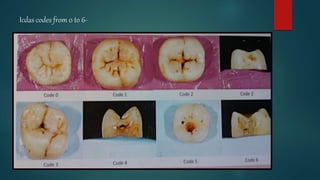
Criteria for coding for primary carious lesion-
Icdas codes from 0 to 6-
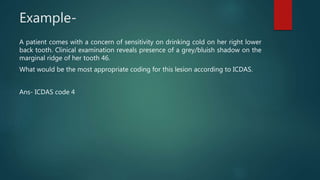
Example-
A patient comes with a concern of sensitivity on drinking cold on her right lower
back tooth. Clinical examination reveals presence of a grey/bluish shadow on the
marginal ridge of her tooth 46.
What would be the most appropriate coding for this lesion according to ICDAS.
Ans- ICDAS code 4
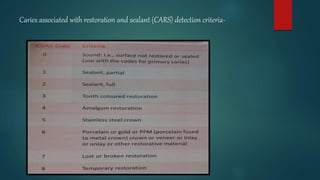
Caries associated with restoration and sealant (CARS) detection criteria-
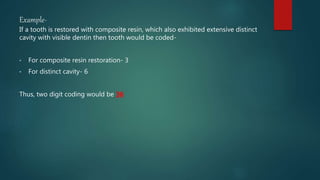
Example-
If a tooth is restored with composite resin, which also exhibited extensive distinct
cavity with visible dentin then tooth would be coded-
• For composite resin restoration- 3
• For distinct cavity- 6
Thus, two digit coding would be 36
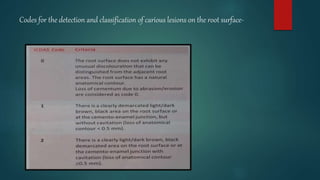
Codes for the detection and classification of carious lesions on the root surface-
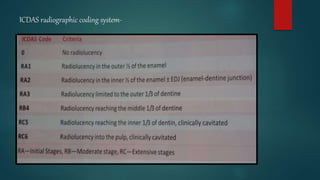
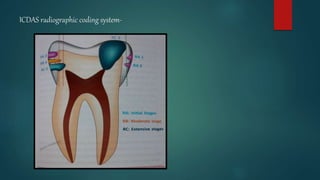
ICDAS radiographic coding system-
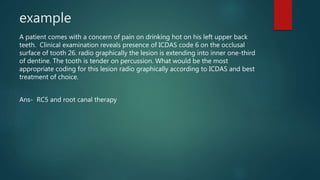
example
A patient comes with a concern of pain on drinking hot on his left upper back
teeth. Clinical examination reveals presence of ICDAS code 6 on the occlusal
surface of tooth 26. radio graphically the lesion is extending into inner one-third
of dentine. The tooth is tender on percussion. What would be the most
appropriate coding for this lesion radio graphically according to ICDAS and best
treatment of choice.
Ans- RC5 and root canal therapy
Thank You!

Icdas caries ppt

  • 1.
    Sri Aurobindo collegeof dentistry Department of pedodontics and preventive dentistry
  • 2.
    ICDAS GUIDED BY- • Dr.Bharat Bhushan Sir • Dr. Khushboo Barjatya Mam • Dr. Binti Rani Chand Mam • Dr. Preene Juneja Mam • Dr. Abhilasha M. Tripathi Mam • Dr. Hariom Meena Sir SUBMITTED BY- Parnavi Mishra Batch 2017-18 Roll No. 46
  • 3.
    ICDAS International caries detectionand assessment system Dental caries is one of the most prevalent affecting mankind and despite the implementation of various preventive technique strategies, it continues to affect health, with social and economic adverse impact. In 2002, a consensus workshop was held to review current evidence of clinical caries trials and develop agreement based on the evidence studies. Thus the workshop has developed the ICDAS that relies on the visual inspection of clean, plaque free wet and dried teeth.
  • 4.
    Uses of ICDASat various levels-  Education  Clinical practice  Research  Epidemiological/public health It presents a paradigm shift in the detection and classification/coding of dental caries, coding the stages of carious process that has comparable histological changes. It is peer-reviewed, evidence-based and as noted has wide range of applications, including oral healthcare delivery, epidemiology and dental research.
  • 5.
    Benefits of ICDAS It can help to focus upon prevention of dental caries by identifying the carious lesion at an early stage and facilitate discussion with patients about the condition of their teeth and measures to be taken to prevent and arrest carious lesions.  This ‘Wardrobe’ of validated tools allows users to select the best criteria and conventions for each specific application of the system.  It is a clinical scoring system which can be used in dental education, clinical practice, research and epidemiology.  It has consistency in its scoring system that can be used for multicentric trials.  It records both enamel and dentine caries and explore the measurement of caries activity.
  • 6.
    Method of recordingICDAS Following steps are mandatory before recording the scores-  Cleaning of the teeth to aid detection as caries forms where there has been plaque stagnation.  Use of the compressed air, necessary to reveal the earliest visual signs of caries.  To facilitate the work clinician/student must be well versed with the ICDAS scoring criteria and preferably it need to be available with recording charts. ICDAS two digit coding method is suggested to identify caries associated with restorations/sealants. • First digit- denotes restoration/sealant • Second digit- appropriate caries code
  • 7.
    Criteria for codingfor primary carious lesion-
  • 8.
  • 9.
    Example- A patient comeswith a concern of sensitivity on drinking cold on her right lower back tooth. Clinical examination reveals presence of a grey/bluish shadow on the marginal ridge of her tooth 46. What would be the most appropriate coding for this lesion according to ICDAS. Ans- ICDAS code 4
  • 10.
    Caries associated withrestoration and sealant (CARS) detection criteria-
  • 11.
    Example- If a toothis restored with composite resin, which also exhibited extensive distinct cavity with visible dentin then tooth would be coded- • For composite resin restoration- 3 • For distinct cavity- 6 Thus, two digit coding would be 36
  • 12.
    Codes for thedetection and classification of carious lesions on the root surface-
  • 13.
  • 14.
  • 15.
    example A patient comeswith a concern of pain on drinking hot on his left upper back teeth. Clinical examination reveals presence of ICDAS code 6 on the occlusal surface of tooth 26. radio graphically the lesion is extending into inner one-third of dentine. The tooth is tender on percussion. What would be the most appropriate coding for this lesion radio graphically according to ICDAS and best treatment of choice. Ans- RC5 and root canal therapy
  • 16.