Sterilization AND METHODS OF
Sterilization USED IN
HOSPITALS
PRESENTED BY :- MRS KIRTI GAUR
Microorganism are responsible for
contamination and infection. They are
present all around. The aim of
sterilization is to remove destroy them
from materials or from surfaces.
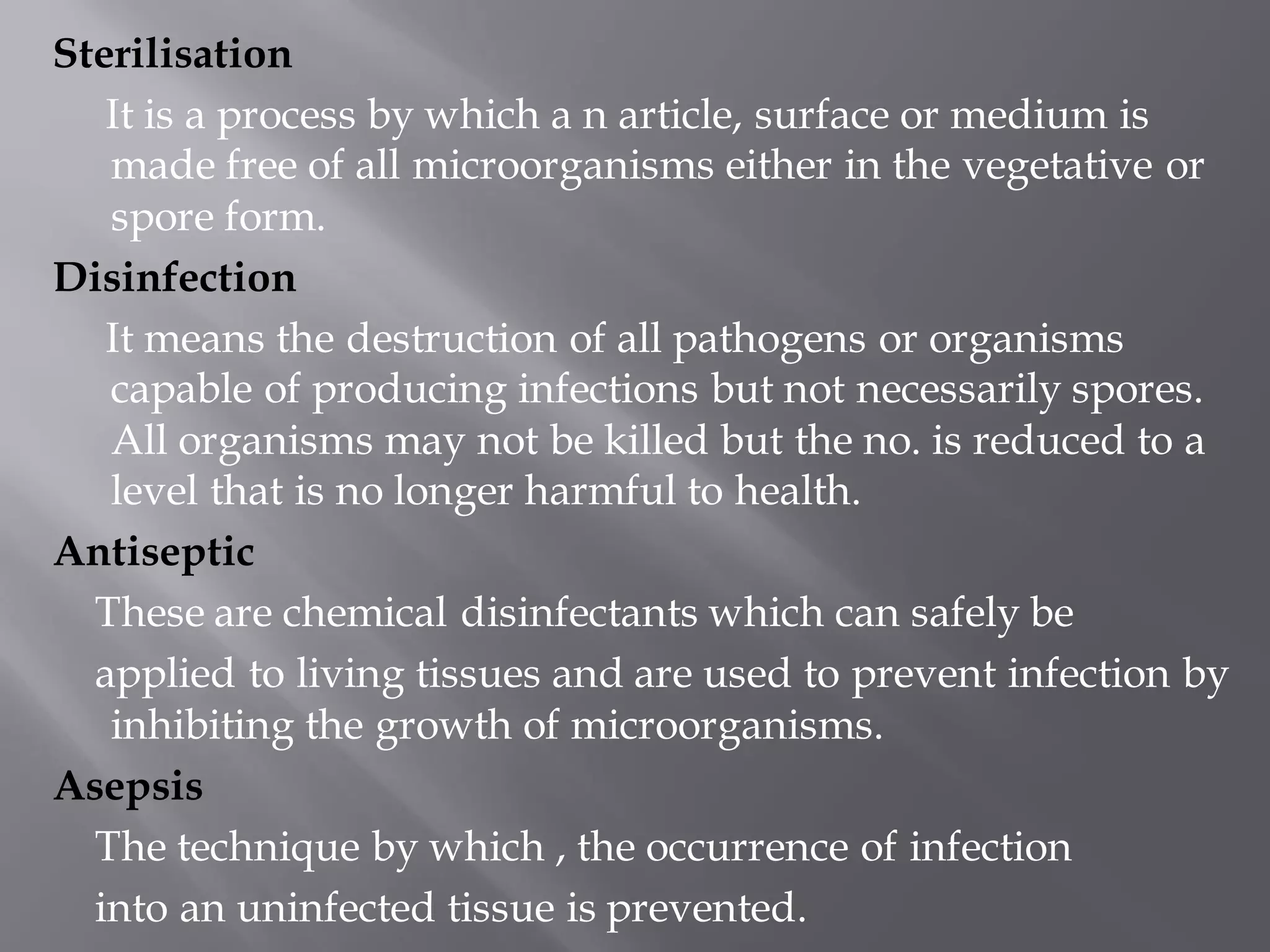
Sterilisation
It is a process by which a n article, surface or medium is
made free of all microorganisms either in the vegetative or
spore form.
Disinfection
It means the destruction of all pathogens or organisms
capable of producing infections but not necessarily spores.
All organisms may not be killed but the no. is reduced to a
level that is no longer harmful to health.
Antiseptic
These are chemical disinfectants which can safely be
applied to living tissues and are used to prevent infection by
inhibiting the growth of microorganisms.
Asepsis
The technique by which , the occurrence of infection
into an uninfected tissue is prevented.
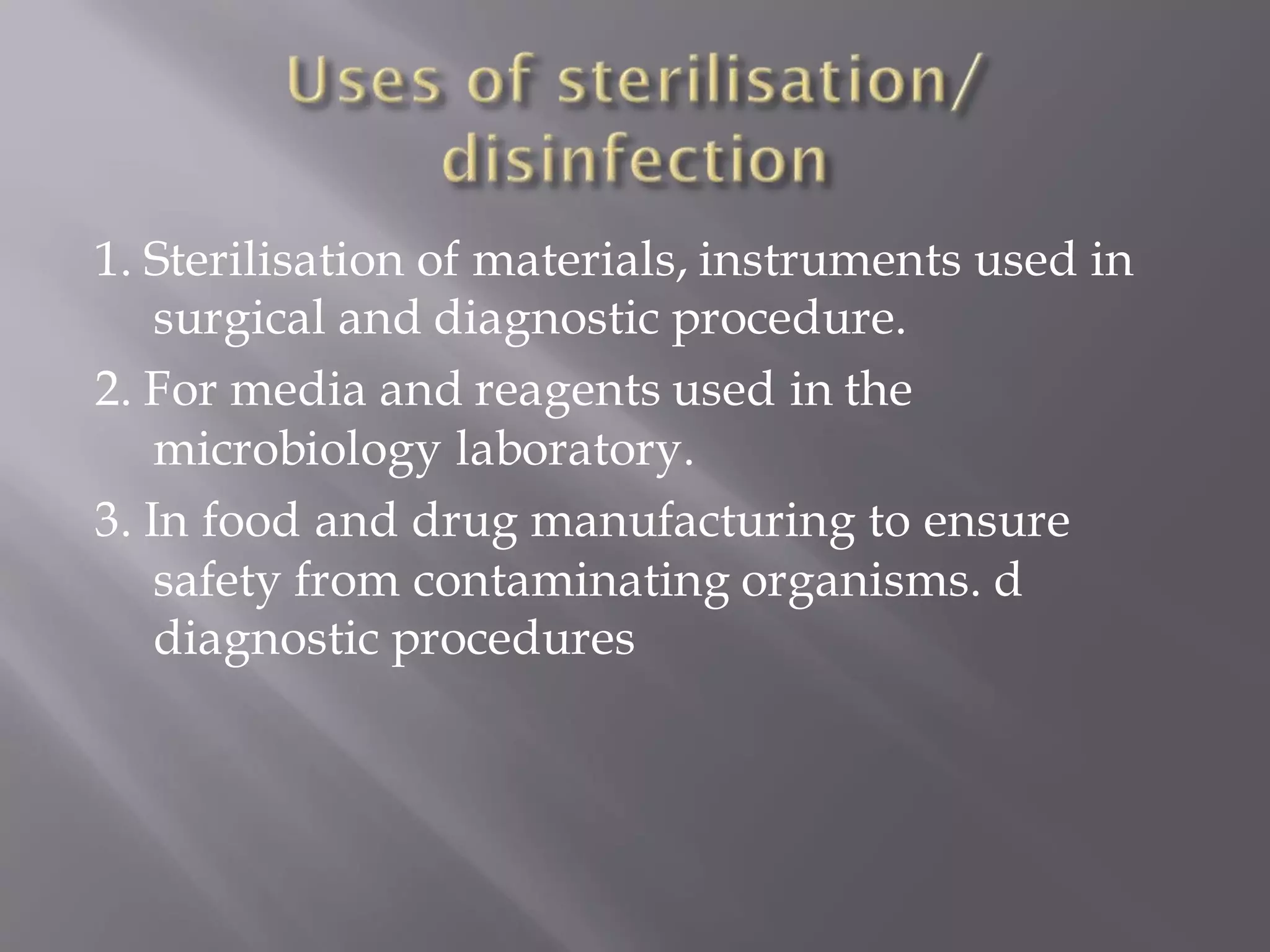
1. Sterilisation of materials, instruments used in
surgical and diagnostic procedure.
2. For media and reagents used in the
microbiology laboratory.
3. In food and drug manufacturing to ensure
safety from contaminating organisms. d
diagnostic procedures
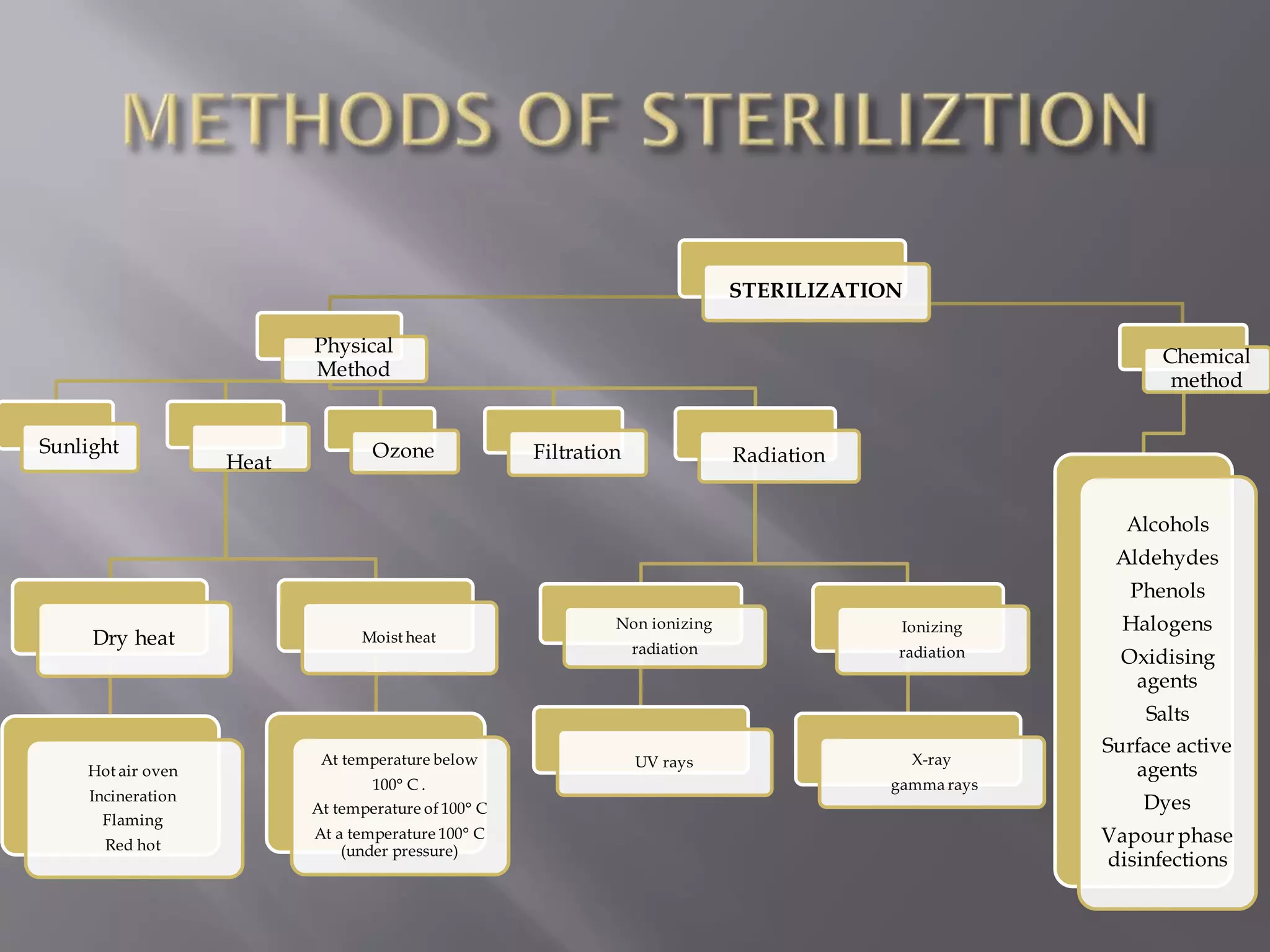
STERILIZATION
Physical
Method
Sunlight
Heat
Dry heat
Hot air oven
Incineration
Flaming
Red hot
Moist heat
At temperature below
100° C .
At temperature of 100° C
At a temperature 100° C
(under pressure)
Ozone Filtration Radiation
Non ionizing
radiation
UV rays
Ionizing
radiation
X-ray
gamma rays
Chemical
method
Alcohols
Aldehydes
Phenols
Halogens
Oxidising
agents
Salts
Surface active
agents
Dyes
Vapour phase
disinfections
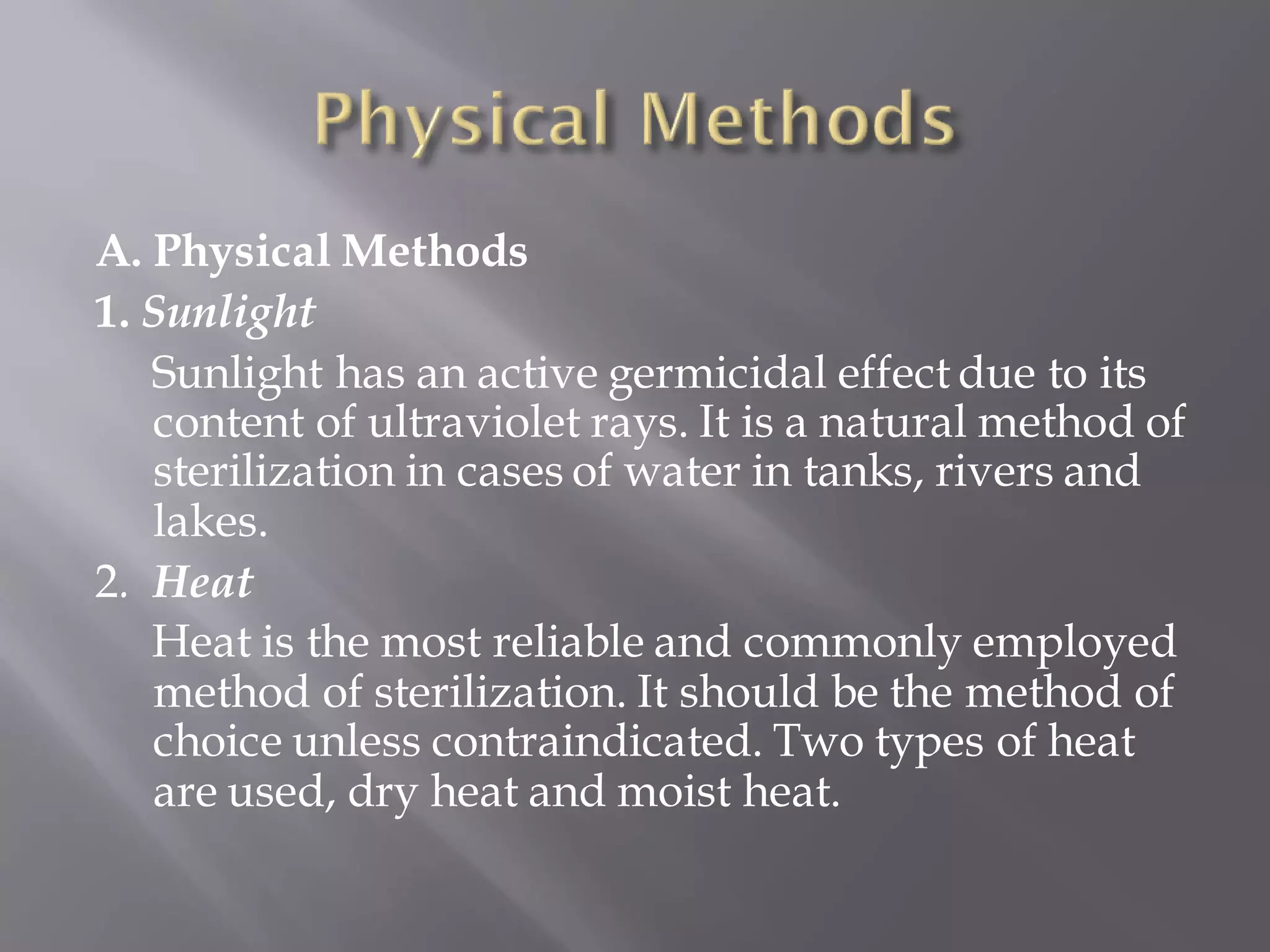
A. Physical Methods
1. Sunlight
Sunlight has an active germicidal effect due to its
content of ultraviolet rays. It is a natural method of
sterilization in cases of water in tanks, rivers and
lakes.
2. Heat
Heat is the most reliable and commonly employed
method of sterilization. It should be the method of
choice unless contraindicated. Two types of heat
are used, dry heat and moist heat.
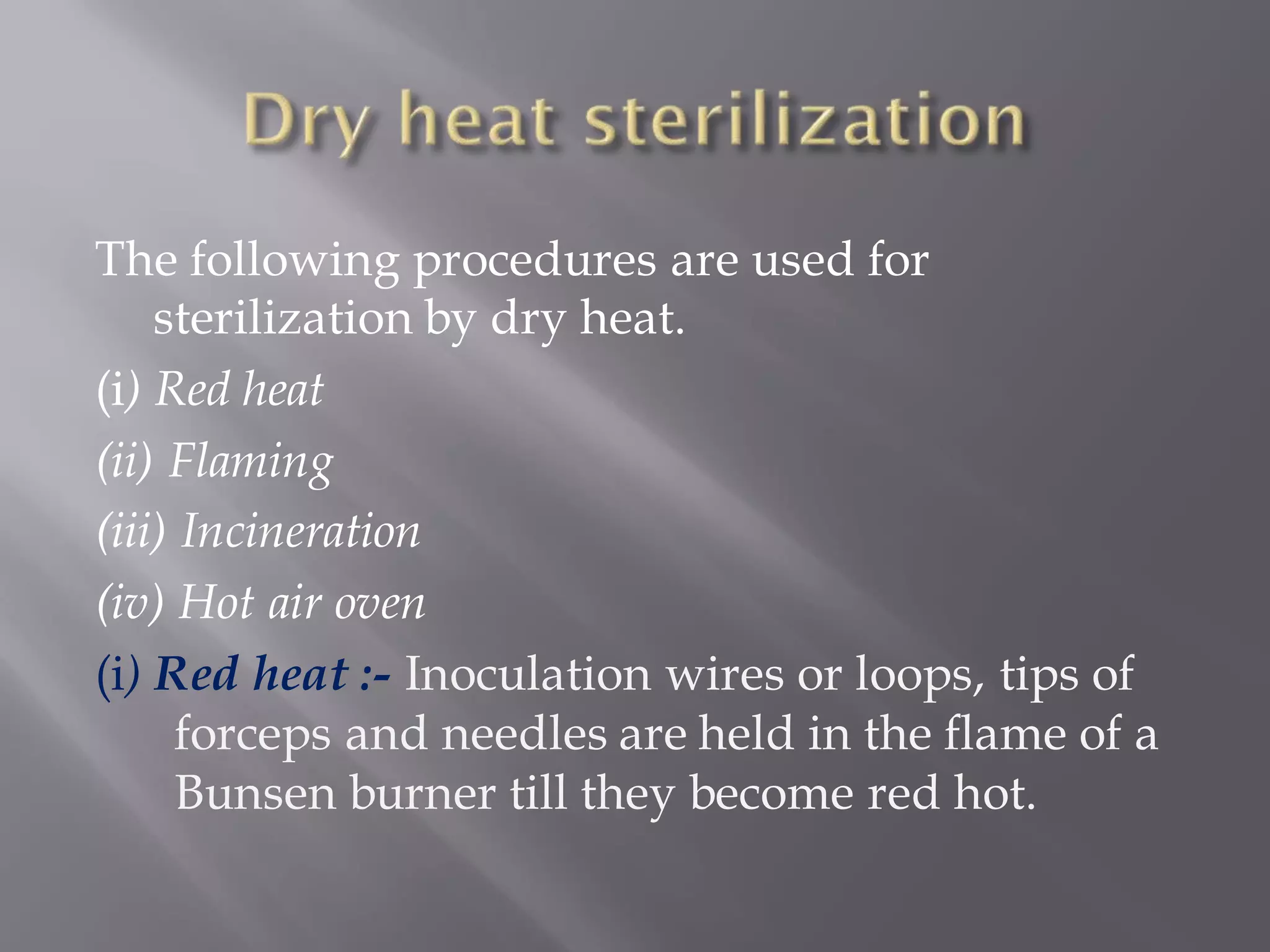
The following procedures are used for
sterilization by dry heat.
(i) Red heat
(ii) Flaming
(iii) Incineration
(iv) Hot air oven
(i) Red heat :- Inoculation wires or loops, tips of
forceps and needles are held in the flame of a
Bunsen burner till they become red hot.
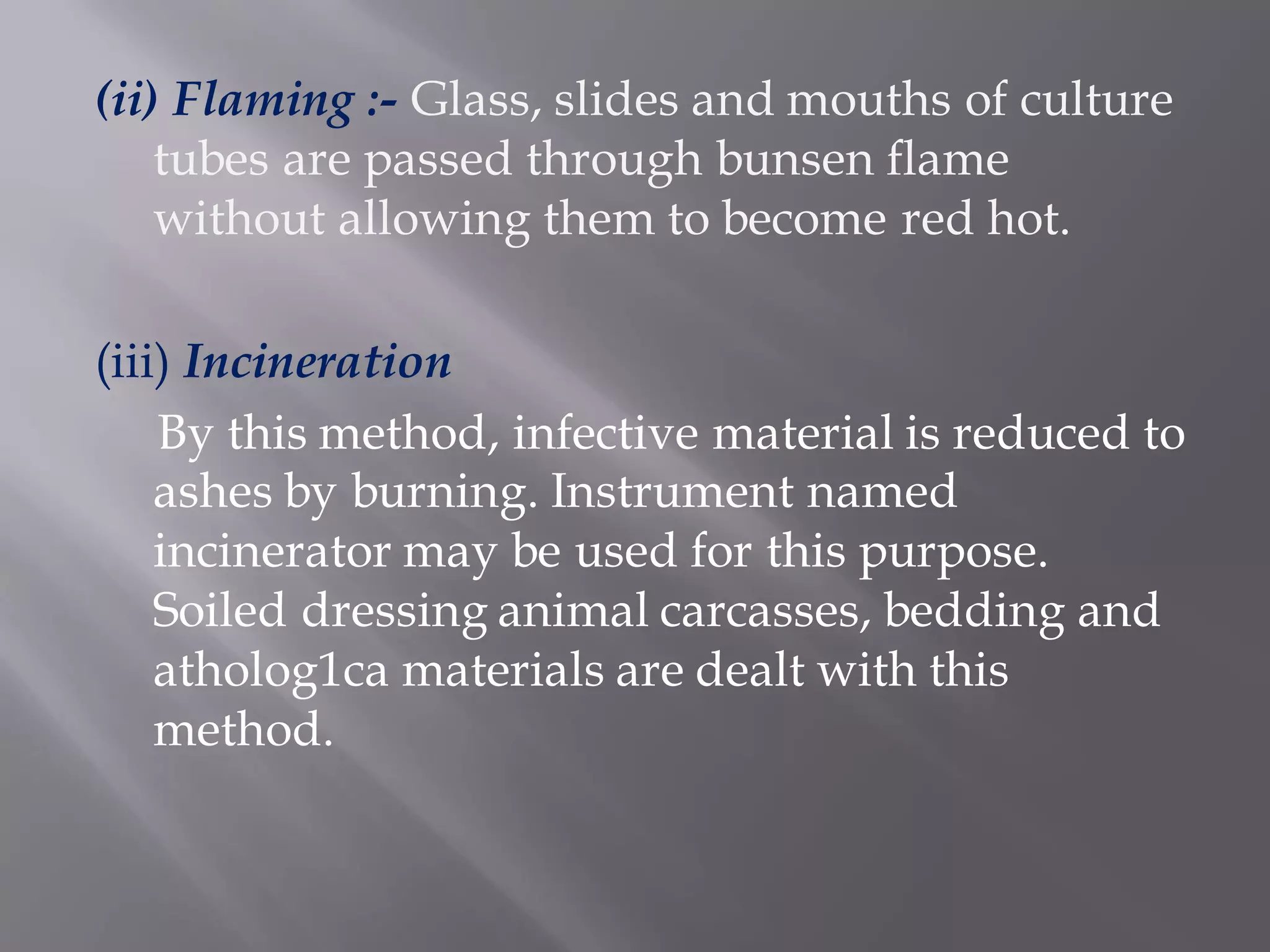
(ii) Flaming :- Glass, slides and mouths of culture
tubes are passed through bunsen flame
without allowing them to become red hot.
(iii) Incineration
By this method, infective material is reduced to
ashes by burning. Instrument named
incinerator may be used for this purpose.
Soiled dressing animal carcasses, bedding and
atholog1ca materials are dealt with this
method.
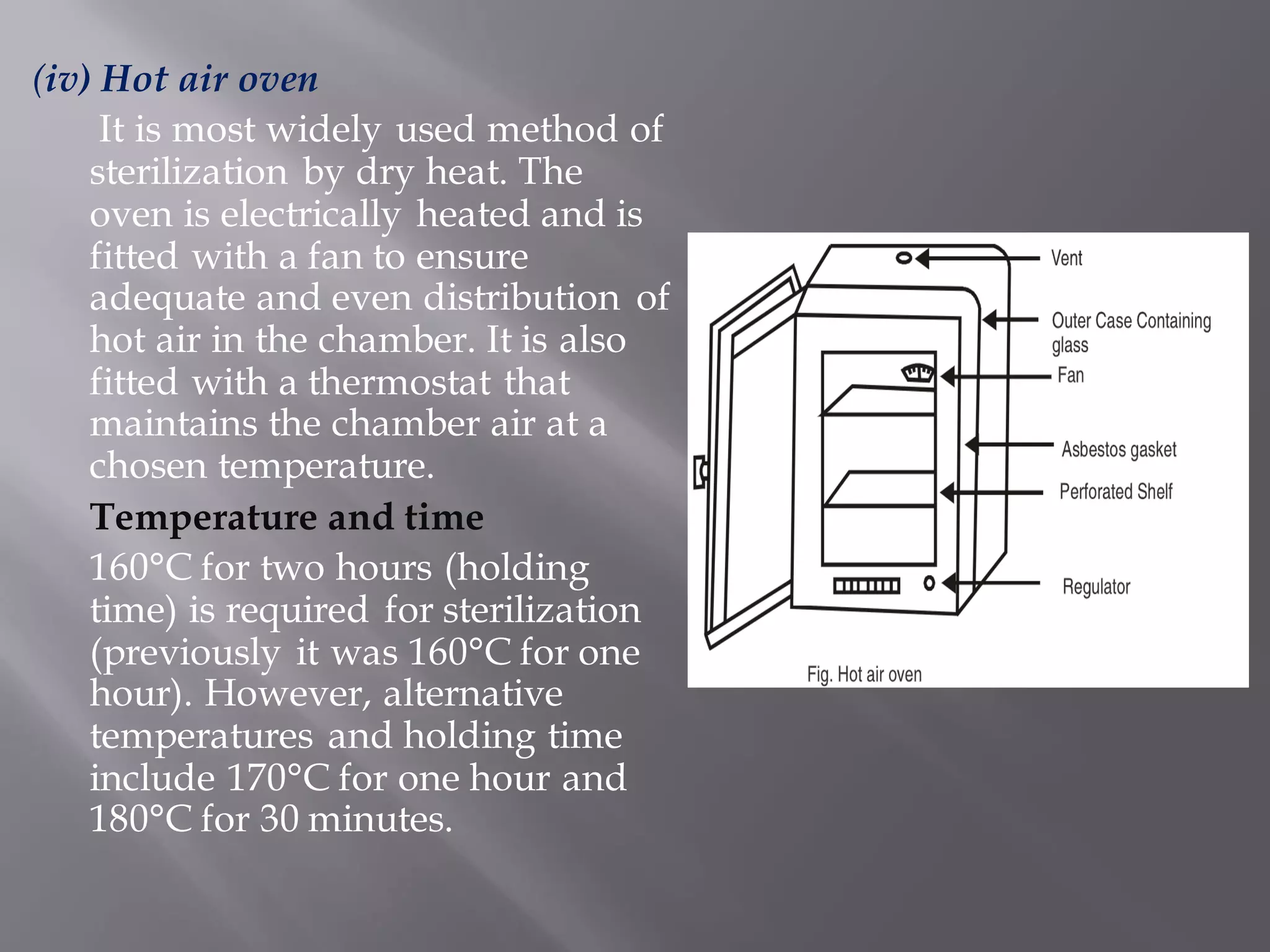
(iv) Hot air oven
It is most widely used method of
sterilization by dry heat. The
oven is electrically heated and is
fitted with a fan to ensure
adequate and even distribution of
hot air in the chamber. It is also
fitted with a thermostat that
maintains the chamber air at a
chosen temperature.
Temperature and time
160°C for two hours (holding
time) is required for sterilization
(previously it was 160°C for one
hour). However, alternative
temperatures and holding time
include 170°C for one hour and
180°C for 30 minutes.
Moist heat of sterilization may be used at
different temperatures as follows.
(i) At a temperature below 100°C
(ii) At a temperature of 100°C
(iii) At a temperature above 100°C
 Pasteurization:- It is method for control of
microorganisms from beverages like fruit and
vegetable juice, beer and dairy products such
as milk.
 Waterbath :- It is used for disinfection of
serum, body fluids and vaccines.
 Inspissations:- It is a process of heating an
article on 3 successive days at 80-85˚C for 30
minutes.
 Boiling:- Boiling of the items in water for 15
minutes may kill most of the vegetative forms
but not the spore, hence not suitable for
sterilization of surgical instruments
 Steaming:- The steam sterilizer are useful for
those media which are decomposed at high
temperature of autoclave.
 Tyndallization:- It is ( named after John
Tyndall ) involves steaming at 100˚C for 20
minutes for 3 consecutive days
 Autoclave functions similar to a pressure
cooker and follows the general law of gas.
 Water boils when its vapour pressure equals
that of the surroundings atmosphere. So when
the atmospheric pressure is raised the boiling
temperature is also raised.
 At normal pressure, water boils at 100˚C . But
when pressure inside a closed vessel increases,
the temperature at which water boils also
increases
Autoclave components are of three parts:-
 Pressure chamber
 A lid
 Electrical heater
Pressure chamber consists of:-
▪ It is a large cylinder (vertical or horizontal) in
which the materials to be sterilised are placed. It is
made up of gunmetal or stainless steel and places
in a supporting iron case.
▪ A stream jacket (water compartment)
▪ The lid is fastened by screw clamps and rendered
air tight by an asbestos washer.
The lid bears the following:-
▪ A discharge tab for air.
▪ Pressure guage
▪ A safety valve
An electrical heater is attached to the jacket that
heats the water to produce steam
Autoclave is particularly useful for media
containing water that cannot be sterilised by heat.
It is the method of choice for sterilising the
following:-
Surgical instruments
Culture media
Autoclave plastic containers
Plastic tubes and pipette tips
Solutions and water
Biohazardous waste
Glassware(autoclave resistible)
 The following precautions should be taken
while using an autoclave:-
 Autoclave should not be used for sterilising
waterproof materials such as oil and grease or
dry materials such as glove powder.
 Material should not touch the sides or top of
the chamber.
 The clean items and the wastes sould be
autoclaved seperately.
 Polythylene drays should not be used as they
may melt and cause damage to the autoclave.
Low Temperature sterilisation by ozone
Ozone steriliser uses oxygen, water and
electricity to produce ozone within the steriliser
and provide sterilisation without producing
toxic chemicals. It runs at lower temperature
i.e. 25°C-35°. In this device, oxygen molecules
(O2) are separated into atomic oxygen (O) in
the presence of intense electrical field. This
atomic oxygen(O) combines with other oxygen
molecules (O) to form ozone (O3).The ozone
provides a sterility assurance of 10ˉ6 in
approximately 4 hours.
 Filtration is an excellent way to remove the
microbial population in solutions of heat-labile
materials like vaccine, antibiotics, toxins, serum
and sugar solution as well as purification of air.
 Types of filters
(i) Candle filters e.g. Berkefeld , Chamberland filter
(ii) Asbestos disc filters e.g. Seitz filter
(iii) Sintered glass filters
(iv) Membrane filters
( v ) Air filters
(vi) Syringe filters
Two types of rations are used for sterilisation ionizing and non-
ionizing.
1. Ionizing Radiation:- It is used ionizing radiation , X-Ray,
gamma rays and cosmic rays.
Mechanism:- It causes breakage of DNA without temperature
rise hence this method is also called as cold sterilsation.
Ionizing radiation is an excellent agent for
sterilsation/disinfection. It penetrates deep into the object.
2.Non-ionizing Radiation
Examples of non-ionizing radiation include infrared and
ultraviolet radiations.
It is used for disinfection of clean surface in operation
theaters, laminar flow as well as for water treatment.
 A variety of chemical agents are used as antiseptics and
disinfectants.
 Alcohols
Ethyl alcohol and isopropyl alcohol are the most frequentlyused.
They act by denaturingbacterial proteins. They rapidly kill
bacteria includingtubercle bacilli but they have no sporicidal or
virucidal activity.
 Aldehydes
FORMALDEHYDE
Uses
(i) Preservation of tissue for histological examination.
(ii) To sterilisebacterialvaccines.
(iii)To preparetoxoid from toxin.
(iv) For killingof bacteriplculturesand suspen sions.
(v) For destroyinga nthrax spores in hair and wool.
sterlization new.pdf

sterlization new.pdf

  • 1.
    Sterilization AND METHODSOF Sterilization USED IN HOSPITALS PRESENTED BY :- MRS KIRTI GAUR
  • 2.
    Microorganism are responsiblefor contamination and infection. They are present all around. The aim of sterilization is to remove destroy them from materials or from surfaces.
  • 3.
    Sterilisation It is aprocess by which a n article, surface or medium is made free of all microorganisms either in the vegetative or spore form. Disinfection It means the destruction of all pathogens or organisms capable of producing infections but not necessarily spores. All organisms may not be killed but the no. is reduced to a level that is no longer harmful to health. Antiseptic These are chemical disinfectants which can safely be applied to living tissues and are used to prevent infection by inhibiting the growth of microorganisms. Asepsis The technique by which , the occurrence of infection into an uninfected tissue is prevented.
  • 4.
    1. Sterilisation ofmaterials, instruments used in surgical and diagnostic procedure. 2. For media and reagents used in the microbiology laboratory. 3. In food and drug manufacturing to ensure safety from contaminating organisms. d diagnostic procedures
  • 5.
    STERILIZATION Physical Method Sunlight Heat Dry heat Hot airoven Incineration Flaming Red hot Moist heat At temperature below 100° C . At temperature of 100° C At a temperature 100° C (under pressure) Ozone Filtration Radiation Non ionizing radiation UV rays Ionizing radiation X-ray gamma rays Chemical method Alcohols Aldehydes Phenols Halogens Oxidising agents Salts Surface active agents Dyes Vapour phase disinfections
  • 6.
    A. Physical Methods 1.Sunlight Sunlight has an active germicidal effect due to its content of ultraviolet rays. It is a natural method of sterilization in cases of water in tanks, rivers and lakes. 2. Heat Heat is the most reliable and commonly employed method of sterilization. It should be the method of choice unless contraindicated. Two types of heat are used, dry heat and moist heat.
  • 7.
    The following proceduresare used for sterilization by dry heat. (i) Red heat (ii) Flaming (iii) Incineration (iv) Hot air oven (i) Red heat :- Inoculation wires or loops, tips of forceps and needles are held in the flame of a Bunsen burner till they become red hot.
  • 8.
    (ii) Flaming :-Glass, slides and mouths of culture tubes are passed through bunsen flame without allowing them to become red hot. (iii) Incineration By this method, infective material is reduced to ashes by burning. Instrument named incinerator may be used for this purpose. Soiled dressing animal carcasses, bedding and atholog1ca materials are dealt with this method.
  • 9.
    (iv) Hot airoven It is most widely used method of sterilization by dry heat. The oven is electrically heated and is fitted with a fan to ensure adequate and even distribution of hot air in the chamber. It is also fitted with a thermostat that maintains the chamber air at a chosen temperature. Temperature and time 160°C for two hours (holding time) is required for sterilization (previously it was 160°C for one hour). However, alternative temperatures and holding time include 170°C for one hour and 180°C for 30 minutes.
  • 10.
    Moist heat ofsterilization may be used at different temperatures as follows. (i) At a temperature below 100°C (ii) At a temperature of 100°C (iii) At a temperature above 100°C
  • 11.
     Pasteurization:- Itis method for control of microorganisms from beverages like fruit and vegetable juice, beer and dairy products such as milk.  Waterbath :- It is used for disinfection of serum, body fluids and vaccines.  Inspissations:- It is a process of heating an article on 3 successive days at 80-85˚C for 30 minutes.
  • 12.
     Boiling:- Boilingof the items in water for 15 minutes may kill most of the vegetative forms but not the spore, hence not suitable for sterilization of surgical instruments  Steaming:- The steam sterilizer are useful for those media which are decomposed at high temperature of autoclave.  Tyndallization:- It is ( named after John Tyndall ) involves steaming at 100˚C for 20 minutes for 3 consecutive days
  • 13.
     Autoclave functionssimilar to a pressure cooker and follows the general law of gas.  Water boils when its vapour pressure equals that of the surroundings atmosphere. So when the atmospheric pressure is raised the boiling temperature is also raised.  At normal pressure, water boils at 100˚C . But when pressure inside a closed vessel increases, the temperature at which water boils also increases
  • 14.
    Autoclave components areof three parts:-  Pressure chamber  A lid  Electrical heater Pressure chamber consists of:- ▪ It is a large cylinder (vertical or horizontal) in which the materials to be sterilised are placed. It is made up of gunmetal or stainless steel and places in a supporting iron case. ▪ A stream jacket (water compartment) ▪ The lid is fastened by screw clamps and rendered air tight by an asbestos washer.
  • 15.
    The lid bearsthe following:- ▪ A discharge tab for air. ▪ Pressure guage ▪ A safety valve An electrical heater is attached to the jacket that heats the water to produce steam
  • 16.
    Autoclave is particularlyuseful for media containing water that cannot be sterilised by heat. It is the method of choice for sterilising the following:- Surgical instruments Culture media Autoclave plastic containers Plastic tubes and pipette tips Solutions and water Biohazardous waste Glassware(autoclave resistible)
  • 17.
     The followingprecautions should be taken while using an autoclave:-  Autoclave should not be used for sterilising waterproof materials such as oil and grease or dry materials such as glove powder.  Material should not touch the sides or top of the chamber.  The clean items and the wastes sould be autoclaved seperately.  Polythylene drays should not be used as they may melt and cause damage to the autoclave.
  • 18.
    Low Temperature sterilisationby ozone Ozone steriliser uses oxygen, water and electricity to produce ozone within the steriliser and provide sterilisation without producing toxic chemicals. It runs at lower temperature i.e. 25°C-35°. In this device, oxygen molecules (O2) are separated into atomic oxygen (O) in the presence of intense electrical field. This atomic oxygen(O) combines with other oxygen molecules (O) to form ozone (O3).The ozone provides a sterility assurance of 10ˉ6 in approximately 4 hours.
  • 19.
     Filtration isan excellent way to remove the microbial population in solutions of heat-labile materials like vaccine, antibiotics, toxins, serum and sugar solution as well as purification of air.  Types of filters (i) Candle filters e.g. Berkefeld , Chamberland filter (ii) Asbestos disc filters e.g. Seitz filter (iii) Sintered glass filters (iv) Membrane filters ( v ) Air filters (vi) Syringe filters
  • 20.
    Two types ofrations are used for sterilisation ionizing and non- ionizing. 1. Ionizing Radiation:- It is used ionizing radiation , X-Ray, gamma rays and cosmic rays. Mechanism:- It causes breakage of DNA without temperature rise hence this method is also called as cold sterilsation. Ionizing radiation is an excellent agent for sterilsation/disinfection. It penetrates deep into the object. 2.Non-ionizing Radiation Examples of non-ionizing radiation include infrared and ultraviolet radiations. It is used for disinfection of clean surface in operation theaters, laminar flow as well as for water treatment.
  • 21.
     A varietyof chemical agents are used as antiseptics and disinfectants.  Alcohols Ethyl alcohol and isopropyl alcohol are the most frequentlyused. They act by denaturingbacterial proteins. They rapidly kill bacteria includingtubercle bacilli but they have no sporicidal or virucidal activity.  Aldehydes FORMALDEHYDE Uses (i) Preservation of tissue for histological examination. (ii) To sterilisebacterialvaccines. (iii)To preparetoxoid from toxin. (iv) For killingof bacteriplculturesand suspen sions. (v) For destroyinga nthrax spores in hair and wool.