RESEARCH PROCESS AND
STEPS INVOLVED
INTRODUCTION
• Research is a search for knowledge.
• Research involves asking a question and then trying to
find an answer to it.
• Research is essentially a systematic, scientific and
structured inquiry seeking facts through objective
methods. Therefore, a research must have a clearly
defined step-by-step process.
• A knowledge of the research process is essential both for
those who conduct the research and for those who wish to
be benefited by the conclusions drawn from the research.
RESEARCH PROCESS
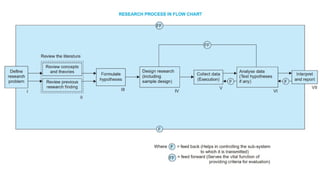
Research process consists of several closely related activities. But such activities
overlap continuously rather than following a strictly prescribed sequence.
The researcher must be vigilant of their order continuously through out the
research process.
The first step determines the nature of the last step to be undertaken.
If subsequent procedures have not been considered in the early stages, serious
difficulties may arise which may even prevent the completion of the study.
1. Formulating the research problem
• first and foremost step.
• The feasibility of a particular solution must be considered before a working formulation
of the problem can be set up.
• Two steps are involved in formulating the research problem
• understanding the problem thoroughly, and
• rephrasing the same into meaningful terms from an analytical point of view
• The main function of formulating a research problem is to decide what you want to find
out about.
• It is important to evaluate the research problem in the light of:
a) Financial resources at your disposal.
b) The time available with you and your research supervisor.
c) The supervisor’s expertise and knowledge in the field of study.
d) Your own expertise and knowledge.
e) Whether you have sufficient knowledge about computers and software if you plan
to use them.
2. Extensive literature survey
• A body of prior work related to a research problem is referred to as literature.
• It helps in understanding of the problems and hypothesis that others have
studied.
• It clarifies the concepts, theories, major variables involved, operational
definitions and research methods used in the past.
• One advantage of review of the literature is that it helps to eliminate
duplication of what has already been done and provides guidance and
suggestions for further research.
• Academic journals, conference proceedings, government reports, books etc.,
must be tapped depending on the nature of the problem.
• One source will lead to another.
3. Development of working hypothesis
• A hypothesis is a tentative assumption in a research problem, which must be
tested empirically with the help of observed data.
• When formulating a hypothesis, a researcher does not know whether it will be
rejected or accepted.
• A hypothesis is constructed and tested; if it is rejected, another one is
formulated; if it is accepted, it is incorporated in the scientific body of
knowledge.
• A good hypothesis states a research problem in concise and precise terms so
that the researcher is focused on the problem at hand.
4. Preparing the research design
• A research design is a well-defined plan of action.
• It is a planned sequence of the entire research
process. It is a blue print of research activity.
• A good research design must use minimum of
resources like time, money and manpower.
• A research design must be able to translate the
general scientific model into a practical research
operation.
• A scientifically developed research design possess
the characteristics like,
(i) objectivity (ii) Reliability ( iii)
Validity (iv) Generalization
5. Determining sample design
• In any investigation the group of all items, objects or individuals under
study is called ‘population’ or ‘universe’.
• For all purpose of determining population characteristics, instead of
enumerating entire population, some items of the population, called a
sample, are observed.
• These have to be a systematic plan to choose the sample items.
• This plan or a technique of drawing a sample is known as sample
design.
• The sample design to be used must be decided by the researcher
taking into consideration the nature of the inquiry and other related
factors.
6. Collecting the data
• There can be two sources of data,
(i) Internal data, that refers to the happenings and functions of a business organization
(ii) External data, which is related to outside sources and external agencies.
• There are two types of data,
(i) Primary data - those observations, which are collected by an investigator for the first
time.
(ii) Secondary data - are already available in the records and have been collected by
some other researcher for the purpose of studying a similar problem.
• Methods of collecting primary data are:
(i) by direct observation and experimentations
(ii) by direct personal interview
(iii) by direct interviews through phone, sms and email.
(iv) by indirect personal interview
(v) by mailed / emailed Questionnaire
(vi) by schedules through enumerators
• Methods of collecting secondary data:
(i) International organizations like WHO, UNO etc.
(ii) Government publications like economic survey, CSO, NSSO.
(iii) Journal and Newspapers
(iv) Research articles
(v) Reports of business organization and financial institutions
• The researcher should select one of these methods of collecting the data
taking into consideration the nature of investigation, objective and scope
of the inquiry, finanical resources, available time and the desired
degree of accuracy.
7. Execution of the project
• If the execution of the project proceeds on correct lines, the data
to be collected would be adequate and dependable.
• The researcher should see that the project is executed in a
systematic manner and in time.
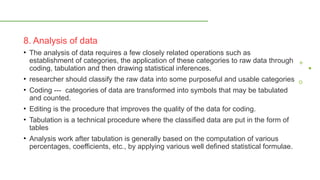
8. Analysis of data
• The analysis of data requires a few closely related operations such as
establishment of categories, the application of these categories to raw data through
coding, tabulation and then drawing statistical inferences.
• researcher should classify the raw data into some purposeful and usable categories
• Coding --- categories of data are transformed into symbols that may be tabulated
and counted.
• Editing is the procedure that improves the quality of the data for coding.
• Tabulation is a technical procedure where the classified data are put in the form of
tables
• Analysis work after tabulation is generally based on the computation of various
percentages, coefficients, etc., by applying various well defined statistical formulae.
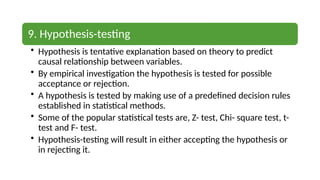
9. Hypothesis-testing
• Hypothesis is tentative explanation based on theory to predict
causal relationship between variables.
• By empirical investigation the hypothesis is tested for possible
acceptance or rejection.
• A hypothesis is tested by making use of a predefined decision rules
established in statistical methods.
• Some of the popular statistical tests are, Z- test, Chi- square test, t-
test and F- test.
• Hypothesis-testing will result in either accepting the hypothesis or
in rejecting it.
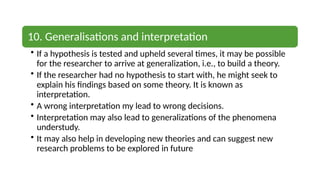
10. Generalisations and interpretation
• If a hypothesis is tested and upheld several times, it may be possible
for the researcher to arrive at generalization, i.e., to build a theory.
• If the researcher had no hypothesis to start with, he might seek to
explain his findings based on some theory. It is known as
interpretation.
• A wrong interpretation my lead to wrong decisions.
• Interpretation may also lead to generalizations of the phenomena
understudy.
• It may also help in developing new theories and can suggest new
research problems to be explored in future
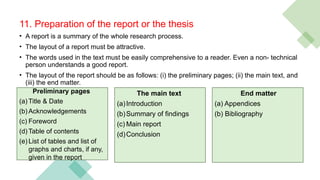
11. Preparation of the report or the thesis
• A report is a summary of the whole research process.
• The layout of a report must be attractive.
• The words used in the text must be easily comprehensive to a reader. Even a non- technical
person understands a good report.
• The layout of the report should be as follows: (i) the preliminary pages; (ii) the main text, and
(iii) the end matter.
Preliminary pages
(a) Title & Date
(b) Acknowledgements
(c) Foreword
(d) Table of contents
(e) List of tables and list of
graphs and charts, if any,
given in the report
End matter
(a) Appendices
(b) Bibliography
The main text
(a)Introduction
(b)Summary of findings
(c) Main report
(d)Conclusion
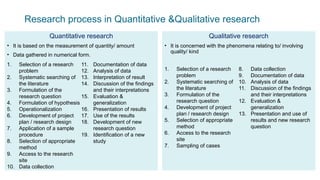
Research process in Quantitative &Qualitative research
Quantitative research
• It is based on the measurement of quantity/ amount
• Data gathered in numerical form.
Qualitative research
• It is concerned with the phenomena relating to/ involving
quality/ kind
1. Selection of a research
problem
2. Systematic searching of
the literature
3. Formulation of the
research question
4. Formulation of hypothesis
5. Operationalization
6. Development of project
plan / research design
7. Application of a sample
procedure
8. Selection of appropriate
method
9. Access to the research
site
10. Data collection
11. Documentation of data
12. Analysis of data
13. Interpretation of result
14. Discussion of the findings
and their interpretations
15. Evaluation &
generalization
16. Presentation of results
17. Use of the results
18. Development of new
research question
19. Identification of a new
study
1. Selection of a research
problem
2. Systematic searching of
the literature
3. Formulation of the
research question
4. Development of project
plan / research design
5. Selection of appropriate
method
6. Access to the research
site
7. Sampling of cases
8. Data collection
9. Documentation of data
10. Analysis of data
11. Discussion of the findings
and their interpretations
12. Evaluation &
generalization
13. Presentation and use of
results and new research
question
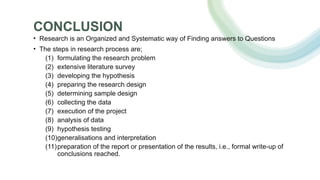
CONCLUSION
• Research is an Organized and Systematic way of Finding answers to Questions
• The steps in research process are;
(1) formulating the research problem
(2) extensive literature survey
(3) developing the hypothesis
(4) preparing the research design
(5) determining sample design
(6) collecting the data
(7) execution of the project
(8) analysis of data
(9) hypothesis testing
(10)generalisations and interpretation
(11)preparation of the report or presentation of the results, i.e., formal write-up of
conclusions reached.
Thank you

RESEARCH PROCESS AND STEPS INVOLVED.pptx

  • 1.
  • 2.
    INTRODUCTION • Research isa search for knowledge. • Research involves asking a question and then trying to find an answer to it. • Research is essentially a systematic, scientific and structured inquiry seeking facts through objective methods. Therefore, a research must have a clearly defined step-by-step process. • A knowledge of the research process is essential both for those who conduct the research and for those who wish to be benefited by the conclusions drawn from the research.
  • 3.
    RESEARCH PROCESS Research processconsists of several closely related activities. But such activities overlap continuously rather than following a strictly prescribed sequence. The researcher must be vigilant of their order continuously through out the research process. The first step determines the nature of the last step to be undertaken. If subsequent procedures have not been considered in the early stages, serious difficulties may arise which may even prevent the completion of the study.
  • 5.
    1. Formulating theresearch problem • first and foremost step. • The feasibility of a particular solution must be considered before a working formulation of the problem can be set up. • Two steps are involved in formulating the research problem • understanding the problem thoroughly, and • rephrasing the same into meaningful terms from an analytical point of view • The main function of formulating a research problem is to decide what you want to find out about. • It is important to evaluate the research problem in the light of: a) Financial resources at your disposal. b) The time available with you and your research supervisor. c) The supervisor’s expertise and knowledge in the field of study. d) Your own expertise and knowledge. e) Whether you have sufficient knowledge about computers and software if you plan to use them.
  • 6.
    2. Extensive literaturesurvey • A body of prior work related to a research problem is referred to as literature. • It helps in understanding of the problems and hypothesis that others have studied. • It clarifies the concepts, theories, major variables involved, operational definitions and research methods used in the past. • One advantage of review of the literature is that it helps to eliminate duplication of what has already been done and provides guidance and suggestions for further research. • Academic journals, conference proceedings, government reports, books etc., must be tapped depending on the nature of the problem. • One source will lead to another.
  • 7.
    3. Development ofworking hypothesis • A hypothesis is a tentative assumption in a research problem, which must be tested empirically with the help of observed data. • When formulating a hypothesis, a researcher does not know whether it will be rejected or accepted. • A hypothesis is constructed and tested; if it is rejected, another one is formulated; if it is accepted, it is incorporated in the scientific body of knowledge. • A good hypothesis states a research problem in concise and precise terms so that the researcher is focused on the problem at hand.
  • 8.
    4. Preparing theresearch design • A research design is a well-defined plan of action. • It is a planned sequence of the entire research process. It is a blue print of research activity. • A good research design must use minimum of resources like time, money and manpower. • A research design must be able to translate the general scientific model into a practical research operation. • A scientifically developed research design possess the characteristics like, (i) objectivity (ii) Reliability ( iii) Validity (iv) Generalization
  • 9.
    5. Determining sampledesign • In any investigation the group of all items, objects or individuals under study is called ‘population’ or ‘universe’. • For all purpose of determining population characteristics, instead of enumerating entire population, some items of the population, called a sample, are observed. • These have to be a systematic plan to choose the sample items. • This plan or a technique of drawing a sample is known as sample design. • The sample design to be used must be decided by the researcher taking into consideration the nature of the inquiry and other related factors.
  • 10.
    6. Collecting thedata • There can be two sources of data, (i) Internal data, that refers to the happenings and functions of a business organization (ii) External data, which is related to outside sources and external agencies. • There are two types of data, (i) Primary data - those observations, which are collected by an investigator for the first time. (ii) Secondary data - are already available in the records and have been collected by some other researcher for the purpose of studying a similar problem. • Methods of collecting primary data are: (i) by direct observation and experimentations (ii) by direct personal interview (iii) by direct interviews through phone, sms and email. (iv) by indirect personal interview (v) by mailed / emailed Questionnaire (vi) by schedules through enumerators
  • 11.
    • Methods ofcollecting secondary data: (i) International organizations like WHO, UNO etc. (ii) Government publications like economic survey, CSO, NSSO. (iii) Journal and Newspapers (iv) Research articles (v) Reports of business organization and financial institutions • The researcher should select one of these methods of collecting the data taking into consideration the nature of investigation, objective and scope of the inquiry, finanical resources, available time and the desired degree of accuracy.
  • 12.
    7. Execution ofthe project • If the execution of the project proceeds on correct lines, the data to be collected would be adequate and dependable. • The researcher should see that the project is executed in a systematic manner and in time.
  • 13.
    8. Analysis ofdata • The analysis of data requires a few closely related operations such as establishment of categories, the application of these categories to raw data through coding, tabulation and then drawing statistical inferences. • researcher should classify the raw data into some purposeful and usable categories • Coding --- categories of data are transformed into symbols that may be tabulated and counted. • Editing is the procedure that improves the quality of the data for coding. • Tabulation is a technical procedure where the classified data are put in the form of tables • Analysis work after tabulation is generally based on the computation of various percentages, coefficients, etc., by applying various well defined statistical formulae.
  • 14.
    9. Hypothesis-testing • Hypothesisis tentative explanation based on theory to predict causal relationship between variables. • By empirical investigation the hypothesis is tested for possible acceptance or rejection. • A hypothesis is tested by making use of a predefined decision rules established in statistical methods. • Some of the popular statistical tests are, Z- test, Chi- square test, t- test and F- test. • Hypothesis-testing will result in either accepting the hypothesis or in rejecting it.
  • 15.
    10. Generalisations andinterpretation • If a hypothesis is tested and upheld several times, it may be possible for the researcher to arrive at generalization, i.e., to build a theory. • If the researcher had no hypothesis to start with, he might seek to explain his findings based on some theory. It is known as interpretation. • A wrong interpretation my lead to wrong decisions. • Interpretation may also lead to generalizations of the phenomena understudy. • It may also help in developing new theories and can suggest new research problems to be explored in future
  • 16.
    11. Preparation ofthe report or the thesis • A report is a summary of the whole research process. • The layout of a report must be attractive. • The words used in the text must be easily comprehensive to a reader. Even a non- technical person understands a good report. • The layout of the report should be as follows: (i) the preliminary pages; (ii) the main text, and (iii) the end matter. Preliminary pages (a) Title & Date (b) Acknowledgements (c) Foreword (d) Table of contents (e) List of tables and list of graphs and charts, if any, given in the report End matter (a) Appendices (b) Bibliography The main text (a)Introduction (b)Summary of findings (c) Main report (d)Conclusion
  • 17.
    Research process inQuantitative &Qualitative research Quantitative research • It is based on the measurement of quantity/ amount • Data gathered in numerical form. Qualitative research • It is concerned with the phenomena relating to/ involving quality/ kind 1. Selection of a research problem 2. Systematic searching of the literature 3. Formulation of the research question 4. Formulation of hypothesis 5. Operationalization 6. Development of project plan / research design 7. Application of a sample procedure 8. Selection of appropriate method 9. Access to the research site 10. Data collection 11. Documentation of data 12. Analysis of data 13. Interpretation of result 14. Discussion of the findings and their interpretations 15. Evaluation & generalization 16. Presentation of results 17. Use of the results 18. Development of new research question 19. Identification of a new study 1. Selection of a research problem 2. Systematic searching of the literature 3. Formulation of the research question 4. Development of project plan / research design 5. Selection of appropriate method 6. Access to the research site 7. Sampling of cases 8. Data collection 9. Documentation of data 10. Analysis of data 11. Discussion of the findings and their interpretations 12. Evaluation & generalization 13. Presentation and use of results and new research question
  • 18.
    CONCLUSION • Research isan Organized and Systematic way of Finding answers to Questions • The steps in research process are; (1) formulating the research problem (2) extensive literature survey (3) developing the hypothesis (4) preparing the research design (5) determining sample design (6) collecting the data (7) execution of the project (8) analysis of data (9) hypothesis testing (10)generalisations and interpretation (11)preparation of the report or presentation of the results, i.e., formal write-up of conclusions reached.
  • 19.

Editor's Notes

  • #6 Once the problem is formulated, a brief summary of it should be written down It is compulsory for a research worker writing a thesis for a Ph.D. degree to write a synopsis of the topic and submit it to the necessary Committee or the Research Board for approval. At this juncture the researcher should undertake extensive literature survey connected with the problem
  • #7 Once a problem is defined and a review of literature is made, the next step is to define clearly the hypothesis in a research problem
  • #9 In any investigation-- the group of all items, objects or individuals under study is called ‘population’ or ‘universe’. For all purpose of determining population characteristics, instead of enumerating entire population, some items of the population, called a sample, are observed. Drawing a sample of some predetermined size from an entire population is not a child’s play. These have to be a systematic plan to choose the sample items. This plan or a technique of drawing a sample is known as sample design or sample plan or sampling technique. Researchers have suggested various sample designs. One research situation may be different from another, therefore, simple random sample, though most popular, may not be suitable in each case. Purposive or Judgment Sampling 2. Simple Random Sampling 3. Stratified Random Sampling 4. Systematic Sampling 5. Cluster Sampling 6. Area Sampling 7. Multi-stage Sampling 8. Multi-phase Sampling
  • #10 Once a sample design is formulated, the next step in a research process is the collection of relevant data
  • #13 After the data have been collected, the researcher turns to the task of analysing them With coding the stage is ready for tabulation Computers ---save time , possible to study large number of variables affecting a problem simultaneously.
  • #14 After analysing the data as stated above, the researcher is in a position to test the hypotheses, if any, he had formulated earlier In a situation where no hypothesis is formulated in a study, the observations are made on the data directly and conclusions are drawn to formulate new generalizations and assumptions for future purposes