is a processof multiple scientific steps in conducting the research work.
Each step is interlinked with other steps.
The process starts with the research problem at first.
Then, it advances in the next steps sequentially.
In research work, primarily, you require a Research Proposal.
It is because the proposal approves the research project whether you
achieve the ability to conduct research or not.
WHAT IS RESEARCH PROCESS?
is ofprimary concern to a researcher
is a perceived difficulty, a feeling of discomfort,
or a discrepancy between a common belief and
reality.
A well-identified problem will lead the
researcher to accomplish all-important phases
of the research process, starting from setting
objectives to selecting the research
methodology.
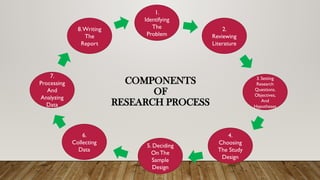
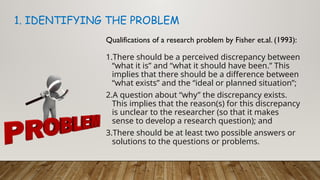
1. IDENTIFYING THE PROBLEM
5.
Qualifications of aresearch problem by Fisher et.al. (1993):
1.There should be a perceived discrepancy between
“what it is” and “what it should have been.” This
implies that there should be a difference between
“what exists” and the “ideal or planned situation”;
2.A question about “why” the discrepancy exists.
This implies that the reason(s) for this discrepancy
is unclear to the researcher (so that it makes
sense to develop a research question); and
3.There should be at least two possible answers or
solutions to the questions or problems.
1. IDENTIFYING THE PROBLEM
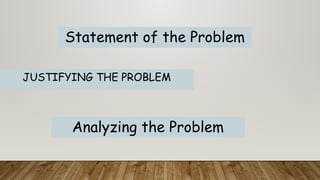
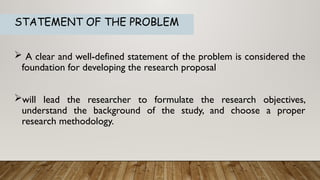
STATEMENT OF THEPROBLEM
A clear and well-defined statement of the problem is considered the
foundation for developing the research proposal
will lead the researcher to formulate the research objectives,
understand the background of the study, and choose a proper
research methodology.
8.
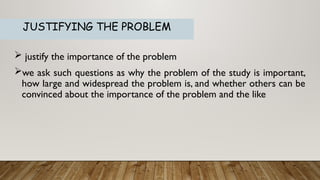
justify theimportance of the problem
we ask such questions as why the problem of the study is important,
how large and widespread the problem is, and whether others can be
convinced about the importance of the problem and the like
JUSTIFYING THE PROBLEM
9.
identify the factorsthat may have contributed to the perceived
problems.
Analyzing the Problem
10.
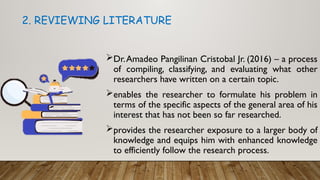
Dr.Amadeo Pangilinan CristobalJr. (2016) – a process
of compiling, classifying, and evaluating what other
researchers have written on a certain topic.
enables the researcher to formulate his problem in
terms of the specific aspects of the general area of his
interest that has not been so far researched.
provides the researcher exposure to a larger body of
knowledge and equips him with enhanced knowledge
to efficiently follow the research process.
2. REVIEWING LITERATURE
After discovering anddefining the research problem, researchers should make a
formal statement of the problem leading to research objectives.
OBJECTIVE
will precisely say what should be researched, describe the type of information that
should be collected, and provide a framework for the scope of the study.
HYPOTHESIS
is an unproven statement or proposition that can be refuted or supported by
empirical data.
a theoretical statement in solving a logical relationship between variables based on
the research problem being solved.
3. SETTING RESEARCH QUESTIONS, OBJECTIVES, AND
HYPOTHESES
13.
is the blueprintor framework for fulfilling objectives and answering
research questions
It is a master plan specifying the methods and procedures for
collecting, processing, and analyzing the collected data.
4. CHOOSING THE STUDY DESIGN
14.
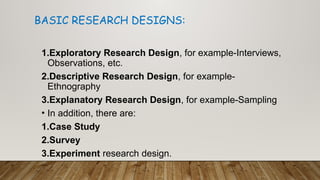
1.Exploratory Research Design,for example-Interviews,
Observations, etc.
2.Descriptive Research Design, for example-
Ethnography
3.Explanatory Research Design, for example-Sampling
• In addition, there are:
1.Case Study
2.Survey
3.Experiment research design.
BASIC RESEARCH DESIGNS:
15.
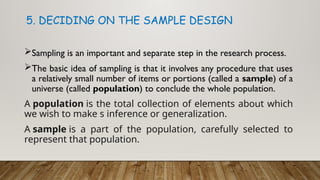
Sampling is animportant and separate step in the research process.
The basic idea of sampling is that it involves any procedure that uses
a relatively small number of items or portions (called a sample) of a
universe (called population) to conclude the whole population.
A population is the total collection of elements about which
we wish to make s inference or generalization.
A sample is a part of the population, carefully selected to
represent that population.
5. DECIDING ON THE SAMPLE DESIGN
16.
Sample design refersto the methods followed in
selecting a sample from the population and the
estimating technique, vis-a-vis formula for computing
the sample statistics.
5. DECIDING ON THE SAMPLE DESIGN
17.
While the researchdesign is decided, then the researcher
collects data, records information.
The approach selected depends on the objectives of the
study, the research design, and the availability of time,
money, and personnel.
The most common means for collecting quantitative data is
the structured interview.
Qualitative data are collected mainly through in-depth
interviews, focus group discussions, Key Informant
Interview (KII), and observational studies.
6. COLLECTING DATA FROM THE RESEARCH
SAMPLE
18.
Data processing generallybegins with the editing and
coding of data.
Data are edited to ensure consistency across
respondents and to locate omissions if any.
In survey data, editing reduces errors in the recording,
improves legibility, and clarifies unclear and
inappropriate responses.
7. PROCESS AND ANALYZE THE COLLECTED
RESEARCH DATA
19.
Data analysis usuallyinvolves reducing accumulated data
to a manageable size, developing summaries, searching
for patterns, and applying statistical techniques for
understanding and interpreting the findings in light of the
research questions.
The techniques used in analyzing data may range from
simple graphical techniques to very complex multivariate
analyses depending on the study’s objectives, research
design employed, and the nature of data collected.
7. PROCESS AND ANALYZE THE COLLECTED
RESEARCH DATA
20.
WAYS OF PRESENTINGDATA
Textual
statements with numerals or numbers that
serve as supplements to tabular presentation
Tabular
a systematic arrangement of related idea in which classes of numerical
facts or data are given each row and their subclasses are given
each a column in order to present the relationships of the sets or
numerical facts or data in a definite, compact and understandable
form).
21.
WAYS OF PRESENTINGDATA
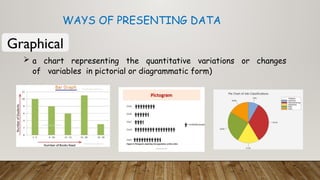
Graphical
a chart representing the quantitative variations or changes
of variables in pictorial or diagrammatic form)
22.
The entire taskof a research study is
accumulated in a document called a
proposal or research proposal.
8. WRITING RESEARCH REPORT
is a work plan, prospectus,
outline, offer, and a statement
of intent or commitment from
an individual researcher or an
organization to produce a
product or render a service to
a potential client or sponsor.
tells what, how, where, and
to whom it will be done.
23.
8. WRITING RESEARCHREPORT
It must also show the benefit of doing it. It always includes
an explanation of the purpose of the study (the research
objectives) or a definition of the problem.
The end goal of a scientific study is to interpret the
results and draw conclusions.
The results of the study can also be disseminated through
peer-reviewed journals published by academic institutions
and reputed publishers both at home and abroad. The
report should be properly evaluated.
24.
SOURCES:
• Awal,A. (2022,July 9). 7 steps research process outline to conduct a
Research. Campus Career Club. Retrieved August 7, 2022, from
https://www.campuscareerclub.com/research-process-outline/
• Research process: 8 steps in research process. iEduNote. (2022, June
21). Retrieved August 7, 2022, from
https://www.iedunote.com/research-process