THE RESEARCH
PROCESS
By: Sanghmitra Gopal
Assistant Professor
Graphic Era Deemed to be University,
Dehradun.
HELLO!
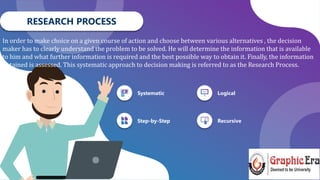
In order to make choice on a given course of action and choose between various alternatives , the decision
maker has to clearly understand the problem to be solved. He will determine the information that is available
to him and what further information is required and the best possible way to obtain it. Finally, the information
obtained is assessed. This systematic approach to decision making is referred to as the Research Process.
Many
Systematic
Step-by-Step
Logical
RESEARCH PROCESS
Recursive
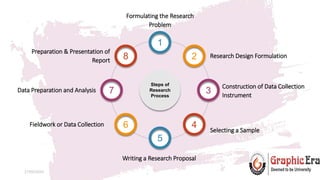
Steps of
Research
Process
Formulating the Research
Problem
Selecting a Sample
Research Design Formulation
Fieldwork or Data Collection
Preparation & Presentation of
Report
Data Preparation and Analysis
1
8 2
3
7
6 4
5
27/05/2024 3
Writing a Research Proposal
Construction of Data Collection
Instrument
STEP 1: Formulating the Research Problem
27/05/2024 4
• The first step in research is to formulate & define the problem, since a poorly defined problem may not yield
useful results.
• When the problem is carefully and precisely designed then only research can provide relevant information.
• For formulating the problem, the researcher should take into account the objectives of the study, the
relevant information needed how it will be helpful in decision making.
• It involves studying of literature and already existing studies in that area.
• Once the problem is stated the researcher should study the literature related to the problem to have a
better understanding of it.
• For this purpose, abstracting of journals, conference proceedings, government reports must be looked upon
depending on the nature of the problem.
STEP 2: Research Design Formulation
27/05/2024 5
• A Research Design is the “Blueprint for Action” i.e. it states how the research will be carried out.
• It states the conceptual structure within which the research will be carried out.
• It details the procedures necessary for obtaining the required information, and its purpose is to design a
study that will test the hypotheses of interest, determine possible answers to the research questions, and
provide the information needed for decision making..
• The preparations of such research design facilitate research to be conducted efficiently and effectively and
thus yielding maximum information.
• In other words, the function of research design is to provide for the collection of relevant evidence with
minimum spending of effort, time and money.
• It can be classified into following three kinds:
• Exploratory Research
• Descriptive Research
• Causal Research
.
27/05/2024 6
STEP 3: Construction of Data Collection Instrument
• Anything that becomes a means Of collecting information for your study is research tool or a research
instrument .e.g. observation forms, interview schedules, questionnaire and interview guides for all
classified as research tool..
• The construction of the research tool is the first step in carrying out the research.
• You will need to decide how you are going to collect data for the proposed study and then construct a
research instrument for data collection.
STEP 4: Selecting a Sample
27/05/2024 7
• The accuracy of your findings largely depends upon the way you select your sample.
• The basic objective of any sampling design is to minimize within the limitation of the cost ,the gap between
the values obtained from your sample and those prevalent in the population.
• Sampling theory is guided by two principles :
1. The avoidance of bias in the selection of a sample; and
2. The attainment of maximum precision for a given outlay of resources.
• There are three categories of sampling design
1. Random/probability sampling designs;
2. Non-random/non probability sampling designs
3. Mixed sampling design
STEP 5: Writing a research proposal
27/05/2024 8
• The research proposal presents a problem, discusses related research efforts, outlines the data needed and
shows the research design
• In general, business proposals can be divided between those generated internally and externally.
• An internal proposal is done for the corporation by staff specialists or by the research department of the
firm.
• External proposals are either solicited or unsolicited.
• Sponsors can be university grant committees, government agencies, government contractors, corporations,
and so forth.
• With few exceptions, the larger the project, the more complex is the proposal.
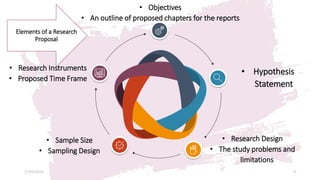
• Research Instruments
• Proposed Time Frame
• Hypothesis
Statement
• Research Design
• The study problems and
limitations
• Sample Size
• Sampling Design
• Objectives
• An outline of proposed chapters for the reports
27/05/2024 9
Elements of a Research
Proposal
Step 6: Fieldwork or Data Collection
27/05/2024 10
• Data collection involves a field force or staff that operates either in the field, as in the case of personal
interviewing (in-home, mall intercept, or computer assisted personal interviewing), from an office by
telephone (telephone or computer-assisted telephone interviewing), through mail (traditional mail and mail
panel surveys with pre-recruited households), or electronically (e-mail or Internet).
• Data can be collected through different ways but most widely used instrument is questionnaire which is
prepared thoroughly keeping in mind the purpose and objective of study.
• Before field force leaps in to field they are given proper instructions regarding how to collect the data and
individuals that are to studied for the purpose of study.
Step 7: Data Preparation and Analysis
27/05/2024 11
Data preparation includes the editing, coding, recording and verification of data.
Each questionnaire or observation form is inspected or edited and, if necessary, corrected.
The main objectives of data analysis are :
1. Evaluate and enhance data quality
2. Describe the study population and its relationship to some presumed source (accounts for all in-scope
potential subjects; compare the available study population with the target
population)
3. Assess potential for bias (e.g., nonresponse, refusal, and attrition, comparison groups) 4. Estimate measures
of frequency and extent (prevalence, incidence, means, medians) 5. Estimate measures of strength of
association or effect
6. Assess the degree of uncertainty from random noise (“chance”)
7. Control and examine effects of other relevant factors
8. Evaluate impact or importance
Step-8: Preparation and presentation of Report
27/05/2024 12
• Reporting research is an integral part of the research process.
• The results of research must be successfully communicated to management. Presenting the results of a
research study to management generally involves a formal written report as well as an oral presentation.
• The report and presentation are extremely important because the written report and the oral presentation
are typically the only aspect of the study that marketing executives are exposed to, and so the overall
evaluation of the research project rests on how well this information is communicated.
• Every person has a different style of writing. There is not really one right style for a report, but there are
some basic principles for writing a research report clearly. Preparing a research report involves other
activities besides writing; in fact, writing is actually the last step in the preparation process.
Elements of a Research Report
27/05/2024 13
• Before writing can take place, the results of the research project must be fully understood and thought must
be given to what the report will say. A formal report normally contains the following:
• Executive Summary
• Table of contents
• Introduction
• Research Objectives
• Research Methodology
• Analysis
• Findings
• Limitations
• Recommendations
• Bibliography
• Based on report the decision maker will take some actions.

Research Process.pptxxxxxxxxxxxxxxxxxxxx

  • 1.
    THE RESEARCH PROCESS By: SanghmitraGopal Assistant Professor Graphic Era Deemed to be University, Dehradun.
  • 2.
    HELLO! In order tomake choice on a given course of action and choose between various alternatives , the decision maker has to clearly understand the problem to be solved. He will determine the information that is available to him and what further information is required and the best possible way to obtain it. Finally, the information obtained is assessed. This systematic approach to decision making is referred to as the Research Process. Many Systematic Step-by-Step Logical RESEARCH PROCESS Recursive
  • 3.
    Steps of Research Process Formulating theResearch Problem Selecting a Sample Research Design Formulation Fieldwork or Data Collection Preparation & Presentation of Report Data Preparation and Analysis 1 8 2 3 7 6 4 5 27/05/2024 3 Writing a Research Proposal Construction of Data Collection Instrument
  • 4.
    STEP 1: Formulatingthe Research Problem 27/05/2024 4 • The first step in research is to formulate & define the problem, since a poorly defined problem may not yield useful results. • When the problem is carefully and precisely designed then only research can provide relevant information. • For formulating the problem, the researcher should take into account the objectives of the study, the relevant information needed how it will be helpful in decision making. • It involves studying of literature and already existing studies in that area. • Once the problem is stated the researcher should study the literature related to the problem to have a better understanding of it. • For this purpose, abstracting of journals, conference proceedings, government reports must be looked upon depending on the nature of the problem.
  • 5.
    STEP 2: ResearchDesign Formulation 27/05/2024 5 • A Research Design is the “Blueprint for Action” i.e. it states how the research will be carried out. • It states the conceptual structure within which the research will be carried out. • It details the procedures necessary for obtaining the required information, and its purpose is to design a study that will test the hypotheses of interest, determine possible answers to the research questions, and provide the information needed for decision making.. • The preparations of such research design facilitate research to be conducted efficiently and effectively and thus yielding maximum information. • In other words, the function of research design is to provide for the collection of relevant evidence with minimum spending of effort, time and money. • It can be classified into following three kinds: • Exploratory Research • Descriptive Research • Causal Research
  • 6.
    . 27/05/2024 6 STEP 3:Construction of Data Collection Instrument • Anything that becomes a means Of collecting information for your study is research tool or a research instrument .e.g. observation forms, interview schedules, questionnaire and interview guides for all classified as research tool.. • The construction of the research tool is the first step in carrying out the research. • You will need to decide how you are going to collect data for the proposed study and then construct a research instrument for data collection.
  • 7.
    STEP 4: Selectinga Sample 27/05/2024 7 • The accuracy of your findings largely depends upon the way you select your sample. • The basic objective of any sampling design is to minimize within the limitation of the cost ,the gap between the values obtained from your sample and those prevalent in the population. • Sampling theory is guided by two principles : 1. The avoidance of bias in the selection of a sample; and 2. The attainment of maximum precision for a given outlay of resources. • There are three categories of sampling design 1. Random/probability sampling designs; 2. Non-random/non probability sampling designs 3. Mixed sampling design
  • 8.
    STEP 5: Writinga research proposal 27/05/2024 8 • The research proposal presents a problem, discusses related research efforts, outlines the data needed and shows the research design • In general, business proposals can be divided between those generated internally and externally. • An internal proposal is done for the corporation by staff specialists or by the research department of the firm. • External proposals are either solicited or unsolicited. • Sponsors can be university grant committees, government agencies, government contractors, corporations, and so forth. • With few exceptions, the larger the project, the more complex is the proposal.
  • 9.
    • Research Instruments •Proposed Time Frame • Hypothesis Statement • Research Design • The study problems and limitations • Sample Size • Sampling Design • Objectives • An outline of proposed chapters for the reports 27/05/2024 9 Elements of a Research Proposal
  • 10.
    Step 6: Fieldworkor Data Collection 27/05/2024 10 • Data collection involves a field force or staff that operates either in the field, as in the case of personal interviewing (in-home, mall intercept, or computer assisted personal interviewing), from an office by telephone (telephone or computer-assisted telephone interviewing), through mail (traditional mail and mail panel surveys with pre-recruited households), or electronically (e-mail or Internet). • Data can be collected through different ways but most widely used instrument is questionnaire which is prepared thoroughly keeping in mind the purpose and objective of study. • Before field force leaps in to field they are given proper instructions regarding how to collect the data and individuals that are to studied for the purpose of study.
  • 11.
    Step 7: DataPreparation and Analysis 27/05/2024 11 Data preparation includes the editing, coding, recording and verification of data. Each questionnaire or observation form is inspected or edited and, if necessary, corrected. The main objectives of data analysis are : 1. Evaluate and enhance data quality 2. Describe the study population and its relationship to some presumed source (accounts for all in-scope potential subjects; compare the available study population with the target population) 3. Assess potential for bias (e.g., nonresponse, refusal, and attrition, comparison groups) 4. Estimate measures of frequency and extent (prevalence, incidence, means, medians) 5. Estimate measures of strength of association or effect 6. Assess the degree of uncertainty from random noise (“chance”) 7. Control and examine effects of other relevant factors 8. Evaluate impact or importance
  • 12.
    Step-8: Preparation andpresentation of Report 27/05/2024 12 • Reporting research is an integral part of the research process. • The results of research must be successfully communicated to management. Presenting the results of a research study to management generally involves a formal written report as well as an oral presentation. • The report and presentation are extremely important because the written report and the oral presentation are typically the only aspect of the study that marketing executives are exposed to, and so the overall evaluation of the research project rests on how well this information is communicated. • Every person has a different style of writing. There is not really one right style for a report, but there are some basic principles for writing a research report clearly. Preparing a research report involves other activities besides writing; in fact, writing is actually the last step in the preparation process.
  • 13.
    Elements of aResearch Report 27/05/2024 13 • Before writing can take place, the results of the research project must be fully understood and thought must be given to what the report will say. A formal report normally contains the following: • Executive Summary • Table of contents • Introduction • Research Objectives • Research Methodology • Analysis • Findings • Limitations • Recommendations • Bibliography • Based on report the decision maker will take some actions.