Topic: Research and Its Process
The Islamia University of
Bahawalpur
Muhammad Khizer Hayat
Khaleel Ahmad
Session: 2016-18 (Spring)
Semester: 3rd
Supervised By: Dr.Fakhra Shamim
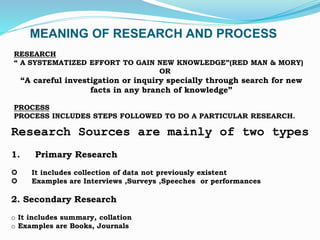
MEANING OF RESEARCH AND PROCESS
RESEARCH
“ A SYSTEMATIZED EFFORT TO GAIN NEW KNOWLEDGE”(RED MAN & MORY)
OR
“A careful investigation or inquiry specially through search for new
facts in any branch of knowledge”
PROCESS
PROCESS INCLUDES STEPS FOLLOWED TO DO A PARTICULAR RESEARCH.
Research Sources are mainly of two types
1. Primary Research
 It includes collection of data not previously existent
 Examples are Interviews ,Surveys ,Speeches or performances
2. Secondary Research
o It includes summary, collation
o Examples are Books, Journals
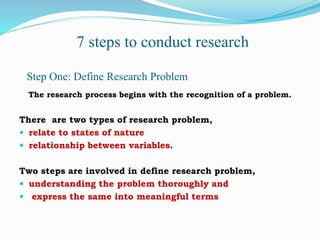
Step One: Define Research Problem
The research process begins with the recognition of a problem.
There are two types of research problem,
 relate to states of nature
 relationship between variables.
Two steps are involved in define research problem,
 understanding the problem thoroughly and
 express the same into meaningful terms
7 steps to conduct research
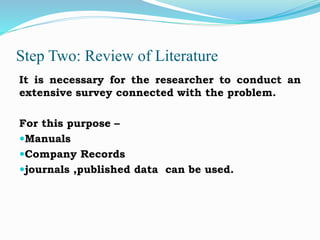
Step Two: Review of Literature
It is necessary for the researcher to conduct an
extensive survey connected with the problem.
For this purpose –
Manuals
Company Records
journals ,published data can be used.
Step Three: Formulate Hypothesis
 Formulate hypothesis is tentative
assumption made in order to draw out and
test its logical consequences. Hypothesis
should be very specific and limited to the
piece of research in hand because it has to
be tested.
The role of the hypothesis is to guide the
researcher by delimiting the area of research
and to keep him on the right track.
Step Four: Preparing the Research Design
 The function of research design is to provide
for the collection of relevant evidence with
minimal expenditure of effort, time and money.
 Research purpose may be grouped into four
categories,
(1) Exploration, (2) Description,
(3) Diagnosis, and (4) Experimentation.
Step Five: Data Collection
 Primary data can be collected through:
By Observation
Through Schedules
Through personal interview
Through telephone interview
By mailing of questionnaires
Step Six: Data Analysis
The Analyses of data can of two types:
 Quantitative analysis
 Qualitative analysis
The analysis of data requires a number of closely
related operations such as establishment of
categories. This stage mainly include :
1. Coding
2. Editing
3. Tabulation
Step Seven: Interpretation and Report Writing
Researcher has to prepare the report of what
has been done by him.
Writing of report includes:
1. the preliminary pages;
2. the main text, and
3. the end matter.

Research and its process

  • 1.
    Topic: Research andIts Process The Islamia University of Bahawalpur Muhammad Khizer Hayat Khaleel Ahmad Session: 2016-18 (Spring) Semester: 3rd Supervised By: Dr.Fakhra Shamim
  • 2.
    MEANING OF RESEARCHAND PROCESS RESEARCH “ A SYSTEMATIZED EFFORT TO GAIN NEW KNOWLEDGE”(RED MAN & MORY) OR “A careful investigation or inquiry specially through search for new facts in any branch of knowledge” PROCESS PROCESS INCLUDES STEPS FOLLOWED TO DO A PARTICULAR RESEARCH. Research Sources are mainly of two types 1. Primary Research  It includes collection of data not previously existent  Examples are Interviews ,Surveys ,Speeches or performances 2. Secondary Research o It includes summary, collation o Examples are Books, Journals
  • 3.
    Step One: DefineResearch Problem The research process begins with the recognition of a problem. There are two types of research problem,  relate to states of nature  relationship between variables. Two steps are involved in define research problem,  understanding the problem thoroughly and  express the same into meaningful terms 7 steps to conduct research
  • 4.
    Step Two: Reviewof Literature It is necessary for the researcher to conduct an extensive survey connected with the problem. For this purpose – Manuals Company Records journals ,published data can be used.
  • 5.
    Step Three: FormulateHypothesis  Formulate hypothesis is tentative assumption made in order to draw out and test its logical consequences. Hypothesis should be very specific and limited to the piece of research in hand because it has to be tested. The role of the hypothesis is to guide the researcher by delimiting the area of research and to keep him on the right track.
  • 6.
    Step Four: Preparingthe Research Design  The function of research design is to provide for the collection of relevant evidence with minimal expenditure of effort, time and money.  Research purpose may be grouped into four categories, (1) Exploration, (2) Description, (3) Diagnosis, and (4) Experimentation.
  • 7.
    Step Five: DataCollection  Primary data can be collected through: By Observation Through Schedules Through personal interview Through telephone interview By mailing of questionnaires
  • 8.
    Step Six: DataAnalysis The Analyses of data can of two types:  Quantitative analysis  Qualitative analysis The analysis of data requires a number of closely related operations such as establishment of categories. This stage mainly include : 1. Coding 2. Editing 3. Tabulation
  • 9.
    Step Seven: Interpretationand Report Writing Researcher has to prepare the report of what has been done by him. Writing of report includes: 1. the preliminary pages; 2. the main text, and 3. the end matter.