Topic 12: Electromagnetic induction
11/02/2015
3
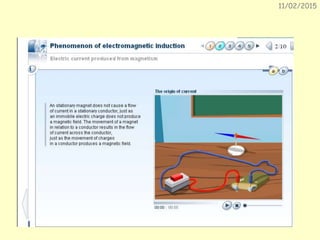
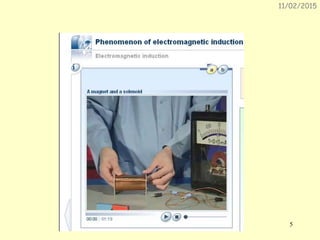
Topic 12: Electromagnetic induction
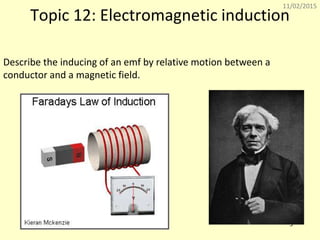
Describe the inducing of an emf by relative motion between a
conductor and a magnetic field.
11/02/2015
4
11/02/2015
5
11/02/2015
6
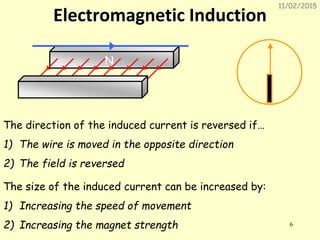
Electromagnetic Induction
N
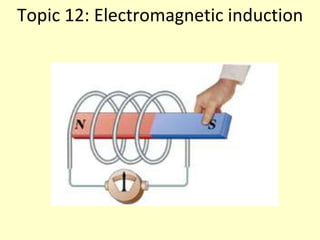
The direction of the induced current is reversed if…
1) The wire is moved in the opposite direction
2) The field is reversed
The size of the induced current can be increased by:
1) Increasing the speed of movement
2) Increasing the magnet strength
11/02/2015
7
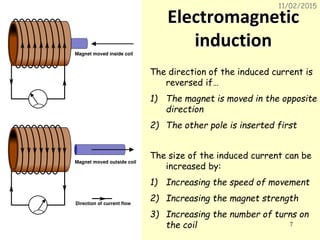
Electromagnetic
induction
The direction of the induced current is
reversed if…
1) The magnet is moved in the opposite
direction
2) The other pole is inserted first
The size of the induced current can be
increased by:
1) Increasing the speed of movement
2) Increasing the magnet strength
3) Increasing the number of turns on
the coil
11/02/2015
8
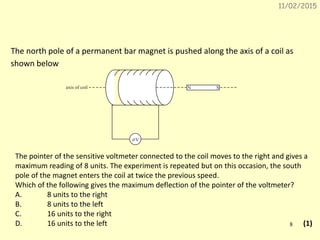
The north pole of a permanent bar magnet is pushed along the axis of a coil as
shown below.
V
N Saxis of coil
The pointer of the sensitive voltmeter connected to the coil moves to the right and gives a
maximum reading of 8 units. The experiment is repeated but on this occasion, the south
pole of the magnet enters the coil at twice the previous speed.
Which of the following gives the maximum deflection of the pointer of the voltmeter?
A. 8 units to the right
B. 8 units to the left
C. 16 units to the right
D. 16 units to the left (1)
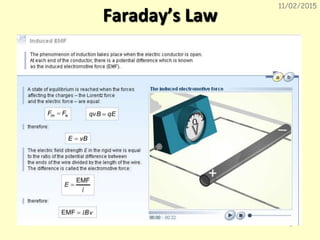
Faraday’s Law
11/02/2015
9
11/02/2015
10
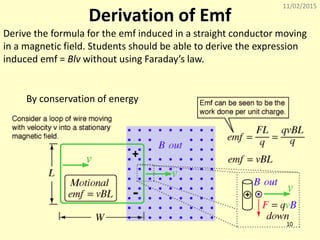
Derivation of Emf
By conservation of energy
Derive the formula for the emf induced in a straight conductor moving
in a magnetic field. Students should be able to derive the expression
induced emf = Blv without using Faraday’s law.
11/02/2015
11
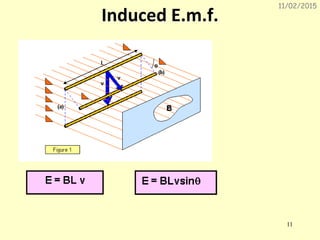
Induced E.m.f.
Magnetic flux
11/02/2015
12
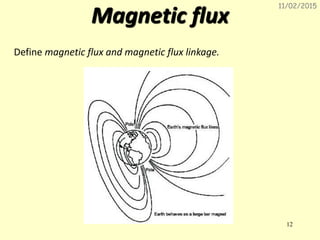
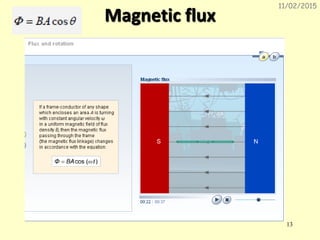
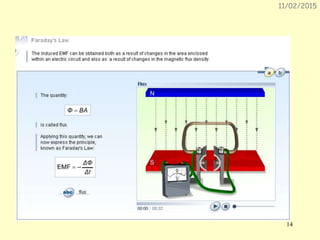
Define magnetic flux and magnetic flux linkage.
Magnetic flux
11/02/2015
13
11/02/2015
14
11/02/2015
15
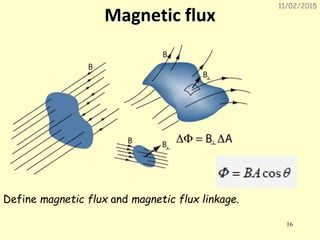
Magnetic Flux
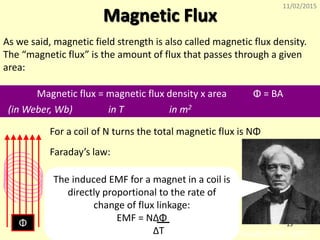
As we said, magnetic field strength is also called magnetic flux density.
The “magnetic flux” is the amount of flux that passes through a given
area:
Magnetic flux = magnetic flux density x area Φ = BA
(in Weber, Wb) in T in m2
For a coil of N turns the total magnetic flux is NΦ
Φ
Faraday (1791-1867)
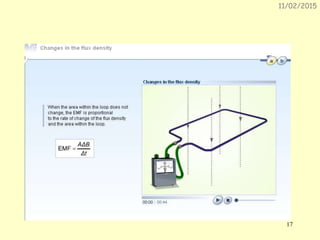
Faraday’s law:
The induced EMF for a magnet in a coil is
directly proportional to the rate of
change of flux linkage:
EMF = NΔΦ
ΔT
11/02/2015
16
Magnetic flux
Define magnetic flux and magnetic flux linkage.
11/02/2015
17
11/02/2015
18
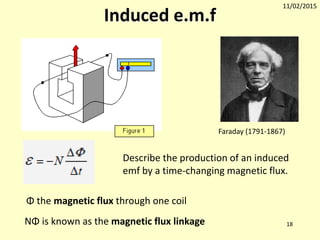
Induced e.m.f
NΦ is known as the magnetic flux linkage
Φ the magnetic flux through one coil
Faraday (1791-1867)
Describe the production of an induced
emf by a time-changing magnetic flux.
11/02/2015
19
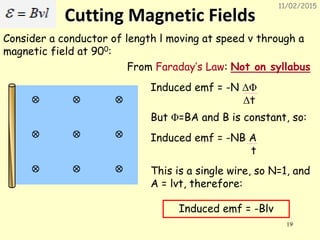
Cutting Magnetic Fields
Consider a conductor of length l moving at speed v through a
magnetic field at 900:
From Faraday’s Law: Not on syllabus
Induced emf = -N ΔΦ
Δt
But Φ=BA and B is constant, so:
Induced emf = -NB A
t
This is a single wire, so N=1, and
A = lvt, therefore:
Induced emf = -Blv
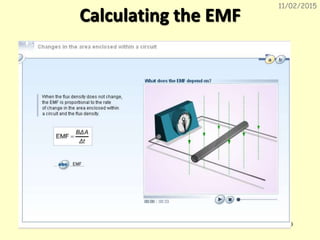
Calculating the EMF
11/02/2015
20
11/02/2015
21
11/02/2015
22
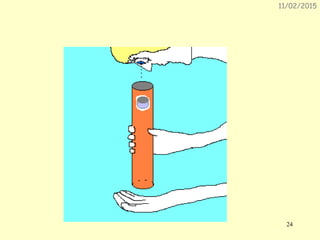
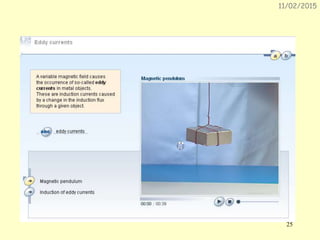
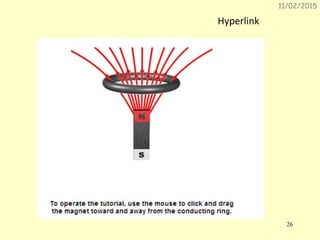
Lenz’s Law
11/02/2015
23
11/02/2015
24
11/02/2015
25
11/02/2015
26
Hyperlink
11/02/2015
27
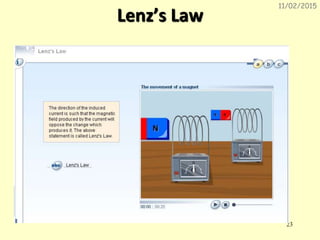
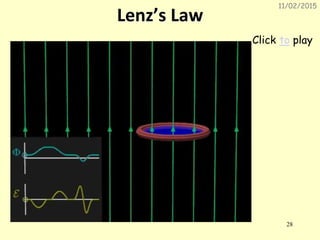
Lenz’s Law
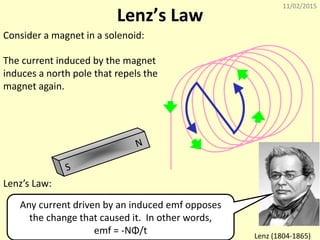
Consider a magnet in a solenoid:
The current induced by the magnet
induces a north pole that repels the
magnet again.
Lenz’s Law:
Lenz (1804-1865)
Any current driven by an induced emf opposes
the change that caused it. In other words,
emf = -NΦ/t
11/02/2015
28
Lenz’s Law
Click to play
11/02/2015
29
Lenz’s law question
• Explain why it is harder to turn a bicycle
dynamo when it is connected to a light bulb
than when it is not connected to anything.
11/02/2015
30
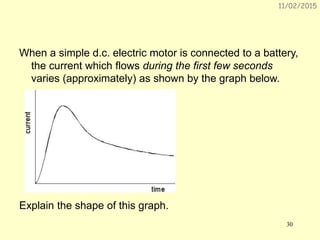
When a simple d.c. electric motor is connected to a battery,
the current which flows during the first few seconds
varies (approximately) as shown by the graph below.
Explain the shape of this graph.
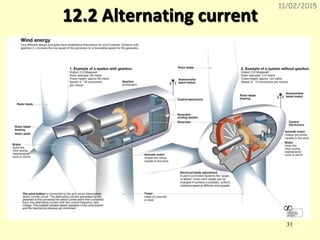
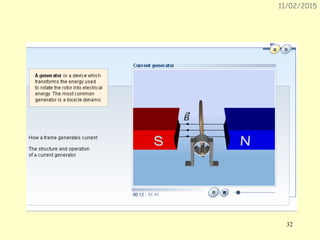
12.2 Alternating current
11/02/2015
31
11/02/2015
32
11/02/2015
33
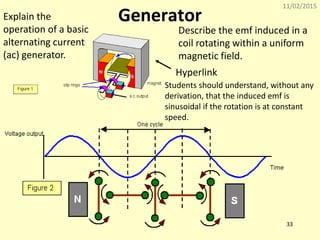
Generator
Hyperlink
Describe the emf induced in a
coil rotating within a uniform
magnetic field.
Explain the
operation of a basic
alternating current
(ac) generator.
Students should understand, without any
derivation, that the induced emf is
sinusoidal if the rotation is at constant
speed.
11/02/2015
34
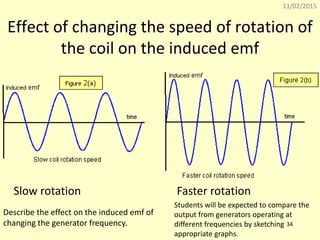
Effect of changing the speed of rotation of
the coil on the induced emf
Slow rotation Faster rotation
Describe the effect on the induced emf of
changing the generator frequency.
Students will be expected to compare the
output from generators operating at
different frequencies by sketching
appropriate graphs.
11/02/2015
35
Generator question
• A rectangular coil, 2cm by 3cm, rotates in a uniform
magnetic field of flux density 0.15T. The axis around which
the coil rotates is at 90° to the flux lines.
The coil has 250 turns and its rotational frequency is 50s-
1.a)Calculate the maximum emf induced in the coil. What
is the position of the coil (relative to the flux lines) when
the induced emf has its maximum value?b)What is the
magnitude of the induced emf at a time 5×10⁻³s after it
has passed through its maximum value.c)Calculate the
magnitude of the induced emf at a time 2.5×10⁻³s after it
has passed through its maximum value.
11/02/2015
36
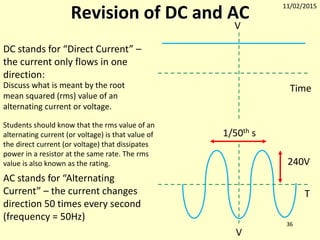
Revision of DC and AC
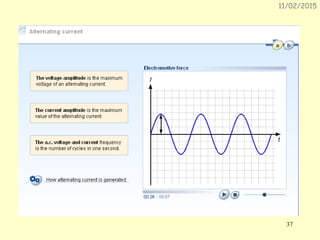
DC stands for “Direct Current” –
the current only flows in one
direction:
AC stands for “Alternating
Current” – the current changes
direction 50 times every second
(frequency = 50Hz)
1/50th s
240V
V
V
Time
T
Discuss what is meant by the root
mean squared (rms) value of an
alternating current or voltage.
Students should know that the rms value of an
alternating current (or voltage) is that value of
the direct current (or voltage) that dissipates
power in a resistor at the same rate. The rms
value is also known as the rating.
11/02/2015
37
11/02/2015
38
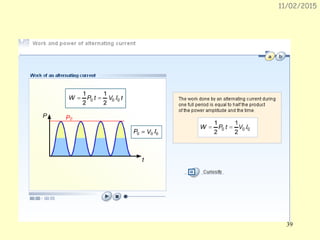
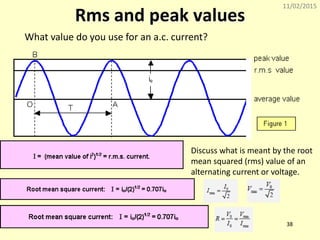
Rms and peak values
What value do you use for an a.c. current?
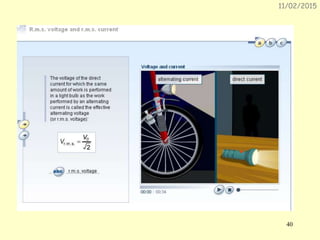
Discuss what is meant by the root
mean squared (rms) value of an
alternating current or voltage.
11/02/2015
39
11/02/2015
40
11/02/2015
41
11/02/2015
42
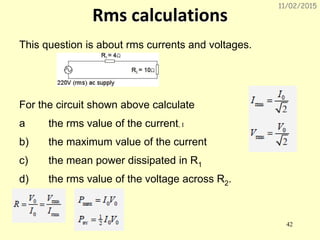
Rms calculations
This question is about rms currents and voltages.
For the circuit shown above calculate
a the rms value of the current, I
b) the maximum value of the current
c) the mean power dissipated in R1
d) the rms value of the voltage across R2.
11/02/2015
43
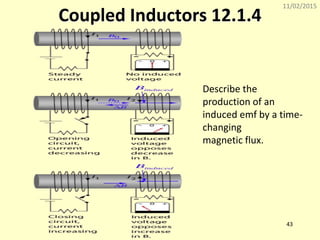
Coupled Inductors 12.1.4
Describe the
production of an
induced emf by a time-
changing
magnetic flux.
11/02/2015
44
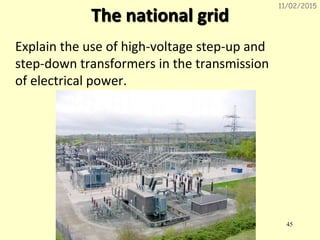
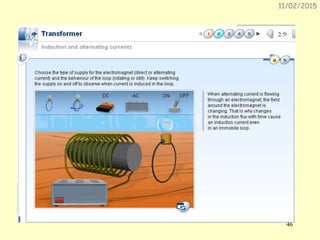
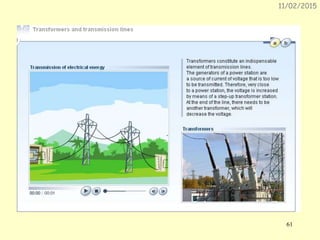
The national grid
Explain the use of high-voltage step-up and
step-down transformers in the transmission
of electrical power.
11/02/2015
45
11/02/2015
46
11/02/2015
47
11/02/2015
48
11/02/2015
49
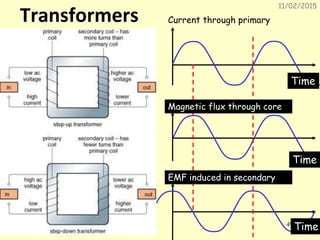
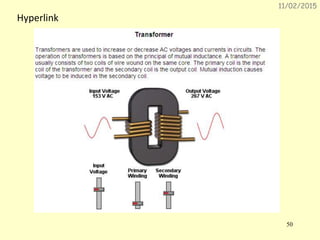
Transformers
Time
Time
Time
Current through primary
Magnetic flux through core
EMF induced in secondary
11/02/2015
50
Hyperlink
11/02/2015
51
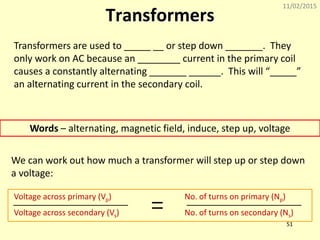
Transformers
Transformers are used to _____ __ or step down _______. They
only work on AC because an ________ current in the primary coil
causes a constantly alternating _______ ______. This will “_____”
an alternating current in the secondary coil.
Words – alternating, magnetic field, induce, step up, voltage
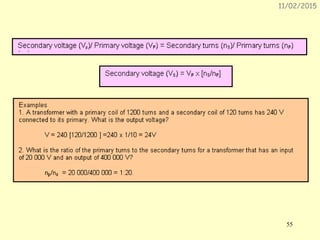
We can work out how much a transformer will step up or step down
a voltage:
Voltage across primary (Vp)
No. of turns on secondary (Ns)Voltage across secondary (Vs)
No. of turns on primary (Np)
11/02/2015
52
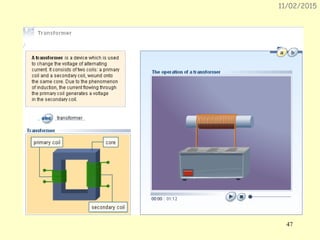
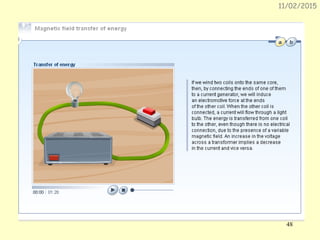
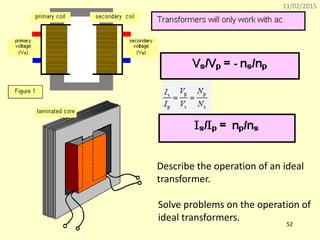
Describe the operation of an ideal
transformer.
Solve problems on the operation of
ideal transformers.
11/02/2015
53
11/02/2015
54
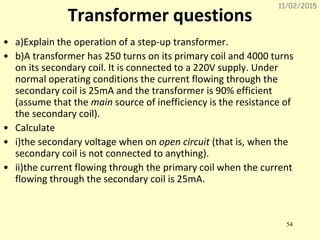
Transformer questions
• a)Explain the operation of a step-up transformer.
• b)A transformer has 250 turns on its primary coil and 4000 turns
on its secondary coil. It is connected to a 220V supply. Under
normal operating conditions the current flowing through the
secondary coil is 25mA and the transformer is 90% efficient
(assume that the main source of inefficiency is the resistance of
the secondary coil).
• Calculate
• i)the secondary voltage when on open circuit (that is, when the
secondary coil is not connected to anything).
• ii)the current flowing through the primary coil when the current
flowing through the secondary coil is 25mA.
11/02/2015
55
11/02/2015
56
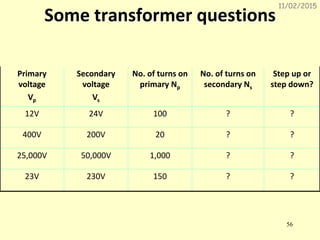
Some transformer questions
Primary
voltage
Vp
Secondary
voltage
Vs
No. of turns on
primary Np
No. of turns on
secondary Ns
Step up or
step down?
12V 24V 100 ? ?
400V 200V 20 ? ?
25,000V 50,000V 1,000 ? ?
23V 230V 150 ? ?
11/02/2015
57
11/02/2015
58
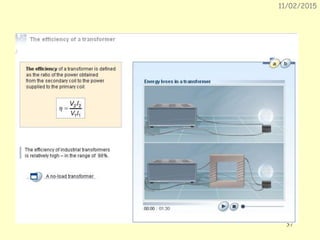
Energy losses in a transformer
• Energy can be lost as:
• (a) heat in the coils because of the resistance of
the wire;
• (b) incomplete transfer of magnetic field;
• (c) heating of the core due to induced currents in
it. This is reduced by making the core out of
insulated soft iron in laminated strips. If this were
not done the cores of large transformers would
get so hot that they would melt.
Outline the reasons for power losses in transmission
lines and real transformers.
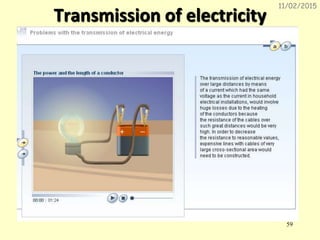
Transmission of electricity
11/02/2015
59
11/02/2015
60
11/02/2015
61
11/02/2015
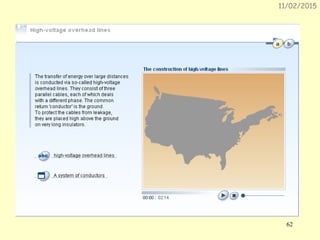
62
11/02/2015
63
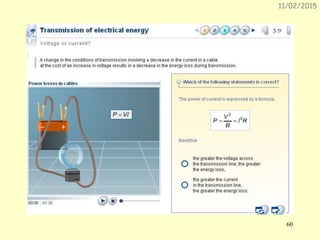
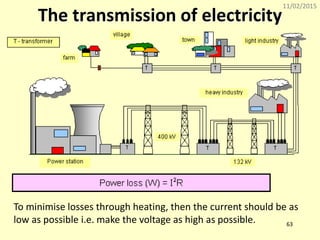
The transmission of electricity
To minimise losses through heating, then the current should be as
low as possible i.e. make the voltage as high as possible.
11/02/2015
64
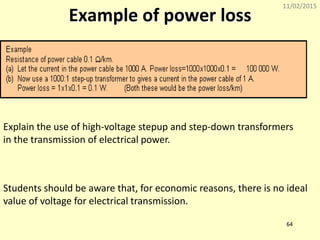
Example of power loss
Explain the use of high-voltage stepup and step-down transformers
in the transmission of electrical power.
Students should be aware that, for economic reasons, there is no ideal
value of voltage for electrical transmission.
Questions
Hamper page 218 Q’s 46,47.
IB pack Q’s 7,8,9.
11/02/2015
65
11/02/2015
66
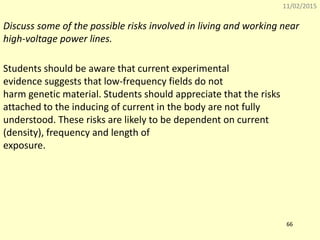
Discuss some of the possible risks involved in living and working near
high-voltage power lines.
Students should be aware that current experimental
evidence suggests that low-frequency fields do not
harm genetic material. Students should appreciate that the risks
attached to the inducing of current in the body are not fully
understood. These risks are likely to be dependent on current
(density), frequency and length of
exposure.
11/02/2015
67
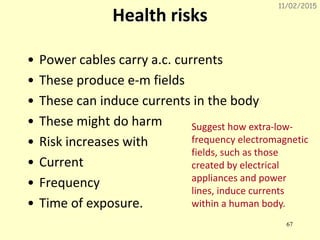
Health risks
• Power cables carry a.c. currents
• These produce e-m fields
• These can induce currents in the body
• These might do harm
• Risk increases with
• Current
• Frequency
• Time of exposure.
Suggest how extra-low-
frequency electromagnetic
fields, such as those
created by electrical
appliances and power
lines, induce currents
within a human body.

Electromagnetic induction

  • 1.
  • 2.
  • 3.
    11/02/2015 3 Topic 12: Electromagneticinduction Describe the inducing of an emf by relative motion between a conductor and a magnetic field.
  • 4.
  • 5.
  • 6.
    11/02/2015 6 Electromagnetic Induction N The directionof the induced current is reversed if… 1) The wire is moved in the opposite direction 2) The field is reversed The size of the induced current can be increased by: 1) Increasing the speed of movement 2) Increasing the magnet strength
  • 7.
    11/02/2015 7 Electromagnetic induction The direction ofthe induced current is reversed if… 1) The magnet is moved in the opposite direction 2) The other pole is inserted first The size of the induced current can be increased by: 1) Increasing the speed of movement 2) Increasing the magnet strength 3) Increasing the number of turns on the coil
  • 8.
    11/02/2015 8 The north poleof a permanent bar magnet is pushed along the axis of a coil as shown below. V N Saxis of coil The pointer of the sensitive voltmeter connected to the coil moves to the right and gives a maximum reading of 8 units. The experiment is repeated but on this occasion, the south pole of the magnet enters the coil at twice the previous speed. Which of the following gives the maximum deflection of the pointer of the voltmeter? A. 8 units to the right B. 8 units to the left C. 16 units to the right D. 16 units to the left (1)
  • 9.
  • 10.
    11/02/2015 10 Derivation of Emf Byconservation of energy Derive the formula for the emf induced in a straight conductor moving in a magnetic field. Students should be able to derive the expression induced emf = Blv without using Faraday’s law.
  • 11.
  • 12.
    Magnetic flux 11/02/2015 12 Define magneticflux and magnetic flux linkage.
  • 13.
  • 14.
  • 15.
    11/02/2015 15 Magnetic Flux As wesaid, magnetic field strength is also called magnetic flux density. The “magnetic flux” is the amount of flux that passes through a given area: Magnetic flux = magnetic flux density x area Φ = BA (in Weber, Wb) in T in m2 For a coil of N turns the total magnetic flux is NΦ Φ Faraday (1791-1867) Faraday’s law: The induced EMF for a magnet in a coil is directly proportional to the rate of change of flux linkage: EMF = NΔΦ ΔT
  • 16.
    11/02/2015 16 Magnetic flux Define magneticflux and magnetic flux linkage.
  • 17.
  • 18.
    11/02/2015 18 Induced e.m.f NΦ isknown as the magnetic flux linkage Φ the magnetic flux through one coil Faraday (1791-1867) Describe the production of an induced emf by a time-changing magnetic flux.
  • 19.
    11/02/2015 19 Cutting Magnetic Fields Considera conductor of length l moving at speed v through a magnetic field at 900: From Faraday’s Law: Not on syllabus Induced emf = -N ΔΦ Δt But Φ=BA and B is constant, so: Induced emf = -NB A t This is a single wire, so N=1, and A = lvt, therefore: Induced emf = -Blv
  • 20.
  • 21.
  • 22.
  • 23.
  • 24.
  • 25.
  • 26.
  • 27.
    11/02/2015 27 Lenz’s Law Consider amagnet in a solenoid: The current induced by the magnet induces a north pole that repels the magnet again. Lenz’s Law: Lenz (1804-1865) Any current driven by an induced emf opposes the change that caused it. In other words, emf = -NΦ/t
  • 28.
  • 29.
    11/02/2015 29 Lenz’s law question •Explain why it is harder to turn a bicycle dynamo when it is connected to a light bulb than when it is not connected to anything.
  • 30.
    11/02/2015 30 When a simpled.c. electric motor is connected to a battery, the current which flows during the first few seconds varies (approximately) as shown by the graph below. Explain the shape of this graph.
  • 31.
  • 32.
  • 33.
    11/02/2015 33 Generator Hyperlink Describe the emfinduced in a coil rotating within a uniform magnetic field. Explain the operation of a basic alternating current (ac) generator. Students should understand, without any derivation, that the induced emf is sinusoidal if the rotation is at constant speed.
  • 34.
    11/02/2015 34 Effect of changingthe speed of rotation of the coil on the induced emf Slow rotation Faster rotation Describe the effect on the induced emf of changing the generator frequency. Students will be expected to compare the output from generators operating at different frequencies by sketching appropriate graphs.
  • 35.
    11/02/2015 35 Generator question • Arectangular coil, 2cm by 3cm, rotates in a uniform magnetic field of flux density 0.15T. The axis around which the coil rotates is at 90° to the flux lines. The coil has 250 turns and its rotational frequency is 50s- 1.a)Calculate the maximum emf induced in the coil. What is the position of the coil (relative to the flux lines) when the induced emf has its maximum value?b)What is the magnitude of the induced emf at a time 5×10⁻³s after it has passed through its maximum value.c)Calculate the magnitude of the induced emf at a time 2.5×10⁻³s after it has passed through its maximum value.
  • 36.
    11/02/2015 36 Revision of DCand AC DC stands for “Direct Current” – the current only flows in one direction: AC stands for “Alternating Current” – the current changes direction 50 times every second (frequency = 50Hz) 1/50th s 240V V V Time T Discuss what is meant by the root mean squared (rms) value of an alternating current or voltage. Students should know that the rms value of an alternating current (or voltage) is that value of the direct current (or voltage) that dissipates power in a resistor at the same rate. The rms value is also known as the rating.
  • 37.
  • 38.
    11/02/2015 38 Rms and peakvalues What value do you use for an a.c. current? Discuss what is meant by the root mean squared (rms) value of an alternating current or voltage.
  • 39.
  • 40.
  • 41.
  • 42.
    11/02/2015 42 Rms calculations This questionis about rms currents and voltages. For the circuit shown above calculate a the rms value of the current, I b) the maximum value of the current c) the mean power dissipated in R1 d) the rms value of the voltage across R2.
  • 43.
    11/02/2015 43 Coupled Inductors 12.1.4 Describethe production of an induced emf by a time- changing magnetic flux.
  • 44.
  • 45.
    The national grid Explainthe use of high-voltage step-up and step-down transformers in the transmission of electrical power. 11/02/2015 45
  • 46.
  • 47.
  • 48.
  • 49.
  • 50.
  • 51.
    11/02/2015 51 Transformers Transformers are usedto _____ __ or step down _______. They only work on AC because an ________ current in the primary coil causes a constantly alternating _______ ______. This will “_____” an alternating current in the secondary coil. Words – alternating, magnetic field, induce, step up, voltage We can work out how much a transformer will step up or step down a voltage: Voltage across primary (Vp) No. of turns on secondary (Ns)Voltage across secondary (Vs) No. of turns on primary (Np)
  • 52.
    11/02/2015 52 Describe the operationof an ideal transformer. Solve problems on the operation of ideal transformers.
  • 53.
  • 54.
    11/02/2015 54 Transformer questions • a)Explainthe operation of a step-up transformer. • b)A transformer has 250 turns on its primary coil and 4000 turns on its secondary coil. It is connected to a 220V supply. Under normal operating conditions the current flowing through the secondary coil is 25mA and the transformer is 90% efficient (assume that the main source of inefficiency is the resistance of the secondary coil). • Calculate • i)the secondary voltage when on open circuit (that is, when the secondary coil is not connected to anything). • ii)the current flowing through the primary coil when the current flowing through the secondary coil is 25mA.
  • 55.
  • 56.
    11/02/2015 56 Some transformer questions Primary voltage Vp Secondary voltage Vs No.of turns on primary Np No. of turns on secondary Ns Step up or step down? 12V 24V 100 ? ? 400V 200V 20 ? ? 25,000V 50,000V 1,000 ? ? 23V 230V 150 ? ?
  • 57.
  • 58.
    11/02/2015 58 Energy losses ina transformer • Energy can be lost as: • (a) heat in the coils because of the resistance of the wire; • (b) incomplete transfer of magnetic field; • (c) heating of the core due to induced currents in it. This is reduced by making the core out of insulated soft iron in laminated strips. If this were not done the cores of large transformers would get so hot that they would melt. Outline the reasons for power losses in transmission lines and real transformers.
  • 59.
  • 60.
  • 61.
  • 62.
  • 63.
    11/02/2015 63 The transmission ofelectricity To minimise losses through heating, then the current should be as low as possible i.e. make the voltage as high as possible.
  • 64.
    11/02/2015 64 Example of powerloss Explain the use of high-voltage stepup and step-down transformers in the transmission of electrical power. Students should be aware that, for economic reasons, there is no ideal value of voltage for electrical transmission.
  • 65.
    Questions Hamper page 218Q’s 46,47. IB pack Q’s 7,8,9. 11/02/2015 65
  • 66.
    11/02/2015 66 Discuss some ofthe possible risks involved in living and working near high-voltage power lines. Students should be aware that current experimental evidence suggests that low-frequency fields do not harm genetic material. Students should appreciate that the risks attached to the inducing of current in the body are not fully understood. These risks are likely to be dependent on current (density), frequency and length of exposure.
  • 67.
    11/02/2015 67 Health risks • Powercables carry a.c. currents • These produce e-m fields • These can induce currents in the body • These might do harm • Risk increases with • Current • Frequency • Time of exposure. Suggest how extra-low- frequency electromagnetic fields, such as those created by electrical appliances and power lines, induce currents within a human body.