COMPUTER SIMULATION
IN
PHARMACOKINETICS
AND
PHARMACODYNAMICS
DR. SHASHI KIRAN MISRA
ASSISTANT PROFESSOR
UIP, CSJMU, KANPUR
INTRODUCTION
A computer simulation or a computer model is a computer program that
attempts to simulate an abstract model of a particular system.
Computer simulation in the field of Pharmacokinetic and Pharmacodynamics
or in silica model is need of the hour in the biomedical field.
• Computational resources available today, large-scale models of the body can
be used to produce realistic simulations.
• It involves the use of computer simulations of biological systems, including
cellular subsystems (such as the networks of metabolites and enzymes which
comprise metabolism, signal transduction, pathways and gene regulatory
networks), to both analyze and visualize the complex connections of these
cellular processes.
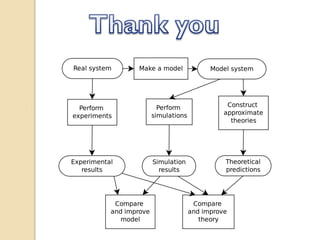
The process to create an imitation of real world
system or physical object into a computer model.
Performing experiments to understand the
behavior of system and evaluating new strategies.
Then observing events, processes, properties and
behavior of system, with computer model.
What is Computer Simulation
Process of Simulating a System
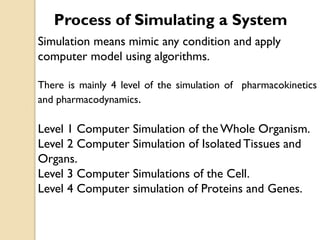
Simulation means mimic any condition and apply
computer model using algorithms.
There is mainly 4 level of the simulation of pharmacokinetics
and pharmacodynamics.
Level 1 Computer Simulation of the Whole Organism.
Level 2 Computer Simulation of Isolated Tissues and
Organs.
Level 3 Computer Simulations of the Cell.
Level 4 Computer simulation of Proteins and Genes.
For the formation of the model simulation of the whole
organism is very important.
The whole organism can be mathematically represented which
mimic the whole physiological condition through the simulation
of the whole organism.
The whole series of the organ can be generated for the clinical
trial purpose.
There are two approaches for simulation of whole organism
A. PK/PD model
B. PBPK model
Level 1
Computer simulation of whole organism
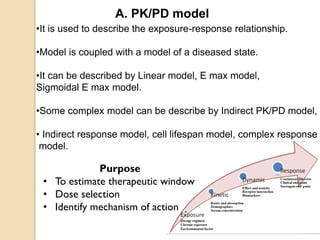
•It is used to describe the exposure-response relationship.
•Model is coupled with a model of a diseased state.
•It can be described by Linear model, E max model,
Sigmoidal E max model.
•Some complex model can be describe by Indirect PK/PD model,
• Indirect response model, cell lifespan model, complex response
model.
A. PK/PD model
Purpose
• To estimate therapeutic window
• Dose selection
• Identify mechanism of action
1.In vitro physiological and in-vivo pharmacokinetics data
are collected to help design PK/PD study protocol.
2.Acute PK/PD pilot model is then conducted to examine
the exposure-response relationship.
3.Set up and screening with the PK/PD model in drug
discovery is a typical and important process that requires
ongoing refinement as new information become available
and the project moves forward.
4.PK/PD model is continuously updated throughout
different drug development to relevant new data.
Steps involved in PK/PD model
The mathematically modeling technique for predicting ADME of
a synthetic or natural chemical substance in human.
Usually multi-compartmental model with predicted organ or
tissue with correction corresponding to blood or lymph flow.
Model made up of compartment corresponding to the different
physiological organ of the body linked by the circulating blood
system.
Each compartment exactly describes by a tissue volume and
blood flow rate that is specific to the species of the intestine.
Each tissue is defined with the assumption of either perfusion
rate limited or permeability rate limited.
B. PBPK model
(Physiology based pharmacokinetic model)
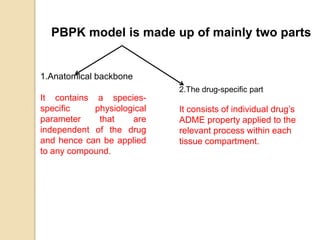
1.Anatomical backbone
It contains a species-
specific physiological
parameter that are
independent of the drug
and hence can be applied
to any compound.
2.The drug-specific part
It consists of individual drug’s
ADME property applied to the
relevant process within each
tissue compartment.
PBPK model is made up of mainly two parts
Level 2
Computer simulation of isolated tissue and organ
Heart, kidney, brain, liver can be a subject of
mathematical modeling research.
Liver simulation is very useful in both field biomedical
and pharmaceutical.
This model offers increased the level of detail and
temporal resolution which gives good mixing and
uniformity of hypothesis.
Simulation of heart and liver can be carried out with
distributed blood tissue model that is known as BTEX
model.
BTEX model
A very first study on the BTEX biodegradation involves only Benzene,
Toluene, isomer of Xylene.
New BTEX model consists of Benzene,Toluene and ortho/meta/para
derivative of Xylene.
Various combination of these molecules is amongst the most frequent found
binary mixture in completed exposure pathway at the hazardous waste site.
Another experimentally observed the non-interaction, simulation, inhibition
and substrate co-metabolism.
The main reason for this synergistic and/or antagonistic interaction during
biodegradation of BTEX compound can be attributed to the competitive
inhibition, toxicity, and formation of the toxic intermediate.
Level 3
Computer simulation of cell
•Simulation of the cell is very complicated because of the
need to know about how intracellular and membrane process
takes place.
•There is no universal record for how the intracellular
and cell wall working take place.
•The virtual cell in an online respiratory of some
of these model makes an available computer
simulation of the whole cell to its user network.
•Another online respiratory of the biophysical model is at the
•CellML website.
•It is mainly used in biomedical research.
Level 4
Computer simulation of protein and genes
In computational protein design the most interacting factor is that it
can lead to design and laboratory creation of the structure that are
not present in nature.
The approach tried to identify a gene that leads to disease
susceptibility and allow mapping of genetic data onto network based
on an ordinary differential equation.
Simulation to pharmacotherapy was in the field of HIV/AIDS
treatment, through the development of HIV viral based on the clinical
data that shed considerable light on the disease mechanism.
One can produce a newer sequence of the gene also help in
translation and transcription process as well as protein identification.
Computer simulation

Computer simulation

  • 1.
    COMPUTER SIMULATION IN PHARMACOKINETICS AND PHARMACODYNAMICS DR. SHASHIKIRAN MISRA ASSISTANT PROFESSOR UIP, CSJMU, KANPUR
  • 2.
    INTRODUCTION A computer simulationor a computer model is a computer program that attempts to simulate an abstract model of a particular system. Computer simulation in the field of Pharmacokinetic and Pharmacodynamics or in silica model is need of the hour in the biomedical field. • Computational resources available today, large-scale models of the body can be used to produce realistic simulations. • It involves the use of computer simulations of biological systems, including cellular subsystems (such as the networks of metabolites and enzymes which comprise metabolism, signal transduction, pathways and gene regulatory networks), to both analyze and visualize the complex connections of these cellular processes.
  • 3.
    The process tocreate an imitation of real world system or physical object into a computer model. Performing experiments to understand the behavior of system and evaluating new strategies. Then observing events, processes, properties and behavior of system, with computer model. What is Computer Simulation
  • 4.
    Process of Simulatinga System Simulation means mimic any condition and apply computer model using algorithms. There is mainly 4 level of the simulation of pharmacokinetics and pharmacodynamics. Level 1 Computer Simulation of the Whole Organism. Level 2 Computer Simulation of Isolated Tissues and Organs. Level 3 Computer Simulations of the Cell. Level 4 Computer simulation of Proteins and Genes.
  • 5.
    For the formationof the model simulation of the whole organism is very important. The whole organism can be mathematically represented which mimic the whole physiological condition through the simulation of the whole organism. The whole series of the organ can be generated for the clinical trial purpose. There are two approaches for simulation of whole organism A. PK/PD model B. PBPK model Level 1 Computer simulation of whole organism
  • 6.
    •It is usedto describe the exposure-response relationship. •Model is coupled with a model of a diseased state. •It can be described by Linear model, E max model, Sigmoidal E max model. •Some complex model can be describe by Indirect PK/PD model, • Indirect response model, cell lifespan model, complex response model. A. PK/PD model Purpose • To estimate therapeutic window • Dose selection • Identify mechanism of action
  • 7.
    1.In vitro physiologicaland in-vivo pharmacokinetics data are collected to help design PK/PD study protocol. 2.Acute PK/PD pilot model is then conducted to examine the exposure-response relationship. 3.Set up and screening with the PK/PD model in drug discovery is a typical and important process that requires ongoing refinement as new information become available and the project moves forward. 4.PK/PD model is continuously updated throughout different drug development to relevant new data. Steps involved in PK/PD model
  • 8.
    The mathematically modelingtechnique for predicting ADME of a synthetic or natural chemical substance in human. Usually multi-compartmental model with predicted organ or tissue with correction corresponding to blood or lymph flow. Model made up of compartment corresponding to the different physiological organ of the body linked by the circulating blood system. Each compartment exactly describes by a tissue volume and blood flow rate that is specific to the species of the intestine. Each tissue is defined with the assumption of either perfusion rate limited or permeability rate limited. B. PBPK model (Physiology based pharmacokinetic model)
  • 9.
    1.Anatomical backbone It containsa species- specific physiological parameter that are independent of the drug and hence can be applied to any compound. 2.The drug-specific part It consists of individual drug’s ADME property applied to the relevant process within each tissue compartment. PBPK model is made up of mainly two parts
  • 10.
    Level 2 Computer simulationof isolated tissue and organ Heart, kidney, brain, liver can be a subject of mathematical modeling research. Liver simulation is very useful in both field biomedical and pharmaceutical. This model offers increased the level of detail and temporal resolution which gives good mixing and uniformity of hypothesis. Simulation of heart and liver can be carried out with distributed blood tissue model that is known as BTEX model.
  • 11.
    BTEX model A veryfirst study on the BTEX biodegradation involves only Benzene, Toluene, isomer of Xylene. New BTEX model consists of Benzene,Toluene and ortho/meta/para derivative of Xylene. Various combination of these molecules is amongst the most frequent found binary mixture in completed exposure pathway at the hazardous waste site. Another experimentally observed the non-interaction, simulation, inhibition and substrate co-metabolism. The main reason for this synergistic and/or antagonistic interaction during biodegradation of BTEX compound can be attributed to the competitive inhibition, toxicity, and formation of the toxic intermediate.
  • 12.
    Level 3 Computer simulationof cell •Simulation of the cell is very complicated because of the need to know about how intracellular and membrane process takes place. •There is no universal record for how the intracellular and cell wall working take place. •The virtual cell in an online respiratory of some of these model makes an available computer simulation of the whole cell to its user network. •Another online respiratory of the biophysical model is at the •CellML website. •It is mainly used in biomedical research.
  • 13.
    Level 4 Computer simulationof protein and genes In computational protein design the most interacting factor is that it can lead to design and laboratory creation of the structure that are not present in nature. The approach tried to identify a gene that leads to disease susceptibility and allow mapping of genetic data onto network based on an ordinary differential equation. Simulation to pharmacotherapy was in the field of HIV/AIDS treatment, through the development of HIV viral based on the clinical data that shed considerable light on the disease mechanism. One can produce a newer sequence of the gene also help in translation and transcription process as well as protein identification.