1
29 March 2018
Austin Baird, PhD
BioGears: A Framework for
Multiscale Physiology Modeling
2
Disclosures
• The views and opinions are expressed in following
presentations are presenters’ own, not representative of
Society of Simulation of Healthcare(SSH), or Healthcare
Systems Modeling and Simulation Affinity Group (HSMSAG)
• The organizing committee do not endorse or recommend
any specific products or services mentioned on this
presentation.
• The organizing committee do not have any personal
financial interest related to the presentation.
3
Healthcare Systems Modeling & Simulation Affinity Group
goo.gl/PRIkog
goo.gl/0r5mOs
http://www.ssih.org/Interest-
Groups/Healthcare-Systems-Modeling-
Simulation
4
1. Overview
a) Introduction
b) Background
c) Software and Modeling
2. Running a Validated Scenario
a) AMM validation scenario overview
b) Results
i. Modifying a scenario
ii. Results
3. Conclusions
Agenda
5
OVERVIEW- INTRODUCTION
6
• Organization: Applied Research Associates, Inc. (ARA)
• Telemedicine & Advanced Technology Research Center
(TATRC) Award #: W81XWH-13-2-0068
• Principal Investigator: Dr. Austin Baird
• Amount: $6,959,593
• Period of Performance: Sept 2013 – Sept 2018
• Disclaimer: This work is supported by the US Army Medical
Research and Materiel Command. The views, opinions and/or findings
contained in this report are those of the author(s) and should not be
construed as an official Department of the Army position, policy, or
decision unless so designated by other documentation.
Project Information
7
High Level Objectives
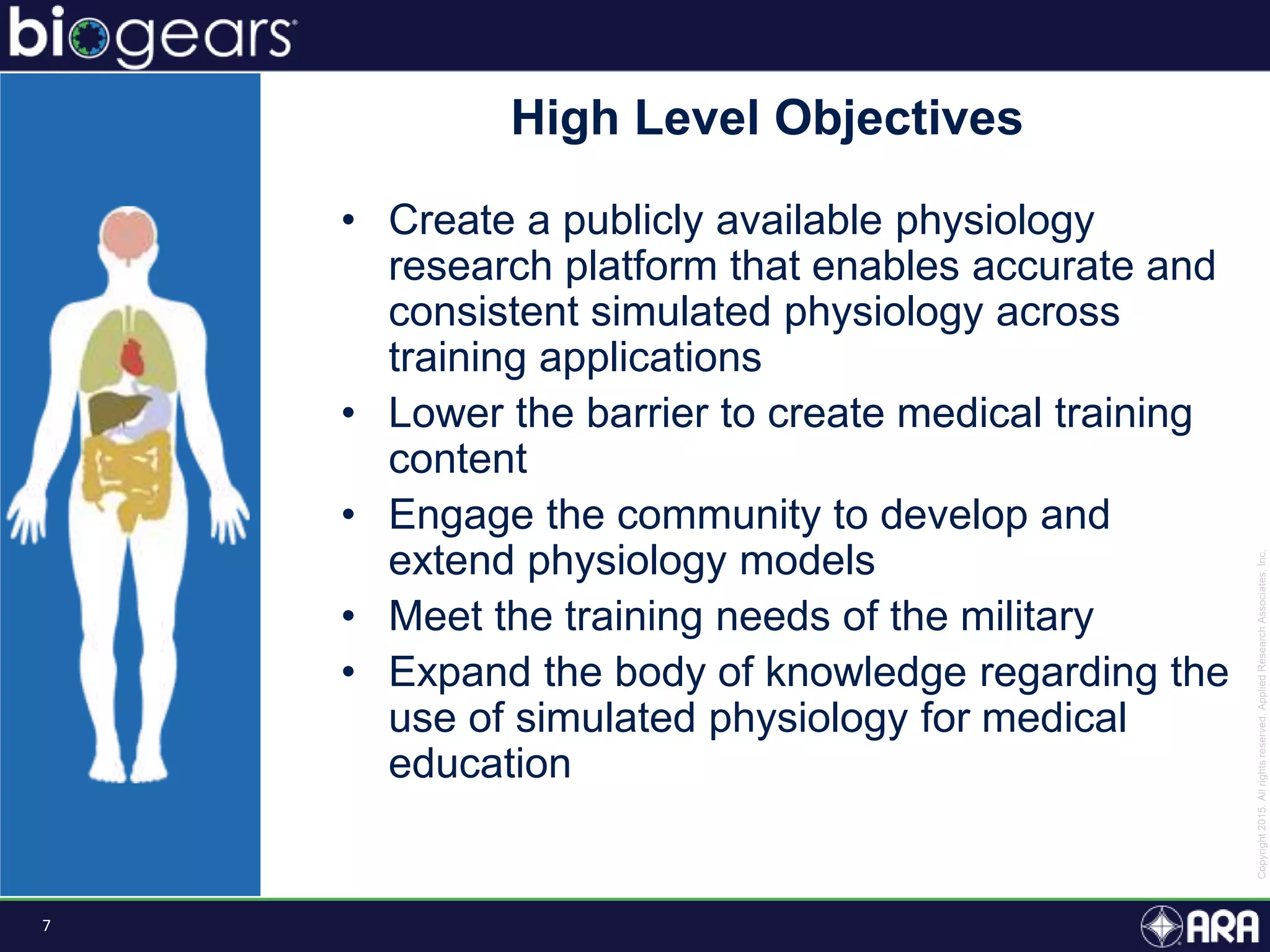
• Create a publicly available physiology
research platform that enables accurate and
consistent simulated physiology across
training applications
• Lower the barrier to create medical training
content
• Engage the community to develop and
extend physiology models
• Meet the training needs of the military
• Expand the body of knowledge regarding the
use of simulated physiology for medical
education
8
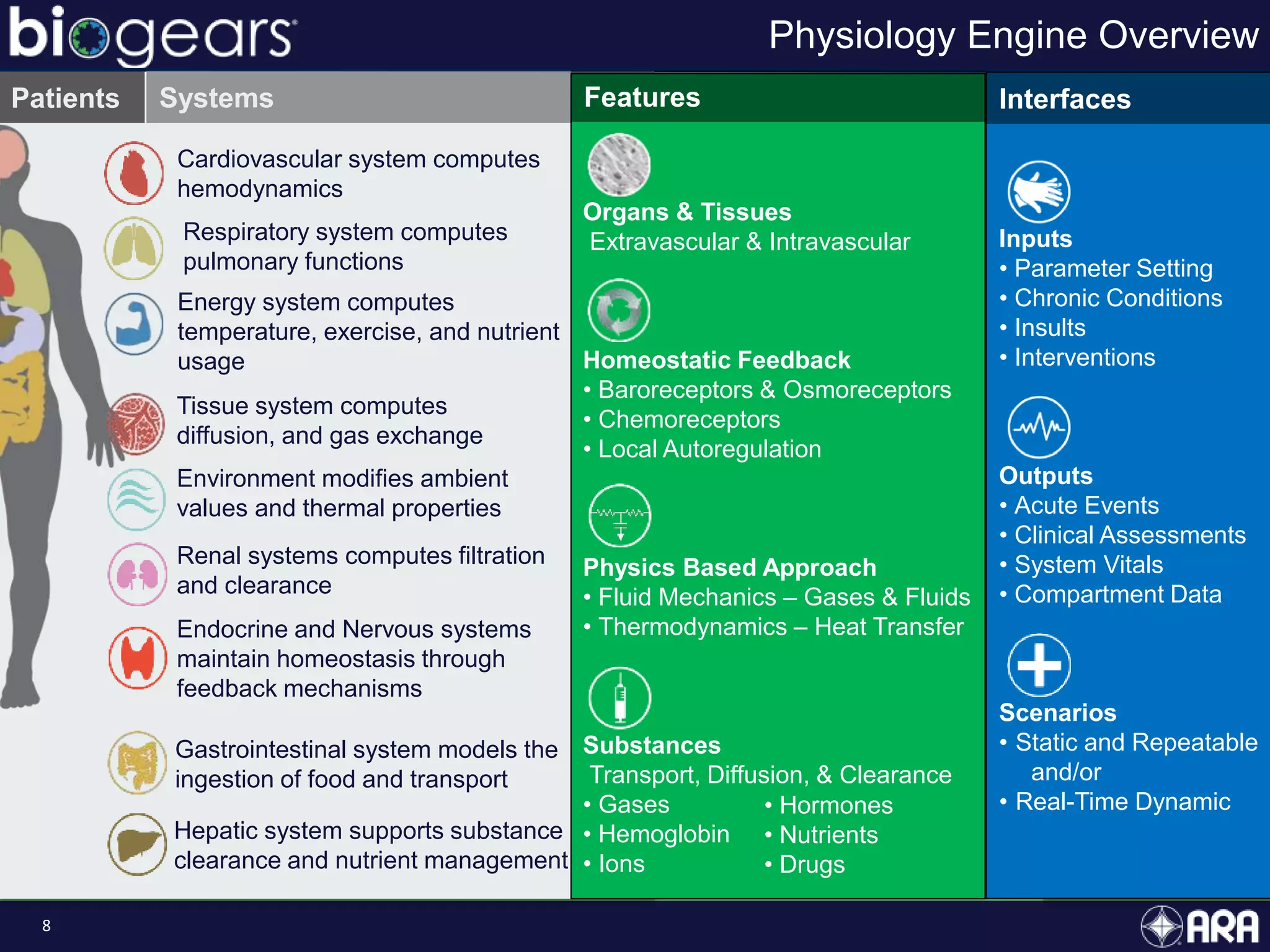
Physiology Engine Overview
Drugs
Hormones
Nutrients
Blood
•PK Model
•PD Model
•Hemoglobin
•Gases
•Ions
•Epinephrine
•Norepinephrine
•Insulin
•glucagon
•Fat
•Sugars
•Proteins
Systems SubstancesPatients
Cardiovascular system computes
hemodynamics
Respiratory system computes
pulmonary functions
Renal systems computes filtration
and clearance
Tissue system computes
diffusion, and gas exchange
Energy system computes
temperature, exercise, and nutrient
usage
Endocrine and Nervous systems
maintain homeostasis through
feedback mechanisms
Environment modifies ambient
values and thermal properties
Gastrointestinal system models the
ingestion of food and transport
Hepatic system supports substance
clearance and nutrient management
Inputs
• Parameter Setting
• Chronic Conditions
• Insults
• Interventions
Outputs
• Acute Events
• Clinical Assessments
• System Vitals
• Compartment Data
Scenarios
• Static and Repeatable
and/or
• Real-Time Dynamic
Interfaces
Organs & Tissues
Extravascular & Intravascular
Homeostatic Feedback
• Baroreceptors & Osmoreceptors
• Chemoreceptors
• Local Autoregulation
Physics Based Approach
• Fluid Mechanics – Gases & Fluids
• Thermodynamics – Heat Transfer
Substances
Transport, Diffusion, & Clearance
• Gases
• Hemoglobin
• Ions
Features
• Hormones
• Nutrients
• Drugs
9
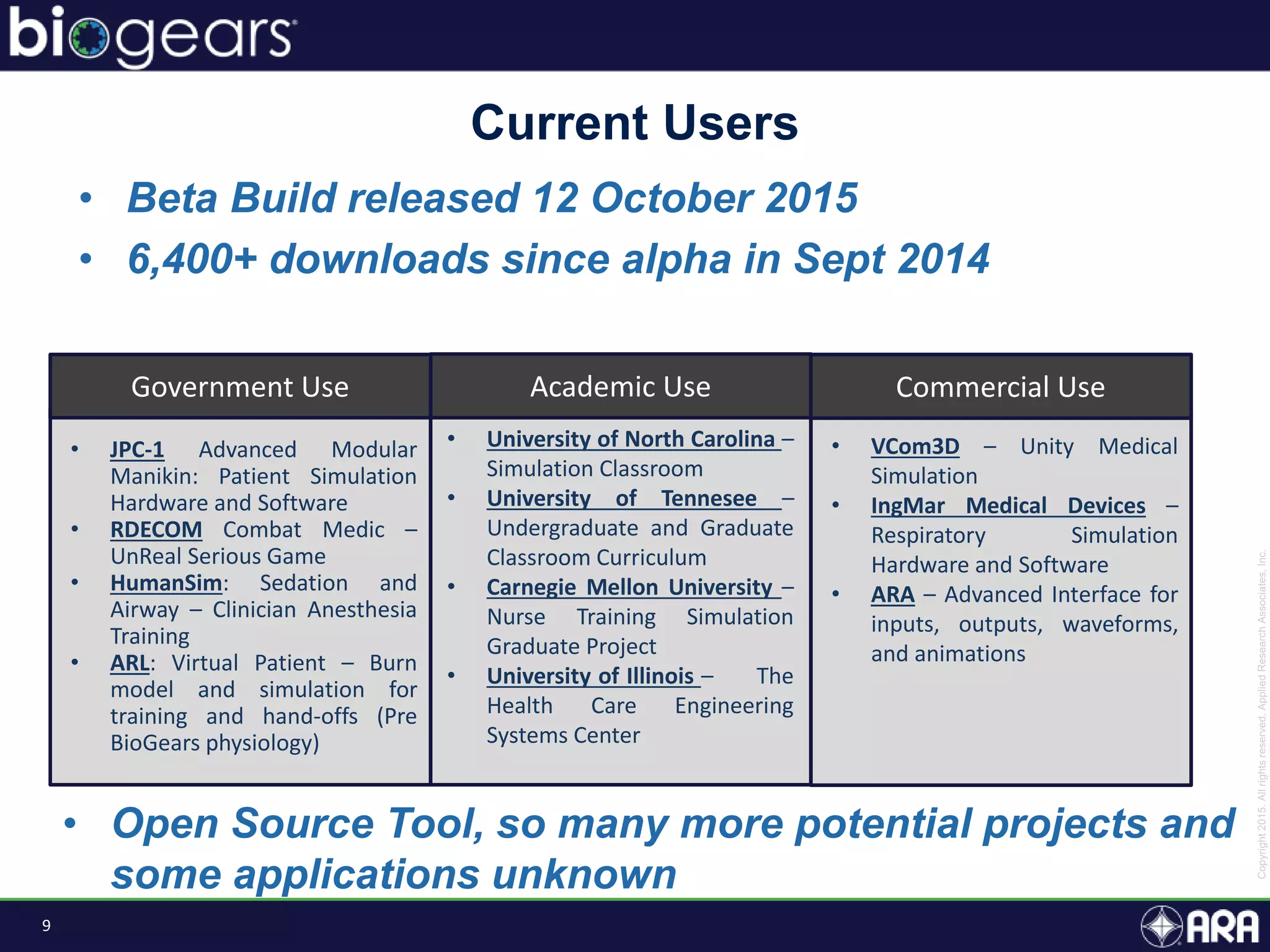
• Beta Build released 12 October 2015
• 6,400+ downloads since alpha in Sept 2014
Current Users
• JPC-1 Advanced Modular
Manikin: Patient Simulation
Hardware and Software
• RDECOM Combat Medic –
UnReal Serious Game
• HumanSim: Sedation and
Airway – Clinician Anesthesia
Training
• ARL: Virtual Patient – Burn
model and simulation for
training and hand-offs (Pre
BioGears physiology)
Government Use
• University of North Carolina –
Simulation Classroom
• University of Tennesee –
Undergraduate and Graduate
Classroom Curriculum
• Carnegie Mellon University –
Nurse Training Simulation
Graduate Project
• University of Illinois – The
Health Care Engineering
Systems Center
Academic Use
• VCom3D – Unity Medical
Simulation
• IngMar Medical Devices –
Respiratory Simulation
Hardware and Software
• ARA – Advanced Interface for
inputs, outputs, waveforms,
and animations
Commercial Use
• Open Source Tool, so many more potential projects and
some applications unknown
10
OVERVIEW- SOFTWARE AND
MODELING
11
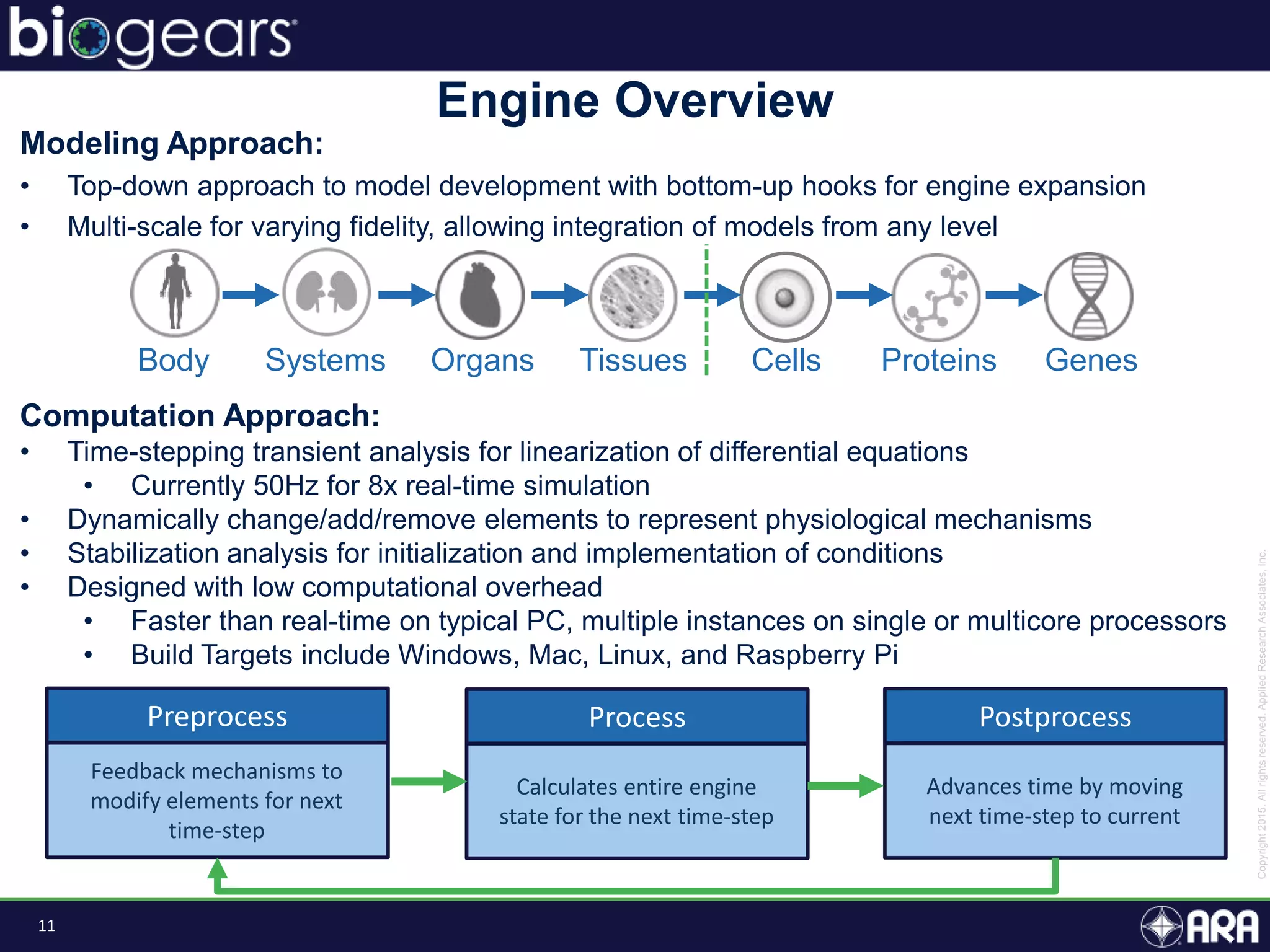
Feedback mechanisms to
modify elements for next
time-step
Preprocess
Calculates entire engine
state for the next time-step
Process
Advances time by moving
next time-step to current
Postprocess
Engine Overview
Computation Approach:
• Time-stepping transient analysis for linearization of differential equations
• Currently 50Hz for 8x real-time simulation
• Dynamically change/add/remove elements to represent physiological mechanisms
• Stabilization analysis for initialization and implementation of conditions
• Designed with low computational overhead
• Faster than real-time on typical PC, multiple instances on single or multicore processors
• Build Targets include Windows, Mac, Linux, and Raspberry Pi
Modeling Approach:
• Top-down approach to model development with bottom-up hooks for engine expansion
• Multi-scale for varying fidelity, allowing integration of models from any level
Body Systems Organs Tissues Cells Proteins Genes
12
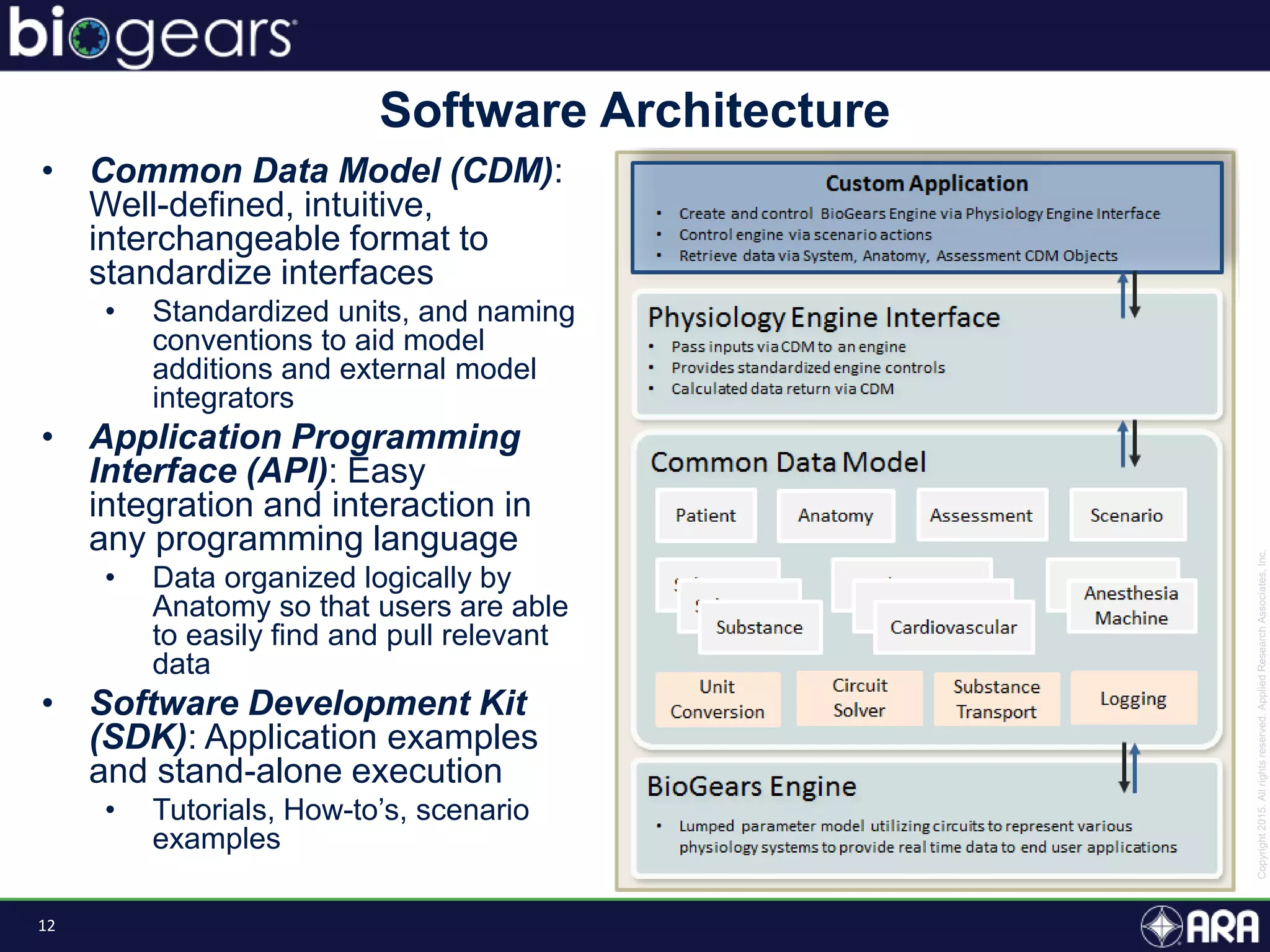
• Common Data Model (CDM):
Well-defined, intuitive,
interchangeable format to
standardize interfaces
• Standardized units, and naming
conventions to aid model
additions and external model
integrators
• Application Programming
Interface (API): Easy
integration and interaction in
any programming language
• Data organized logically by
Anatomy so that users are able
to easily find and pull relevant
data
• Software Development Kit
(SDK): Application examples
and stand-alone execution
• Tutorials, How-to’s, scenario
examples
Software Architecture
13
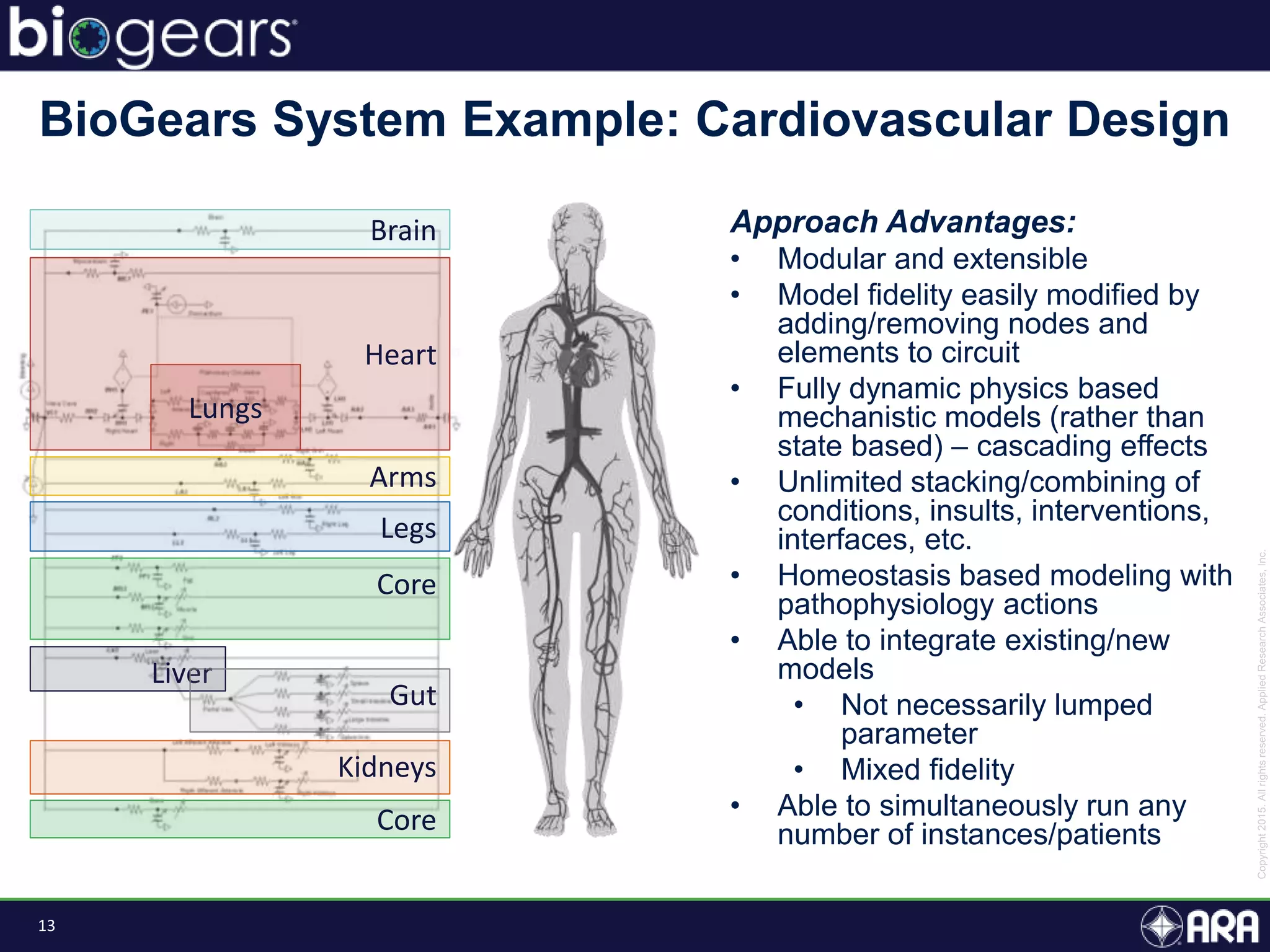
BioGears System Example: Cardiovascular Design
Brain
Heart
Arms
Legs
Core
Approach Advantages:
• Modular and extensible
• Model fidelity easily modified by
adding/removing nodes and
elements to circuit
• Fully dynamic physics based
mechanistic models (rather than
state based) – cascading effects
• Unlimited stacking/combining of
conditions, insults, interventions,
interfaces, etc.
• Homeostasis based modeling with
pathophysiology actions
• Able to integrate existing/new
models
• Not necessarily lumped
parameter
• Mixed fidelity
• Able to simultaneously run any
number of instances/patients
Liver
Gut
Kidneys
Core
Lungs
14
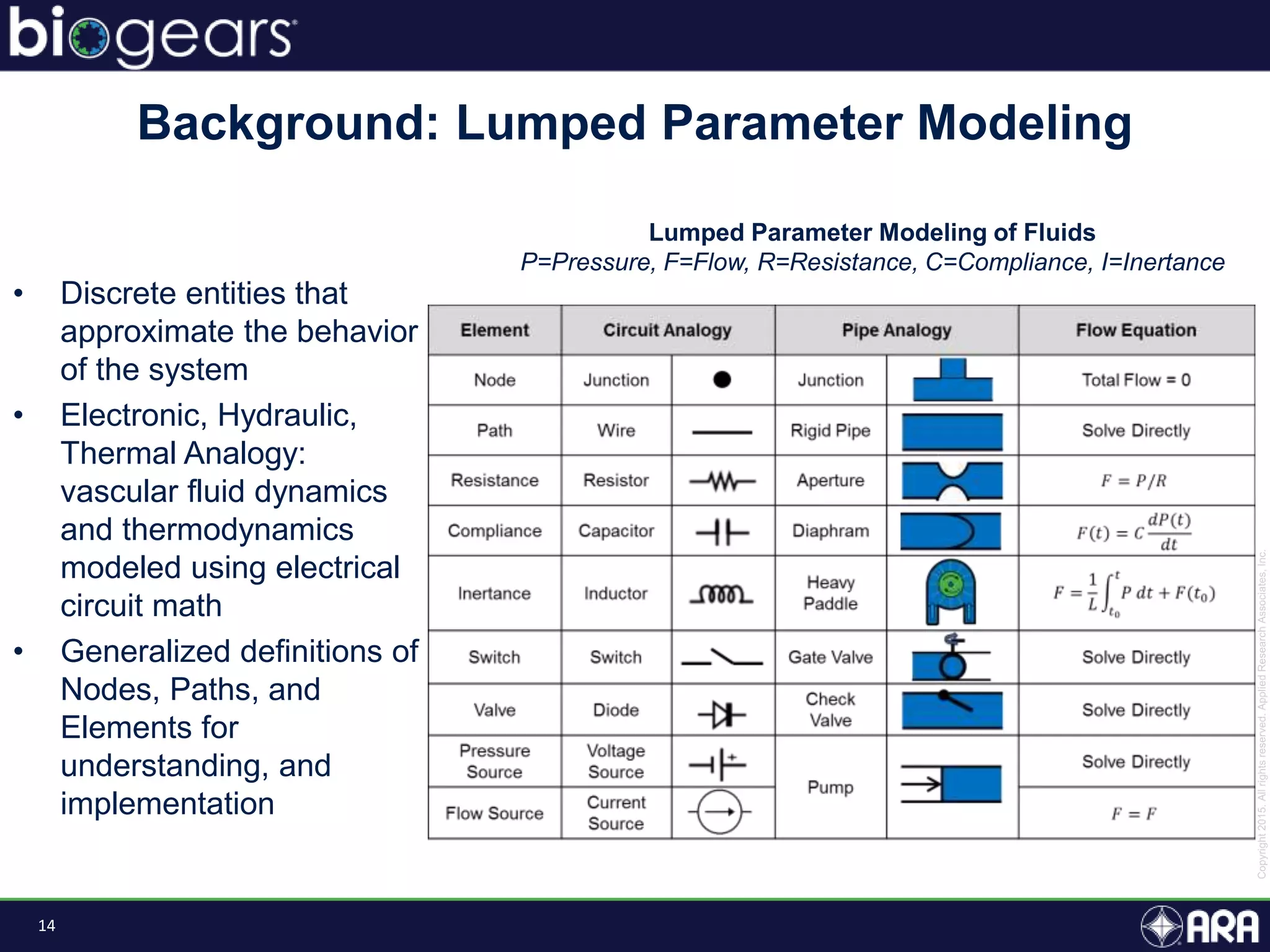
• Discrete entities that
approximate the behavior
of the system
• Electronic, Hydraulic,
Thermal Analogy:
vascular fluid dynamics
and thermodynamics
modeled using electrical
circuit math
• Generalized definitions of
Nodes, Paths, and
Elements for
understanding, and
implementation
Background: Lumped Parameter Modeling
Lumped Parameter Modeling of Fluids
P=Pressure, F=Flow, R=Resistance, C=Compliance, I=Inertance
15 ARA Proprietary
© 2011 Applied Research Associates, Inc.
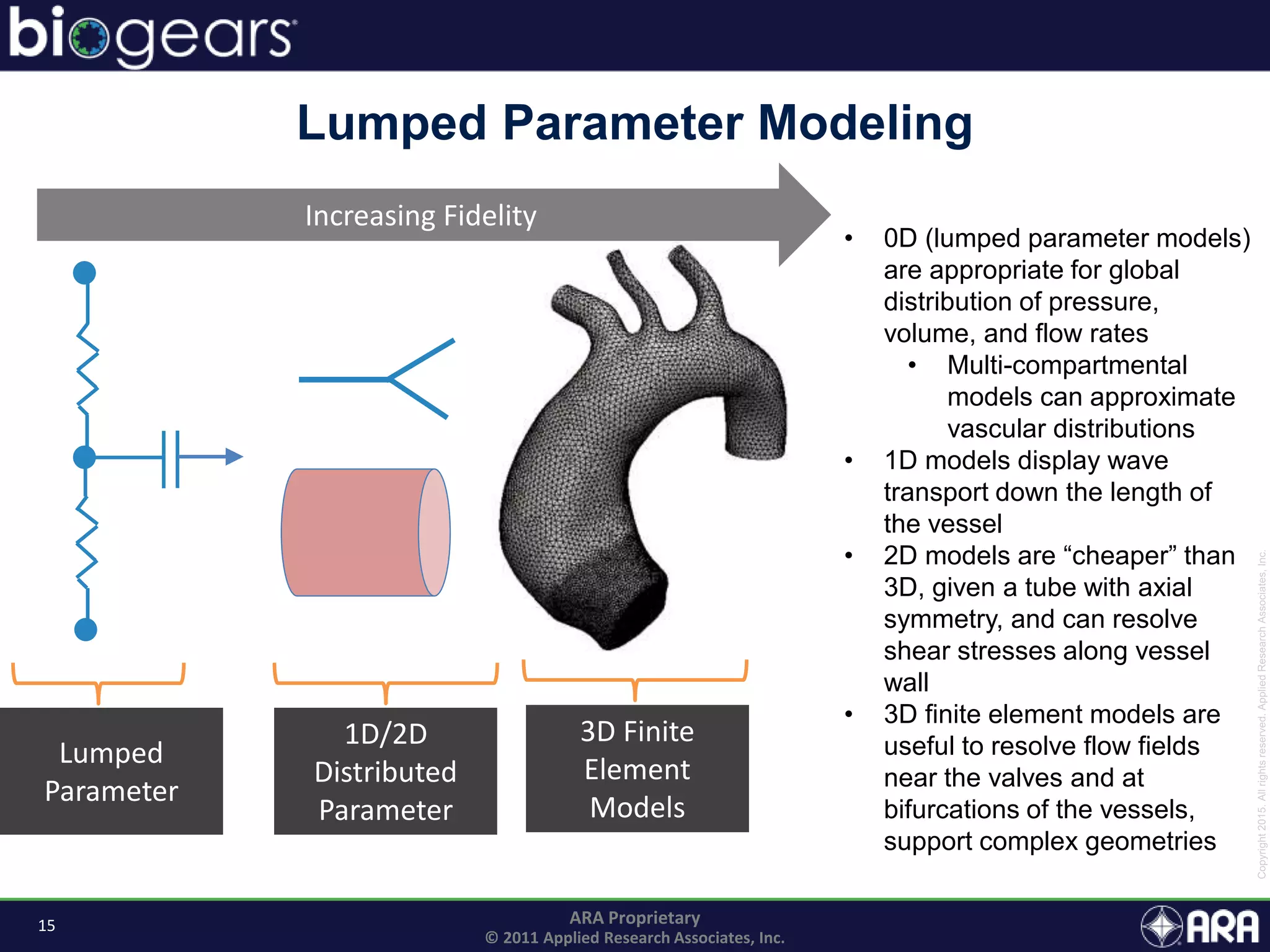
Lumped Parameter Modeling
Increasing Fidelity
Lumped
Parameter
1D/2D
Distributed
Parameter
3D Finite
Element
Models
• 0D (lumped parameter models)
are appropriate for global
distribution of pressure,
volume, and flow rates
• Multi-compartmental
models can approximate
vascular distributions
• 1D models display wave
transport down the length of
the vessel
• 2D models are “cheaper” than
3D, given a tube with axial
symmetry, and can resolve
shear stresses along vessel
wall
• 3D finite element models are
useful to resolve flow fields
near the valves and at
bifurcations of the vessels,
support complex geometries
16
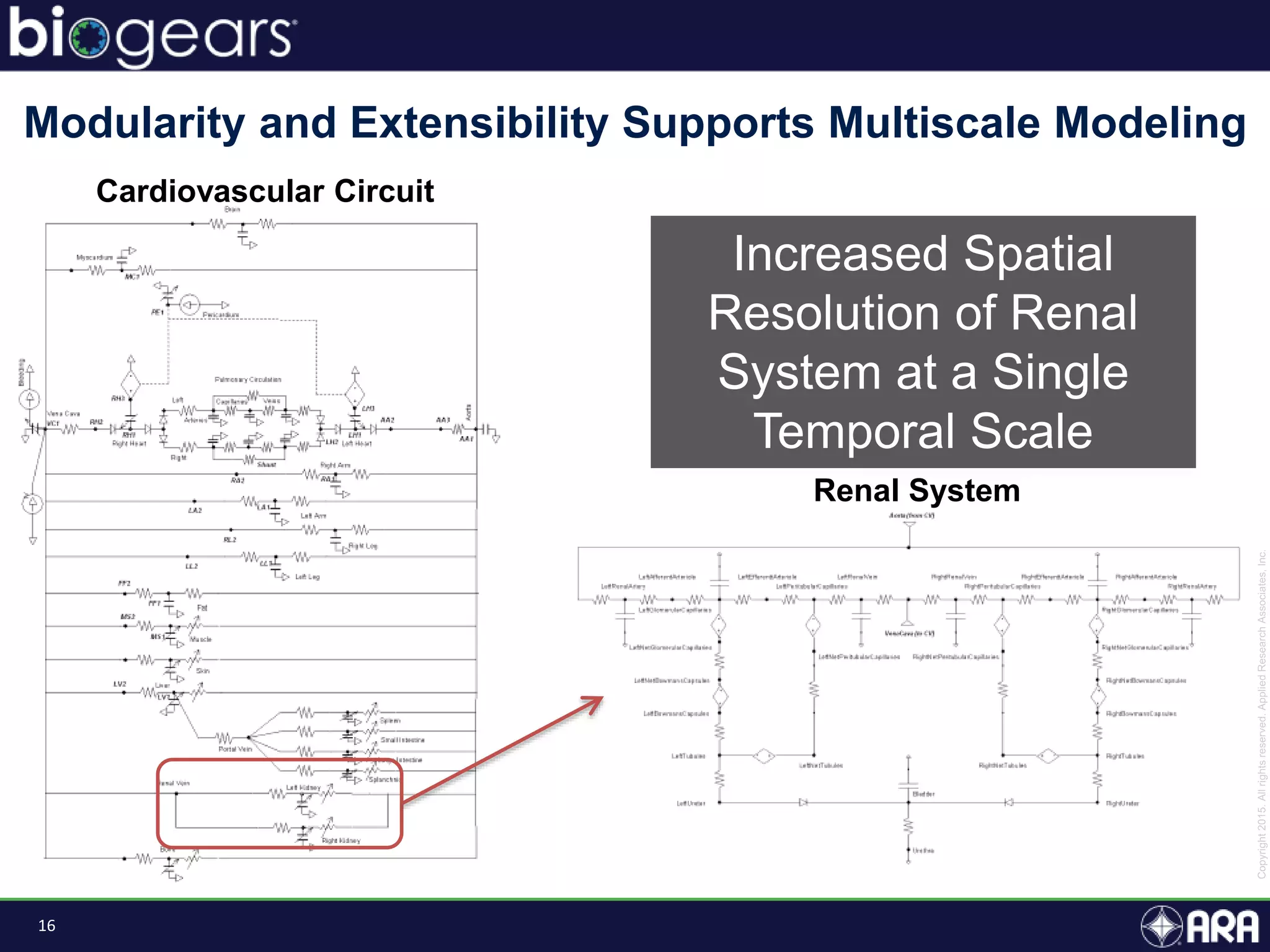
Modularity and Extensibility Supports Multiscale Modeling
Increased Spatial
Resolution of Renal
System at a Single
Temporal Scale
Cardiovascular Circuit
Renal System
17
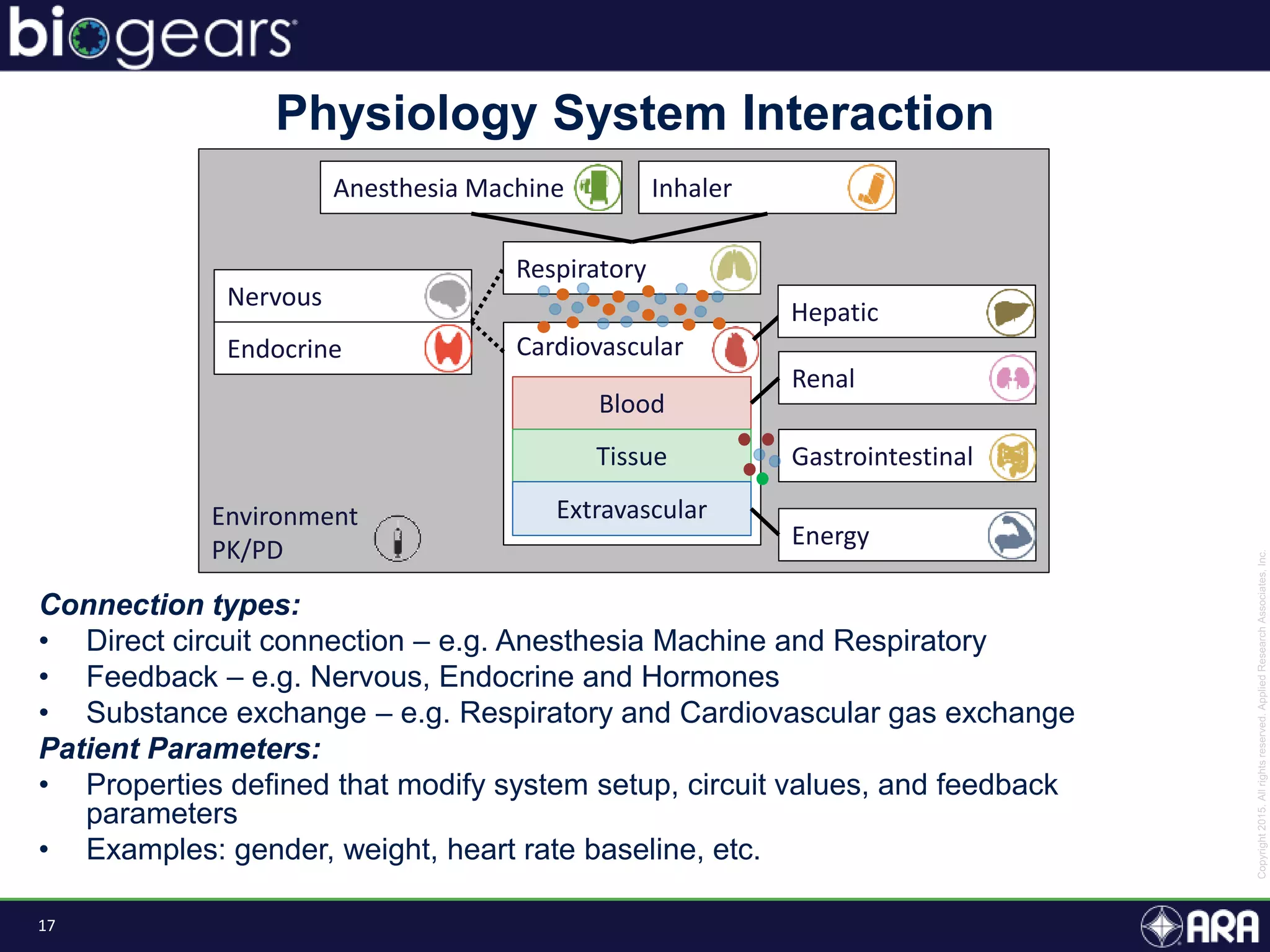
Connection types:
• Direct circuit connection – e.g. Anesthesia Machine and Respiratory
• Feedback – e.g. Nervous, Endocrine and Hormones
• Substance exchange – e.g. Respiratory and Cardiovascular gas exchange
Patient Parameters:
• Properties defined that modify system setup, circuit values, and feedback
parameters
• Examples: gender, weight, heart rate baseline, etc.
Physiology System Interaction
Environment
PK/PD
Cardiovascular
Blood
Tissue
Extravascular
Respiratory
Anesthesia Machine
Renal
Gastrointestinal
Energy
Nervous
Endocrine
Inhaler
Hepatic
18
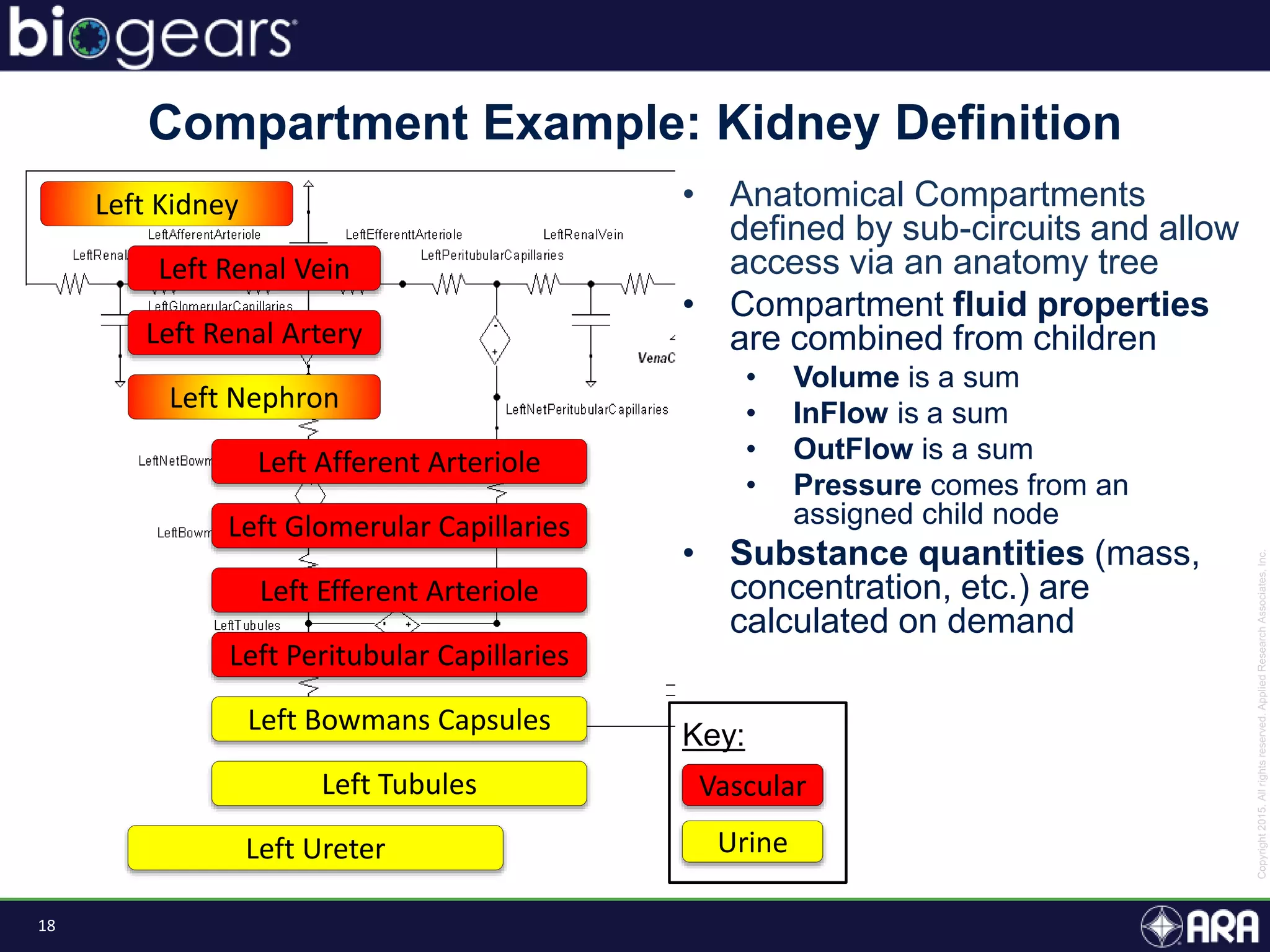
• Anatomical Compartments
defined by sub-circuits and allow
access via an anatomy tree
• Compartment fluid properties
are combined from children
• Volume is a sum
• InFlow is a sum
• OutFlow is a sum
• Pressure comes from an
assigned child node
• Substance quantities (mass,
concentration, etc.) are
calculated on demand
Left Kidney
Left Renal Artery
Left Renal Vein
Left Nephron
Left Afferent Arteriole
Left Glomerular Capillaries
Left Efferent Arteriole
Left Peritubular Capillaries
Left Bowmans Capsules
Left Tubules
Left Ureter
Compartment Example: Kidney Definition
Key:
Vascular
Urine
19
Engine Initialization
Resting Conditions Running
Stabilization Simulation Time = 0
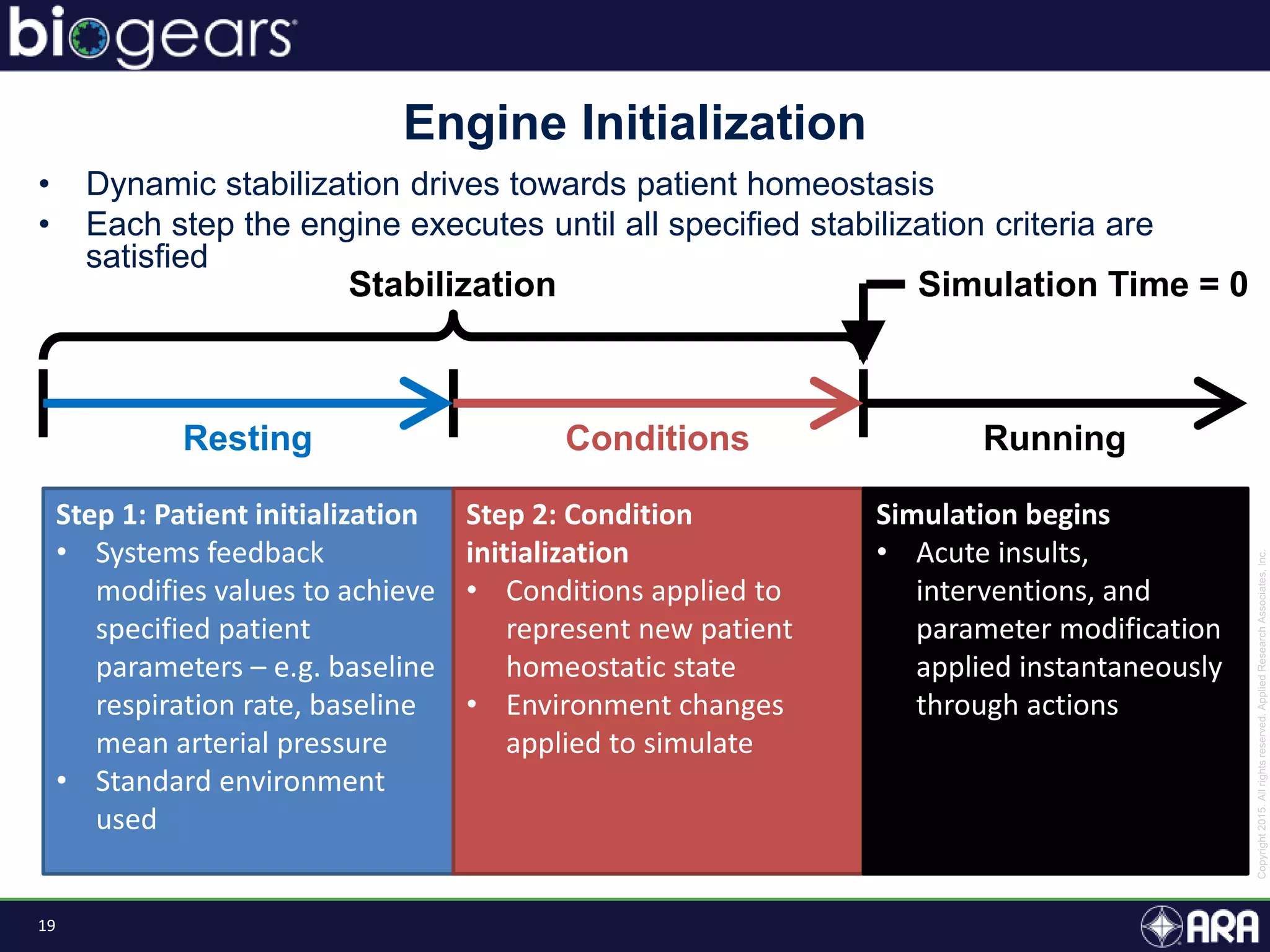
• Dynamic stabilization drives towards patient homeostasis
• Each step the engine executes until all specified stabilization criteria are
satisfied
Step 1: Patient initialization
• Systems feedback
modifies values to achieve
specified patient
parameters – e.g. baseline
respiration rate, baseline
mean arterial pressure
• Standard environment
used
Step 2: Condition
initialization
• Conditions applied to
represent new patient
homeostatic state
• Environment changes
applied to simulate
Simulation begins
• Acute insults,
interventions, and
parameter modification
applied instantaneously
through actions
20
BioGears Solvers
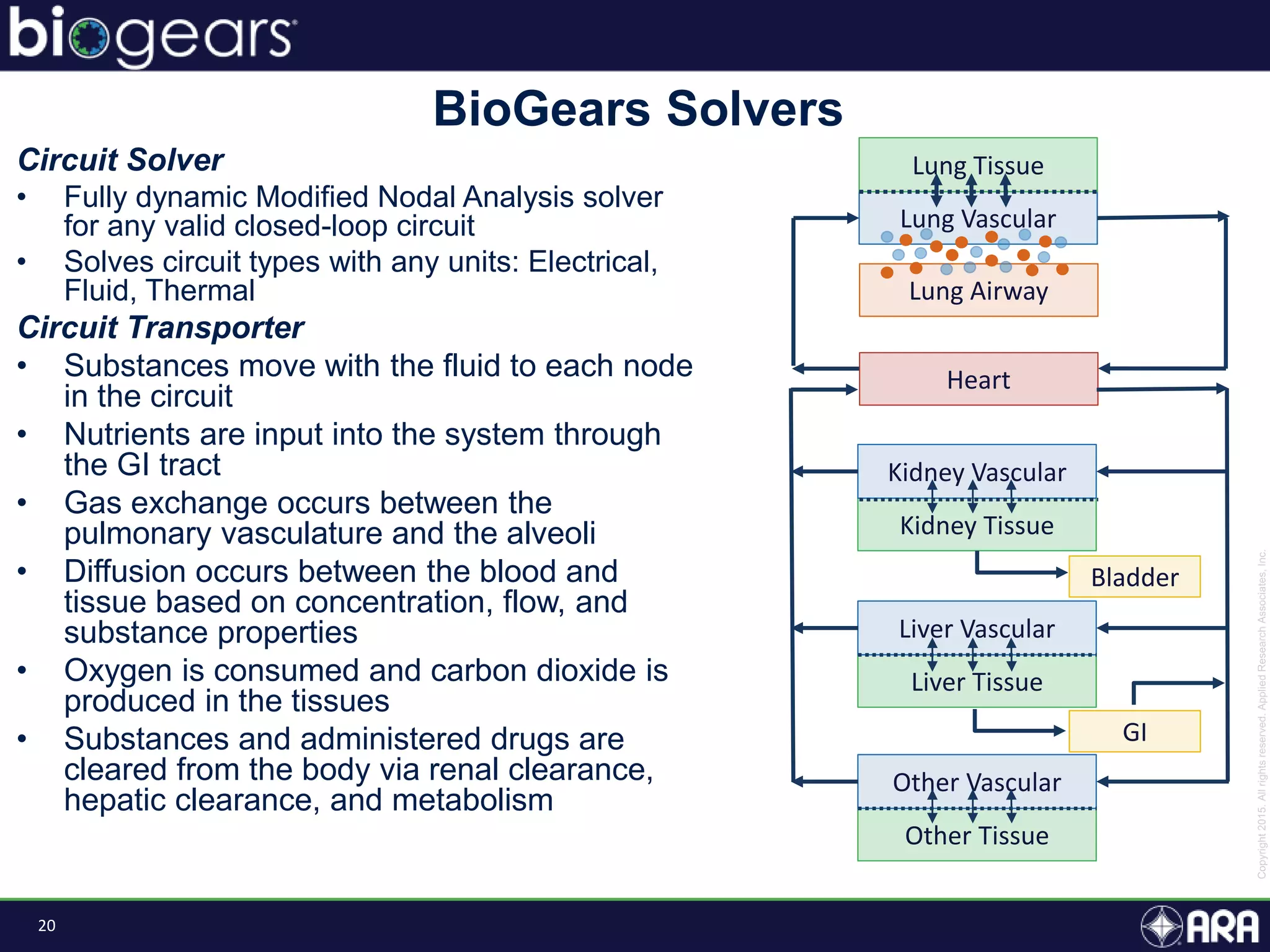
Circuit Solver
• Fully dynamic Modified Nodal Analysis solver
for any valid closed-loop circuit
• Solves circuit types with any units: Electrical,
Fluid, Thermal
Circuit Transporter
• Substances move with the fluid to each node
in the circuit
• Nutrients are input into the system through
the GI tract
• Gas exchange occurs between the
pulmonary vasculature and the alveoli
• Diffusion occurs between the blood and
tissue based on concentration, flow, and
substance properties
• Oxygen is consumed and carbon dioxide is
produced in the tissues
• Substances and administered drugs are
cleared from the body via renal clearance,
hepatic clearance, and metabolism
Lung Vascular
Lung Tissue
Heart
Kidney Tissue
Kidney Vascular
Lung Airway
Liver Tissue
Liver Vascular
Other Tissue
Other Vascular
Bladder
GI
21
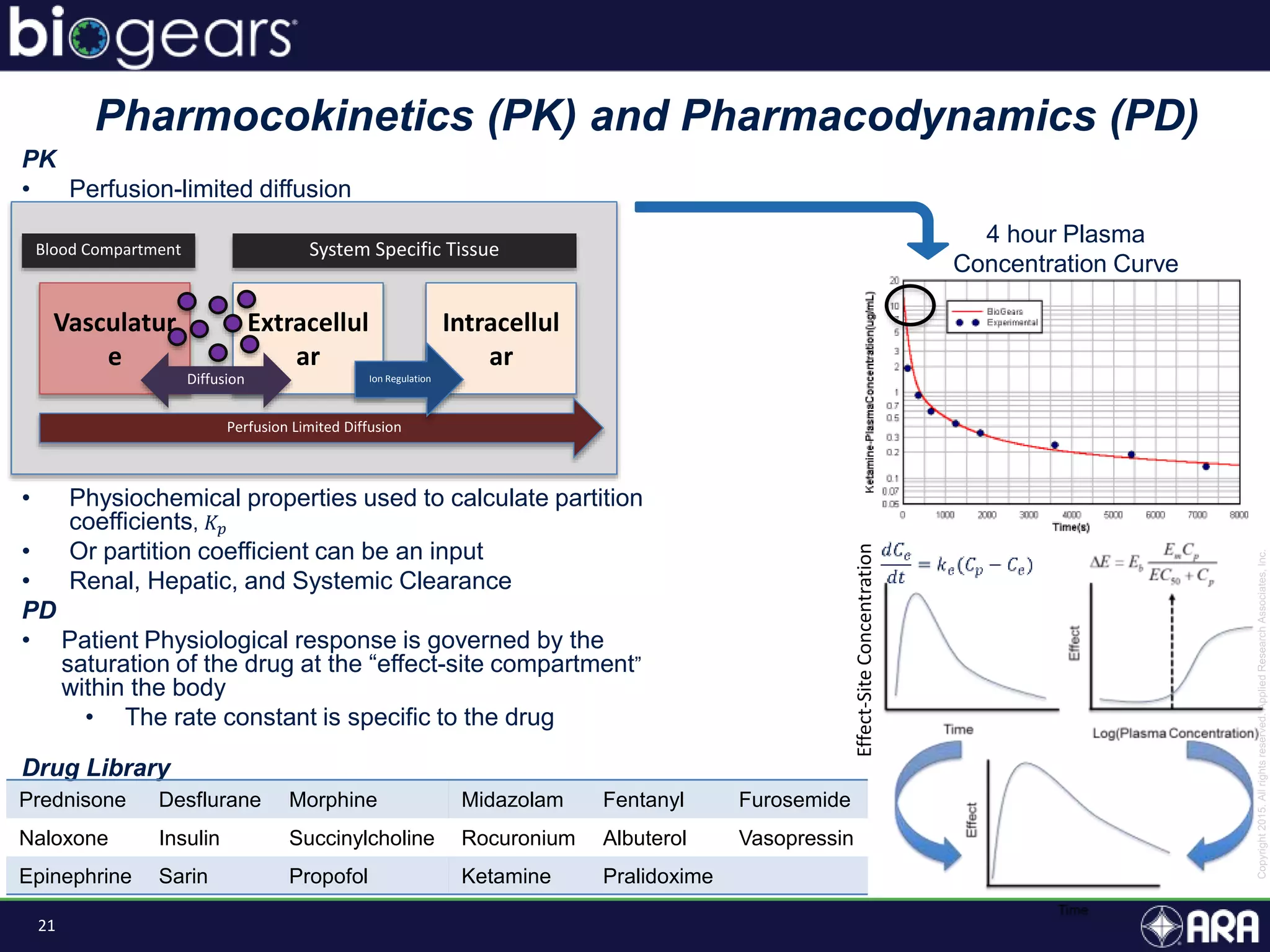
Pharmocokinetics (PK) and Pharmacodynamics (PD)
PK
• Perfusion-limited diffusion
• Physiochemical properties used to calculate partition
coefficients, 𝐾 𝑝
• Or partition coefficient can be an input
• Renal, Hepatic, and Systemic Clearance
PD
• Patient Physiological response is governed by the
saturation of the drug at the “effect-site compartment”
within the body
• The rate constant is specific to the drug
Drug Library
Prednisone Desflurane Morphine Midazolam Fentanyl Furosemide
Naloxone Insulin Succinylcholine Rocuronium Albuterol Vasopressin
Epinephrine Sarin Propofol Ketamine Pralidoxime
4 hour Plasma
Concentration Curve
Effect-SiteConcentration
Vasculatur
e
Extracellul
ar
Intracellul
ar
Perfusion Limited Diffusion
Ion Regulation
System Specific Tissue
Diffusion
Blood Compartment
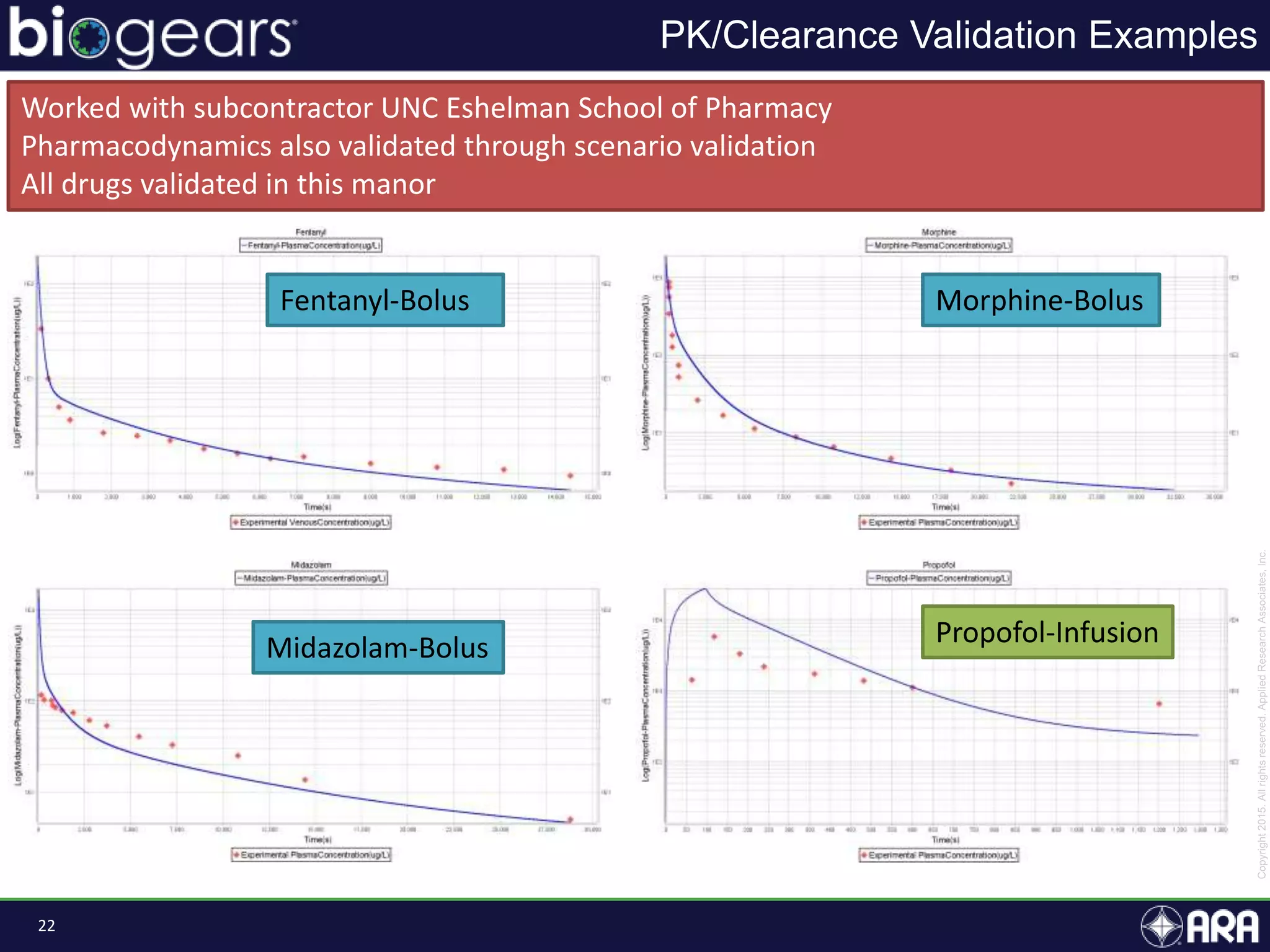
22
Worked with subcontractor UNC Eshelman School of Pharmacy
Pharmacodynamics also validated through scenario validation
All drugs validated in this manor
PK/Clearance Validation Examples
Fentanyl-Bolus Morphine-Bolus
Midazolam-Bolus Propofol-Infusion
23
Modifying Engine Inputs
Modifiable Files
Patients
Substances
Compounds
Environments
Scenarios
Patient File Excerpt
Weight
CarinaToTeethDistance
Contractility
FunctionalResidualCapacity
HeartRateBasline
MaximumPulmonaryVentilationRate
MeanArterialPressure
Minimum Stroke Volume
RespirationRateBaseline
RightLungRatio
TotalBloodVolume
Tidal Volume varies with
weight
Circuit is modified to
vary arterial pressure
Driver is modified to vary
heart rate
1
2
3
1 2
3
Files can be modified
directly in the XML
(text) files
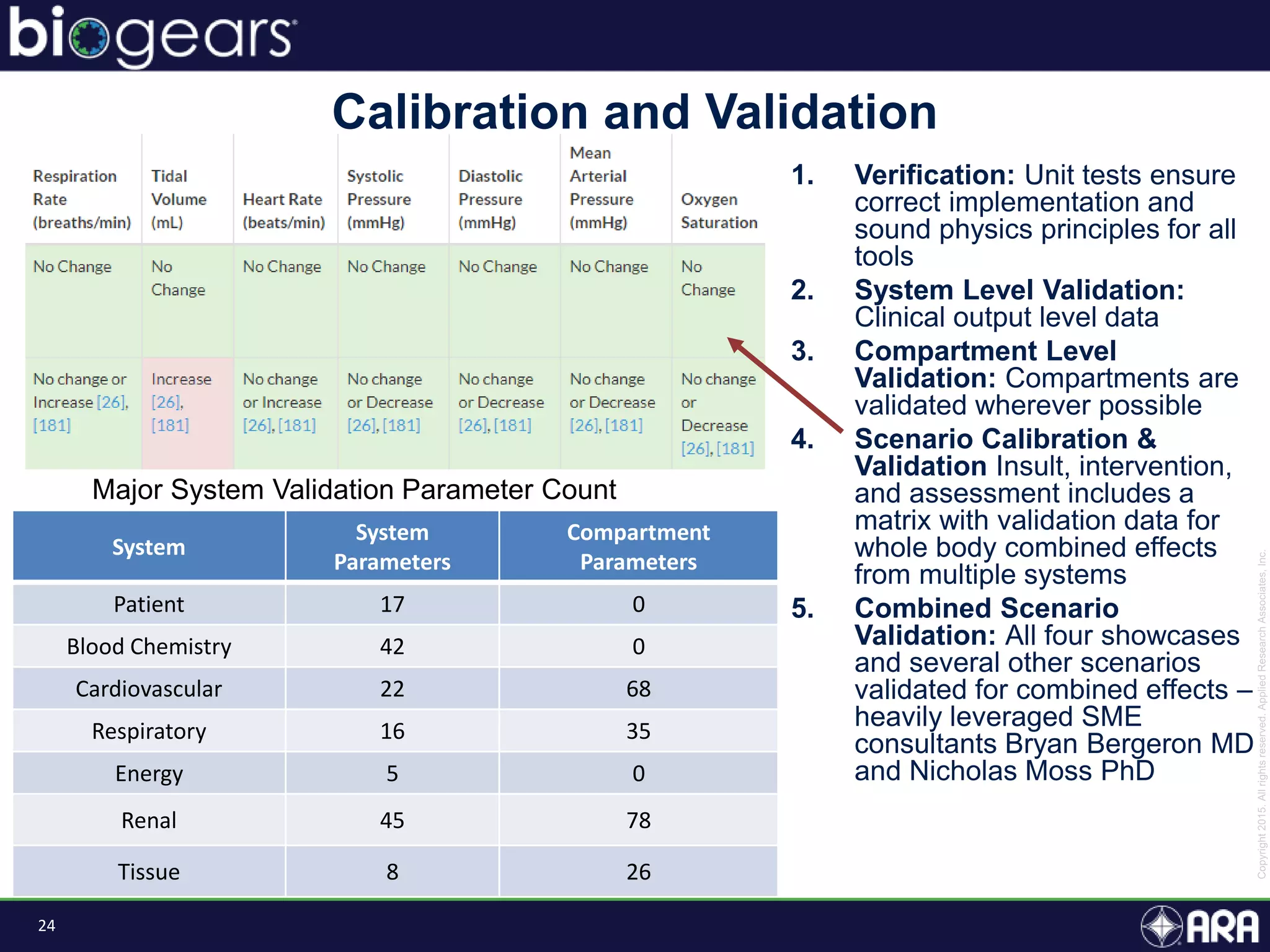
24
1. Verification: Unit tests ensure
correct implementation and
sound physics principles for all
tools
2. System Level Validation:
Clinical output level data
3. Compartment Level
Validation: Compartments are
validated wherever possible
4. Scenario Calibration &
Validation Insult, intervention,
and assessment includes a
matrix with validation data for
whole body combined effects
from multiple systems
5. Combined Scenario
Validation: All four showcases
and several other scenarios
validated for combined effects –
heavily leveraged SME
consultants Bryan Bergeron MD
and Nicholas Moss PhD
System
System
Parameters
Compartment
Parameters
Patient 17 0
Blood Chemistry 42 0
Cardiovascular 22 68
Respiratory 16 35
Energy 5 0
Renal 45 78
Tissue 8 26
Major System Validation Parameter Count
Calibration and Validation
25
RUNNING A VALIDATED
SCENARIO
26 ARA Proprietary
© 2011 Applied Research Associates, Inc.
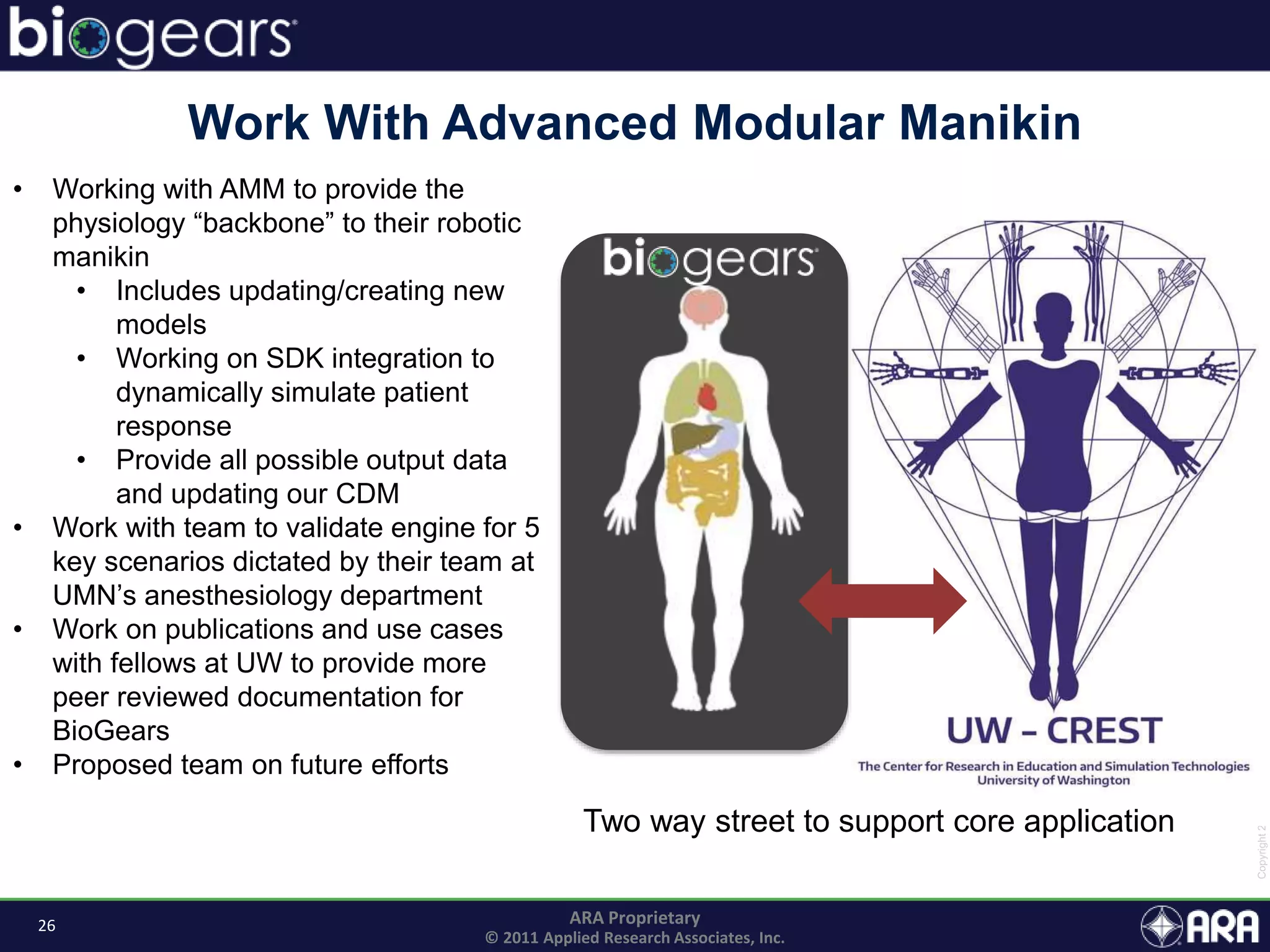
Work With Advanced Modular Manikin
• Working with AMM to provide the
physiology “backbone” to their robotic
manikin
• Includes updating/creating new
models
• Working on SDK integration to
dynamically simulate patient
response
• Provide all possible output data
and updating our CDM
• Work with team to validate engine for 5
key scenarios dictated by their team at
UMN’s anesthesiology department
• Work on publications and use cases
with fellows at UW to provide more
peer reviewed documentation for
BioGears
• Proposed team on future efforts
Two way street to support core application
27 ARA Proprietary
© 2011 Applied Research Associates, Inc.
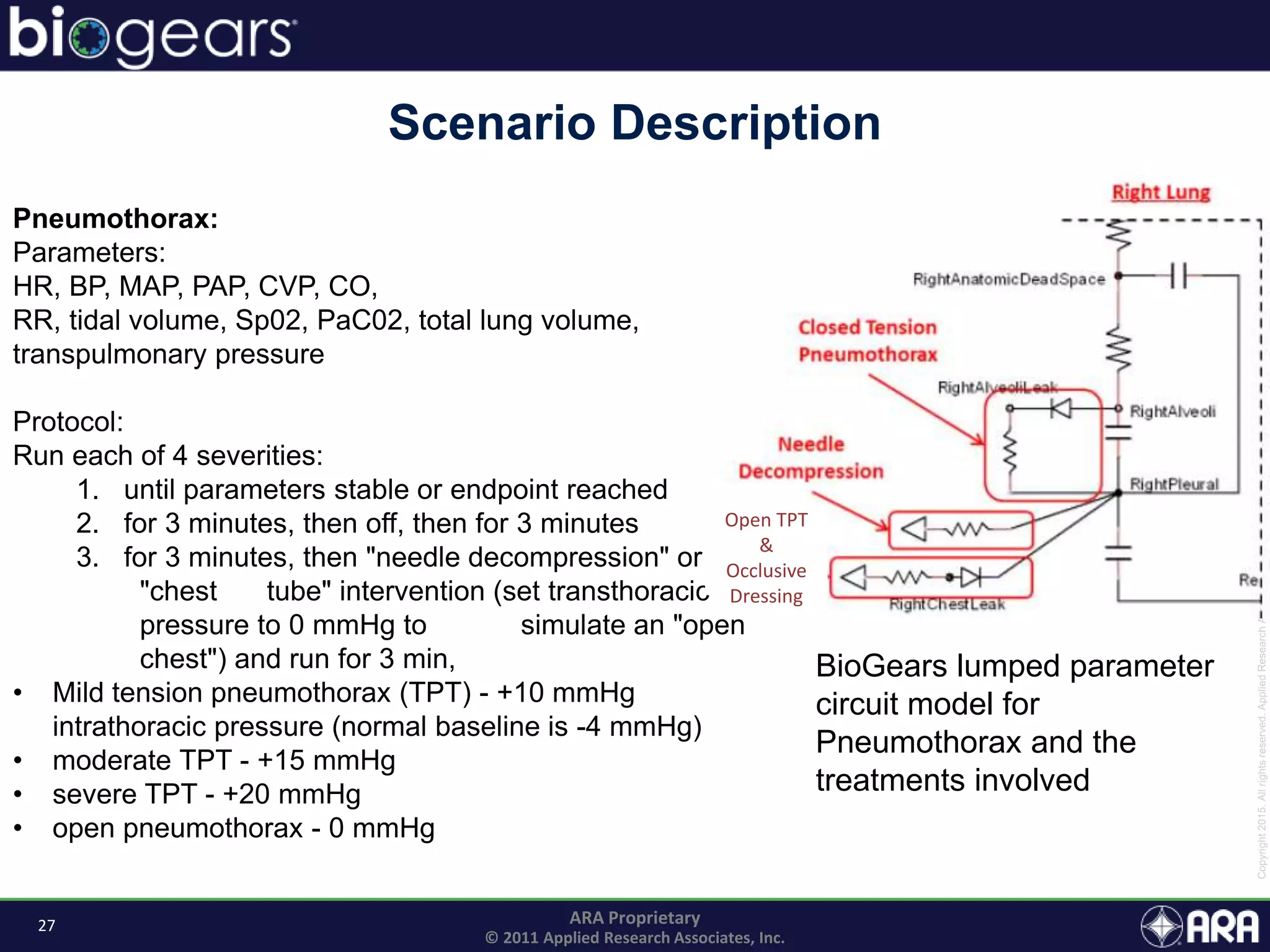
Scenario Description
Pneumothorax:
Parameters:
HR, BP, MAP, PAP, CVP, CO,
RR, tidal volume, Sp02, PaC02, total lung volume,
transpulmonary pressure
Protocol:
Run each of 4 severities:
1. until parameters stable or endpoint reached
2. for 3 minutes, then off, then for 3 minutes
3. for 3 minutes, then "needle decompression" or
"chest tube" intervention (set transthoracic
pressure to 0 mmHg to simulate an "open
chest") and run for 3 min,
• Mild tension pneumothorax (TPT) - +10 mmHg
intrathoracic pressure (normal baseline is -4 mmHg)
• moderate TPT - +15 mmHg
• severe TPT - +20 mmHg
• open pneumothorax - 0 mmHg
BioGears lumped parameter
circuit model for
Pneumothorax and the
treatments involved
Open TPT
&
Occlusive
Dressing
28 ARA Proprietary
© 2011 Applied Research Associates, Inc.
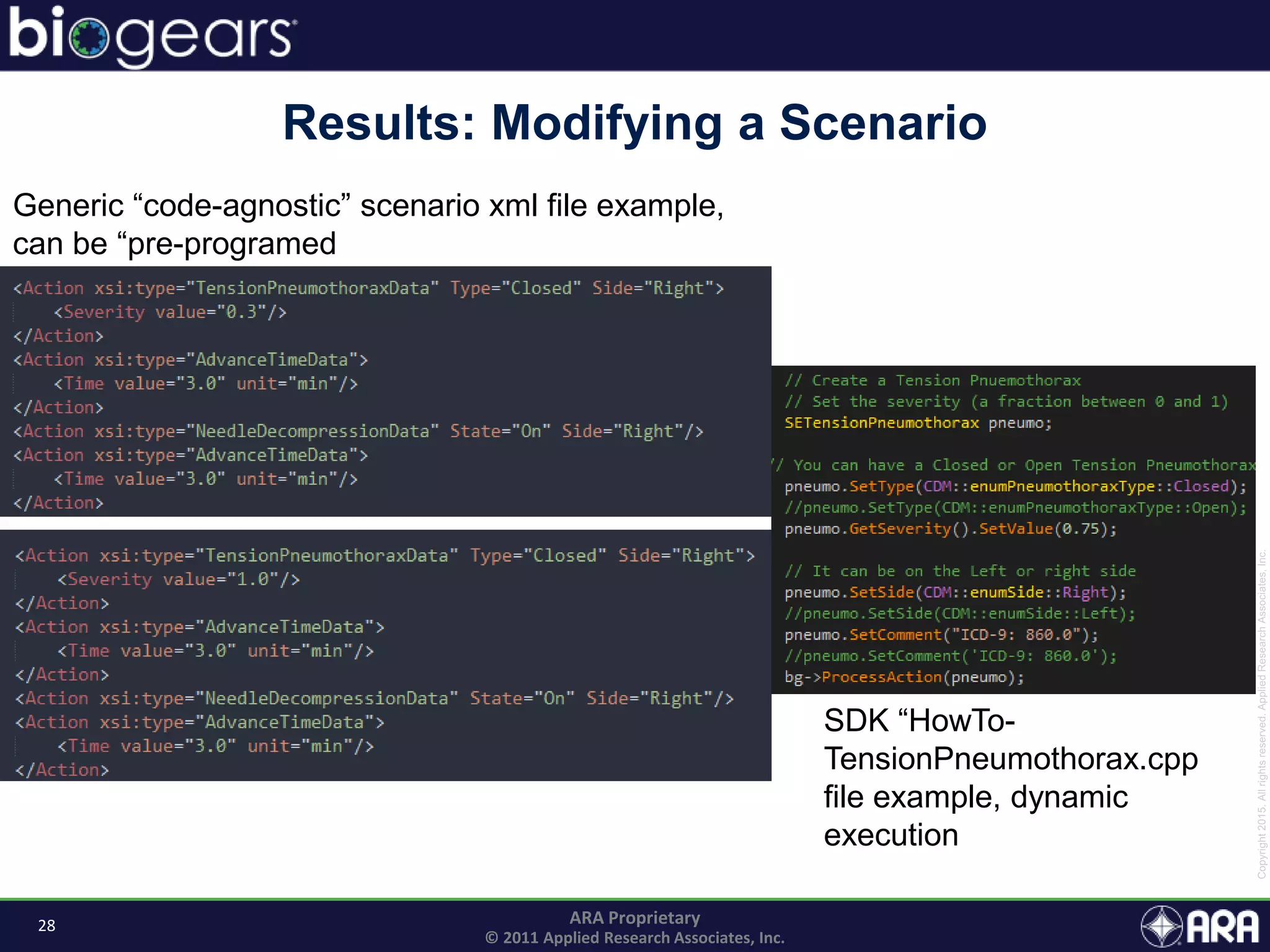
Results: Modifying a Scenario
Generic “code-agnostic” scenario xml file example,
can be “pre-programed
SDK “HowTo-
TensionPneumothorax.cpp
file example, dynamic
execution
29 ARA Proprietary
© 2011 Applied Research Associates, Inc.
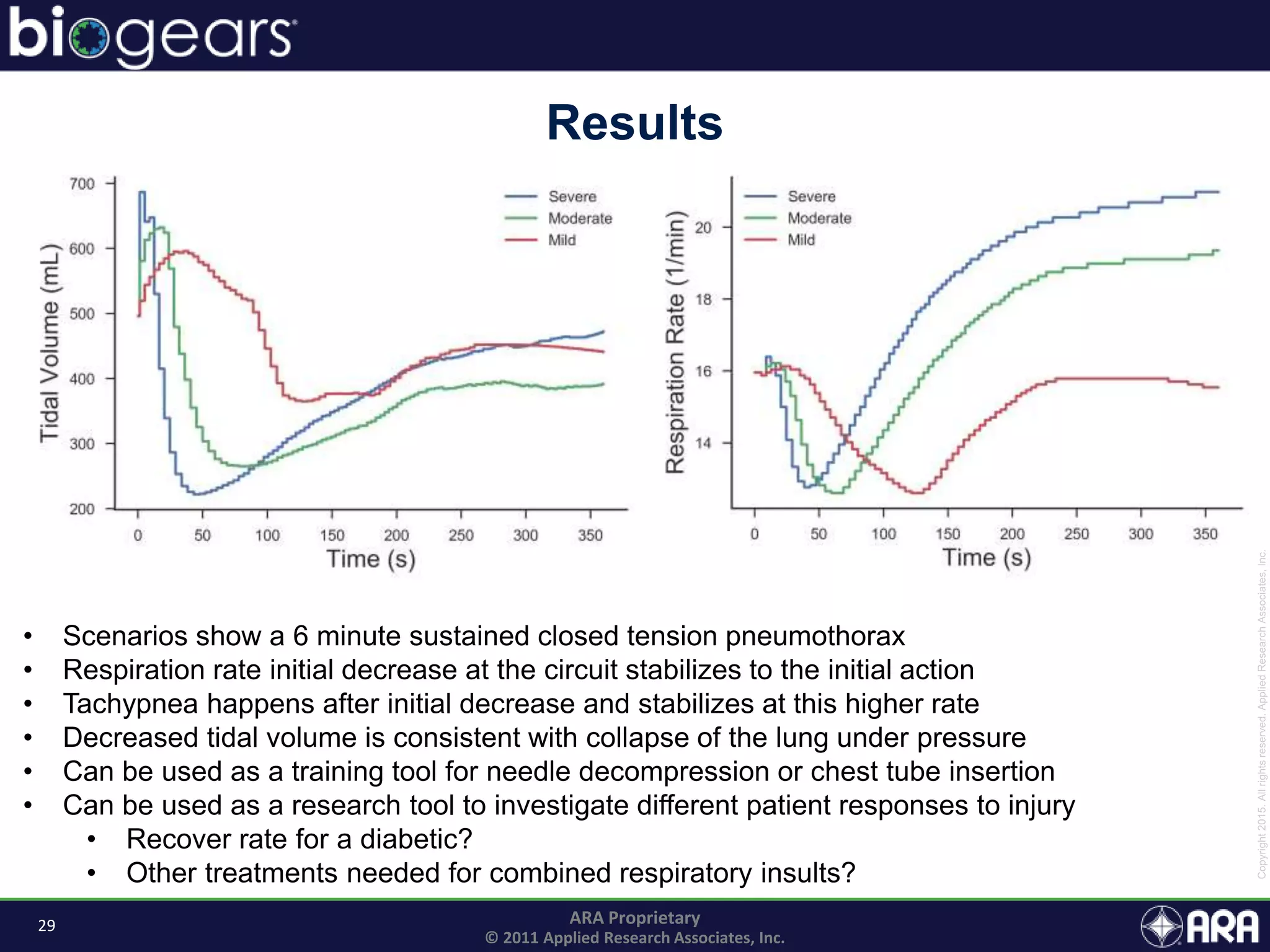
Results
• Scenarios show a 6 minute sustained closed tension pneumothorax
• Respiration rate initial decrease at the circuit stabilizes to the initial action
• Tachypnea happens after initial decrease and stabilizes at this higher rate
• Decreased tidal volume is consistent with collapse of the lung under pressure
• Can be used as a training tool for needle decompression or chest tube insertion
• Can be used as a research tool to investigate different patient responses to injury
• Recover rate for a diabetic?
• Other treatments needed for combined respiratory insults?
30
CONCLUSIONS
31
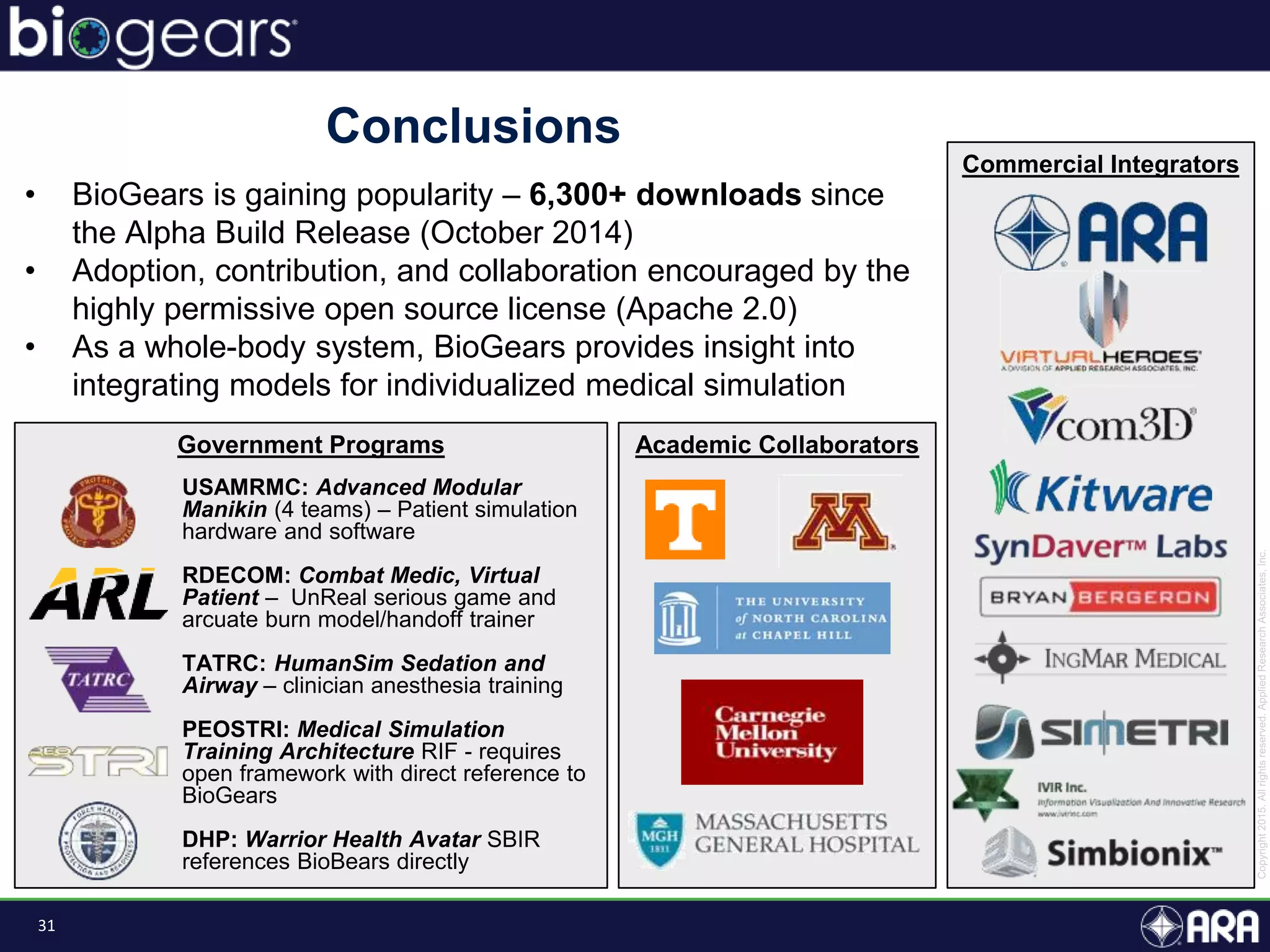
Conclusions
Commercial Integrators
Academic CollaboratorsGovernment Programs
• BioGears is gaining popularity – 6,300+ downloads since
the Alpha Build Release (October 2014)
• Adoption, contribution, and collaboration encouraged by the
highly permissive open source license (Apache 2.0)
• As a whole-body system, BioGears provides insight into
integrating models for individualized medical simulation
USAMRMC: Advanced Modular
Manikin (4 teams) – Patient simulation
hardware and software
RDECOM: Combat Medic, Virtual
Patient – UnReal serious game and
arcuate burn model/handoff trainer
TATRC: HumanSim Sedation and
Airway – clinician anesthesia training
PEOSTRI: Medical Simulation
Training Architecture RIF - requires
open framework with direct reference to
BioGears
DHP: Warrior Health Avatar SBIR
references BioBears directly
32
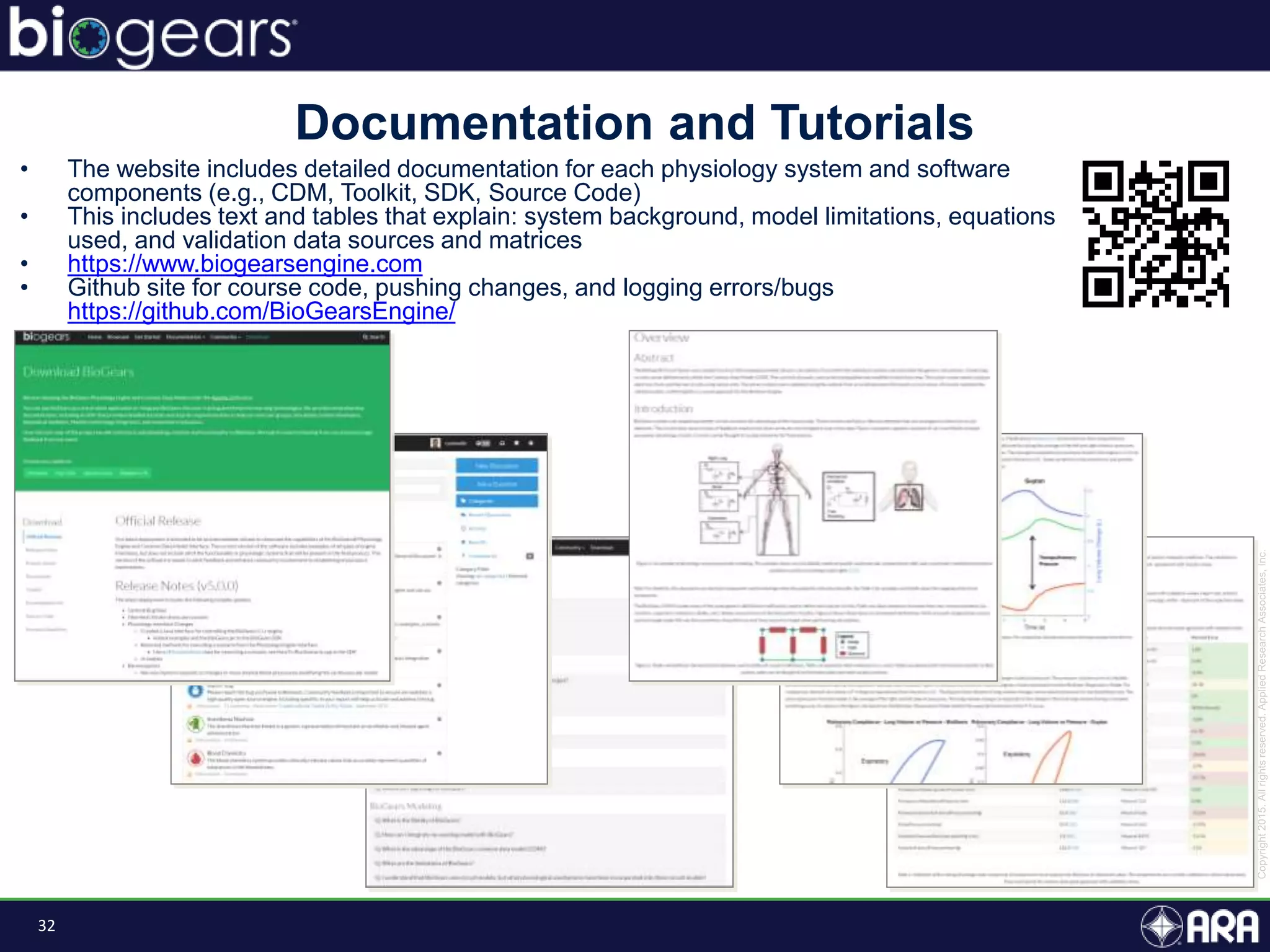
Documentation and Tutorials
• The website includes detailed documentation for each physiology system and software
components (e.g., CDM, Toolkit, SDK, Source Code)
• This includes text and tables that explain: system background, model limitations, equations
used, and validation data sources and matrices
• https://www.biogearsengine.com
• Github site for course code, pushing changes, and logging errors/bugs
https://github.com/BioGearsEngine/
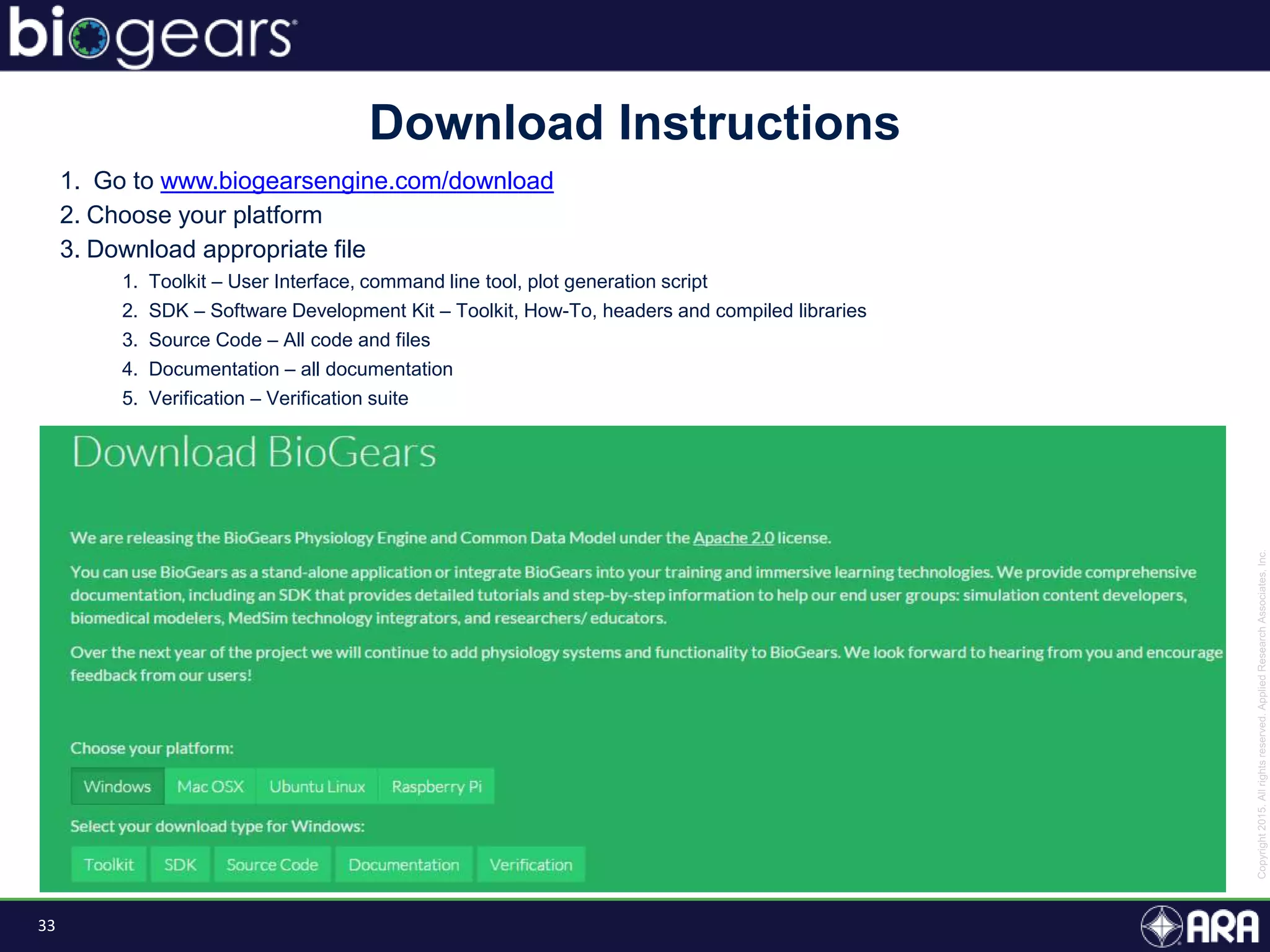
33
1. Go to www.biogearsengine.com/download
2. Choose your platform
3. Download appropriate file
1. Toolkit – User Interface, command line tool, plot generation script
2. SDK – Software Development Kit – Toolkit, How-To, headers and compiled libraries
3. Source Code – All code and files
4. Documentation – all documentation
5. Verification – Verification suite
Download Instructions
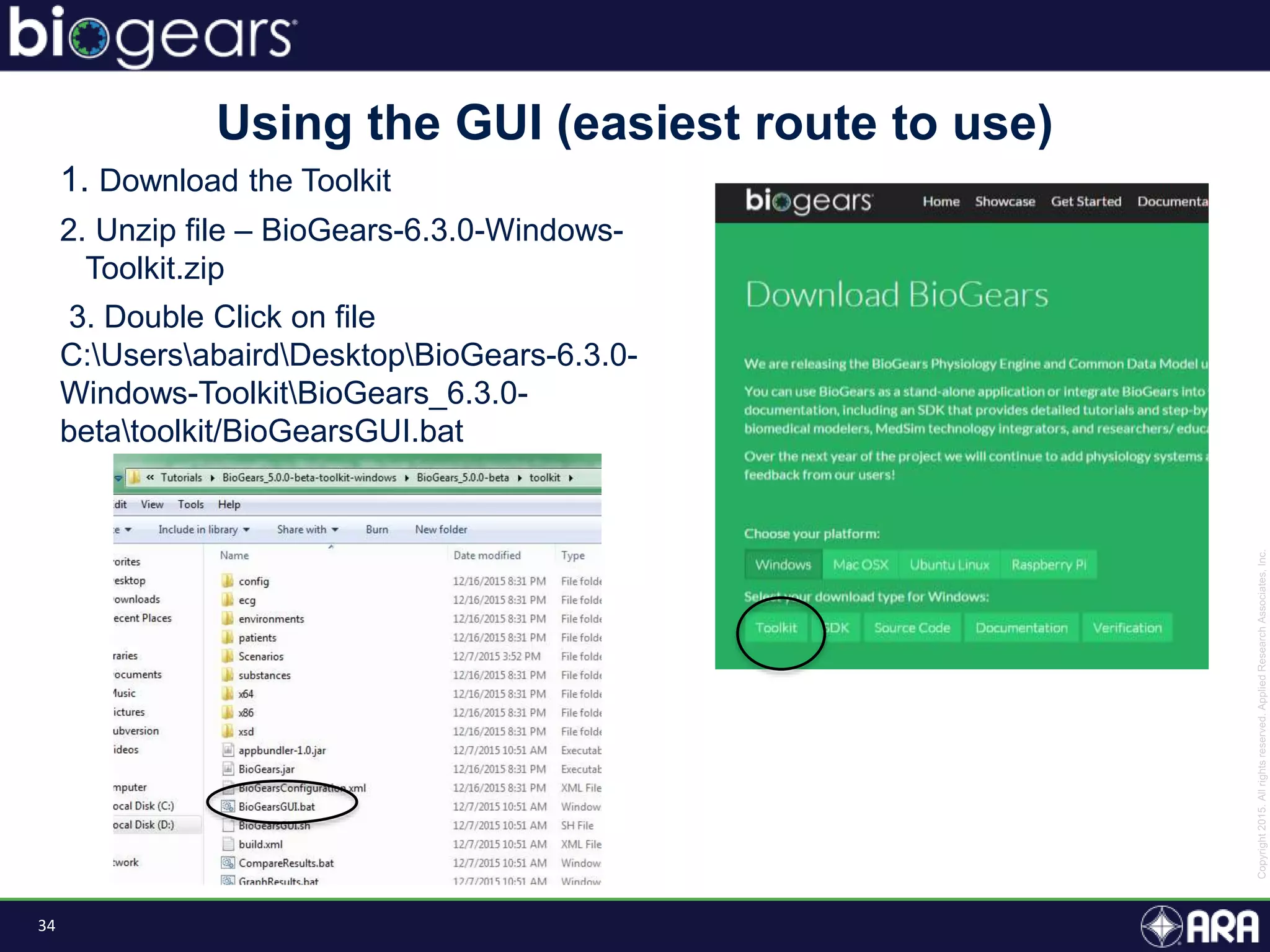
34
1. Download the Toolkit
2. Unzip file – BioGears-6.3.0-Windows-
Toolkit.zip
3. Double Click on file
C:UsersabairdDesktopBioGears-6.3.0-
Windows-ToolkitBioGears_6.3.0-
betatoolkit/BioGearsGUI.bat
Using the GUI (easiest route to use)
35 ARA Proprietary
© 2011 Applied Research Associates, Inc.
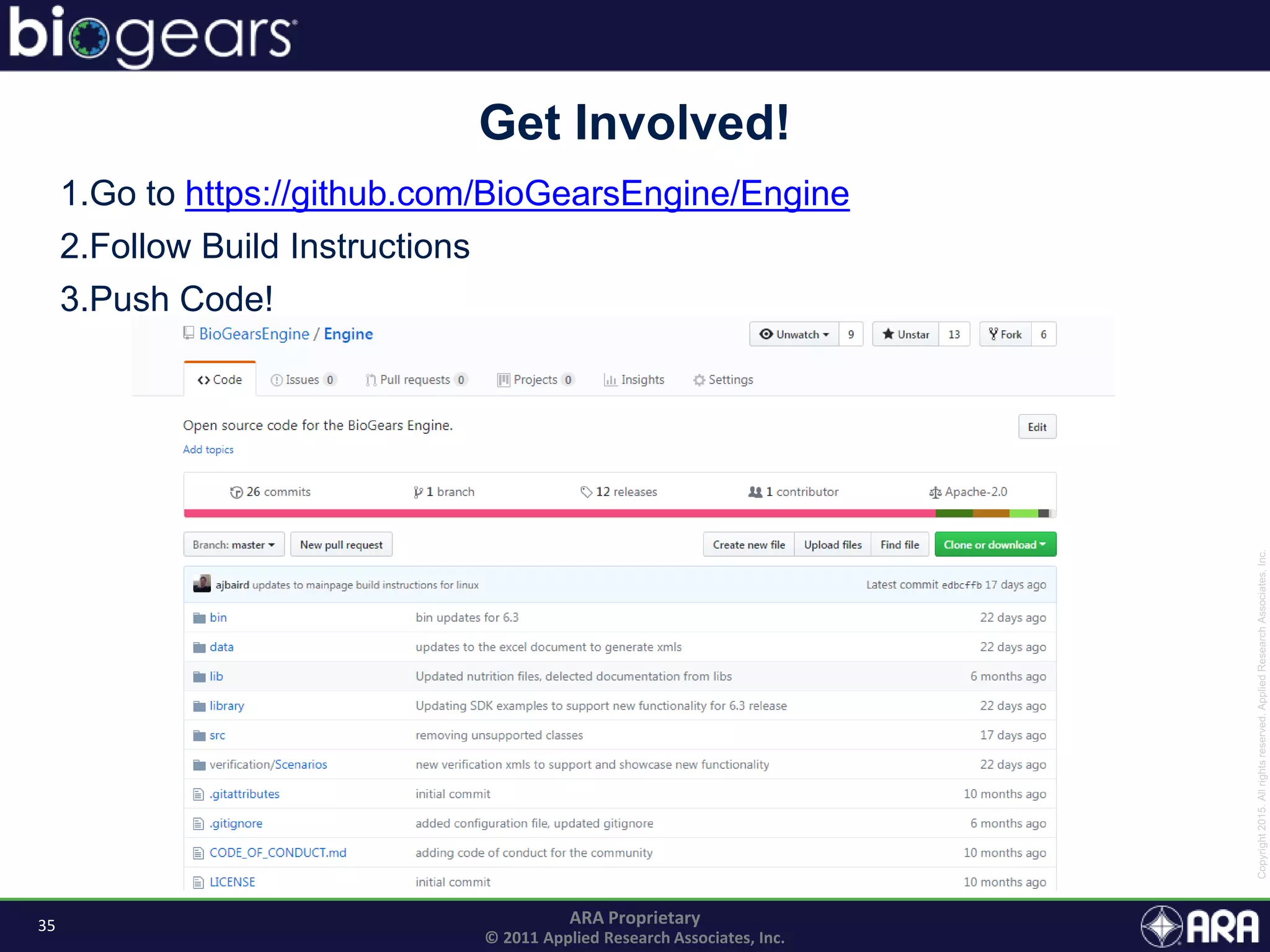
Get Involved!
1.Go to https://github.com/BioGearsEngine/Engine
2.Follow Build Instructions
3.Push Code!
36 ARA Proprietary
© 2011 Applied Research Associates, Inc.
Future Work
• Detailed and updated user interface to create a broader and easier to use
jumping-in point
• Static and dynamic execution
• View engine data
• Highly customizable for use in education and research
• Parameter override functionality to directly set an in silico patients vitals during a
simulation
• Key for use in training scenarios
• BioGears Lite: lower computational overhead and increase speed
• Customizable systems allows for off/on buttons and varying levels of fidelity
• Fully-tested and supported to run at real time on embedded Linux
platforms/devices
• State engine support (in the user interface)
• Creation of state based decision trees
• Allows for prolonged scenario description
• Could supports existing training scenarios from other physiology engines
• Many new model updates and stability/validation/performance enhancements
• Much more community involvement and application support
37
QUESTIONS

BioGears Overview for SSIH Healthcare Systems Modeling & Simulation Affinity Group

  • 1.
    1 29 March 2018 AustinBaird, PhD BioGears: A Framework for Multiscale Physiology Modeling
  • 2.
    2 Disclosures • The viewsand opinions are expressed in following presentations are presenters’ own, not representative of Society of Simulation of Healthcare(SSH), or Healthcare Systems Modeling and Simulation Affinity Group (HSMSAG) • The organizing committee do not endorse or recommend any specific products or services mentioned on this presentation. • The organizing committee do not have any personal financial interest related to the presentation.

  • 3.
    3 Healthcare Systems Modeling& Simulation Affinity Group goo.gl/PRIkog goo.gl/0r5mOs http://www.ssih.org/Interest- Groups/Healthcare-Systems-Modeling- Simulation
  • 4.
    4 1. Overview a) Introduction b)Background c) Software and Modeling 2. Running a Validated Scenario a) AMM validation scenario overview b) Results i. Modifying a scenario ii. Results 3. Conclusions Agenda
  • 5.
  • 6.
    6 • Organization: AppliedResearch Associates, Inc. (ARA) • Telemedicine & Advanced Technology Research Center (TATRC) Award #: W81XWH-13-2-0068 • Principal Investigator: Dr. Austin Baird • Amount: $6,959,593 • Period of Performance: Sept 2013 – Sept 2018 • Disclaimer: This work is supported by the US Army Medical Research and Materiel Command. The views, opinions and/or findings contained in this report are those of the author(s) and should not be construed as an official Department of the Army position, policy, or decision unless so designated by other documentation. Project Information
  • 7.
    7 High Level Objectives •Create a publicly available physiology research platform that enables accurate and consistent simulated physiology across training applications • Lower the barrier to create medical training content • Engage the community to develop and extend physiology models • Meet the training needs of the military • Expand the body of knowledge regarding the use of simulated physiology for medical education
  • 8.
    8 Physiology Engine Overview Drugs Hormones Nutrients Blood •PKModel •PD Model •Hemoglobin •Gases •Ions •Epinephrine •Norepinephrine •Insulin •glucagon •Fat •Sugars •Proteins Systems SubstancesPatients Cardiovascular system computes hemodynamics Respiratory system computes pulmonary functions Renal systems computes filtration and clearance Tissue system computes diffusion, and gas exchange Energy system computes temperature, exercise, and nutrient usage Endocrine and Nervous systems maintain homeostasis through feedback mechanisms Environment modifies ambient values and thermal properties Gastrointestinal system models the ingestion of food and transport Hepatic system supports substance clearance and nutrient management Inputs • Parameter Setting • Chronic Conditions • Insults • Interventions Outputs • Acute Events • Clinical Assessments • System Vitals • Compartment Data Scenarios • Static and Repeatable and/or • Real-Time Dynamic Interfaces Organs & Tissues Extravascular & Intravascular Homeostatic Feedback • Baroreceptors & Osmoreceptors • Chemoreceptors • Local Autoregulation Physics Based Approach • Fluid Mechanics – Gases & Fluids • Thermodynamics – Heat Transfer Substances Transport, Diffusion, & Clearance • Gases • Hemoglobin • Ions Features • Hormones • Nutrients • Drugs
  • 9.
    9 • Beta Buildreleased 12 October 2015 • 6,400+ downloads since alpha in Sept 2014 Current Users • JPC-1 Advanced Modular Manikin: Patient Simulation Hardware and Software • RDECOM Combat Medic – UnReal Serious Game • HumanSim: Sedation and Airway – Clinician Anesthesia Training • ARL: Virtual Patient – Burn model and simulation for training and hand-offs (Pre BioGears physiology) Government Use • University of North Carolina – Simulation Classroom • University of Tennesee – Undergraduate and Graduate Classroom Curriculum • Carnegie Mellon University – Nurse Training Simulation Graduate Project • University of Illinois – The Health Care Engineering Systems Center Academic Use • VCom3D – Unity Medical Simulation • IngMar Medical Devices – Respiratory Simulation Hardware and Software • ARA – Advanced Interface for inputs, outputs, waveforms, and animations Commercial Use • Open Source Tool, so many more potential projects and some applications unknown
  • 10.
  • 11.
    11 Feedback mechanisms to modifyelements for next time-step Preprocess Calculates entire engine state for the next time-step Process Advances time by moving next time-step to current Postprocess Engine Overview Computation Approach: • Time-stepping transient analysis for linearization of differential equations • Currently 50Hz for 8x real-time simulation • Dynamically change/add/remove elements to represent physiological mechanisms • Stabilization analysis for initialization and implementation of conditions • Designed with low computational overhead • Faster than real-time on typical PC, multiple instances on single or multicore processors • Build Targets include Windows, Mac, Linux, and Raspberry Pi Modeling Approach: • Top-down approach to model development with bottom-up hooks for engine expansion • Multi-scale for varying fidelity, allowing integration of models from any level Body Systems Organs Tissues Cells Proteins Genes
  • 12.
    12 • Common DataModel (CDM): Well-defined, intuitive, interchangeable format to standardize interfaces • Standardized units, and naming conventions to aid model additions and external model integrators • Application Programming Interface (API): Easy integration and interaction in any programming language • Data organized logically by Anatomy so that users are able to easily find and pull relevant data • Software Development Kit (SDK): Application examples and stand-alone execution • Tutorials, How-to’s, scenario examples Software Architecture
  • 13.
    13 BioGears System Example:Cardiovascular Design Brain Heart Arms Legs Core Approach Advantages: • Modular and extensible • Model fidelity easily modified by adding/removing nodes and elements to circuit • Fully dynamic physics based mechanistic models (rather than state based) – cascading effects • Unlimited stacking/combining of conditions, insults, interventions, interfaces, etc. • Homeostasis based modeling with pathophysiology actions • Able to integrate existing/new models • Not necessarily lumped parameter • Mixed fidelity • Able to simultaneously run any number of instances/patients Liver Gut Kidneys Core Lungs
  • 14.
    14 • Discrete entitiesthat approximate the behavior of the system • Electronic, Hydraulic, Thermal Analogy: vascular fluid dynamics and thermodynamics modeled using electrical circuit math • Generalized definitions of Nodes, Paths, and Elements for understanding, and implementation Background: Lumped Parameter Modeling Lumped Parameter Modeling of Fluids P=Pressure, F=Flow, R=Resistance, C=Compliance, I=Inertance
  • 15.
    15 ARA Proprietary ©2011 Applied Research Associates, Inc. Lumped Parameter Modeling Increasing Fidelity Lumped Parameter 1D/2D Distributed Parameter 3D Finite Element Models • 0D (lumped parameter models) are appropriate for global distribution of pressure, volume, and flow rates • Multi-compartmental models can approximate vascular distributions • 1D models display wave transport down the length of the vessel • 2D models are “cheaper” than 3D, given a tube with axial symmetry, and can resolve shear stresses along vessel wall • 3D finite element models are useful to resolve flow fields near the valves and at bifurcations of the vessels, support complex geometries
  • 16.
    16 Modularity and ExtensibilitySupports Multiscale Modeling Increased Spatial Resolution of Renal System at a Single Temporal Scale Cardiovascular Circuit Renal System
  • 17.
    17 Connection types: • Directcircuit connection – e.g. Anesthesia Machine and Respiratory • Feedback – e.g. Nervous, Endocrine and Hormones • Substance exchange – e.g. Respiratory and Cardiovascular gas exchange Patient Parameters: • Properties defined that modify system setup, circuit values, and feedback parameters • Examples: gender, weight, heart rate baseline, etc. Physiology System Interaction Environment PK/PD Cardiovascular Blood Tissue Extravascular Respiratory Anesthesia Machine Renal Gastrointestinal Energy Nervous Endocrine Inhaler Hepatic
  • 18.
    18 • Anatomical Compartments definedby sub-circuits and allow access via an anatomy tree • Compartment fluid properties are combined from children • Volume is a sum • InFlow is a sum • OutFlow is a sum • Pressure comes from an assigned child node • Substance quantities (mass, concentration, etc.) are calculated on demand Left Kidney Left Renal Artery Left Renal Vein Left Nephron Left Afferent Arteriole Left Glomerular Capillaries Left Efferent Arteriole Left Peritubular Capillaries Left Bowmans Capsules Left Tubules Left Ureter Compartment Example: Kidney Definition Key: Vascular Urine
  • 19.
    19 Engine Initialization Resting ConditionsRunning Stabilization Simulation Time = 0 • Dynamic stabilization drives towards patient homeostasis • Each step the engine executes until all specified stabilization criteria are satisfied Step 1: Patient initialization • Systems feedback modifies values to achieve specified patient parameters – e.g. baseline respiration rate, baseline mean arterial pressure • Standard environment used Step 2: Condition initialization • Conditions applied to represent new patient homeostatic state • Environment changes applied to simulate Simulation begins • Acute insults, interventions, and parameter modification applied instantaneously through actions
  • 20.
    20 BioGears Solvers Circuit Solver •Fully dynamic Modified Nodal Analysis solver for any valid closed-loop circuit • Solves circuit types with any units: Electrical, Fluid, Thermal Circuit Transporter • Substances move with the fluid to each node in the circuit • Nutrients are input into the system through the GI tract • Gas exchange occurs between the pulmonary vasculature and the alveoli • Diffusion occurs between the blood and tissue based on concentration, flow, and substance properties • Oxygen is consumed and carbon dioxide is produced in the tissues • Substances and administered drugs are cleared from the body via renal clearance, hepatic clearance, and metabolism Lung Vascular Lung Tissue Heart Kidney Tissue Kidney Vascular Lung Airway Liver Tissue Liver Vascular Other Tissue Other Vascular Bladder GI
  • 21.
    21 Pharmocokinetics (PK) andPharmacodynamics (PD) PK • Perfusion-limited diffusion • Physiochemical properties used to calculate partition coefficients, 𝐾 𝑝 • Or partition coefficient can be an input • Renal, Hepatic, and Systemic Clearance PD • Patient Physiological response is governed by the saturation of the drug at the “effect-site compartment” within the body • The rate constant is specific to the drug Drug Library Prednisone Desflurane Morphine Midazolam Fentanyl Furosemide Naloxone Insulin Succinylcholine Rocuronium Albuterol Vasopressin Epinephrine Sarin Propofol Ketamine Pralidoxime 4 hour Plasma Concentration Curve Effect-SiteConcentration Vasculatur e Extracellul ar Intracellul ar Perfusion Limited Diffusion Ion Regulation System Specific Tissue Diffusion Blood Compartment
  • 22.
    22 Worked with subcontractorUNC Eshelman School of Pharmacy Pharmacodynamics also validated through scenario validation All drugs validated in this manor PK/Clearance Validation Examples Fentanyl-Bolus Morphine-Bolus Midazolam-Bolus Propofol-Infusion
  • 23.
    23 Modifying Engine Inputs ModifiableFiles Patients Substances Compounds Environments Scenarios Patient File Excerpt Weight CarinaToTeethDistance Contractility FunctionalResidualCapacity HeartRateBasline MaximumPulmonaryVentilationRate MeanArterialPressure Minimum Stroke Volume RespirationRateBaseline RightLungRatio TotalBloodVolume Tidal Volume varies with weight Circuit is modified to vary arterial pressure Driver is modified to vary heart rate 1 2 3 1 2 3 Files can be modified directly in the XML (text) files
  • 24.
    24 1. Verification: Unittests ensure correct implementation and sound physics principles for all tools 2. System Level Validation: Clinical output level data 3. Compartment Level Validation: Compartments are validated wherever possible 4. Scenario Calibration & Validation Insult, intervention, and assessment includes a matrix with validation data for whole body combined effects from multiple systems 5. Combined Scenario Validation: All four showcases and several other scenarios validated for combined effects – heavily leveraged SME consultants Bryan Bergeron MD and Nicholas Moss PhD System System Parameters Compartment Parameters Patient 17 0 Blood Chemistry 42 0 Cardiovascular 22 68 Respiratory 16 35 Energy 5 0 Renal 45 78 Tissue 8 26 Major System Validation Parameter Count Calibration and Validation
  • 25.
  • 26.
    26 ARA Proprietary ©2011 Applied Research Associates, Inc. Work With Advanced Modular Manikin • Working with AMM to provide the physiology “backbone” to their robotic manikin • Includes updating/creating new models • Working on SDK integration to dynamically simulate patient response • Provide all possible output data and updating our CDM • Work with team to validate engine for 5 key scenarios dictated by their team at UMN’s anesthesiology department • Work on publications and use cases with fellows at UW to provide more peer reviewed documentation for BioGears • Proposed team on future efforts Two way street to support core application
  • 27.
    27 ARA Proprietary ©2011 Applied Research Associates, Inc. Scenario Description Pneumothorax: Parameters: HR, BP, MAP, PAP, CVP, CO, RR, tidal volume, Sp02, PaC02, total lung volume, transpulmonary pressure Protocol: Run each of 4 severities: 1. until parameters stable or endpoint reached 2. for 3 minutes, then off, then for 3 minutes 3. for 3 minutes, then "needle decompression" or "chest tube" intervention (set transthoracic pressure to 0 mmHg to simulate an "open chest") and run for 3 min, • Mild tension pneumothorax (TPT) - +10 mmHg intrathoracic pressure (normal baseline is -4 mmHg) • moderate TPT - +15 mmHg • severe TPT - +20 mmHg • open pneumothorax - 0 mmHg BioGears lumped parameter circuit model for Pneumothorax and the treatments involved Open TPT & Occlusive Dressing
  • 28.
    28 ARA Proprietary ©2011 Applied Research Associates, Inc. Results: Modifying a Scenario Generic “code-agnostic” scenario xml file example, can be “pre-programed SDK “HowTo- TensionPneumothorax.cpp file example, dynamic execution
  • 29.
    29 ARA Proprietary ©2011 Applied Research Associates, Inc. Results • Scenarios show a 6 minute sustained closed tension pneumothorax • Respiration rate initial decrease at the circuit stabilizes to the initial action • Tachypnea happens after initial decrease and stabilizes at this higher rate • Decreased tidal volume is consistent with collapse of the lung under pressure • Can be used as a training tool for needle decompression or chest tube insertion • Can be used as a research tool to investigate different patient responses to injury • Recover rate for a diabetic? • Other treatments needed for combined respiratory insults?
  • 30.
  • 31.
    31 Conclusions Commercial Integrators Academic CollaboratorsGovernmentPrograms • BioGears is gaining popularity – 6,300+ downloads since the Alpha Build Release (October 2014) • Adoption, contribution, and collaboration encouraged by the highly permissive open source license (Apache 2.0) • As a whole-body system, BioGears provides insight into integrating models for individualized medical simulation USAMRMC: Advanced Modular Manikin (4 teams) – Patient simulation hardware and software RDECOM: Combat Medic, Virtual Patient – UnReal serious game and arcuate burn model/handoff trainer TATRC: HumanSim Sedation and Airway – clinician anesthesia training PEOSTRI: Medical Simulation Training Architecture RIF - requires open framework with direct reference to BioGears DHP: Warrior Health Avatar SBIR references BioBears directly
  • 32.
    32 Documentation and Tutorials •The website includes detailed documentation for each physiology system and software components (e.g., CDM, Toolkit, SDK, Source Code) • This includes text and tables that explain: system background, model limitations, equations used, and validation data sources and matrices • https://www.biogearsengine.com • Github site for course code, pushing changes, and logging errors/bugs https://github.com/BioGearsEngine/
  • 33.
    33 1. Go towww.biogearsengine.com/download 2. Choose your platform 3. Download appropriate file 1. Toolkit – User Interface, command line tool, plot generation script 2. SDK – Software Development Kit – Toolkit, How-To, headers and compiled libraries 3. Source Code – All code and files 4. Documentation – all documentation 5. Verification – Verification suite Download Instructions
  • 34.
    34 1. Download theToolkit 2. Unzip file – BioGears-6.3.0-Windows- Toolkit.zip 3. Double Click on file C:UsersabairdDesktopBioGears-6.3.0- Windows-ToolkitBioGears_6.3.0- betatoolkit/BioGearsGUI.bat Using the GUI (easiest route to use)
  • 35.
    35 ARA Proprietary ©2011 Applied Research Associates, Inc. Get Involved! 1.Go to https://github.com/BioGearsEngine/Engine 2.Follow Build Instructions 3.Push Code!
  • 36.
    36 ARA Proprietary ©2011 Applied Research Associates, Inc. Future Work • Detailed and updated user interface to create a broader and easier to use jumping-in point • Static and dynamic execution • View engine data • Highly customizable for use in education and research • Parameter override functionality to directly set an in silico patients vitals during a simulation • Key for use in training scenarios • BioGears Lite: lower computational overhead and increase speed • Customizable systems allows for off/on buttons and varying levels of fidelity • Fully-tested and supported to run at real time on embedded Linux platforms/devices • State engine support (in the user interface) • Creation of state based decision trees • Allows for prolonged scenario description • Could supports existing training scenarios from other physiology engines • Many new model updates and stability/validation/performance enhancements • Much more community involvement and application support
  • 37.

Editor's Notes

  • #8 Our major driver is to produce a useable engine that can be extended over time BioGears has been released under a permissable (Apache 2.0) open source license
  • #9 This slide represents high level systems and features of the current scope of BioGears BioGears includes multiple external interfaces – such as the anesthesia machine. As we expand the scope of BioGears, we anticipate being able to
  • #13 Common physiology system level model for modeling and simulation of the human body Provides a well-defined data interchange format that disparate models can use for standardizing inputs and outputs between each other Object Oriented Design of class structures providing a unified set of tools that promotes fast development, compatible data sets, and well-defined interfaces Separates the physiological data from the physiological modeling methodology Prevents “engineer” code mixing with data organization and design Strongly typed design that is intended to grow via community adoption and involvement Extension allowed for model specific extensions, but interfaces are defined by the common data model
  • #17 BioGears is designed with modularity and extensibility in mind. Here is one case where we increased the spatial resolution by discretizing the lumped-parameter model. If you download the next version of BioGears, which should deploy in the next few weeks, you’ll notice that there are actually two renal circuits in the circuits file. That’s because the original 3-element model was not sufficient. We increased the spatial resolution of the renal system to meet the requirements. Of course, this is only one method for changing the spatial scale. One could easily interface between the lumped model and a continuous model. I will show you an example of that in just a moment. By defining a framework for multiscale physiology simulation, BioGears takes a step towards individualized, predictive healthcare simulation. The BioGears framework facilitates a “middle-out” approach to multiscale modelling. New models are integrated with existing models in BioGears by ensuring that they meet the minimum data requirements for integration, and new interaction requirements will continue to be defined as models move higher or lower in the scale hierarchy. In other words, the modelling approach itself is extensible.
  • #32 In conclusion, BioGears continues to gain trust and acceptance, and we anticipate interest and adoption to continue to increase. In fact, BioGears has been specifically mentioned in several recent requests for information and proposals by the US Government. As more people use BioGears and ultimately begin to contribute, we believe that the models will only get better. By constructing definitions and methodologies to facilitate community development, BioGears has elucidated possible solutions to the challenge of integration for building truly multiscale models of whole-body physiology.