COMPUTER SIMULATIONS IN
PHARMACOKINETICS AND
PHARMACODYNAMICS
Presented By: Dr Nawaz Mahammed
Associate Professor
RIPER, Anantapur
• A computer simulation or a computer
model is a computer program that attempts
to simulate an abstract model of a
particular system.
• Computer simulation in the field of
Pharmacokinetic and Pharmacodynamics or
in silica model is need of the hour in the
biomedical field.
• Computational resources available today,
large-scale models of the body can be used
to produce realistic simulations.
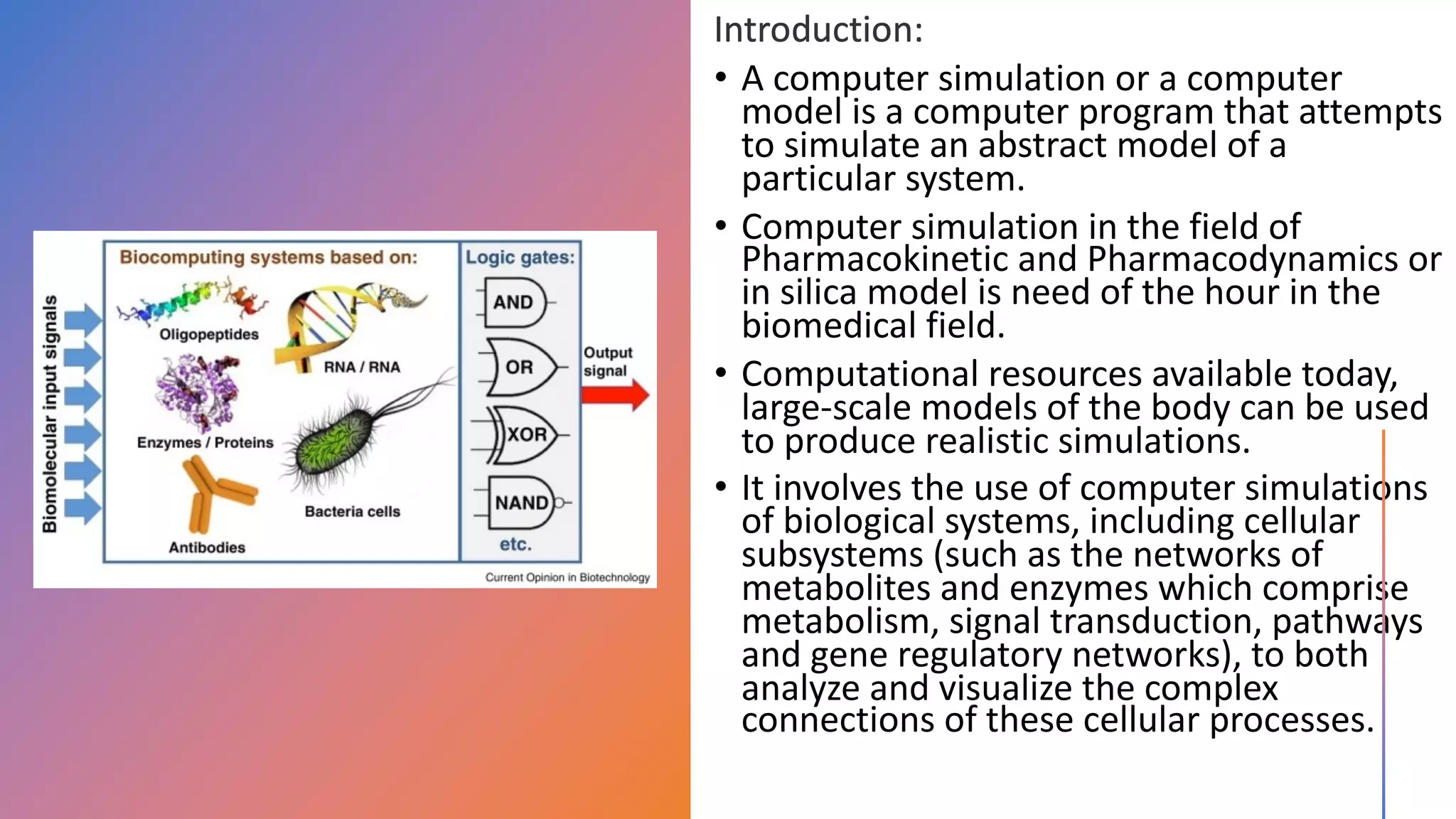
• It involves the use of computer simulations
of biological systems, including cellular
subsystems (such as the networks of
metabolites and enzymes which comprise
metabolism, signal transduction, pathways
and gene regulatory networks), to both
analyze and visualize the complex
connections of these cellular processes.
• The process to create an imitation of real world system or
physical object into a computer model.
Performing experiments to understand the
behavior of system and evaluating new
strategies.
• Then observing events, processes, properties
and behavior of system, with computer
model. What is Computer Simulation
• According to Guyton and other holistic
physiologists, a living homeostatic system was
thought of as being comprised of a series of
interacting parts, or sub systems, an
understanding of which was deemed
essential to comprehension of the complex
dynamics of the whole.
• It was believed that only through information
gathered on the macroscopic behavior of the
whole could one understand the inner
workings of the parts.
• Aristotle’s proposal that “the whole is more than the
sum of the parts,” direct investigation of the living
system was essential.
• The approach was “top to bottom.” pharmaceutical
sciences from clinical pharmacology to molecular
pharmacology.
• The FDA,-advances in bio computation and has
introduced recent developments in computational
modeling in the development process through the
issue of guidances and consensus documents.
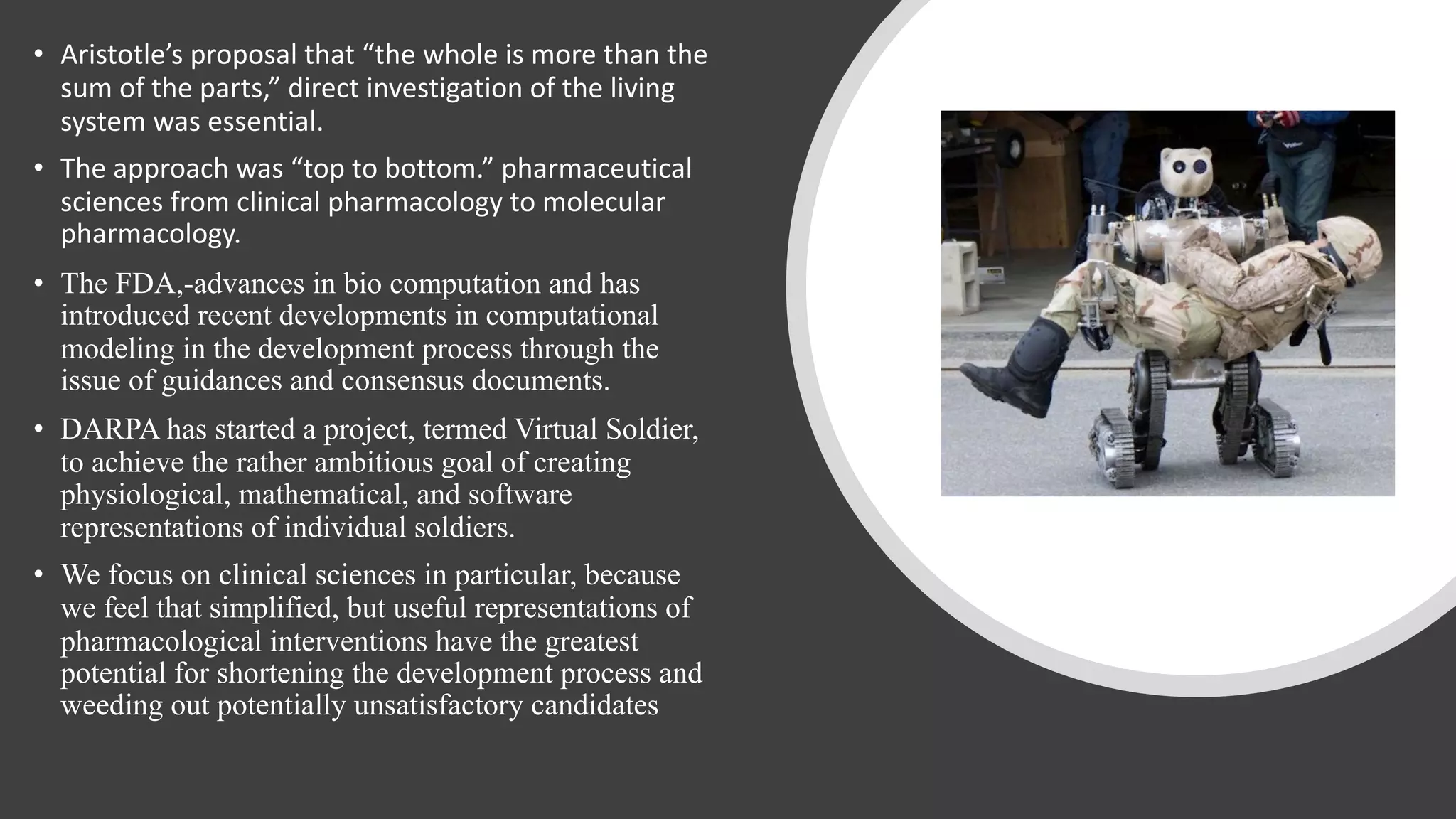
• DARPA has started a project, termed Virtual Soldier,
to achieve the rather ambitious goal of creating
physiological, mathematical, and software
representations of individual soldiers.
• We focus on clinical sciences in particular, because
we feel that simplified, but useful representations of
pharmacological interventions have the greatest
potential for shortening the development process and
weeding out potentially unsatisfactory candidates
COMPUTER SIMULATION OF THE
WHOLE ORGANISM
• For the formation of the model simulation
of the whole organism is very important.
• The whole organism can be mathematically
represented which mimic the whole
physiological condition through the
simulation of the whole organism.
• The whole series of the organ can be
generated for the clinical trial purpose.
• There are two approaches for simulation of
whole organism A. PK/PD model B. PBPK
model Level 1 Computer simulation of
whole organism
• t is used to describe the exposure-response
relationship.
• Model is coupled with a model of a
diseased state. •It can be described by
Linear model, E max model, Sigmoidal E
max model.
• Some complex model can be describe by
Indirect PK/PD model,
• Indirect response model, cell lifespan
model, complex response model. A. PK/PD
model Purpose
• To estimate therapeutic window • Dose
selection • Identify mechanism of action
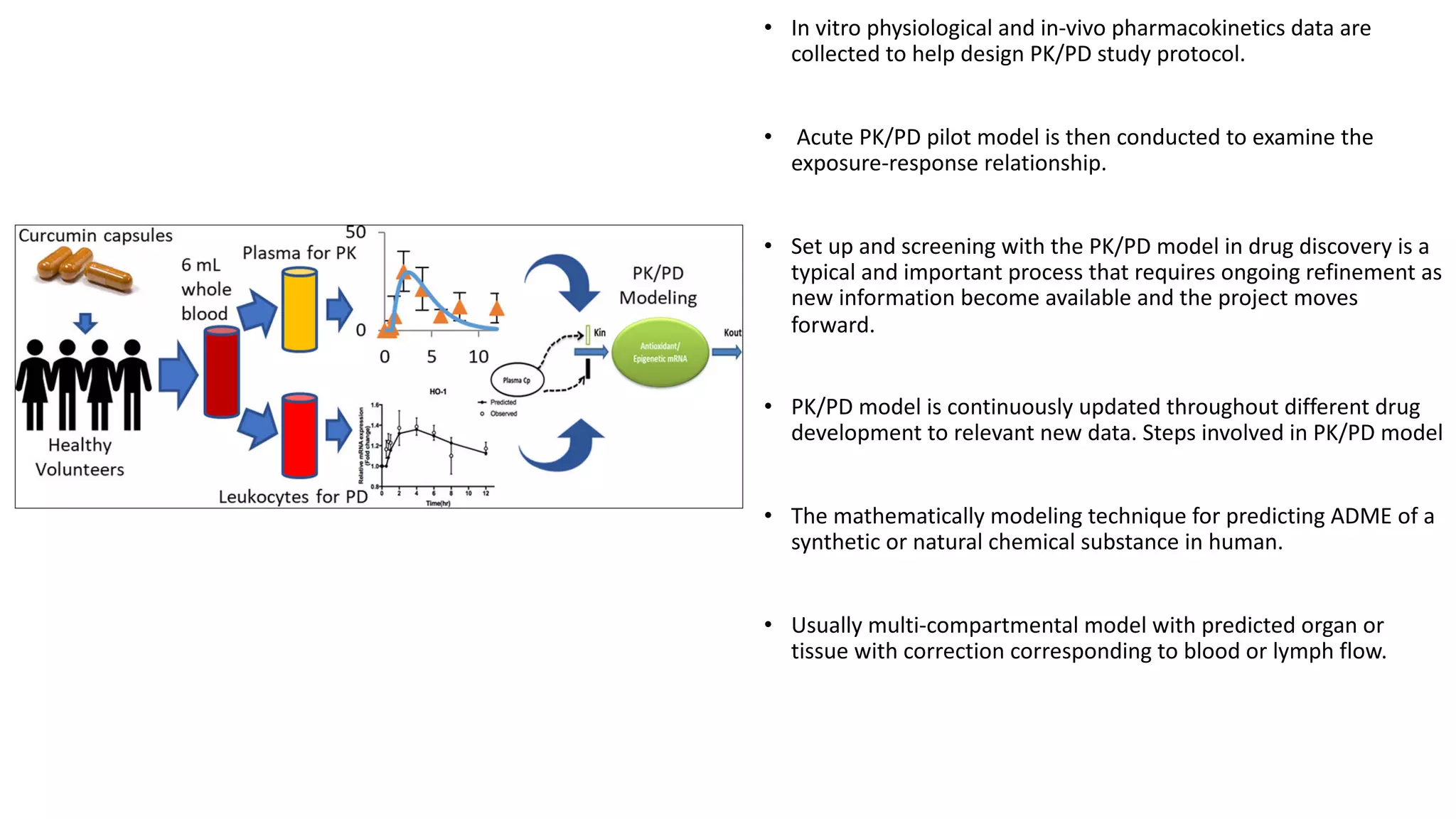
• In vitro physiological and in-vivo pharmacokinetics data are
collected to help design PK/PD study protocol.
• Acute PK/PD pilot model is then conducted to examine the
exposure-response relationship.
• Set up and screening with the PK/PD model in drug discovery is a
typical and important process that requires ongoing refinement as
new information become available and the project moves
forward.
• PK/PD model is continuously updated throughout different drug
development to relevant new data. Steps involved in PK/PD model
• The mathematically modeling technique for predicting ADME of a
synthetic or natural chemical substance in human.
• Usually multi-compartmental model with predicted organ or
tissue with correction corresponding to blood or lymph flow.
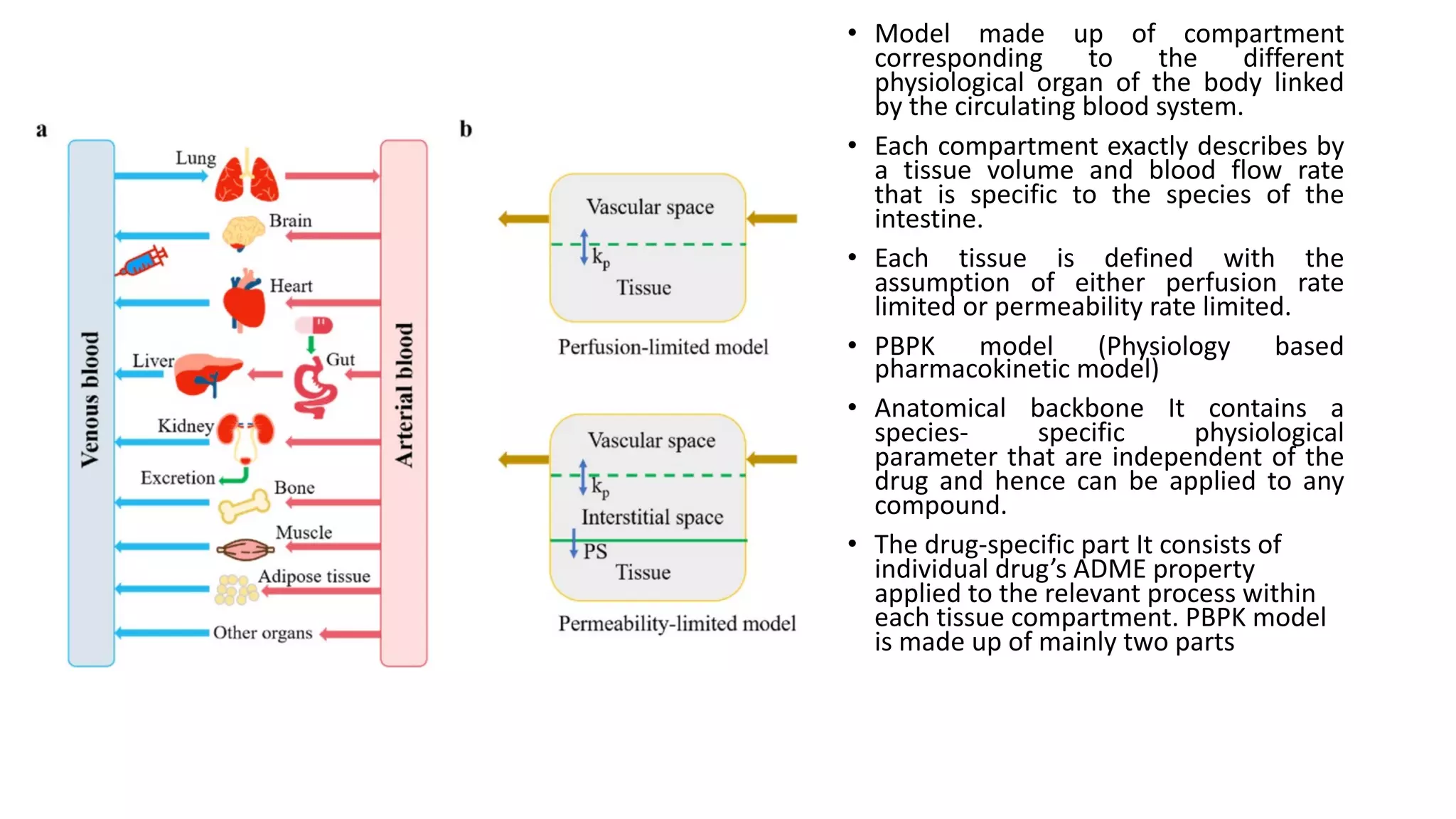
• Model made up of compartment
corresponding to the different
physiological organ of the body linked
by the circulating blood system.
• Each compartment exactly describes by
a tissue volume and blood flow rate
that is specific to the species of the
intestine.
• Each tissue is defined with the
assumption of either perfusion rate
limited or permeability rate limited.
• PBPK model (Physiology based
pharmacokinetic model)
• Anatomical backbone It contains a
species- specific physiological
parameter that are independent of the
drug and hence can be applied to any
compound.
• The drug-specific part It consists of
individual drug’s ADME property
applied to the relevant process within
each tissue compartment. PBPK model
is made up of mainly two parts
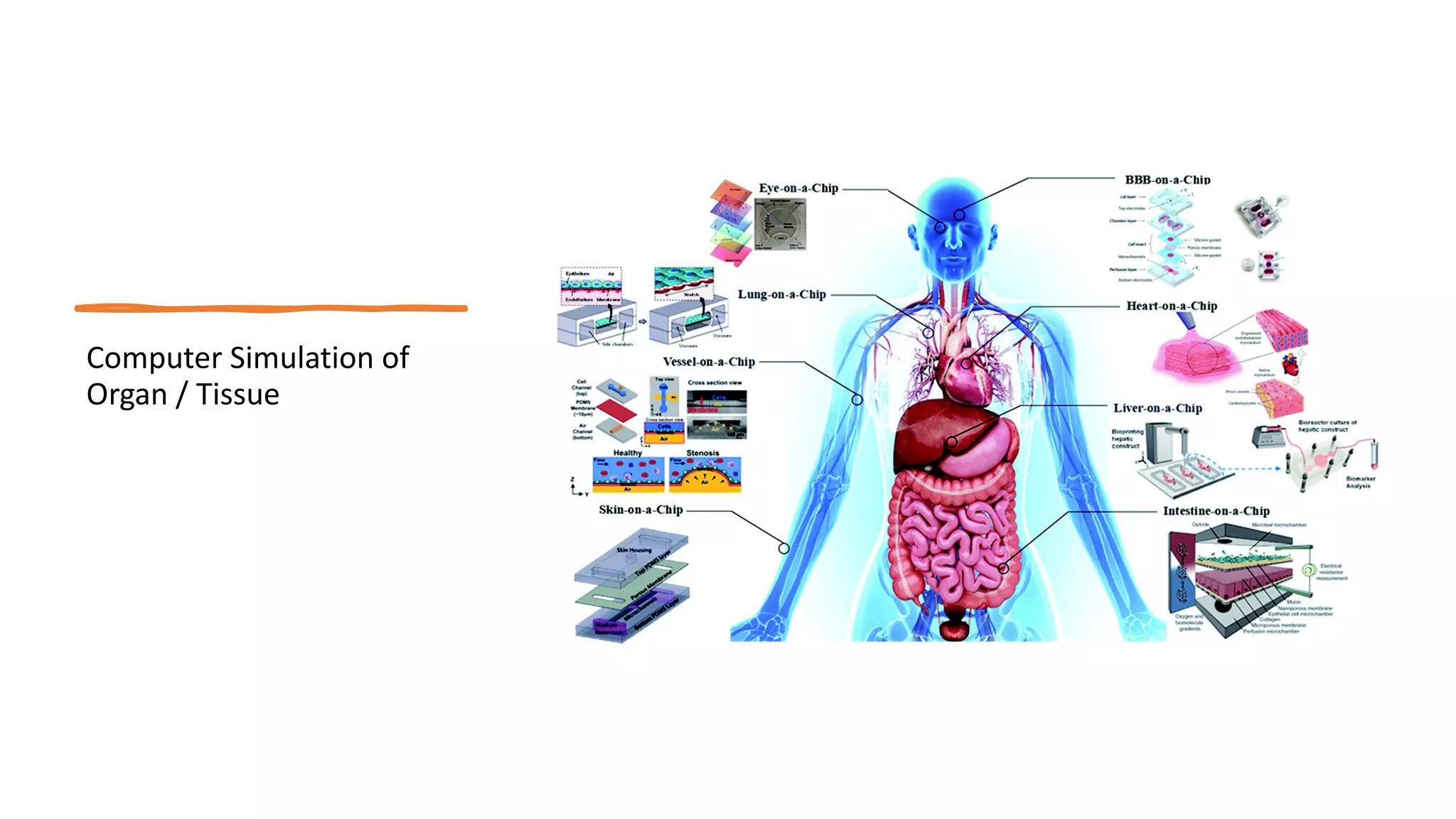
Computer Simulation of
Organ / Tissue
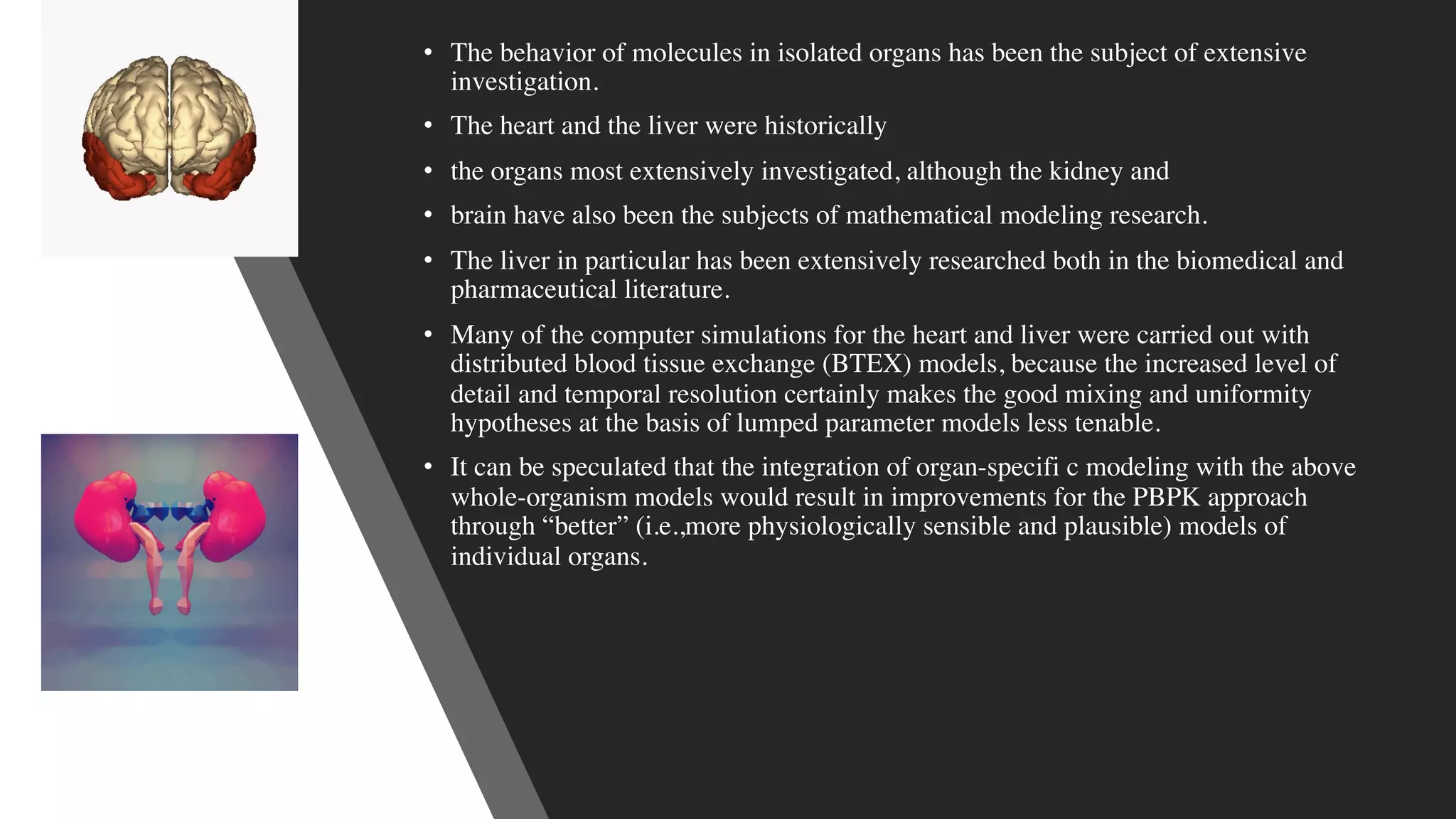
• The behavior of molecules in isolated organs has been the subject of extensive
investigation.
• The heart and the liver were historically
• the organs most extensively investigated, although the kidney and
• brain have also been the subjects of mathematical modeling research.
• The liver in particular has been extensively researched both in the biomedical and
pharmaceutical literature.
• Many of the computer simulations for the heart and liver were carried out with
distributed blood tissue exchange (BTEX) models, because the increased level of
detail and temporal resolution certainly makes the good mixing and uniformity
hypotheses at the basis of lumped parameter models less tenable.
• It can be speculated that the integration of organ-specifi c modeling with the above
whole-organism models would result in improvements for the PBPK approach
through “better” (i.e.,more physiologically sensible and plausible) models of
individual organs.
• New project funded by the National Institute for General Medical Sciences at the NIH, the Center
for Modeling Integrated Metabolic Systems (MIMS) [41], has as its mission the development and
integration of in vivo, organ-specific mathematical models that can successfully predict behaviors
for a range of parameters,including rest and exercise and various pathophysiological conditions.
• The Microcirculation Physiome [42] and the Cardiome [43] are other multicenter projects focused
on particular aspects of the Physiome undertaking.
• It seems widely accepted that the development of integrated computational representations of
biological systems has to borrow from many fi elds, if nothing else because of the
multidisciplinary complexity that some of these endeavor simply.
LEVEL 3: COMPUTER SIMULATIONS
OF THE CELL
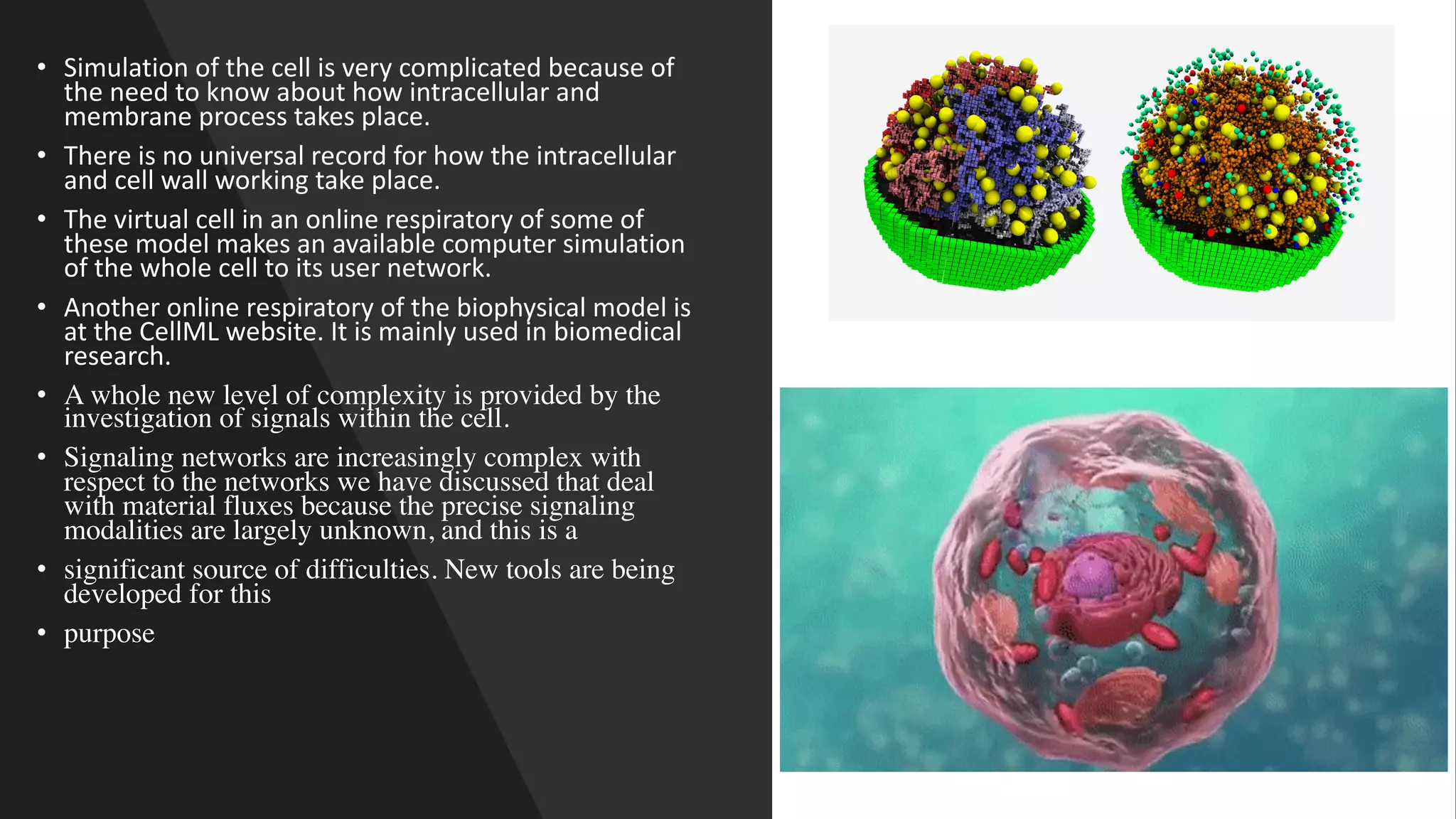
• Simulation of the cell is very complicated because of
the need to know about how intracellular and
membrane process takes place.
• There is no universal record for how the intracellular
and cell wall working take place.
• The virtual cell in an online respiratory of some of
these model makes an available computer simulation
of the whole cell to its user network.
• Another online respiratory of the biophysical model is
at the CellML website. It is mainly used in biomedical
research.
• A whole new level of complexity is provided by the
investigation of signals within the cell.
• Signaling networks are increasingly complex with
respect to the networks we have discussed that deal
with material fluxes because the precise signaling
modalities are largely unknown, and this is a
• significant source of difficulties. New tools are being
developed for this
• purpose
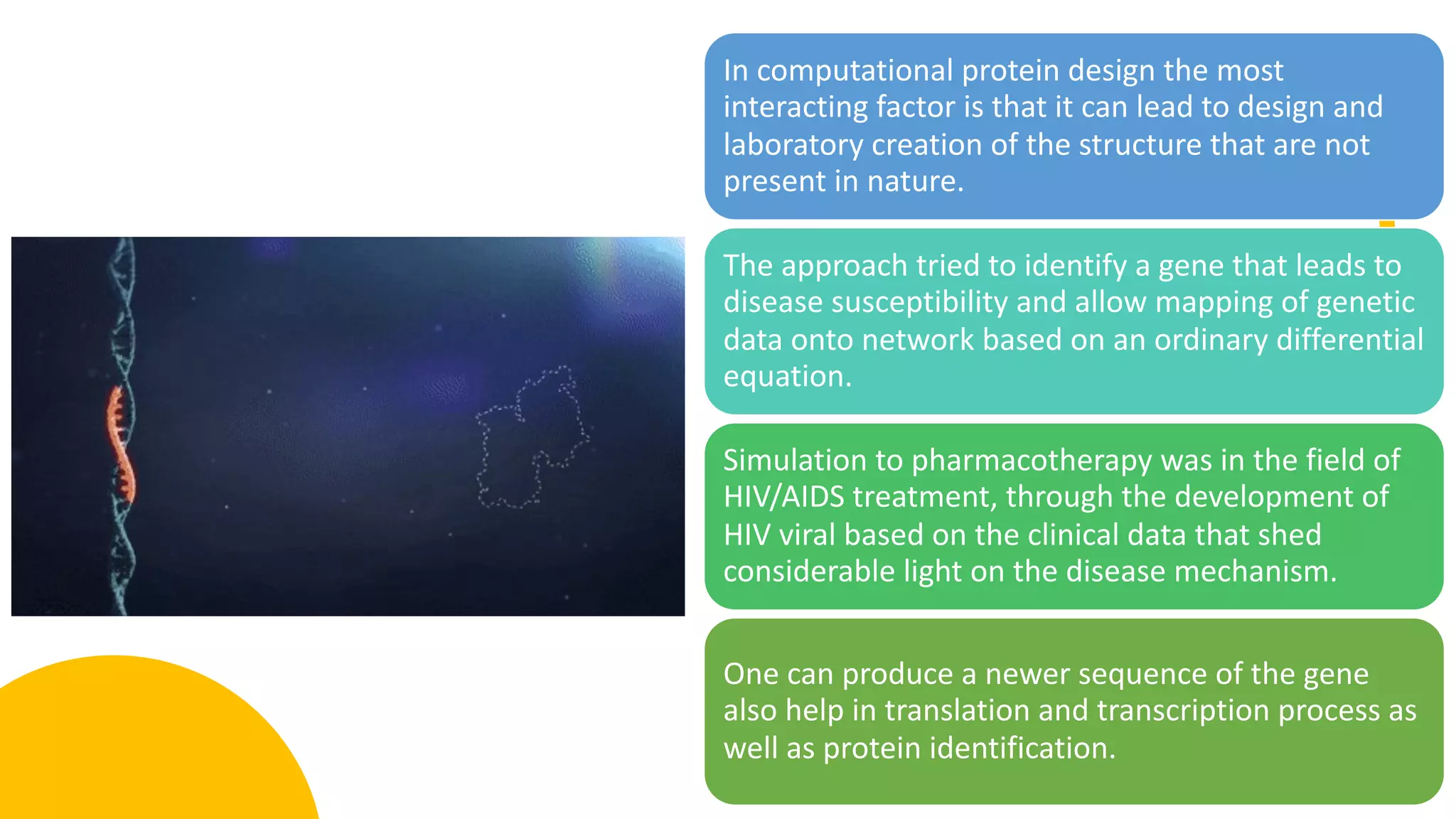
LEVEL 4: PROTEINS AND GEN
In computational protein design the most
interacting factor is that it can lead to design and
laboratory creation of the structure that are not
present in nature.
The approach tried to identify a gene that leads to
disease susceptibility and allow mapping of genetic
data onto network based on an ordinary differential
equation.
Simulation to pharmacotherapy was in the field of
HIV/AIDS treatment, through the development of
HIV viral based on the clinical data that shed
considerable light on the disease mechanism.
One can produce a newer sequence of the gene
also help in translation and transcription process as
well as protein identification.
Thank You

COMPUTER SIMULATIONS IN PHARMACOKINETICS AND PHARMACODYNAMICS

  • 1.
    COMPUTER SIMULATIONS IN PHARMACOKINETICSAND PHARMACODYNAMICS Presented By: Dr Nawaz Mahammed Associate Professor RIPER, Anantapur
  • 2.
    • A computersimulation or a computer model is a computer program that attempts to simulate an abstract model of a particular system. • Computer simulation in the field of Pharmacokinetic and Pharmacodynamics or in silica model is need of the hour in the biomedical field. • Computational resources available today, large-scale models of the body can be used to produce realistic simulations. • It involves the use of computer simulations of biological systems, including cellular subsystems (such as the networks of metabolites and enzymes which comprise metabolism, signal transduction, pathways and gene regulatory networks), to both analyze and visualize the complex connections of these cellular processes.
  • 3.
    • The processto create an imitation of real world system or physical object into a computer model. Performing experiments to understand the behavior of system and evaluating new strategies. • Then observing events, processes, properties and behavior of system, with computer model. What is Computer Simulation • According to Guyton and other holistic physiologists, a living homeostatic system was thought of as being comprised of a series of interacting parts, or sub systems, an understanding of which was deemed essential to comprehension of the complex dynamics of the whole. • It was believed that only through information gathered on the macroscopic behavior of the whole could one understand the inner workings of the parts.
  • 4.
    • Aristotle’s proposalthat “the whole is more than the sum of the parts,” direct investigation of the living system was essential. • The approach was “top to bottom.” pharmaceutical sciences from clinical pharmacology to molecular pharmacology. • The FDA,-advances in bio computation and has introduced recent developments in computational modeling in the development process through the issue of guidances and consensus documents. • DARPA has started a project, termed Virtual Soldier, to achieve the rather ambitious goal of creating physiological, mathematical, and software representations of individual soldiers. • We focus on clinical sciences in particular, because we feel that simplified, but useful representations of pharmacological interventions have the greatest potential for shortening the development process and weeding out potentially unsatisfactory candidates
  • 5.
    COMPUTER SIMULATION OFTHE WHOLE ORGANISM
  • 6.
    • For theformation of the model simulation of the whole organism is very important. • The whole organism can be mathematically represented which mimic the whole physiological condition through the simulation of the whole organism. • The whole series of the organ can be generated for the clinical trial purpose. • There are two approaches for simulation of whole organism A. PK/PD model B. PBPK model Level 1 Computer simulation of whole organism • t is used to describe the exposure-response relationship. • Model is coupled with a model of a diseased state. •It can be described by Linear model, E max model, Sigmoidal E max model. • Some complex model can be describe by Indirect PK/PD model, • Indirect response model, cell lifespan model, complex response model. A. PK/PD model Purpose • To estimate therapeutic window • Dose selection • Identify mechanism of action
  • 7.
    • In vitrophysiological and in-vivo pharmacokinetics data are collected to help design PK/PD study protocol. • Acute PK/PD pilot model is then conducted to examine the exposure-response relationship. • Set up and screening with the PK/PD model in drug discovery is a typical and important process that requires ongoing refinement as new information become available and the project moves forward. • PK/PD model is continuously updated throughout different drug development to relevant new data. Steps involved in PK/PD model • The mathematically modeling technique for predicting ADME of a synthetic or natural chemical substance in human. • Usually multi-compartmental model with predicted organ or tissue with correction corresponding to blood or lymph flow.
  • 8.
    • Model madeup of compartment corresponding to the different physiological organ of the body linked by the circulating blood system. • Each compartment exactly describes by a tissue volume and blood flow rate that is specific to the species of the intestine. • Each tissue is defined with the assumption of either perfusion rate limited or permeability rate limited. • PBPK model (Physiology based pharmacokinetic model) • Anatomical backbone It contains a species- specific physiological parameter that are independent of the drug and hence can be applied to any compound. • The drug-specific part It consists of individual drug’s ADME property applied to the relevant process within each tissue compartment. PBPK model is made up of mainly two parts
  • 9.
  • 10.
    • The behaviorof molecules in isolated organs has been the subject of extensive investigation. • The heart and the liver were historically • the organs most extensively investigated, although the kidney and • brain have also been the subjects of mathematical modeling research. • The liver in particular has been extensively researched both in the biomedical and pharmaceutical literature. • Many of the computer simulations for the heart and liver were carried out with distributed blood tissue exchange (BTEX) models, because the increased level of detail and temporal resolution certainly makes the good mixing and uniformity hypotheses at the basis of lumped parameter models less tenable. • It can be speculated that the integration of organ-specifi c modeling with the above whole-organism models would result in improvements for the PBPK approach through “better” (i.e.,more physiologically sensible and plausible) models of individual organs.
  • 11.
    • New projectfunded by the National Institute for General Medical Sciences at the NIH, the Center for Modeling Integrated Metabolic Systems (MIMS) [41], has as its mission the development and integration of in vivo, organ-specific mathematical models that can successfully predict behaviors for a range of parameters,including rest and exercise and various pathophysiological conditions. • The Microcirculation Physiome [42] and the Cardiome [43] are other multicenter projects focused on particular aspects of the Physiome undertaking. • It seems widely accepted that the development of integrated computational representations of biological systems has to borrow from many fi elds, if nothing else because of the multidisciplinary complexity that some of these endeavor simply.
  • 12.
    LEVEL 3: COMPUTERSIMULATIONS OF THE CELL
  • 13.
    • Simulation ofthe cell is very complicated because of the need to know about how intracellular and membrane process takes place. • There is no universal record for how the intracellular and cell wall working take place. • The virtual cell in an online respiratory of some of these model makes an available computer simulation of the whole cell to its user network. • Another online respiratory of the biophysical model is at the CellML website. It is mainly used in biomedical research. • A whole new level of complexity is provided by the investigation of signals within the cell. • Signaling networks are increasingly complex with respect to the networks we have discussed that deal with material fluxes because the precise signaling modalities are largely unknown, and this is a • significant source of difficulties. New tools are being developed for this • purpose
  • 14.
  • 15.
    In computational proteindesign the most interacting factor is that it can lead to design and laboratory creation of the structure that are not present in nature. The approach tried to identify a gene that leads to disease susceptibility and allow mapping of genetic data onto network based on an ordinary differential equation. Simulation to pharmacotherapy was in the field of HIV/AIDS treatment, through the development of HIV viral based on the clinical data that shed considerable light on the disease mechanism. One can produce a newer sequence of the gene also help in translation and transcription process as well as protein identification.
  • 16.