“STRUCTURE BASED DRUG DESIGN”
STUTI GUPTA
NUID: 002685313
CHEM5620
PROTEIN
CHEMISTRY
PROF. W STEPHEN
FARACI
INTRODUCTION TO STRUCTURE-BASED
DRUG DESIGN
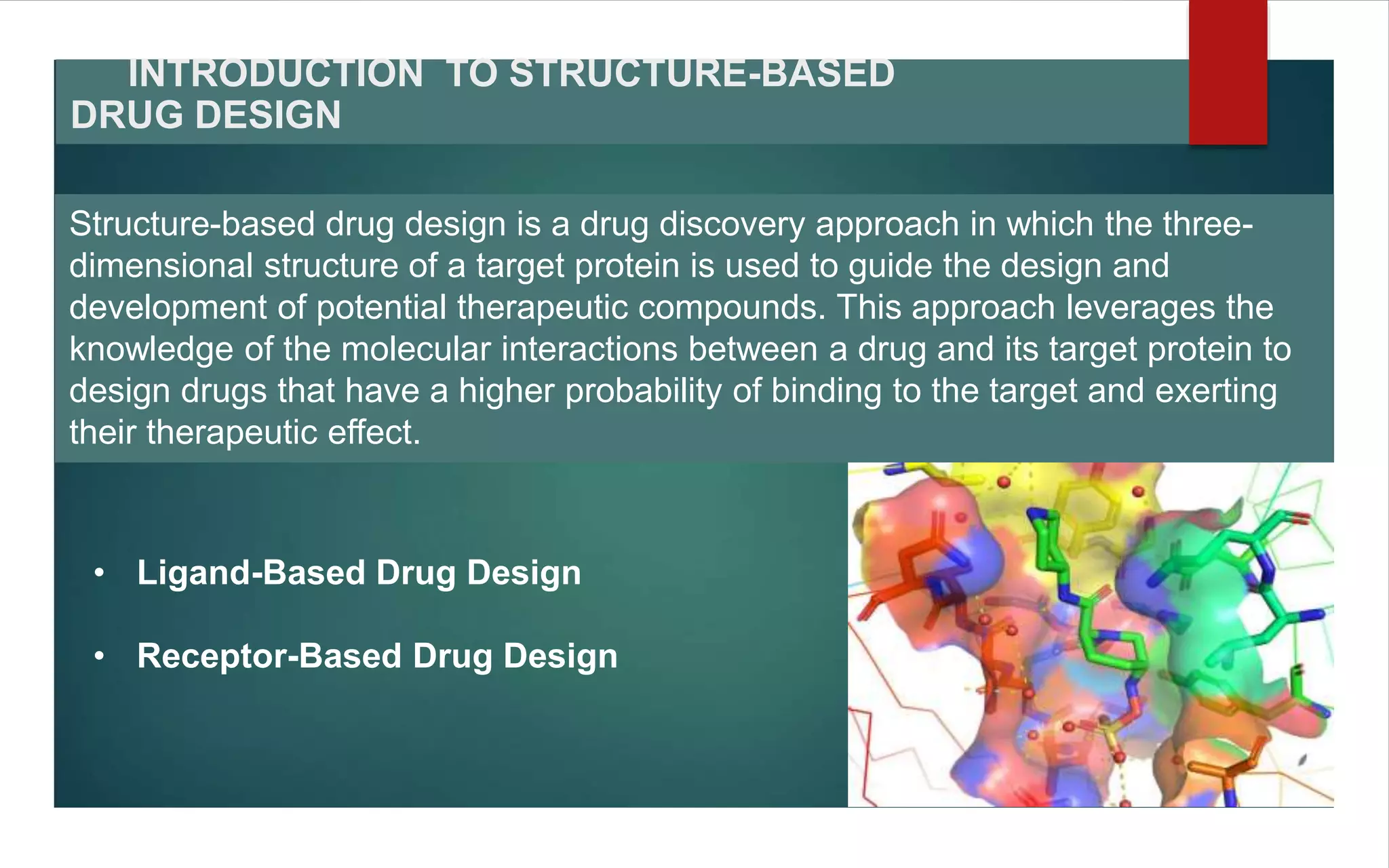
Structure-based drug design is a drug discovery approach in which the three-
dimensional structure of a target protein is used to guide the design and
development of potential therapeutic compounds. This approach leverages the
knowledge of the molecular interactions between a drug and its target protein to
design drugs that have a higher probability of binding to the target and exerting
their therapeutic effect.
• Ligand-Based Drug Design
• Receptor-Based Drug Design
STRUCTURE BASED DRUG DESIGN PIPELINE
SBDD:
"RELEVANCE TO
PROTEIN
CHEMISTRY"
Structure-based drug design is relevant
to protein chemistry because proteins
play a critical role in many biological
processes and are often the target of
drugs. Proteins are complex molecules
that carry out a wide range of functions
within cells, and they do so through their
specific three-dimensional structures.
Understanding the molecular interactions
between a drug and its target protein is
essential for developing drugs that are
both safe and effective.
"LABORATORY
BASED
TECHNIQUES
USED IN SBDD "
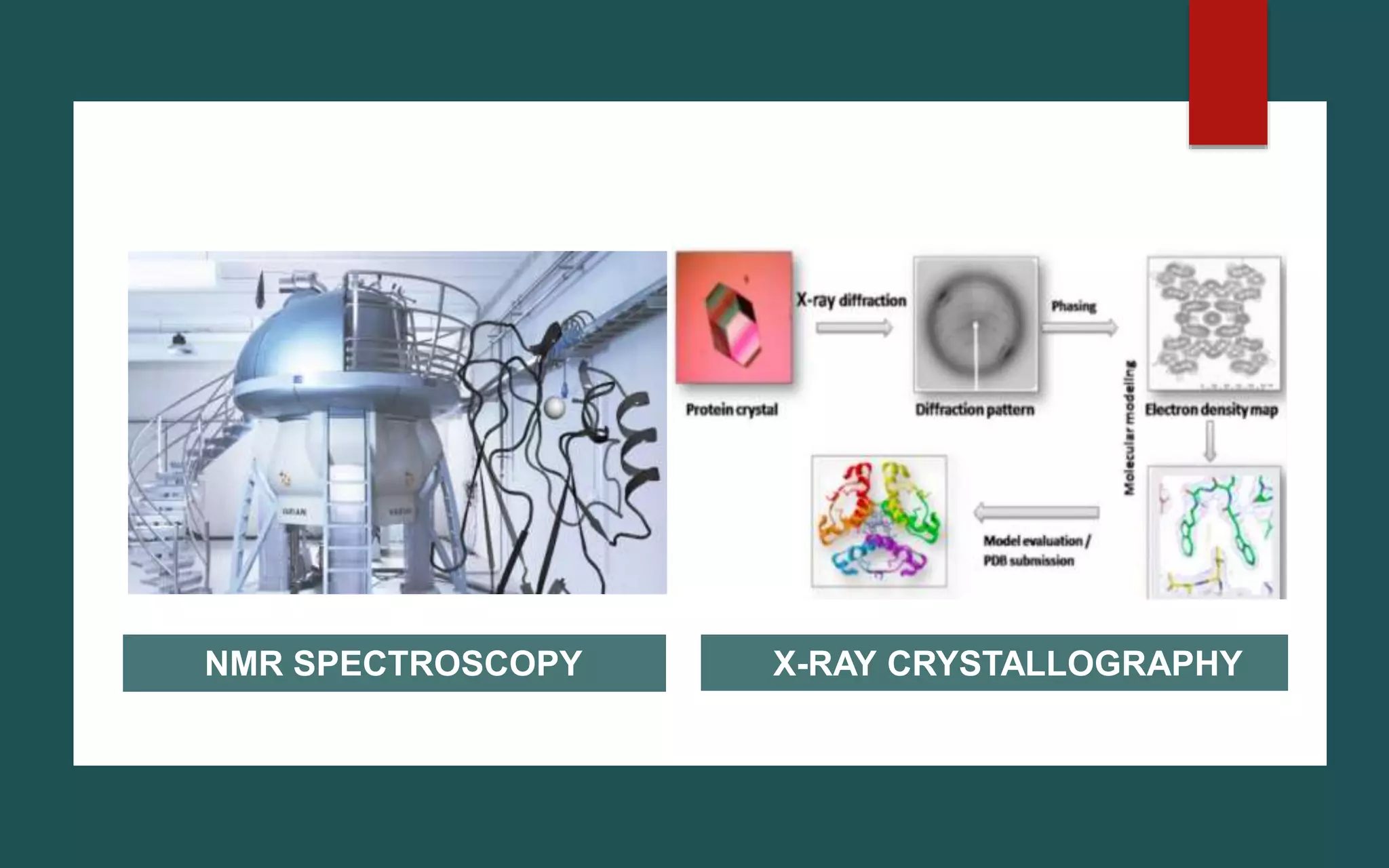
X-ray crystallography: This method involves growing
large, high-quality crystals of the target protein and using
X-ray diffraction to determine the protein's 3D structure.
This information can be used to guide the design of small
molecule drugs that bind to specific pockets on the
protein surface.
Nuclear Magnetic Resonance (NMR) spectroscopy: This
method uses magnetic fields and radio waves to
determine the 3D structure of a protein in solution. NMR
spectroscopy can be used to study the interactions
between a protein and small molecule drugs, providing
important information for SBDD.
Site-directed mutagenesis: This method involves making
targeted changes to the genetic code of a target protein
in order to study the effect of these changes on protein
function and drug binding. This information can be used
to guide the optimization of small-molecule drugs.
NMR SPECTROSCOPY X-RAY CRYSTALLOGRAPHY
Structure-based drug design (SBDD) is majorly a computational method but laboratory
methods are also used to design drugs based on the molecular structure of biological
targets. The goal of SBDD is to identify small molecules that can bind to a target and
modulate its activity in a desirable way. SBDD is largely computer-based, with the use of
algorithms, simulations, and data analysis to design and evaluate potential drugs.
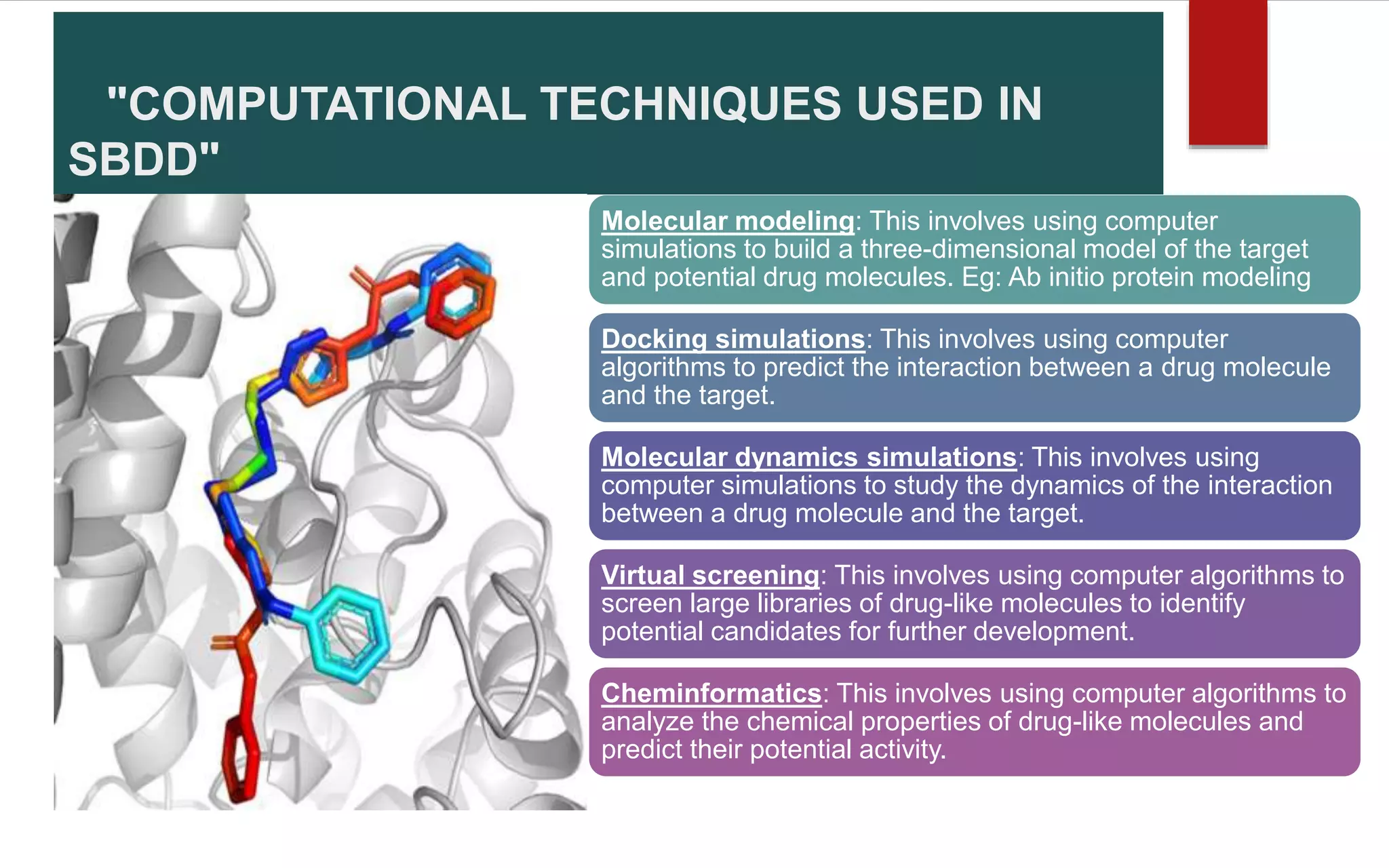
Molecular modeling: This involves using computer
simulations to build a three-dimensional model of the target
and potential drug molecules. Eg: Ab initio protein modeling
Docking simulations: This involves using computer
algorithms to predict the interaction between a drug molecule
and the target.
Molecular dynamics simulations: This involves using
computer simulations to study the dynamics of the interaction
between a drug molecule and the target.
Virtual screening: This involves using computer algorithms to
screen large libraries of drug-like molecules to identify
potential candidates for further development.
Cheminformatics: This involves using computer algorithms to
analyze the chemical properties of drug-like molecules and
predict their potential activity.
"COMPUTATIONAL TECHNIQUES USED IN
SBDD"
STEPS OF HOMOLOGY MODELING
 Docking refers to the ability to position a ligand in the active or a
designated site of a protein and calculate the specific binding
affinities.
 Docking algorithms can be used to find ligands and binding
conformations at a receptor site close to experimentally
determined structures.
 Docking algorithms are also used to identify multiple proteins
to which a small molecule can bind.
 Some of the docking programs are GOLD (Genetic Optimization
for Ligand Docking), AUTODOCK, LUDI, HEX
MOLECULAR DOCKING
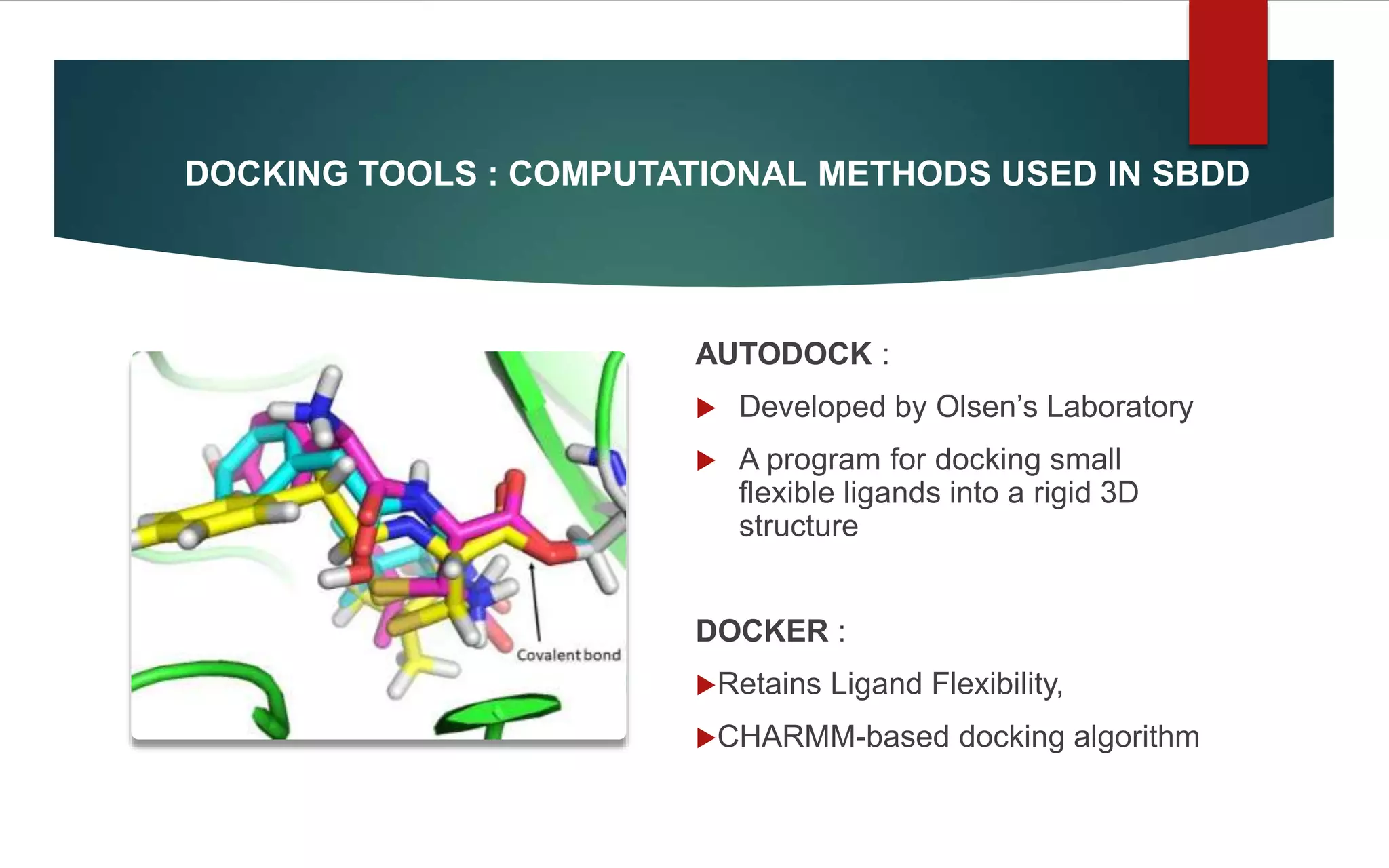
AUTODOCK :
 Developed by Olsen’s Laboratory
 A program for docking small
flexible ligands into a rigid 3D
structure
DOCKER :
Retains Ligand Flexibility,
CHARMM-based docking algorithm
DOCKING TOOLS : COMPUTATIONAL METHODS USED IN SBDD
VIRTUAL SCREENING: SURFACE REPRESENTATION & MATCHING
De Novo
EVOLUTION
 After docking program, we can modify ligands by two methods
 Based on active site features to identify functional groups that
can establish strong interactions with the receptor. Then,
functional groups can be linked.
 Using the original ligand scaffolds to develop derivatives that
can complement the receptor.
 Programs like UCSF , DOCK define the volume available to a
ligand by filling the active site with spheres. Further constraints
follow, using positions of H-bond acceptors and donors.
 Other docking algorithms, such as FLOG, GOLD, and
FlexiDock 16 use an all-atom representations to achieve fine
detail.
 Ray-tracing algorithms, such as SMART,represent another
strategy 3
De Novo DRUG DESIGN USING A.I.
Advantages of SBDD include:
• Increased understanding of the molecular basis of disease: By modeling the
molecular interactions between drugs and their targets, SBDD provides a deeper
understanding of the molecular basis of disease, which can inform the design of new
drugs.
• Reduced drug discovery time and cost: SBDD can help reduce the time and
cost required for drug discovery by enabling scientists to rapidly screen and evaluate
large numbers of potential drug candidates.
• Improved drug specificity: SBDD enables the design of drugs that specifically
target disease-causing molecules, reducing the likelihood of off-target effects and
improving the safety and efficacy of new drugs.
• Increased success rate: SBDD can increase the success rate of drug discovery by
enabling scientists to design drugs that are more likely to be effective, reducing the
number of drugs that fail in later stages of development.
USE OF SBDD IN THE DISCOVERY OF NEW DRUGS
"SBDD
CANNOT
REPLACE
TRADITIONAL
DRUG
DISCOVERY
PROCESSES "
Advantages of traditional drug discovery include:
Empiricism: Traditional drug discovery is often based on
empirical observations and experimentation, which can
provide valuable insights into the biology of disease and
the mechanisms of drug action.
Biological diversity: Traditional drug discovery often
involves screening a diverse array of biological samples,
which can help identify new targets and increase the
chances of discovering novel drugs.
Clinical relevance: Traditional drug discovery is often
based on patient samples and clinical observations,
which can provide valuable information about the disease
and the potential efficacy of new drugs. SAFETY and
EFFICACY comes first.
TARGETS USED IN SBDD TO FORM NEW
DRUGS
Kinases: SBDD has been used to design
drugs that target kinases, enzymes that
play a key role in cell signaling. Examples
of kinase inhibitors that have been
discovered or optimized using SBDD
include imatinib (Gleevec), dasatinib
(Sprycel), sunitinib (Sutent). These
drugs are used to treat cancers such as
chronic myeloid leukemia, gastrointestinal
stromal tumors, and renal cell carcinoma.
G protein-coupled receptors (GPCRs):
SBDD has been used to design drugs
that target GPCRs, a large family of
receptors that play a key role in cell
signaling. Examples of GPCR-targeted
drugs that have been discovered or
optimized using SBDD include liraglutide
(Victoza), a drug used to treat type 2
diabetes, and sumatriptan (Imitrex), a
drug used to treat migraines.
Nuclear receptors: SBDD has been used
to design drugs that target nuclear
receptors, proteins that play a key role in
regulating gene expression. Examples of
nuclear receptor-targeted drugs that have
been discovered or optimized using
SBDD include tamoxifen, a drug used to
treat breast cancer, and rosuvastatin
(Crestor), a drug used to lower cholesterol
levels.
Enzymes: SBDD has been used to
design drugs that target enzymes
involved in the production of toxic
substances. Examples of enzyme-
targeted drugs that have been discovered
or optimized using SBDD include
allopurinol, a drug used to treat gout,
and acetyldigitoxin, a drug used to treat
heart failure.
INHIBITOR TARGET DISEASE
HUMAN RENIN ANTI HYPERTENSION
COLLAGENASE AND
STROMELYSIN
ANTICANCER
,ANTIARTHRITIS
PURINE NUCLEOTIDE
PHOSPHORYLASE
ANTIDEPRESSANT
THYMIDYLATE
SYNTHASE
ANTIPROLIFERATION
PROTEASE (Ritonavir) ANTI HIV
EXAMPLES OF DRUGS DESIGNED BY
SBDD
In SBDD, AI (ARTIFICIAL
INTELLIGENCE) and
ML(MACHINE LEARNING)
techniques can be used for tasks
such as:
MOLECULAR DOCKING: AI and
ML algorithms can be used to
predict the binding affinity between
a drug molecule and its target
protein, helping to identify the most
promising drug candidates.
VIRTUAL SCREENING: AI and ML
algorithms can be used to screen
large databases of chemical
compounds to identify those that
are likely to bind to a specific target
protein, reducing the need for
laboratory-based screening.
LEAD OPTIMIZATION: AI and ML
algorithms can be used to predict
the properties of modified drug
molecules and guide the
optimization process, helping to
identify the best candidate for
further development and improving
protein interaction specificity.
ADVERSE EFFECT PREDICTION:
AI and ML algorithms can be used
to predict the likelihood of adverse
effects associated with new drugs,
helping to identify potential safety
concerns early in the drug
discovery process.
USES OF AI AND ML IN
BIOTECHNOLOGY AND
SBDD
• INDUSTRIAL BIOTECH INVOLVES THE PRODUCTION OF NEW ENZYME CATALYSTS TO MAXIMIZE AND
OPTIMIZE BIOCHEMICAL PATHWAYS THAT CAN BE USED IN MANUFACTURING. COMPUTER-AIDED
DESIGNS AND AI ARE HELPING GENERATE ACCURATE MOLECULE DESIGN, AND MACHINE LEARNING
HELPS CALCULATE PERMUTATIONS AND COMBINATIONS OF DIFFERENT CHEMICALS TO REVEAL AN
ACCURATE FORMULA WITHOUT HAVING TO CONDUCT LENGTHY MANUAL EXPERIMENTS IN THE LAB.
OPERATIONS THAT USUALLY TAKE 5-10 YEARS NOW ONLY TAKE A COUPLE AT MOST WITH THE USE OF
ARTIFICIAL INTELLIGENCE IN BIOTECHNOLOGY.
• MEDICAL BIOTECH PRODUCES DRUGS AND ANTIBIOTICS TO BETTER HUMAN HEALTH AND
GENETICALLY MANIPULATES CELLS TO PRODUCE BENEFICIAL CHARACTERISTICS. MACHINE LEARNING
AND COMPUTER VISION ARE COMMONLY USED IN THE DETECTION OF CANCERS AND OTHER
DISEASES, AS IT MAKES THE IDENTIFICATION MORE PRECISE BY IMPROVING UPON ITSELF EVERY
TIME THE ALGORITHM IS RUN. AND THIS PERSONALIZED MEDICINE IS A VALUABLE ASPECT OF AI
TECHNOLOGY IN THE MEDICAL FIELD.
"THE FUTURE/RECENT ON GOING RESEARCH
DEVELOPMENTS OF SBDD THROUGH AI/ML"
ONE RECENT DEVELOPMENT IS THE USE OF DEEP LEARNING
ALGORITHMS TO PREDICT THE BINDING AFFINITY OF SMALL
MOLECULES TO TARGET PROTEINS. THESE ALGORITHMS ARE
TRAINED ON LARGE DATASETS OF KNOWN LIGAND-PROTEIN
COMPLEXES, ALLOWING THEM TO MAKE ACCURATE PREDICTIONS
FOR NEW MOLECULES WITHOUT THE NEED FOR EXTENSIVE
COMPUTATIONAL SIMULATIONS.
ANOTHER AREA OF RESEARCH INVOLVES THE USE OF GENERATIVE
MODELS, SUCH AS GENERATIVE ADVERSARIAL NETWORKS (GANS), TO
GENERATE NEW DRUG MOLECULES WITH DESIRED PROPERTIES.
THESE MODELS CAN BE TRAINED ON LARGE DATABASES OF KNOWN
DRUG MOLECULES AND CAN GENERATE NEW COMPOUNDS WITH
SPECIFIC CHEMICAL AND PHARMACOLOGICAL PROPERTIES.
TRENDS/PREDICTIO
NS FOR THE FUTURE
OF SBDD THROUGH
AI/ML
•INCREASED EFFICIENCY: AI AND ML ALGORITHMS ARE
BECOMING MORE CAPABLE OF PREDICTING THE BINDING
AFFINITY BETWEEN A DRUG MOLECULE AND ITS TARGET
PROTEIN, REDUCING THE NEED FOR LABORATORY-BASED
SCREENING. THIS WILL INCREASE THE EFFICIENCY OF THE
DRUG DISCOVERY PROCESS AND SPEED UP THE TIME TO
MARKET THEM.
•IMPROVED ACCURACY: AS AI AND ML BECOME MORE
SOPHISTICATED, THEY WILL BE ABLE TO PREDICT THE
PROPERTIES OF MODIFIED DRUG MOLECULES WITH
INCREASING ACCURACY, GUIDING THE OPTIMIZATION
PROCESS AND HELPING TO IDENTIFY THE BEST CANDIDATE
FOR FURTHER DEVELOPMENT.
•ADVERSE EFFECT PREDICTION: AI AND ML ARE MORE
CAPABLE OF PREDICTING THE LIKELIHOOD OF ADVERSE
EFFECTS ASSOCIATED WITH NEW DRUGS, REDUCING THE
RISK OF COSTLY FAILURES LATE IN THE DEVELOPMENT
PROCESS.
•ENHANCED VIRTUAL SCREENING: AI AND ML ALGORITHMS
ARE MORE CAPABLE OF SCREENING LARGE DATABASES OF
CHEMICAL COMPOUNDS TO IDENTIFY THOSE THAT ARE
LIKELY TO BIND TO A SPECIFIC TARGET PROTEIN, REDUCING
THE NEED FOR LABORATORY-BASED SCREENING.
REVOLUTIONIZING BIOTECHNOLOGY
AI: A HEALTHY INVESTMENT FOR
FUTURE
Many companies have invested
in utilizing AI software as the core
operator of their new products. It
is estimated that there will be an
additional revenue driven by AI in
pharmaceutical/biotechnology
companies of $1.2 trillion by
2024.
ATOMWISE was the first
company to apply
ML "Convolutional Neuro
Networks" to drug design.
EYENUK developed a
product called 'EYEART' that
uses AI to detect disease from
retinal images. The detection of
diabetic retinopathy was over
95% accurate trial with about 950
patients spanning 15 medical
centers across the U.S.
A company
'DESKTOPGENETICS' created a
platform to design gene
editing constructs using CRISPR
that operates via AI.
DEEPMIND developed a system
called 'ALPHAFOLD' that
utilizes ML to predict the 3-D
structure of a protein given solely
its genetic sequence which is
commendable.
These predictions are far more
accurate than any other
human/non AI predictions from
the past.
COMPANIES USING AI FOR DRUG DISCOVERY
REFERENCE
S
THANK YOU!

STRUCTURE BASED DRUG DESIGN.pptx

  • 1.
    “STRUCTURE BASED DRUGDESIGN” STUTI GUPTA NUID: 002685313 CHEM5620 PROTEIN CHEMISTRY PROF. W STEPHEN FARACI
  • 2.
    INTRODUCTION TO STRUCTURE-BASED DRUGDESIGN Structure-based drug design is a drug discovery approach in which the three- dimensional structure of a target protein is used to guide the design and development of potential therapeutic compounds. This approach leverages the knowledge of the molecular interactions between a drug and its target protein to design drugs that have a higher probability of binding to the target and exerting their therapeutic effect. • Ligand-Based Drug Design • Receptor-Based Drug Design
  • 3.
    STRUCTURE BASED DRUGDESIGN PIPELINE
  • 4.
    SBDD: "RELEVANCE TO PROTEIN CHEMISTRY" Structure-based drugdesign is relevant to protein chemistry because proteins play a critical role in many biological processes and are often the target of drugs. Proteins are complex molecules that carry out a wide range of functions within cells, and they do so through their specific three-dimensional structures. Understanding the molecular interactions between a drug and its target protein is essential for developing drugs that are both safe and effective.
  • 6.
    "LABORATORY BASED TECHNIQUES USED IN SBDD" X-ray crystallography: This method involves growing large, high-quality crystals of the target protein and using X-ray diffraction to determine the protein's 3D structure. This information can be used to guide the design of small molecule drugs that bind to specific pockets on the protein surface. Nuclear Magnetic Resonance (NMR) spectroscopy: This method uses magnetic fields and radio waves to determine the 3D structure of a protein in solution. NMR spectroscopy can be used to study the interactions between a protein and small molecule drugs, providing important information for SBDD. Site-directed mutagenesis: This method involves making targeted changes to the genetic code of a target protein in order to study the effect of these changes on protein function and drug binding. This information can be used to guide the optimization of small-molecule drugs.
  • 7.
    NMR SPECTROSCOPY X-RAYCRYSTALLOGRAPHY
  • 8.
    Structure-based drug design(SBDD) is majorly a computational method but laboratory methods are also used to design drugs based on the molecular structure of biological targets. The goal of SBDD is to identify small molecules that can bind to a target and modulate its activity in a desirable way. SBDD is largely computer-based, with the use of algorithms, simulations, and data analysis to design and evaluate potential drugs.
  • 9.
    Molecular modeling: Thisinvolves using computer simulations to build a three-dimensional model of the target and potential drug molecules. Eg: Ab initio protein modeling Docking simulations: This involves using computer algorithms to predict the interaction between a drug molecule and the target. Molecular dynamics simulations: This involves using computer simulations to study the dynamics of the interaction between a drug molecule and the target. Virtual screening: This involves using computer algorithms to screen large libraries of drug-like molecules to identify potential candidates for further development. Cheminformatics: This involves using computer algorithms to analyze the chemical properties of drug-like molecules and predict their potential activity. "COMPUTATIONAL TECHNIQUES USED IN SBDD"
  • 10.
  • 11.
     Docking refersto the ability to position a ligand in the active or a designated site of a protein and calculate the specific binding affinities.  Docking algorithms can be used to find ligands and binding conformations at a receptor site close to experimentally determined structures.  Docking algorithms are also used to identify multiple proteins to which a small molecule can bind.  Some of the docking programs are GOLD (Genetic Optimization for Ligand Docking), AUTODOCK, LUDI, HEX MOLECULAR DOCKING
  • 12.
    AUTODOCK :  Developedby Olsen’s Laboratory  A program for docking small flexible ligands into a rigid 3D structure DOCKER : Retains Ligand Flexibility, CHARMM-based docking algorithm DOCKING TOOLS : COMPUTATIONAL METHODS USED IN SBDD
  • 13.
    VIRTUAL SCREENING: SURFACEREPRESENTATION & MATCHING
  • 14.
    De Novo EVOLUTION  Afterdocking program, we can modify ligands by two methods  Based on active site features to identify functional groups that can establish strong interactions with the receptor. Then, functional groups can be linked.  Using the original ligand scaffolds to develop derivatives that can complement the receptor.  Programs like UCSF , DOCK define the volume available to a ligand by filling the active site with spheres. Further constraints follow, using positions of H-bond acceptors and donors.  Other docking algorithms, such as FLOG, GOLD, and FlexiDock 16 use an all-atom representations to achieve fine detail.  Ray-tracing algorithms, such as SMART,represent another strategy 3
  • 15.
    De Novo DRUGDESIGN USING A.I.
  • 16.
    Advantages of SBDDinclude: • Increased understanding of the molecular basis of disease: By modeling the molecular interactions between drugs and their targets, SBDD provides a deeper understanding of the molecular basis of disease, which can inform the design of new drugs. • Reduced drug discovery time and cost: SBDD can help reduce the time and cost required for drug discovery by enabling scientists to rapidly screen and evaluate large numbers of potential drug candidates. • Improved drug specificity: SBDD enables the design of drugs that specifically target disease-causing molecules, reducing the likelihood of off-target effects and improving the safety and efficacy of new drugs. • Increased success rate: SBDD can increase the success rate of drug discovery by enabling scientists to design drugs that are more likely to be effective, reducing the number of drugs that fail in later stages of development. USE OF SBDD IN THE DISCOVERY OF NEW DRUGS
  • 17.
    "SBDD CANNOT REPLACE TRADITIONAL DRUG DISCOVERY PROCESSES " Advantages oftraditional drug discovery include: Empiricism: Traditional drug discovery is often based on empirical observations and experimentation, which can provide valuable insights into the biology of disease and the mechanisms of drug action. Biological diversity: Traditional drug discovery often involves screening a diverse array of biological samples, which can help identify new targets and increase the chances of discovering novel drugs. Clinical relevance: Traditional drug discovery is often based on patient samples and clinical observations, which can provide valuable information about the disease and the potential efficacy of new drugs. SAFETY and EFFICACY comes first.
  • 18.
    TARGETS USED INSBDD TO FORM NEW DRUGS Kinases: SBDD has been used to design drugs that target kinases, enzymes that play a key role in cell signaling. Examples of kinase inhibitors that have been discovered or optimized using SBDD include imatinib (Gleevec), dasatinib (Sprycel), sunitinib (Sutent). These drugs are used to treat cancers such as chronic myeloid leukemia, gastrointestinal stromal tumors, and renal cell carcinoma. G protein-coupled receptors (GPCRs): SBDD has been used to design drugs that target GPCRs, a large family of receptors that play a key role in cell signaling. Examples of GPCR-targeted drugs that have been discovered or optimized using SBDD include liraglutide (Victoza), a drug used to treat type 2 diabetes, and sumatriptan (Imitrex), a drug used to treat migraines. Nuclear receptors: SBDD has been used to design drugs that target nuclear receptors, proteins that play a key role in regulating gene expression. Examples of nuclear receptor-targeted drugs that have been discovered or optimized using SBDD include tamoxifen, a drug used to treat breast cancer, and rosuvastatin (Crestor), a drug used to lower cholesterol levels. Enzymes: SBDD has been used to design drugs that target enzymes involved in the production of toxic substances. Examples of enzyme- targeted drugs that have been discovered or optimized using SBDD include allopurinol, a drug used to treat gout, and acetyldigitoxin, a drug used to treat heart failure.
  • 19.
    INHIBITOR TARGET DISEASE HUMANRENIN ANTI HYPERTENSION COLLAGENASE AND STROMELYSIN ANTICANCER ,ANTIARTHRITIS PURINE NUCLEOTIDE PHOSPHORYLASE ANTIDEPRESSANT THYMIDYLATE SYNTHASE ANTIPROLIFERATION PROTEASE (Ritonavir) ANTI HIV EXAMPLES OF DRUGS DESIGNED BY SBDD
  • 20.
    In SBDD, AI(ARTIFICIAL INTELLIGENCE) and ML(MACHINE LEARNING) techniques can be used for tasks such as: MOLECULAR DOCKING: AI and ML algorithms can be used to predict the binding affinity between a drug molecule and its target protein, helping to identify the most promising drug candidates. VIRTUAL SCREENING: AI and ML algorithms can be used to screen large databases of chemical compounds to identify those that are likely to bind to a specific target protein, reducing the need for laboratory-based screening. LEAD OPTIMIZATION: AI and ML algorithms can be used to predict the properties of modified drug molecules and guide the optimization process, helping to identify the best candidate for further development and improving protein interaction specificity. ADVERSE EFFECT PREDICTION: AI and ML algorithms can be used to predict the likelihood of adverse effects associated with new drugs, helping to identify potential safety concerns early in the drug discovery process.
  • 21.
    USES OF AIAND ML IN BIOTECHNOLOGY AND SBDD • INDUSTRIAL BIOTECH INVOLVES THE PRODUCTION OF NEW ENZYME CATALYSTS TO MAXIMIZE AND OPTIMIZE BIOCHEMICAL PATHWAYS THAT CAN BE USED IN MANUFACTURING. COMPUTER-AIDED DESIGNS AND AI ARE HELPING GENERATE ACCURATE MOLECULE DESIGN, AND MACHINE LEARNING HELPS CALCULATE PERMUTATIONS AND COMBINATIONS OF DIFFERENT CHEMICALS TO REVEAL AN ACCURATE FORMULA WITHOUT HAVING TO CONDUCT LENGTHY MANUAL EXPERIMENTS IN THE LAB. OPERATIONS THAT USUALLY TAKE 5-10 YEARS NOW ONLY TAKE A COUPLE AT MOST WITH THE USE OF ARTIFICIAL INTELLIGENCE IN BIOTECHNOLOGY. • MEDICAL BIOTECH PRODUCES DRUGS AND ANTIBIOTICS TO BETTER HUMAN HEALTH AND GENETICALLY MANIPULATES CELLS TO PRODUCE BENEFICIAL CHARACTERISTICS. MACHINE LEARNING AND COMPUTER VISION ARE COMMONLY USED IN THE DETECTION OF CANCERS AND OTHER DISEASES, AS IT MAKES THE IDENTIFICATION MORE PRECISE BY IMPROVING UPON ITSELF EVERY TIME THE ALGORITHM IS RUN. AND THIS PERSONALIZED MEDICINE IS A VALUABLE ASPECT OF AI TECHNOLOGY IN THE MEDICAL FIELD.
  • 22.
    "THE FUTURE/RECENT ONGOING RESEARCH DEVELOPMENTS OF SBDD THROUGH AI/ML" ONE RECENT DEVELOPMENT IS THE USE OF DEEP LEARNING ALGORITHMS TO PREDICT THE BINDING AFFINITY OF SMALL MOLECULES TO TARGET PROTEINS. THESE ALGORITHMS ARE TRAINED ON LARGE DATASETS OF KNOWN LIGAND-PROTEIN COMPLEXES, ALLOWING THEM TO MAKE ACCURATE PREDICTIONS FOR NEW MOLECULES WITHOUT THE NEED FOR EXTENSIVE COMPUTATIONAL SIMULATIONS. ANOTHER AREA OF RESEARCH INVOLVES THE USE OF GENERATIVE MODELS, SUCH AS GENERATIVE ADVERSARIAL NETWORKS (GANS), TO GENERATE NEW DRUG MOLECULES WITH DESIRED PROPERTIES. THESE MODELS CAN BE TRAINED ON LARGE DATABASES OF KNOWN DRUG MOLECULES AND CAN GENERATE NEW COMPOUNDS WITH SPECIFIC CHEMICAL AND PHARMACOLOGICAL PROPERTIES.
  • 23.
    TRENDS/PREDICTIO NS FOR THEFUTURE OF SBDD THROUGH AI/ML •INCREASED EFFICIENCY: AI AND ML ALGORITHMS ARE BECOMING MORE CAPABLE OF PREDICTING THE BINDING AFFINITY BETWEEN A DRUG MOLECULE AND ITS TARGET PROTEIN, REDUCING THE NEED FOR LABORATORY-BASED SCREENING. THIS WILL INCREASE THE EFFICIENCY OF THE DRUG DISCOVERY PROCESS AND SPEED UP THE TIME TO MARKET THEM. •IMPROVED ACCURACY: AS AI AND ML BECOME MORE SOPHISTICATED, THEY WILL BE ABLE TO PREDICT THE PROPERTIES OF MODIFIED DRUG MOLECULES WITH INCREASING ACCURACY, GUIDING THE OPTIMIZATION PROCESS AND HELPING TO IDENTIFY THE BEST CANDIDATE FOR FURTHER DEVELOPMENT. •ADVERSE EFFECT PREDICTION: AI AND ML ARE MORE CAPABLE OF PREDICTING THE LIKELIHOOD OF ADVERSE EFFECTS ASSOCIATED WITH NEW DRUGS, REDUCING THE RISK OF COSTLY FAILURES LATE IN THE DEVELOPMENT PROCESS. •ENHANCED VIRTUAL SCREENING: AI AND ML ALGORITHMS ARE MORE CAPABLE OF SCREENING LARGE DATABASES OF CHEMICAL COMPOUNDS TO IDENTIFY THOSE THAT ARE LIKELY TO BIND TO A SPECIFIC TARGET PROTEIN, REDUCING THE NEED FOR LABORATORY-BASED SCREENING.
  • 24.
    REVOLUTIONIZING BIOTECHNOLOGY AI: AHEALTHY INVESTMENT FOR FUTURE Many companies have invested in utilizing AI software as the core operator of their new products. It is estimated that there will be an additional revenue driven by AI in pharmaceutical/biotechnology companies of $1.2 trillion by 2024. ATOMWISE was the first company to apply ML "Convolutional Neuro Networks" to drug design. EYENUK developed a product called 'EYEART' that uses AI to detect disease from retinal images. The detection of diabetic retinopathy was over 95% accurate trial with about 950 patients spanning 15 medical centers across the U.S. A company 'DESKTOPGENETICS' created a platform to design gene editing constructs using CRISPR that operates via AI. DEEPMIND developed a system called 'ALPHAFOLD' that utilizes ML to predict the 3-D structure of a protein given solely its genetic sequence which is commendable. These predictions are far more accurate than any other human/non AI predictions from the past.
  • 25.
    COMPANIES USING AIFOR DRUG DISCOVERY
  • 27.
  • 28.