GOALS 
1. Organize qualitative data into a frequency table. 
2. Present a frequency table as a bar chart or a pie 
chart. 
3. Organize quantitative data into a frequency 
distribution. 
4. Present a frequency distribution for quantitative 
data using histograms, frequency polygons, and 
cumulative frequency polygons. 
Business Statistics, A First Course (4e) © 2006 Prentice-Hall, Inc. Chap 2-1
Tabulating Numerical Data: 
Frequency Distributions 
What is a Frequency Distribution? 
 A frequency distribution is a list or a table … 
 containing class groupings (ranges within which 
the data fall) ... 
 and the corresponding frequencies with which 
data fall within each grouping or category 
Business Statistics, A First Course (4e) © 2006 Prentice-Hall, Inc. Chap 2-2
Why Use a Frequency Distribution? 
 It is a way to summarize numerical data 
 It condenses the raw data into a more 
useful form... 
 It allows for a quick visual interpretation of 
the data 
Business Statistics, A First Course (4e) © 2006 Prentice-Hall, Inc. Chap 2-3
Class Intervals 
and Class Boundaries 
 Each class grouping has the same width 
 Determine the width of each interval by 
Width of interval @ range 
number of desired class groupings 
 Usually at least 5 but no more than 15 
groupings 
 Class boundaries never overlap 
 Round up the interval width to get desirable 
endpoints 
Business Statistics, A First Course (4e) © 2006 Prentice-Hall, Inc. Chap 2-4
EExxaammppllee:: HHoonnddaa AAuuttoo RReeppaaiirr 
TThhee mmaannaaggeerr ooff HHoonnddaa AAuuttoo 
wwoouulldd lliikkee ttoo hhaavvee aa bbeetttteerr 
uunnddeerrssttaannddiinngg ooff tthhee ccoosstt 
ooff ppaarrttss uusseedd iinn tthhee eennggiinnee 
ttuunnee--uuppss ppeerrffoorrmmeedd iinn tthhee 
sshhoopp.. SShhee eexxaammiinneess 5500 
ccuussttoommeerr iinnvvooiicceess ffoorr ttuunnee--uuppss.. TThhee ccoossttss ooff ppaarrttss,, 
rroouunnddeedd ttoo tthhee nneeaarreesstt ddoollllaarr,, aarree lliisstteedd oonn tthhee nneexxtt 
sslliiddee.. 
Business Statistics, A First Course (4e) © 2006 Prentice-Hall, Inc. Chap 2-5
EExxaammppllee:: HHoonnddaa AAuuttoo RReeppaaiirr 
 SSaammppllee ooff PPaarrttss CCoosstt ffoorr 5500 TTuunnee--uuppss 
91 78 93 57 75 52 99 80 97 62 
71 69 72 89 66 75 79 75 72 76 
104 74 62 68 97 105 77 65 80 109 
85 97 88 68 83 68 71 69 67 74 
62 82 98 101 79 105 79 69 62 73 
Business Statistics, A First Course (4e) © 2006 Prentice-Hall, Inc. Chap 2-6
Tabular Summary: 
Frequency and Percent Frequency 
PPaarrttss 
CCoosstt (($$)) 
5500--5599 
6600--6699 
7700--7799 
8800--8899 
9900--9999 
110000--110099 
PPaarrttss 
FFrreeqquueennccyy 
22 
1133 
1166 
77 
77 
55 
5500 
PPeerrcceenntt 
FFrreeqquueennccyy 
44 
2266 
3322 
1144 
1144 
1100 
110000 
((22/5500))110000 
Business Statistics, A First Course (4e) © 2006 Prentice-Hall, Inc. Chap 2-7
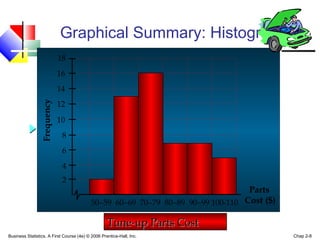
Graphical Summary: Histogram 
18 
16 
14 
12 
10 
8 
6 
4 
2 
Parts 
Cost ($) 
Frequency 
50-59 60-69 70-79 80-89 90-99 100-110 
TTuunnee--uupp PPaarrttss CCoosstt 
Business Statistics, A First Course (4e) © 2006 Prentice-Hall, Inc. Chap 2-8
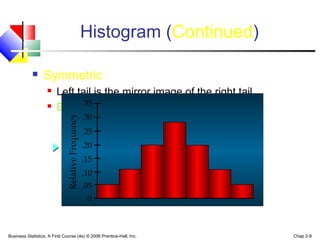
Histogram (Continued) 
 Symmetric 
 Left tail is the mirror image of the right tail 
 Example: heights and weights of people 
Relative Frequency 
.35 
.30 
.25 
.20 
.15 
.10 
.05 
0 
Business Statistics, A First Course (4e) © 2006 Prentice-Hall, Inc. Chap 2-9
Histogram (Continued) 
 Moderately Skewed Left 
 A longer tail to the left 
 Example: exam scores 
Relative Frequency 
.35 
.30 
.25 
.20 
.15 
.10 
.05 
0 
Business Statistics, A First Course (4e) © 2006 Prentice-Hall, Inc. Chap 2-10
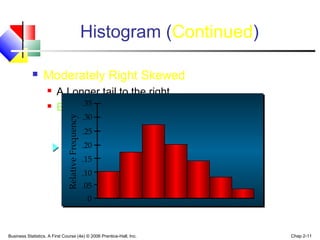
Histogram (Continued) 
 Moderately Right Skewed 
 A Longer tail to the right 
 Example: housing values 
Relative Frequency 
.35 
.30 
.25 
.20 
.15 
.10 
.05 
0 
Business Statistics, A First Course (4e) © 2006 Prentice-Hall, Inc. Chap 2-11
Histogram (Continued) 
 Highly Skewed Right 
 A very long tail to the right 
 Example: .35 
executive salaries 
.30 
Relative Frequency .05 
.25 
.20 
.15 
.10 
0 
Business Statistics, A First Course (4e) © 2006 Prentice-Hall, Inc. Chap 2-12
Frequency Distribution Example 
Example: A manufacturer of insulation randomly 
selects 20 winter days and records the daily 
high temperature 
24, 35, 17, 21, 24, 37, 26, 46, 58, 30, 
32, 13, 12, 38, 41, 43, 44, 27, 53, 27 
Business Statistics, A First Course (4e) © 2006 Prentice-Hall, Inc. Chap 2-13
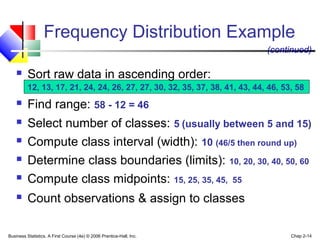
Frequency Distribution Example 
(continued) 
 Sort raw data in ascending order: 
12, 13, 17, 21, 24, 24, 26, 27, 27, 30, 32, 35, 37, 38, 41, 43, 44, 46, 53, 58 
 Find range: 58 - 12 = 46 
 Select number of classes: 5 (usually between 5 and 15) 
 Compute class interval (width): 10 (46/5 then round up) 
 Determine class boundaries (limits): 10, 20, 30, 40, 50, 60 
 Compute class midpoints: 15, 25, 35, 45, 55 
 Count observations  assign to classes 
Business Statistics, A First Course (4e) © 2006 Prentice-Hall, Inc. Chap 2-14
Frequency Distribution Example 
Data in ordered array: 
(continued) 
12, 13, 17, 21, 24, 24, 26, 27, 27, 30, 32, 35, 37, 38, 41, 43, 44, 46, 53, 58 
Relative 
Frequency Percentage 
Class Frequency 
10 but less than 20 3 .15 15 
20 but less than 30 6 .30 30 
30 but less than 40 5 .25 25 
40 but less than 50 4 .20 20 
50 but less than 60 2 .10 10 
Total 20 1.00 100 
Business Statistics, A First Course (4e) © 2006 Prentice-Hall, Inc. Chap 2-15
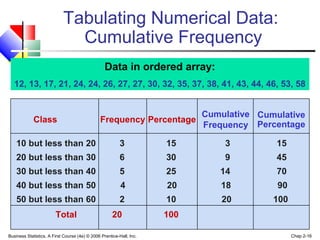
Tabulating Numerical Data: 
Cumulative Frequency 
12, 13, 17, 21, 24, 24, 26, 27, 27, 30, 32, 35, 37, 38, 41, 43, 44, 46, 53, 58 
Class 
Data in ordered array: 
Frequency Cumulative 
Percentage Cumulative 
Percentage 
Frequency 
10 but less than 20 3 15 3 15 
20 but less than 30 6 30 9 45 
30 but less than 40 5 25 14 70 
40 but less than 50 4 20 18 90 
50 but less than 60 2 10 20 100 
Total 20 100 
Business Statistics, A First Course (4e) © 2006 Prentice-Hall, Inc. Chap 2-16
Graphing Numerical Data: 
The Histogram 
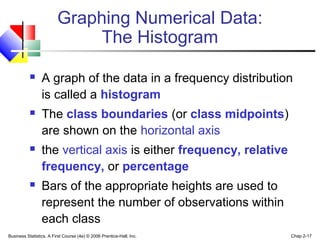
 A graph of the data in a frequency distribution 
is called a histogram 
 The class boundaries (or class midpoints) 
are shown on the horizontal axis 
 the vertical axis is either frequency, relative 
frequency, or percentage 
 Bars of the appropriate heights are used to 
represent the number of observations within 
each class 
Business Statistics, A First Course (4e) © 2006 Prentice-Hall, Inc. Chap 2-17
Histogram Example 
Histogram: Daily High Temperature 
7 
6 
5 
4 
3 
2 
1 
0 
5 15 25 35 45 55 65 
Frequency 
Frequency 
Class Midpoints 
Class 
Midpoint 
10 but less than 20 15 3 
20 but less than 30 25 6 
30 but less than 40 35 5 
40 but less than 50 45 4 
50 but less than 60 55 2 
(No gaps 
between 
bars) 
Class 
Business Statistics, A First Course (4e) © 2006 Prentice-Hall, Inc. Chap 2-18
Graphing Numerical Data: 
The Frequency Polygon 
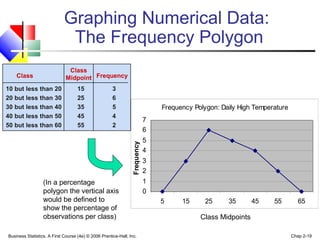
Frequency Polygon: Daily High Temperature 
7 
6 
5 
4 
3 
2 
1 
0 
5 15 25 35 45 55 65 
Frequency 
Class Midpoints 
Class 
Frequency 
Class 
Midpoint 
10 but less than 20 15 3 
20 but less than 30 25 6 
30 but less than 40 35 5 
40 but less than 50 45 4 
50 but less than 60 55 2 
(In a percentage 
polygon the vertical axis 
would be defined to 
show the percentage of 
observations per class) 
Business Statistics, A First Course (4e) © 2006 Prentice-Hall, Inc. Chap 2-19
Graphing Cumulative Frequencies: 
The Ogive (Cumulative % Polygon) 
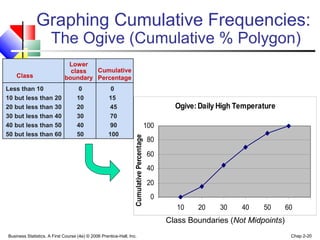
Ogive: Daily High Temperature 
100 
80 
60 
40 
20 
0 
10 20 30 40 50 60 
Cumulative Percentage 
Class Boundaries (Not Midpoints) 
Class 
Cumulative 
Percentage 
Lower 
class 
boundary 
Less than 10 0 0 
10 but less than 20 10 15 
20 but less than 30 20 45 
30 but less than 40 30 70 
40 but less than 50 40 90 
50 but less than 60 50 100 
Business Statistics, A First Course (4e) © 2006 Prentice-Hall, Inc. Chap 2-20
Categorical Data 
  Categorical data involves categories or 
 groups. 
  These can be made without the fear of 
 their order to be disturbed 
 i.e. sex, age, marital status. 
  It covers the following topics: 
 Frequency Distribution 
 Graphs 
Business Statistics, A First Course (4e) © 2006 Prentice-Hall, Inc. Chap 2-21
Example: Marada Inn 
Guests staying at Marada Inn were 
asked to rate the quality of their 
accommodations as being excellent, 
above average, average, below average, or 
poor. The ratings provided by a sample of 20 guests are: 
BBeellooww AAvveerraaggee 
AAbboovvee AAvveerraaggee 
AAvveerraaggee 
AAbboovvee AAvveerraaggee 
AAvveerraaggee 
AAbboovvee AAvveerraaggee 
AAvveerraaggee 
AAbboovvee AAvveerraaggee 
BBeellooww AAvveerraaggee 
PPoooorr 
EExxcceelllleenntt 
AAbboovvee AAvveerraaggee 
AAvveerraaggee 
AAbboovvee AAvveerraaggee 
BBeellooww AAvveerraaggee 
PPoooorr 
AAbboovvee AAvveerraaggee 
AAvveerraaggee 
AAvveerraaggee 
Business Statistics, A First Course (4e) © 2006 Prentice-Hall, Inc. Chap 2-22
FFrreeqquueennccyy DDiissttrriibbuuttiioonn 
RRaattiinngg FFrreeqquueennccyy 
PPoooorr 
BBeellooww AAvveerraaggee 
AAvveerraaggee 
AAbboovvee AAvveerraaggee 
EExxcceelllleenntt 
22 
33 
55 
99 
11 
TToottaall 2200 
Business Statistics, A First Course (4e) © 2006 Prentice-Hall, Inc. Chap 2-23
BBaarr GGrraapphh 
10 
9 
8 
7 
MMaarraaddaa IInnnn QQuuaalliittyy RRaattiinnggss 
Excellent Frequency 
Poor Below 
Average 
Average Above 
Average 
Rating 
6 
5 
4 
3 
2 
1 
Business Statistics, A First Course (4e) © 2006 Prentice-Hall, Inc. Chap 2-24
PPeerrcceennttaaggee FFrreeqquueennccyy DDiissttrriibbuuttiioonn 
RRaattiinngg PPeerrcceennttaaggeess 
PPoooorr 
BBeellooww AAvveerraaggee 
AAvveerraaggee 
AAbboovvee AAvveerraaggee 
EExxcceelllleenntt 
1100 
1155 
2255 
4455 
55 
Business Statistics, A First Course (4e) © 2006 Prentice-Hall, Inc. Chap 2-25
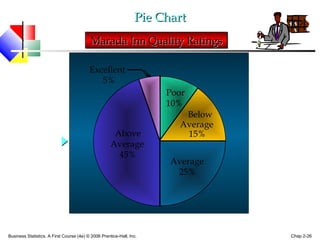
PPiiee CChhaarrtt 
MMMMaaaarrrraaaaddddaaaa IIIInnnnnnnn QQQQuuuuaaaalllliiiittttyyyy RRRRaaaattttiiiinnnnggggssss 
Poor 
10% 
Below 
Average 
15% 
Average 
25% 
Excellent 
5% 
Above 
Average 
45% 
Business Statistics, A First Course (4e) © 2006 Prentice-Hall, Inc. Chap 2-26
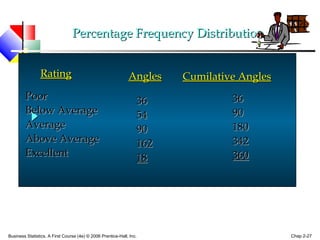
PPeerrcceennttaaggee FFrreeqquueennccyy DDiissttrriibbuuttiioonn 
RRaattiinngg AAnngglleess 
PPoooorr 
BBeellooww AAvveerraaggee 
AAvveerraaggee 
AAbboovvee AAvveerraaggee 
EExxcceelllleenntt 
3366 
5544 
9900 
116622 
1188 
CCuummiillaattiivvee AAnngglleess 
3366 
9900 
118800 
334422 
336600 
Business Statistics, A First Course (4e) © 2006 Prentice-Hall, Inc. Chap 2-27

Statistics

  • 1.
    GOALS 1. Organizequalitative data into a frequency table. 2. Present a frequency table as a bar chart or a pie chart. 3. Organize quantitative data into a frequency distribution. 4. Present a frequency distribution for quantitative data using histograms, frequency polygons, and cumulative frequency polygons. Business Statistics, A First Course (4e) © 2006 Prentice-Hall, Inc. Chap 2-1
  • 2.
    Tabulating Numerical Data: Frequency Distributions What is a Frequency Distribution?  A frequency distribution is a list or a table …  containing class groupings (ranges within which the data fall) ...  and the corresponding frequencies with which data fall within each grouping or category Business Statistics, A First Course (4e) © 2006 Prentice-Hall, Inc. Chap 2-2
  • 3.
    Why Use aFrequency Distribution?  It is a way to summarize numerical data  It condenses the raw data into a more useful form...  It allows for a quick visual interpretation of the data Business Statistics, A First Course (4e) © 2006 Prentice-Hall, Inc. Chap 2-3
  • 4.
    Class Intervals andClass Boundaries  Each class grouping has the same width  Determine the width of each interval by Width of interval @ range number of desired class groupings  Usually at least 5 but no more than 15 groupings  Class boundaries never overlap  Round up the interval width to get desirable endpoints Business Statistics, A First Course (4e) © 2006 Prentice-Hall, Inc. Chap 2-4
  • 5.
    EExxaammppllee:: HHoonnddaa AAuuttooRReeppaaiirr TThhee mmaannaaggeerr ooff HHoonnddaa AAuuttoo wwoouulldd lliikkee ttoo hhaavvee aa bbeetttteerr uunnddeerrssttaannddiinngg ooff tthhee ccoosstt ooff ppaarrttss uusseedd iinn tthhee eennggiinnee ttuunnee--uuppss ppeerrffoorrmmeedd iinn tthhee sshhoopp.. SShhee eexxaammiinneess 5500 ccuussttoommeerr iinnvvooiicceess ffoorr ttuunnee--uuppss.. TThhee ccoossttss ooff ppaarrttss,, rroouunnddeedd ttoo tthhee nneeaarreesstt ddoollllaarr,, aarree lliisstteedd oonn tthhee nneexxtt sslliiddee.. Business Statistics, A First Course (4e) © 2006 Prentice-Hall, Inc. Chap 2-5
  • 6.
    EExxaammppllee:: HHoonnddaa AAuuttooRReeppaaiirr SSaammppllee ooff PPaarrttss CCoosstt ffoorr 5500 TTuunnee--uuppss 91 78 93 57 75 52 99 80 97 62 71 69 72 89 66 75 79 75 72 76 104 74 62 68 97 105 77 65 80 109 85 97 88 68 83 68 71 69 67 74 62 82 98 101 79 105 79 69 62 73 Business Statistics, A First Course (4e) © 2006 Prentice-Hall, Inc. Chap 2-6
  • 7.
    Tabular Summary: Frequencyand Percent Frequency PPaarrttss CCoosstt (($$)) 5500--5599 6600--6699 7700--7799 8800--8899 9900--9999 110000--110099 PPaarrttss FFrreeqquueennccyy 22 1133 1166 77 77 55 5500 PPeerrcceenntt FFrreeqquueennccyy 44 2266 3322 1144 1144 1100 110000 ((22/5500))110000 Business Statistics, A First Course (4e) © 2006 Prentice-Hall, Inc. Chap 2-7
  • 8.
    Graphical Summary: Histogram 18 16 14 12 10 8 6 4 2 Parts Cost ($) Frequency 50-59 60-69 70-79 80-89 90-99 100-110 TTuunnee--uupp PPaarrttss CCoosstt Business Statistics, A First Course (4e) © 2006 Prentice-Hall, Inc. Chap 2-8
  • 9.
    Histogram (Continued) Symmetric  Left tail is the mirror image of the right tail  Example: heights and weights of people Relative Frequency .35 .30 .25 .20 .15 .10 .05 0 Business Statistics, A First Course (4e) © 2006 Prentice-Hall, Inc. Chap 2-9
  • 10.
    Histogram (Continued) Moderately Skewed Left  A longer tail to the left  Example: exam scores Relative Frequency .35 .30 .25 .20 .15 .10 .05 0 Business Statistics, A First Course (4e) © 2006 Prentice-Hall, Inc. Chap 2-10
  • 11.
    Histogram (Continued) Moderately Right Skewed  A Longer tail to the right  Example: housing values Relative Frequency .35 .30 .25 .20 .15 .10 .05 0 Business Statistics, A First Course (4e) © 2006 Prentice-Hall, Inc. Chap 2-11
  • 12.
    Histogram (Continued) Highly Skewed Right  A very long tail to the right  Example: .35 executive salaries .30 Relative Frequency .05 .25 .20 .15 .10 0 Business Statistics, A First Course (4e) © 2006 Prentice-Hall, Inc. Chap 2-12
  • 13.
    Frequency Distribution Example Example: A manufacturer of insulation randomly selects 20 winter days and records the daily high temperature 24, 35, 17, 21, 24, 37, 26, 46, 58, 30, 32, 13, 12, 38, 41, 43, 44, 27, 53, 27 Business Statistics, A First Course (4e) © 2006 Prentice-Hall, Inc. Chap 2-13
  • 14.
    Frequency Distribution Example (continued)  Sort raw data in ascending order: 12, 13, 17, 21, 24, 24, 26, 27, 27, 30, 32, 35, 37, 38, 41, 43, 44, 46, 53, 58  Find range: 58 - 12 = 46  Select number of classes: 5 (usually between 5 and 15)  Compute class interval (width): 10 (46/5 then round up)  Determine class boundaries (limits): 10, 20, 30, 40, 50, 60  Compute class midpoints: 15, 25, 35, 45, 55  Count observations assign to classes Business Statistics, A First Course (4e) © 2006 Prentice-Hall, Inc. Chap 2-14
  • 15.
    Frequency Distribution Example Data in ordered array: (continued) 12, 13, 17, 21, 24, 24, 26, 27, 27, 30, 32, 35, 37, 38, 41, 43, 44, 46, 53, 58 Relative Frequency Percentage Class Frequency 10 but less than 20 3 .15 15 20 but less than 30 6 .30 30 30 but less than 40 5 .25 25 40 but less than 50 4 .20 20 50 but less than 60 2 .10 10 Total 20 1.00 100 Business Statistics, A First Course (4e) © 2006 Prentice-Hall, Inc. Chap 2-15
  • 16.
    Tabulating Numerical Data: Cumulative Frequency 12, 13, 17, 21, 24, 24, 26, 27, 27, 30, 32, 35, 37, 38, 41, 43, 44, 46, 53, 58 Class Data in ordered array: Frequency Cumulative Percentage Cumulative Percentage Frequency 10 but less than 20 3 15 3 15 20 but less than 30 6 30 9 45 30 but less than 40 5 25 14 70 40 but less than 50 4 20 18 90 50 but less than 60 2 10 20 100 Total 20 100 Business Statistics, A First Course (4e) © 2006 Prentice-Hall, Inc. Chap 2-16
  • 17.
    Graphing Numerical Data: The Histogram  A graph of the data in a frequency distribution is called a histogram  The class boundaries (or class midpoints) are shown on the horizontal axis  the vertical axis is either frequency, relative frequency, or percentage  Bars of the appropriate heights are used to represent the number of observations within each class Business Statistics, A First Course (4e) © 2006 Prentice-Hall, Inc. Chap 2-17
  • 18.
    Histogram Example Histogram:Daily High Temperature 7 6 5 4 3 2 1 0 5 15 25 35 45 55 65 Frequency Frequency Class Midpoints Class Midpoint 10 but less than 20 15 3 20 but less than 30 25 6 30 but less than 40 35 5 40 but less than 50 45 4 50 but less than 60 55 2 (No gaps between bars) Class Business Statistics, A First Course (4e) © 2006 Prentice-Hall, Inc. Chap 2-18
  • 19.
    Graphing Numerical Data: The Frequency Polygon Frequency Polygon: Daily High Temperature 7 6 5 4 3 2 1 0 5 15 25 35 45 55 65 Frequency Class Midpoints Class Frequency Class Midpoint 10 but less than 20 15 3 20 but less than 30 25 6 30 but less than 40 35 5 40 but less than 50 45 4 50 but less than 60 55 2 (In a percentage polygon the vertical axis would be defined to show the percentage of observations per class) Business Statistics, A First Course (4e) © 2006 Prentice-Hall, Inc. Chap 2-19
  • 20.
    Graphing Cumulative Frequencies: The Ogive (Cumulative % Polygon) Ogive: Daily High Temperature 100 80 60 40 20 0 10 20 30 40 50 60 Cumulative Percentage Class Boundaries (Not Midpoints) Class Cumulative Percentage Lower class boundary Less than 10 0 0 10 but less than 20 10 15 20 but less than 30 20 45 30 but less than 40 30 70 40 but less than 50 40 90 50 but less than 60 50 100 Business Statistics, A First Course (4e) © 2006 Prentice-Hall, Inc. Chap 2-20
  • 21.
    Categorical Data  Categorical data involves categories or  groups.   These can be made without the fear of  their order to be disturbed  i.e. sex, age, marital status.   It covers the following topics:  Frequency Distribution  Graphs Business Statistics, A First Course (4e) © 2006 Prentice-Hall, Inc. Chap 2-21
  • 22.
    Example: Marada Inn Guests staying at Marada Inn were asked to rate the quality of their accommodations as being excellent, above average, average, below average, or poor. The ratings provided by a sample of 20 guests are: BBeellooww AAvveerraaggee AAbboovvee AAvveerraaggee AAbboovvee AAvveerraaggee AAvveerraaggee AAbboovvee AAvveerraaggee AAvveerraaggee AAbboovvee AAvveerraaggee AAvveerraaggee AAbboovvee AAvveerraaggee BBeellooww AAvveerraaggee PPoooorr EExxcceelllleenntt AAbboovvee AAvveerraaggee AAvveerraaggee AAbboovvee AAvveerraaggee AAbboovvee AAvveerraaggee BBeellooww AAvveerraaggee PPoooorr AAbboovvee AAvveerraaggee AAvveerraaggee AAvveerraaggee Business Statistics, A First Course (4e) © 2006 Prentice-Hall, Inc. Chap 2-22
  • 23.
    FFrreeqquueennccyy DDiissttrriibbuuttiioonn RRaattiinnggFFrreeqquueennccyy PPoooorr BBeellooww AAvveerraaggee AAvveerraaggee AAbboovvee AAvveerraaggee EExxcceelllleenntt 22 33 55 99 11 TToottaall 2200 Business Statistics, A First Course (4e) © 2006 Prentice-Hall, Inc. Chap 2-23
  • 24.
    BBaarr GGrraapphh 10 9 8 7 MMaarraaddaa IInnnn QQuuaalliittyy RRaattiinnggss Excellent Frequency Poor Below Average Average Above Average Rating 6 5 4 3 2 1 Business Statistics, A First Course (4e) © 2006 Prentice-Hall, Inc. Chap 2-24
  • 25.
    PPeerrcceennttaaggee FFrreeqquueennccyy DDiissttrriibbuuttiioonn RRaattiinngg PPeerrcceennttaaggeess PPoooorr BBeellooww AAvveerraaggee AAvveerraaggee AAbboovvee AAvveerraaggee EExxcceelllleenntt 1100 1155 2255 4455 55 Business Statistics, A First Course (4e) © 2006 Prentice-Hall, Inc. Chap 2-25
  • 26.
    PPiiee CChhaarrtt MMMMaaaarrrraaaaddddaaaaIIIInnnnnnnn QQQQuuuuaaaalllliiiittttyyyy RRRRaaaattttiiiinnnnggggssss Poor 10% Below Average 15% Average 25% Excellent 5% Above Average 45% Business Statistics, A First Course (4e) © 2006 Prentice-Hall, Inc. Chap 2-26
  • 27.
    PPeerrcceennttaaggee FFrreeqquueennccyy DDiissttrriibbuuttiioonn RRaattiinngg AAnngglleess PPoooorr BBeellooww AAvveerraaggee AAvveerraaggee AAbboovvee AAvveerraaggee EExxcceelllleenntt 3366 5544 9900 116622 1188 CCuummiillaattiivvee AAnngglleess 3366 9900 118800 334422 336600 Business Statistics, A First Course (4e) © 2006 Prentice-Hall, Inc. Chap 2-27