Vishwakarma
Government
Engineering College,
Chandkheda
ENROLL. NO: -
150170106054,150170106055,150170106056,
150170106057,150170106058,150170106059,
150170106060,150170106061
Branch -CIVIL ENGINEERING
Sub - BC
Sem -3
Topic -GREEN BUILDINGS
GREEN BUILDING
Definition :- “It is the practice of
increasing efficiency with which
buildings use resources- energy,
water and materials-while reducing
building impacts on human health
and the environment.”
``Green building technology should
reach all''
OBJECTIVES OF GREEN
BUILDING
• Green Buildings are designed to reduce the
overall impact on human health and the natural
environment by the following ways:
• Using energy, water and other resources
efficiently.
• By reducing waste, pollution, and
environmental degradation.
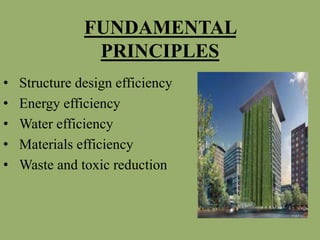
FUNDAMENTAL
PRINCIPLES
• Structure design efficiency
• Energy efficiency
• Water efficiency
• Materials efficiency
• Waste and toxic reduction
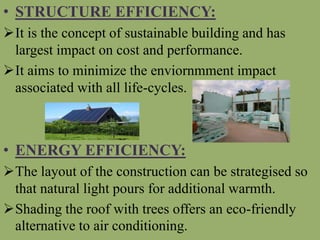
• STRUCTURE EFFICIENCY:
It is the concept of sustainable building and has
largest impact on cost and performance.
It aims to minimize the enviornmment impact
associated with all life-cycles.
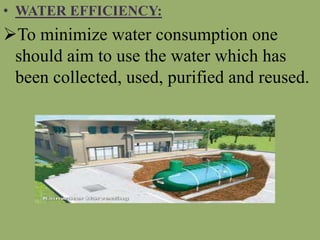
• ENERGY EFFICIENCY:
The layout of the construction can be strategised so
that natural light pours for additional warmth.
Shading the roof with trees offers an eco-friendly
alternative to air conditioning.
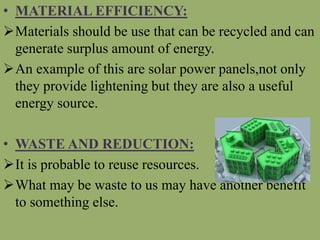
• WATER EFFICIENCY:
To minimize water consumption one
should aim to use the water which has
been collected, used, purified and reused.
• MATERIAL EFFICIENCY:
Materials should be use that can be recycled and can
generate surplus amount of energy.
An example of this are solar power panels,not only
they provide lightening but they are also a useful
energy source.
• WASTE AND REDUCTION:
It is probable to reuse resources.
What may be waste to us may have another benefit
to something else.
INDIAN GREEN BUILDING
COUNCIL
• The Indian Green Building Council (IGBC)
was formed in the year 2001 by Confederation
of Indian Industry (CII).
• The aim of the council is to bring green
building movement in India and facilitate
India to become one of the global leaders in
green buildings by 2015.
IGBC RATING SYSTEM
• IGBC has developed green building rating
programmes to cover commercial, residential,
factory buildings, etc.
• Each rating system divided into different levels of
certification are as follows:
 ‘Certified’ to recognise best practices.
 ‘Silver’ to recognise outstanding performance.
 ‘Gold’ to recognise national excellence.
 ‘Platinum’ to recognise global leadership.
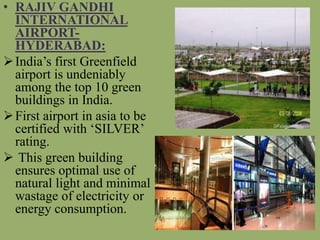
• SUZLON ENERGY
LIMITED,PUNE:
 Several accolades continue
to shower upon Suzlon’s
global headquarter in Pune
“One Earth”.
 LEED certified it as
‘PLATINUM’ and it is built
on an area of 10.13acres.
 One Earth can be counted as
among the largest green
building projects in India.
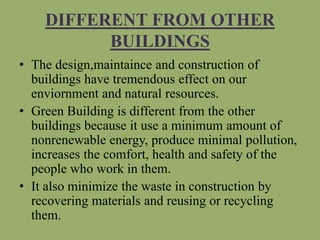
• RAJIV GANDHI
INTERNATIONAL
AIRPORT-
HYDERABAD:
India’s first Greenfield
airport is undeniably
among the top 10 green
buildings in India.
First airport in asia to be
certified with ‘SILVER’
rating.
 This green building
ensures optimal use of
natural light and minimal
wastage of electricity or
energy consumption.
DIFFERENT FROM OTHER
BUILDINGS
• The design,maintaince and construction of
buildings have tremendous effect on our
enviornment and natural resources.
• Green Building is different from the other
buildings because it use a minimum amount of
nonrenewable energy, produce minimal pollution,
increases the comfort, health and safety of the
people who work in them.
• It also minimize the waste in construction by
recovering materials and reusing or recycling
them.
Why “Go green”?
Features of green buildings
 Efficient use of natural resources
 Waste minimisation
 Eco-friendly construction materials
 Incorporation of local climate conditions
 Less energy required to transport building materials
 Limited impact on surroundings (e.g. lower emissions, noise, smell)
 Consideration of life cycle costs
 Health
 Location near population centres and close to public transportation
facilities
 Efficient building management and commissioning
 Social capacity and building user‘s comfort
 Convenient indoor environment
Water System design
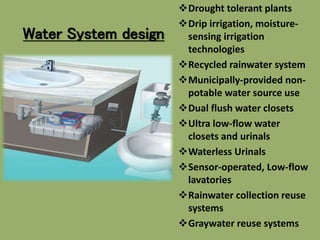
Drought tolerant plants
Drip irrigation, moisture-
sensing irrigation
technologies
Recycled rainwater system
Municipally-provided non-
potable water source use
Dual flush water closets
Ultra low-flow water
closets and urinals
Waterless Urinals
Sensor-operated, Low-flow
lavatories
Rainwater collection reuse
systems
Graywater reuse systems
Energy management system
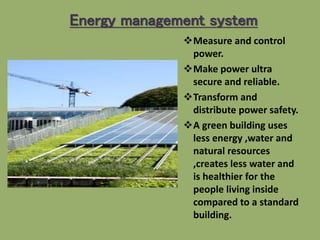
Measure and control
power.
Make power ultra
secure and reliable.
Transform and
distribute power safety.
A green building uses
less energy ,water and
natural resources
,creates less water and
is healthier for the
people living inside
compared to a standard
building.
MATERIALS USED IN GREEN
BUILDINGS
Wool brick
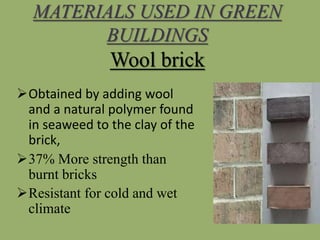
Obtained by adding wool
and a natural polymer found
in seaweed to the clay of the
brick,
37% More strength than
burnt bricks
Resistant for cold and wet
climate
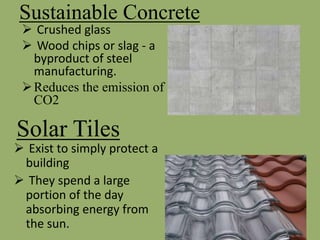
Sustainable Concrete
 Crushed glass
 Wood chips or slag - a
byproduct of steel
manufacturing.
Reduces the emission of
CO2
Solar Tiles
 Exist to simply protect a
building
 They spend a large
portion of the day
absorbing energy from
the sun.
Paper Insulation
 Made from recycled
newspapers and cardboard
 Then filled with chemical
foam
 Insect resistant &fire
retardant
Triple-Glazed Windows
 Super-efficient windows
 Stops heat to enter the
building & from direct
sunlight
Merits Of Green Building
 Efficient Technologies
 Easier Maintenance
 Return On Investment
 Improved Indoor Air Quality
 Energy Efficiency
 Water Efficiency
 Waste Reduction
 Temperature Moderation
 Water Conservation
 Economical Construction For Poor
 Healthier Lifestyles and Recreation
 Improved Health.
DEMERITS OF GREEN
BUILDING
INITIAL COST IS HIGH
AVAILABILITY OF MATERIALS
NEED MORE TIME TO CONSTRUCT
NEED SKILED WORKER
GREEN BUILDINGS PROJECT IN
INDIA
• Suzlon Energy Limited-Pune
• Biodiversity Conservation India-Bangalore
• Olympia Technology Park-Chennai
• ITC Green Centre-Gurgaon
• The Druk White Lotus School-Ladakh
• Doon School-Dehradun
• Raintree Hotels-Chennai
• Nokia-Gurgaon
• Rajiv Gandhi International Airport-Hyderabad
• Hiranandini-BG House, Powai
• ABN Amro Bank, Chennai
• Palais Royale at Worli, Mumbai
• Punjab Forest Complex,Mohali
GREEN BUILDING POLICY
& CODES
NATIONAL BUILDING CODE (NBC)
 THE BUREAU OF INDIAN STANDARDS (BIS)
ENERGY CONSERVATION BUILDING CODE
(ECBC)
 THE BUREAU OF ENERGY EFFICIENCY (BEE)
ENVIRONMENTAL IMPACT ASSESSMENT (EIA)
 THE MINISTRY OF ENVIRONMENTAL
&FORESTS (MoFE)
Y
O
U
T
H
A
N
K

Green buildings

  • 1.
    Vishwakarma Government Engineering College, Chandkheda ENROLL. NO:- 150170106054,150170106055,150170106056, 150170106057,150170106058,150170106059, 150170106060,150170106061 Branch -CIVIL ENGINEERING Sub - BC Sem -3 Topic -GREEN BUILDINGS
  • 2.
    GREEN BUILDING Definition :-“It is the practice of increasing efficiency with which buildings use resources- energy, water and materials-while reducing building impacts on human health and the environment.” ``Green building technology should reach all''
  • 3.
    OBJECTIVES OF GREEN BUILDING •Green Buildings are designed to reduce the overall impact on human health and the natural environment by the following ways: • Using energy, water and other resources efficiently. • By reducing waste, pollution, and environmental degradation.
  • 4.
    FUNDAMENTAL PRINCIPLES • Structure designefficiency • Energy efficiency • Water efficiency • Materials efficiency • Waste and toxic reduction
  • 5.
    • STRUCTURE EFFICIENCY: Itis the concept of sustainable building and has largest impact on cost and performance. It aims to minimize the enviornmment impact associated with all life-cycles. • ENERGY EFFICIENCY: The layout of the construction can be strategised so that natural light pours for additional warmth. Shading the roof with trees offers an eco-friendly alternative to air conditioning.
  • 6.
    • WATER EFFICIENCY: Tominimize water consumption one should aim to use the water which has been collected, used, purified and reused.
  • 7.
    • MATERIAL EFFICIENCY: Materialsshould be use that can be recycled and can generate surplus amount of energy. An example of this are solar power panels,not only they provide lightening but they are also a useful energy source. • WASTE AND REDUCTION: It is probable to reuse resources. What may be waste to us may have another benefit to something else.
  • 8.
    INDIAN GREEN BUILDING COUNCIL •The Indian Green Building Council (IGBC) was formed in the year 2001 by Confederation of Indian Industry (CII). • The aim of the council is to bring green building movement in India and facilitate India to become one of the global leaders in green buildings by 2015.
  • 9.
    IGBC RATING SYSTEM •IGBC has developed green building rating programmes to cover commercial, residential, factory buildings, etc. • Each rating system divided into different levels of certification are as follows:  ‘Certified’ to recognise best practices.  ‘Silver’ to recognise outstanding performance.  ‘Gold’ to recognise national excellence.  ‘Platinum’ to recognise global leadership.
  • 10.
    • SUZLON ENERGY LIMITED,PUNE: Several accolades continue to shower upon Suzlon’s global headquarter in Pune “One Earth”.  LEED certified it as ‘PLATINUM’ and it is built on an area of 10.13acres.  One Earth can be counted as among the largest green building projects in India.
  • 11.
    • RAJIV GANDHI INTERNATIONAL AIRPORT- HYDERABAD: India’sfirst Greenfield airport is undeniably among the top 10 green buildings in India. First airport in asia to be certified with ‘SILVER’ rating.  This green building ensures optimal use of natural light and minimal wastage of electricity or energy consumption.
  • 12.
    DIFFERENT FROM OTHER BUILDINGS •The design,maintaince and construction of buildings have tremendous effect on our enviornment and natural resources. • Green Building is different from the other buildings because it use a minimum amount of nonrenewable energy, produce minimal pollution, increases the comfort, health and safety of the people who work in them. • It also minimize the waste in construction by recovering materials and reusing or recycling them.
  • 13.
    Why “Go green”? Featuresof green buildings  Efficient use of natural resources  Waste minimisation  Eco-friendly construction materials  Incorporation of local climate conditions  Less energy required to transport building materials  Limited impact on surroundings (e.g. lower emissions, noise, smell)  Consideration of life cycle costs  Health  Location near population centres and close to public transportation facilities  Efficient building management and commissioning  Social capacity and building user‘s comfort  Convenient indoor environment
  • 14.
    Water System design Droughttolerant plants Drip irrigation, moisture- sensing irrigation technologies Recycled rainwater system Municipally-provided non- potable water source use Dual flush water closets Ultra low-flow water closets and urinals Waterless Urinals Sensor-operated, Low-flow lavatories Rainwater collection reuse systems Graywater reuse systems
  • 15.
    Energy management system Measureand control power. Make power ultra secure and reliable. Transform and distribute power safety. A green building uses less energy ,water and natural resources ,creates less water and is healthier for the people living inside compared to a standard building.
  • 16.
    MATERIALS USED INGREEN BUILDINGS Wool brick Obtained by adding wool and a natural polymer found in seaweed to the clay of the brick, 37% More strength than burnt bricks Resistant for cold and wet climate
  • 17.
    Sustainable Concrete  Crushedglass  Wood chips or slag - a byproduct of steel manufacturing. Reduces the emission of CO2 Solar Tiles  Exist to simply protect a building  They spend a large portion of the day absorbing energy from the sun.
  • 18.
    Paper Insulation  Madefrom recycled newspapers and cardboard  Then filled with chemical foam  Insect resistant &fire retardant Triple-Glazed Windows  Super-efficient windows  Stops heat to enter the building & from direct sunlight
  • 19.
    Merits Of GreenBuilding  Efficient Technologies  Easier Maintenance  Return On Investment  Improved Indoor Air Quality  Energy Efficiency  Water Efficiency  Waste Reduction  Temperature Moderation  Water Conservation  Economical Construction For Poor  Healthier Lifestyles and Recreation  Improved Health.
  • 20.
    DEMERITS OF GREEN BUILDING INITIALCOST IS HIGH AVAILABILITY OF MATERIALS NEED MORE TIME TO CONSTRUCT NEED SKILED WORKER
  • 21.
    GREEN BUILDINGS PROJECTIN INDIA • Suzlon Energy Limited-Pune • Biodiversity Conservation India-Bangalore • Olympia Technology Park-Chennai • ITC Green Centre-Gurgaon • The Druk White Lotus School-Ladakh • Doon School-Dehradun • Raintree Hotels-Chennai • Nokia-Gurgaon • Rajiv Gandhi International Airport-Hyderabad • Hiranandini-BG House, Powai • ABN Amro Bank, Chennai • Palais Royale at Worli, Mumbai • Punjab Forest Complex,Mohali
  • 22.
    GREEN BUILDING POLICY &CODES NATIONAL BUILDING CODE (NBC)  THE BUREAU OF INDIAN STANDARDS (BIS) ENERGY CONSERVATION BUILDING CODE (ECBC)  THE BUREAU OF ENERGY EFFICIENCY (BEE) ENVIRONMENTAL IMPACT ASSESSMENT (EIA)  THE MINISTRY OF ENVIRONMENTAL &FORESTS (MoFE)
  • 23.

Editor's Notes

  • #22 With the projected energy demand, thermal energy is not likely to be a solution and renewable energy can only meet the part of energy requirement. CPWD ensured griha compliance in all future govt. buildings. MNRE (Ministry of New and Renewable Energy) in association with TERI (The Energy and Resources Institute) founded ADaRSH (Association for Development and Research of Sustainable Habitats). It is an independent society for the interaction on scientific and administrative issues related to sustainable habitats in India, founded jointly by Government of India with experts in the domain of sustainability of built environment . ADaRSH promotes GRIHA (Green Rating for Integrated Habitat Assessment) as a design and evaluation tool for green buildings and habitats. IGBC formed LEED rating system to promote the concept of green building.