CEG 331
Structural Analysis 1
(2, 0)
Dept of Civil & Environmental Engineering
Dr Olusegun AAfolabi
CEG 331 Lectures
Introduction: Structures and Analysis
Loading system
Structural floor system
Symmetric Structures and loading
Structural Idealization,
Constraints/Static equilibrium,
Statically determinate and Indeterminate system
Methods of structural Analysis, Moment distribution,
Moment area method, Influence lines
Introduction: Analysis of Structures
Structural analysis is the evaluation of anticipated
loads/forces and determination of structural response
Structural responses (eg, Q, M, deformation(ε),
displacements (θ, Δ), fatigue), are necessary parameters in
the design and construction of structures
Structural modeling and simulations are computer-based
method of analysis, using specific algorithms to evaluate
the structural responses and behaviors
Load bearing System
Structures are load bearing systems, designed and constructed
for the purpose of supporting load application in static
equilibrium state
Examples include, Building, Bridges, Dams, Towers, Shell etc
Structures are usually presented as arrangement of structural
components, connected at the nodes (or, joints, ends etc) to
ensure monolithic action and static equilibrium state during
transition of forces and moments by the components
The components assist in transition of applied load (stresses)
from point of load application to sub-structural system and
the ground, that is,
Applied Load → Structural Components → Ground soil
Load transition path by structural components
Load (Force) → Slab → Beam → Column →
Foundation → Ground soil
Typical Structural System
(a): Dam (b): Building/bridge deck
Structural Floor System
Known also as Suspended floor slabs, they are structural
components that serve as point of load application on
structures
Located at the precise level (or height) of load application
Due to their structural function, the floor system are
suspended and supported by other structural components that
assist in keeping them in position and in distribution of
internal stresses (load) through components to the ground
Floor systems (ie, slab and beams) of multi-storey building,
are linked by series of columns forming frame structures
(consisting of floors and columns)
Other assemblies (eg, dams, mast, shell etc) have different
structural system and mode of load application
For example,
Dam : Mass or Reinforced concrete without component
Mast: Truss systems
Shell structures: Membrane systems
Symmetric structures and Loading
Symmetry is the act of exhibiting a pattern that provides similar
arrangement of component parts of an object about a reference axis,
including agreement in dimension, scales and orientation
In mathematics, symmetry usually, refer to an object that is invariant
under some transformations including, rotation, reflection, etc.
The function f(x) = f(-x) is symmetric (eg, Fij = -Fji )
→ Fij - Fji = 0 ie, ∑F = 0 (a static equilibrium state)
Also, the static equilibrium state requires that,
∑M = 0 → Mij = -Mji
Ie, clockwise moment is equal to anticlockwise moment ( a
symmetric behavior)
Similarly, f(x) = - f(-x) is asymmetric
Asymmetric is the act of not symmetric
Therefore, load application and structural arrangement must be made
to encourage symmetric actions and behaviors for the static
equilibrium state
Symmetric Planar Structures
Many planar framed structures have either axes of symmetry or point
(center) of symmetry
Planar structure (in the xy plane) is symmetric with respect to an axis
Y, if its geometry as well as the material properties are the same with
respect to right-hand orthogonal axis, x, y, z and x!
, y!
, z!
Such that x =
x!
, y = y!
, and z = z!
Similarly, a planar structure (in the xy plane) is symmetric with respect
to a point (centre of symmetry), if its geometry and material properties
are the same with respect to two sets of orthogonal axes x, y, z and x!
,
y!
, z!
Such that x = -x!
, y = -y!
, and z = -z!
.
Structural Idealization
Idealization is scientific process of constructing models to represent
information and state of physical object, ie, the shape, form, dimensions
etc.
The information is used to model the system during analysis to
determine the responses, including stability to load application
Structural load are most essential data in analysis and must accurately
determined, which include,
Self weight of the structure
Applied or imposed load (type of structure)
Environmental Load: Wind load, Seismic force etc
Climatic factor: Temperature change etc
Idealizations
Structural Constraints / Static Equilibrium
Consider a rigid body system subjected to applied force, the tendency is to
commence motion, therefore the body can only remain at rest, if an
opposing force is applied
Ie, F = ma = 0 (not feasible, since F has magnitude, hence a cannot be 0)
According to Newton's third law, “action and reaction are equal and
opposite” therefore, F = -R and. F + R = 0
And, ∑F = 0, application of R keeps the system in static equilibrium
state
Static equilibrium state, is the design requirement of structures, such that
action of applied forces must not produce motion nor displacement
The opposing force R is known as restraining force (or constraint)
Constraints are systems (or objects) which possess reactive forces
that can keep structures or structural components in static
equilibrium (ie, rest position)
Supports / Constraint Reactive forces
Fixed or Encastre 3 Nos
Hinged or Pinned 2 Nos
Roller 1
Statically Determinate and Indeterminate Structures
Statically determinate describes structures with minimum reactive
forces (3Nos) required to maintain static equilibrium state,
Thus, can easily be analyzed with static equilibrium equations, as
follows,
∑Fx = 0, ∑Fy = 0, and ∑M = 0
Statically indeterminate structures possesses more than 3 Nos reactive
forces (due to structural reasons), required for static equilibrium state
and the static equilibrium equations are not sufficient for the analysis.
Other analytical methods are involved in the analysis
Examples include, Continuous beams, fixed ended and propped
cantilevered beams, frame structural system.
Degree of Determinacy (D)
D = 3m + R -3j – NAR
In the expression, D is the degree of determinancy,
m = number of members, R = reactive forces at the supports
j = number of joints and, NAR = number of action released at joints
D ≥ 0 and
statically determinate, when D = 0
D 0 the structure is defined as statically indeterminate
˃
Structural Analysis Methods
Methods of structural analysis are classified into two distinct groups
and methods as follows
Classical methods
Modern or matrix methods
Classical methods are earlier concept of analysis involving equilibrium
of forces and actions acting on structures,
Are important in understanding fundamental concepts of structural
analysis which enables the analysis of simple structures.
Examples include, Static equilibrium equation, Moment distribution
method, Moment area method, slope-deflection etc.
Modern matrix
Modern matrix methods are employed usually for
indeterminate and complex structures
It involves computer algorithms, programs and softwares for
the analysis, modeling and simulations to visualize the
structural response
They constitute powerful tools for analyzing complex
structures with high degree of indeterminacy and involving
large number of simultaneous equations (with m x n matrices).
Modern matrix method is carried out using either a stiffness
matrix or a flexibility matrix
Statically Determinate Beams
Simply supported beams or Cantilever beams. Beams having 3 reactive forces at
the support
Compound beams (continuous and indeterminate beams) but on removal
structural action like BM using hinge(s) it becomes statically determinate
Simply supported beams/cantilevers
Analysis involve only static equilibrium equations
Procedures; Determine the reactive forces at support using static equilibrium
equations
∑Fx = 0 ∑Fy = 0 and ∑M = 0
Solving for reactive forces show that the beam is in equilibrium with the applied
load and reactive forces
Q, N and M
Internal forces are forces induced in the structure as a result load transmitting
through it to the supports
Internal forces in beams are Shear force (Q), Normal forces (N) and bending
moment (M)
Q is defined as sum of all forces perpendicular to the axis of the beam from one
end to a cross section x
N is the sum of all forces on the longitudinal axis of the beam from one end to
cross section x
M is the sum of all forces times perpendicular distances (M = F d) from one end to
a cross section x
Home assignment: solve atleast 3 simply supported beams and 2 cantilever
beams
Analysis of statically determinate structures,
Compound beams
and Frames
Compound structures are indeterminate systems
introduction of hinge(s) within span or nodes removes
actions (eg, BM), to enable statically determinate
analysis using static equilibrium equation
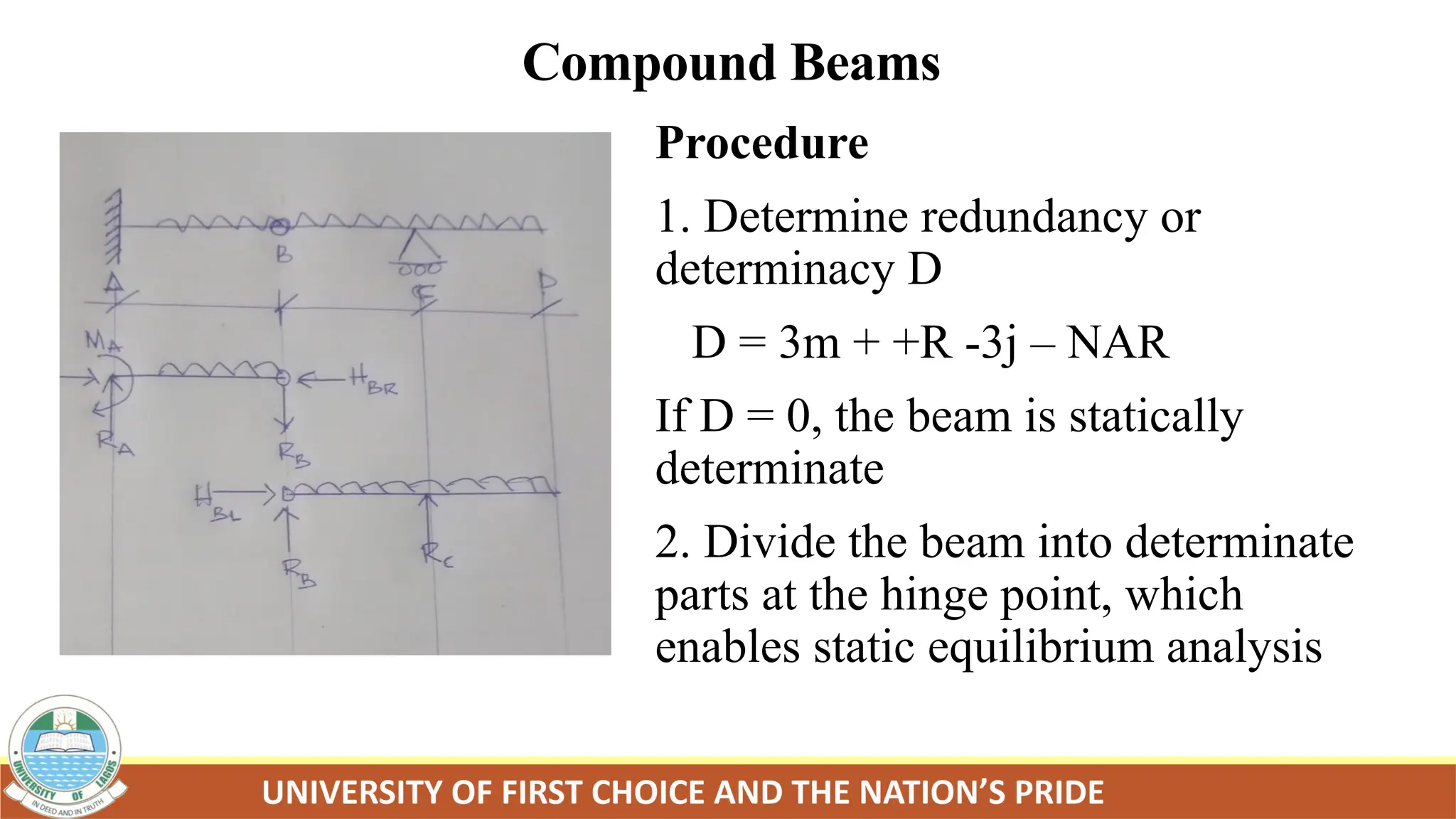
Compound Beams
Procedure
1. Determine redundancy or
determinacy D
D = 3m + +R -3j – NAR
If D = 0, the beam is statically
determinate
2. Divide the beam into determinate
parts at the hinge point, which
enables static equilibrium analysis
3). at the hinge ∑F = 0 and M = 0
NBr + NBl = 0 and NBr = - NBl
HBr + HBl = 0 and HBr = - HBl
Note: the equilibrium of the hinge
provides forces of equal magnitude and
opposite sense
4. Analyze component parts using static
equilibrium equation and solve for
reactive forces at support
5. Determine and draw the internal
forces, SFD, NFD and BMD
Internal forces in beams are defined as
Q is defined as sum of all forces
perpendicular to the axis of the beam
from one end to a cross section x
N is the sum of all forces on the
longitudinal axis of the beam from one
end to cross section x
M is the sum of all forces times
perpendicular distances (M = F d) from
one end to a cross section x
Example
Analyze the compound beam shown
and the draw SFD and BMD
D = 3m + R -3j –NAR
= 3x4 + 5 – 3x5 -2 = 0
The compound beam is statically
determinate
Divide the compound beam into three
segments at the hinges to enable
static equilibrium analysis of the
segments
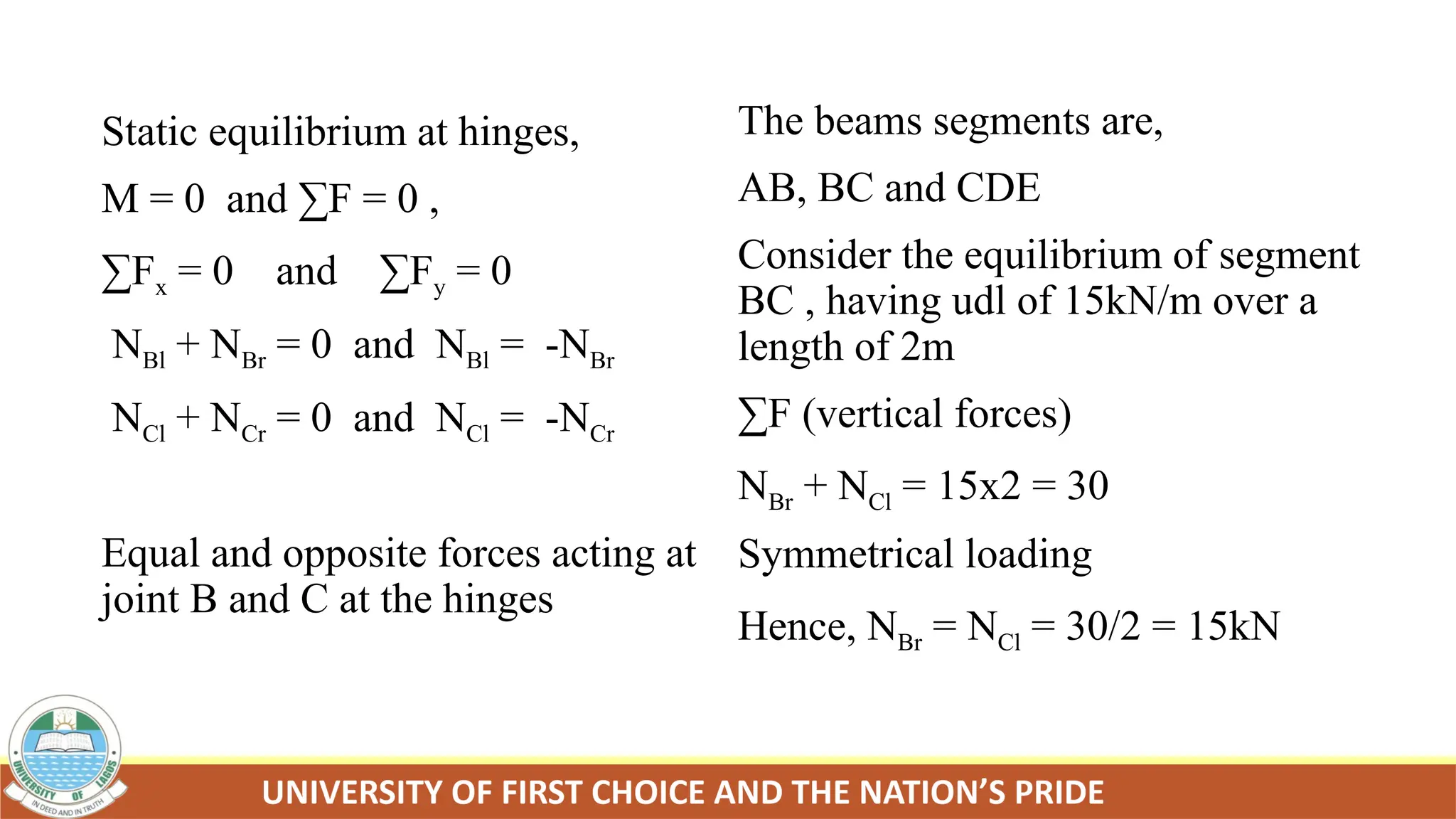
Static equilibrium at hinges,
M = 0 and ∑F = 0 ,
∑Fx = 0 and ∑Fy = 0
NBl + NBr = 0 and NBl = -NBr
NCl + NCr = 0 and NCl = -NCr
Equal and opposite forces acting at
joint B and C at the hinges
The beams segments are,
AB, BC and CDE
Consider the equilibrium of segment
BC , having udl of 15kN/m over a
length of 2m
∑F (vertical forces)
NBr + NCl = 15x2 = 30
Symmetrical loading
Hence, NBr = NCl = 30/2 = 15kN
Segment AB
∑M = 0
MA + 15x3 = 0
MA = - 45kNm
∑FY = 0
RA - 15 = 0 RA = 15kN
∑FX = 0 thus HA = 0
Segment CDE
∑M about E,
4RD – 15x7 -30x2 = 0
4RD = 105 + 60 = 165
RD = 165/4 = 41.25kN
∑FY = 0
RE + RD = 15 + 30
RE = 45 – 41.25 = 3.75kN
SFD
Starting from point A, consider a section X-X at
distance x from A
QX = ∑FY
At A, x = 0 and Q = 15kN
Q value is constant between A and B (0 ≤ x ≤ 3m)
between B and C, QX = 15 + 15(x-3) = 60 – 15x,
at B, x = 3 and Q = 60 – 15x3 = 15kN
at C, x =5 and Q = 60 – 15x5 = -15kN
between C and D, Qx = 15 – 30 = - 15kN
at D, QX = - 15 + RD = -15 + 41.25 = 26.25kN
at E, QX = 3.75kN
BMD
Mx = ∑FY X
Ie, Sum of the moment from one end of
the beam to specific cross section
MA = -45 kNm
MB = -45 + Ra x3 = -45 + 15x3 = 0
MC = -45 + 15x5 – 15x2x(1) = 0
MD = -45 + 15x8 – 15x2x4 = -45 kNm
ME = 0
STRUCTURAL FRAME SYSTEMS
Frame systems are assemblies of structural
beams and columns monolithically
connected at the nodes (or, joints)
The system is considered as a unit known
as frame during structural analysis
The frame ABCD in the fig., comprise of
members AB (column), BC (beam) and CD
(column)
Node B and C the connection joint
A and D are supports
Structural Joints
Joints are node points where two or more structural members are
connected for structural purpose (eg supports and load transition)
Joints are further classified as follows,
Continuous Joints: when structural actions are continuous and can
be transfer adequately from one member to another while maintain
static equilibrium state ∑F = 0 and ∑M = 0
Hinged Joint: The release of M of a continuous joint makes it a
hinged joint. Also the equilibrium equation is M = 0 and ∑F = 0
Types of Frame Systems
Followings are common type
of structural frame system
Portal Frame
Gable Frame
Multibay Frame: joining bays
Multi-storey Frame: joining
heights
Space Frame: 3D view (x, y, z
direction)
Sway and Nonsway Frames
Configuration of frame system (ie, multistorey, space frames)
enables rotations (θ) and lateral displacement of the frames.
Sway is lateral displacement due to loading, structural
configuration, and design etc. It is a characteristic property of the
system such as stability and dynamics.
Due to parameters such as robustness, elastic stiffness, allowable
drift limits and modulus of rigidity etc
A non sway frame is stable and considered to have minimal or
permissible lateral displacement (Δ) and interstorey drift and also in
static equilibrium state during load application
Sway displacement (θ and Δ)
must be negligible for safe and
stability of structures,
and achieved either by bracing
(eg, shear wall), or by
symmetric loading and
configurations
Analysis of Statically Determinate Frames
Statically determinate frames are,
- Frames with 3 support reactive
forces
- Compound frames
Method of Analysis for Statically
determinate system is
∑FX = 0 ∑FY = 0
and ∑M = 0
Compound Frame
Procedure
1. Determine redundancy or determinacy D
D = 3m +R -3j – NAR
If D = 0, the beam is statically determinate
2. Divide the frame into determinate parts at the hinge point, which
enables the static equilibrium analysis
3. Analyze component parts using static equilibrium equation and
solve for reactive forces at support
4. Determine and draw the internal forces, SFD, NFD and BMD
Example: Analyze the compound frame shown, and
draw the SFD, NFD and BMD
The frame is divided at the hinge into
2 component parts
Lets consider the equilibrium of
section BCD
∑FX = 0, and NBr = 0
∑FY = 0, QBr + RD = 18 x 4 =72
∑MB = 0 , 4RD = 18 x 4 x 2
. and RD = 36kN
then, QBr = 72 – RD = 36kN
Consider section AB
∑FY = 0 QBL – RA = 0
. RA = QBl = 36kN
. ∑FX = 0 HA + 10 = 0
and HA = -10 kN
.
∑MB = MB = 0
. MA – 4HA – 10x1 = 0
. MA = 4HA + 10
= -40 + 10 = -30kNm
Assignment
Use the reactive forces
to draw the SFD, NFD and BMD
Statically Indeterminate Structural System
Analysis Method
Moment Distribution
Method
Moment Area Method
Moment Distribution Method (MDM)
A structural analysis method for statically indeterminate beams and
frames developed by Prof Hardy Cross in 1930. It belongs to the
category of displacement method of structural analysis that involve
solving simultaneous equations by means of iteration
Iteration is a standard form of algorithms, and involves repetition of
processes in order to generate sequence of outcomes. The degree of
accuracy depends on the number of iteration process before convergence
MDM as an approximate method does not directly requires solving the
simultaneous equations (unlike slope deflection method where
simultaneous equations are directly solved).
MDM
In the method, moment equilibrium equation of the joints are solved
iteratively by considering the static equilibrium of each joint
independently while other joints are assumed restraint
For static equilibrium of joint L,
∑M = 0, ie, MLM + MLK + MLJ = 0
Basic Concept of MDM
Consider the frame shown,
Members of the frame are
assumed not to deform
axially nor translate relative
to one another
Joints A, C, D of the frame
are fixed, while joint B can
rotate slightly due to applied
load
Before implementing the moment
distribution among members, all
joints are assumed to be temporary
locked using clamp
MDM
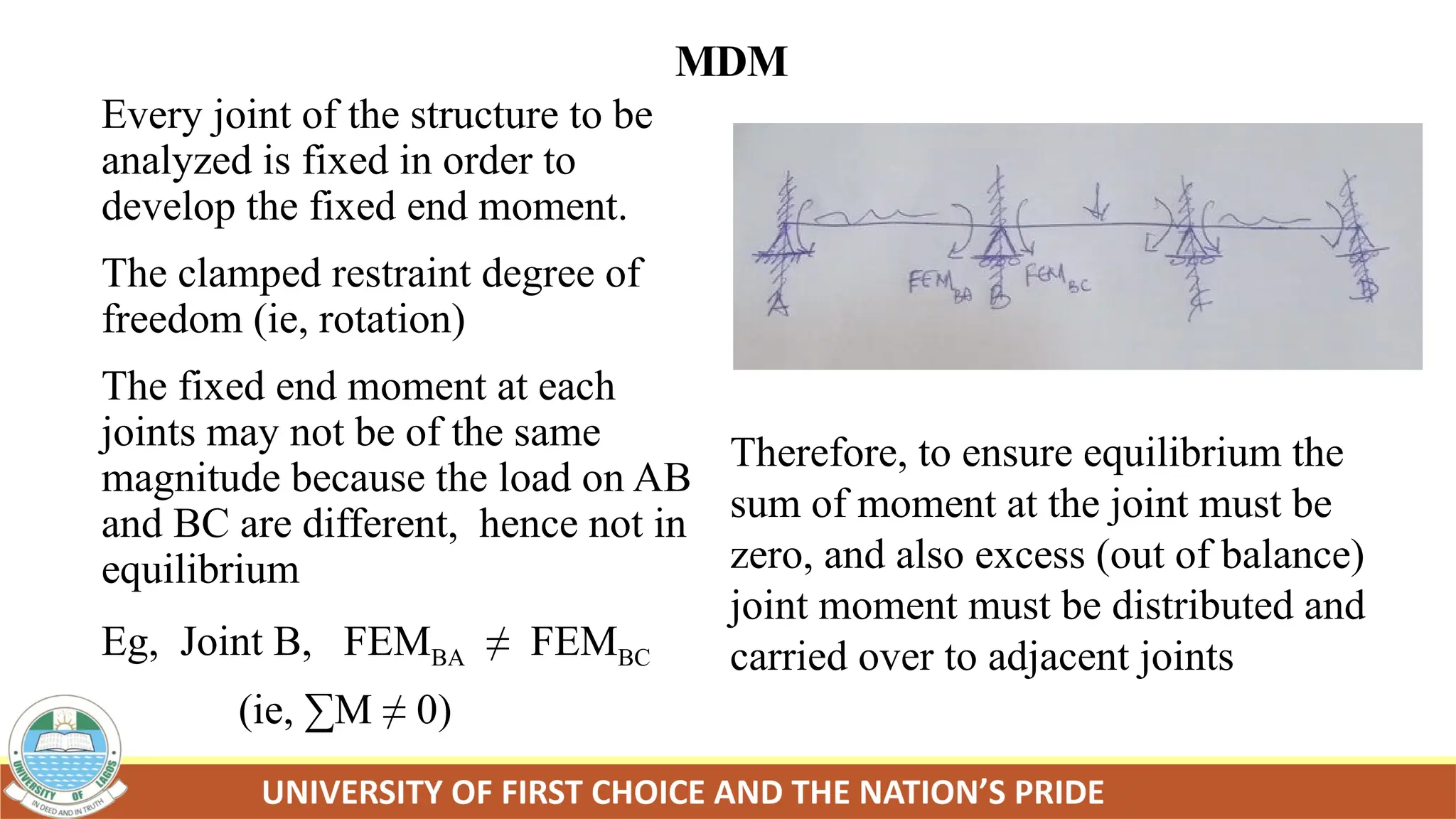
Every joint of the structure to be
analyzed is fixed in order to
develop the fixed end moment.
The clamped restraint degree of
freedom (ie, rotation)
The fixed end moment at each
joints may not be of the same
magnitude because the load on AB
and BC are different, hence not in
equilibrium
Eg, Joint B, FEMBA ≠ FEMBC
(ie, ∑M ≠ 0)
Therefore, to ensure equilibrium the
sum of moment at the joint must be
zero, and also excess (out of balance)
joint moment must be distributed and
carried over to adjacent joints
Definitions and Terminology
Sign Convention
Counterclockwise member end
moments are considered negative
Clockwise moments are considered
positive
Fixed end Moments (FEM)
Moment produced at member ends
due to applied load, and calculated
assuming the supports are fixed or
clamped
Member Stiffness
Consider a prismatic beam AB, hinged at
end A and fixed at end B
If moment M is applied at end A, the
beam rotates by an angle θ at the hinged A
and develops a moment MBA at the fixed
end B as shown
The relationship between the applied
moment M and the rotation θ can be
established using the slope deflection
equation
By substituting, Mab = M, θA = θ
and, θb = FEMab = 0
in the slope-deflection equation
Mab = 2EI/L)(2θa + θb) + FEMab
= (2EI/L)(2θa) = (4EI/L)θ
Bending stiffness k, of a member is
defined as the moment that must be
applied at an end of the member to cause a
unit rotation at that end
By setting θ = 1 rad, the expression of
bending stiffness of beam becomes
K = 4EI/L
Now suppose that the far end B of the
beam is hinged,
Relationship between the applied moment
M and the rotation θ of end A of the beam
can now be determined, using the
modified slope-deflection equation
By substituting, Mab = M, θa = θ and
FEMab = FEMba = 0
in the slope-deflection equation,
Then, M = (3EI/L)θ
and by setting θ = 1 rad
K = 3EI/L
Carry-Over Moments
Distributed moments at ends of
members meeting at a joint cause
moments in the other ends, which are
assumed to be fixed
These induced moments at the other
ends are called carry-over moments
If a moment M, is applied to the left end
of the beam, the slope-deflection
equations for both ends of the beam can
be written as follows,
Note, θB = 0 being a fixed end
M1 = 2EK(2θA) = 4EkθA ------ (1)
M2 = 2EkθA ------ (2)
solving eqn (1) and (2)
θA = M1/4Ek
and, M2 = ½(M1) or, M1/M2 = ½
Therefore, Carry Over Factor = ½
Distribution Factor
Distribution factor is a factor used in
determining the proportion of
unbalanced moment distributed to each
of the members at a joint
For members at joint O of the frame, the
distribution factors are computed based
on member stiffness K, as follows
If, ∑K = kOA + kOB + kOC + kOD
DFOA = kOA /∑K DFOB = kOB /∑K
DFOC = kOC /∑K DFOD = kOD /∑K
∑DF = DFOA + DFOB + DFOC + DFOD
= 1 (sum of DF at any joint)
Special Cases
at fixed end support,
Since no rotation is permitted k=0,
Then, DF = 0
Cantilever end:
the joint is not an ideal joint
sum of DF = 1 + 0 = 1
The cantilever moment M,
remains constant
Therefore the DF = 0 at the
cantilevered section
Distributed Moments (DEM)
The distributed moments are
computed as follows,
MOA = (kOA/∑K)Mo = DFOA
(MO)
MOB = DFOB (M0)
MOC = DFOC (M0)
MOD = DFOD (M0)
Boundary Conditions
In structural systems, described by mathematical functions, such as
the boundary value problems (ie differential equations). A boundary
value problem has conditions specified at the extremes (boundaries)
of the independent variable in the equation
In structural systems (eg, beams, frames), the boundary conditions
are those parameters available at the ends of elastic deformation
curve that satisfies the solutions of resulting differential equations.
Therefore, BC are known or assumed conditions that enables the
analysis of structural system. Examples are, Support system (fixed,
hinge, roller), elastic curve (slope, deflection) etc,
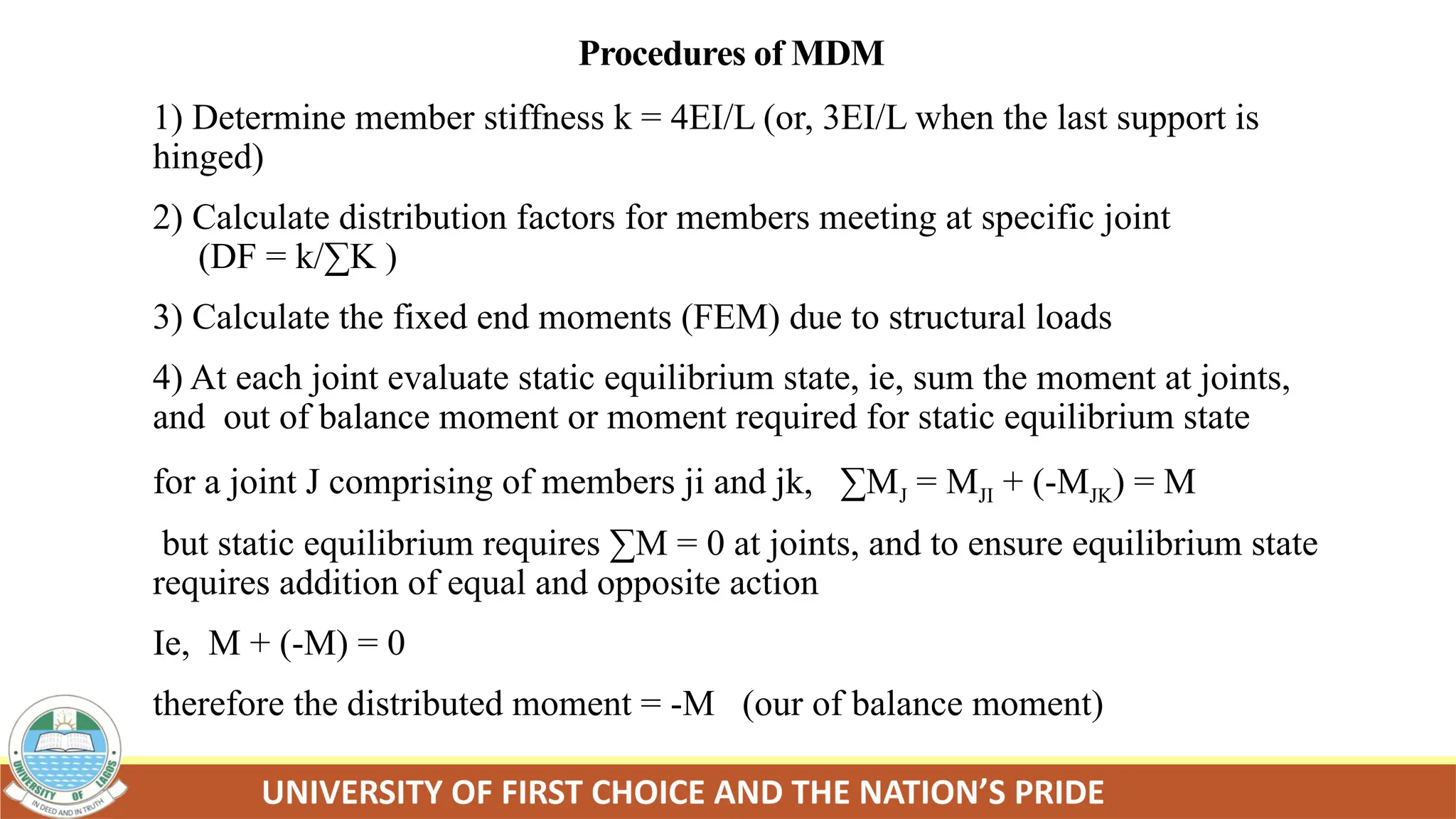
Procedures of MDM
1) Determine member stiffness k = 4EI/L (or, 3EI/L when the last support is
hinged)
2) Calculate distribution factors for members meeting at specific joint
(DF = k/∑K )
3) Calculate the fixed end moments (FEM) due to structural loads
4) At each joint evaluate static equilibrium state, ie, sum the moment at joints,
and out of balance moment or moment required for static equilibrium state
for a joint J comprising of members ji and jk, ∑MJ = MJI + (-MJK) = M
but static equilibrium requires ∑M = 0 at joints, and to ensure equilibrium state
requires addition of equal and opposite action
Ie, M + (-M) = 0
therefore the distributed moment = -M (our of balance moment)
5). Distribute the out-of-balance moment at joints to members meeting at each joint by
multiplying the moment (-M) by their respective distribution factors (DF) in the first
cycle of MDM
ie, DMJI = DFJI (-M) and DMJK = DFJK (-M)
In the second cycle and subsequent cycles, carry-over moments from the distributed
moment are carried to the other ends within the same span of a beam (or frame)
COM = ½(Distributed moment)
6) The process is tabulated and the procedure being iterative is repeated severally until
distributed moment becomes very negligible (ie, a convergence is attained).
7) After Moment distribution exercise, the beam or frame, becomes statically
determinate and can be analyzed for internal forces and actions (Q, N and M) using
static equilibrium equation
8) Draw SFD, NFD and BMD
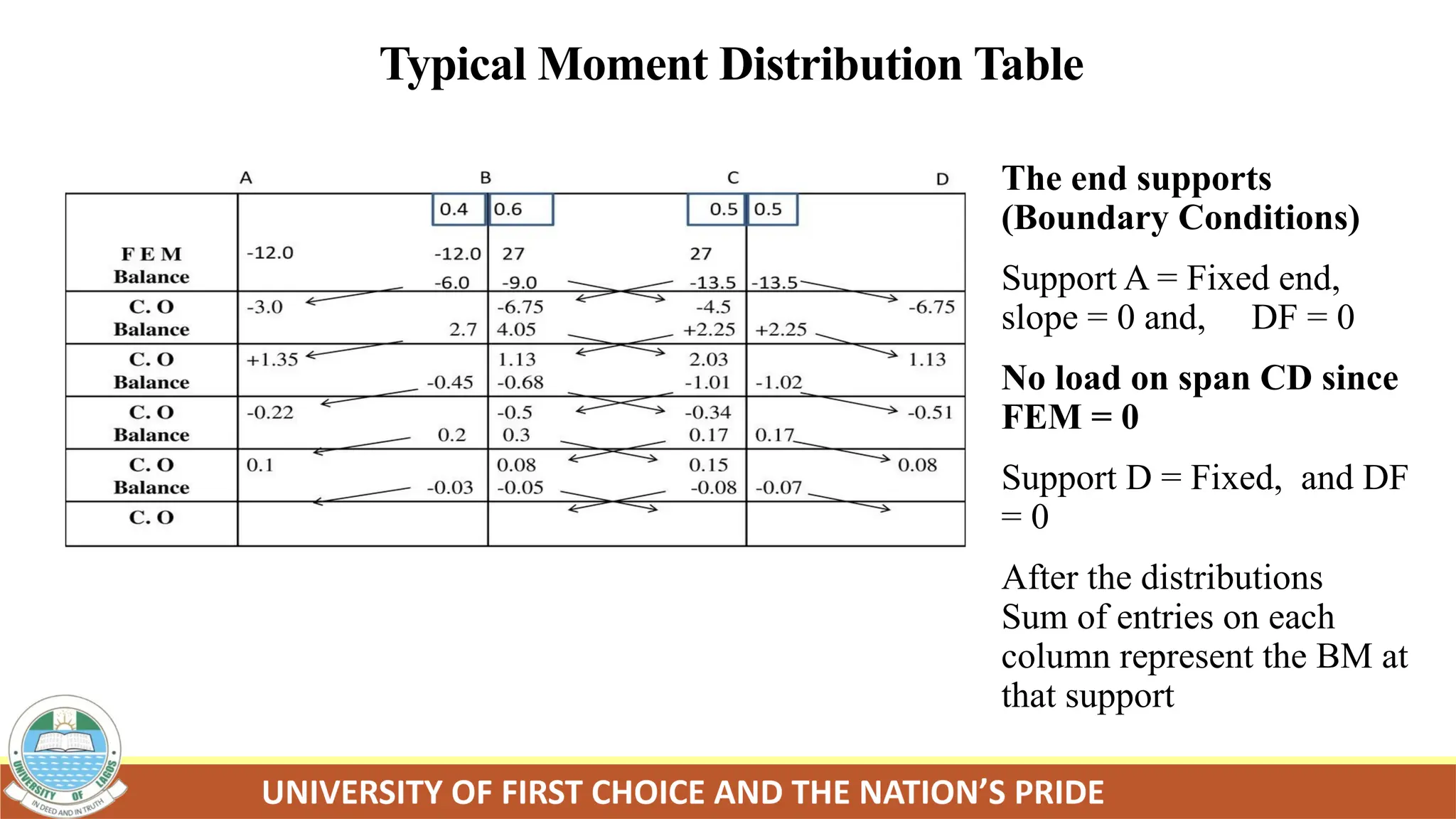
Typical Moment Distribution Table
The end supports
(Boundary Conditions)
Support A = Fixed end,
slope = 0 and, DF = 0
No load on span CD since
FEM = 0
Support D = Fixed, and DF
= 0
After the distributions
Sum of entries on each
column represent the BM at
that support
Initial Support Displacement
Beams with initial settlement/relative displacement of the supports
The displacement or yielding beam supports subjects the beam to twisting
moment
The FEM at that support becomes cumulative addition of the FEM due to
applied load on the beam and FEM (ie, twisting moment) due to support
displacement
For a displacement Δ at support B, then,
FEMAB = FEMAB (applied load) + FEMAB (support Δ)
FEMBA = FEMBA (applied load) + FEMBA (support Δ)
FEMAB = FEMBA = -6EIΔ/L2
(negative sign or slope, shows right support is displaced etc)
Fixed end Moments
ASSIGNMENT: (Home Practice)
(1). Calculate Member stiffness, Distribution factors and Fixed end
Moments.
(2) Assume support B (the beam) settles by 2 mm determine FEMs (EI =
19.44 x 10⁹
kN-mm2
)
Example:
Analyze using MDM, the beam shown, and draw the SFD, BMD and
elastic curve diagram. Values of second moment of area are indicated
along the member
Relative Member Stiffness (k =
I/L)
kAB = kBA = (IAB /LAB ) = 2I/5 = 0.4I
kBC = kCB = 3I/6 = 0.5I
kCD = kDC = (3/4)(4I/5) = 0.6I (end
support D is hinged)
Distribution Factor (DF = k/∑k)
Joint A , (fixed end, member AB)
DFAB =kAB/∑k = (0.4I/(0.4I+ ) = 0
ἀ
( very large due to fixed end)
ἀ
Joint B (members BA and BC)
DFBA = 0.4I/(0.4I+0.5I) = 0.44
DFBC = 0.5I/(0.4I+0.5I) = 0.56
Joint C (members CB and CD)
DFCB = 0.5I/(0.5I+0.6I) = 0.45
DFCD = 0.6I/(0.5I+0.6I) = 0.55
Joint D = (member DC)
DFDC = kDC/KDC+0 = 0.6I/(0.6I+0) = 1
Fixed End Moments
FEMAB = -PL/8 = -100x5/8 = -62.5kNm
FEMBA = PL/8 = 62.5kNm
FEMBC = -wL2
/12 = -30x62
/12 = -90kNm
FEMCB = wL2
/12 = 90kNm
FEMCD = -Pab2
/L2
= -80x1.25x3.752
/52
+ (-40x3.75x1.252
/52
)
= -65.63kNm
FEMDC = Pa2
b/L2
= 80x1.252
x3.75/52
+ 40x3.752
x1.25/52
= 46.88kNm
MDM Table
Joints A B B C C D
Members AB BA BC CB CD DC
DF 0 0.44 0.56 0.45 0.55 1.00
FEM
Bal
-62.5
0
62.5
12.10
-90
15.40
90
-10.97
-65.63
-13.4
46.88
-46.88
COM
Bal
6.05
0
0
2.42
-5.49
3.07
7.70
-3.47
0
-4.23
COM
Bal
1.21
0
0
0.77
-1.74
0.97
1.54
-0.69
0
-0.85
COM
Bal
0.39
0
0
0.15
-0.35
0.20
0.49
-0.22
0
-0.27
COM
Bal
0.08
0
0
0.05
-0.11
0.06
0.10
-0.05
0
-0.05
COM
Bal
0.03
0
0
0.01
-0.03
0.02
0.03
-0.01
0
-0.02
∑M -54.74 78.0 -78.0 84.45 -84.45 0.00
MDM
1st
cycle
Joint A, FEMAB = -62.5 DF = 0
Therefore, balancing MAB = 0
Joint B, FEMBA = 62.5 and FEMBC = -90
FEMBA + FEMBC = 62.5 – 90 = -27.5 but ∑M = 0 for
static equilibrium. Hence, Bal. M = 27.5kNm
MBA = 27.5x0.44 = 12.1 , and MBC = 27.5x0.56 =
15.40
Joint C, FEMCB = 90 and FEMCD = -65.63
FEMCB + FEMCD = 90 – 65.63 = 24.37
Therefore, Bal. M = -24.37kN
MCB = -24.37x0.45 = -10.97
and MCD = -24.37x0.55 = -13.40
Joint D, FEMDC = 46.88 and DF = 1
Bal M = -46.88 and MDC = -46.88x1 = -46.88kNm
2nd Cycle: Carry over moments
Distributed end moments are carry over within the
span from one end to the other to account for
additional moment at the joints
Eg, MBA → ½ MBA to joint AB also MAB → ½ MAB
to BA etc
Then balancing moment is repeated to ensure ∑M
= 0 at each joint
The process is repeated iteratively (for other
cycles) until convergence
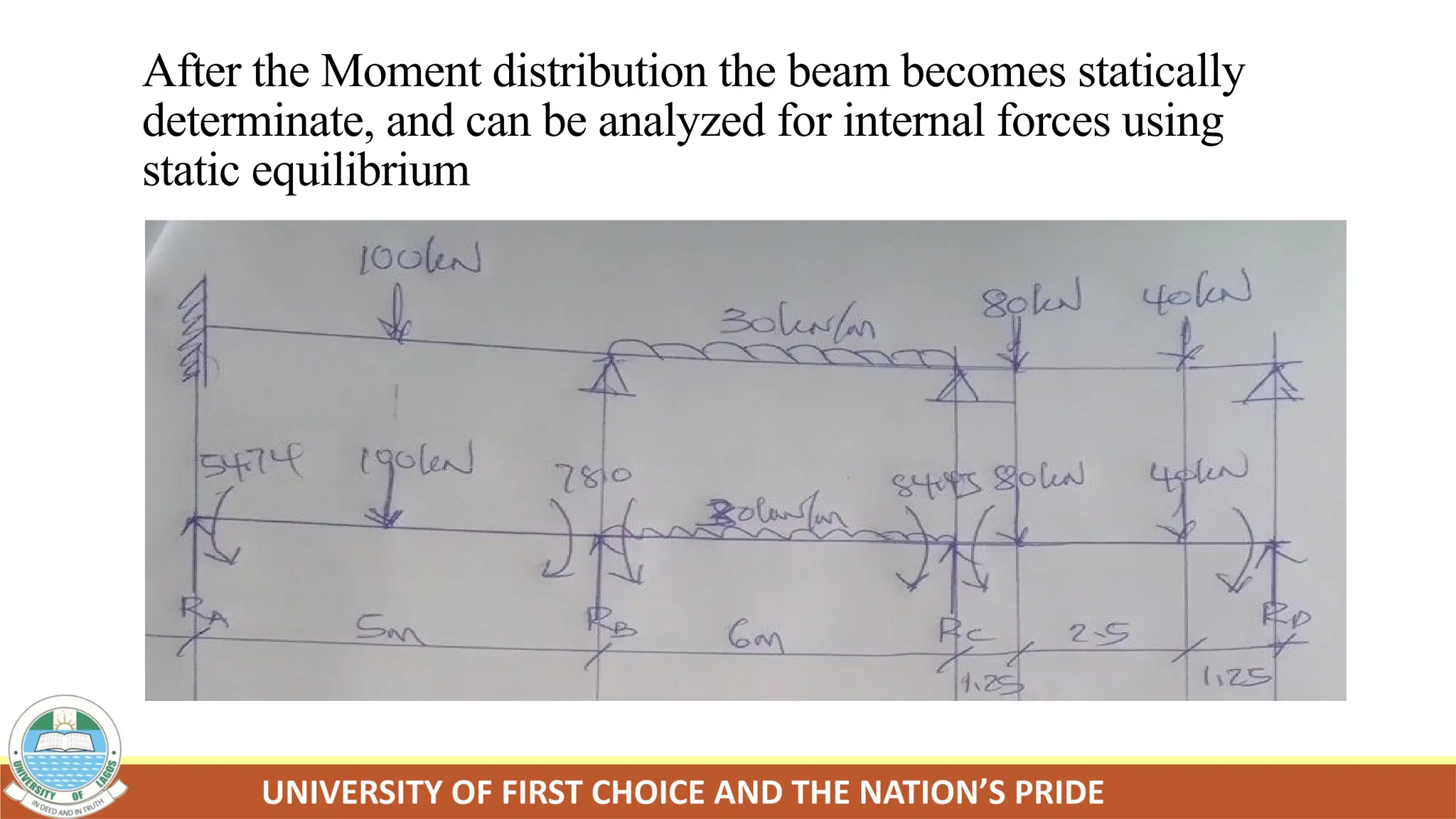
After the Moment distribution the beam becomes statically
determinate, and can be analyzed for internal forces using
static equilibrium
Determine Support’s reactive forces
Draw SFD, BDM and Elastic curve diagram
∑MB = 0, 5RA – 100x2.5-
54.74+78.0
5RA – 226.74 = 0
RA = 226.64/5 = 45.35kN
∑MC = 0, 45.35x11 -100x8.5 -
54.74 + 6RB -30x6x3 + 84.45 = 0
6RB = 934.7 and
RB = 934.7/6 = 155.78kN
∑MC = 0 (from the right)
-5RD + 40x3.75 + 80x1.25 – 84.45 =
0
-5RD +165.55 = 0
RD = 165.55/5 = 33.11kN
∑FY = 0, RA + RB + RC + RD = 100
+ 30x6 + 80 + 40 = 400
RC = 400 – 45.35 – 155.78 – 33.11
= 165.76kN
Elastic curve diagrams
Beams deforms due to load
application and within elastic limits
The deformation change the
configuration resulting in increase
in dimension, and
change the initial straight
(horizontal) position to curvature
form known as elastic curve
Drawing elastic deformation curve
requires Stiffness (EI), applied load
(or, BM) and boundary conditions
Analyze using MDM and assume that support B of the
continuous beam shown settles by 8mm.
Draw SFD and BMD, Let EI = constant = 20,000 kNm2
.
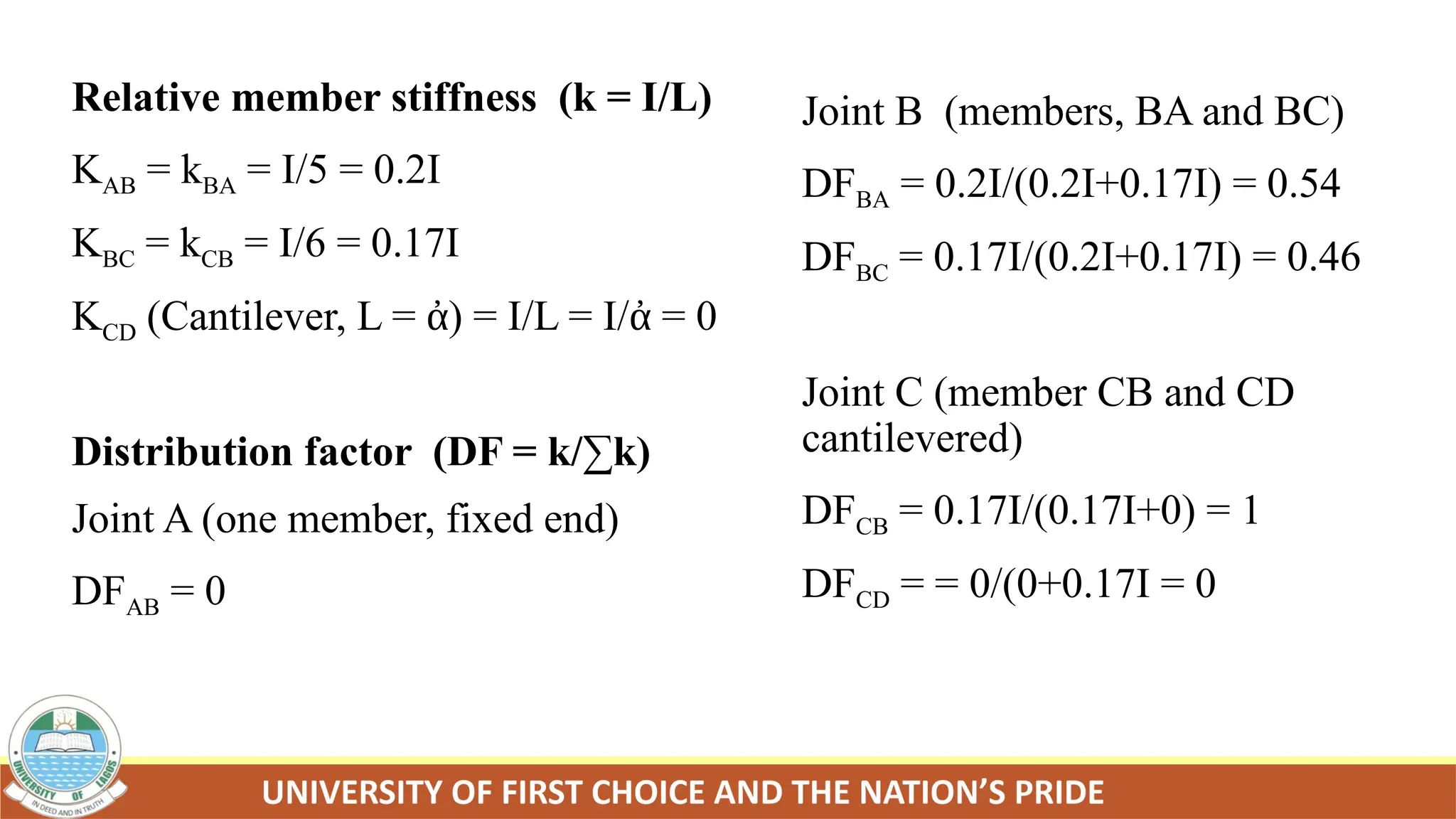
Relative member stiffness (k = I/L)
KAB = kBA = I/5 = 0.2I
KBC = kCB = I/6 = 0.17I
KCD (Cantilever, L = ) = I/L = I/ = 0
ἀ ἀ
Distribution factor (DF = k/∑k)
Joint A (one member, fixed end)
DFAB = 0
Joint B (members, BA and BC)
DFBA = 0.2I/(0.2I+0.17I) = 0.54
DFBC = 0.17I/(0.2I+0.17I) = 0.46
Joint C (member CB and CD
cantilevered)
DFCB = 0.17I/(0.17I+0) = 1
DFCD = = 0/(0+0.17I = 0
Fixed end Moments
Fixed end Moments (applied loads)
FEMAB = -PL/8 = -100x5/8 = -62.5kNm, FEMBA = PL/8 = 62.5kNm
FEMBC = -wL2
/12 = -30x62
/12 = -90kNm, FEMCB = 90kNm
FEMCD = cantilever bending moment = -20x1.5 = -30kNm
Effect of displacement of support B (8mm), with respect to slope of
AB and BC
FEMAB = FEMBA = -6EIΔ/L2
= -6x20,000x0.008/52
= -38.4kNm
FEMBC = FEMCB = 6x20,000x0.008/62
= 26.67kNm
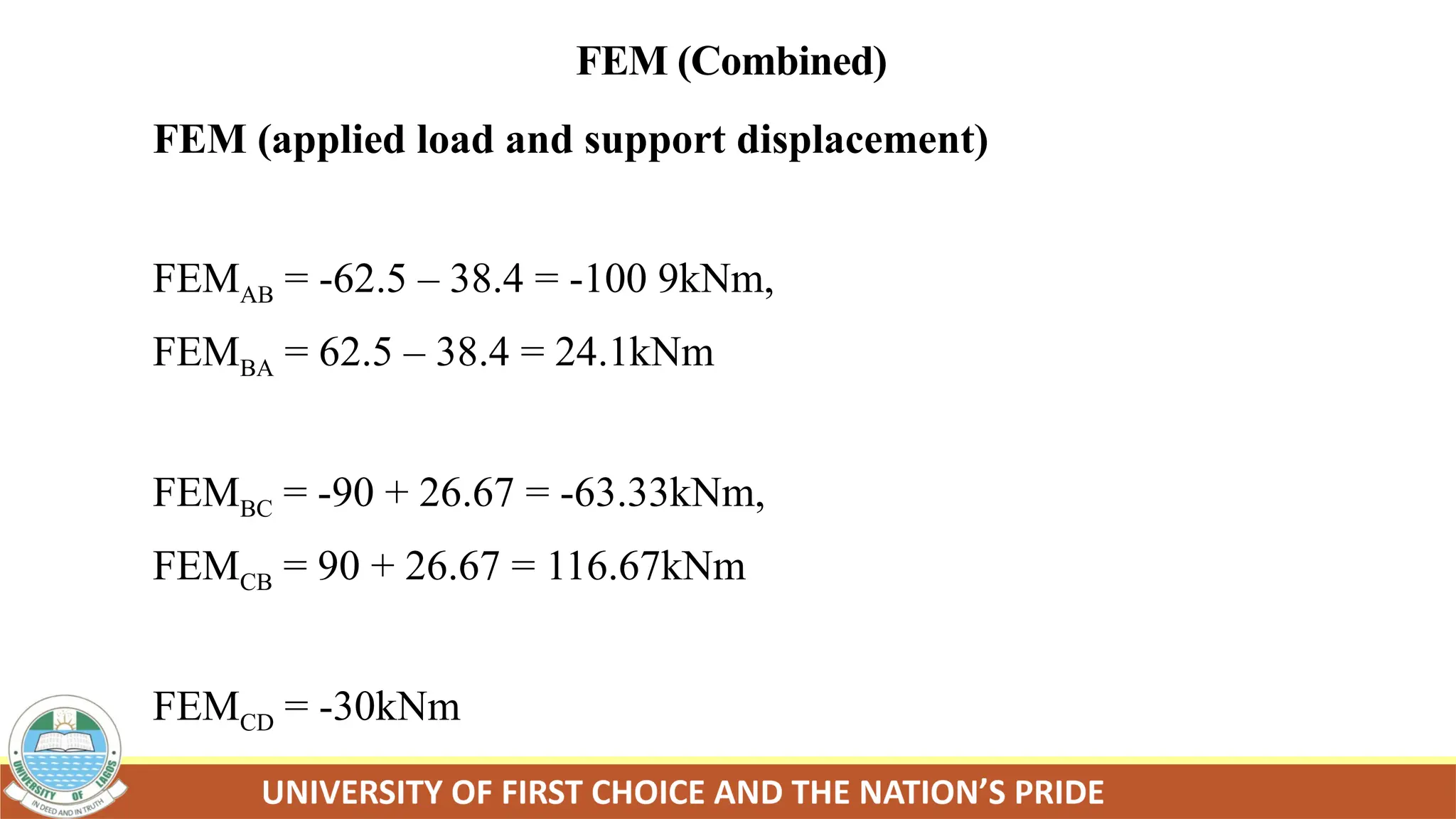
FEM (Combined)
FEM (applied load and support displacement)
FEMAB = -62.5 – 38.4 = -100 9kNm,
FEMBA = 62.5 – 38.4 = 24.1kNm
FEMBC = -90 + 26.67 = -63.33kNm,
FEMCB = 90 + 26.67 = 116.67kNm
FEMCD = -30kNm
MDM Table
Joints A B B C C
Members
DF
AB
0
BA
0.54
BC
0.46
CB
1.0
CD
0
FEM
Bal
-100.9
0
24.1
21.17
-63.3
18.03
116.67
-86.67
-30
COM
Bal
10.59
0
0
23.40
-43.34
19.94
9.02
-9.02
COM
Bal
11.7
0
0
2.44
-4.51
2.07
9.97
-9.97
COM
Bal
1.22
0
0
2.70
-5.00
2.30
1.04
-1.04
∑M -77.39 73.81 -73.81 30 -30
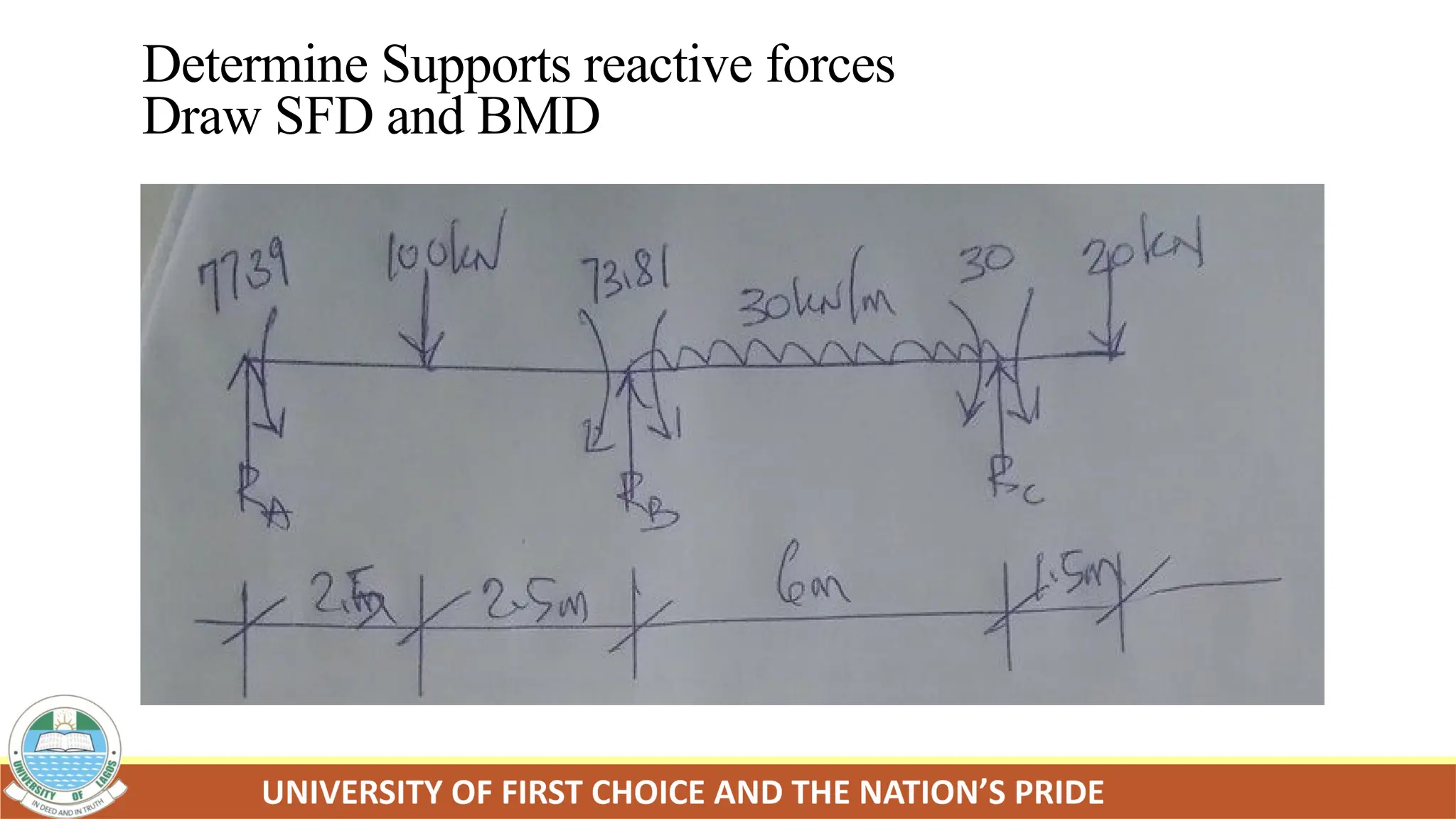
Determine Supports reactive forces
Draw SFD and BMD
Reactive forces
∑MB = 0, 5RA -77.39 -100x2.5 + 73.81 = 0
RA = 253.58/5 = 50.72kN
∑MC = 0, 11x50.72 -77.39 -100(8.5) -30x6x3 + 6RB = 0
6RB = 939.47, and, RB = 939.47/6 = 156.58kN
∑FY = 0,
RA + RB + RC = 100 + 30x6 +20 = 300
RC = 300 – 50.72 -156.58 = 92.7kN
Example: Frame Structure
Determine joints moment of the frame shown using MDM
Draw SFD, NFD and BMD
Member stiffness (k = I/L)
KAB = kBA = I/L = 2I/5 = 0.4I
KBC = kCB = ¾(I/L) = ¾(I/3) = 0.25I
(Joint C, a Hinged)
KBD = kDB = I/L = I/3 = 0.33I
Distribution factor (DF = k/∑k)
DFAB = 0 ( member AB, with a fixed end)
DFCB = 1 (member CB, with a hinged end)
DFDB = 0 (member DB, with a fixed end)
Joint B (members BA, BC and
BD)
∑k = (0.4 + 0.25 + 0.33)I = 0.98I
DFBA = kBA/∑k = 0.4I/0.98I = 0.41
DFBC = 0.25I/0.98I = 0.25
DFBD = 0.33I/0.98I = 0.34
∑DFB = 0.41 + 0.25 + 0.34 = 1
Fixed end Moment
FEMAB = -Pab2
/L2
= -100x2x32
/52
= -72kNm
FEMBA = Pa2
b/L2
= 100x22
x3/52
= 48kNm
FEMBC = -wL2
/12 = -20x32
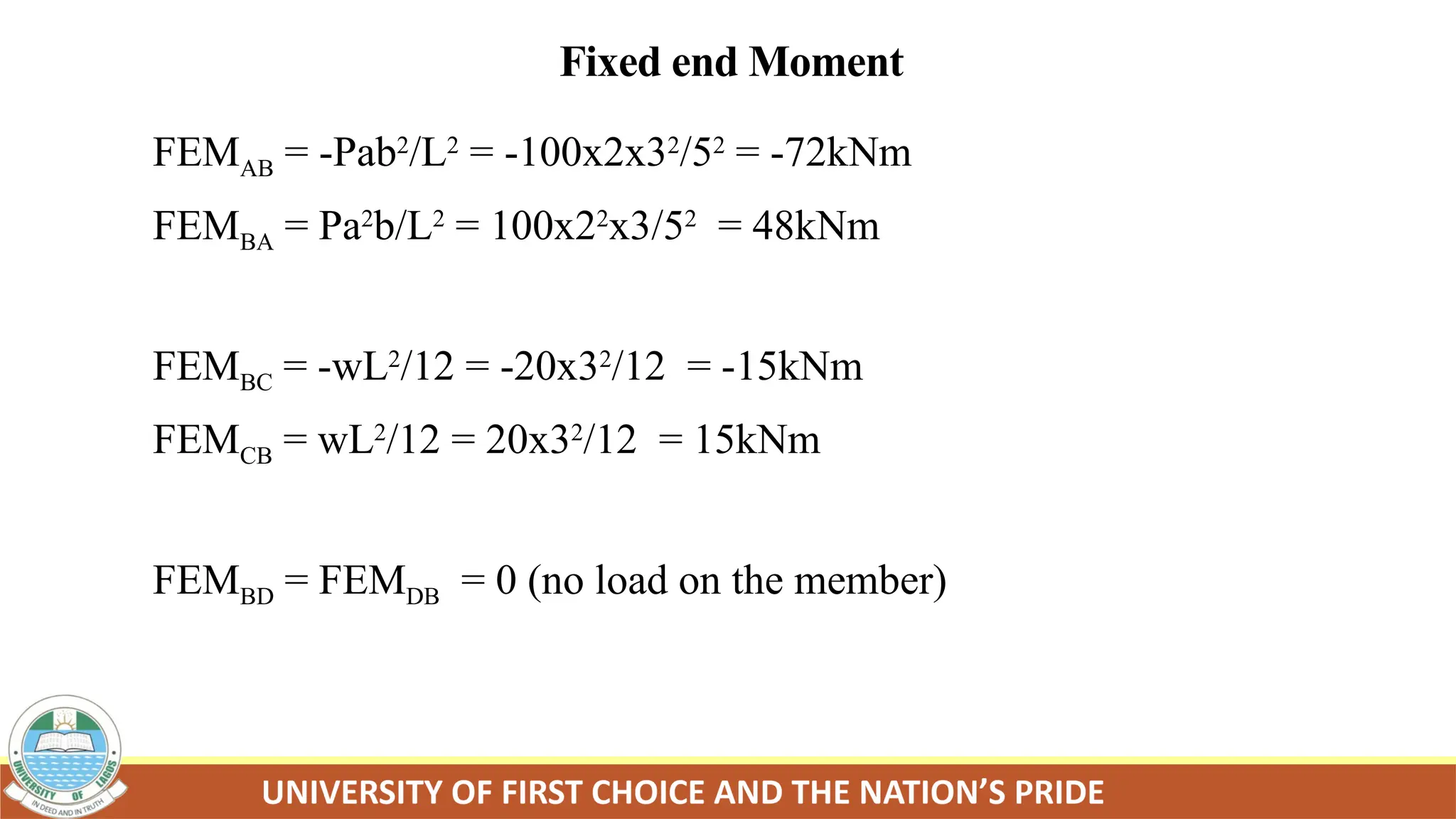
/12 = -15kNm
FEMCB = wL2
/12 = 20x32
/12 = 15kNm
FEMBD = FEMDB = 0 (no load on the member)
MDM Table
Joint A B B B C D
Member AB BA BD BC CB DB
DF 0 0.41 0.34 0.25 0.3 0
FEM
Bal
-72.0
0
48.0
-13.53
0
-11.22
-15
-8.25
15.0
-15.0
0
0
CO
Bal
-6.77
0
0
3.08
0
2.55
-7.55
1.88
0
0
-5.61
0
CO
Bal
1.54
0
0 0 0 0 1.28
0
∑M -77.23 37.55 -8.67 -28.87 0.00 -4.33
Calculate RA , RB and RC
∑MB = 0, 5RA - 77.39 - 100x2.5 + 73.81 = 0
RA = 253.58/5 = 50.72kN
∑MC = 0, 11x50.72 – 77.39 – 100x8.5 – 30x6x3 – 30 + 6RB = 0
6RB = 939.47 and RB = 939.47/6 = 156.58kN
∑FY = 0, RA + RB + RC = 100 + 30x6 +20 = 300
RC = 300 – 50.72 -156.58 = 92.7kN
Draw the SFD, NFD and BMD
MOMENTAREA METHOD OFANALYSIS
Mohr’s Area Moment theorem
Theorem 1: Slope law (A/EI)
Theorem 2: Deflection Law (A /EI)
ẋ
Introduction: Beam’s Deformation
Beams when subjected to loading experience deformation due to
induced stress and strain
Force → Stress (σ) → Strain, ε (deformation)
The deformation cause lateral displacement of point on the
longitudinal axis, which changes the form/shape of an initially
straight beam to curved shape as a result of the support constraint
Deformation depends on beams geometry, elastic modulus (E),
flexural rigidity (EI) and applied bending moment
.
Design requirement indicates that
deflection is undesirable
Therefore, must be within
tolerable/permissible limits for safety
and stability during load application
Ie, Serviceability limit state
Moment area method was developed
using the concept of displacement
(deflection)
Moment Area Method
Developed by Sir Author Mohr around 1873, is based on two theorems
known as moment-area-theorems
It is a method for analyzing indeterminate structures using compatibility
of displacement and superposition principle
Superposition principle enables decomposition of structures during
loading, into two components
Primary structure: a statically determinate representation of the structure
with the applied loads (ie, structure with 3 reactions)
Reactant structures: representation of the redundant reactions acting (as
load) on the primary structure
Primary and Reactant Structures
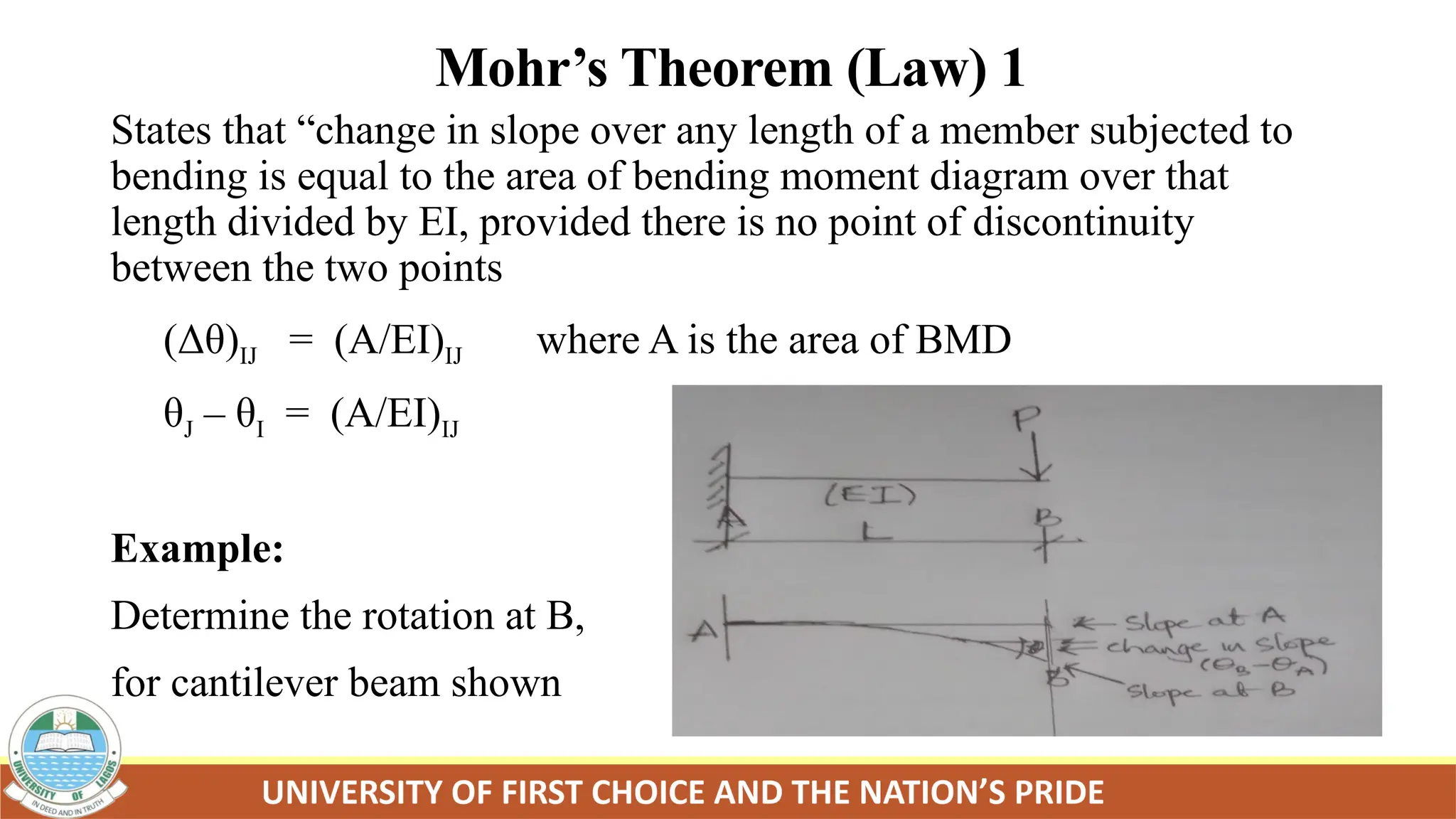
Mohr’s Theorem (Law) 1
States that “change in slope over any length of a member subjected to
bending is equal to the area of bending moment diagram over that
length divided by EI, provided there is no point of discontinuity
between the two points
(Δθ)IJ = (A/EI)IJ where A is the area of BMD
θJ – θI = (A/EI)IJ
Example:
Determine the rotation at B,
for cantilever beam shown
ΔθAB = (A/EI)AB
where A = area of BMD
θB – θA = (A/EI)AB
= (1/EI) ½(L PL)
Support A is fixed end and does not
permit rotation,
therefore θA = 0
Hence, θB = PL2
/2EI
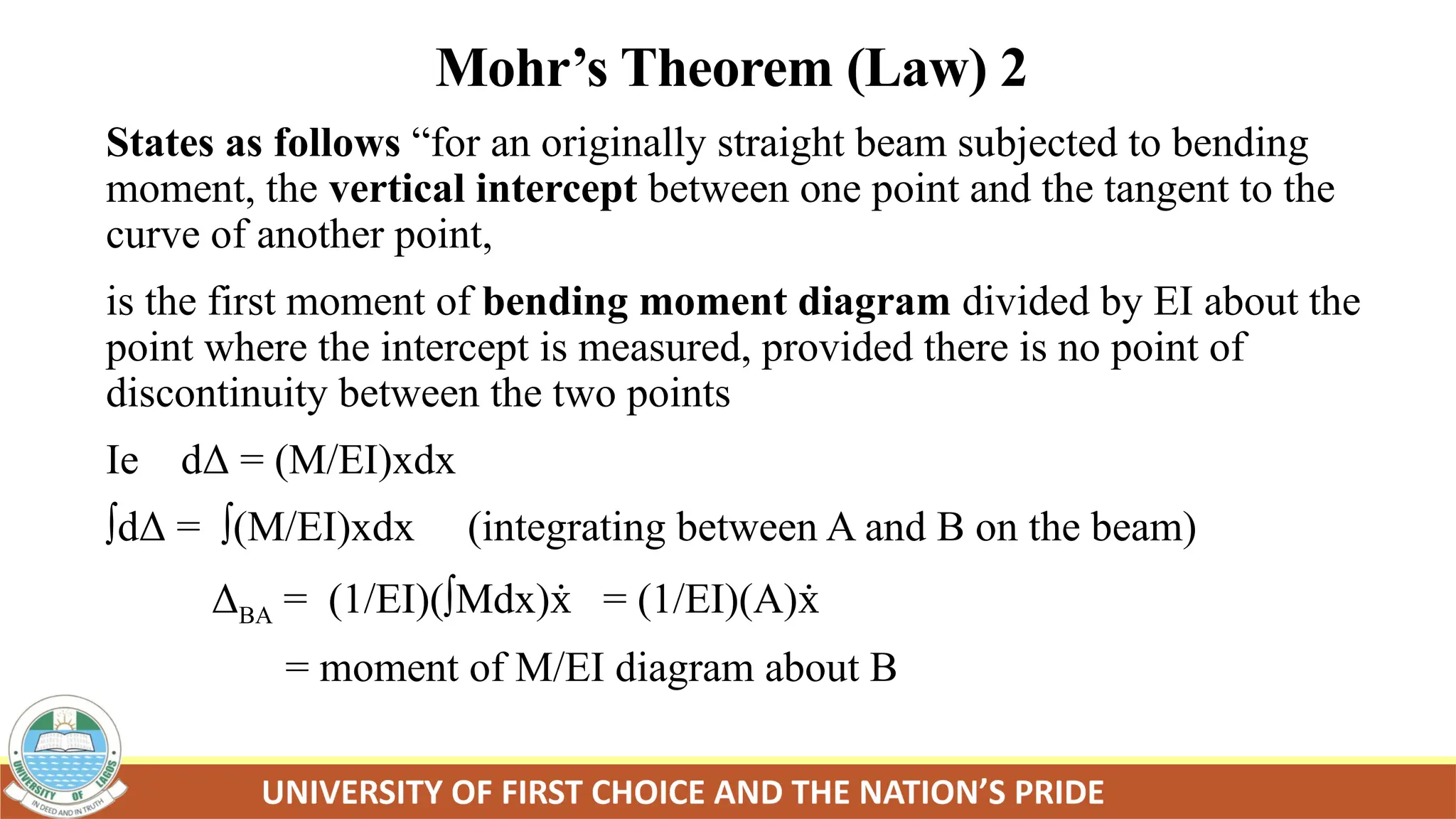
Mohr’s Theorem (Law) 2
States as follows “for an originally straight beam subjected to bending
moment, the vertical intercept between one point and the tangent to the
curve of another point,
is the first moment of bending moment diagram divided by EI about the
point where the intercept is measured, provided there is no point of
discontinuity between the two points
Ie dΔ = (M/EI)xdx
∫dΔ = ∫(M/EI)xdx (integrating between A and B on the beam)
ΔBA = (1/EI)(∫Mdx) = (1/EI)(A)
ẋ ẋ
= moment of M/EI diagram about B
Geometric Relationship between, θ, Δ and L
Reference to the diagrams,
tan θ = θ = Δ/L
(for very small angle θ)
And, Δ = θL
The expression can be used
together with Mohr’s laws 1 and 2
to analyze indeterminate beams
In fig. 2
θA = opp/adj = (ΔB + ΔBA)/L
but, ΔB = 0 no displace of joint B
Then, θA = ΔBA/L and ΔBA = θA L
Applying Mohr Law 2
and ΔBA = (1/EI)(moment of M
diagram about B)
To determine ΔC displacement
(deflection) of point C
Consider C between AB and ΔCA is
the vertical intercept from C to
tangent from A
θA = opp/adj = (ΔCA – ΔC )/LCA
ΔC = ΔCA – θA(LCA)
ΔCA = (1/EI)(moment of BMD
between AC, and about C)
Maximum Deflection
Max deflection occurs at the point of change of curvature
of elastic curve which also the point of zero slope (θ = 0)
ΔθAC = (A/EI)AC
θC – θA = (A/EI)AC
And if θC = 0 then, θA = (A/EI)AC
the expression can be analyze depending on the unknowns
Application to indeterminate Structures
Indeterminate beams are beams
with more than 3 reactive forces
The beams can then be divided into
two known as Primary and Reactant
Structures
Using principle of superposition,
the two structures, deflection at a
known point is determined (eg, at
support Δ = 0)
Then using compatibility of
displacement to equate the two
calculated deflections to the known
deflection of the original structure
Once the unknown values of reactive
forces are determined, the beam
becomes statically determinate
Hence, deflection, rotation can be
determined and SFD, BDM can be
drawn
Example 1:
Analyze the propped cantilever beam shown using moment
area method
Practice Question:
In the example, the beam degree of indeterminate =1, then
we only need to remove 1 action to enable determinacy
Reaction at B was assumed as the redundant and used in the
analysis
As an exercise, assume the moment at A is the redundant,
then draw the bending moment diagrams for both
primary structure and reactant structure respectively
Example 2:
Analyze the beam in fig Q2 using moment area method
stractares aralyses  skskskdkdjfjfjjvjvjgfjj

stractares aralyses skskskdkdjfjfjjvjvjgfjj

  • 1.
    CEG 331 Structural Analysis1 (2, 0) Dept of Civil & Environmental Engineering Dr Olusegun AAfolabi
  • 2.
    CEG 331 Lectures Introduction:Structures and Analysis Loading system Structural floor system Symmetric Structures and loading Structural Idealization, Constraints/Static equilibrium, Statically determinate and Indeterminate system Methods of structural Analysis, Moment distribution, Moment area method, Influence lines
  • 3.
    Introduction: Analysis ofStructures Structural analysis is the evaluation of anticipated loads/forces and determination of structural response Structural responses (eg, Q, M, deformation(ε), displacements (θ, Δ), fatigue), are necessary parameters in the design and construction of structures Structural modeling and simulations are computer-based method of analysis, using specific algorithms to evaluate the structural responses and behaviors
  • 4.
    Load bearing System Structuresare load bearing systems, designed and constructed for the purpose of supporting load application in static equilibrium state Examples include, Building, Bridges, Dams, Towers, Shell etc Structures are usually presented as arrangement of structural components, connected at the nodes (or, joints, ends etc) to ensure monolithic action and static equilibrium state during transition of forces and moments by the components
  • 5.
    The components assistin transition of applied load (stresses) from point of load application to sub-structural system and the ground, that is, Applied Load → Structural Components → Ground soil Load transition path by structural components Load (Force) → Slab → Beam → Column → Foundation → Ground soil
  • 6.
    Typical Structural System (a):Dam (b): Building/bridge deck
  • 7.
    Structural Floor System Knownalso as Suspended floor slabs, they are structural components that serve as point of load application on structures Located at the precise level (or height) of load application Due to their structural function, the floor system are suspended and supported by other structural components that assist in keeping them in position and in distribution of internal stresses (load) through components to the ground
  • 8.
    Floor systems (ie,slab and beams) of multi-storey building, are linked by series of columns forming frame structures (consisting of floors and columns) Other assemblies (eg, dams, mast, shell etc) have different structural system and mode of load application For example, Dam : Mass or Reinforced concrete without component Mast: Truss systems Shell structures: Membrane systems
  • 9.
    Symmetric structures andLoading Symmetry is the act of exhibiting a pattern that provides similar arrangement of component parts of an object about a reference axis, including agreement in dimension, scales and orientation In mathematics, symmetry usually, refer to an object that is invariant under some transformations including, rotation, reflection, etc. The function f(x) = f(-x) is symmetric (eg, Fij = -Fji ) → Fij - Fji = 0 ie, ∑F = 0 (a static equilibrium state)
  • 10.
    Also, the staticequilibrium state requires that, ∑M = 0 → Mij = -Mji Ie, clockwise moment is equal to anticlockwise moment ( a symmetric behavior) Similarly, f(x) = - f(-x) is asymmetric Asymmetric is the act of not symmetric Therefore, load application and structural arrangement must be made to encourage symmetric actions and behaviors for the static equilibrium state
  • 11.
    Symmetric Planar Structures Manyplanar framed structures have either axes of symmetry or point (center) of symmetry Planar structure (in the xy plane) is symmetric with respect to an axis Y, if its geometry as well as the material properties are the same with respect to right-hand orthogonal axis, x, y, z and x! , y! , z! Such that x = x! , y = y! , and z = z! Similarly, a planar structure (in the xy plane) is symmetric with respect to a point (centre of symmetry), if its geometry and material properties are the same with respect to two sets of orthogonal axes x, y, z and x! , y! , z! Such that x = -x! , y = -y! , and z = -z! .
  • 12.
    Structural Idealization Idealization isscientific process of constructing models to represent information and state of physical object, ie, the shape, form, dimensions etc. The information is used to model the system during analysis to determine the responses, including stability to load application Structural load are most essential data in analysis and must accurately determined, which include, Self weight of the structure Applied or imposed load (type of structure) Environmental Load: Wind load, Seismic force etc Climatic factor: Temperature change etc
  • 13.
  • 14.
    Structural Constraints /Static Equilibrium Consider a rigid body system subjected to applied force, the tendency is to commence motion, therefore the body can only remain at rest, if an opposing force is applied Ie, F = ma = 0 (not feasible, since F has magnitude, hence a cannot be 0) According to Newton's third law, “action and reaction are equal and opposite” therefore, F = -R and. F + R = 0 And, ∑F = 0, application of R keeps the system in static equilibrium state Static equilibrium state, is the design requirement of structures, such that action of applied forces must not produce motion nor displacement
  • 15.
    The opposing forceR is known as restraining force (or constraint) Constraints are systems (or objects) which possess reactive forces that can keep structures or structural components in static equilibrium (ie, rest position) Supports / Constraint Reactive forces Fixed or Encastre 3 Nos Hinged or Pinned 2 Nos Roller 1
  • 16.
    Statically Determinate andIndeterminate Structures Statically determinate describes structures with minimum reactive forces (3Nos) required to maintain static equilibrium state, Thus, can easily be analyzed with static equilibrium equations, as follows, ∑Fx = 0, ∑Fy = 0, and ∑M = 0 Statically indeterminate structures possesses more than 3 Nos reactive forces (due to structural reasons), required for static equilibrium state and the static equilibrium equations are not sufficient for the analysis. Other analytical methods are involved in the analysis
  • 17.
    Examples include, Continuousbeams, fixed ended and propped cantilevered beams, frame structural system. Degree of Determinacy (D) D = 3m + R -3j – NAR In the expression, D is the degree of determinancy, m = number of members, R = reactive forces at the supports j = number of joints and, NAR = number of action released at joints D ≥ 0 and statically determinate, when D = 0 D 0 the structure is defined as statically indeterminate ˃
  • 18.
    Structural Analysis Methods Methodsof structural analysis are classified into two distinct groups and methods as follows Classical methods Modern or matrix methods Classical methods are earlier concept of analysis involving equilibrium of forces and actions acting on structures, Are important in understanding fundamental concepts of structural analysis which enables the analysis of simple structures. Examples include, Static equilibrium equation, Moment distribution method, Moment area method, slope-deflection etc.
  • 19.
    Modern matrix Modern matrixmethods are employed usually for indeterminate and complex structures It involves computer algorithms, programs and softwares for the analysis, modeling and simulations to visualize the structural response They constitute powerful tools for analyzing complex structures with high degree of indeterminacy and involving large number of simultaneous equations (with m x n matrices). Modern matrix method is carried out using either a stiffness matrix or a flexibility matrix
  • 20.
    Statically Determinate Beams Simplysupported beams or Cantilever beams. Beams having 3 reactive forces at the support Compound beams (continuous and indeterminate beams) but on removal structural action like BM using hinge(s) it becomes statically determinate Simply supported beams/cantilevers Analysis involve only static equilibrium equations Procedures; Determine the reactive forces at support using static equilibrium equations ∑Fx = 0 ∑Fy = 0 and ∑M = 0 Solving for reactive forces show that the beam is in equilibrium with the applied load and reactive forces
  • 21.
    Q, N andM Internal forces are forces induced in the structure as a result load transmitting through it to the supports Internal forces in beams are Shear force (Q), Normal forces (N) and bending moment (M) Q is defined as sum of all forces perpendicular to the axis of the beam from one end to a cross section x N is the sum of all forces on the longitudinal axis of the beam from one end to cross section x M is the sum of all forces times perpendicular distances (M = F d) from one end to a cross section x Home assignment: solve atleast 3 simply supported beams and 2 cantilever beams
  • 22.
    Analysis of staticallydeterminate structures, Compound beams and Frames Compound structures are indeterminate systems introduction of hinge(s) within span or nodes removes actions (eg, BM), to enable statically determinate analysis using static equilibrium equation
  • 23.
    Compound Beams Procedure 1. Determineredundancy or determinacy D D = 3m + +R -3j – NAR If D = 0, the beam is statically determinate 2. Divide the beam into determinate parts at the hinge point, which enables static equilibrium analysis
  • 24.
    3). at thehinge ∑F = 0 and M = 0 NBr + NBl = 0 and NBr = - NBl HBr + HBl = 0 and HBr = - HBl Note: the equilibrium of the hinge provides forces of equal magnitude and opposite sense 4. Analyze component parts using static equilibrium equation and solve for reactive forces at support 5. Determine and draw the internal forces, SFD, NFD and BMD Internal forces in beams are defined as Q is defined as sum of all forces perpendicular to the axis of the beam from one end to a cross section x N is the sum of all forces on the longitudinal axis of the beam from one end to cross section x M is the sum of all forces times perpendicular distances (M = F d) from one end to a cross section x
  • 25.
    Example Analyze the compoundbeam shown and the draw SFD and BMD D = 3m + R -3j –NAR = 3x4 + 5 – 3x5 -2 = 0 The compound beam is statically determinate Divide the compound beam into three segments at the hinges to enable static equilibrium analysis of the segments
  • 26.
    Static equilibrium athinges, M = 0 and ∑F = 0 , ∑Fx = 0 and ∑Fy = 0 NBl + NBr = 0 and NBl = -NBr NCl + NCr = 0 and NCl = -NCr Equal and opposite forces acting at joint B and C at the hinges The beams segments are, AB, BC and CDE Consider the equilibrium of segment BC , having udl of 15kN/m over a length of 2m ∑F (vertical forces) NBr + NCl = 15x2 = 30 Symmetrical loading Hence, NBr = NCl = 30/2 = 15kN
  • 28.
    Segment AB ∑M =0 MA + 15x3 = 0 MA = - 45kNm ∑FY = 0 RA - 15 = 0 RA = 15kN ∑FX = 0 thus HA = 0 Segment CDE ∑M about E, 4RD – 15x7 -30x2 = 0 4RD = 105 + 60 = 165 RD = 165/4 = 41.25kN ∑FY = 0 RE + RD = 15 + 30 RE = 45 – 41.25 = 3.75kN
  • 29.
    SFD Starting from pointA, consider a section X-X at distance x from A QX = ∑FY At A, x = 0 and Q = 15kN Q value is constant between A and B (0 ≤ x ≤ 3m) between B and C, QX = 15 + 15(x-3) = 60 – 15x, at B, x = 3 and Q = 60 – 15x3 = 15kN at C, x =5 and Q = 60 – 15x5 = -15kN between C and D, Qx = 15 – 30 = - 15kN at D, QX = - 15 + RD = -15 + 41.25 = 26.25kN at E, QX = 3.75kN
  • 30.
    BMD Mx = ∑FYX Ie, Sum of the moment from one end of the beam to specific cross section MA = -45 kNm MB = -45 + Ra x3 = -45 + 15x3 = 0 MC = -45 + 15x5 – 15x2x(1) = 0 MD = -45 + 15x8 – 15x2x4 = -45 kNm ME = 0
  • 31.
    STRUCTURAL FRAME SYSTEMS Framesystems are assemblies of structural beams and columns monolithically connected at the nodes (or, joints) The system is considered as a unit known as frame during structural analysis The frame ABCD in the fig., comprise of members AB (column), BC (beam) and CD (column) Node B and C the connection joint A and D are supports
  • 32.
    Structural Joints Joints arenode points where two or more structural members are connected for structural purpose (eg supports and load transition) Joints are further classified as follows, Continuous Joints: when structural actions are continuous and can be transfer adequately from one member to another while maintain static equilibrium state ∑F = 0 and ∑M = 0 Hinged Joint: The release of M of a continuous joint makes it a hinged joint. Also the equilibrium equation is M = 0 and ∑F = 0
  • 33.
    Types of FrameSystems Followings are common type of structural frame system Portal Frame Gable Frame Multibay Frame: joining bays Multi-storey Frame: joining heights Space Frame: 3D view (x, y, z direction)
  • 34.
    Sway and NonswayFrames Configuration of frame system (ie, multistorey, space frames) enables rotations (θ) and lateral displacement of the frames. Sway is lateral displacement due to loading, structural configuration, and design etc. It is a characteristic property of the system such as stability and dynamics. Due to parameters such as robustness, elastic stiffness, allowable drift limits and modulus of rigidity etc A non sway frame is stable and considered to have minimal or permissible lateral displacement (Δ) and interstorey drift and also in static equilibrium state during load application

  • 35.
    Sway displacement (θand Δ) must be negligible for safe and stability of structures, and achieved either by bracing (eg, shear wall), or by symmetric loading and configurations
  • 36.
    Analysis of StaticallyDeterminate Frames Statically determinate frames are, - Frames with 3 support reactive forces - Compound frames Method of Analysis for Statically determinate system is ∑FX = 0 ∑FY = 0 and ∑M = 0
  • 37.
    Compound Frame Procedure 1. Determineredundancy or determinacy D D = 3m +R -3j – NAR If D = 0, the beam is statically determinate 2. Divide the frame into determinate parts at the hinge point, which enables the static equilibrium analysis 3. Analyze component parts using static equilibrium equation and solve for reactive forces at support 4. Determine and draw the internal forces, SFD, NFD and BMD
  • 38.
    Example: Analyze thecompound frame shown, and draw the SFD, NFD and BMD
  • 39.
    The frame isdivided at the hinge into 2 component parts Lets consider the equilibrium of section BCD ∑FX = 0, and NBr = 0 ∑FY = 0, QBr + RD = 18 x 4 =72 ∑MB = 0 , 4RD = 18 x 4 x 2 . and RD = 36kN then, QBr = 72 – RD = 36kN Consider section AB ∑FY = 0 QBL – RA = 0 . RA = QBl = 36kN . ∑FX = 0 HA + 10 = 0 and HA = -10 kN . ∑MB = MB = 0 . MA – 4HA – 10x1 = 0 . MA = 4HA + 10 = -40 + 10 = -30kNm
  • 40.
    Assignment Use the reactiveforces to draw the SFD, NFD and BMD
  • 41.
    Statically Indeterminate StructuralSystem Analysis Method Moment Distribution Method Moment Area Method
  • 42.
    Moment Distribution Method(MDM) A structural analysis method for statically indeterminate beams and frames developed by Prof Hardy Cross in 1930. It belongs to the category of displacement method of structural analysis that involve solving simultaneous equations by means of iteration Iteration is a standard form of algorithms, and involves repetition of processes in order to generate sequence of outcomes. The degree of accuracy depends on the number of iteration process before convergence MDM as an approximate method does not directly requires solving the simultaneous equations (unlike slope deflection method where simultaneous equations are directly solved).
  • 43.
    MDM In the method,moment equilibrium equation of the joints are solved iteratively by considering the static equilibrium of each joint independently while other joints are assumed restraint For static equilibrium of joint L, ∑M = 0, ie, MLM + MLK + MLJ = 0
  • 44.
    Basic Concept ofMDM Consider the frame shown, Members of the frame are assumed not to deform axially nor translate relative to one another Joints A, C, D of the frame are fixed, while joint B can rotate slightly due to applied load Before implementing the moment distribution among members, all joints are assumed to be temporary locked using clamp
  • 45.
    MDM Every joint ofthe structure to be analyzed is fixed in order to develop the fixed end moment. The clamped restraint degree of freedom (ie, rotation) The fixed end moment at each joints may not be of the same magnitude because the load on AB and BC are different, hence not in equilibrium Eg, Joint B, FEMBA ≠ FEMBC (ie, ∑M ≠ 0) Therefore, to ensure equilibrium the sum of moment at the joint must be zero, and also excess (out of balance) joint moment must be distributed and carried over to adjacent joints
  • 46.
    Definitions and Terminology SignConvention Counterclockwise member end moments are considered negative Clockwise moments are considered positive Fixed end Moments (FEM) Moment produced at member ends due to applied load, and calculated assuming the supports are fixed or clamped
  • 47.
    Member Stiffness Consider aprismatic beam AB, hinged at end A and fixed at end B If moment M is applied at end A, the beam rotates by an angle θ at the hinged A and develops a moment MBA at the fixed end B as shown The relationship between the applied moment M and the rotation θ can be established using the slope deflection equation
  • 48.
    By substituting, Mab= M, θA = θ and, θb = FEMab = 0 in the slope-deflection equation Mab = 2EI/L)(2θa + θb) + FEMab = (2EI/L)(2θa) = (4EI/L)θ Bending stiffness k, of a member is defined as the moment that must be applied at an end of the member to cause a unit rotation at that end By setting θ = 1 rad, the expression of bending stiffness of beam becomes K = 4EI/L Now suppose that the far end B of the beam is hinged, Relationship between the applied moment M and the rotation θ of end A of the beam can now be determined, using the modified slope-deflection equation By substituting, Mab = M, θa = θ and FEMab = FEMba = 0 in the slope-deflection equation, Then, M = (3EI/L)θ and by setting θ = 1 rad K = 3EI/L
  • 49.
    Carry-Over Moments Distributed momentsat ends of members meeting at a joint cause moments in the other ends, which are assumed to be fixed These induced moments at the other ends are called carry-over moments If a moment M, is applied to the left end of the beam, the slope-deflection equations for both ends of the beam can be written as follows, Note, θB = 0 being a fixed end M1 = 2EK(2θA) = 4EkθA ------ (1) M2 = 2EkθA ------ (2) solving eqn (1) and (2) θA = M1/4Ek and, M2 = ½(M1) or, M1/M2 = ½ Therefore, Carry Over Factor = ½
  • 50.
    Distribution Factor Distribution factoris a factor used in determining the proportion of unbalanced moment distributed to each of the members at a joint For members at joint O of the frame, the distribution factors are computed based on member stiffness K, as follows If, ∑K = kOA + kOB + kOC + kOD DFOA = kOA /∑K DFOB = kOB /∑K DFOC = kOC /∑K DFOD = kOD /∑K ∑DF = DFOA + DFOB + DFOC + DFOD = 1 (sum of DF at any joint) Special Cases at fixed end support, Since no rotation is permitted k=0, Then, DF = 0
  • 51.
    Cantilever end: the jointis not an ideal joint sum of DF = 1 + 0 = 1 The cantilever moment M, remains constant Therefore the DF = 0 at the cantilevered section Distributed Moments (DEM) The distributed moments are computed as follows, MOA = (kOA/∑K)Mo = DFOA (MO) MOB = DFOB (M0) MOC = DFOC (M0) MOD = DFOD (M0)
  • 52.
    Boundary Conditions In structuralsystems, described by mathematical functions, such as the boundary value problems (ie differential equations). A boundary value problem has conditions specified at the extremes (boundaries) of the independent variable in the equation In structural systems (eg, beams, frames), the boundary conditions are those parameters available at the ends of elastic deformation curve that satisfies the solutions of resulting differential equations. Therefore, BC are known or assumed conditions that enables the analysis of structural system. Examples are, Support system (fixed, hinge, roller), elastic curve (slope, deflection) etc,
  • 53.
    Procedures of MDM 1)Determine member stiffness k = 4EI/L (or, 3EI/L when the last support is hinged) 2) Calculate distribution factors for members meeting at specific joint (DF = k/∑K ) 3) Calculate the fixed end moments (FEM) due to structural loads 4) At each joint evaluate static equilibrium state, ie, sum the moment at joints, and out of balance moment or moment required for static equilibrium state for a joint J comprising of members ji and jk, ∑MJ = MJI + (-MJK) = M but static equilibrium requires ∑M = 0 at joints, and to ensure equilibrium state requires addition of equal and opposite action Ie, M + (-M) = 0 therefore the distributed moment = -M (our of balance moment)
  • 54.
    5). Distribute theout-of-balance moment at joints to members meeting at each joint by multiplying the moment (-M) by their respective distribution factors (DF) in the first cycle of MDM ie, DMJI = DFJI (-M) and DMJK = DFJK (-M) In the second cycle and subsequent cycles, carry-over moments from the distributed moment are carried to the other ends within the same span of a beam (or frame) COM = ½(Distributed moment) 6) The process is tabulated and the procedure being iterative is repeated severally until distributed moment becomes very negligible (ie, a convergence is attained). 7) After Moment distribution exercise, the beam or frame, becomes statically determinate and can be analyzed for internal forces and actions (Q, N and M) using static equilibrium equation 8) Draw SFD, NFD and BMD
  • 55.
    Typical Moment DistributionTable The end supports (Boundary Conditions) Support A = Fixed end, slope = 0 and, DF = 0 No load on span CD since FEM = 0 Support D = Fixed, and DF = 0 After the distributions Sum of entries on each column represent the BM at that support
  • 56.
    Initial Support Displacement Beamswith initial settlement/relative displacement of the supports The displacement or yielding beam supports subjects the beam to twisting moment The FEM at that support becomes cumulative addition of the FEM due to applied load on the beam and FEM (ie, twisting moment) due to support displacement For a displacement Δ at support B, then, FEMAB = FEMAB (applied load) + FEMAB (support Δ) FEMBA = FEMBA (applied load) + FEMBA (support Δ) FEMAB = FEMBA = -6EIΔ/L2 (negative sign or slope, shows right support is displaced etc)
  • 57.
  • 58.
    ASSIGNMENT: (Home Practice) (1).Calculate Member stiffness, Distribution factors and Fixed end Moments. (2) Assume support B (the beam) settles by 2 mm determine FEMs (EI = 19.44 x 10⁹ kN-mm2 )
  • 59.
    Example: Analyze using MDM,the beam shown, and draw the SFD, BMD and elastic curve diagram. Values of second moment of area are indicated along the member
  • 60.
    Relative Member Stiffness(k = I/L) kAB = kBA = (IAB /LAB ) = 2I/5 = 0.4I kBC = kCB = 3I/6 = 0.5I kCD = kDC = (3/4)(4I/5) = 0.6I (end support D is hinged) Distribution Factor (DF = k/∑k) Joint A , (fixed end, member AB) DFAB =kAB/∑k = (0.4I/(0.4I+ ) = 0 ἀ ( very large due to fixed end) ἀ Joint B (members BA and BC) DFBA = 0.4I/(0.4I+0.5I) = 0.44 DFBC = 0.5I/(0.4I+0.5I) = 0.56 Joint C (members CB and CD) DFCB = 0.5I/(0.5I+0.6I) = 0.45 DFCD = 0.6I/(0.5I+0.6I) = 0.55 Joint D = (member DC) DFDC = kDC/KDC+0 = 0.6I/(0.6I+0) = 1
  • 61.
    Fixed End Moments FEMAB= -PL/8 = -100x5/8 = -62.5kNm FEMBA = PL/8 = 62.5kNm FEMBC = -wL2 /12 = -30x62 /12 = -90kNm FEMCB = wL2 /12 = 90kNm FEMCD = -Pab2 /L2 = -80x1.25x3.752 /52 + (-40x3.75x1.252 /52 ) = -65.63kNm FEMDC = Pa2 b/L2 = 80x1.252 x3.75/52 + 40x3.752 x1.25/52 = 46.88kNm
  • 62.
    MDM Table Joints AB B C C D Members AB BA BC CB CD DC DF 0 0.44 0.56 0.45 0.55 1.00 FEM Bal -62.5 0 62.5 12.10 -90 15.40 90 -10.97 -65.63 -13.4 46.88 -46.88 COM Bal 6.05 0 0 2.42 -5.49 3.07 7.70 -3.47 0 -4.23 COM Bal 1.21 0 0 0.77 -1.74 0.97 1.54 -0.69 0 -0.85 COM Bal 0.39 0 0 0.15 -0.35 0.20 0.49 -0.22 0 -0.27 COM Bal 0.08 0 0 0.05 -0.11 0.06 0.10 -0.05 0 -0.05 COM Bal 0.03 0 0 0.01 -0.03 0.02 0.03 -0.01 0 -0.02 ∑M -54.74 78.0 -78.0 84.45 -84.45 0.00
  • 63.
    MDM 1st cycle Joint A, FEMAB= -62.5 DF = 0 Therefore, balancing MAB = 0 Joint B, FEMBA = 62.5 and FEMBC = -90 FEMBA + FEMBC = 62.5 – 90 = -27.5 but ∑M = 0 for static equilibrium. Hence, Bal. M = 27.5kNm MBA = 27.5x0.44 = 12.1 , and MBC = 27.5x0.56 = 15.40 Joint C, FEMCB = 90 and FEMCD = -65.63 FEMCB + FEMCD = 90 – 65.63 = 24.37 Therefore, Bal. M = -24.37kN MCB = -24.37x0.45 = -10.97 and MCD = -24.37x0.55 = -13.40 Joint D, FEMDC = 46.88 and DF = 1 Bal M = -46.88 and MDC = -46.88x1 = -46.88kNm 2nd Cycle: Carry over moments Distributed end moments are carry over within the span from one end to the other to account for additional moment at the joints Eg, MBA → ½ MBA to joint AB also MAB → ½ MAB to BA etc Then balancing moment is repeated to ensure ∑M = 0 at each joint The process is repeated iteratively (for other cycles) until convergence
  • 64.
    After the Momentdistribution the beam becomes statically determinate, and can be analyzed for internal forces using static equilibrium
  • 65.
    Determine Support’s reactiveforces Draw SFD, BDM and Elastic curve diagram ∑MB = 0, 5RA – 100x2.5- 54.74+78.0 5RA – 226.74 = 0 RA = 226.64/5 = 45.35kN ∑MC = 0, 45.35x11 -100x8.5 - 54.74 + 6RB -30x6x3 + 84.45 = 0 6RB = 934.7 and RB = 934.7/6 = 155.78kN ∑MC = 0 (from the right) -5RD + 40x3.75 + 80x1.25 – 84.45 = 0 -5RD +165.55 = 0 RD = 165.55/5 = 33.11kN ∑FY = 0, RA + RB + RC + RD = 100 + 30x6 + 80 + 40 = 400 RC = 400 – 45.35 – 155.78 – 33.11 = 165.76kN
  • 66.
    Elastic curve diagrams Beamsdeforms due to load application and within elastic limits The deformation change the configuration resulting in increase in dimension, and change the initial straight (horizontal) position to curvature form known as elastic curve Drawing elastic deformation curve requires Stiffness (EI), applied load (or, BM) and boundary conditions
  • 67.
    Analyze using MDMand assume that support B of the continuous beam shown settles by 8mm. Draw SFD and BMD, Let EI = constant = 20,000 kNm2 .
  • 68.
    Relative member stiffness(k = I/L) KAB = kBA = I/5 = 0.2I KBC = kCB = I/6 = 0.17I KCD (Cantilever, L = ) = I/L = I/ = 0 ἀ ἀ Distribution factor (DF = k/∑k) Joint A (one member, fixed end) DFAB = 0 Joint B (members, BA and BC) DFBA = 0.2I/(0.2I+0.17I) = 0.54 DFBC = 0.17I/(0.2I+0.17I) = 0.46 Joint C (member CB and CD cantilevered) DFCB = 0.17I/(0.17I+0) = 1 DFCD = = 0/(0+0.17I = 0
  • 69.
    Fixed end Moments Fixedend Moments (applied loads) FEMAB = -PL/8 = -100x5/8 = -62.5kNm, FEMBA = PL/8 = 62.5kNm FEMBC = -wL2 /12 = -30x62 /12 = -90kNm, FEMCB = 90kNm FEMCD = cantilever bending moment = -20x1.5 = -30kNm Effect of displacement of support B (8mm), with respect to slope of AB and BC FEMAB = FEMBA = -6EIΔ/L2 = -6x20,000x0.008/52 = -38.4kNm FEMBC = FEMCB = 6x20,000x0.008/62 = 26.67kNm
  • 70.
    FEM (Combined) FEM (appliedload and support displacement) FEMAB = -62.5 – 38.4 = -100 9kNm, FEMBA = 62.5 – 38.4 = 24.1kNm FEMBC = -90 + 26.67 = -63.33kNm, FEMCB = 90 + 26.67 = 116.67kNm FEMCD = -30kNm
  • 71.
    MDM Table Joints AB B C C Members DF AB 0 BA 0.54 BC 0.46 CB 1.0 CD 0 FEM Bal -100.9 0 24.1 21.17 -63.3 18.03 116.67 -86.67 -30 COM Bal 10.59 0 0 23.40 -43.34 19.94 9.02 -9.02 COM Bal 11.7 0 0 2.44 -4.51 2.07 9.97 -9.97 COM Bal 1.22 0 0 2.70 -5.00 2.30 1.04 -1.04 ∑M -77.39 73.81 -73.81 30 -30
  • 72.
    Determine Supports reactiveforces Draw SFD and BMD
  • 73.
    Reactive forces ∑MB =0, 5RA -77.39 -100x2.5 + 73.81 = 0 RA = 253.58/5 = 50.72kN ∑MC = 0, 11x50.72 -77.39 -100(8.5) -30x6x3 + 6RB = 0 6RB = 939.47, and, RB = 939.47/6 = 156.58kN ∑FY = 0, RA + RB + RC = 100 + 30x6 +20 = 300 RC = 300 – 50.72 -156.58 = 92.7kN
  • 74.
    Example: Frame Structure Determinejoints moment of the frame shown using MDM Draw SFD, NFD and BMD
  • 75.
    Member stiffness (k= I/L) KAB = kBA = I/L = 2I/5 = 0.4I KBC = kCB = ¾(I/L) = ¾(I/3) = 0.25I (Joint C, a Hinged) KBD = kDB = I/L = I/3 = 0.33I Distribution factor (DF = k/∑k) DFAB = 0 ( member AB, with a fixed end) DFCB = 1 (member CB, with a hinged end) DFDB = 0 (member DB, with a fixed end) Joint B (members BA, BC and BD) ∑k = (0.4 + 0.25 + 0.33)I = 0.98I DFBA = kBA/∑k = 0.4I/0.98I = 0.41 DFBC = 0.25I/0.98I = 0.25 DFBD = 0.33I/0.98I = 0.34 ∑DFB = 0.41 + 0.25 + 0.34 = 1
  • 76.
    Fixed end Moment FEMAB= -Pab2 /L2 = -100x2x32 /52 = -72kNm FEMBA = Pa2 b/L2 = 100x22 x3/52 = 48kNm FEMBC = -wL2 /12 = -20x32 /12 = -15kNm FEMCB = wL2 /12 = 20x32 /12 = 15kNm FEMBD = FEMDB = 0 (no load on the member)
  • 77.
    MDM Table Joint AB B B C D Member AB BA BD BC CB DB DF 0 0.41 0.34 0.25 0.3 0 FEM Bal -72.0 0 48.0 -13.53 0 -11.22 -15 -8.25 15.0 -15.0 0 0 CO Bal -6.77 0 0 3.08 0 2.55 -7.55 1.88 0 0 -5.61 0 CO Bal 1.54 0 0 0 0 0 1.28 0 ∑M -77.23 37.55 -8.67 -28.87 0.00 -4.33
  • 78.
    Calculate RA ,RB and RC ∑MB = 0, 5RA - 77.39 - 100x2.5 + 73.81 = 0 RA = 253.58/5 = 50.72kN ∑MC = 0, 11x50.72 – 77.39 – 100x8.5 – 30x6x3 – 30 + 6RB = 0 6RB = 939.47 and RB = 939.47/6 = 156.58kN ∑FY = 0, RA + RB + RC = 100 + 30x6 +20 = 300 RC = 300 – 50.72 -156.58 = 92.7kN Draw the SFD, NFD and BMD
  • 79.
    MOMENTAREA METHOD OFANALYSIS Mohr’sArea Moment theorem Theorem 1: Slope law (A/EI) Theorem 2: Deflection Law (A /EI) ẋ
  • 80.
    Introduction: Beam’s Deformation Beamswhen subjected to loading experience deformation due to induced stress and strain Force → Stress (σ) → Strain, ε (deformation) The deformation cause lateral displacement of point on the longitudinal axis, which changes the form/shape of an initially straight beam to curved shape as a result of the support constraint Deformation depends on beams geometry, elastic modulus (E), flexural rigidity (EI) and applied bending moment
  • 81.
    . Design requirement indicatesthat deflection is undesirable Therefore, must be within tolerable/permissible limits for safety and stability during load application Ie, Serviceability limit state Moment area method was developed using the concept of displacement (deflection)
  • 82.
    Moment Area Method Developedby Sir Author Mohr around 1873, is based on two theorems known as moment-area-theorems It is a method for analyzing indeterminate structures using compatibility of displacement and superposition principle Superposition principle enables decomposition of structures during loading, into two components Primary structure: a statically determinate representation of the structure with the applied loads (ie, structure with 3 reactions) Reactant structures: representation of the redundant reactions acting (as load) on the primary structure
  • 83.
  • 84.
    Mohr’s Theorem (Law)1 States that “change in slope over any length of a member subjected to bending is equal to the area of bending moment diagram over that length divided by EI, provided there is no point of discontinuity between the two points (Δθ)IJ = (A/EI)IJ where A is the area of BMD θJ – θI = (A/EI)IJ Example: Determine the rotation at B, for cantilever beam shown
  • 85.
    ΔθAB = (A/EI)AB whereA = area of BMD θB – θA = (A/EI)AB = (1/EI) ½(L PL) Support A is fixed end and does not permit rotation, therefore θA = 0 Hence, θB = PL2 /2EI
  • 86.
    Mohr’s Theorem (Law)2 States as follows “for an originally straight beam subjected to bending moment, the vertical intercept between one point and the tangent to the curve of another point, is the first moment of bending moment diagram divided by EI about the point where the intercept is measured, provided there is no point of discontinuity between the two points Ie dΔ = (M/EI)xdx ∫dΔ = ∫(M/EI)xdx (integrating between A and B on the beam) ΔBA = (1/EI)(∫Mdx) = (1/EI)(A) ẋ ẋ = moment of M/EI diagram about B
  • 87.
    Geometric Relationship between,θ, Δ and L Reference to the diagrams, tan θ = θ = Δ/L (for very small angle θ) And, Δ = θL The expression can be used together with Mohr’s laws 1 and 2 to analyze indeterminate beams
  • 88.
    In fig. 2 θA= opp/adj = (ΔB + ΔBA)/L but, ΔB = 0 no displace of joint B Then, θA = ΔBA/L and ΔBA = θA L Applying Mohr Law 2 and ΔBA = (1/EI)(moment of M diagram about B) To determine ΔC displacement (deflection) of point C Consider C between AB and ΔCA is the vertical intercept from C to tangent from A θA = opp/adj = (ΔCA – ΔC )/LCA ΔC = ΔCA – θA(LCA) ΔCA = (1/EI)(moment of BMD between AC, and about C)
  • 89.
    Maximum Deflection Max deflectionoccurs at the point of change of curvature of elastic curve which also the point of zero slope (θ = 0) ΔθAC = (A/EI)AC θC – θA = (A/EI)AC And if θC = 0 then, θA = (A/EI)AC the expression can be analyze depending on the unknowns
  • 90.
    Application to indeterminateStructures Indeterminate beams are beams with more than 3 reactive forces The beams can then be divided into two known as Primary and Reactant Structures Using principle of superposition, the two structures, deflection at a known point is determined (eg, at support Δ = 0) Then using compatibility of displacement to equate the two calculated deflections to the known deflection of the original structure Once the unknown values of reactive forces are determined, the beam becomes statically determinate Hence, deflection, rotation can be determined and SFD, BDM can be drawn
  • 91.
    Example 1: Analyze thepropped cantilever beam shown using moment area method
  • 92.
    Practice Question: In theexample, the beam degree of indeterminate =1, then we only need to remove 1 action to enable determinacy Reaction at B was assumed as the redundant and used in the analysis As an exercise, assume the moment at A is the redundant, then draw the bending moment diagrams for both primary structure and reactant structure respectively
  • 93.
    Example 2: Analyze thebeam in fig Q2 using moment area method