The Research Paper
and the Theoretical
Framework
Presenter: Mrs. Daphnie S. Monteverde
2
HYPOTHESES
Hypotheses
3
-A temporary answer to a
research problem
-serves as guide as to what
process are needed in answering
the research questions and what
research design is to be
undertaken in the study
4
REMEMBER
In qualitative research, hypotheses
may not be needed or may
emerge as the study progresses,
depending on the purpose of the
study.
TYPES OF HYPOTHESIS
5
1. Scientific Hypothesis
-Provides an answer to a research
question based on the review of related
literature
-If conflicting results exist in the RL, the
researcher may consider those results
from researches conducted in similar
context as that of the present study
TYPES OF HYPOTHESIS
6
2. Statistical Hypothesis
-Presents the standard hypothesis for the
statistical procedure to be employed in
the study
2 TYPES:
a. NULL
b. ALTERNATIVE
a. NULL HYPOTHESES
7
-Suggests a negative relation
between variables.
-It negates the existences of a
characteristic, or a difference in
effect of the variables
b. ALTERNATIVE HYPOTHESES
8
-Suggests a positive relation
between variables.
-The existence of a
characteristics, or a difference in
effect of the variables
9
THEORETICAL VS.
CONCEPTUAL
FRAMEWORK
10
-Described as the abstract ,
logical structure of meaning that
guides the development of the
study
-all frameworks are based on the
identification of and relationships
among key concepts
11
THEORETICAL FRAMEWORK
-adopted when a particular
theory is enough to provide
theoretical basis for the
conduct of the study
12
THEORETICAL FRAMEWORK
-used when the concepts from
the different theory are
borrowed to provide bases
for an investigation, because
one theory does not cover all
the concerns of the study
13
THEORETICAL FRAMEWORK
-adopted when a particular
theory is enough to provide
theoretical basis for the
conduct of the study
14
CONCEPTUAL FRAMEWORK
-used when the concepts from
different theories are
borrowed to provide bases
for an investigation, because
one theory does not cover all
the concerns of the study
15
RESEARCH PARADIGM
-a graphical representation of
the concepts
-encapsulates the entire
research idea
16
Significance
Of the Study
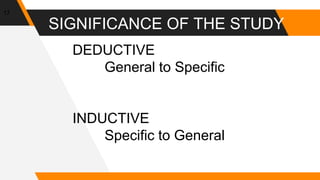
SIGNIFICANCE OF THE STUDY
17
DEDUCTIVE
General to Specific
INDUCTIVE
Specific to General
SIGNIFICANCE OF THE STUDY
18
-explains how the study will be
beneficial to the different
stakeholders of the society
-identifies target beneficiaries or
target users of the current study
19
Scope and
Limitations
Scope and DELimitations
20
SCOPE
-determined by major variables
DELIMITATION
-identified by the sub-variables
and their characteristics, and
attributes or the indicators
Scope and DELimitations
21
-beneficial to mention the locale
or setting of the research and
when the data will be gathered
Scope and Limitations
22
-presents the variables or
subjects of the study, the extent
to which the research will cover,
the possible factors or nuances
that will be given focus on the
course of the study
▸SCOPE
Covers the explanation
as to up to what extent
the researcher would
want to explore or
interpret in his/her
research
▸LIMITATIONS/
DELIMITATIONS
Which is a justification
as to the ‘limits’ or
boundaries of the
research
23
▸LIMITATIONS
-are conditions beyond
the control of the
researcher that may
cause restrictions and
make the conclusions to
be generalizable only to
the conditions set by the
researcher
▸DELIMITATIONS
-are the conditions that
the researcher
purposely controlled.
These are limits
beyond the control of
the study
24
EXAMPLE (Cristobal, 2003)
The study assessed the intrapersonal and
interpersonal competencies of the school managers in
the Division of City Schools in Balanga, Bataan, school
year 2001-2002. The school managers that were
included in the study were the secondary school
principals and head teachers of national high schools in
the division, Moreover, teacher respondents included
only the teachers who are teaching Teknolohiya,
Edukasyong Pangkalusugan, at Pantahanan subject.
25
26
VARIABLE
-any factor or property that
a researcher measures,
controls, and/or
manipulates.
VARIABLE
▸CONCEPT
Can be defined by a
dictionary and is
commonly used by an
educator (e.g. age,
degree, weight, height,
civil status, etc.)
▸CONTRUCT
Usually combines 2
concepts
(e.g. level of
performance, nature of
environment, rate of
recovery, educational
attainment, etc.)
27
KINDS OF VARIABLES
1. VARIABLES ACCDG. TO THE NUMBER OF
CATEGORIES
a. Categorical Variables -represent unordered
categories, groups, or classes
EX: multiple intelligences, learning styles
b. Dichotomous – represent only 2 categories
EX: sex, side, diabetes
28
KINDS OF VARIABLES
1. VARIABLES ACCDG. TO THE NUMBER OF
CATEGORIES
c. Polychotomous Variables –have more than 2
categories
EX: educational attainment, economic status
d. Continuous Variables– take on any of a range
of value
EX: weight, height, speed, blood glucose level
29
KINDS OF VARIABLES
2. VARIABLES USED IN AN EXPERIMENT
a. Independent Variables –are the cause
variables, the reasons of changes in the
dependent variables
b. Dependent Variables– refer to those that are
effected by the cause variables
30
KINDS OF VARIABLES
3. VARIABLES ACCDG. TO THEIR NATURE
a. Concrete Variables –are variables that can be
perceived through the senses
EX: height, skin color, taste
b. Abstract Variables– are variables of quality
EX: knowledge level, perception level
31
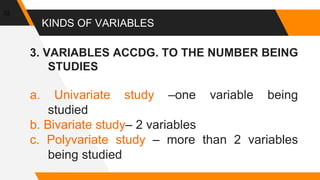
KINDS OF VARIABLES
3. VARIABLES ACCDG. TO THE NUMBER BEING
STUDIES
a. Univariate study –one variable being
studied
b. Bivariate study– 2 variables
c. Polyvariate study – more than 2 variables
being studied
32
Assumptions
-are accepted cause-and-effect
relationships, or estimates the
existence of a fact from the
known existence of other facts.
Definition of Terms
1. Conceptual
2. Operational

Research Paper and the Theoretical Framework

  • 1.
    The Research Paper andthe Theoretical Framework Presenter: Mrs. Daphnie S. Monteverde
  • 2.
  • 3.
    Hypotheses 3 -A temporary answerto a research problem -serves as guide as to what process are needed in answering the research questions and what research design is to be undertaken in the study
  • 4.
    4 REMEMBER In qualitative research,hypotheses may not be needed or may emerge as the study progresses, depending on the purpose of the study.
  • 5.
    TYPES OF HYPOTHESIS 5 1.Scientific Hypothesis -Provides an answer to a research question based on the review of related literature -If conflicting results exist in the RL, the researcher may consider those results from researches conducted in similar context as that of the present study
  • 6.
    TYPES OF HYPOTHESIS 6 2.Statistical Hypothesis -Presents the standard hypothesis for the statistical procedure to be employed in the study 2 TYPES: a. NULL b. ALTERNATIVE
  • 7.
    a. NULL HYPOTHESES 7 -Suggestsa negative relation between variables. -It negates the existences of a characteristic, or a difference in effect of the variables
  • 8.
    b. ALTERNATIVE HYPOTHESES 8 -Suggestsa positive relation between variables. -The existence of a characteristics, or a difference in effect of the variables
  • 9.
  • 10.
    FRAMEWORK 10 -Described as theabstract , logical structure of meaning that guides the development of the study -all frameworks are based on the identification of and relationships among key concepts
  • 11.
    11 THEORETICAL FRAMEWORK -adopted whena particular theory is enough to provide theoretical basis for the conduct of the study
  • 12.
    12 THEORETICAL FRAMEWORK -used whenthe concepts from the different theory are borrowed to provide bases for an investigation, because one theory does not cover all the concerns of the study
  • 13.
    13 THEORETICAL FRAMEWORK -adopted whena particular theory is enough to provide theoretical basis for the conduct of the study
  • 14.
    14 CONCEPTUAL FRAMEWORK -used whenthe concepts from different theories are borrowed to provide bases for an investigation, because one theory does not cover all the concerns of the study
  • 15.
    15 RESEARCH PARADIGM -a graphicalrepresentation of the concepts -encapsulates the entire research idea
  • 16.
  • 17.
    SIGNIFICANCE OF THESTUDY 17 DEDUCTIVE General to Specific INDUCTIVE Specific to General
  • 18.
    SIGNIFICANCE OF THESTUDY 18 -explains how the study will be beneficial to the different stakeholders of the society -identifies target beneficiaries or target users of the current study
  • 19.
  • 20.
    Scope and DELimitations 20 SCOPE -determinedby major variables DELIMITATION -identified by the sub-variables and their characteristics, and attributes or the indicators
  • 21.
    Scope and DELimitations 21 -beneficialto mention the locale or setting of the research and when the data will be gathered
  • 22.
    Scope and Limitations 22 -presentsthe variables or subjects of the study, the extent to which the research will cover, the possible factors or nuances that will be given focus on the course of the study
  • 23.
    ▸SCOPE Covers the explanation asto up to what extent the researcher would want to explore or interpret in his/her research ▸LIMITATIONS/ DELIMITATIONS Which is a justification as to the ‘limits’ or boundaries of the research 23
  • 24.
    ▸LIMITATIONS -are conditions beyond thecontrol of the researcher that may cause restrictions and make the conclusions to be generalizable only to the conditions set by the researcher ▸DELIMITATIONS -are the conditions that the researcher purposely controlled. These are limits beyond the control of the study 24
  • 25.
    EXAMPLE (Cristobal, 2003) Thestudy assessed the intrapersonal and interpersonal competencies of the school managers in the Division of City Schools in Balanga, Bataan, school year 2001-2002. The school managers that were included in the study were the secondary school principals and head teachers of national high schools in the division, Moreover, teacher respondents included only the teachers who are teaching Teknolohiya, Edukasyong Pangkalusugan, at Pantahanan subject. 25
  • 26.
    26 VARIABLE -any factor orproperty that a researcher measures, controls, and/or manipulates.
  • 27.
    VARIABLE ▸CONCEPT Can be definedby a dictionary and is commonly used by an educator (e.g. age, degree, weight, height, civil status, etc.) ▸CONTRUCT Usually combines 2 concepts (e.g. level of performance, nature of environment, rate of recovery, educational attainment, etc.) 27
  • 28.
    KINDS OF VARIABLES 1.VARIABLES ACCDG. TO THE NUMBER OF CATEGORIES a. Categorical Variables -represent unordered categories, groups, or classes EX: multiple intelligences, learning styles b. Dichotomous – represent only 2 categories EX: sex, side, diabetes 28
  • 29.
    KINDS OF VARIABLES 1.VARIABLES ACCDG. TO THE NUMBER OF CATEGORIES c. Polychotomous Variables –have more than 2 categories EX: educational attainment, economic status d. Continuous Variables– take on any of a range of value EX: weight, height, speed, blood glucose level 29
  • 30.
    KINDS OF VARIABLES 2.VARIABLES USED IN AN EXPERIMENT a. Independent Variables –are the cause variables, the reasons of changes in the dependent variables b. Dependent Variables– refer to those that are effected by the cause variables 30
  • 31.
    KINDS OF VARIABLES 3.VARIABLES ACCDG. TO THEIR NATURE a. Concrete Variables –are variables that can be perceived through the senses EX: height, skin color, taste b. Abstract Variables– are variables of quality EX: knowledge level, perception level 31
  • 32.
    KINDS OF VARIABLES 3.VARIABLES ACCDG. TO THE NUMBER BEING STUDIES a. Univariate study –one variable being studied b. Bivariate study– 2 variables c. Polyvariate study – more than 2 variables being studied 32
  • 33.
    Assumptions -are accepted cause-and-effect relationships,or estimates the existence of a fact from the known existence of other facts.
  • 34.
    Definition of Terms 1.Conceptual 2. Operational