Methods of Research
Guillermo B. Bonghanoy, M.A. Math
Facilitator
08/06/18 Prof. Guillermo B. Bonghanoy
Rationale
• To prepare the students in exploring the world of
research
• To encourage the participants to be involved in
research not only as a course requirement, but a way
of life as well
• To widen and deepen the awareness of the students
in research and development
• To increase the productivity of students in terms of
research
• To allow the students to respond to the call of the
times
08/06/18 Prof. Guillermo B. Bonghanoy
Lecture Organization
• Introduction
– The Research Problem
– The Research Title
– The Background of the Study (Rationale)
– The Statement of the Problem
– The Hypothesis
– The Review of Related Literature and Studies
– The Theoretical and the Conceptual Framework
– The Importance of the Study
08/06/18 Prof. Guillermo B. Bonghanoy
Lecture Organization
• The Method
– Research Design
– Research Instrument
– Research Procedure
– Data Analysis and Tools
08/06/18 Prof. Guillermo B. Bonghanoy
The Research Problem
What is a Research Problem?
A research problem is exactly – a problem that someone
would like to research. A problem can be
– anything that a person finds unsatisfactory or
unsettling,
– a difficulty of some sort,
– a state of affairs that needs to be changed,
– anything that is not working as well as it might.
Problem involves areas of concern to researchers, conditions
they want to improve, difficulties they want to eliminate,
questions for which they seek answers.
08/06/18 Prof. Guillermo B. Bonghanoy
Research Problems
A research problem is initially posed as question, which
serves as the focus of the researcher’s investigation.
Sample Questions
1. Does the client-centered therapy produce more satisfaction
in clients than traditional? (traditional experimental
research)
2. Does behavior modification reduce aggression in autistic
children? (single-subject experimental research)
3. Are the descriptions of people in social studied discussions
biased? (grounded theory research)
08/06/18 Prof. Guillermo B. Bonghanoy
4. What goes on in tertiary school classroom during an average
week? (ethnographic research)
5.) Do teachers behave differently toward students of different
genders? (causal-comparative research)
6.) How can we predict which students might have trouble
learning certain kinds of subject matter? (correlational
research)
7.) How do parents feel about the school counseling program?
(survey research)
8.) How can a school administrator improve faculty morale?
(interview research)
08/06/18 Prof. Guillermo B. Bonghanoy
Characteristics of Good Question
1. The question is feasible – that is, capable of being
investigated with available resources.
2. The question is clear
3. The question is significant – that is, worthy of investigation
4. The question is ethical – that is, their investigation should
not involve physical or psychological harm or damage to
human beings or to the natural or social environment of
which they are part.
5. Research questions often (although not always) suggest a
relationship to be investigated.
The term relationship, as used in research, refers to a
connection between two or more characteristics or
qualities.
08/06/18 Prof. Guillermo B. Bonghanoy
The Research Title
• The title is the window of research. It speaks what
the research is all about.
Questions to be considered in making the title:
1. Are the main factors/variables found in the title?
2. Does the title tell readers about the type of
study; case or survey?
08/06/18 Prof. Guillermo B. Bonghanoy
The Research Title
The following components of the title must be
present for several quantitative research:
• Independent Variable
• Dependent Variable
• The Subject of the Study
• The Research Locale
Consider the examples below:
08/06/18 Prof. Guillermo B. Bonghanoy
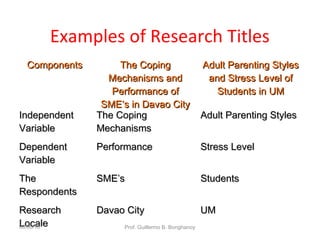
Examples of Research Titles
ComponentsComponents The CopingThe Coping
Mechanisms andMechanisms and
Performance ofPerformance of
SME’s in Davao CitySME’s in Davao City
Adult Parenting StylesAdult Parenting Styles
and Stress Level ofand Stress Level of
Students in UMStudents in UM
IndependentIndependent
VariableVariable
The CopingThe Coping
MechanismsMechanisms
Adult Parenting StylesAdult Parenting Styles
DependentDependent
VariableVariable
PerformancePerformance Stress LevelStress Level
TheThe
RespondentsRespondents
SME’sSME’s StudentsStudents
ResearchResearch
LocaleLocale
Davao CityDavao City UMUM
08/06/18 Prof. Guillermo B. Bonghanoy
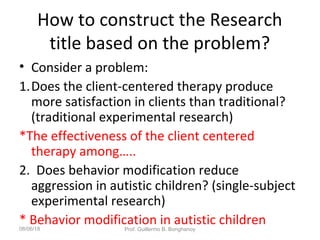
How to construct the Research
title based on the problem?
• Consider a problem:
1.Does the client-centered therapy produce
more satisfaction in clients than traditional?
(traditional experimental research)
*The effectiveness of the client centered
therapy among…..
2. Does behavior modification reduce
aggression in autistic children? (single-subject
experimental research)
* Behavior modification in autistic children08/06/18 Prof. Guillermo B. Bonghanoy
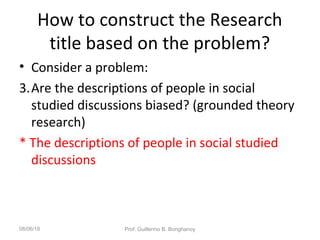
How to construct the Research
title based on the problem?
• Consider a problem:
3.Are the descriptions of people in social
studied discussions biased? (grounded theory
research)
* The descriptions of people in social studied
discussions
08/06/18 Prof. Guillermo B. Bonghanoy
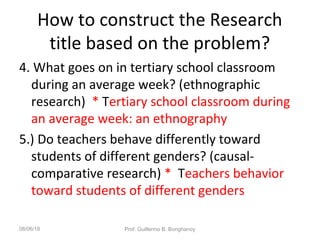
How to construct the Research
title based on the problem?
4. What goes on in tertiary school classroom
during an average week? (ethnographic
research) * Tertiary school classroom during
an average week: an ethnography
5.) Do teachers behave differently toward
students of different genders? (causal-
comparative research) * Teachers behavior
toward students of different genders
08/06/18 Prof. Guillermo B. Bonghanoy
How to construct the Research
title based on the problem?
6.) How can we predict which students might
have trouble learning certain kinds of subject
matter? (correlational research)* A predictive
analysis on learning troubles in acertain
subject matter
08/06/18 Prof. Guillermo B. Bonghanoy
How to construct the Research
title based on the problem?
7.) How do parents feel about the school
counseling program? (survey research) *The
school counseling program as perceived by
parents
8.) How can a school administrator improve
faculty morale? (interview research) *The
improvement of the morale of the faculty:
Administrators’ perspectives
08/06/18 Prof. Guillermo B. Bonghanoy
The Introduction
• The introduction serves as the preliminaries of the study. It
starts with the rationale.
• In the Rationale of the Study, the following might be
considered important:
– What is the worrisome/ problematic situation which needs
to be studied?
– What specific factors/ conditions has given rise to the
problem?
– The reason why this study is conducted; urgency
– The practical importance of the study
– The problem/s that the study intends to answer (Global,
National and Local)
– The theoretical importance of the study
08/06/18 Prof. Guillermo B. Bonghanoy
Statement of the Problem
• The following components are suggested in the
statement of the problem :
– Question for the independent variable
– Question for the dependent variable
– Question for the significance of the difference of the
variables when analyzed by the moderator variable
– Question for the significance of the relationship of the
independent and the dependent variables.
08/06/18 Prof. Guillermo B. Bonghanoy
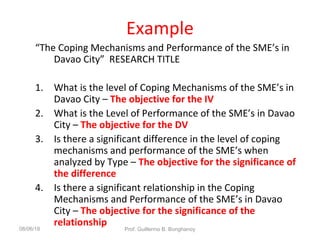
Example
“The Coping Mechanisms and Performance of the SME’s in
Davao City” RESEARCH TITLE
1. What is the level of Coping Mechanisms of the SME’s in
Davao City – The objective for the IV
2. What is the Level of Performance of the SME’s in Davao
City – The objective for the DV
3. Is there a significant difference in the level of coping
mechanisms and performance of the SME’s when
analyzed by Type – The objective for the significance of
the difference
4. Is there a significant relationship in the Coping
Mechanisms and Performance of the SME’s in Davao
City – The objective for the significance of the
relationship08/06/18 Prof. Guillermo B. Bonghanoy
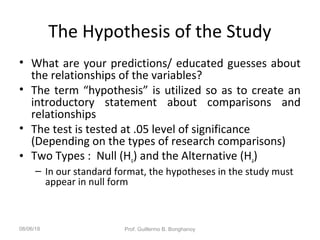
The Hypothesis of the Study
• What are your predictions/ educated guesses about
the relationships of the variables?
• The term “hypothesis” is utilized so as to create an
introductory statement about comparisons and
relationships
• The test is tested at .05 level of significance
(Depending on the types of research comparisons)
• Two Types : Null (Ho) and the Alternative (Ha)
– In our standard format, the hypotheses in the study must
appear in null form
08/06/18 Prof. Guillermo B. Bonghanoy
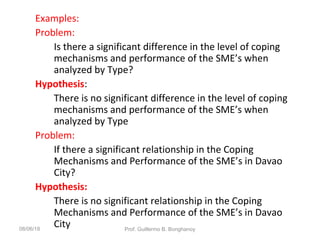
Examples:
Problem:
Is there a significant difference in the level of coping
mechanisms and performance of the SME’s when
analyzed by Type?
Hypothesis:
There is no significant difference in the level of coping
mechanisms and performance of the SME’s when
analyzed by Type
Problem:
If there a significant relationship in the Coping
Mechanisms and Performance of the SME’s in Davao
City?
Hypothesis:
There is no significant relationship in the Coping
Mechanisms and Performance of the SME’s in Davao
City08/06/18 Prof. Guillermo B. Bonghanoy
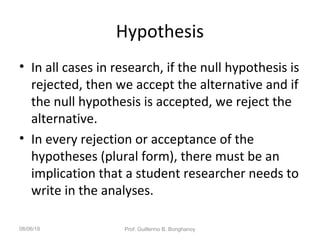
Hypothesis
• In all cases in research, if the null hypothesis is
rejected, then we accept the alternative and if
the null hypothesis is accepted, we reject the
alternative.
• In every rejection or acceptance of the
hypotheses (plural form), there must be an
implication that a student researcher needs to
write in the analyses.
08/06/18 Prof. Guillermo B. Bonghanoy
Theoretical/Conceptual Framework
• The purpose of the theoretical framework section is
to develop and present an understanding of how the
problem relates to a unified explanation of related
ideas and to provide the foundation on which the
study will build and develop
• On what theories can the study be anchored?
• What are related theories/ beliefs/ propositions
which can provide support to your
conceptualization?
• How do you see the variables being related
together?
08/06/18 Prof. Guillermo B. Bonghanoy
Theoretical Framework
• This section further expounds on the topic by
providing a summary of the major theories or
research supporting, clarifying, refuting, or
driving the research proposed. It may also
include references to similar studies in related
areas and provide a rationale for the study. The
place of the theory in the study depends on what
is known about the particular topic.
08/06/18 Prof. Guillermo B. Bonghanoy
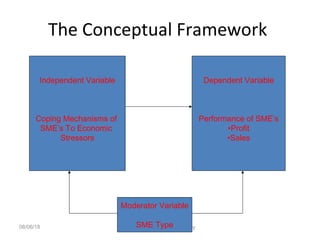
The Conceptual Framework
08/06/18 Prof. Guillermo B. Bonghanoy
Independent Variable
Coping Mechanisms of
SME’s To Economic
Stressors
Dependent Variable
Performance of SME’s
•Profit
•Sales
Moderator Variable
SME Type
Importance of the Study
• Why is the research title important
to be studied?
• Who stands to benefit from the
results?
• Categorize beneficiaries and explain
why this study is important to them.
08/06/18 Prof. Guillermo B. Bonghanoy
Definition of Terms
–What terms should be defined/ explained
for clearer understanding of the study?
–Define them operationally or how they are
being utilized in the study.
Delimitation/ Scope of the Study
–What are the limits/ boundaries of the
study?
–What can be expected included, or not
included, in the study?
08/06/18 Prof. Guillermo B. Bonghanoy
Methods
1. The Research Design.
• What research design is appropriate for
the study? What? Why? How?
• Descriptive, correlational or the
combination, experimental, etc.
1. The Research Subjects.
• Who you will be studying?
• How will they be chosen? How many?
• Why are they chosen? What sampling
method is appropriate?
08/06/18 Prof. Guillermo B. Bonghanoy
3. Research Instruments.
• What instruments will you use to get the
data?
• Who validates it?
• Are the indicators found in your related
literature and studies?
• What scale is appropriate for the study?
• What is the meaning of the choices?
What are the bases of interpretation?
08/06/18 Prof. Guillermo B. Bonghanoy
4. Data Gathering Procedure. Asking permission
to conduct the study; Validation and
Distribution; Collation and Analyses.
5. Data Analysis.
• How will you treat or analyze the data
collected?
• What statistical tools are needed for the
study?
• Will I always rely on my Statistician?
08/06/18 Prof. Guillermo B. Bonghanoy
Thank You.
08/06/18 Prof. Guillermo B. Bonghanoy

Methods of research

  • 1.
    Methods of Research GuillermoB. Bonghanoy, M.A. Math Facilitator 08/06/18 Prof. Guillermo B. Bonghanoy
  • 2.
    Rationale • To preparethe students in exploring the world of research • To encourage the participants to be involved in research not only as a course requirement, but a way of life as well • To widen and deepen the awareness of the students in research and development • To increase the productivity of students in terms of research • To allow the students to respond to the call of the times 08/06/18 Prof. Guillermo B. Bonghanoy
  • 3.
    Lecture Organization • Introduction –The Research Problem – The Research Title – The Background of the Study (Rationale) – The Statement of the Problem – The Hypothesis – The Review of Related Literature and Studies – The Theoretical and the Conceptual Framework – The Importance of the Study 08/06/18 Prof. Guillermo B. Bonghanoy
  • 4.
    Lecture Organization • TheMethod – Research Design – Research Instrument – Research Procedure – Data Analysis and Tools 08/06/18 Prof. Guillermo B. Bonghanoy
  • 5.
    The Research Problem Whatis a Research Problem? A research problem is exactly – a problem that someone would like to research. A problem can be – anything that a person finds unsatisfactory or unsettling, – a difficulty of some sort, – a state of affairs that needs to be changed, – anything that is not working as well as it might. Problem involves areas of concern to researchers, conditions they want to improve, difficulties they want to eliminate, questions for which they seek answers. 08/06/18 Prof. Guillermo B. Bonghanoy
  • 6.
    Research Problems A researchproblem is initially posed as question, which serves as the focus of the researcher’s investigation. Sample Questions 1. Does the client-centered therapy produce more satisfaction in clients than traditional? (traditional experimental research) 2. Does behavior modification reduce aggression in autistic children? (single-subject experimental research) 3. Are the descriptions of people in social studied discussions biased? (grounded theory research) 08/06/18 Prof. Guillermo B. Bonghanoy
  • 7.
    4. What goeson in tertiary school classroom during an average week? (ethnographic research) 5.) Do teachers behave differently toward students of different genders? (causal-comparative research) 6.) How can we predict which students might have trouble learning certain kinds of subject matter? (correlational research) 7.) How do parents feel about the school counseling program? (survey research) 8.) How can a school administrator improve faculty morale? (interview research) 08/06/18 Prof. Guillermo B. Bonghanoy
  • 8.
    Characteristics of GoodQuestion 1. The question is feasible – that is, capable of being investigated with available resources. 2. The question is clear 3. The question is significant – that is, worthy of investigation 4. The question is ethical – that is, their investigation should not involve physical or psychological harm or damage to human beings or to the natural or social environment of which they are part. 5. Research questions often (although not always) suggest a relationship to be investigated. The term relationship, as used in research, refers to a connection between two or more characteristics or qualities. 08/06/18 Prof. Guillermo B. Bonghanoy
  • 9.
    The Research Title •The title is the window of research. It speaks what the research is all about. Questions to be considered in making the title: 1. Are the main factors/variables found in the title? 2. Does the title tell readers about the type of study; case or survey? 08/06/18 Prof. Guillermo B. Bonghanoy
  • 10.
    The Research Title Thefollowing components of the title must be present for several quantitative research: • Independent Variable • Dependent Variable • The Subject of the Study • The Research Locale Consider the examples below: 08/06/18 Prof. Guillermo B. Bonghanoy
  • 11.
    Examples of ResearchTitles ComponentsComponents The CopingThe Coping Mechanisms andMechanisms and Performance ofPerformance of SME’s in Davao CitySME’s in Davao City Adult Parenting StylesAdult Parenting Styles and Stress Level ofand Stress Level of Students in UMStudents in UM IndependentIndependent VariableVariable The CopingThe Coping MechanismsMechanisms Adult Parenting StylesAdult Parenting Styles DependentDependent VariableVariable PerformancePerformance Stress LevelStress Level TheThe RespondentsRespondents SME’sSME’s StudentsStudents ResearchResearch LocaleLocale Davao CityDavao City UMUM 08/06/18 Prof. Guillermo B. Bonghanoy
  • 12.
    How to constructthe Research title based on the problem? • Consider a problem: 1.Does the client-centered therapy produce more satisfaction in clients than traditional? (traditional experimental research) *The effectiveness of the client centered therapy among….. 2. Does behavior modification reduce aggression in autistic children? (single-subject experimental research) * Behavior modification in autistic children08/06/18 Prof. Guillermo B. Bonghanoy
  • 13.
    How to constructthe Research title based on the problem? • Consider a problem: 3.Are the descriptions of people in social studied discussions biased? (grounded theory research) * The descriptions of people in social studied discussions 08/06/18 Prof. Guillermo B. Bonghanoy
  • 14.
    How to constructthe Research title based on the problem? 4. What goes on in tertiary school classroom during an average week? (ethnographic research) * Tertiary school classroom during an average week: an ethnography 5.) Do teachers behave differently toward students of different genders? (causal- comparative research) * Teachers behavior toward students of different genders 08/06/18 Prof. Guillermo B. Bonghanoy
  • 15.
    How to constructthe Research title based on the problem? 6.) How can we predict which students might have trouble learning certain kinds of subject matter? (correlational research)* A predictive analysis on learning troubles in acertain subject matter 08/06/18 Prof. Guillermo B. Bonghanoy
  • 16.
    How to constructthe Research title based on the problem? 7.) How do parents feel about the school counseling program? (survey research) *The school counseling program as perceived by parents 8.) How can a school administrator improve faculty morale? (interview research) *The improvement of the morale of the faculty: Administrators’ perspectives 08/06/18 Prof. Guillermo B. Bonghanoy
  • 17.
    The Introduction • Theintroduction serves as the preliminaries of the study. It starts with the rationale. • In the Rationale of the Study, the following might be considered important: – What is the worrisome/ problematic situation which needs to be studied? – What specific factors/ conditions has given rise to the problem? – The reason why this study is conducted; urgency – The practical importance of the study – The problem/s that the study intends to answer (Global, National and Local) – The theoretical importance of the study 08/06/18 Prof. Guillermo B. Bonghanoy
  • 18.
    Statement of theProblem • The following components are suggested in the statement of the problem : – Question for the independent variable – Question for the dependent variable – Question for the significance of the difference of the variables when analyzed by the moderator variable – Question for the significance of the relationship of the independent and the dependent variables. 08/06/18 Prof. Guillermo B. Bonghanoy
  • 19.
    Example “The Coping Mechanismsand Performance of the SME’s in Davao City” RESEARCH TITLE 1. What is the level of Coping Mechanisms of the SME’s in Davao City – The objective for the IV 2. What is the Level of Performance of the SME’s in Davao City – The objective for the DV 3. Is there a significant difference in the level of coping mechanisms and performance of the SME’s when analyzed by Type – The objective for the significance of the difference 4. Is there a significant relationship in the Coping Mechanisms and Performance of the SME’s in Davao City – The objective for the significance of the relationship08/06/18 Prof. Guillermo B. Bonghanoy
  • 20.
    The Hypothesis ofthe Study • What are your predictions/ educated guesses about the relationships of the variables? • The term “hypothesis” is utilized so as to create an introductory statement about comparisons and relationships • The test is tested at .05 level of significance (Depending on the types of research comparisons) • Two Types : Null (Ho) and the Alternative (Ha) – In our standard format, the hypotheses in the study must appear in null form 08/06/18 Prof. Guillermo B. Bonghanoy
  • 21.
    Examples: Problem: Is there asignificant difference in the level of coping mechanisms and performance of the SME’s when analyzed by Type? Hypothesis: There is no significant difference in the level of coping mechanisms and performance of the SME’s when analyzed by Type Problem: If there a significant relationship in the Coping Mechanisms and Performance of the SME’s in Davao City? Hypothesis: There is no significant relationship in the Coping Mechanisms and Performance of the SME’s in Davao City08/06/18 Prof. Guillermo B. Bonghanoy
  • 22.
    Hypothesis • In allcases in research, if the null hypothesis is rejected, then we accept the alternative and if the null hypothesis is accepted, we reject the alternative. • In every rejection or acceptance of the hypotheses (plural form), there must be an implication that a student researcher needs to write in the analyses. 08/06/18 Prof. Guillermo B. Bonghanoy
  • 23.
    Theoretical/Conceptual Framework • Thepurpose of the theoretical framework section is to develop and present an understanding of how the problem relates to a unified explanation of related ideas and to provide the foundation on which the study will build and develop • On what theories can the study be anchored? • What are related theories/ beliefs/ propositions which can provide support to your conceptualization? • How do you see the variables being related together? 08/06/18 Prof. Guillermo B. Bonghanoy
  • 24.
    Theoretical Framework • Thissection further expounds on the topic by providing a summary of the major theories or research supporting, clarifying, refuting, or driving the research proposed. It may also include references to similar studies in related areas and provide a rationale for the study. The place of the theory in the study depends on what is known about the particular topic. 08/06/18 Prof. Guillermo B. Bonghanoy
  • 25.
    The Conceptual Framework 08/06/18Prof. Guillermo B. Bonghanoy Independent Variable Coping Mechanisms of SME’s To Economic Stressors Dependent Variable Performance of SME’s •Profit •Sales Moderator Variable SME Type
  • 26.
    Importance of theStudy • Why is the research title important to be studied? • Who stands to benefit from the results? • Categorize beneficiaries and explain why this study is important to them. 08/06/18 Prof. Guillermo B. Bonghanoy
  • 27.
    Definition of Terms –Whatterms should be defined/ explained for clearer understanding of the study? –Define them operationally or how they are being utilized in the study. Delimitation/ Scope of the Study –What are the limits/ boundaries of the study? –What can be expected included, or not included, in the study? 08/06/18 Prof. Guillermo B. Bonghanoy
  • 28.
    Methods 1. The ResearchDesign. • What research design is appropriate for the study? What? Why? How? • Descriptive, correlational or the combination, experimental, etc. 1. The Research Subjects. • Who you will be studying? • How will they be chosen? How many? • Why are they chosen? What sampling method is appropriate? 08/06/18 Prof. Guillermo B. Bonghanoy
  • 29.
    3. Research Instruments. •What instruments will you use to get the data? • Who validates it? • Are the indicators found in your related literature and studies? • What scale is appropriate for the study? • What is the meaning of the choices? What are the bases of interpretation? 08/06/18 Prof. Guillermo B. Bonghanoy
  • 30.
    4. Data GatheringProcedure. Asking permission to conduct the study; Validation and Distribution; Collation and Analyses. 5. Data Analysis. • How will you treat or analyze the data collected? • What statistical tools are needed for the study? • Will I always rely on my Statistician? 08/06/18 Prof. Guillermo B. Bonghanoy
  • 31.
    Thank You. 08/06/18 Prof.Guillermo B. Bonghanoy