Presented By:-Gurkirat Singh (Electrical Engineering)
CONTENT
• Diesel power plant
• Advantages & disadvantages
• Site selection
• Diesel power plant working principle
• Terms related with ic engines
• Four stroke cycle diesel engines
• 2-Stroke diesel engine
• Difference Between 2 Stroke and 4 Stroke Engines
Presented By:-Gurkirat Singh (Electrical Engineering)
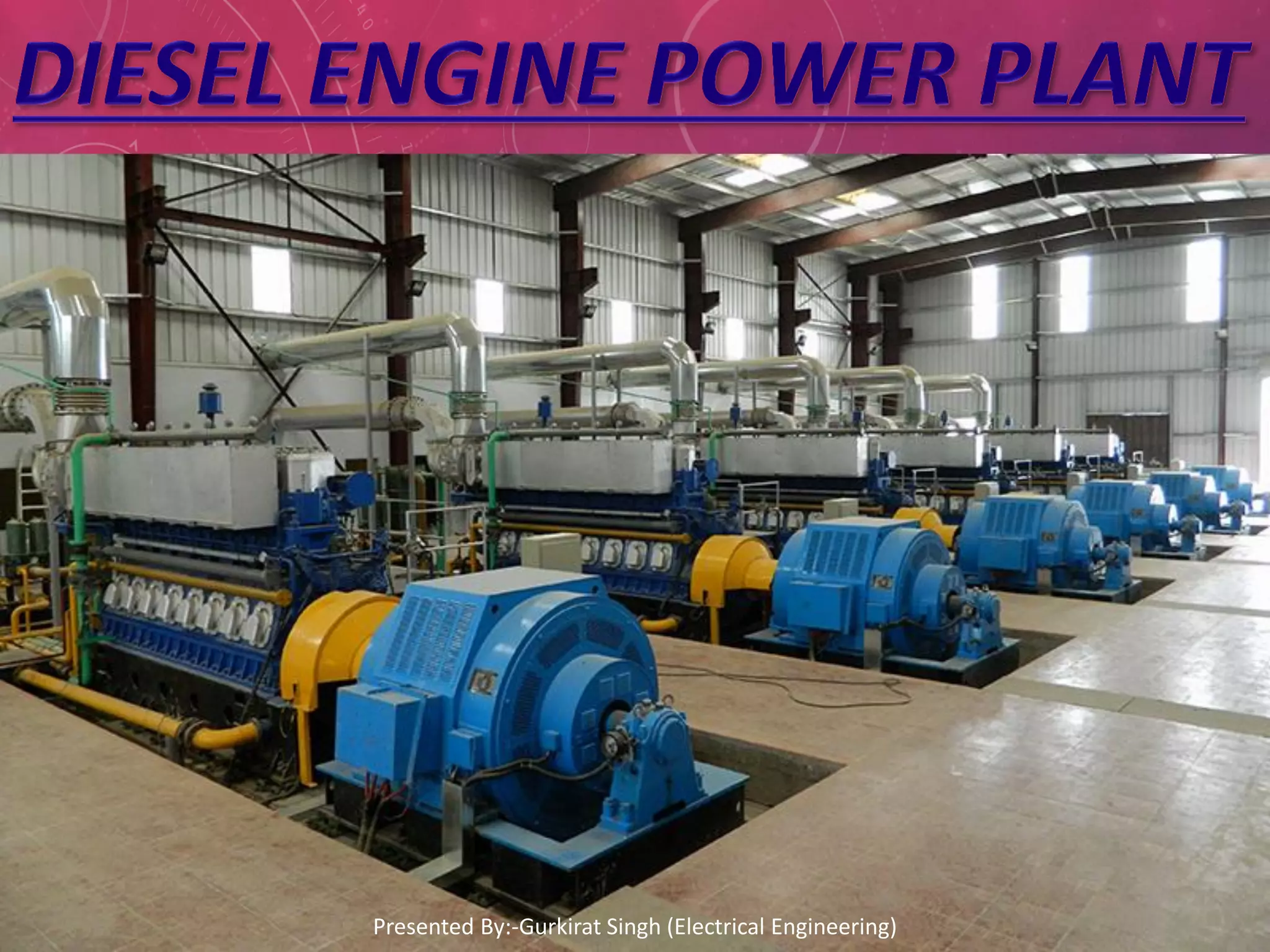
DIESEL POWER PLANT
• A diesel power plant or standby power station is the plant when
we use diesel engine as a prime mover or combine a diesel
engine with an electric generator to produce electrical energy by
using diesel fuel or liquid fuels like natural gas.
• It’s generally a compact station so it can be located when we
actually required.
• And the diesel power plant produces limited amounts
of electricity in the range of 2 to 50 MW; So, We can use it as
standby sets to supply peak load of hospitals, radio station,
telephone exchanges, industries, cinema theatres, and very
suitable for mobile power generation, railways and ships.
Presented By:-Gurkirat Singh (Electrical Engineering)
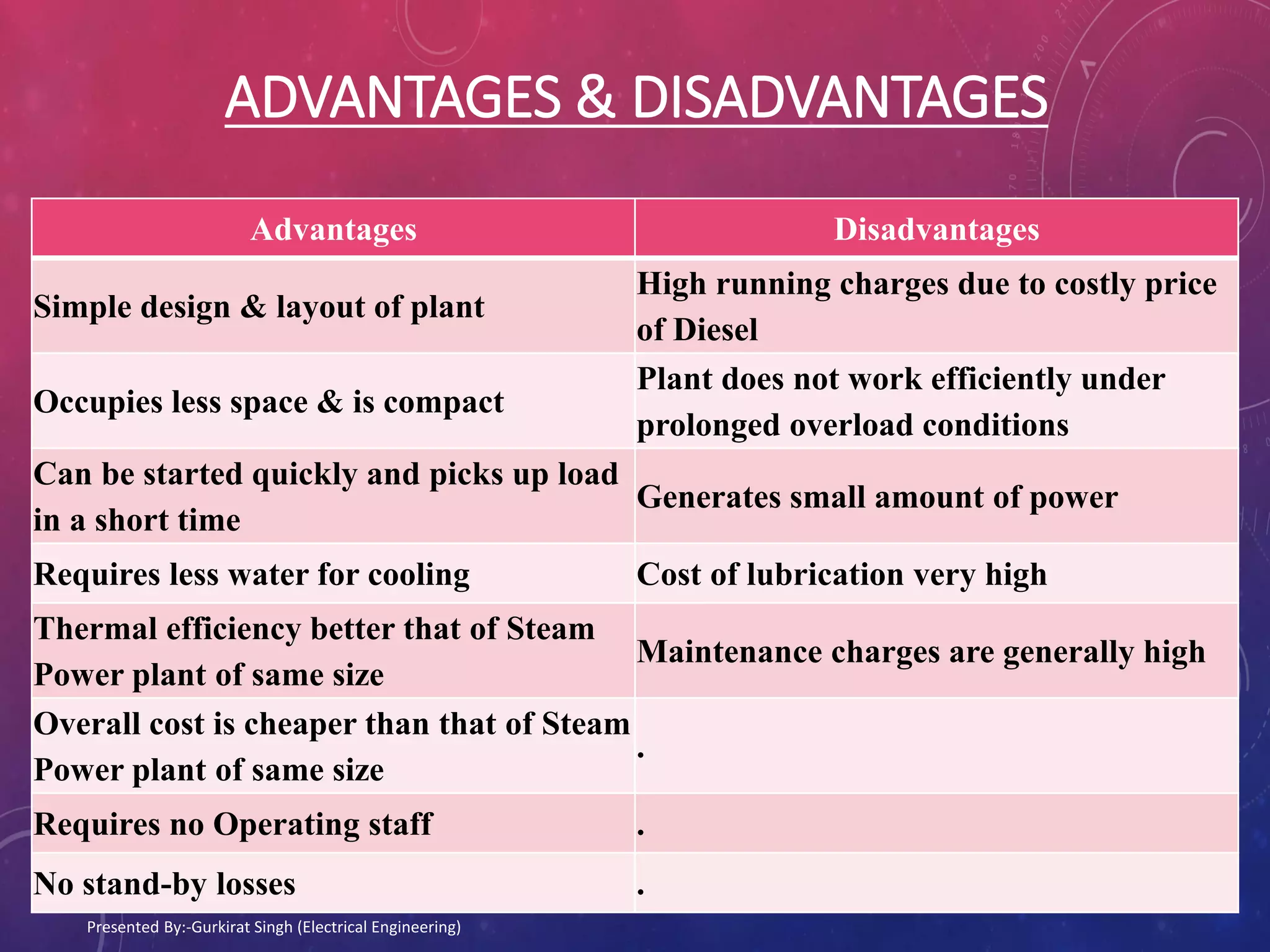
ADVANTAGES & DISADVANTAGES
Advantages Disadvantages
Simple design & layout of plant
High running charges due to costly price
of Diesel
Occupies less space & is compact
Plant does not work efficiently under
prolonged overload conditions
Can be started quickly and picks up load
in a short time
Generates small amount of power
Requires less water for cooling Cost of lubrication very high
Thermal efficiency better that of Steam
Power plant of same size
Maintenance charges are generally high
Overall cost is cheaper than that of Steam
Power plant of same size
.
Requires no Operating staff .
No stand-by losses .
Presented By:-Gurkirat Singh (Electrical Engineering)
SITE SELECTION
The following factors should be considered while selecting the site of diesel
power plant:
• Foundation sub-soil condition: The conditions of sub-soil should be such
that a foundation at a reasonable depth should be capable of providing a
strong support to the engine.
• Access to the site: the site should be so selected that it is accessible
through rail and road.
• Distance from the load centre: The location of the plant should be near
the load centre. This reduces the cost of transmission lines and
maintenance cost. The power loss is also minimized.
• Availability of water: sufficient quantity of water should be available at
the site selected.
• Fuel transportation: The site selected should be near to the source of
fuel supply so that transportation charges are low.
Presented By:-Gurkirat Singh (Electrical Engineering)
DIESEL POWER PLANT WORKING PRINCIPLE
• The working principle of the diesel power station is very
simple; as we compress the air in a cylinder to raise the
temperature, then we burn the diesel inside the engine and
the combustion produces the working fluid at high-
temperature and high-pressure to convert the heat energy into
mechanical energy.
• And as the diesel engine acts as a prime mover it rotates the
rotor of the electrical generator and converts this mechanical
energy into electrical energy.
• This working principle is a working cycle done by the processes:
intake, compression, expansion, and exhaust.
Presented By:-Gurkirat Singh (Electrical Engineering)
TERMS RELATED WITH IC ENGINES
• Top dead center (T.D.C.): In a reciprocating engine the piston moves to
and fro motion in the cylinder. When the piston moves upper
direction in the cylinder, a point at which the piston comes to rest or
change its direction known as top dead center. It is situated at top end
of cylinder.
• Bottom dead center (B.D.C.): When the piston moves in downward
direction, a point at which the piston come to rest or change its
direction known as bottom dead center. It is situated in bottom side
of cylinder.
• Stroke (L): The maximum distance travel by the piston in single
direction is known as stroke. It is the distance between top dead
center and bottom dead center.
• Bore (b): The inner diameter of cylinder known as bore of cylinder
Presented By:-Gurkirat Singh (Electrical Engineering)
TERMS RELATED TO I.C. ENGINES
Presented By:-Gurkirat Singh (Electrical Engineering)
• Maximum or total volume of cylinder (Vtotal): It is the volume of cylinder
when the piston is at bottom dead center. Generally, it is measure in
centimeter cube (c.c.).
• Minimum or clearance volume of cylinder (Vclearance): It is the volume of
cylinder when the piston is at top dead center.
• Swept or displace volume (Vswept): It is the volume which swept by the
piston. The difference between total volume and clearance volume is
known as swept volume.
Swept volume = Total volume – Clearance volume
• Compression ratio: The ratio of maximum volume to minimum volume of
cylinder is known as the compression ratio. It is 8 to 12 for spark ignition
engine and 12 to 24 for compression ignition engine.
Compression ratio = Total volume / Clearance volume
Presented By:-Gurkirat Singh (Electrical Engineering)
• Piston speed: The average speed of the piston is called piston speed.
Piston speed = 2 LN
Where, L= Length of the stroke, and
N = Speed of the engine in r.p.m.
• Self Ignition Temperature(SIT): Self ignition temperature is the lowest
temperature at which a diesel/Petrol will ignite itself without the presence
of a spark or flame.
 The Self Ignition Temperature of Diesel is 210°C and that of Petrol varies
from 247°C to 280°C.
 The lower SIT of Diesel is the reason behind the absence of spark plug in
diesel engine.
 The temperature of fuel air mixture in diesel engine running at 1:20
compression ratio can go as high as 700°C. Since this temperature is
much higher than the STI,diesel automatically catches fire at 210°C.
 Petrol engines have lesser compression ratios compared to diesel
engines(1:8–10) and they relay on spark plugs for source of ignition.
 Diesel engine is more efficient than petrol engine in fact that Energy in
diesel is 36.9 Mega-joules/liter and Energy in petrol is 33.7 Mega-
joules/liter.
Presented By:-Gurkirat Singh (Electrical Engineering)
FOUR STROKE CYCLE DIESEL ENGINES
This types of engine comprises of the following four strokes:
• COMPRESSION STROKE - Means the reduction in volume and increase in
pressure of the air or combustible mixture in the cylinder prior to
combustion. This is achieved by piston which is moving upwards in
cylinder. Also compression of gas naturally increases the temperature.
• IGNITION STROKE - Means the act of igniting fuel in cylinder. The fuel is
injected into the cylinder through fuel injectors and this is ignited by
either a spark plug or by the heat produced in the cylinder due to
compression.
• EXPANSION/POWER STROKE - After the ignition the combustion occurs in
the cylinder which is nothing but a "blast" which causes a rapid expansion
of gases which causes the piston to move downward.
• EXHAUST STROKE - Also there exits another stroke which is called the
Exhaust stroke which happens, where all the burnt gases are removed
from the cylinder due to the upward movement of the piston.
Presented By:-Gurkirat Singh (Electrical Engineering)
FOUR STROKE CYCLE DIESEL ENGINES
P-V DIAGRAM
ACTUAL CYCLE
• The fig. shows the actual indicator diagram for a four-stroke Diesel
cycle engine. It may be noted that line (a-b) is below the
atmospheric pressure line. This is due to the fact that owing to the
restricted area of the inlet passages the entering air can’t cope with
the speed of the piston. The exhaust line (a-e) is slightly above the
atmospheric line. This is because of the restricted exhaust passages
which do not allow the exhaust gases to leave the engine cylinder
quickly.
• The loop of area (e-a-b) is called negative loop; it gives the
pumping loss due to admission of air and removal of exhaust gases.
The area (b-c-d-e) is the total or gross work obtained from the
piston and net work can be obtained by subtracting area (e-a-b)
from area (b-c-d-e).
Presented By:-Gurkirat Singh (Electrical Engineering)
where:
S – piston stroke
Vc – clearance volume
Vd – displaced (swept)
volume
p0 – atmospheric pressure
W – work
TDC – top dead center
BDC – bottom dead center
IV – inlet valve
EV – exhaust valve
IVO – inlet valve opening
IVC – inlet valve closing
EVO – exhaust valve
opening
EVC – exhaust valve
closing
IGN (INJ) – ignition
(injection)
Presented By:-Gurkirat Singh (Electrical Engineering)
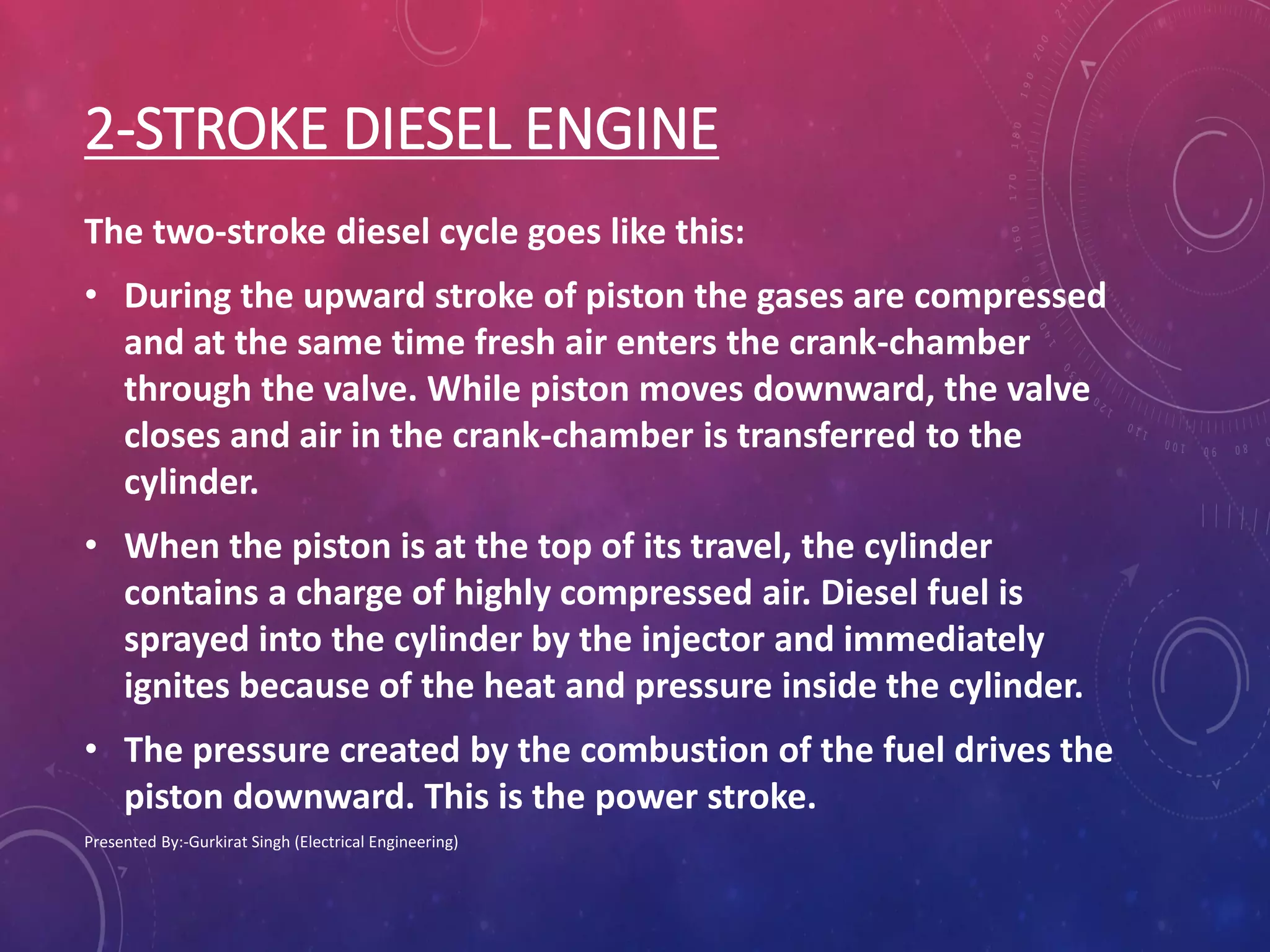
2-STROKE DIESEL ENGINE
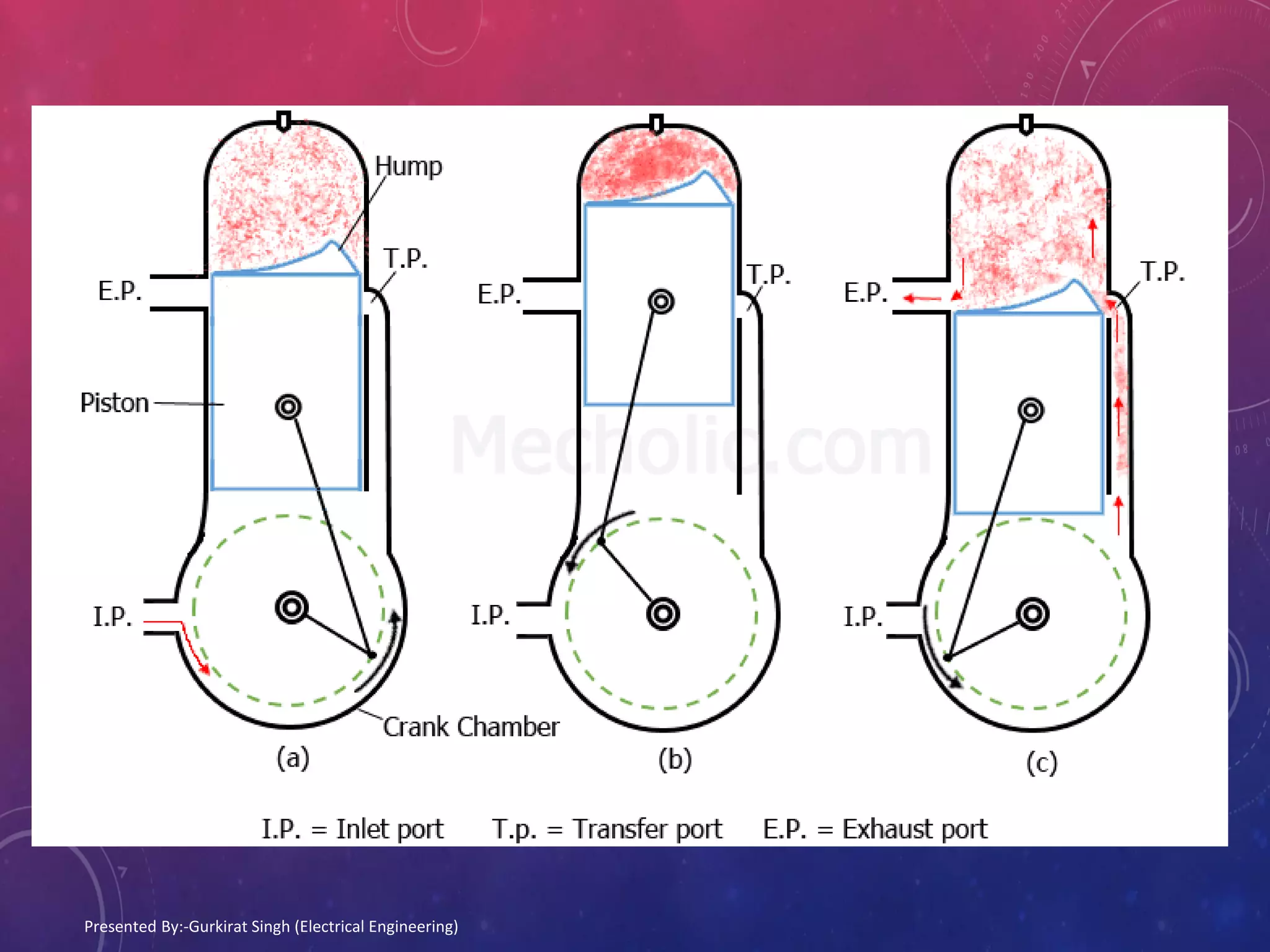
The two-stroke diesel cycle goes like this:
• During the upward stroke of piston the gases are compressed
and at the same time fresh air enters the crank-chamber
through the valve. While piston moves downward, the valve
closes and air in the crank-chamber is transferred to the
cylinder.
• When the piston is at the top of its travel, the cylinder
contains a charge of highly compressed air. Diesel fuel is
sprayed into the cylinder by the injector and immediately
ignites because of the heat and pressure inside the cylinder.
• The pressure created by the combustion of the fuel drives the
piston downward. This is the power stroke.
Presented By:-Gurkirat Singh (Electrical Engineering)
2-STROKE DIESEL ENGINE
• As the piston nears the bottom of its stroke, the exhaust
valves opens and exhaust gases rush out of the cylinder,
relieving the pressure.
• The transfer port, then is uncovered immediately, and the air
from the crank-chamber flows into the cylinder and is
deflected by the hump provided on the head of the piston.
Pressurized air fills the cylinder, forcing out the remainder of
the exhaust gases.
• The exhaust valves close and the piston starts traveling back
upward, re-covering the intake ports and compressing the
fresh charge of air. This is the compression stroke.
• As the piston nears the top of the cylinder, the cycle repeats
with step 1.
Presented By:-Gurkirat Singh (Electrical Engineering)
DIFFERENCE BETWEEN 2 STROKE AND 4 STROKE ENGINES
S.No. Four stroke engine Two stroke engine
1.
It has one power stroke for every two
revolutions of the crankshaft.
It has one power stroke for each
revolution of the crankshaft.
2.
Heavy flywheel is required and engine
runs unbalanced because turning
moment on the crankshaft is not even
due to one power stroke for every two
revolutions of the crankshaft.
Lighter flywheel is required and engine
runs balanced because turning
moment is more even due to one power
stroke for each revolution of the
crankshaft.
3. Engine is heavy Engine is light
4.
Engine design is complicated due to
valve mechanism.
Engine design is simple due to absence
of valve mechanism.
5. More cost. Less cost than 4 stroke.
6.
Less mechanical efficiency due to
more friction on many parts.
More mechanical efficiency due to less
friction on a few parts.
7.
More output due to full fresh charge
intake and full burnt gases
exhaust.
Less output due to mixing of fresh
charge with the hot burnt gases.
Presented By:-Gurkirat Singh (Electrical Engineering)
S.No. Four stroke engine Two stroke engine
8. Engine runs cooler. Engine runs hotter.
9. Engine is water cooled. Engine is air cooled.
10.
Less fuel consumption and complete
burning of fuel.
More fuel consumption and fresh
charge is mixed with exhaust gases.
11. Engine requires more space. Engine requires less space.
12. Complicated lubricating system. Simple lubricating system.
13. Less noise is created by engine. More noise is created by engine.
14.
Engine consists of inlet and exhaust
valve.
Engine consists of inlet and exhaust
ports.
15. More thermal efficiency. Less thermal efficiency.
16. It consumes less lubricating oil. It consumes more lubricating oil.
17. Less wear and tear of moving parts. More wear and tear of moving parts.
18. Used in cars, buses, trucks etc.
Used in mopeds,
scooters, motorcycles etc.
Presented By:-Gurkirat Singh (Electrical Engineering)
Thank you……
PRESENTED BY: GURKIRAT SINGH
Presented By:-Gurkirat Singh (Electrical Engineering)

Diesel engine power plant

  • 1.
    Presented By:-Gurkirat Singh(Electrical Engineering)
  • 2.
    CONTENT • Diesel powerplant • Advantages & disadvantages • Site selection • Diesel power plant working principle • Terms related with ic engines • Four stroke cycle diesel engines • 2-Stroke diesel engine • Difference Between 2 Stroke and 4 Stroke Engines Presented By:-Gurkirat Singh (Electrical Engineering)
  • 3.
    DIESEL POWER PLANT •A diesel power plant or standby power station is the plant when we use diesel engine as a prime mover or combine a diesel engine with an electric generator to produce electrical energy by using diesel fuel or liquid fuels like natural gas. • It’s generally a compact station so it can be located when we actually required. • And the diesel power plant produces limited amounts of electricity in the range of 2 to 50 MW; So, We can use it as standby sets to supply peak load of hospitals, radio station, telephone exchanges, industries, cinema theatres, and very suitable for mobile power generation, railways and ships. Presented By:-Gurkirat Singh (Electrical Engineering)
  • 4.
    ADVANTAGES & DISADVANTAGES AdvantagesDisadvantages Simple design & layout of plant High running charges due to costly price of Diesel Occupies less space & is compact Plant does not work efficiently under prolonged overload conditions Can be started quickly and picks up load in a short time Generates small amount of power Requires less water for cooling Cost of lubrication very high Thermal efficiency better that of Steam Power plant of same size Maintenance charges are generally high Overall cost is cheaper than that of Steam Power plant of same size . Requires no Operating staff . No stand-by losses . Presented By:-Gurkirat Singh (Electrical Engineering)
  • 5.
    SITE SELECTION The followingfactors should be considered while selecting the site of diesel power plant: • Foundation sub-soil condition: The conditions of sub-soil should be such that a foundation at a reasonable depth should be capable of providing a strong support to the engine. • Access to the site: the site should be so selected that it is accessible through rail and road. • Distance from the load centre: The location of the plant should be near the load centre. This reduces the cost of transmission lines and maintenance cost. The power loss is also minimized. • Availability of water: sufficient quantity of water should be available at the site selected. • Fuel transportation: The site selected should be near to the source of fuel supply so that transportation charges are low. Presented By:-Gurkirat Singh (Electrical Engineering)
  • 6.
    DIESEL POWER PLANTWORKING PRINCIPLE • The working principle of the diesel power station is very simple; as we compress the air in a cylinder to raise the temperature, then we burn the diesel inside the engine and the combustion produces the working fluid at high- temperature and high-pressure to convert the heat energy into mechanical energy. • And as the diesel engine acts as a prime mover it rotates the rotor of the electrical generator and converts this mechanical energy into electrical energy. • This working principle is a working cycle done by the processes: intake, compression, expansion, and exhaust. Presented By:-Gurkirat Singh (Electrical Engineering)
  • 7.
    Presented By:-Gurkirat Singh(Electrical Engineering)
  • 8.
    TERMS RELATED WITHIC ENGINES • Top dead center (T.D.C.): In a reciprocating engine the piston moves to and fro motion in the cylinder. When the piston moves upper direction in the cylinder, a point at which the piston comes to rest or change its direction known as top dead center. It is situated at top end of cylinder. • Bottom dead center (B.D.C.): When the piston moves in downward direction, a point at which the piston come to rest or change its direction known as bottom dead center. It is situated in bottom side of cylinder. • Stroke (L): The maximum distance travel by the piston in single direction is known as stroke. It is the distance between top dead center and bottom dead center. • Bore (b): The inner diameter of cylinder known as bore of cylinder Presented By:-Gurkirat Singh (Electrical Engineering)
  • 9.
    TERMS RELATED TOI.C. ENGINES Presented By:-Gurkirat Singh (Electrical Engineering)
  • 10.
    • Maximum ortotal volume of cylinder (Vtotal): It is the volume of cylinder when the piston is at bottom dead center. Generally, it is measure in centimeter cube (c.c.). • Minimum or clearance volume of cylinder (Vclearance): It is the volume of cylinder when the piston is at top dead center. • Swept or displace volume (Vswept): It is the volume which swept by the piston. The difference between total volume and clearance volume is known as swept volume. Swept volume = Total volume – Clearance volume • Compression ratio: The ratio of maximum volume to minimum volume of cylinder is known as the compression ratio. It is 8 to 12 for spark ignition engine and 12 to 24 for compression ignition engine. Compression ratio = Total volume / Clearance volume Presented By:-Gurkirat Singh (Electrical Engineering)
  • 11.
    • Piston speed:The average speed of the piston is called piston speed. Piston speed = 2 LN Where, L= Length of the stroke, and N = Speed of the engine in r.p.m. • Self Ignition Temperature(SIT): Self ignition temperature is the lowest temperature at which a diesel/Petrol will ignite itself without the presence of a spark or flame.  The Self Ignition Temperature of Diesel is 210°C and that of Petrol varies from 247°C to 280°C.  The lower SIT of Diesel is the reason behind the absence of spark plug in diesel engine.  The temperature of fuel air mixture in diesel engine running at 1:20 compression ratio can go as high as 700°C. Since this temperature is much higher than the STI,diesel automatically catches fire at 210°C.  Petrol engines have lesser compression ratios compared to diesel engines(1:8–10) and they relay on spark plugs for source of ignition.  Diesel engine is more efficient than petrol engine in fact that Energy in diesel is 36.9 Mega-joules/liter and Energy in petrol is 33.7 Mega- joules/liter. Presented By:-Gurkirat Singh (Electrical Engineering)
  • 12.
    FOUR STROKE CYCLEDIESEL ENGINES This types of engine comprises of the following four strokes: • COMPRESSION STROKE - Means the reduction in volume and increase in pressure of the air or combustible mixture in the cylinder prior to combustion. This is achieved by piston which is moving upwards in cylinder. Also compression of gas naturally increases the temperature. • IGNITION STROKE - Means the act of igniting fuel in cylinder. The fuel is injected into the cylinder through fuel injectors and this is ignited by either a spark plug or by the heat produced in the cylinder due to compression. • EXPANSION/POWER STROKE - After the ignition the combustion occurs in the cylinder which is nothing but a "blast" which causes a rapid expansion of gases which causes the piston to move downward. • EXHAUST STROKE - Also there exits another stroke which is called the Exhaust stroke which happens, where all the burnt gases are removed from the cylinder due to the upward movement of the piston. Presented By:-Gurkirat Singh (Electrical Engineering)
  • 13.
    FOUR STROKE CYCLEDIESEL ENGINES
  • 14.
  • 15.
    ACTUAL CYCLE • Thefig. shows the actual indicator diagram for a four-stroke Diesel cycle engine. It may be noted that line (a-b) is below the atmospheric pressure line. This is due to the fact that owing to the restricted area of the inlet passages the entering air can’t cope with the speed of the piston. The exhaust line (a-e) is slightly above the atmospheric line. This is because of the restricted exhaust passages which do not allow the exhaust gases to leave the engine cylinder quickly. • The loop of area (e-a-b) is called negative loop; it gives the pumping loss due to admission of air and removal of exhaust gases. The area (b-c-d-e) is the total or gross work obtained from the piston and net work can be obtained by subtracting area (e-a-b) from area (b-c-d-e). Presented By:-Gurkirat Singh (Electrical Engineering)
  • 16.
    where: S – pistonstroke Vc – clearance volume Vd – displaced (swept) volume p0 – atmospheric pressure W – work TDC – top dead center BDC – bottom dead center IV – inlet valve EV – exhaust valve IVO – inlet valve opening IVC – inlet valve closing EVO – exhaust valve opening EVC – exhaust valve closing IGN (INJ) – ignition (injection) Presented By:-Gurkirat Singh (Electrical Engineering)
  • 17.
    2-STROKE DIESEL ENGINE Thetwo-stroke diesel cycle goes like this: • During the upward stroke of piston the gases are compressed and at the same time fresh air enters the crank-chamber through the valve. While piston moves downward, the valve closes and air in the crank-chamber is transferred to the cylinder. • When the piston is at the top of its travel, the cylinder contains a charge of highly compressed air. Diesel fuel is sprayed into the cylinder by the injector and immediately ignites because of the heat and pressure inside the cylinder. • The pressure created by the combustion of the fuel drives the piston downward. This is the power stroke. Presented By:-Gurkirat Singh (Electrical Engineering)
  • 18.
  • 19.
    • As thepiston nears the bottom of its stroke, the exhaust valves opens and exhaust gases rush out of the cylinder, relieving the pressure. • The transfer port, then is uncovered immediately, and the air from the crank-chamber flows into the cylinder and is deflected by the hump provided on the head of the piston. Pressurized air fills the cylinder, forcing out the remainder of the exhaust gases. • The exhaust valves close and the piston starts traveling back upward, re-covering the intake ports and compressing the fresh charge of air. This is the compression stroke. • As the piston nears the top of the cylinder, the cycle repeats with step 1. Presented By:-Gurkirat Singh (Electrical Engineering)
  • 20.
    Presented By:-Gurkirat Singh(Electrical Engineering)
  • 21.
    DIFFERENCE BETWEEN 2STROKE AND 4 STROKE ENGINES S.No. Four stroke engine Two stroke engine 1. It has one power stroke for every two revolutions of the crankshaft. It has one power stroke for each revolution of the crankshaft. 2. Heavy flywheel is required and engine runs unbalanced because turning moment on the crankshaft is not even due to one power stroke for every two revolutions of the crankshaft. Lighter flywheel is required and engine runs balanced because turning moment is more even due to one power stroke for each revolution of the crankshaft. 3. Engine is heavy Engine is light 4. Engine design is complicated due to valve mechanism. Engine design is simple due to absence of valve mechanism. 5. More cost. Less cost than 4 stroke. 6. Less mechanical efficiency due to more friction on many parts. More mechanical efficiency due to less friction on a few parts. 7. More output due to full fresh charge intake and full burnt gases exhaust. Less output due to mixing of fresh charge with the hot burnt gases. Presented By:-Gurkirat Singh (Electrical Engineering)
  • 22.
    S.No. Four strokeengine Two stroke engine 8. Engine runs cooler. Engine runs hotter. 9. Engine is water cooled. Engine is air cooled. 10. Less fuel consumption and complete burning of fuel. More fuel consumption and fresh charge is mixed with exhaust gases. 11. Engine requires more space. Engine requires less space. 12. Complicated lubricating system. Simple lubricating system. 13. Less noise is created by engine. More noise is created by engine. 14. Engine consists of inlet and exhaust valve. Engine consists of inlet and exhaust ports. 15. More thermal efficiency. Less thermal efficiency. 16. It consumes less lubricating oil. It consumes more lubricating oil. 17. Less wear and tear of moving parts. More wear and tear of moving parts. 18. Used in cars, buses, trucks etc. Used in mopeds, scooters, motorcycles etc. Presented By:-Gurkirat Singh (Electrical Engineering)
  • 23.
    Thank you…… PRESENTED BY:GURKIRAT SINGH Presented By:-Gurkirat Singh (Electrical Engineering)