CYANIDE RESISTANT RESPIRATION
• Cyanide-resistant respiration was discovered at the
beginning of the 20th century in thermogenic plants during
anthesis and was later found to be a typical feature of plant
respiration. It is a respiratory pathway, occurring only in
mitochondria of some plants, yeasts, and bacteria, that is
unaffected by cyanide. Electron transport from NADH or
succinate to O2 involves a non heme iron protein as the
terminal oxidase; this is insensitive to cyanide. The cyanide-
resistant pathway complements the more usual
cyanide-sensitive pathway; this contains cytochrome oxidase,
which is inhibited by cyanide. Cyanide-resistant respiration
is not found in animals The phenomenon of respiration
resistant to cyanide is connected with the presence in the
respiratory chain of an additional terminal oxidase —
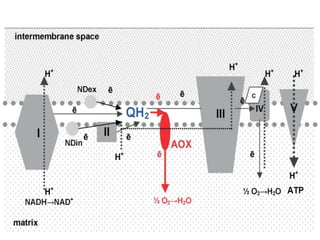
alternative oxidase (AOX). Plant respiratory chain branches
at the level of ubiquinone from where the electrons flow
through the cytochrome pathway or to alternative oxidase.
More often AOX is studied in details using transgenic plants
or in vitro cell cultures.Most information on AOX genes and
AOX regulation comes from experiments on Sauromatum
guttatum, Arabidopsis thaliana,Glycine max, Pisum sativum
and Nicotiana tabacum.
AOX is an approximately 32-kDa homo dimeric integral
mitochondrial inner membrane protein with a non-haem di-
Fe centre and two membrane spanning protein .
The expression of the alternative oxidase gene AOX is
influenced by stresses such as cold, reactive oxygen species
and infection by pathogens, as well as other factors that
reduce electron flow through the cytochrome pathway of
respiration.
MECHANISM :
AOX branches from the main respiratory chain at the level of
ubiquinone and catalyses the four-electron reduction of
oxygen to water. It does not pump H+, so the transfer of
electrons by AOX does not generate a transmembrane
potential and the drop in free energy between ubiquinol and
oxygen is dissipated, or ‘wasted’, as heat
AOX in higher plants is encoded by the
nuclear genome. The AOX1 gene is most widely known
for its expression by stress stimuli in many tissues and is
present in both monocotyledon and eudicotyledon plant
species.
Aox

Aox

  • 1.
    CYANIDE RESISTANT RESPIRATION •Cyanide-resistant respiration was discovered at the beginning of the 20th century in thermogenic plants during anthesis and was later found to be a typical feature of plant respiration. It is a respiratory pathway, occurring only in mitochondria of some plants, yeasts, and bacteria, that is unaffected by cyanide. Electron transport from NADH or succinate to O2 involves a non heme iron protein as the terminal oxidase; this is insensitive to cyanide. The cyanide- resistant pathway complements the more usual
  • 2.
    cyanide-sensitive pathway; thiscontains cytochrome oxidase, which is inhibited by cyanide. Cyanide-resistant respiration is not found in animals The phenomenon of respiration resistant to cyanide is connected with the presence in the respiratory chain of an additional terminal oxidase — alternative oxidase (AOX). Plant respiratory chain branches at the level of ubiquinone from where the electrons flow through the cytochrome pathway or to alternative oxidase.
  • 3.
    More often AOXis studied in details using transgenic plants or in vitro cell cultures.Most information on AOX genes and AOX regulation comes from experiments on Sauromatum guttatum, Arabidopsis thaliana,Glycine max, Pisum sativum and Nicotiana tabacum. AOX is an approximately 32-kDa homo dimeric integral mitochondrial inner membrane protein with a non-haem di- Fe centre and two membrane spanning protein .
  • 4.
    The expression ofthe alternative oxidase gene AOX is influenced by stresses such as cold, reactive oxygen species and infection by pathogens, as well as other factors that reduce electron flow through the cytochrome pathway of respiration. MECHANISM : AOX branches from the main respiratory chain at the level of ubiquinone and catalyses the four-electron reduction of oxygen to water. It does not pump H+, so the transfer of electrons by AOX does not generate a transmembrane
  • 5.
    potential and thedrop in free energy between ubiquinol and oxygen is dissipated, or ‘wasted’, as heat AOX in higher plants is encoded by the nuclear genome. The AOX1 gene is most widely known for its expression by stress stimuli in many tissues and is present in both monocotyledon and eudicotyledon plant species.