Sucrose…
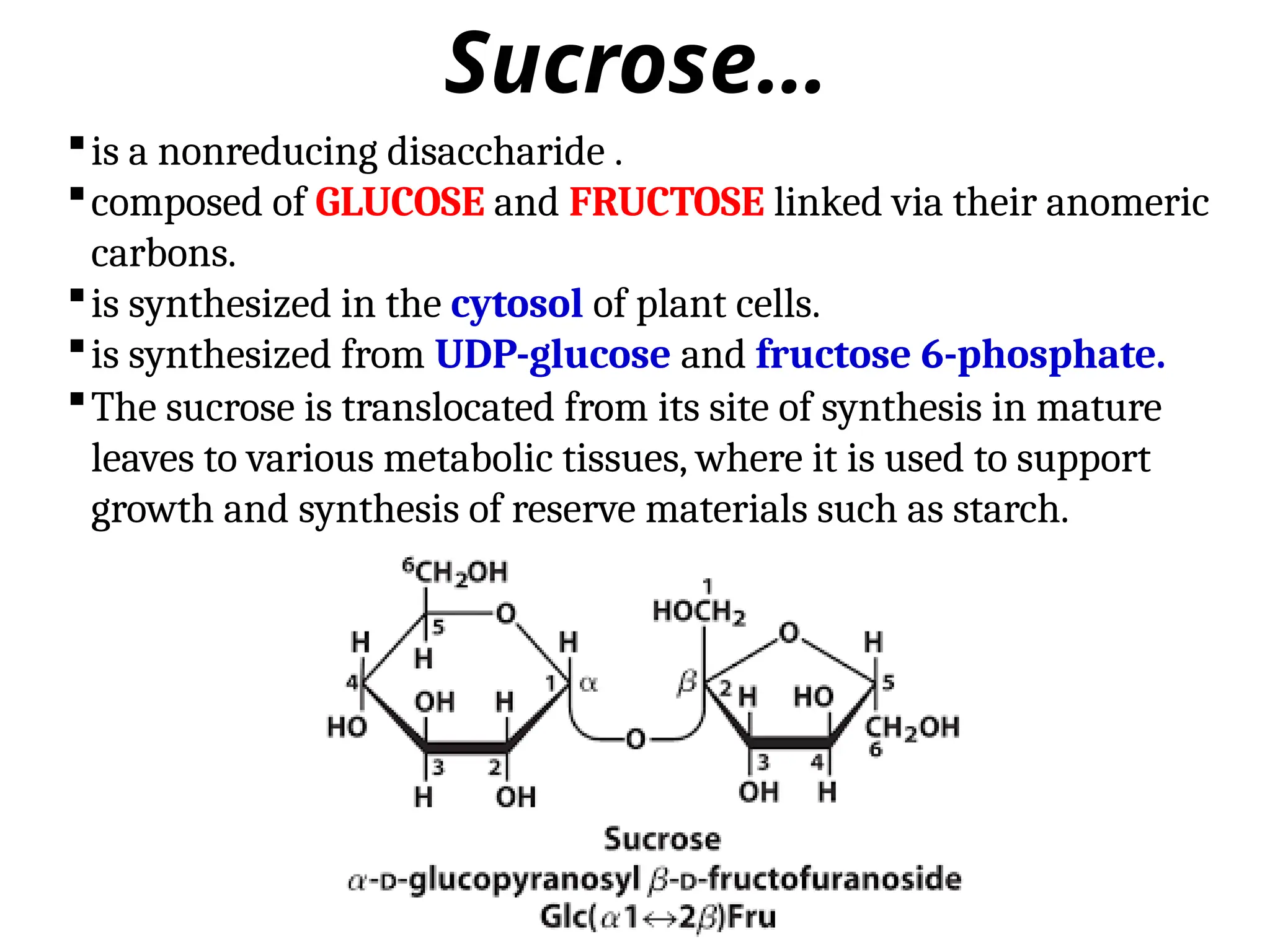
is a nonreducingdisaccharide .
composed of GLUCOSE and FRUCTOSE linked via their anomeric
carbons.
is synthesized in the cytosol of plant cells.
is synthesized from UDP-glucose and fructose 6-phosphate.
The sucrose is translocated from its site of synthesis in mature
leaves to various metabolic tissues, where it is used to support
growth and synthesis of reserve materials such as starch.
3.
starch…
is a polymerof α-D-glucose.
Occurs in two main forms: amylose, consisting of predominantly
linear chains of glucose monomers linked by α1,4-glycosidic bonds,
and amylopectin, in which the chains are branched by the
addition of α1,6-glycosidic bonds.
Fewer branches than glycogen.
is synthesized in the chloroplast (stroma).
Precursor is Activated ADP-glucose.
4.
starch…
Starch granules areclassified as transitory or reserve.
Transitory starch granules accumulate for only a short period
of time before they are degraded, e.g.
a) Starch forms in leaf chloroplasts during the day.
b) hydrolyzed and transported to other plant parts at night
as simple sugar.
Reserve starch, an energy storage for germination, a major
component of food and feed, and an industrial starting material,
is formed in amyloplasts.
Amylose
A linear polymerof -D-glucose with 1,4-linkage .
α α
May have a low level of branching (~one branch per 1000
residues) with an 1,6-linkage.
α
Comprises between 11 and 37% of the starch found in plants
(depending upon the species and the site of storage)
Much lower in molecular weight than amylopectin.
7.
Amylopectin
Highly branched polymerof -D-glucose with 1,4& 1,6
α α α
linkages .
Consists of 10,000 - 100,000 glucose units.
highly branched, 20 - 25 glucoses/branch
It makes up ~65% of starch.
Much higher molecular weight than amylose.
Sucrose biosynthesis pathway
Sucrose is Synthesized from UDP-Glucose and Fructose 6-P by in cytosol
by sucrose 6-phosphate synthase and sucrose 6-phosphate phosphatase.
DHAP
CO2
Ga3P
3PGA
RuBP
1,3 bisPGA
CO2
FBP
Ga3P
sucrose P
F6P
G6P
Pi
DHAP
sucrose
UTP
PPi
G1P
UDGP
11.
Sucrose biosynthesis
Sucrosebiosynthesis is beginning with dihydroxyacetone
phosphate exported from the chloroplast by Pi-triose
phosphate antiporter.
Dihydroxyacetone phosphate is then converted to glyceraldehyde
3-phosphate by triose phosphate isomerase.
12.
Pi-triose phosphateantiporter a transport system exports triose
phosphates from the chloroplast and import phosphate:
1. Pi-triose phosphate antiporter simultaneously moves Pi into the
chloroplast and moves triphosphate into the cytosol.
2. Sucrose synthesis release Pi.
3. If this exchange was blocked, triose phosphate synthesis would
quickly deplete the available Pi in chloroplast.
13.
Role of thePi-triose phosphate antiporter in the
transport of ATP and reducing equivalents.
o A second potential source of energy is the ATP and NADPH generated in
chloroplast.
o Pi-triose phosphate antiporter system has the indirect effect of moving
ATP equivalents and reducing equivalents.
14.
Transaldolase Reaction
+
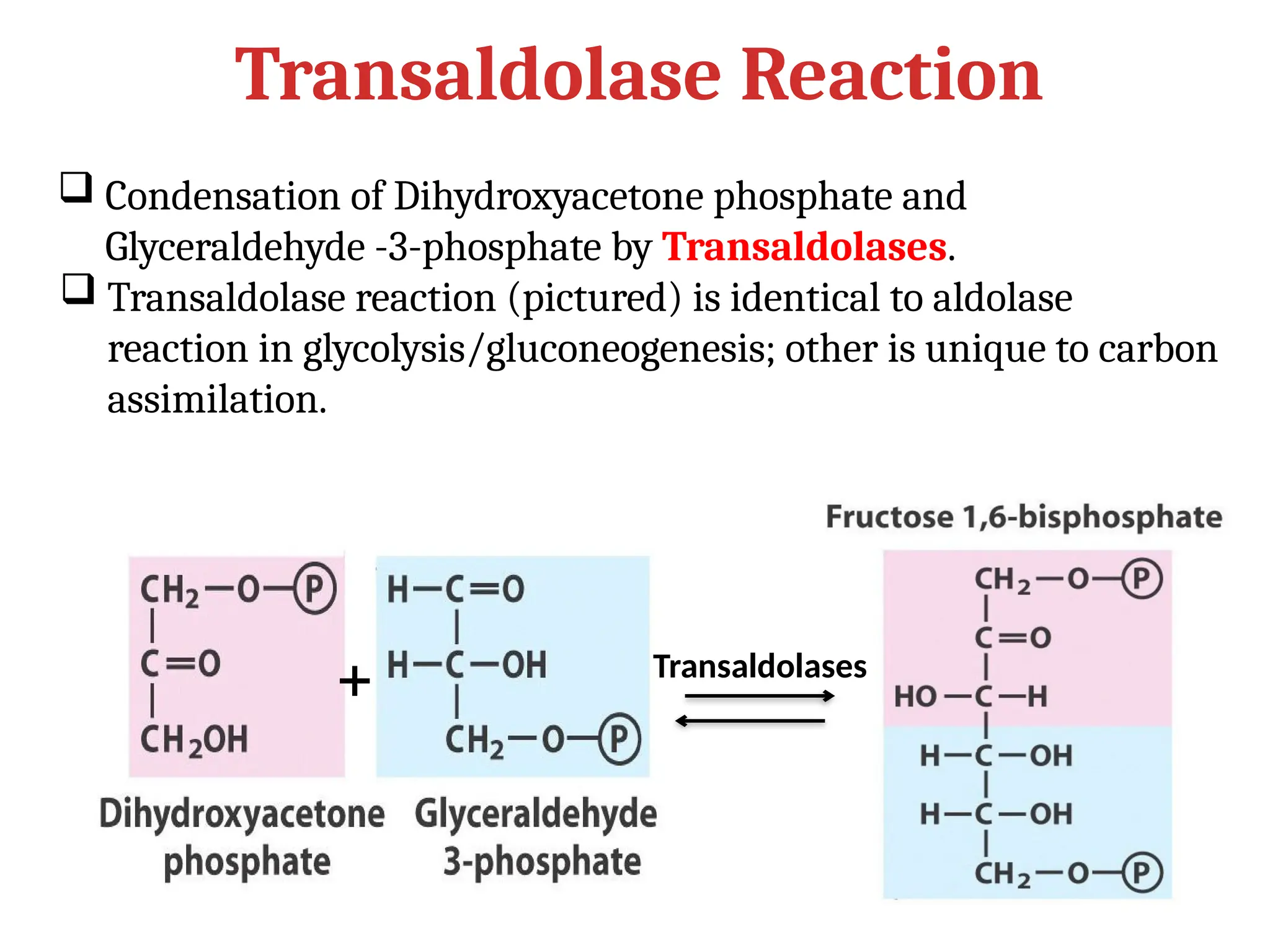
Condensationof Dihydroxyacetone phosphate and
Glyceraldehyde -3-phosphate by Transaldolases.
Transaldolase reaction (pictured) is identical to aldolase
reaction in glycolysis/gluconeogenesis; other is unique to carbon
assimilation.
Transaldolases
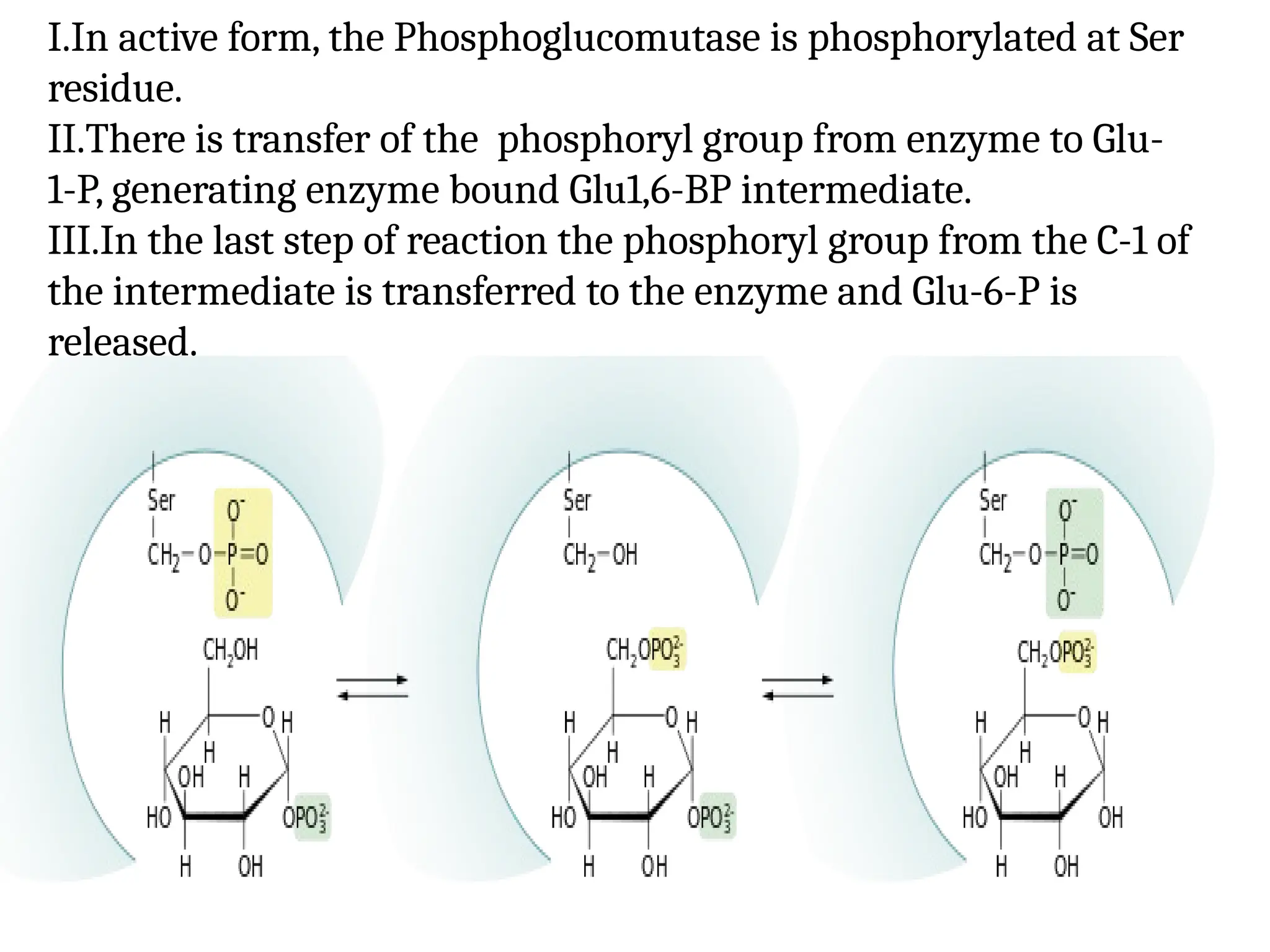
I.In active form,the Phosphoglucomutase is phosphorylated at Ser
residue.
II.There is transfer of the phosphoryl group from enzyme to Glu-
1-P, generating enzyme bound Glu1,6-BP intermediate.
III.In the last step of reaction the phosphoryl group from the C-1 of
the intermediate is transferred to the enzyme and Glu-6-P is
released.
19.
UDP-glucose pyrophosphorylase
UDP-glucose isformed through a condensation reaction between
glucose-1-P and UTP in a reaction catalyzed by UDP-glucose
pyrophosphorylase.
Pyrophosphatase
PPi + H2O 2Pi + 2H+
21.
Sucrose 6-phosphate synthase(SPS)
catalyze the formation of sucrose-6-phosphate from UDP-glucose
and Fructose-6-P
22.
Sucrose 6-phosphate phosphatase
catalyze the formation of sucrose by dephosphorylation
H2O
Highly energetically
favored
∆G = -13 kJ / mol
How sucrose ispartitioned between the two pathways?
may be regulated primarily by the concentration of sucrose.
Sucrose synthase (Km, 15 mM) has a much lower Km for sucrose
compared with the neutral invertase (Km, 65 mM).
Consequently, the sucrose synthase pathway may be relatively
more important when sucrose availability is limiting.
This pathway is also more energetically efficient, as the energy
contained in the glycosidic linkage of the sucrose molecule is
preserved.
Thus, to metabolize one molecule of sucrose to the level of
triose-P requires the input of three ATP in the sucrose
synthase pathway, compared with four ATP in the invertase
pathway.
Consequently, it may be beneficial to the cells to have the most
efficient pathway operate when carbon supplies are limiting
26.
Starch biosynthesis pathway
ADP-glucose is used as the precursor.
Starch synthase transfers the glucose unit to the
nonreducing end of a preexisting primer.
Branches in amylopectin are synthesized using
branching enzyme.
The synthesis of ADP-Glucose, catalyzed by ADP-
glucose pyrophosphorylase, is rate limiting.
ADP-glucose pyrophosphorylase
• AGPasebrings about the first committed step in the
biosynthetic pathway leading to starch production in all the
plants.
• AGPase is a heterotetramer of 2 large (54-60Kd) and 2 small
(51-55 Kd) subunits.
• Both subunits required for activity. Small subunit thought to
be main catalytic activity, large subunit is regulatory.
• Generally, this enzyme is allosterically regulated by 3-
phosphoglycerate (activator) and inorganic orthophosphate
(inhibitor).
30.
Starch synthase
Starch Synthase(SS)catalyzes a 1,4- linkage between
nonreducing end of glucan chain & Glc from ADP-Glc.
SS can use both amylose and amylopectin as acceptors.
Priming event not known: some evidence for protein primer,
some evidence for de novo synthesis.
31.
ADP-Glc acts asthe glucosyl donor for different classes of
starch synthases (SS), which elongate the a-1,4-linked glucan
chains of the two insoluble starch polymers amylose and
amylopectin of which the granule is composed.
Five distinct SS classes are known in plants: granule-bound SS,
which is responsible for the synthesis of amylose; and soluble SS
I to IV, responsible for amylopectin synthesis.
Both granule bound SS (GBSSI) and soluble SS are found in
amyloplasts.
Intriguingly, SS III and SS IV have recently been implicated to be
responsible for starch granule initiation.
32.
Starch Synthasecatalyzes 1,4-
α linkage between nonreducing
end of glucan chain & Glc from ADP-Glc.
Soluble starch synthase (SSS) responsible for amylopectin
synthesis.
Granule-bond starch synthase (GBSS) responsible for amylose
synthesis.
33.
Starch branching enzyme(SBE)
SBE hydrolyzes 1,4-linkage in glucan chain in stable double
α
helical conformation & catalyzes formation of 1,6- linkage
α
between reducing end of “cut” chain and Glc in another chain.
Two classes of BE (BEI and BEII) that differ in terms of the lengths
of chains transferred in vitro, with BEII transferring shorter
chains than BEI.
In cereals, there are two closely related forms of BEII (BEIIa and
BEIIb).
These also differ in chain-length specificity in vitro, with BEIIb
transferring shorter chains than BEIIa during extended
incubation.
Interestingly, starch synthesisalso involves two types of
debranching enzymes (isoamylase; glycogen 6-
glucanohydrolase), which cleave branch points and are
probably involved in tailoring the branched glucans into a
form capable of crystallization within the granule
Starch debranching enzyme (SDBE)
36.
Starch degradation
Thestarch granule is attacked by the endoamylase amylase,
α‐
which releases soluble linear and branched glucans.
These are acted on by the debranching
enzyme limit dextrinase and the
exoamylase amylase to produce maltose.
β‐
Maltose is then hydrolyzed to glucose
by an glucosidase (maltase).
α‐
#11 TIM catalyzes an intramolecular oxidation-reduction.
This isomerization of a ketose into an aldose proceeds through an enediol intermediate.
#12 This transporter facilitates the exchange of cytosolic Pi for stromal dihydroxyacetone phosphate. The products of photosynthetic carbon assimilation are thus moved into the cytosol, where they serve as a starting point for sucrose biosynthesis, and Pi required for photophosphorylation is moved into the stroma. This same antiporter can transport 3-phosphoglycerate and acts in the shuttle for exporting ATP and reducing equivalents (see Figure 20-16).
#13 Dihydroxyacetone phosphate leaves the chloroplast and is converted to glyceraldehyde 3-phosphate in the cytosol. The cytosolic glyceraldehyde 3-phosphate dehydrogenase and phosphoglycerate kinase reactions then produce NADH, ATP, and 3-phosphoglycerate. The latter reenters the chloroplast and is reduced to dihydroxyacetone phosphate, completing a cycle that effectively moves ATP and reducing equivalents (NAD(P)H) from chloroplast to cytosol.
#24 . It is interesting to note that soybean nodules also contain both sucrose synthase and alkaline invertase, but the affinity for sucrose of the invertase is much higher than that of sucrose synthase
#38 The concentration of the allosteric regulator fructose 2,6-bisphosphate in plant cells is regulated by the products of photosynthetic carbon assimilation and by Pi. Dihydroxyacetone phosphate and 3-phosphoglycerate produced by CO2 assimilation inhibit phosphofructokinase-2 (PFK-2), the enzyme that synthesizes the regulator; Pi stimulates PFK-2. The concentration of the regulator is therefore inversely proportional to the rate of photosynthesis. In the dark, the concentration of fructose 2,6-bisphosphate increases and stimulates the glycolytic enzyme PPi-dependent phosphofructokinase-1 (PP-PFK-1), while inhibiting the gluconeogenic enzyme fructose 1,6-bisphosphatase (FBPase-1). When photosynthesis is active (in the light), the concentration of the regulator drops and the synthesis of fructose 6-phosphate and sucrose is favored.
#39 A protein kinase (SPS kinase) specific for sucrose phosphate synthase (SPS) phosphorylates a Ser residue in SPS, inactivating it; a specific phosphatase (SPS phosphatase) reverses this inhibition. The kinase is inhibited allosterically by glucose 6-phosphate, which also activates SPS allosterically. The phosphatase is inhibited by Pi, which also inhibits SPS directly. Thus when the concentration of glucose 6-phosphate is high as a result of active photosynthesis, SPS is activated and produces sucrose phosphate. A high Pi concentration, which occurs when photosynthetic conversion of ADP to ATP is slow, inhibits sucrose phosphate synthesis.
#40 This enzyme, which produces the precursor for starch synthesis, is rate-limiting in starch production. The enzyme is stimulated allosterically by 3-phosphoglycerate (3-PGA) and inhibited by Pi; in effect, the ratio [3-PGA]/[Pi], which rises with increasing rates of photosynthesis, controls starch synthesis at this step.