Frederick Herzberg & Douglas McGregor A Starblazers Production
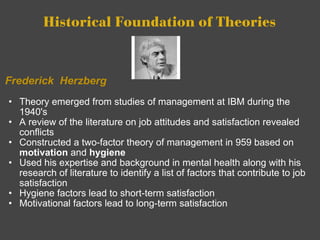
Historical Foundation of Theories   Frederick  Herzberg Theory emerged from studies of management at IBM during the 1940's A review of the literature on job attitudes and satisfaction revealed conflicts Constructed a two-factor theory of management in 959 based on  motivation  and  hygiene Used his expertise and background in mental health along with his research of literature to identify a list of factors that contribute to job satisfaction Hygiene factors lead to short-term satisfaction Motivational factors lead to long-term satisfaction       
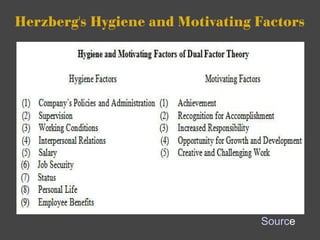
Herzberg's Hygiene and Motivating Factors Sourc e
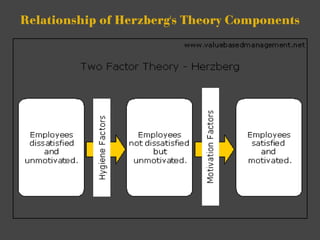
Relationship of Herzberg's Theory Components
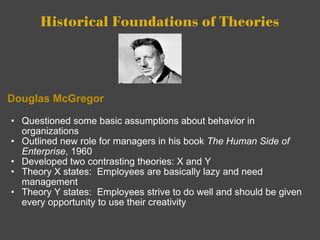
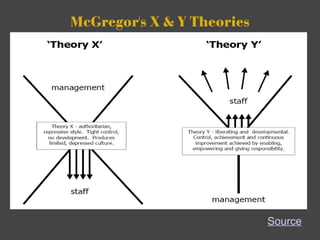
Historical Foundations of Theories Douglas McGregor Questioned some basic assumptions about behavior in organizations Outlined new role for managers in his book  The Human Side of Enterprise , 1960 Developed two contrasting theories: X and Y Theory X states:  Employees are basically lazy and need management Theory Y states:  Employees strive to do well and should be given every opportunity to use their creativity
McGregor's X & Y Theories   Source
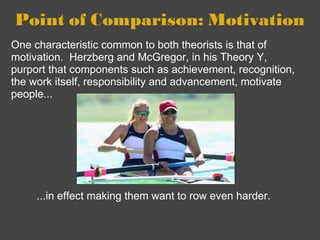
Point of Comparison: Motivation ...in effect making them want to row even harder.  One characteristic common to both theorists is that of motivation.  Herzberg and McGregor, in his Theory Y, purport that components such as achievement, recognition, the work itself, responsibility and advancement, motivate people...
Concerns about the Theories   Herzberg and McGregor agree that leaders have it within their power to tap into the human potential in their organizations and thereby improve performance.     However, we know that not everyone working in the school has achieved high levels of self-esteem and self-actualization.  Marzano notes that a typical school has 30 percent superstars, 50 percent middle stars, and 20 percent falling stars   (p. 44).
Concerns about the Theories   The falling stars may be satisfied with Herzberg's hygiene factors like decent working conditions and a reliable weekly paycheck.  They may even appreciate Theory X type management because they do not want to be involved in organizational problem-solving.     A good leader must satisfy these desires and find a way for falling stars to contribute to rather than withdraw from or create conflict within the school community.     
 
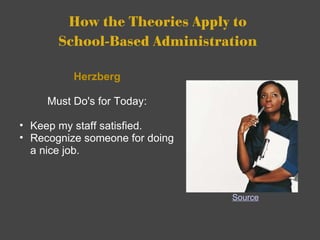
How the Theories Apply to  School-Based Administration  Herzberg Must Do's for Today: Keep my staff satisfied. Recognize someone for doing a nice job. Source
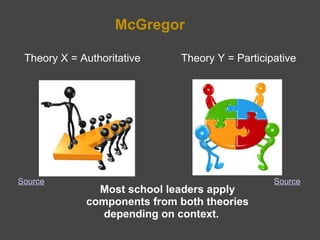
McGregor Theory X = Authoritative Theory Y = Participative Most school leaders apply components from both theories depending on context.     Source Source
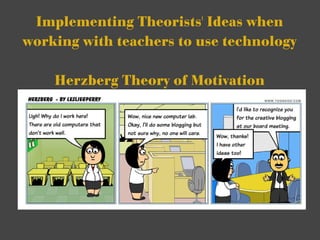
Implementing Theorists' Ideas when working with teachers to use technology Herzberg Theory of Motivation
Implementing Theorists' Ideas when working with teachers to use technology McGregor's X Theory
Implementing Theorists' Ideas when working with teachers to use technology McGregor's Y Theory
Project Team Members Beth Novick  Barbara Recchio-Demmin Shannon Peterson Leslie G Perry Brooke Mulartrick

Starblazer Herzberg and McGregor

  • 1.
    Frederick Herzberg &Douglas McGregor A Starblazers Production
  • 2.
    Historical Foundation ofTheories   Frederick  Herzberg Theory emerged from studies of management at IBM during the 1940's A review of the literature on job attitudes and satisfaction revealed conflicts Constructed a two-factor theory of management in 959 based on motivation and  hygiene Used his expertise and background in mental health along with his research of literature to identify a list of factors that contribute to job satisfaction Hygiene factors lead to short-term satisfaction Motivational factors lead to long-term satisfaction       
  • 3.
  • 4.
    Relationship of Herzberg'sTheory Components
  • 5.
    Historical Foundations ofTheories Douglas McGregor Questioned some basic assumptions about behavior in organizations Outlined new role for managers in his book The Human Side of Enterprise , 1960 Developed two contrasting theories: X and Y Theory X states:  Employees are basically lazy and need management Theory Y states:  Employees strive to do well and should be given every opportunity to use their creativity
  • 6.
    McGregor's X &Y Theories   Source
  • 7.
    Point of Comparison:Motivation ...in effect making them want to row even harder. One characteristic common to both theorists is that of motivation.  Herzberg and McGregor, in his Theory Y, purport that components such as achievement, recognition, the work itself, responsibility and advancement, motivate people...
  • 8.
    Concerns about theTheories   Herzberg and McGregor agree that leaders have it within their power to tap into the human potential in their organizations and thereby improve performance.    However, we know that not everyone working in the school has achieved high levels of self-esteem and self-actualization.  Marzano notes that a typical school has 30 percent superstars, 50 percent middle stars, and 20 percent falling stars   (p. 44).
  • 9.
    Concerns about theTheories The falling stars may be satisfied with Herzberg's hygiene factors like decent working conditions and a reliable weekly paycheck.  They may even appreciate Theory X type management because they do not want to be involved in organizational problem-solving.    A good leader must satisfy these desires and find a way for falling stars to contribute to rather than withdraw from or create conflict within the school community.   
  • 10.
  • 11.
    How the TheoriesApply to  School-Based Administration  Herzberg Must Do's for Today: Keep my staff satisfied. Recognize someone for doing a nice job. Source
  • 12.
    McGregor Theory X= Authoritative Theory Y = Participative Most school leaders apply components from both theories depending on context.     Source Source
  • 13.
    Implementing Theorists' Ideaswhen working with teachers to use technology Herzberg Theory of Motivation
  • 14.
    Implementing Theorists' Ideaswhen working with teachers to use technology McGregor's X Theory
  • 15.
    Implementing Theorists' Ideaswhen working with teachers to use technology McGregor's Y Theory
  • 16.
    Project Team MembersBeth Novick Barbara Recchio-Demmin Shannon Peterson Leslie G Perry Brooke Mulartrick