Motivation
Presentation by:
Abanoub Amir Mahmoud Ahmed
Anas Khaled Abdelrhaman Mohamed
Said Abdelwahed Loay amgad
Introduction:
• High performance is achieved by well-motivated people who are prepared to
exercise discretionary effort.
Motivation definition:
• The psychological process that initiates, guides, and
maintains goal-oriented behaviors.
Motivation Types :
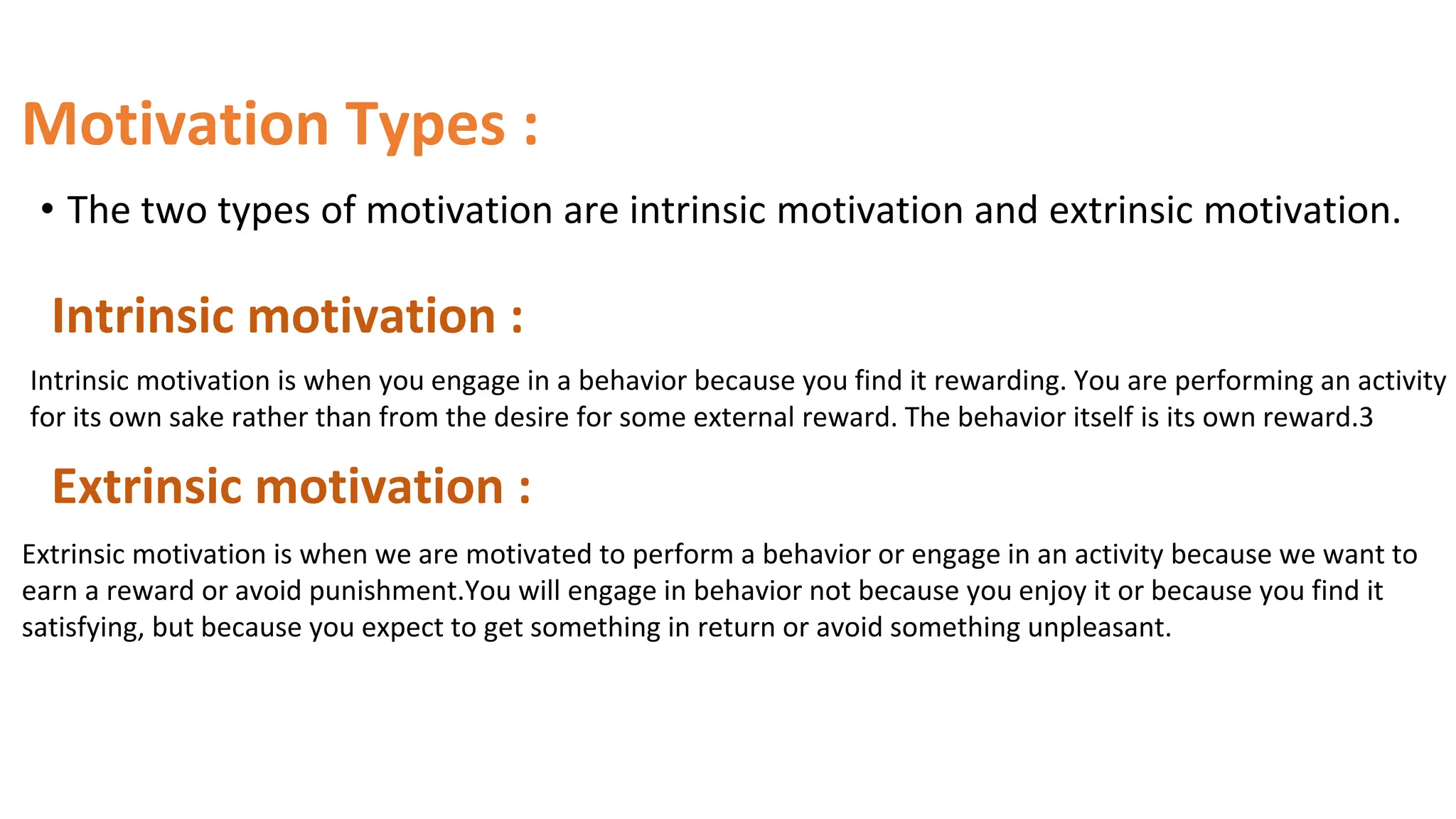
• The two types of motivation are intrinsic motivation and extrinsic motivation.
Intrinsic motivation :
Intrinsic motivation is when you engage in a behavior because you find it rewarding. You are performing an activity
for its own sake rather than from the desire for some external reward. The behavior itself is its own reward.3
Extrinsic motivation :
Extrinsic motivation is when we are motivated to perform a behavior or engage in an activity because we want to
earn a reward or avoid punishment.You will engage in behavior not because you enjoy it or because you find it
satisfying, but because you expect to get something in return or avoid something unpleasant.
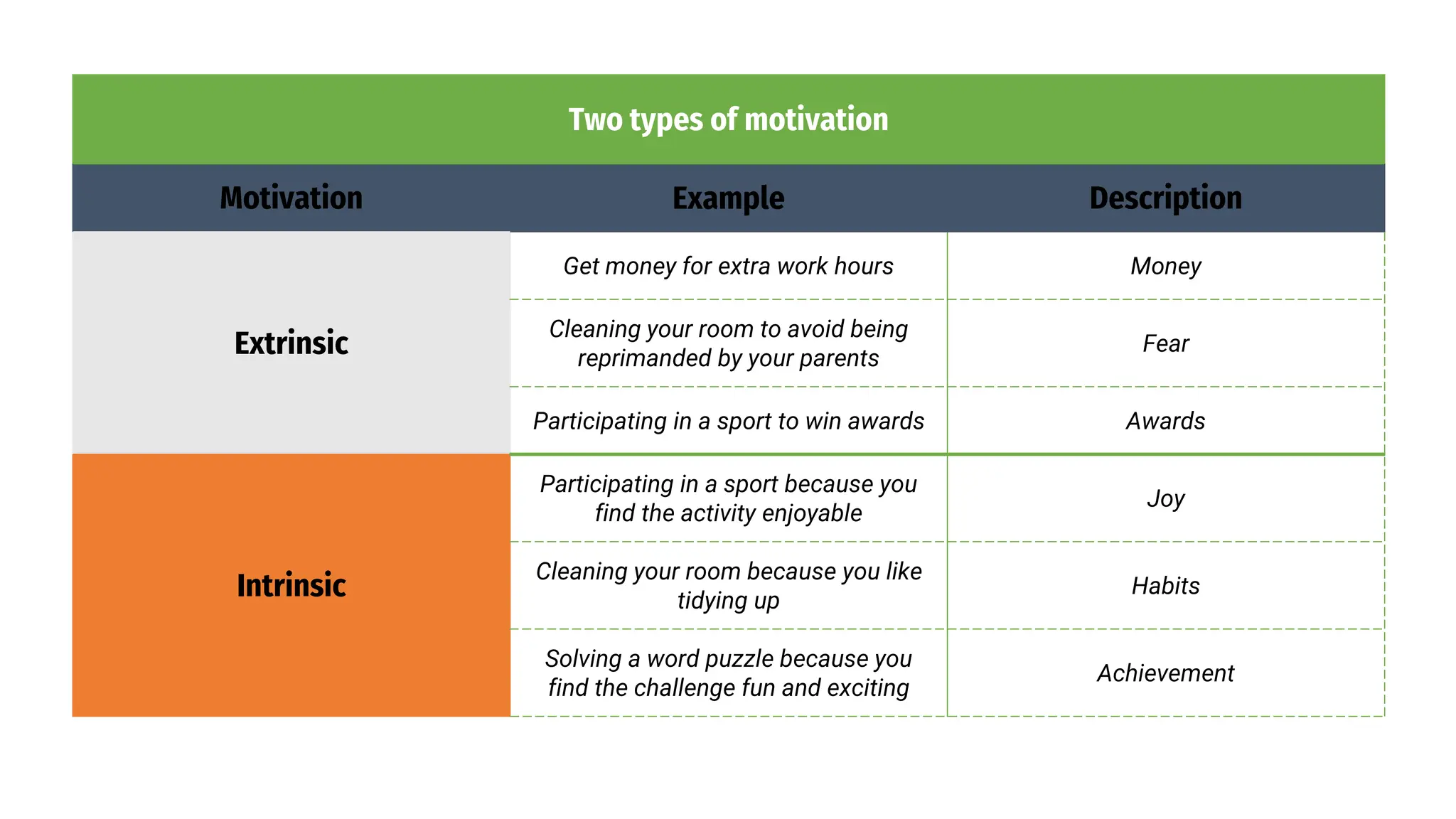
Two types of motivation
Motivation Example Description
Extrinsic
Get money for extra work hours Money
Cleaning your room to avoid being
reprimanded by your parents
Fear
Participating in a sport to win awards Awards
Intrinsic
Participating in a sport because you
find the activity enjoyable
Joy
Cleaning your room because you like
tidying up
Habits
Solving a word puzzle because you
find the challenge fun and exciting
Achievement
Maslow’s hierarchy of needs
Self-actualization Development needs
Esteem Respect, recognition
Belonging Friendship, caring
Safety Security, stability, health
Physiological Food, sleep, air, water
Herzberg’s two-factor model:
Herzberg's two-factor theory, also known as the dual-factor theory or motivation-hygiene theory, was proposed
by psychologist Frederick Herzberg in the 1950s. It suggests that there are two distinct sets of factors that
influence employee motivation and job satisfaction:
Hygiene factors (also called maintenance factors): These are the factors that are necessary to prevent dissatisfaction in
the workplace. They include aspects such as salary, job security, working conditions, company policies, and interpersonal
relationships. When these factors are adequate, they prevent employees from being dissatisfied, but their presence alone
doesn't necessarily lead to motivation or job satisfaction.
Motivational factors: These are the factors that contribute to job satisfaction and motivation. They include aspects
such as recognition, achievement, advancement opportunities, responsibility, and the nature of the work itself. Unlike
hygiene factors, the presence of motivational factors leads to increased job satisfaction and motivation, while their absence
may not necessarily cause dissatisfaction but can result in a lack of motivation.
According to Herzberg, the absence of hygiene factors can lead to dissatisfaction, but their presence doesn't
necessarily lead to motivation or satisfaction. Instead, motivation and satisfaction are primarily influenced by the
presence of motivational factors. Therefore, to motivate employees effectively, organizations need to focus on
providing both hygiene factors to prevent dissatisfaction and motivational factors to enhance satisfaction and
motivation.
McGregor’s Theory X and Y:
Theory X:
• Theory X assumes that employees inherently dislike work and will avoid it if they can.
• According to this theory, individuals must be coerced, controlled, directed, or even threatened with punishment to get
them to put forth effort towards organizational goals.
• It implies that employees are inherently lazy, unambitious, and self-centered, and need to be closely supervised.
• Managers who adhere to Theory X tend to adopt a more authoritarian style, with strict rules, centralized decision-
making, and little delegation of authority.
Theory Y:
• Theory Y, on the other hand, assumes that work is as natural as play or rest, and that individuals can be self-motivated and
self-directed towards achieving organizational objectives.
• According to this theory, people are inherently creative, enjoy autonomy, seek responsibility, and are capable of making
significant contributions to the organization when properly motivated.
• It suggests that employees can be trusted to do their jobs well and that management's role is to facilitate and empower
them.
• Managers who embrace Theory Y tend to adopt a more participative management style, encouraging open communication,
delegation of authority, and opportunities for personal and professional growth.
McGregor's theories have had a significant impact on management practices, particularly in
understanding different managerial attitudes and approaches towards employees. They highlight the
importance of managers' assumptions about human nature in shaping their leadership style and
organizational culture.

Motivation Definition and Types and others

  • 1.
    Motivation Presentation by: Abanoub AmirMahmoud Ahmed Anas Khaled Abdelrhaman Mohamed Said Abdelwahed Loay amgad
  • 2.
    Introduction: • High performanceis achieved by well-motivated people who are prepared to exercise discretionary effort. Motivation definition: • The psychological process that initiates, guides, and maintains goal-oriented behaviors.
  • 3.
    Motivation Types : •The two types of motivation are intrinsic motivation and extrinsic motivation. Intrinsic motivation : Intrinsic motivation is when you engage in a behavior because you find it rewarding. You are performing an activity for its own sake rather than from the desire for some external reward. The behavior itself is its own reward.3 Extrinsic motivation : Extrinsic motivation is when we are motivated to perform a behavior or engage in an activity because we want to earn a reward or avoid punishment.You will engage in behavior not because you enjoy it or because you find it satisfying, but because you expect to get something in return or avoid something unpleasant.
  • 4.
    Two types ofmotivation Motivation Example Description Extrinsic Get money for extra work hours Money Cleaning your room to avoid being reprimanded by your parents Fear Participating in a sport to win awards Awards Intrinsic Participating in a sport because you find the activity enjoyable Joy Cleaning your room because you like tidying up Habits Solving a word puzzle because you find the challenge fun and exciting Achievement
  • 5.
    Maslow’s hierarchy ofneeds Self-actualization Development needs Esteem Respect, recognition Belonging Friendship, caring Safety Security, stability, health Physiological Food, sleep, air, water
  • 6.
    Herzberg’s two-factor model: Herzberg'stwo-factor theory, also known as the dual-factor theory or motivation-hygiene theory, was proposed by psychologist Frederick Herzberg in the 1950s. It suggests that there are two distinct sets of factors that influence employee motivation and job satisfaction: Hygiene factors (also called maintenance factors): These are the factors that are necessary to prevent dissatisfaction in the workplace. They include aspects such as salary, job security, working conditions, company policies, and interpersonal relationships. When these factors are adequate, they prevent employees from being dissatisfied, but their presence alone doesn't necessarily lead to motivation or job satisfaction. Motivational factors: These are the factors that contribute to job satisfaction and motivation. They include aspects such as recognition, achievement, advancement opportunities, responsibility, and the nature of the work itself. Unlike hygiene factors, the presence of motivational factors leads to increased job satisfaction and motivation, while their absence may not necessarily cause dissatisfaction but can result in a lack of motivation. According to Herzberg, the absence of hygiene factors can lead to dissatisfaction, but their presence doesn't necessarily lead to motivation or satisfaction. Instead, motivation and satisfaction are primarily influenced by the presence of motivational factors. Therefore, to motivate employees effectively, organizations need to focus on providing both hygiene factors to prevent dissatisfaction and motivational factors to enhance satisfaction and motivation.
  • 7.
    McGregor’s Theory Xand Y: Theory X: • Theory X assumes that employees inherently dislike work and will avoid it if they can. • According to this theory, individuals must be coerced, controlled, directed, or even threatened with punishment to get them to put forth effort towards organizational goals. • It implies that employees are inherently lazy, unambitious, and self-centered, and need to be closely supervised. • Managers who adhere to Theory X tend to adopt a more authoritarian style, with strict rules, centralized decision- making, and little delegation of authority. Theory Y: • Theory Y, on the other hand, assumes that work is as natural as play or rest, and that individuals can be self-motivated and self-directed towards achieving organizational objectives. • According to this theory, people are inherently creative, enjoy autonomy, seek responsibility, and are capable of making significant contributions to the organization when properly motivated. • It suggests that employees can be trusted to do their jobs well and that management's role is to facilitate and empower them. • Managers who embrace Theory Y tend to adopt a more participative management style, encouraging open communication, delegation of authority, and opportunities for personal and professional growth. McGregor's theories have had a significant impact on management practices, particularly in understanding different managerial attitudes and approaches towards employees. They highlight the importance of managers' assumptions about human nature in shaping their leadership style and organizational culture.