Staphylococcus
 Spherical cells
 arranged in grapes like clusters
 Gram positive
 non-motile
 non-acid fast and non-spore forming
 aerobic and facultative anaerobic
 Most strains form pigments
 positive for catalase, coagulase
 Negative for oxidase
History
 Ogston (1883) introduced the name
Staphylococcus (a bunch of grapes) for the
group-micrococci causing inflammation and
suppuration.
 Rosenbach (1884) – described the genus
Staphylococcus, dividing the genus into the two
species Staphylococcus aureus and S. albus.
Habitat and Ecology
 occurs worldwide in mammals and birds on skin
and mucous membranes
 Found in the pharynx, mouth, blood, mammary
glands, and intestinal, genitourinary, and upper
respiratory tracts of these hosts
 Opportunist
Morphology
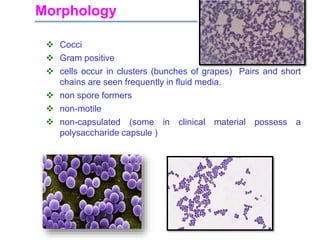
 Cocci
 Gram positive
 cells occur in clusters (bunches of grapes) Pairs and short
chains are seen frequently in fluid media.
 non spore formers
 non-motile
 non-capsulated (some in clinical material possess a
polysaccharide capsule )
Cultural characteristics
 Aerobic and facultatively anaerobic.
 optimum temperature of 35-37°C.
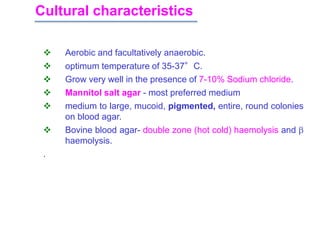
 Grow very well in the presence of 7-10% Sodium chloride.
 Mannitol salt agar - most preferred medium
 medium to large, mucoid, pigmented, entire, round colonies
on blood agar.
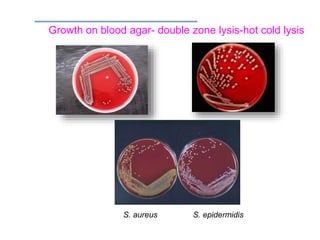
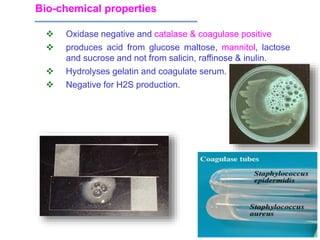
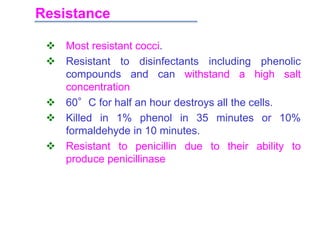
 Bovine blood agar- double zone (hot cold) haemolysis and 
haemolysis.
.
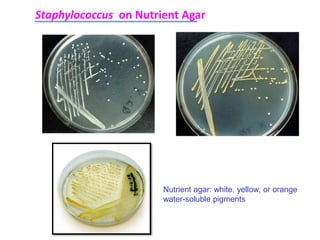
Staphylococcus on Nutrient Agar
Nutrient agar: white, yellow, or orange
water-soluble pigments
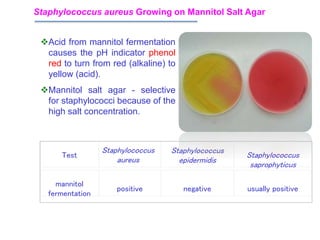
Staphylococcus aureus Growing on Mannitol Salt Agar
Acid from mannitol fermentation
causes the pH indicator phenol
red to turn from red (alkaline) to
yellow (acid).
Mannitol salt agar - selective
for staphylococci because of the
high salt concentration.
Test
Staphylococcus
aureus
Staphylococcus
epidermidis
Staphylococcus
saprophyticus
mannitol
fermentation
positive negative usually positive
Growth on blood agar- double zone lysis-hot cold lysis
S. aureus S. epidermidis
Bio-chemical properties
 Oxidase negative and catalase & coagulase positive
 produces acid from glucose maltose, mannitol, lactose
and sucrose and not from salicin, raffinose & inulin.
 Hydrolyses gelatin and coagulate serum.
 Negative for H2S production.
Resistance
 Most resistant cocci.
 Resistant to disinfectants including phenolic
compounds and can withstand a high salt
concentration
 60°C for half an hour destroys all the cells.
 Killed in 1% phenol in 35 minutes or 10%
formaldehyde in 10 minutes.
 Resistant to penicillin due to their ability to
produce penicillinase
Virulence Factors
 Three groups of virulence factors
 Surface components : Protein A, Cell wall,
Capsule
 Exotoxins :
 Hemolysin (Alpha, Beta, delta and Epsilon toxin),
 Leukotoxin,
 Enterotoxin (heat stable, not destroyed at 100°C for 80
minutes), Dermonecrotoxin, Toxic shock syndrome
toxin
 Extracellular enzymes Coagulase (CPS)
Hyaluronidase, Nucleases, Fibrinolysin
Lipases & esterase, Lysozyme and
Penicillinase
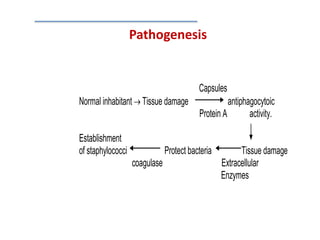
Pathogenesis
Capsules
Normal inhabitant  Tissue damage antiphagocytoic
Protein A activity.
Establishment
of staphylococci Protect bacteria Tissue damage
coagulase Extracellular
Enzymes
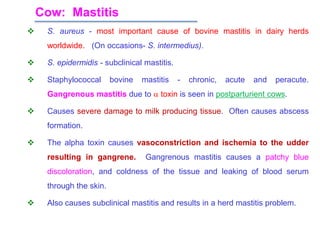
Cow: Mastitis
 S. aureus - most important cause of bovine mastitis in dairy herds
worldwide. (On occasions- S. intermedius).
 S. epidermidis - subclinical mastitis.
 Staphylococcal bovine mastitis - chronic, acute and peracute.
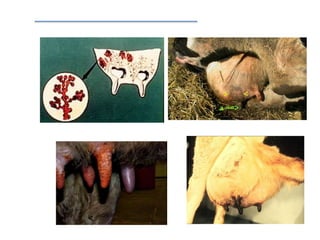
Gangrenous mastitis due to  toxin is seen in postparturient cows.
 Causes severe damage to milk producing tissue. Often causes abscess
formation.
 The alpha toxin causes vasoconstriction and ischemia to the udder
resulting in gangrene. Gangrenous mastitis causes a patchy blue
discoloration, and coldness of the tissue and leaking of blood serum
through the skin.
 Also causes subclinical mastitis and results in a herd mastitis problem.
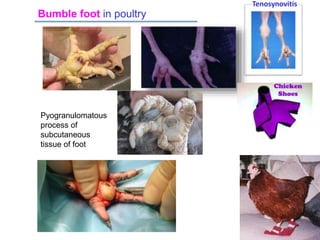
Tenosynovitis
MALMARUGAN, 2015
Bumble foot in poultry
Pyogranulomatous
process of
subcutaneous
tissue of foot
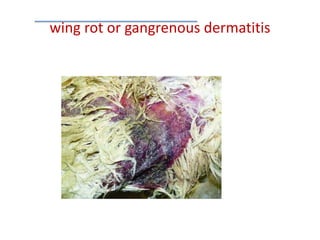
wing rot or gangrenous dermatitis
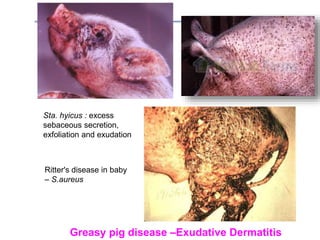
Greasy pig disease –Exudative Dermatitis
Sta. hyicus : excess
sebaceous secretion,
exfoliation and exudation
Ritter's disease in baby
– S.aureus
Horse
 Botryomycosis: Infrequent chronic
granulomatous lesions involving the
spermatic cord of male horses.
Sheep
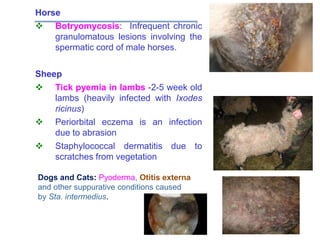
 Tick pyemia in lambs -2-5 week old
lambs (heavily infected with Ixodes
ricinus)
 Periorbital eczema is an infection
due to abrasion
 Staphylococcal dermatitis due to
scratches from vegetation
Dogs and Cats: Pyoderma, Otitis externa
and other suppurative conditions caused
by Sta. intermedius.
Diagnosis
Materials for diagnosis
 Pus, affected tissue and milk samples.
Examination of culture and pus smear
 Grams staining reveal Gram-positive organisms with typical
arrangement.
Isolation and identification by culture method:
 Organisms grow well in ordinary laboratory media.
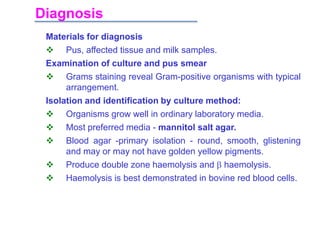
 Most preferred media - mannitol salt agar.
 Blood agar -primary isolation - round, smooth, glistening
and may or may not have golden yellow pigments.
 Produce double zone haemolysis and  haemolysis.
 Haemolysis is best demonstrated in bovine red blood cells.
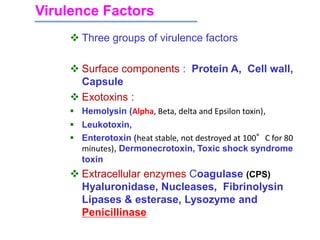
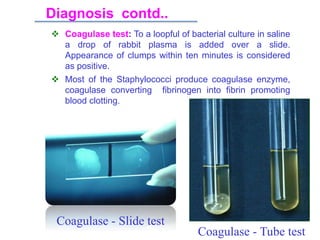
 Coagulase test: To a loopful of bacterial culture in saline
a drop of rabbit plasma is added over a slide.
Appearance of clumps within ten minutes is considered
as positive.
 Most of the Staphylococci produce coagulase enzyme,
coagulase converting fibrinogen into fibrin promoting
blood clotting.
Diagnosis contd..
Coagulase - Tube test
Coagulase - Slide test
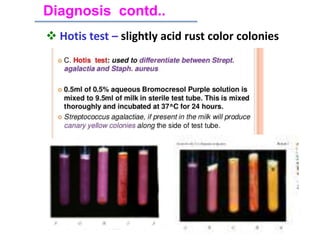
 Hotis test – slightly acid rust color colonies
Diagnosis contd..
 Latex agglutination test
 Phage typing
 Biochemical tests: oxidase test, coagulase test,
beta haemolysis, pigment production, utilisation
of maltose and mannitol and sensitivity to
novobiocin.
Diagnosis contd..
Treatment
 Acute individual or sporadic cases could be treated
with effective antimicrobial.
 Cloxacillin is effective in treatment of
staphylococcal mastitis in dry cows on a herd
basis.
 Other drugs that are effective against
staphylococcal infections in animals are
chloramphenicol, erythromycin, cephalosporin,
vancomycin, lincomycin and trimethoprim sulfas.
 Methicillin resistance is indicative of multiple
resistance

Staphylococcus.ppt veterinary microbiology

  • 1.
    Staphylococcus  Spherical cells arranged in grapes like clusters  Gram positive  non-motile  non-acid fast and non-spore forming  aerobic and facultative anaerobic  Most strains form pigments  positive for catalase, coagulase  Negative for oxidase
  • 2.
    History  Ogston (1883)introduced the name Staphylococcus (a bunch of grapes) for the group-micrococci causing inflammation and suppuration.  Rosenbach (1884) – described the genus Staphylococcus, dividing the genus into the two species Staphylococcus aureus and S. albus.
  • 3.
    Habitat and Ecology occurs worldwide in mammals and birds on skin and mucous membranes  Found in the pharynx, mouth, blood, mammary glands, and intestinal, genitourinary, and upper respiratory tracts of these hosts  Opportunist
  • 4.
    Morphology  Cocci  Grampositive  cells occur in clusters (bunches of grapes) Pairs and short chains are seen frequently in fluid media.  non spore formers  non-motile  non-capsulated (some in clinical material possess a polysaccharide capsule )
  • 5.
    Cultural characteristics  Aerobicand facultatively anaerobic.  optimum temperature of 35-37°C.  Grow very well in the presence of 7-10% Sodium chloride.  Mannitol salt agar - most preferred medium  medium to large, mucoid, pigmented, entire, round colonies on blood agar.  Bovine blood agar- double zone (hot cold) haemolysis and  haemolysis. .
  • 6.
    Staphylococcus on NutrientAgar Nutrient agar: white, yellow, or orange water-soluble pigments
  • 7.
    Staphylococcus aureus Growingon Mannitol Salt Agar Acid from mannitol fermentation causes the pH indicator phenol red to turn from red (alkaline) to yellow (acid). Mannitol salt agar - selective for staphylococci because of the high salt concentration. Test Staphylococcus aureus Staphylococcus epidermidis Staphylococcus saprophyticus mannitol fermentation positive negative usually positive
  • 8.
    Growth on bloodagar- double zone lysis-hot cold lysis S. aureus S. epidermidis
  • 9.
    Bio-chemical properties  Oxidasenegative and catalase & coagulase positive  produces acid from glucose maltose, mannitol, lactose and sucrose and not from salicin, raffinose & inulin.  Hydrolyses gelatin and coagulate serum.  Negative for H2S production.
  • 10.
    Resistance  Most resistantcocci.  Resistant to disinfectants including phenolic compounds and can withstand a high salt concentration  60°C for half an hour destroys all the cells.  Killed in 1% phenol in 35 minutes or 10% formaldehyde in 10 minutes.  Resistant to penicillin due to their ability to produce penicillinase
  • 11.
    Virulence Factors  Threegroups of virulence factors  Surface components : Protein A, Cell wall, Capsule  Exotoxins :  Hemolysin (Alpha, Beta, delta and Epsilon toxin),  Leukotoxin,  Enterotoxin (heat stable, not destroyed at 100°C for 80 minutes), Dermonecrotoxin, Toxic shock syndrome toxin  Extracellular enzymes Coagulase (CPS) Hyaluronidase, Nucleases, Fibrinolysin Lipases & esterase, Lysozyme and Penicillinase
  • 12.
    Pathogenesis Capsules Normal inhabitant Tissue damage antiphagocytoic Protein A activity. Establishment of staphylococci Protect bacteria Tissue damage coagulase Extracellular Enzymes
  • 13.
    Cow: Mastitis  S.aureus - most important cause of bovine mastitis in dairy herds worldwide. (On occasions- S. intermedius).  S. epidermidis - subclinical mastitis.  Staphylococcal bovine mastitis - chronic, acute and peracute. Gangrenous mastitis due to  toxin is seen in postparturient cows.  Causes severe damage to milk producing tissue. Often causes abscess formation.  The alpha toxin causes vasoconstriction and ischemia to the udder resulting in gangrene. Gangrenous mastitis causes a patchy blue discoloration, and coldness of the tissue and leaking of blood serum through the skin.  Also causes subclinical mastitis and results in a herd mastitis problem.
  • 15.
    Tenosynovitis MALMARUGAN, 2015 Bumble footin poultry Pyogranulomatous process of subcutaneous tissue of foot
  • 16.
    wing rot organgrenous dermatitis
  • 17.
    Greasy pig disease–Exudative Dermatitis Sta. hyicus : excess sebaceous secretion, exfoliation and exudation Ritter's disease in baby – S.aureus
  • 18.
    Horse  Botryomycosis: Infrequentchronic granulomatous lesions involving the spermatic cord of male horses. Sheep  Tick pyemia in lambs -2-5 week old lambs (heavily infected with Ixodes ricinus)  Periorbital eczema is an infection due to abrasion  Staphylococcal dermatitis due to scratches from vegetation Dogs and Cats: Pyoderma, Otitis externa and other suppurative conditions caused by Sta. intermedius.
  • 19.
    Diagnosis Materials for diagnosis Pus, affected tissue and milk samples. Examination of culture and pus smear  Grams staining reveal Gram-positive organisms with typical arrangement. Isolation and identification by culture method:  Organisms grow well in ordinary laboratory media.  Most preferred media - mannitol salt agar.  Blood agar -primary isolation - round, smooth, glistening and may or may not have golden yellow pigments.  Produce double zone haemolysis and  haemolysis.  Haemolysis is best demonstrated in bovine red blood cells.
  • 20.
     Coagulase test:To a loopful of bacterial culture in saline a drop of rabbit plasma is added over a slide. Appearance of clumps within ten minutes is considered as positive.  Most of the Staphylococci produce coagulase enzyme, coagulase converting fibrinogen into fibrin promoting blood clotting. Diagnosis contd.. Coagulase - Tube test Coagulase - Slide test
  • 21.
     Hotis test– slightly acid rust color colonies Diagnosis contd..
  • 22.
     Latex agglutinationtest  Phage typing  Biochemical tests: oxidase test, coagulase test, beta haemolysis, pigment production, utilisation of maltose and mannitol and sensitivity to novobiocin. Diagnosis contd..
  • 23.
    Treatment  Acute individualor sporadic cases could be treated with effective antimicrobial.  Cloxacillin is effective in treatment of staphylococcal mastitis in dry cows on a herd basis.  Other drugs that are effective against staphylococcal infections in animals are chloramphenicol, erythromycin, cephalosporin, vancomycin, lincomycin and trimethoprim sulfas.  Methicillin resistance is indicative of multiple resistance