

1 of 60
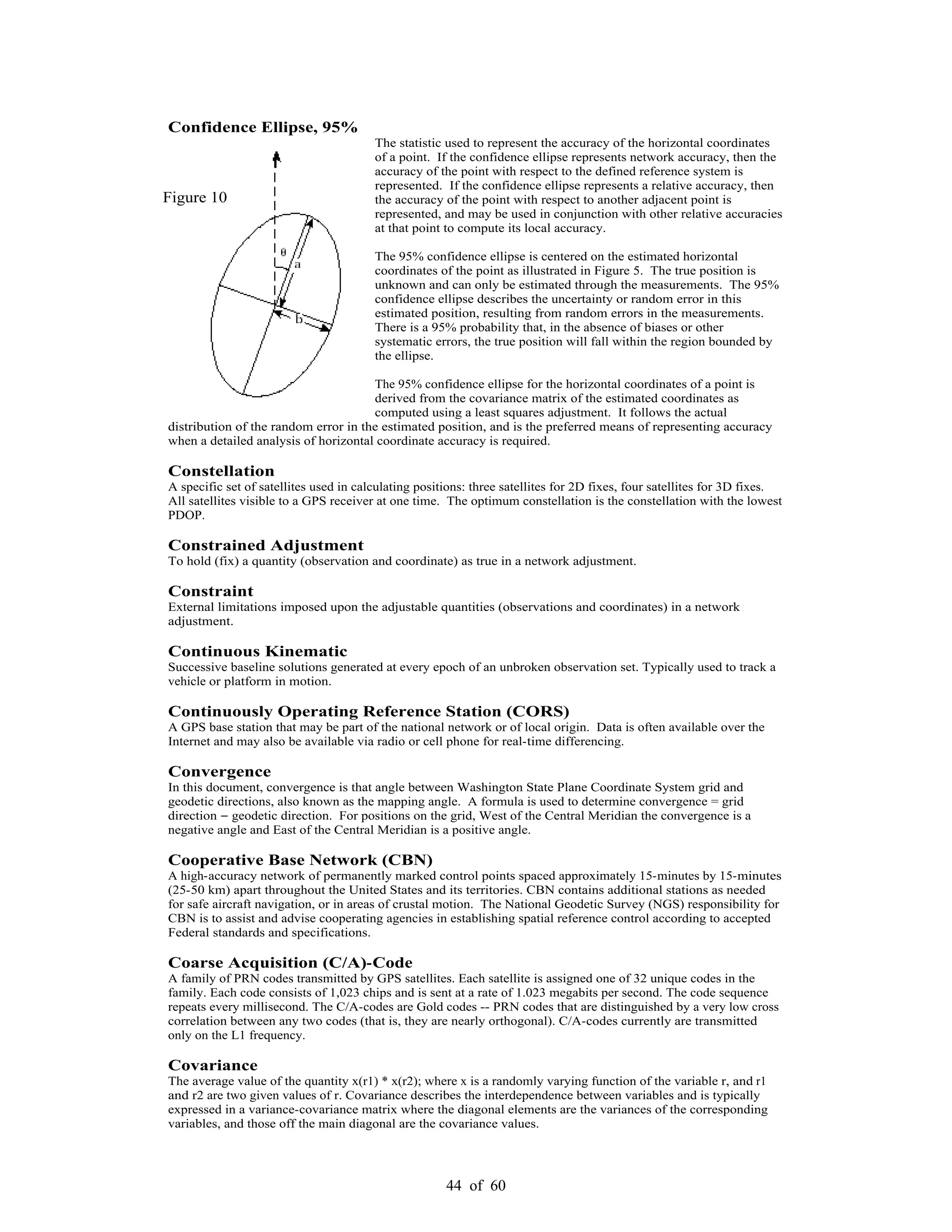
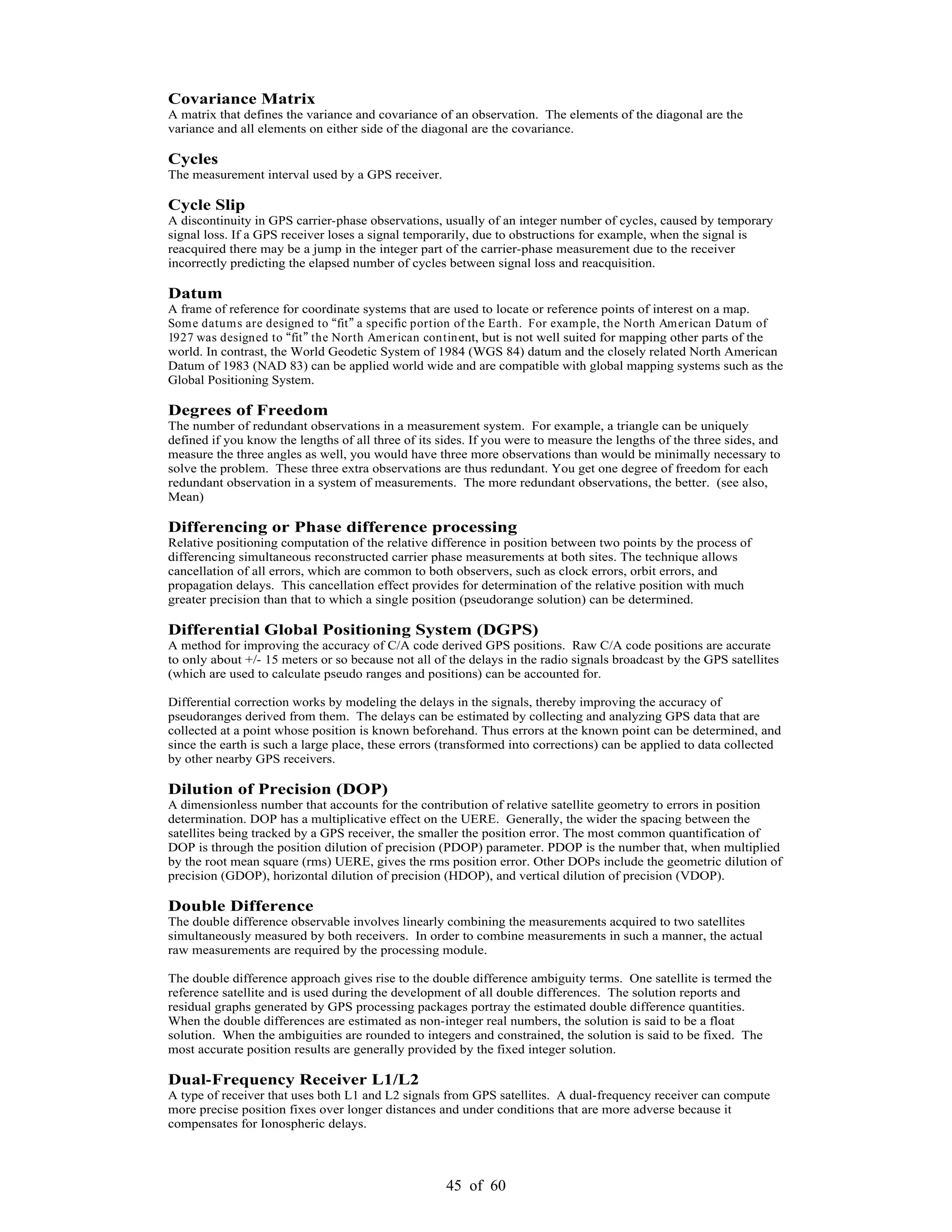
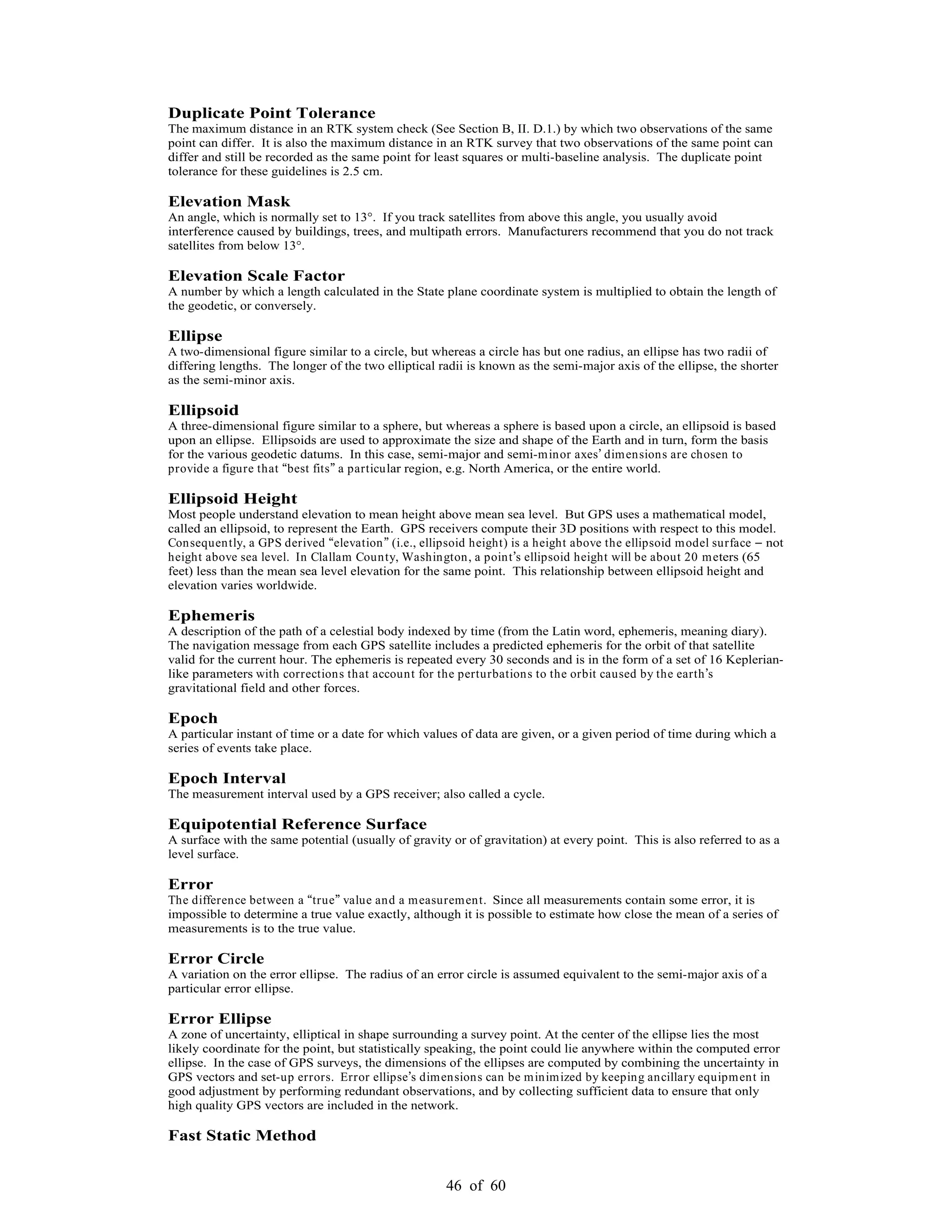
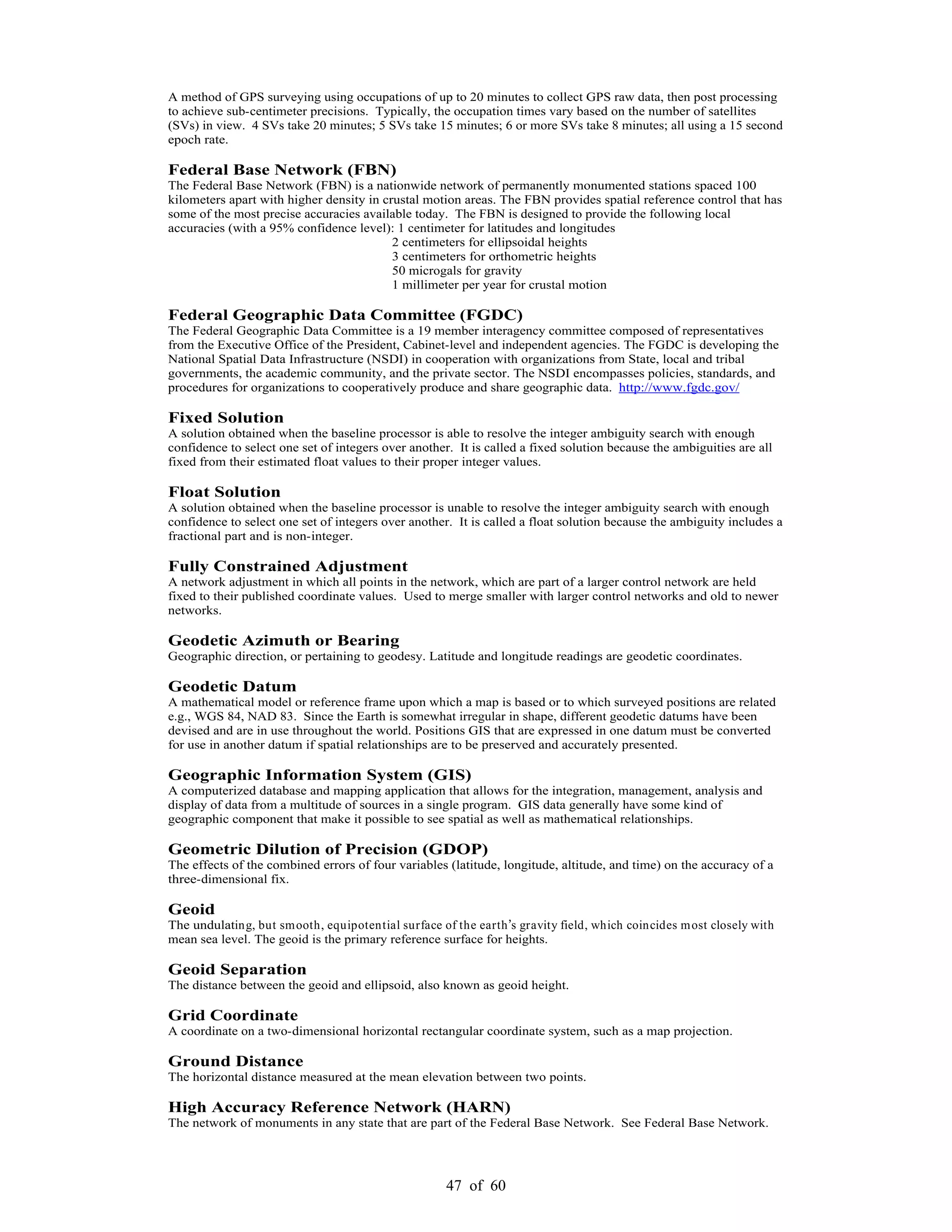
Standards and Guidelines
For
LAND SURVEYING
Using
Global Positioning System Methods
August 6, 2004
Version 2.1.3
By The Survey Advisory Board
for
Washington State
Department of Natural Resources
2 of 60
Table of Contents
TABLE OF CONTENTS.............................................................................................4
FOR EXAMPLES, TABLES, AND FIGURES..............................................4
FOREWORD.....................................................................................................................5
Disclaimer Statement..........................................................................................6
GPS SURVEY GUIDELINES ...............................................................................7
SECTION A: STANDARDS FOR POSITIONAL ACCURACY .........8
Accuracy Standard................................................................................................8
Horizontal .........................................................................................................................9
Vertical.............................................................................................................................9
Relative Accuracy and Local Accuracy ..........................................................................9
Local Accuracy..............................................................................................................9
Network Accuracy ........................................................................................................9
Linear Closure Relationship.........................................................................11
Expected Local Accuracy Positional Standards for GPS
Land Surveys............................................................................................................14
SECTION B: TYPES OF GPS SURVEYING ..........................................15
Survey Project Control .....................................................................................15
Survey Measurements ......................................................................................16
Vertical Control......................................................................................................17
Basic Rules......................................................................................................................19
Control Requirements...................................................................................................19
Procedures ......................................................................................................................19
Adjustment......................................................................................................................20
Data Acquisition for Topographic/Contour Maps....................21
SECTION C: FIELD OPERATIONS AND
PROCEDURES.......................................................................................................22
General Requirements......................................................................................22
Field Data Acquisition Methods................................................................23
Static Positioning...........................................................................................................25
Fast-Static Positioning..................................................................................................25
Post-Processed Kinematic (PPK) Positioning............................................................26
Real-time Kinematic (RTK) Positioning.....................................................................27
RTK System Check..................................................................................................27
RTK Calibrations.....................................................................................................28
RTK Corner Measurement ...................................................................................29
RTK Corner Moves (stakeout).............................................................................31
SECTION D: DATA PROCESSING AND ANALYSIS..32
Introduction to Loop Closures....................................................................32
Checking Baselines Observed in Multiple Sessions...................32
Internal Accuracy.................................................................................................34
Introduction to network adjustment.....................................................34
3 of 60
Minimally Constrained Adjustment......................................................34
Fully Constrained Adjustment ...................................................................35
Error Ellipses ...........................................................................................................35
Independent Baselines......................................................................................35
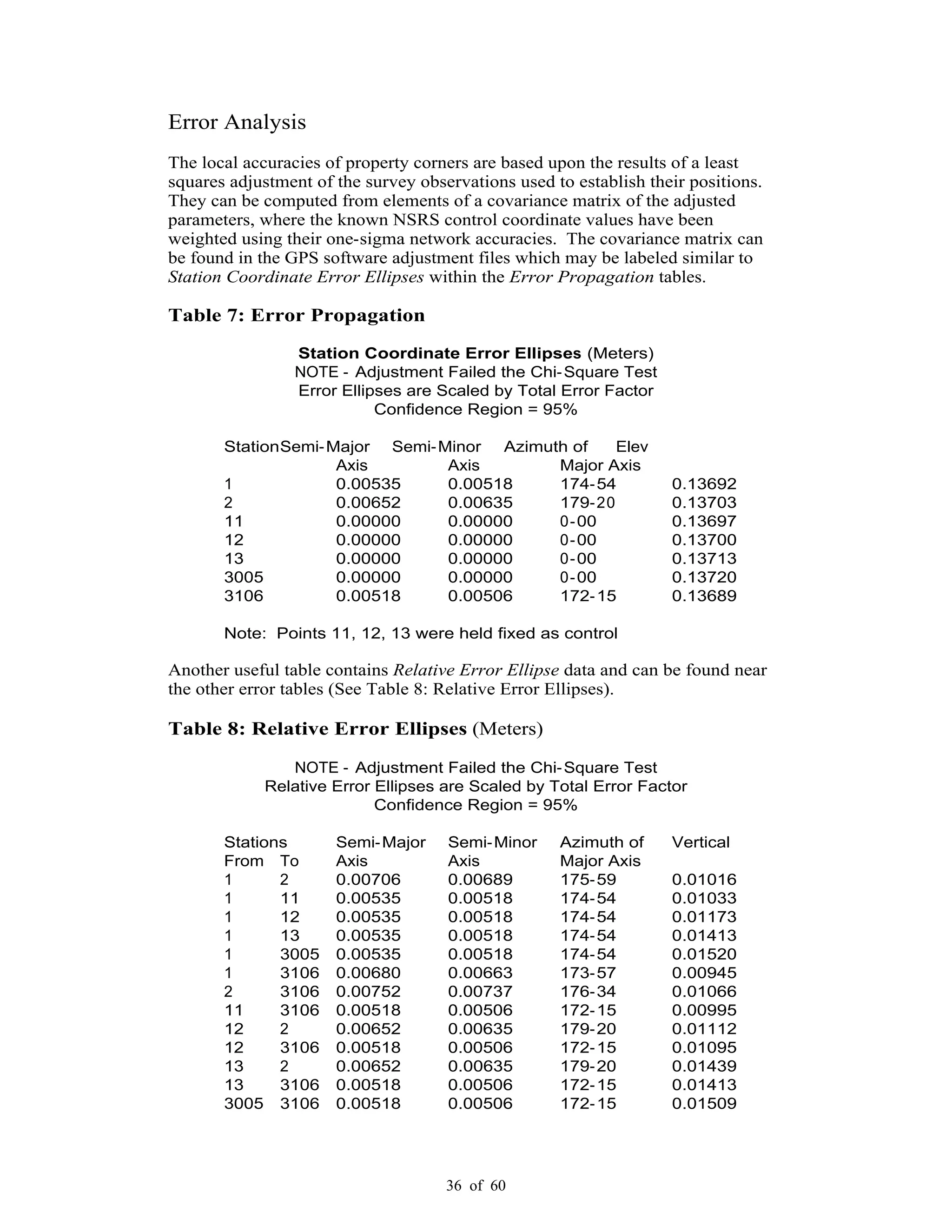
Error Analysis.........................................................................................................36
Data Integration....................................................................................................37
SECTION E: PROJECT DOCUMENTATION......................38
Narrative Report...................................................................................................39
Reporting bearings and Distances.........................................................41
APPENDIX A.................................................................................................................42
GLOSSARY AND DEFINITIONS..............................................................42
APPENDIX B.................................................................................................................57
LEGAL REFERENCES......................................................................................57
APPENDIX C.................................................................................................................58
REFERENCES..........................................................................................................58
1
4 of 60
Table of Contents
for Examples, Tables, and Figures
Examples
Example 1 Local Accuracy 10
Example 2 Network Accuracy 11
Example 3 Expected Random Error 13
Example 4 Linear Closure ~ Accuracy Relationship 13
Example 5 Errors Caused by Lack of Redundant Measurements
33
Example 6 Inability to Find Errors without Redundant Measurements 33
Example 7 Narrative Report for a Record of Survey 40
Tables
Table 1 FGDC Accuracy Standards 8
Table 2 Linear Closure ~ Accuracy Relationship 12
Table 3 Relative Accuracy between Points 12
Table 4 Expected Local Accuracy Positional Standards 14
Table 5 Survey Type ~ Method Matrix 23
Table 6 Summary of Carrier-Phase GPS Positioning Methods 24
Table 7 Error Propagation 36
Table 8 Relative Error Ellipses 36
Figures
Figure 1 Horizontal and Vertical Accuracy Cylinder 9
Figure 2 Local Accuracy 10
Figure 3 Network Accuracy 11
Figure 4 Geoid, Orthometric, Ellipsoid Diagram 18
Figure 5 Network Diagram 32
Figure 6 GPS Traverse Diagram 33
Figure 7 Braced Figure GPS Network 33
Figure 8 Baseline Closure summary 34
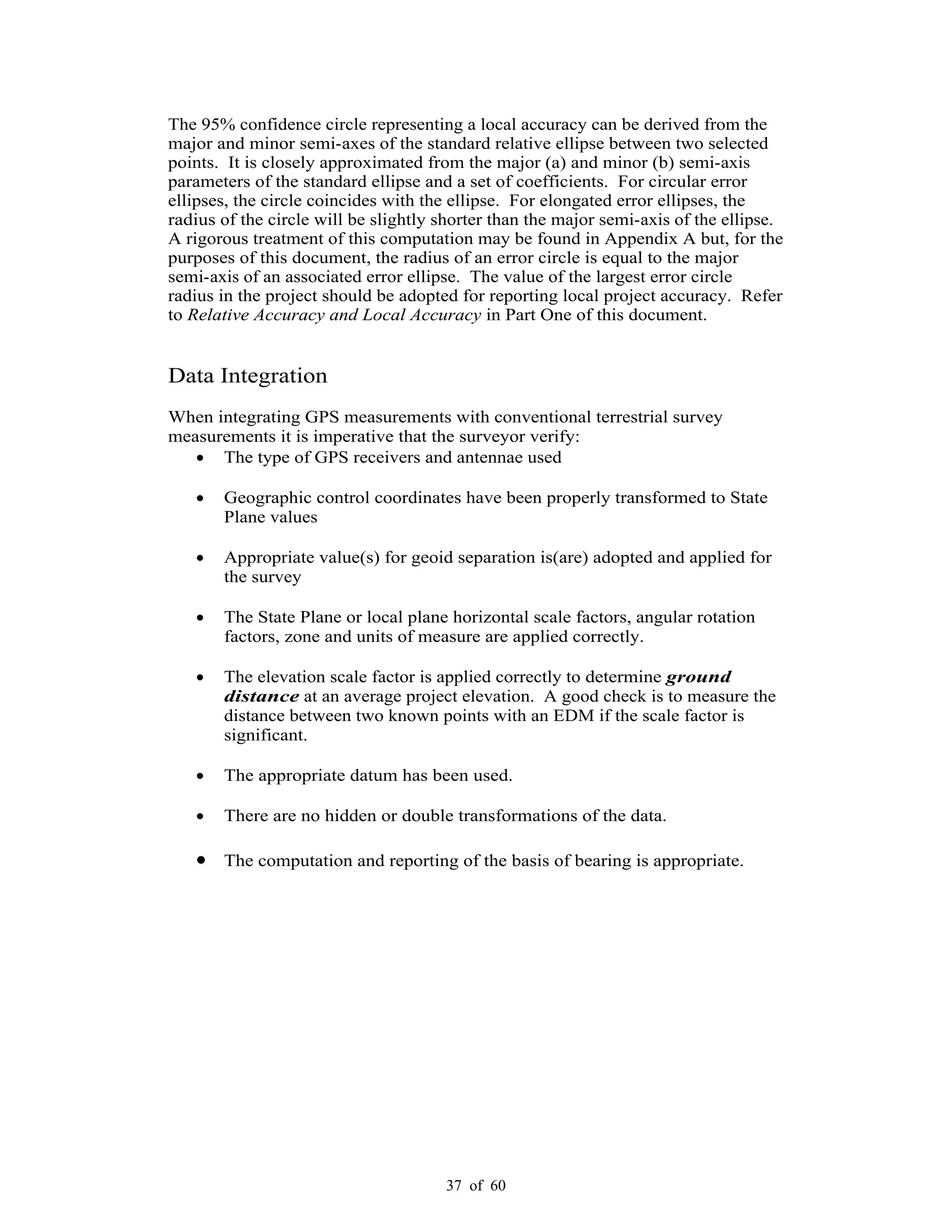
Figure 9 Confidence Circle 43
Figure 10 Confidence Ellipse 44
5 of 60
Foreword
These Standards and Guidelines provide guidance to land surveyors using Global
Positioning System (GPS) technology to perform land surveys1. They do not
require that land surveys be performed to the higher accuracy and methodology
requirements of geodetic control surveys but are intended to provide sufficient
observational and occupational redundancy to detect blunders and quantitatively
demonstrate the stated or required accuracy of a survey has been achieved. All
tables and references are shown in metric dimensions.
Many sources were consulted during the preparation of this document. These
sources included other GPS survey standards and guidelines, technical reports
and manuals (see Appendix D for References). Opinions and reviews were also
sought from public and private Professional Land Surveyors who use GPS for
land surveying.
There are a number of errors that affect the position estimates derived from GPS
measurements. The errors can generally be divided into three distinct groups;
satellite dependent errors, propagation dependent errors, and receiver dependent
errors.
Clock Errors
Satellite Orbits
Selective Availability
Atmospheric Errors
Troposphere
Ionosphere
Multipath
Antenna Phase Center
Measurement Uncertainty
The majority of the errors listed are "spatially related", in other words, two
receivers at adjacent locations experience similar errors. This characteristic is
used to eliminate many of the errors by surveying with two receivers
simultaneously. The position error at both sites is assumed the same; therefore,
the difference in coordinates between the two receivers should be significantly
more accurate than the absolute position of each receiver. This technique is
termed differential positioning and is used in all surveying applications of GPS
technology. Two sources of error that are site specific with GPS are cycle slips
and multipath. Cycle slips are generally physical objects, which block the signal
but may also include seemingly insignificant things such as mesh fences or other
small objects, which can deflect the satellite signal. Multipath is caused when the
satellite signal takes two routes to the receiver. One route is direct from satellite
to receiver and the second generally occurs when nearby hard surfaced flat
objects deflect the signal from the satellite to the receiver. Unseen obstructions
such as electromagnetic transmissions or natural occurring atmospheric
disturbances may also interfere with this signal. Ionospheric corrections should
be made on long baselines to compensate for any signal distortion.
1 This document will not cover geodetic control surveys and it does not cover the requirements
necessary to meet the National Spatial Data Infrastructure (NSDI).
6 of 60
The static and fast static survey procedures in these guidelines follow long
established and well-documented industry and government survey practices.
Guidelines for real-time kinematic surveys are in the early stages of development.
Real-time kinematic GPS is suitable for land surveying small areas. Maintenance
of positional confidence requires certain observational and occupational
redundancies and checks.
Disclaimer Statement
This document is intended to provide the user with guidelines for planning,
execution, and classification of surveys performed using GPS carrier phase
methodology.
Note: Italicized words in bold font, i.e., independent occupation, indicate
that a definition for that word appears in Appendix A: Definitions. Definition
words are shown bold, italicized the first instance only.
7 of 60
GPS Survey Guidelines
The guidelines outlined in this document focus on;
Standards for Positional Accuracy Section A
Types of surveying that may use GPS Section B
Field operations and procedures Section C
Data processing and data analysis Section D
Project documentation Section E
The use of these guidelines and the manufacturer s specifications provide a
means for the surveyor to evaluate the survey and to verify that the specified
accuracy standard can be achieved.
These guidelines are designed to ensure that a survey performed with GPS
technology is repeatable, legally defensible and can be referenced to the National
Spatial Reference System (NSRS) by addressing the following set of criteria:
1. Elimination or reduction of known and potential systematic error sources.
2. Occupational (station) and observational (baseline) redundancy to clearly
demonstrate the stated accuracy.
3. Documentation of baseline processing, data adjustment, and data
analysis, which demonstrates the recommended procedures and required
accuracy.
4. Compliance with the current Bureau of Land Management Manual of
Instructions for the Survey of the Public Lands of the United States.
5. Compliance with Revised Code of Washington (RCW) and Washington
Administrative Code (WAC).
GPS survey guidelines continually evolve with the advancements in equipment
and techniques. Changes to these guidelines are expected as these advancements
occur. The size, scope, and site conditions of a project may also require variations
from these guidelines.
Any variations from these guidelines should be designed to meet the above
criteria and to achieve the accuracy standard of the survey as suggested by this
document. All variations should be documented in a project report (See Section
E).
8 of 60
Section A: Standards for Positional Accuracy
Accuracy Standard
The accuracy of classical triangulation network or traverse surveys was described
by a proportional standard, e.g. 1:10,000, which reflected the distance-dependent
nature of terrestrial surveying error. The accuracy of GPS and photogrammetric
surveys, being less distance dependent, used different accuracy standards (linear
and positional covariance standards). This use of multiple standards created
difficulty in comparing the accuracy of coordinate values obtained by different
survey methods.
In recognition of these difficulties, the Federal Geographic Data Committee
(FGDC) has changed its methodology for reporting the accuracy of horizontal and
vertical coordinate values. The new reporting standard is defined by 95%
confidence intervals, a circle for horizontal uncertainty, and a linear value for
vertical uncertainty.
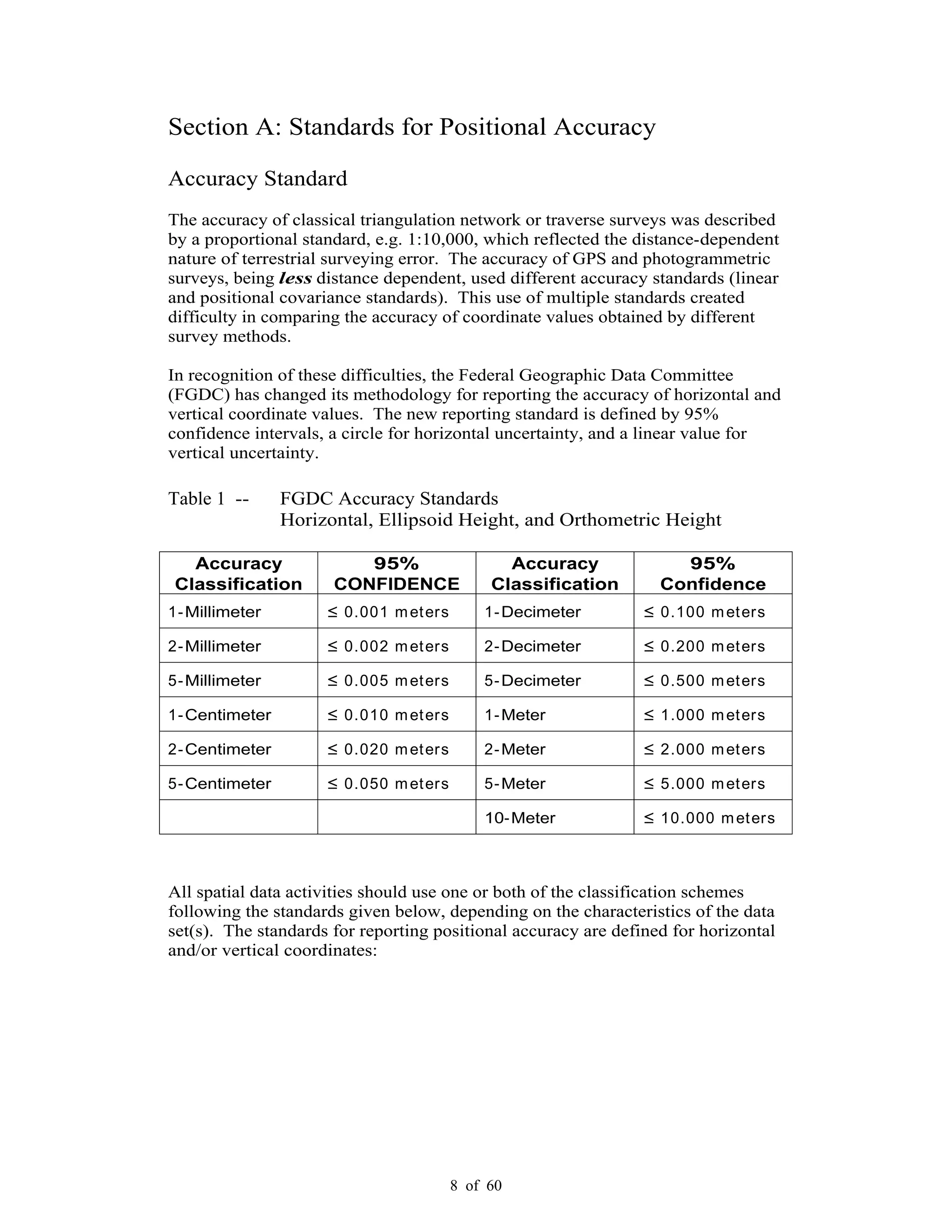
Table 1 -- FGDC Accuracy Standards
Horizontal, Ellipsoid Height, and Orthometric Height
Accuracy
Classification
95%
CONFIDENCE
Accuracy
Classification
95%
Confidence
1-Millimeter 0.001 meters 1-Decimeter 0.100 meters
2-Millimeter 0.002 meters 2-Decimeter 0.200 meters
5-Millimeter 0.005 meters 5-Decimeter 0.500 meters
1-Centimeter 0.010 meters 1-Meter 1.000 meters
2-Centimeter 0.020 meters 2-Meter 2.000 meters
5-Centimeter 0.050 meters 5-Meter 5.000 meters
10-Meter 10.000 meters
All spatial data activities should use one or both of the classification schemes
following the standards given below, depending on the characteristics of the data
set(s). The standards for reporting positional accuracy are defined for horizontal
and/or vertical coordinates:
9 of 60
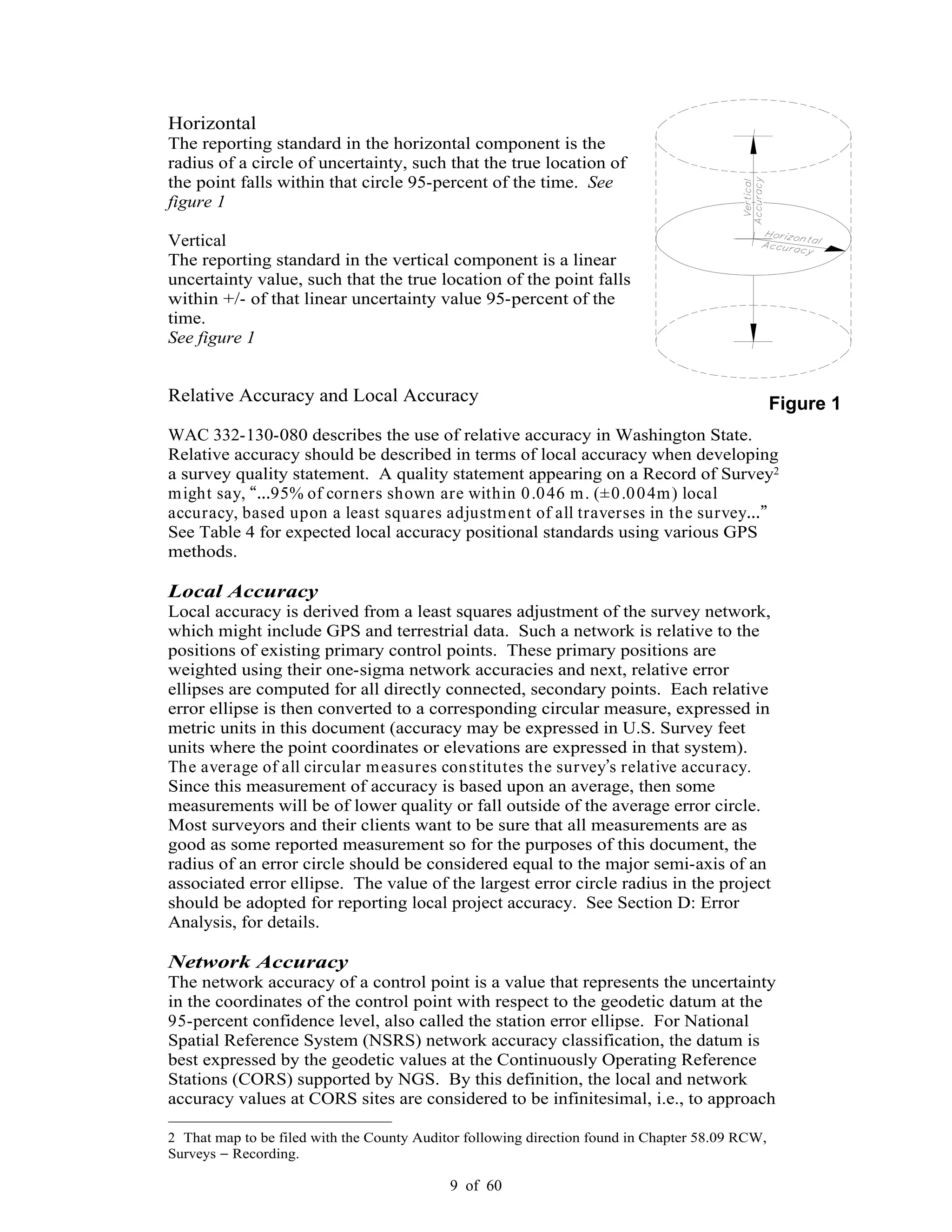
Horizontal
The reporting standard in the horizontal component is the
radius of a circle of uncertainty, such that the true location of
the point falls within that circle 95-percent of the time. See
figure 1
Vertical
The reporting standard in the vertical component is a linear
uncertainty value, such that the true location of the point falls
within +/- of that linear uncertainty value 95-percent of the
time.
See figure 1
Relative Accuracy and Local Accuracy
WAC 332-130-080 describes the use of relative accuracy in Washington State.
Relative accuracy should be described in terms of local accuracy when developing
a survey quality statement. A quality statement appearing on a Record of Survey2
might say, 95% of corners shown are within 0.046 m. (±0.004m) local
accuracy, based upon a least squares adjustment of all traverses in the survey
See Table 4 for expected local accuracy positional standards using various GPS
methods.
Local Accuracy
Local accuracy is derived from a least squares adjustment of the survey network,
which might include GPS and terrestrial data. Such a network is relative to the
positions of existing primary control points. These primary positions are
weighted using their one-sigma network accuracies and next, relative error
ellipses are computed for all directly connected, secondary points. Each relative
error ellipse is then converted to a corresponding circular measure, expressed in
metric units in this document (accuracy may be expressed in U.S. Survey feet
units where the point coordinates or elevations are expressed in that system).
The average of all circular measures constitutes the survey s relative accuracy.
Since this measurement of accuracy is based upon an average, then some
measurements will be of lower quality or fall outside of the average error circle.
Most surveyors and their clients want to be sure that all measurements are as
good as some reported measurement so for the purposes of this document, the
radius of an error circle should be considered equal to the major semi-axis of an
associated error ellipse. The value of the largest error circle radius in the project
should be adopted for reporting local project accuracy. See Section D: Error
Analysis, for details.
Network Accuracy
The network accuracy of a control point is a value that represents the uncertainty
in the coordinates of the control point with respect to the geodetic datum at the
95-percent confidence level, also called the station error ellipse. For National
Spatial Reference System (NSRS) network accuracy classification, the datum is
best expressed by the geodetic values at the Continuously Operating Reference
Stations (CORS) supported by NGS. By this definition, the local and network
accuracy values at CORS sites are considered to be infinitesimal, i.e., to approach
2 That map to be filed with the County Auditor following direction found in Chapter 58.09 RCW,
Surveys Recording.
Figure 1
10 of 60
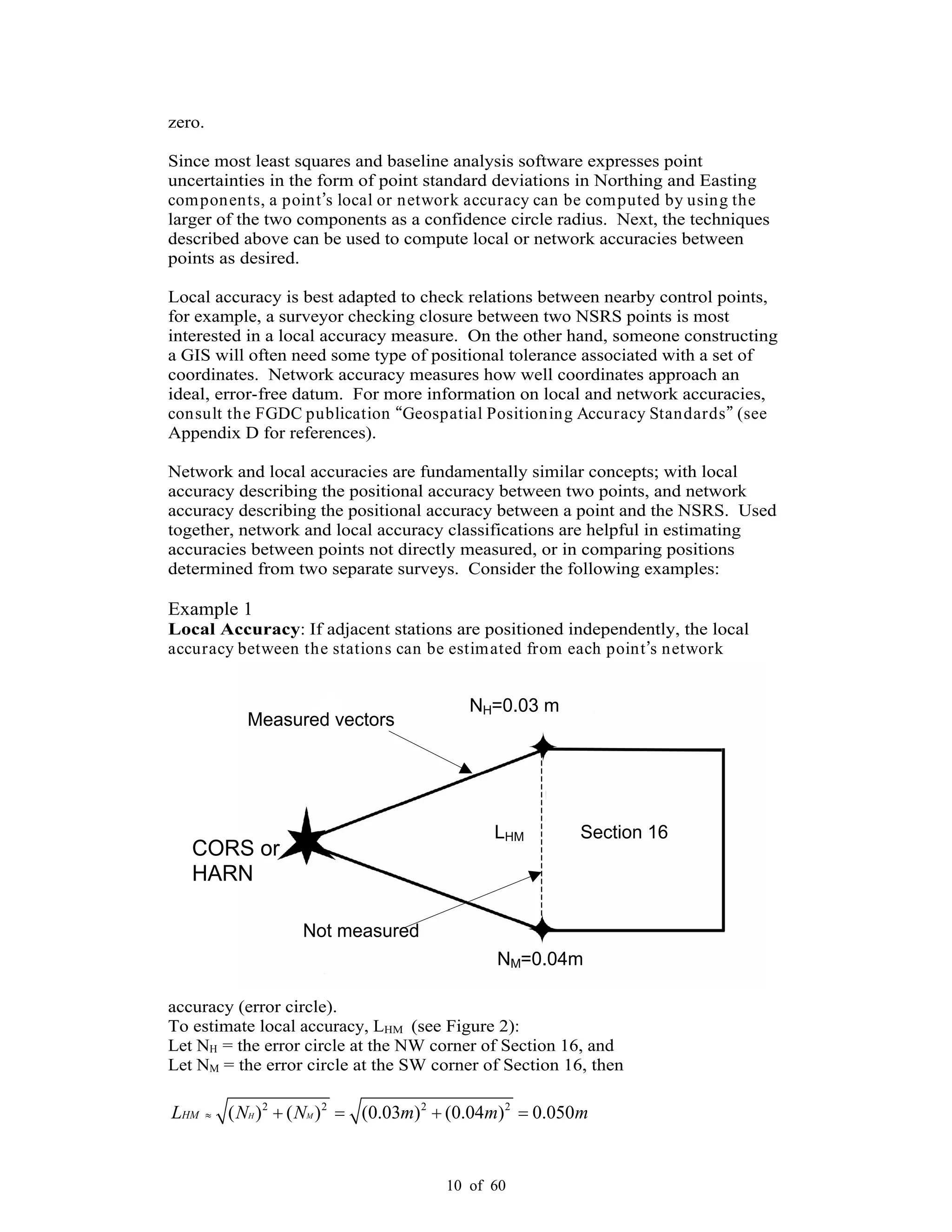
NH=0.03 m
NM=0.04m
Section 16
CORS or
HARN
LHM
Measured vectors
Not measured
zero.
Since most least squares and baseline analysis software expresses point
uncertainties in the form of point standard deviations in Northing and Easting
components, a point s local or network accuracy can be computed by using the
larger of the two components as a confidence circle radius. Next, the techniques
described above can be used to compute local or network accuracies between
points as desired.
Local accuracy is best adapted to check relations between nearby control points,
for example, a surveyor checking closure between two NSRS points is most
interested in a local accuracy measure. On the other hand, someone constructing
a GIS will often need some type of positional tolerance associated with a set of
coordinates. Network accuracy measures how well coordinates approach an
ideal, error-free datum. For more information on local and network accuracies,
consult the FGDC publication Geospatial Positioning Accuracy Standards (see
Appendix D for references).
Network and local accuracies are fundamentally similar concepts; with local
accuracy describing the positional accuracy between two points, and network
accuracy describing the positional accuracy between a point and the NSRS. Used
together, network and local accuracy classifications are helpful in estimating
accuracies between points not directly measured, or in comparing positions
determined from two separate surveys. Consider the following examples:
Example 1
Local Accuracy: If adjacent stations are positioned independently, the local
accuracy between the stations can be estimated from each point s network
accuracy (error circle).
To estimate local accuracy, LHM (see Figure 2):
Let NH = the error circle at the NW corner of Section 16, and
Let NM = the error circle at the SW corner of Section 16, then
2 2 2 2
( ) ( ) (0.03 ) (0.04 ) 0.050H MHML N N m m m
11 of 60
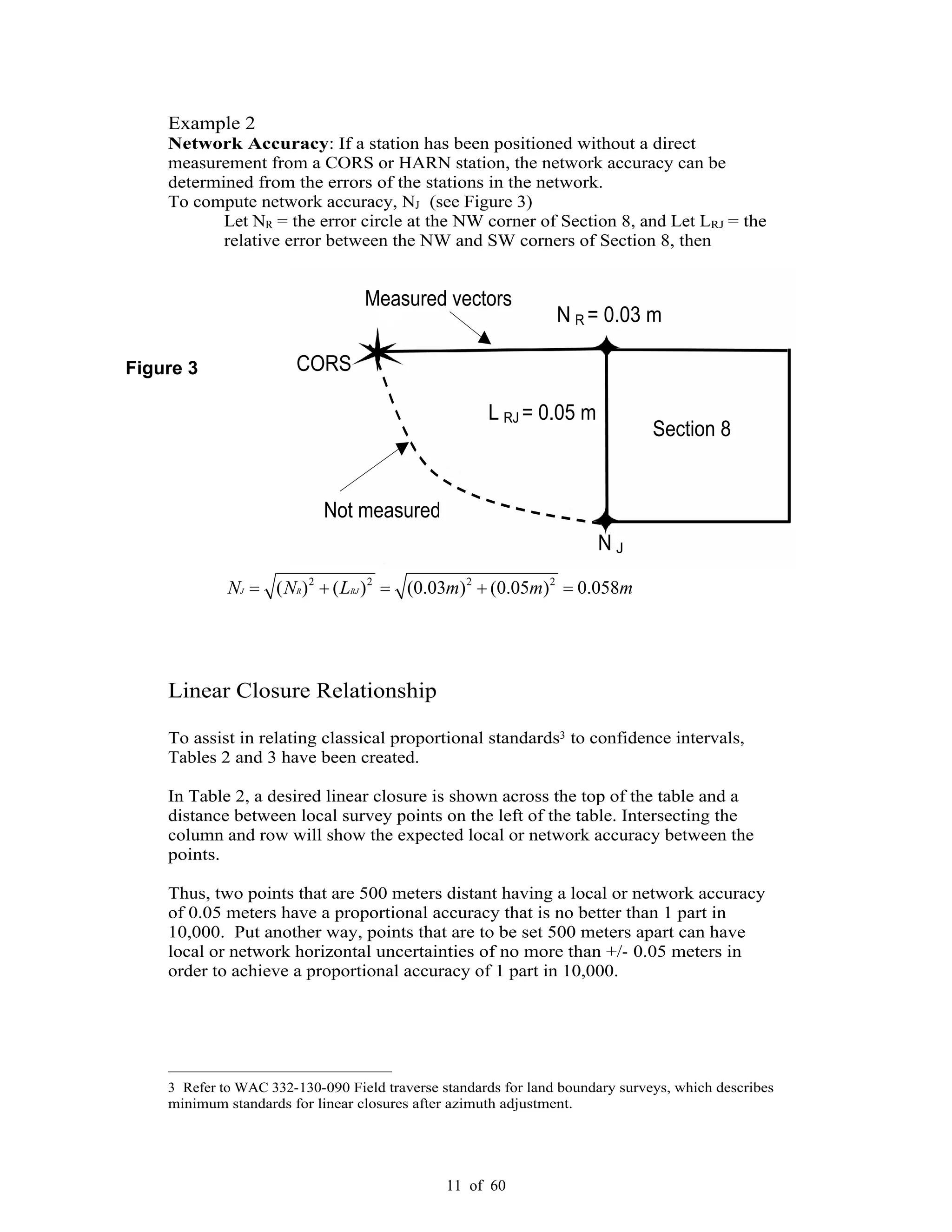
Example 2
Network Accuracy: If a station has been positioned without a direct
measurement from a CORS or HARN station, the network accuracy can be
determined from the errors of the stations in the network.
To compute network accuracy, NJ (see Figure 3)
Let NR = the error circle at the NW corner of Section 8, and Let LRJ = the
relative error between the NW and SW corners of Section 8, then
2 2 2 2
( ) ( ) (0.03 ) (0.05 ) 0.058J R RJN N L m m m
Linear Closure Relationship
To assist in relating classical proportional standards3 to confidence intervals,
Tables 2 and 3 have been created.
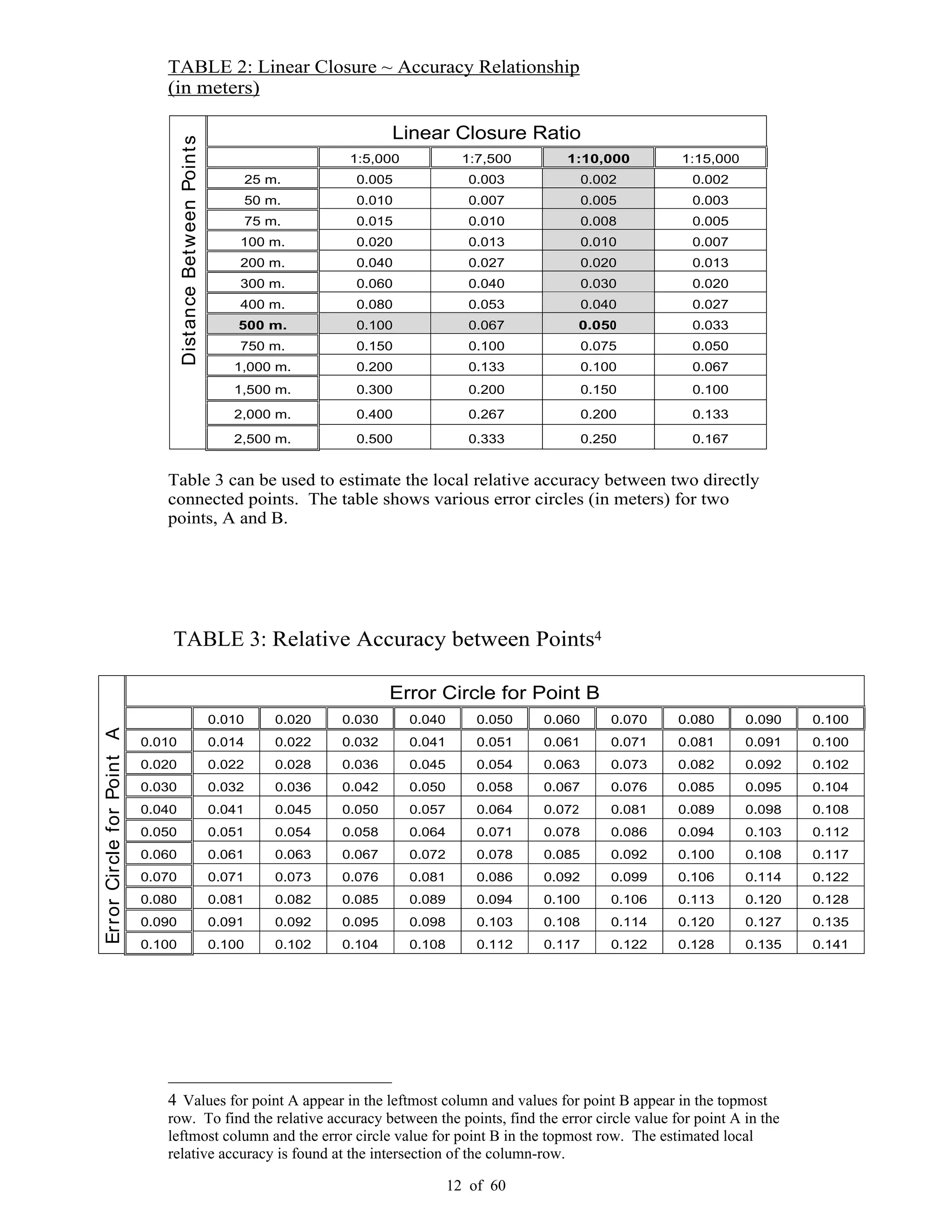
In Table 2, a desired linear closure is shown across the top of the table and a
distance between local survey points on the left of the table. Intersecting the
column and row will show the expected local or network accuracy between the
points.
Thus, two points that are 500 meters distant having a local or network accuracy
of 0.05 meters have a proportional accuracy that is no better than 1 part in
10,000. Put another way, points that are to be set 500 meters apart can have
local or network horizontal uncertainties of no more than +/- 0.05 meters in
order to achieve a proportional accuracy of 1 part in 10,000.
3 Refer to WAC 332-130-090 Field traverse standards for land boundary surveys, which describes
minimum standards for linear closures after azimuth adjustment.
Figure 3 CORS
Section 8
N R = 0.03 m
N J
L RJ = 0.05 m
Not measured
Measured vectors
12 of 60
TABLE 2: Linear Closure ~ Accuracy Relationship
(in meters)
Linear Closure Ratio
1:5,000 1:7,500 1:10,000 1:15,000
25 m. 0.005 0.003 0.002 0.002
50 m. 0.010 0.007 0.005 0.003
75 m. 0.015 0.010 0.008 0.005
100 m. 0.020 0.013 0.010 0.007
200 m. 0.040 0.027 0.020 0.013
300 m. 0.060 0.040 0.030 0.020
400 m. 0.080 0.053 0.040 0.027
500 m. 0.100 0.067 0.050 0.033
750 m. 0.150 0.100 0.075 0.050
DistanceBetweenPoints
1,000 m. 0.200 0.133 0.100 0.067
1,500 m. 0.300 0.200 0.150 0.100
2,000 m. 0.400 0.267 0.200 0.133
2,500 m. 0.500 0.333 0.250 0.167
Table 3 can be used to estimate the local relative accuracy between two directly
connected points. The table shows various error circles (in meters) for two
points, A and B.
TABLE 3: Relative Accuracy between Points4
Error Circle for Point B
0.010 0.020 0.030 0.040 0.050 0.060 0.070 0.080 0.090 0.100
0.010 0.014 0.022 0.032 0.041 0.051 0.061 0.071 0.081 0.091 0.100
0.020 0.022 0.028 0.036 0.045 0.054 0.063 0.073 0.082 0.092 0.102
0.030 0.032 0.036 0.042 0.050 0.058 0.067 0.076 0.085 0.095 0.104
0.040 0.041 0.045 0.050 0.057 0.064 0.072 0.081 0.089 0.098 0.108
0.050 0.051 0.054 0.058 0.064 0.071 0.078 0.086 0.094 0.103 0.112
0.060 0.061 0.063 0.067 0.072 0.078 0.085 0.092 0.100 0.108 0.117
0.070 0.071 0.073 0.076 0.081 0.086 0.092 0.099 0.106 0.114 0.122
0.080 0.081 0.082 0.085 0.089 0.094 0.100 0.106 0.113 0.120 0.128
0.090 0.091 0.092 0.095 0.098 0.103 0.108 0.114 0.120 0.127 0.135
ErrorCircleforPointA
0.100 0.100 0.102 0.104 0.108 0.112 0.117 0.122 0.128 0.135 0.141
4 Values for point A appear in the leftmost column and values for point B appear in the topmost
row. To find the relative accuracy between the points, find the error circle value for point A in the
leftmost column and the error circle value for point B in the topmost row. The estimated local
relative accuracy is found at the intersection of the column-row.
13 of 60
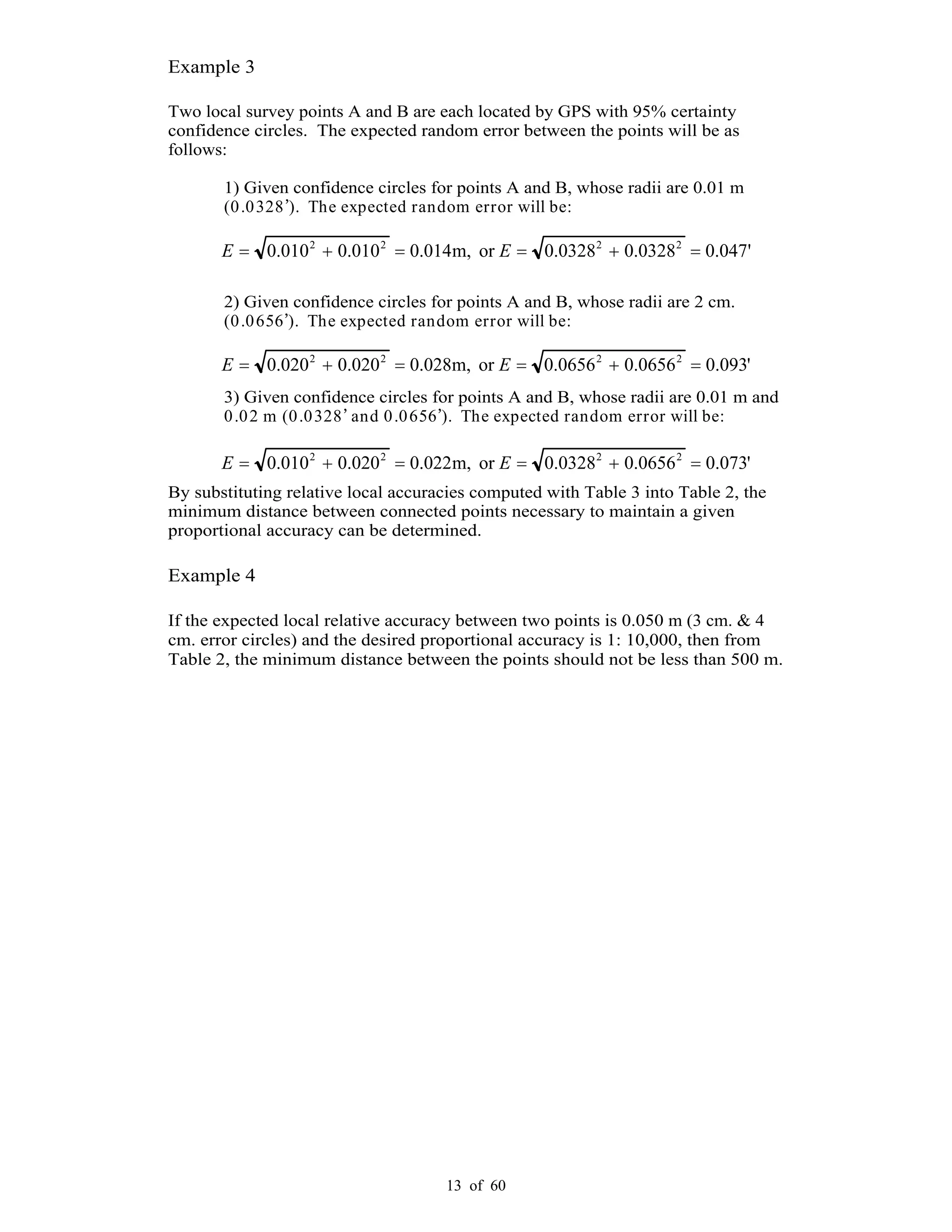
Example 3
Two local survey points A and B are each located by GPS with 95% certainty
confidence circles. The expected random error between the points will be as
follows:
1) Given confidence circles for points A and B, whose radii are 0.01 m
(0.0328 ). The expected random error will be:
2) Given confidence circles for points A and B, whose radii are 2 cm.
(0.0656 ). The expected random error will be:
3) Given confidence circles for points A and B, whose radii are 0.01 m and
0.02 m (0.0328 and 0.0656 ). The expected random error will be:
By substituting relative local accuracies computed with Table 3 into Table 2, the
minimum distance between connected points necessary to maintain a given
proportional accuracy can be determined.
Example 4
If the expected local relative accuracy between two points is 0.050 m (3 cm. & 4
cm. error circles) and the desired proportional accuracy is 1: 10,000, then from
Table 2, the minimum distance between the points should not be less than 500 m.
'047.00328.00328.0orm,014.0010.0010.0 2222
EE
'093.00656.00656.0orm,028.0020.0020.0 2222
EE
'073.00656.00328.0orm,022.0020.0010.0 2222
EE
14 of 60
Expected Local Accuracy Positional Standards for GPS Land
Surveys
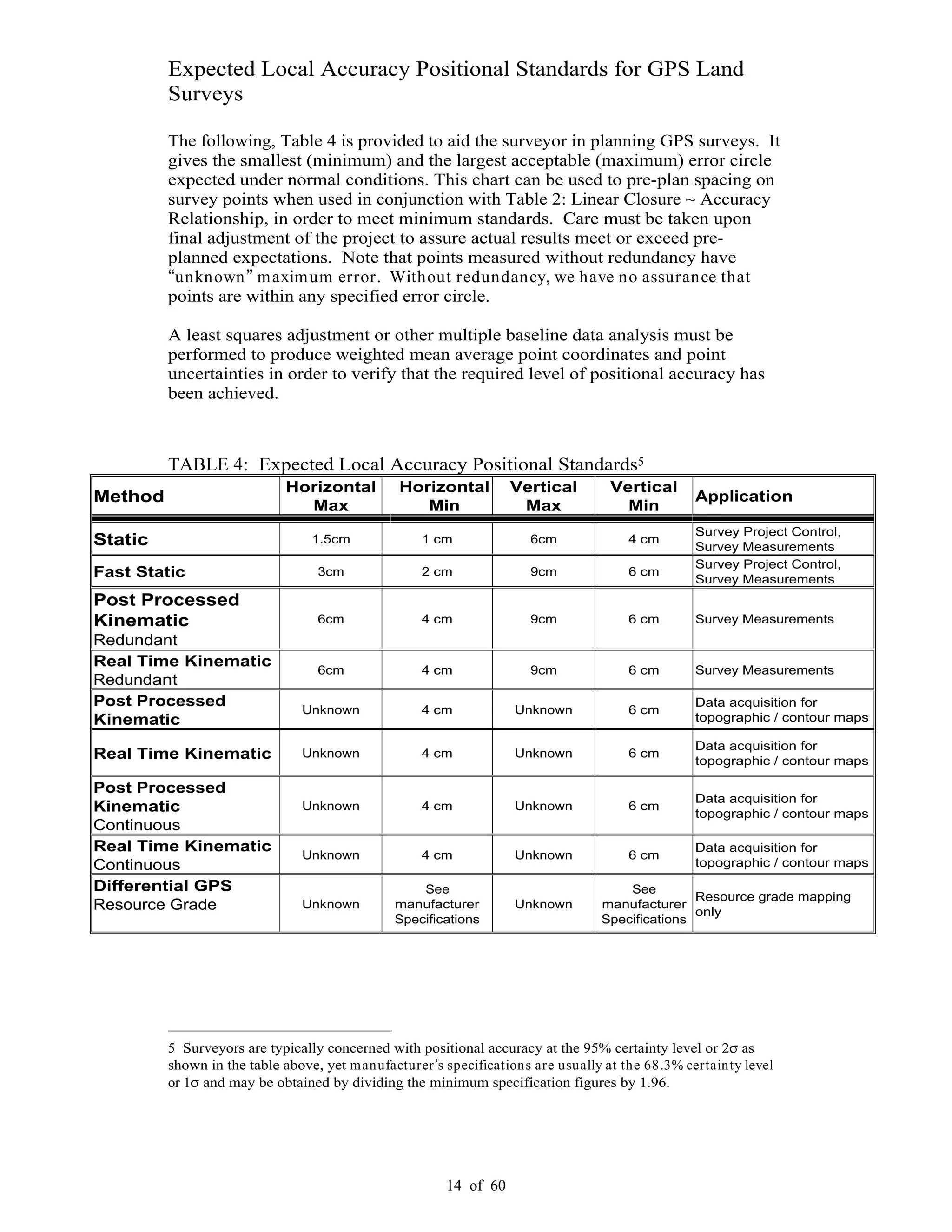
The following, Table 4 is provided to aid the surveyor in planning GPS surveys. It
gives the smallest (minimum) and the largest acceptable (maximum) error circle
expected under normal conditions. This chart can be used to pre-plan spacing on
survey points when used in conjunction with Table 2: Linear Closure ~ Accuracy
Relationship, in order to meet minimum standards. Care must be taken upon
final adjustment of the project to assure actual results meet or exceed pre-
planned expectations. Note that points measured without redundancy have
unknown maximum error. Without redundancy, we have no assurance that
points are within any specified error circle.
A least squares adjustment or other multiple baseline data analysis must be
performed to produce weighted mean average point coordinates and point
uncertainties in order to verify that the required level of positional accuracy has
been achieved.
TABLE 4: Expected Local Accuracy Positional Standards5
Method
Horizontal
Max
Horizontal
Min
Vertical
Max
Vertical
Min
Application
Static 1.5cm 1 cm 6cm 4 cm
Survey Project Control,
Survey Measurements
Fast Static 3cm 2 cm 9cm 6 cm
Survey Project Control,
Survey Measurements
Post Processed
Kinematic
Redundant
6cm 4 cm 9cm 6 cm Survey Measurements
Real Time Kinematic
Redundant
6cm 4 cm 9cm 6 cm Survey Measurements
Post Processed
Kinematic
Unknown 4 cm Unknown 6 cm
Data acquisition for
topographic / contour maps
Real Time Kinematic Unknown 4 cm Unknown 6 cm
Data acquisition for
topographic / contour maps
Post Processed
Kinematic
Continuous
Unknown 4 cm Unknown 6 cm
Data acquisition for
topographic / contour maps
Real Time Kinematic
Continuous
Unknown 4 cm Unknown 6 cm
Data acquisition for
topographic / contour maps
Differential GPS
Resource Grade Unknown
See
manufacturer
Specifications
Unknown
See
manufacturer
Specifications
Resource grade mapping
only
5 Surveyors are typically concerned with positional accuracy at the 95% certainty level or 2 as
shown in the table above, yet manufacturer s specifications are usually at the 68.3% certainty level
or 1 and may be obtained by dividing the minimum specification figures by 1.96.
15 of 60
Section B: Types of GPS Surveying
Survey Project Control
Survey project control is a network of GPS stations tied to the NSRS or a local
control scheme, which is surveyed to control all subsequent GPS survey
measurements. Project control may also be used to bracket or surround a
kinematic project with static points.
Using survey project control tied to the NSRS is required when a land surveyor
intends to place coordinates on the final survey map following guidance in RCW
58.20.180.
The survey project control network must be established by either static or fast-
static survey methods. The network measurements may be observed at the same
time the survey measurements are observed and are designed to meet the
following purposes:
Provides a framework to reference the survey to a datum, a mapping
projection, and the NSRS.
Supports registration of the survey measurements into the public record
under RCW 58.20.180 and into Geographic Information Systems (GIS).
Serves as the basis for all subsequent GPS and conventional survey
measurements.
Ties to the NSRS will allow reporting of the network accuracy of survey
measurements per FGDC Geospatial Positioning Accuracy Standards .
A well-designed survey project control network will offer the surveyor
more flexibility when using fast static, kinematic, and RTK survey
methods for the survey measurement portion of a survey. It provides an
adequate amount of reference (base) station locations, ties the survey
measurement points together, allows for expanding the survey area and
provides accurate checks throughout the survey project.
The number of stations in the survey project control network depends upon
factors such as project size, topography, positioning method used, and access. A
minimum of three or more survey project control stations should be established
as a reference for the survey measurements. All survey project control networks
referenced to the NSRS should be tied to at least three High Accuracy Reference
Network (HARN) stations (also called High Precision Geodetic Network (HPGN)
stations) or three Continuous Operating Reference Stations (CORS) of the NSRS.
Currently, the Washington HARN values are in NAD 83(1991) and NAD
83(1998), whereas CORS values are in NAD 83(CORS), which is compatible with
the 1998 adjustment. These adjustments should not be mixed.
In the absence of HARN or CORS stations, other GPS control stations, which are
referenced to the NSRS and published by or available through other federal, state,
or local agencies, may be used. The use of such stations should be evaluated by
the surveyor regarding the relationship to the NSRS before inclusion into the
16 of 60
survey project control network and before any survey measurements occur. In
some instances, a GPS survey may be performed without connection of the NSRS
and a local or assumed datum utilized. Coordinate values derived from a local
datum should not be published on the survey record, but the specific datum or
basis of meridian should be designated. The current Washington State reference
datum is the North American Datum of 1983, (see RCW 58.20.180). All control
and project information should be referenced to an adjustment of NAD 83, for
example, NAD 1983 (1998) (see WAC 332-130-060). Orthometric heights
require reference to a datum and epoch as well. The currently preferred datum is
the North American Vertical Datum of 1988 (NAVD 88) for work on land and a
tidal datum with tide station reference for surveys in tidal waters. The datum tag
or date of the datum represents the date of the regional least squares adjustment
associated with the horizontal control point. The epoch date is used for stations
in regions of episodic and/or crustal motion where the coordinates change with
time. The epoch date indicates the date the published horizontal coordinates and
heights are valid. All points with adjusted horizontal coordinates and/or heights
that fall within a designated crustal motion region will have an epoch date based
on the date of the latest survey from which the coordinates were determined.
All survey project control networks should conform to the following:
Be referenced to three or more NSRS or other published or local datum
horizontal control stations, located in three or more quadrants,
surrounding the survey project area.
Points are connected by two or more independent baselines.
Contain valid loops with a minimum of three baselines and a maximum of
10 baselines. A loop must contain baselines from at least two different
observing sessions to be valid.
Baselines have a fixed integer double difference solution or adhere to
the manufacturer s specifications for baseline lengths that exceed the fixed
solution criteria.
All stations in the survey project control network should have two or more
independent occupations.
The survey project control network must be a geometrically closed figure.
Therefore, single radial (spur) lines or side shots to a point are not
acceptable.
Survey Measurements
Survey measurements are used to define the location and extent of ownership
boundaries or property lines. Survey measurements are referenced to the survey
project control coordinates or by direct ties to the NSRS.
17 of 60
All survey measurement observations, except RTK, should conform to the
following:
Be constrained to three or more survey project or NSRS stations, which
are located in three or more quadrants surrounding the survey project
area.
Points are connected by two or more independent baselines.
Contain valid loops with a minimum of three independent baselines.
Baselines have a fixed integer double difference solution or adhere to the
manufacturer s specifications for baseline lengths that exceed the fixed
solution criteria.
Any station pair, used as azimuth or bearing reference during
conventional survey measurements, should be included in a network, or
measured with a minimum of two independent vectors following the RTK
techniques described in Section B-I-d. Baselines between station pairs
must be measured for inclusion in network adjustment and analysis.
All stations in the survey measurements shall have two or more
independent occupations.
Single radial (spur) lines or side shots to a point are not acceptable.
Vertical Control
Based on the Federal Geographic Data Committee publication, "Geospatial
Positioning Accuracy Standards" [http://www.fgdc.gov/
standards/document/standards/accuracy], guidelines were developed by the
National Geodetic Survey (NGS) for performing GPS surveys intended to achieve
ellipsoid height network accuracies of 5 cm at the 95 percent confidence level, as
well as ellipsoid height local accuracies of 2 cm and 5 cm, also at the 95 percent
confidence level.
GPS carrier phase measurements are used to determine vector baselines in space,
where the components of the baseline are expressed in terms of Cartesian
coordinate differences. These vector baselines can be converted to distance,
azimuth, and ellipsoidal height differences (dh) relative to a defined reference
ellipsoid.
18 of 60
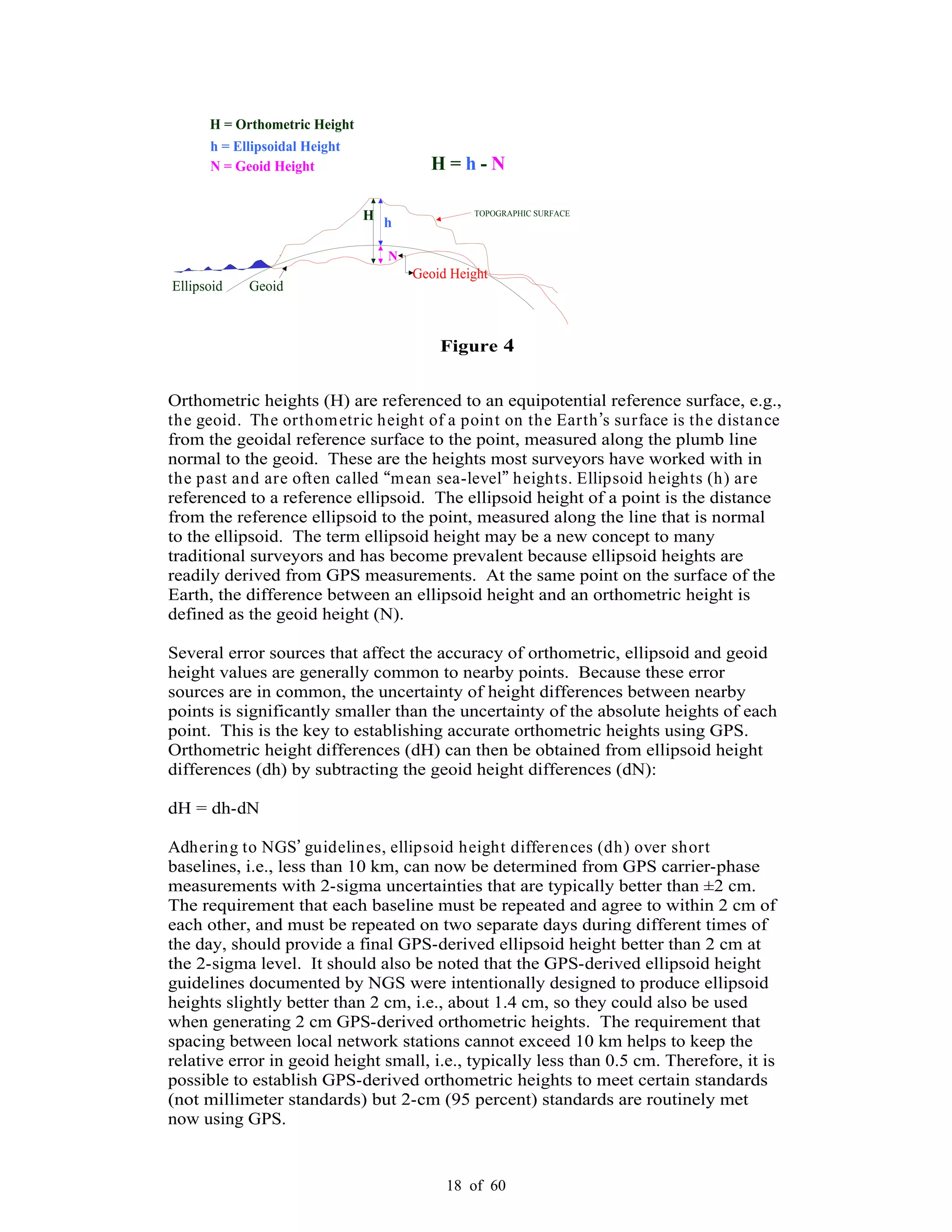
H h
Ellipsoid
H = Orthometric Height
N
Geoid
H = h - N
TOPOGRAPHIC SURFACE
h = Ellipsoidal Height
N = Geoid Height
Geoid Height
Figure 4
Orthometric heights (H) are referenced to an equipotential reference surface, e.g.,
the geoid. The orthometric height of a point on the Earth s surface is the distance
from the geoidal reference surface to the point, measured along the plumb line
normal to the geoid. These are the heights most surveyors have worked with in
the past and are often called mean sea-level heights. Ellipsoid heights (h) are
referenced to a reference ellipsoid. The ellipsoid height of a point is the distance
from the reference ellipsoid to the point, measured along the line that is normal
to the ellipsoid. The term ellipsoid height may be a new concept to many
traditional surveyors and has become prevalent because ellipsoid heights are
readily derived from GPS measurements. At the same point on the surface of the
Earth, the difference between an ellipsoid height and an orthometric height is
defined as the geoid height (N).
Several error sources that affect the accuracy of orthometric, ellipsoid and geoid
height values are generally common to nearby points. Because these error
sources are in common, the uncertainty of height differences between nearby
points is significantly smaller than the uncertainty of the absolute heights of each
point. This is the key to establishing accurate orthometric heights using GPS.
Orthometric height differences (dH) can then be obtained from ellipsoid height
differences (dh) by subtracting the geoid height differences (dN):
dH = dh-dN
Adhering to NGS guidelines, ellipsoid height differences (dh) over short
baselines, i.e., less than 10 km, can now be determined from GPS carrier-phase
measurements with 2-sigma uncertainties that are typically better than ±2 cm.
The requirement that each baseline must be repeated and agree to within 2 cm of
each other, and must be repeated on two separate days during different times of
the day, should provide a final GPS-derived ellipsoid height better than 2 cm at
the 2-sigma level. It should also be noted that the GPS-derived ellipsoid height
guidelines documented by NGS were intentionally designed to produce ellipsoid
heights slightly better than 2 cm, i.e., about 1.4 cm, so they could also be used
when generating 2 cm GPS-derived orthometric heights. The requirement that
spacing between local network stations cannot exceed 10 km helps to keep the
relative error in geoid height small, i.e., typically less than 0.5 cm. Therefore, it is
possible to establish GPS-derived orthometric heights to meet certain standards
(not millimeter standards) but 2-cm (95 percent) standards are routinely met
now using GPS.
19 of 60
There are three basic rules, four control requirements, and five procedures that
need to be adhered to for computing accurate NAVD 88 GPS-derived orthometric
heights.
Basic Rules
Rule 1: Follow NGS guidelines for establishing GPS-derived ellipsoid heights
when performing GPS surveys,
Rule 2: Use NGS latest national geoid model, e.g. GEOID03, when computing
GPS-derived orthometric heights, and
Rule 3: Use the latest National Vertical Datum, NAVD 88, height values to
control the project s adjusted heights.
Control Requirements
Requirement 1: GPS-occupy stations with valid NAVD 88 orthometric heights;
stations should be evenly distributed throughout project.
Requirement 2: For project areas less than 20 km on a side, surround project
with valid NAVD 88 bench marks, i.e., minimum number of stations is four; one
in each corner of project. [NOTE: The user may have to enlarge the project area
to occupy enough bench marks, even if the project area extends beyond the
original area of interest.]
Requirement 3: For project areas greater than 20 km on a side, keep distances
between valid GPS-occupied NAVD 88 benchmarks to less than 20 km.
Requirement 4: For projects located in mountainous regions, occupy valid
benchmarks at the base and summit of mountains, even if the distance is less
than 20 km.
Procedures
Procedure 1: Perform a 3-D minimum-constrained least squares adjustment of
the GPS survey project, i.e., constrain one latitude, one longitude, and one
orthometric height value.
Procedure 2: Using the results from the adjustment in procedure 1, detect and
remove all data outliers. [NOTE: If the user follows NGS guidelines for
establishing GPS-derived ellipsoid heights, the user will already know which
vectors may need to be rejected, and following the GPS-derived ellipsoid height
guidelines should have already re-observed those base lines.] The user should
repeat procedures 1 and 2 until all data outliers are removed.
Procedure 3: Compute the differences between the set of GPS-derived
orthometric heights from the minimum-constrained adjustment (using the
20 of 60
current Geoid model) from procedure 2 and the corresponding published NAVD
88 benchmarks.
Procedure 4: Using the results from procedure 3, determine which bench marks
have valid NAVD 88 height values. This is the most important step of the
process. Determining which benchmarks have valid heights is critical to
computing accurate GPS-derived orthometric heights. [NOTE: The user should
include a few extra NAVD 88 bench marks in case some are inconsistent, i.e., are
not valid NAVD 88 height values.]
Procedure 5: Using the results from procedure 4, perform a constrained
adjustment holding one latitude value, one longitude value, and all valid NAVD
88 height values fixed.
Adjustment
1. Compare repeat base lines
The procedure is very simple: subtract one ellipsoid height from the other, i.e.,
the ellipsoid height from base line A to B on day 1 minus the ellipsoid height from
base line A to B on day 2. If this difference is greater than 2 cm, one of the base
lines must be observed again. This is a very simple procedure, but also one of the
most important. Many users complain about having to repeat base lines, but
requiring an extra half-hour occupation session in the field can often save many
days of analysis in the office.
2. Analyze loop misclosures
Loop misclosures can be used to detect "bad" observations. If two loops with a
common base line have large misclosures, this may be an indication that the
common base line is an outlier. Since users must repeat base lines on different
days and at different times of the day, there are several different loops that can be
generated from the individual base lines. If a repeat base line difference is greater
than 2 cm then comparing the loop misclosures involved with the base line may
help determine which base line is the outlier. According to NGS guidelines, if a
repeat base line difference exceeds 2 cm then one of the base lines must be
observed again, and base lines must be observed at least twice on two different
days and at two different times of the day.
3. Plot ellipsoid height residuals from least squares adjustment
Like comparing repeat base lines, analyzing ellipsoid height residuals is also
important. During this procedure, the user performs a 3D minimum-constraint
least squares adjustment of the GPS survey project, i.e., constrain one latitude,
one longitude, and one ellipsoid height; plots the ellipsoid height residuals; and
investigates all residuals greater than 2 cm. Be aware that NAD 83(1998) heights
should be used since NAD 83(1991) heights are not good.
4. Select a best fit to a tilted plane
Best fitting a tilted plane to the height differences is a good method of detecting
and removing any systematic trend between the height differences. Most GPS
adjustment software available today has an option for solving for a tilted plane or
rotations and scale parameters to remove the systematic trend from data if one
exists. After a trend has been removed, all differences should be less than ± 2 cm.
21 of 60
Data Acquisition for Topographic/Contour Maps
GPS is suited to topographic surveys for areas having large open areas for easy
satellite acquisition. Some of the benefits of GPS are 5-second occupation time
per shot, the data collector is available at each point when described, and a line of
sight between base and rover are not required.
Topographic surveys may be based on an existing vertical and/or horizontal
datum or be totally based on an assumed datum. When based on an existing
datum, base station setup procedures (see Section C; RTK System Check on page
27) must be followed for the type of data capture being used. When using an
assumed horizontal and vertical datum the base point is assigned an assumed
value, each shot is then based on the relative position between the base antenna
and the rover antenna. For assumed datum it is recommended that at least two
additional control points for the survey be set using redundant measurements to
assure coordinate values are correct. Periodic checks made to these points assure
that all settings and adjustments are still correct. Subsequent setups on the base
location previously used as an assumed datum must be treated as an existing
datum with all setup procedures followed.
When the surveyor needs assurance that objects being surveyed during a
topographic survey are within a certain tolerance one should refer to Table 4 to
determine the redundancies and procedures to meet these tolerances.
These surveys are usually performed using Post Processed Kinematic (PPK), Real
Time Kinematic (RTK), Post Processed Kinematic continuous (PPK-c), or Real
Time Kinematic continuous (RTK-c) with radial data capture techniques. Vertical
and horizontal project control is normally performed before topographic
mapping. The setup of the base station on a known point is verified by making a
measurement from the base station setup to another survey project control
station or previously observed survey measurement point. If the measured x, y, z
coordinate values are within the manufacturers duplicate point tolerance of the
existing coordinate values, then the setup is assumed good. The manufacturers
specifications are used to determine the expected accuracy for individual
topographic points. A client may also have requirements or the surface material
(hard or soft) dictates that the accuracy be greater than possible using RTK. The
surveyor needs to remember that there will be a certain number of positional
outliers even under ideal field conditions. Obstructions, atmospheric
disturbances, and electromagnetic forces can also cause multipath and cycle
slips which will increase the number of outliers. For this reason enough
positions must be acquired to negate the effects of these errors on the final map.
Any feature to be mapped requiring positional certainty must be located using
redundant measurement techniques.
Point positional standards are independent of, and must exceed, the topographic
map accuracy standards for the map that is being created.
22 of 60
SECTION C: FIELD OPERATIONS AND
PROCEDURES
General Requirements
The general requirements for surveys recommended by this document apply to all
types of GPS surveys - static, rapid static and kinematic.
The general requirements include:
Referring to the manufacturer's documentation for instructions as to the
correct use of equipment
All ancillary equipment such as tripods, tribrachs, optical and laser
plummets, etc. should be in good condition
Users should take extreme care when measuring the height of the antenna
above the ground mark
The point identifier should be recorded at the time of survey
Satellite geometry as defined by the Geometric Dilution Of Precision
(GDOP) should be less than 8
All receivers must observe at least four common satellites
The elevation mask should not be less than 15 degrees
When establishing reference stations, marks with high quality coordinates
should be adopted
When heights are required, marks with high quality height values must be
used
Field observation sheets6 should be used for all static survey occupations
It is not necessary to record meteorological readings, but if desired the
readings should be taken with precise instrumentation. Standard
Tropospheric models should normally be used during data processing and
GPS processing software will provide different model choices of which the
manufacturer may provide a default model.
Measurements for horizontal coordination purposes must form a closed
figure and be connected to at least two marks with known coordinates in
the desired coordinate system
Least squares adjustments should be carried out to ascertain whether
required accuracy standards have been met
6 Documentation of the point being measured, equipment operators, equipment used to measure,
time and date of measurement, antenna height measurements, and any details that may appear
unusual, e.g. lightning or other severe weather.
23 of 60
All least squares adjustments should be three dimensional in nature
These guidelines provide a basic framework for performing surveys.
Field Data Acquisition Methods
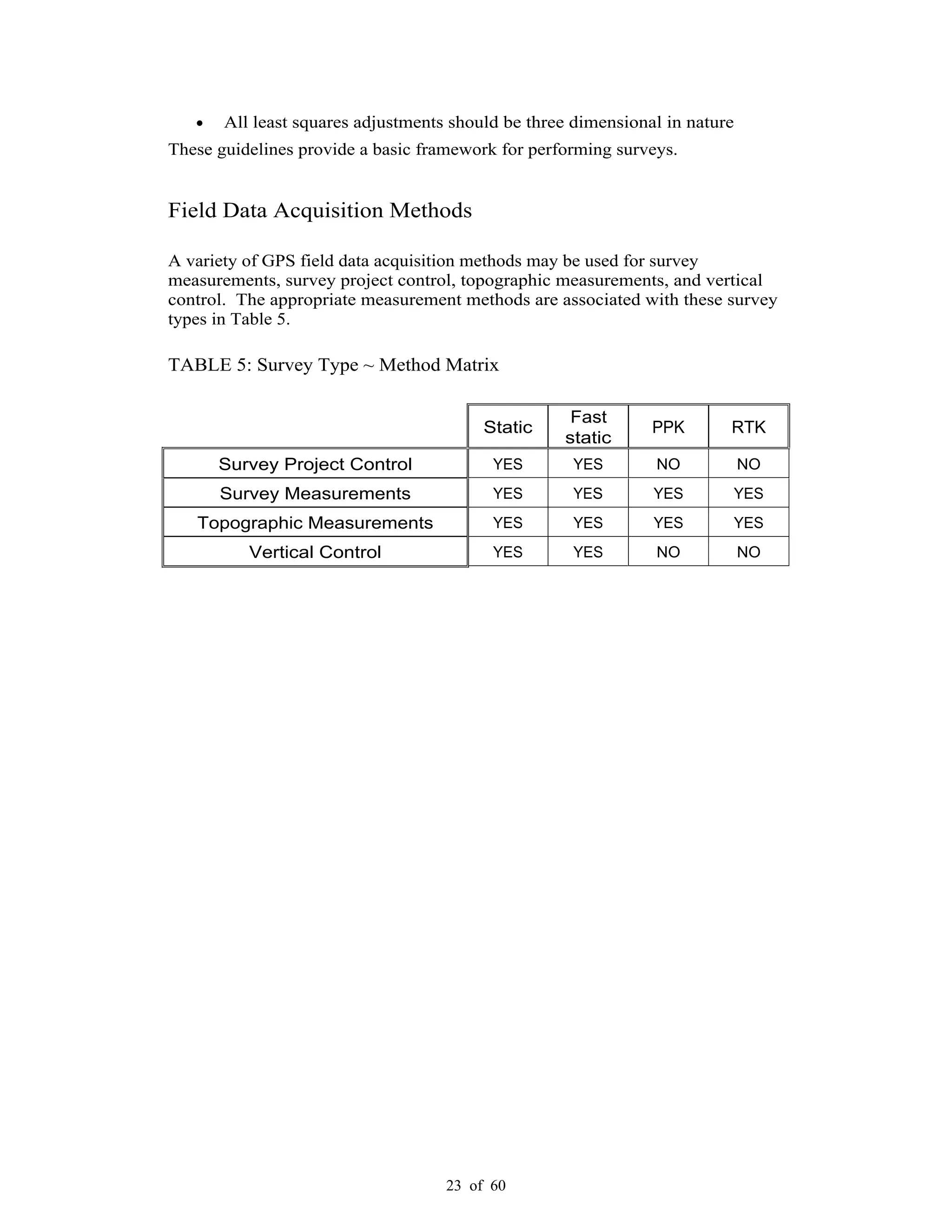
A variety of GPS field data acquisition methods may be used for survey
measurements, survey project control, topographic measurements, and vertical
control. The appropriate measurement methods are associated with these survey
types in Table 5.
TABLE 5: Survey Type ~ Method Matrix
Static
Fast
static
PPK RTK
Survey Project Control YES YES NO NO
Survey Measurements YES YES YES YES
Topographic Measurements YES YES YES YES
Vertical Control YES YES NO NO
24 of 60
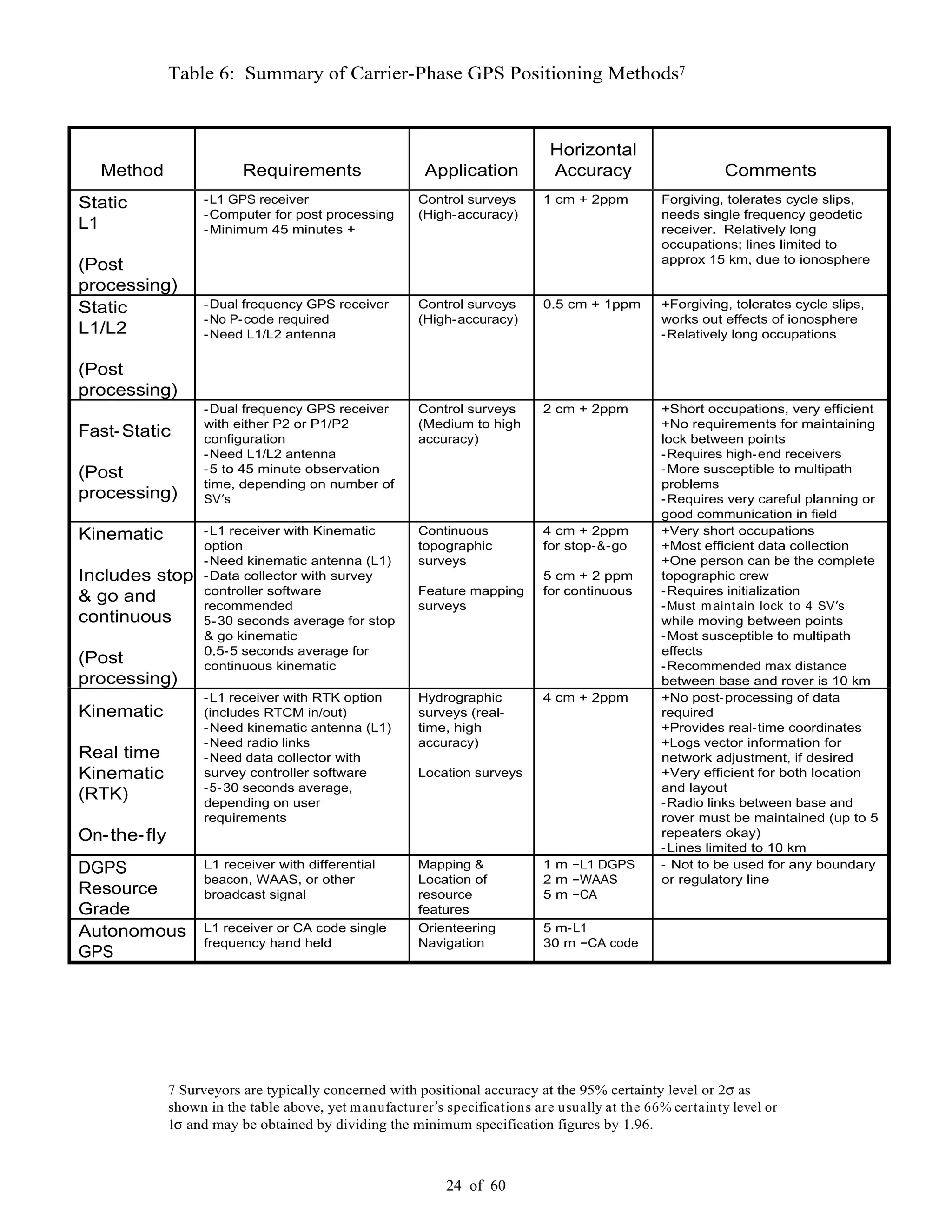
Table 6: Summary of Carrier-Phase GPS Positioning Methods7
Method Requirements Application
Horizontal
Accuracy Comments
Static
L1
(Post
processing)

-L1 GPS receiver
-Computer for post processing
-Minimum 45 minutes +
Control surveys
(High-accuracy)

1 cm + 2ppm Forgiving, tolerates cycle slips,
needs single frequency geodetic
receiver. Relatively long
occupations; lines limited to
approx 15 km, due to ionosphere
Static
L1/L2
(Post
processing)
-Dual frequency GPS receiver
-No P-code required
-Need L1/L2 antenna
Control surveys
(High-accuracy)
0.5 cm + 1ppm +Forgiving, tolerates cycle slips,
works out effects of ionosphere
-Relatively long occupations
Fast-Static
(Post
processing)
-Dual frequency GPS receiver
with either P2 or P1/P2
configuration
-Need L1/L2 antenna
-5 to 45 minute observation
time, depending on number of
SV s
Control surveys
(Medium to high
accuracy)
2 cm + 2ppm +Short occupations, very efficient
+No requirements for maintaining
lock between points
-Requires high-end receivers
-More susceptible to multipath
problems
-Requires very careful planning or
good communication in field
Kinematic
Includes stop
& go and
continuous
(Post
processing)
-L1 receiver with Kinematic
option
-Need kinematic antenna (L1)
-Data collector with survey
controller software
recommended
5-30 seconds average for stop
& go kinematic
0.5-5 seconds average for
continuous kinematic
Continuous
topographic
surveys
Feature mapping
surveys
4 cm + 2ppm
for stop-&-go
5 cm + 2 ppm
for continuous
+Very short occupations
+Most efficient data collection
+One person can be the complete
topographic crew
-Requires initialization
-Must maintain lock to 4 SV s
while moving between points
-Most susceptible to multipath
effects
-Recommended max distance
between base and rover is 10 km
Kinematic
Real time
Kinematic
(RTK)
On-the-fly
-L1 receiver with RTK option
(includes RTCM in/out)
-Need kinematic antenna (L1)
-Need radio links
-Need data collector with
survey controller software
-5-30 seconds average,
depending on user
requirements
Hydrographic
surveys (real-
time, high
accuracy)
Location surveys
4 cm + 2ppm +No post-processing of data
required
+Provides real-time coordinates
+Logs vector information for
network adjustment, if desired
+Very efficient for both location
and layout
-Radio links between base and
rover must be maintained (up to 5
repeaters okay)
-Lines limited to 10 km
DGPS
Resource
Grade
L1 receiver with differential
beacon, WAAS, or other
broadcast signal
Mapping &
Location of
resource
features
1 m L1 DGPS
2 m WAAS
5 m CA
- Not to be used for any boundary
or regulatory line
Autonomous
GPS
L1 receiver or CA code single
frequency hand held
Orienteering
Navigation
5 m-L1
30 m CA code
7 Surveyors are typically concerned with positional accuracy at the 95% certainty level or 2 as
shown in the table above, yet manufacturer s specifications are usually at the 66% certainty level or
1 and may be obtained by dividing the minimum specification figures by 1.96.
25 of 60
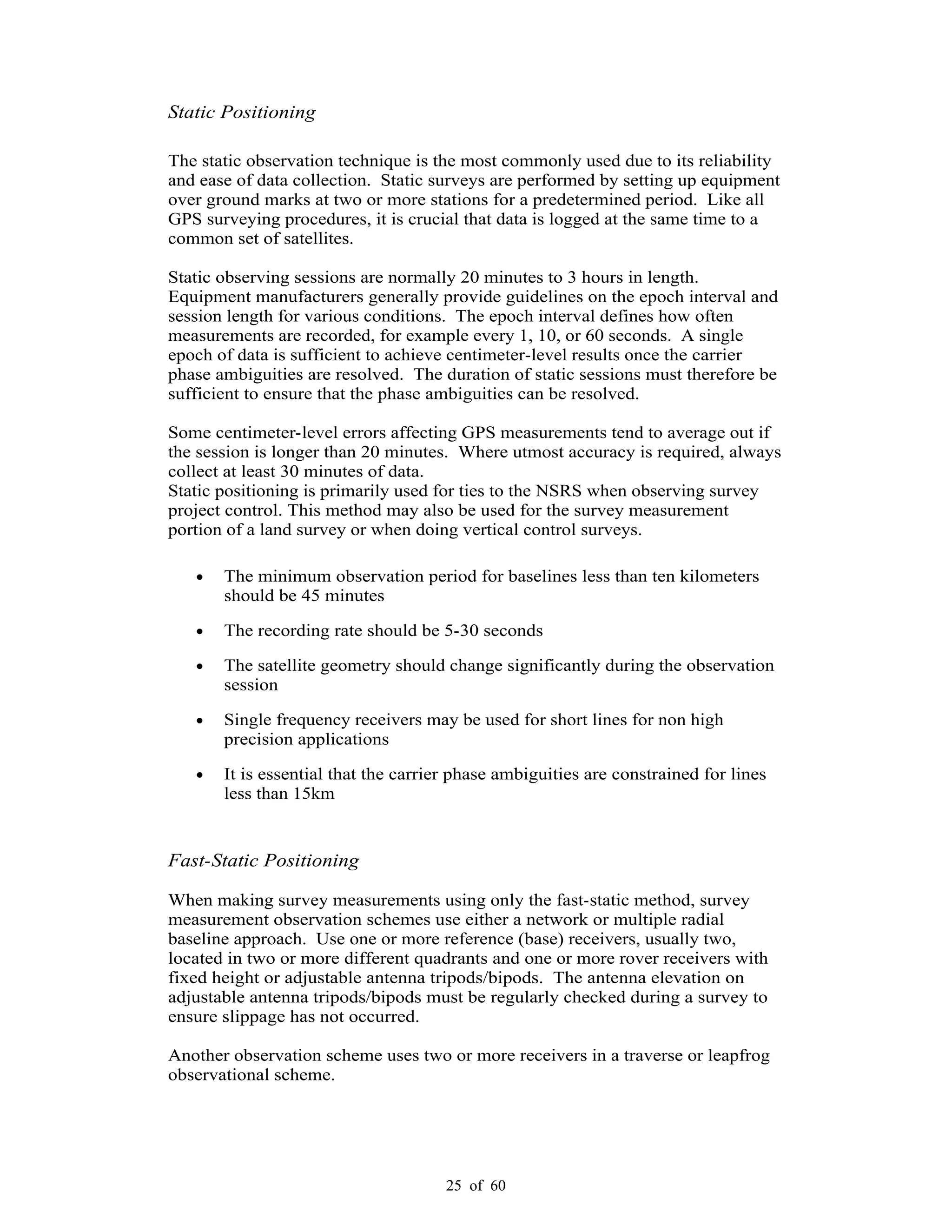
Static Positioning
The static observation technique is the most commonly used due to its reliability
and ease of data collection. Static surveys are performed by setting up equipment
over ground marks at two or more stations for a predetermined period. Like all
GPS surveying procedures, it is crucial that data is logged at the same time to a
common set of satellites.
Static observing sessions are normally 20 minutes to 3 hours in length.
Equipment manufacturers generally provide guidelines on the epoch interval and
session length for various conditions. The epoch interval defines how often
measurements are recorded, for example every 1, 10, or 60 seconds. A single
epoch of data is sufficient to achieve centimeter-level results once the carrier
phase ambiguities are resolved. The duration of static sessions must therefore be
sufficient to ensure that the phase ambiguities can be resolved.
Some centimeter-level errors affecting GPS measurements tend to average out if
the session is longer than 20 minutes. Where utmost accuracy is required, always
collect at least 30 minutes of data.
Static positioning is primarily used for ties to the NSRS when observing survey
project control. This method may also be used for the survey measurement
portion of a land survey or when doing vertical control surveys.
The minimum observation period for baselines less than ten kilometers
should be 45 minutes
The recording rate should be 5-30 seconds
The satellite geometry should change significantly during the observation
session
Single frequency receivers may be used for short lines for non high
precision applications
It is essential that the carrier phase ambiguities are constrained for lines
less than 15km
Fast-Static Positioning
When making survey measurements using only the fast-static method, survey
measurement observation schemes use either a network or multiple radial
baseline approach. Use one or more reference (base) receivers, usually two,
located in two or more different quadrants and one or more rover receivers with
fixed height or adjustable antenna tripods/bipods. The antenna elevation on
adjustable antenna tripods/bipods must be regularly checked during a survey to
ensure slippage has not occurred.
Another observation scheme uses two or more receivers in a traverse or leapfrog
observational scheme.
26 of 60
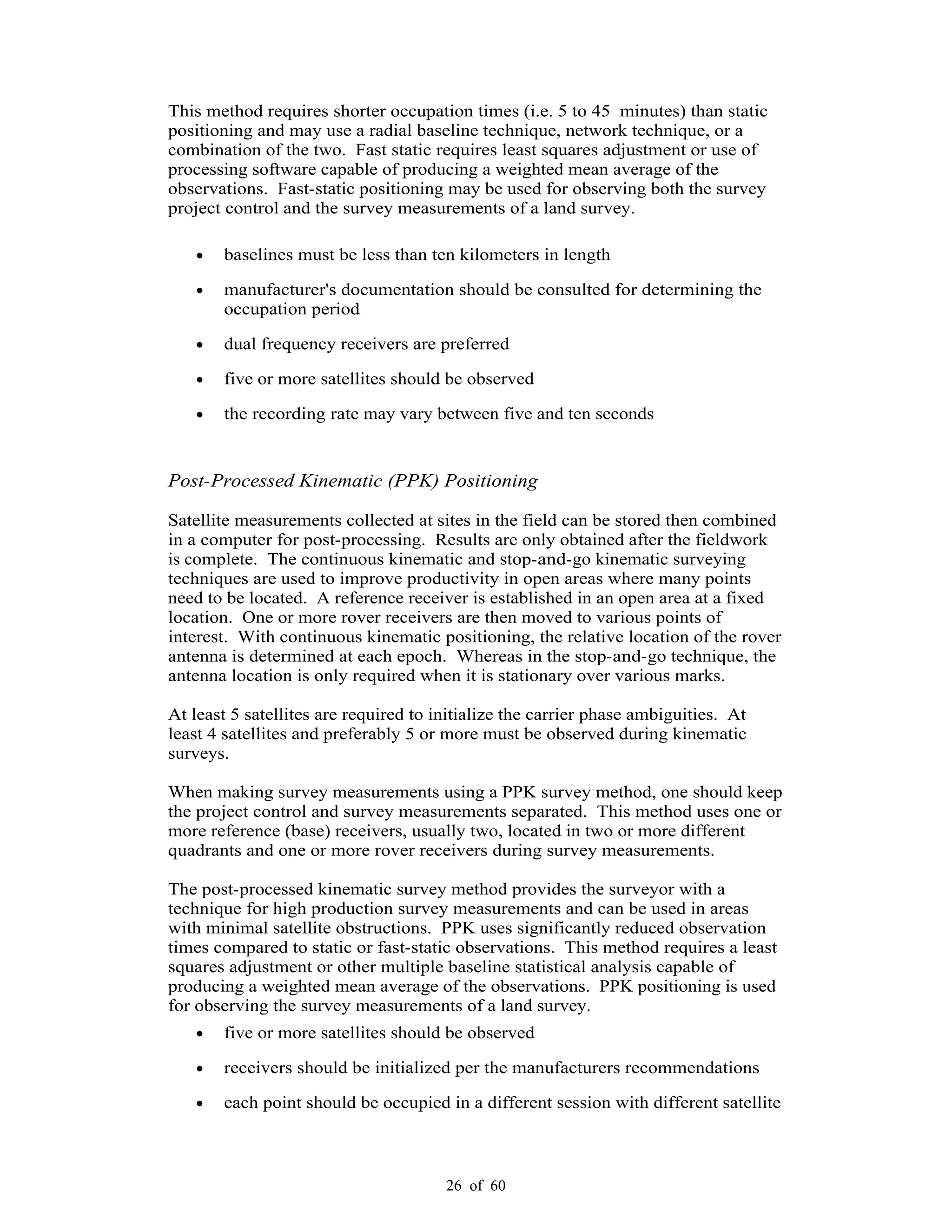
This method requires shorter occupation times (i.e. 5 to 45 minutes) than static
positioning and may use a radial baseline technique, network technique, or a
combination of the two. Fast static requires least squares adjustment or use of
processing software capable of producing a weighted mean average of the
observations. Fast-static positioning may be used for observing both the survey
project control and the survey measurements of a land survey.
baselines must be less than ten kilometers in length
manufacturer's documentation should be consulted for determining the
occupation period
dual frequency receivers are preferred
five or more satellites should be observed
the recording rate may vary between five and ten seconds
Post-Processed Kinematic (PPK) Positioning
Satellite measurements collected at sites in the field can be stored then combined
in a computer for post-processing. Results are only obtained after the fieldwork
is complete. The continuous kinematic and stop-and-go kinematic surveying
techniques are used to improve productivity in open areas where many points
need to be located. A reference receiver is established in an open area at a fixed
location. One or more rover receivers are then moved to various points of
interest. With continuous kinematic positioning, the relative location of the rover
antenna is determined at each epoch. Whereas in the stop-and-go technique, the
antenna location is only required when it is stationary over various marks.
At least 5 satellites are required to initialize the carrier phase ambiguities. At
least 4 satellites and preferably 5 or more must be observed during kinematic
surveys.
When making survey measurements using a PPK survey method, one should keep
the project control and survey measurements separated. This method uses one or
more reference (base) receivers, usually two, located in two or more different
quadrants and one or more rover receivers during survey measurements.
The post-processed kinematic survey method provides the surveyor with a
technique for high production survey measurements and can be used in areas
with minimal satellite obstructions. PPK uses significantly reduced observation
times compared to static or fast-static observations. This method requires a least
squares adjustment or other multiple baseline statistical analysis capable of
producing a weighted mean average of the observations. PPK positioning is used
for observing the survey measurements of a land survey.
five or more satellites should be observed
receivers should be initialized per the manufacturers recommendations
each point should be occupied in a different session with different satellite
27 of 60
geometry, unless collecting data while moving, e.g. during Light Detection
and Ranging (LiDAR).
the recording rate should be between one and five seconds
single frequency receivers may be used although dual frequency receivers
are preferred
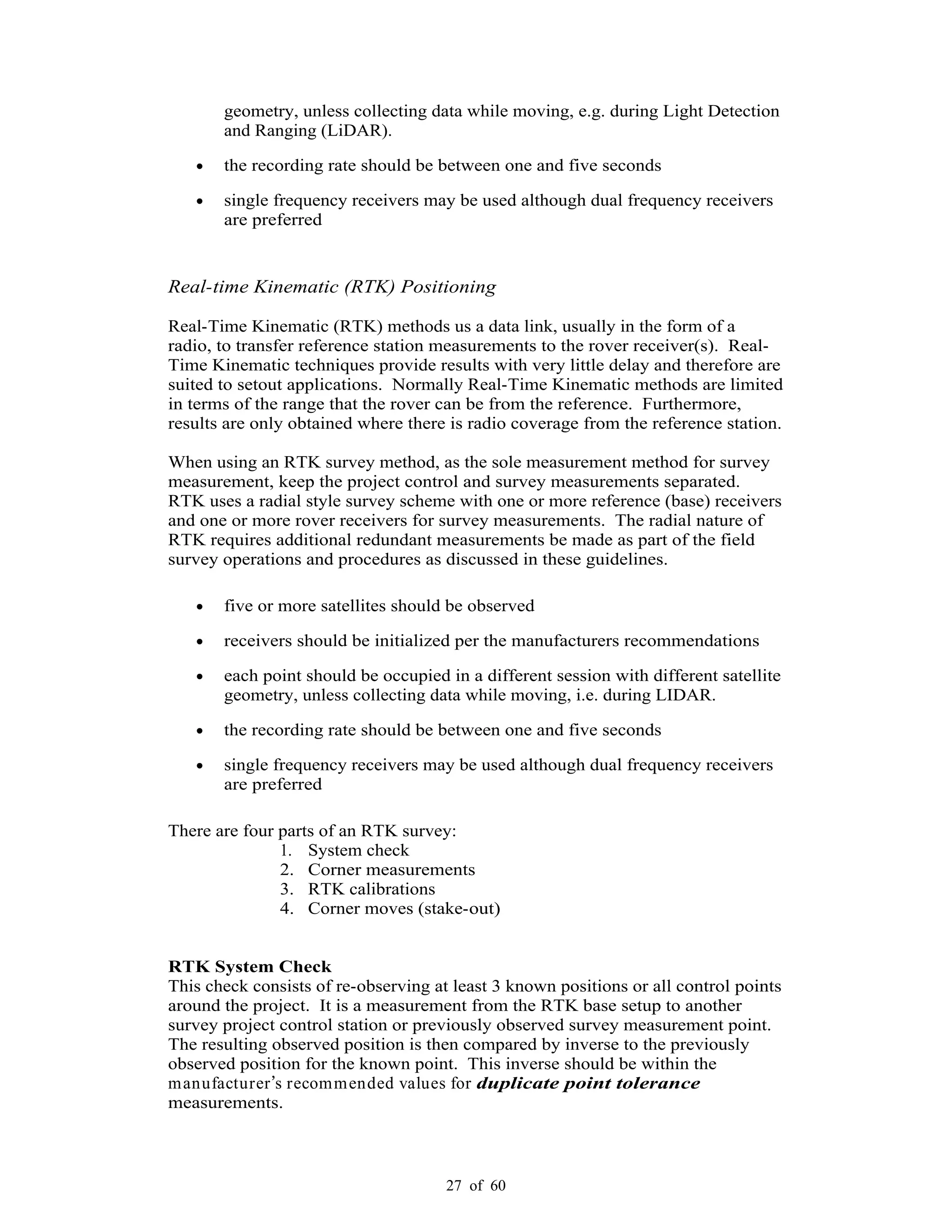
Real-time Kinematic (RTK) Positioning
Real-Time Kinematic (RTK) methods us a data link, usually in the form of a
radio, to transfer reference station measurements to the rover receiver(s). Real-
Time Kinematic techniques provide results with very little delay and therefore are
suited to setout applications. Normally Real-Time Kinematic methods are limited
in terms of the range that the rover can be from the reference. Furthermore,
results are only obtained where there is radio coverage from the reference station.
When using an RTK survey method, as the sole measurement method for survey
measurement, keep the project control and survey measurements separated.
RTK uses a radial style survey scheme with one or more reference (base) receivers
and one or more rover receivers for survey measurements. The radial nature of
RTK requires additional redundant measurements be made as part of the field
survey operations and procedures as discussed in these guidelines.
five or more satellites should be observed
receivers should be initialized per the manufacturers recommendations
each point should be occupied in a different session with different satellite
geometry, unless collecting data while moving, i.e. during LIDAR.
the recording rate should be between one and five seconds
single frequency receivers may be used although dual frequency receivers
are preferred
There are four parts of an RTK survey:
1. System check
2. Corner measurements
3. RTK calibrations
4. Corner moves (stake-out)
RTK System Check
This check consists of re-observing at least 3 known positions or all control points
around the project. It is a measurement from the RTK base setup to another
survey project control station or previously observed survey measurement point.
The resulting observed position is then compared by inverse to the previously
observed position for the known point. This inverse should be within the
manufacturer s recommended values for duplicate point tolerance
measurements.
28 of 60
When observing these measurements, the rover will be set to the manufacturer s
specifications, or less, for duplicate point tolerance for the measurement of a
known point with an existing point name. Manufacturers recommend that an
RTK system check may also be made at any time during the course of each RTK
survey session or at any time the base receiver(s) and rover receiver(s) are setup
and initialized.
An RTK system check is designed to check the following:
The correct reference base station is occupied.
The GPS antenna height is correctly measured and entered at the base and
rover. One way to minimize blunders in measure-up is to record both
meters and feet and make a comparison.
The receiver antennas are plumb over the station at the base and rover.
The base coordinates are in the correct datum and the plane projections
are correct.
The reference base stations or the remote stations have not been
disturbed.
The radio-communication link is working.
The RTK system is correctly initialized.
Root mean square (RMS) values are within the manufacturer s limits.
RTK Calibrations
A calibration or site registration is needed in real-time surveying to relate World
Geodetic System 1984 (WGS-84) positions to local grid coordinate projections.
UTM and State Plane coordinates can be directly derived from WGS-84 positions
and are considered a calibration. Local North- East (NE) systems require one or
more points that have coordinates in both WGS-84 and the chosen local grid
coordinate projection system. A calibration is needed whenever new points are to
be staked out. The accuracy of points to be staked out will depend on the
calibration accuracy. The accuracy and consistency of these points and of the
GPS measurements to them will affect the quality of the calibration. Calibrations
are not applicable to static or fast-static surveys.
The number of points that can be used in a calibration is manufacturer and
software dependent, although, it is recommended that the project be surrounded
by control. Calibration points should be well distributed around the project
exterior.
A minimum of four points with existing chosen vertical datum and GPS
measurements are required to introduce the vertical component into the project.
These points need to be distributed around the project in a box configuration
such that they include any measured points within their boundary. The same
points may be used for both horizontal and vertical calibration.
Care should be taken to keep relative equal spacing on control points. Clusters of
control points should be avoided since the calibration software may place greater
weight on these groups and skew or distort results.
A calibration, horizontal or vertical, may be used for subsequent projects as long
as the new project falls within the calibrated area.
29 of 60
Projects may be calibrated by different equipment and software:
a) Within a data collector
b) Using network adjustment software, then uploaded to the data collector
(recommended for large projects).
The calibration computation summary should be examined for reasonable results
in the horizontal scale, maximum vertical adjustment inclination, and the
maximum horizontal and vertical residuals. The RTK System Check can be used
to verify the accuracy of the calibration.
RTK Corner Measurement
Corner measurements are usually made with RTK using one or more base
configurations and one or more rover receiver configurations. RTK corner
measurements shall only be made after completion of the system setup-check
procedures.
When using RTK for corner measurements, follow the manufacturer s
recommendations for observation times to achieve the highest level of accuracy,
(for example, 180 seconds of time or when the horizontal (0.020 m) and vertical
(0.050 m) precision has been met for a kinematic control point). Under optimal
conditions, (clear sky, low positional dilution of precision (PDOP)) a deviation
from the manufactures suggested time could be appropriate.. However,
observation times should be set to account for field conditions, measurement
methods, (i.e. topographic point or kinematic control point) and the type of
measurement checks being performed. Observation time may need to be
increased (i.e. 200+ sec) if the field data is post-processed as a check.
Recommended methods for RTK corner measurement: RTK measurement
method choices are based upon availability of control, terrain, timing, and staff
and are optional.
Observe the unknown point per guidelines described above and store the
measurement (M1) in the data collector.
Initialization may be checked at this time by forcing a loss of satellite lock.
The best way to accomplish this is to invert the antenna. The initialization
can then be checked by a stakeout to the point or a second measurement
(M2).
RTK measurement verification: The baseline measurement (M1) to the
found corner location or temporary point can be verified by the following
method.
Perform a check measurement (M2) from the same or different
survey project control station used for the M1 measurement, at
least 1 hour after the M1 measurement was taken. This resultant
(M2) measurement can then be merged into the first ( M1)
measurement or stored separately (M2) for later analysis. The base
receivers height must be altered to insure an independent
baseline.
Note: The survey measurement tolerance of 4.6 cm is the maximum
acceptable distance for M1 M2 inverse. It should be accepted only
under extremely poor GPS conditions due to tree cover, multi-path, etc. If
30 of 60
this tolerance is exceeded, then one should measure with an alternate
method or move to a different location.
Real-time kinematic (RTK) positioning is similar to a PPK or a total station radial
survey. RTK does not require post-processing of the data to obtain a position
solution. This allows for real-time surveying in the field. This method allows the
surveyor to make corner moves (stake out) similar to total station/data collector
methods. RTK positioning is used for the survey measurement portion of a land
survey.
Real-time surveying technology may utilize dual-frequency (L1/L2) techniques
for initialization. The subsequent RTK measurements are then accomplished
using the L1 carrier phase frequency and are subject to the baseline length
limitations of 10 km. Other RTK measurement technologies can use the L1/L2
frequencies coupled with improved atmospheric models to determine baseline
solutions. This allows longer baselines to be measured using RTK.
RTK surveys can be performed using multiple base stations that can be
permanently installed or mobile. One system requires a set of fixed reference
stations, which continuously transmit to a central computer server. The server
performs sophisticated error checks. The server then models corrections for a
rover based upon its location within the network of base stations from a position
transmitted to the server via a two-way connection. This same connection then
sends the standard corrections to the rover. Other systems operate using a series
of independent base stations transmitting corrections that require the user to
analyze the data from each station sequentially.
Caution: Steps must be taken for reobservation and to remove the antennae
from any multipath areas. There is a need for redundancy during this type of
work. This type of surveying is not acceptable for control since there is not
enough redundancy or ability to analyze the data. The surveyor must make an
informed decision when choosing the appropriate methodology to be used in a
particular project area. For survey projects in a forest canopy environment with
marginal sky visibility, static or fast-static GPS methods or even conventional
optical methods should be considered in-lieu of using RTK or PPK.
Field survey operations should be performed using the manufacturer s
recommended receiver settings and observation times. Operations under
adverse conditions, such as under a forest canopy, may require longer
observation times than specified by the manufacturer, moving the setup to
an area of less obstruction, or waiting for a change in the constellation.
Fixed height or adjustable height antenna tripods/bipods can be used for
all rover GPS observations. The elevation of an adjustable height antenna
tripod/bipod should be regularly checked to make sure slippage has not
occurred.
All plumbing/centering equipment should be regularly checked for proper
adjustment.
31 of 60
RTK Corner Moves (stakeout)
RTK technology allows the surveyor to make a corner move or stakeout from a
known position to an unknown (calculated) position relative to the controlling
corners for a land survey. The system check will detect blunders and the
initialization quality of the survey. A system check must be done before making
any corner moves.
Note: Exercise caution when using grid coordinates for a stakeout. It is
important to apply the appropriate corrections for convergence, elevation,
and distance in accordance with the Public Land Survey System (PLSS) rules
found in the Bureau of Land Management s Manual of Instructions for the
Survey of the Public Lands of the United States, 1973 .
The recommended corner move procedure is:
Navigate to a calculated corner location (e.g. Corner A) using coordinates
from your local control base station (e.g. point 100).
Make a measurement at a temporary point called M1; inverse between the
M1 coordinate and the calculated Corner A coordinate; move the distance
and direction to the calculated Corner A location. Repeat these
measurements and corrections until you are satisfied that you occupy the
calculated Corner A position, set a temporary stake at the position, then
measure this location (e.g. M3) and overwrite the previously stored
temporary point.
Invert the rover antenna to force loss of satellite lock and initialization.
Reinitialize and check the location of the temporary point (M3).
Inverse between the M3 and M4 coordinates. If the measured positions of
M3 and M4 are within the duplicate point tolerance of the calculated
Corner A position then the initializations and measurements are correct.
Note, in this example, the M3 and M4 measurements are a short duration
(i.e. 30 seconds).
Set the monument at the true Corner A location.
Measure from another base station or after 2 hours to get a new
constellation.
Take a measurement on the set monument (e.g. for 180 seconds) and store
the position with a different name (e.g. Corner A-1). Optionally, set the
receiver or data collector to store data for subsequent post-processing.
As a check, inverse from the monumented, stored corner coordinate (e.g. A-
1) to the calculated Corner A coordinate to determine the difference from
the true corner location. The monumented corner location should be
within the defined local spatial accuracy standards required of the survey.
32 of 60
SECTION D: DATA PROCESSING AND ANALYSIS
Introduction to Loop Closures
The GPS surveying techniques are capable of generating centimeter accuracy
results if the carrier phase ambiguities are correctly identified and constrained
during data processing. The results are generally presented as Cartesian
coordinate differences, referenced to the World Geodetic System 1984 (WGS 84)
coordinate datum. These coordinate differences, or vectors, represent the three-
dimensional coordinate difference between the reference and rover receiver. In
addition to Cartesian coordinates, the vectors can be presented in terms of east,
north, and height differences. This is commonly performed using a local horizon
plane projection. Regardless of the manner in which the vectors are presented,
closures of connecting baselines can aid in the detection of erroneous
measurements. In the same manner in which a traverse misclosure is computed,
the three dimensional misclosure of GPS vectors can also be determined. GPS
surveys are not performed to generate traverse measurement equivalents;
therefore, surveyors use manually selected baselines to form loops of baselines.
The closures can be performed using a calculator, however, some GPS surveying
systems provide loop closure utilities with the data processing software.
Intelligent use of loop closures can enable erroneous baselines to be identified.
Checking Baselines Observed in Multiple Sessions
In order for a loop closure to be performed, GPS baselines are required from
more than one observation session. If only one session is used, the baselines are
correlated8 and loop closures will tend to always indicate excellent results. This is
due to the correlation between the baselines rather than the quality of the
baselines. When multiple sessions are observed, a number of strategies for
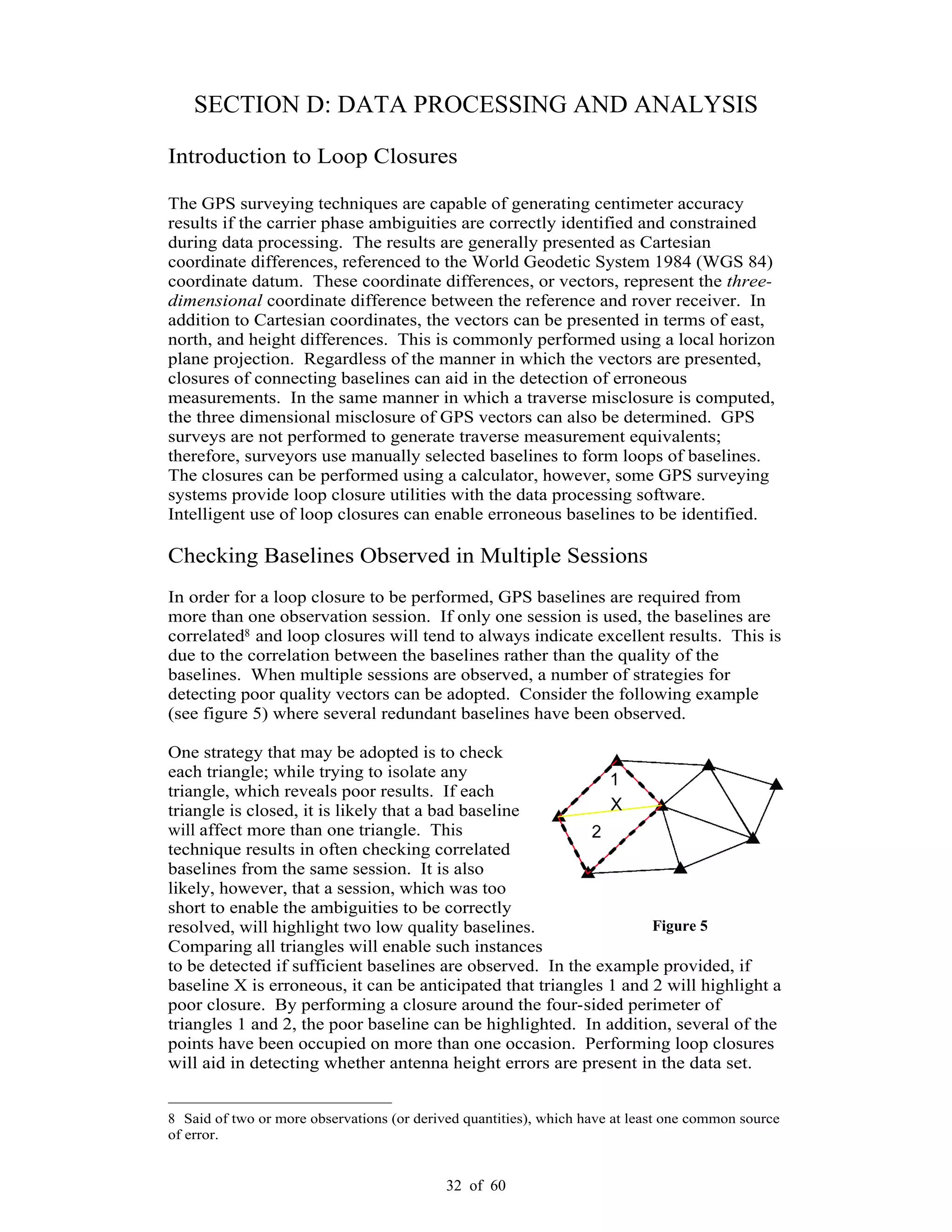
detecting poor quality vectors can be adopted. Consider the following example
(see figure 5) where several redundant baselines have been observed.
One strategy that may be adopted is to check
each triangle; while trying to isolate any
triangle, which reveals poor results. If each
triangle is closed, it is likely that a bad baseline
will affect more than one triangle. This
technique results in often checking correlated
baselines from the same session. It is also
likely, however, that a session, which was too
short to enable the ambiguities to be correctly
resolved, will highlight two low quality baselines.
Comparing all triangles will enable such instances
to be detected if sufficient baselines are observed. In the example provided, if
baseline X is erroneous, it can be anticipated that triangles 1 and 2 will highlight a
poor closure. By performing a closure around the four-sided perimeter of
triangles 1 and 2, the poor baseline can be highlighted. In addition, several of the
points have been occupied on more than one occasion. Performing loop closures
will aid in detecting whether antenna height errors are present in the data set.
8 Said of two or more observations (or derived quantities), which have at least one common source
of error.
Figure 5
33 of 60
Example 5: Errors caused by lack of redundant measurements
Experience has shown that during a static GPS survey (using dual-
frequency geodetic equipment), it is possible to get good loop closure and
have very small residuals in the network adjustment, yet still have a large
errors in the adjusted positions of some stations. This can happen if
stations are occupied in one session only.
In one situation, later traversing revealed an error of 2.4 meters in a single
occupied station s coordinates. Reprocessing the vectors in and out of the
point, from a single session, changed the position by 2.4 meters to a
position just a few hundredths different than one measured by ground
traverse. Both the original and reprocessed GPS networks had good loop
closure through the station in question. The vectors through the station in
question had high variance numbers. There were compensating errors in
the vectors in and out of the station. This can be attributed to the fact that
both vectors into the station are computed from the same data set.
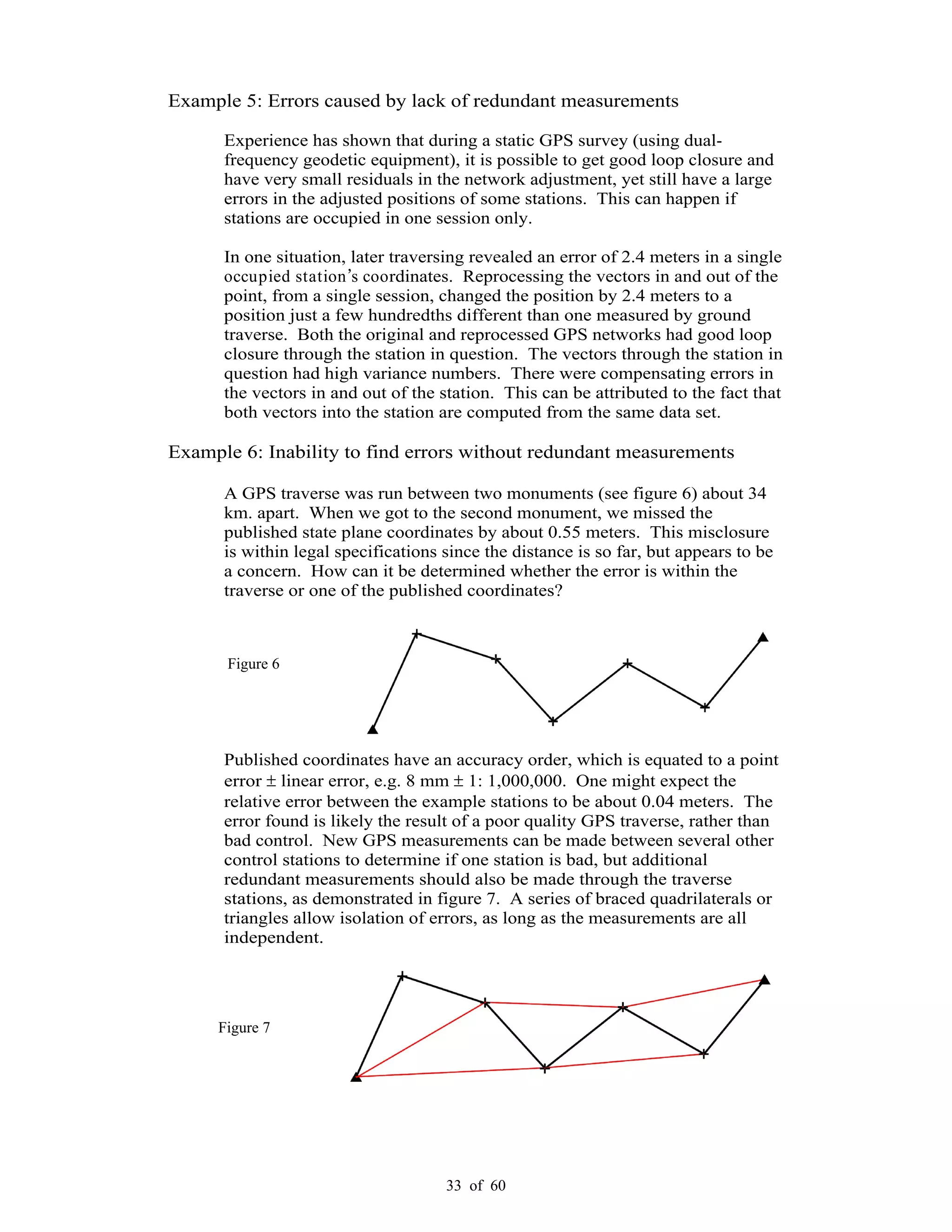
Example 6: Inability to find errors without redundant measurements
A GPS traverse was run between two monuments (see figure 6) about 34
km. apart. When we got to the second monument, we missed the
published state plane coordinates by about 0.55 meters. This misclosure
is within legal specifications since the distance is so far, but appears to be
a concern. How can it be determined whether the error is within the
traverse or one of the published coordinates?
Published coordinates have an accuracy order, which is equated to a point
error linear error, e.g. 8 mm 1: 1,000,000. One might expect the
relative error between the example stations to be about 0.04 meters. The
error found is likely the result of a poor quality GPS traverse, rather than
bad control. New GPS measurements can be made between several other
control stations to determine if one station is bad, but additional
redundant measurements should also be made through the traverse
stations, as demonstrated in figure 7. A series of braced quadrilaterals or
triangles allow isolation of errors, as long as the measurements are all
independent.
Figure 6
Figure 7
34 of 60
Internal Accuracy
Accuracy of a total station traverse can be computed based upon its misclosure. A
loop of GPS baselines can be treated in a similar fashion: loop misclosure is
computed in all three coordinate components and expressed as a ratio to the total
distance of the loop. More commonly, however, this internal accuracy can be
expressed in parts per million of the total baseline length. This will easily enable
an assessment to be made regarding the loop
closure performance in comparison to the
manufacturer defined specifications, which
are generally presented in parts per million.
An example of a baseline closure is shown in
figure 6. Six baselines with a combined length
of more than eleven kilometers have been
selected. The loops close to within a few
centimeters, resulting in a part per million
error of just over one and a half millimeters
per kilometer.
Loop closures should be performed on all networks before least squares network
adjustments are carried out. This will simplify the network adjustment process as
bad GPS baselines should have been detected and eliminated from the least
squares adjustment.
Introduction to network adjustment
When performing networks of GPS baselines, a least squares adjustment of the
generated baselines is often performed once processing is complete and should
follow the manufacturer s recommended procedures. These networks may
comprise static and kinematic baselines. The network adjustment procedure has
several functions in the GPS surveying process. The adjustment provides a single
set of coordinates based on all the measurements acquired, as well as providing a
mechanism by which baselines that have not been resolved to sufficient accuracy
can be detected. A series of loop closures should be performed before the
network adjustment procedure to limit the number of erroneous baselines
entering the adjustment process. A further feature of the network adjustment
stage is that transformation parameters relating the GPS vectors to a local
coordinate system can be estimated as part of the adjustment. The adjustment
process can be done in several ways. The following sections highlight the major
elements of the adjustment process.
Minimally Constrained Adjustment
Once the processed Cartesian vectors have been loaded into the adjustment
module9, an adjustment should be performed where no coordinates are
constrained. The adjustment should be performed using the WGS84 datum and
appropriate estimates of station centering error. In fact, the processor does
9 That portion of a GPS software application that is used to perform least squares adjustment of
GPS networks.
Figure 8
35 of 60
constrain one point internally to enable this adjustment to be solved. This
solution provides a mechanism by which GPS baselines, which are not sufficiently
accurate, can be detected. Once the minimally constrained adjustment has been
performed, the surveyor should analyze the baseline residuals and statistical
outputs (which will differ between adjustment programs) and ascertain whether
any baselines should be removed from subsequent adjustments. This process
relies on the baseline network being observed in such a manner to ensure that
redundant baselines exist. Redundant baselines enable erroneous baselines to be
detected as illustrated by Example 5.
Fully Constrained Adjustment
Once the minimally constrained adjustment has been performed and all
unsatisfactory baseline solutions removed, a fully constrained adjustment can be
performed. The constrained adjustment is performed to compute transformation
parameters, if required, and yield coordinates of all unknown points in the
desired coordinate system. The surveyor must ensure that sufficient points with
known coordinates are occupied as part of the survey. The user should analyze
the statistical output of the processor to ascertain the quality of the adjustment.
Large residuals at this stage, after the minimally constrained adjustment has been
performed, will indicate that the control points are non-homogeneous. It is,
therefore, important that additional control points are occupied to ensure that
such errors can be detected.
Error Ellipses
The standard deviation of the estimated coordinates is derived from the inverse of
the normal matrix generated during formulation of the least squares process.
Error ellipses for each point can be computed from the elements of this matrix.
The ellipse presents a two standard deviation confidence region (95% certainty)
in which the most probable solution based on the measurements will fall.
Surveyors should base the quality of the adjustment process on the magnitude of
these ellipses. Many contracts will specify the magnitude of error ellipses for both
the minimally constrained and fully constrained adjustments as a method of
prescribing required accuracy levels. The product documentation for the
adjustment program will further indicate the manner in which the ellipse values
are generated.
Independent Baselines
For the least squares adjustment process to be successful, the surveyor must
ensure that independent baselines have been observed. If more than one session
is used to build the baseline network, then independent baselines will exist. In
instances where one session is observed and all baselines adjusted, the
measurement residuals will all be extremely small. This is due to the correlation
that exists between the baseline solutions as they are derived from common data
sets. This is not a problem as long as the surveyor is aware of the occurrence and
does not assume that the baselines are of as high accuracy as implied from the
network adjustment results. (Surveyors Board of Victoria, Australia)
36 of 60
Error Analysis
The local accuracies of property corners are based upon the results of a least
squares adjustment of the survey observations used to establish their positions.
They can be computed from elements of a covariance matrix of the adjusted
parameters, where the known NSRS control coordinate values have been
weighted using their one-sigma network accuracies. The covariance matrix can
be found in the GPS software adjustment files which may be labeled similar to
Station Coordinate Error Ellipses within the Error Propagation tables.
Table 7: Error Propagation
Station Coordinate Error Ellipses (Meters)
NOTE - Adjustment Failed the Chi-Square Test
Error Ellipses are Scaled by Total Error Factor
Confidence Region = 95%
StationSemi-Major Semi-Minor Azimuth of Elev
Axis Axis Major Axis
1 0.00535 0.00518 174-54 0.13692
2 0.00652 0.00635 179-20 0.13703
11 0.00000 0.00000 0-00 0.13697
12 0.00000 0.00000 0-00 0.13700
13 0.00000 0.00000 0-00 0.13713
3005 0.00000 0.00000 0-00 0.13720
3106 0.00518 0.00506 172-15 0.13689
Note: Points 11, 12, 13 were held fixed as control
Another useful table contains Relative Error Ellipse data and can be found near
the other error tables (See Table 8: Relative Error Ellipses).
Table 8: Relative Error Ellipses (Meters)
NOTE - Adjustment Failed the Chi-Square Test
Relative Error Ellipses are Scaled by Total Error Factor
Confidence Region = 95%
Stations Semi-Major Semi-Minor Azimuth of Vertical
From To Axis Axis Major Axis
1 2 0.00706 0.00689 175-59 0.01016
1 11 0.00535 0.00518 174-54 0.01033
1 12 0.00535 0.00518 174-54 0.01173
1 13 0.00535 0.00518 174-54 0.01413
1 3005 0.00535 0.00518 174-54 0.01520
1 3106 0.00680 0.00663 173-57 0.00945
2 3106 0.00752 0.00737 176-34 0.01066
11 3106 0.00518 0.00506 172-15 0.00995
12 2 0.00652 0.00635 179-20 0.01112
12 3106 0.00518 0.00506 172-15 0.01095
13 2 0.00652 0.00635 179-20 0.01439
13 3106 0.00518 0.00506 172-15 0.01413
3005 3106 0.00518 0.00506 172-15 0.01509
37 of 60
The 95% confidence circle representing a local accuracy can be derived from the
major and minor semi-axes of the standard relative ellipse between two selected
points. It is closely approximated from the major (a) and minor (b) semi-axis
parameters of the standard ellipse and a set of coefficients. For circular error
ellipses, the circle coincides with the ellipse. For elongated error ellipses, the
radius of the circle will be slightly shorter than the major semi-axis of the ellipse.
A rigorous treatment of this computation may be found in Appendix A but, for the
purposes of this document, the radius of an error circle is equal to the major
semi-axis of an associated error ellipse. The value of the largest error circle
radius in the project should be adopted for reporting local project accuracy. Refer
to Relative Accuracy and Local Accuracy in Part One of this document.
Data Integration
When integrating GPS measurements with conventional terrestrial survey
measurements it is imperative that the surveyor verify:
The type of GPS receivers and antennae used
Geographic control coordinates have been properly transformed to State
Plane values
Appropriate value(s) for geoid separation is(are) adopted and applied for
the survey
The State Plane or local plane horizontal scale factors, angular rotation
factors, zone and units of measure are applied correctly.
The elevation scale factor is applied correctly to determine ground
distance at an average project elevation. A good check is to measure the
distance between two known points with an EDM if the scale factor is
significant.
The appropriate datum has been used.
There are no hidden or double transformations of the data.
The computation and reporting of the basis of bearing is appropriate.
38 of 60
SECTION E: PROJECT DOCUMENTATION
All GPS surveying projects must be performed under responsible charge of a
Professional Land Surveyor licensed to practice Land Surveying in Washington
State (RCW 18.43.040). The Board of Registration for Professional Engineers
and Land Surveyors considers the use of GPS surveying methods to establish
geodetic control and make survey measurements to be the practice of
Professional Land Surveying. Project documentation should be prepared and
stored in the appropriate project file, either hard copy or electronic, by the
surveyor in responsible charge as documentation of the GPS survey.
It is the surveyor s responsibility to ensure the appropriate safekeeping of survey
observation and computation data. The resources allocated to archiving depend
on the importance of the data and should be addressed on a case-by-case basis.
The overriding principle is that the more important the data, the more care
should be taken in preserving it. When making an assessment the following
items should be considered:
Is the data of public interest
Is the data of historic interest (the data may become useful for an
apparently unrelated project)
Is the data useful for future projects
How much would it cost to replace the data
How accessible should the data be (e.g. should hardcopy be scanned)
In what format should the data be stored to make it easily used in the
future (e.g. RINEX format for GPS data)
On what medium should the information be stored (will the medium still
be useable in the future, and will it require maintenance in the meantime)
Should the data have redundant archiving
Should there be off-site storage in case of a major catastrophe.
GPS data forms a record of the fieldwork and therefore should be archived so that
it could be reprocessed or used as evidence in the future. Where possible, raw
GPS observational data should be saved to Digital Versatile Disk (DVD), Compact
Disk-Read Only Memory (CD-ROM), floppy disk, or tape. Data should be stored
in the receiver native format or Receiver Independent Exchange (RINEX) format.
There are many GPS software packages available and although all return similar
results, there is considerable variety in the information produced. Ideally, this
would include all the mandatory and optional fields in the Receiver Independent
Exchange (RINEX) file
(ftp://igscb.jpl.nasa.gov/igscb/data/format/rinex210.txt), but at least the
information below should be available:
The station identifier
The observing authority
The antenna eccentricities (in all three dimensions) measured to the
Antenna Reference Point (ARP)
The receiver type
The antenna type
The GPS observables collected
The satellites observed
39 of 60
The observing times (start & finish)
Other key GPS solution elements that should be retained would include all
elements specified in the Solution Independent Exchange (SINEX) format
(ftp://igscb.jpl.nasa.gov/igscb/data/format/sinex.txt), but at least the
information below should be available:
Processing Authority
Software (name & version)
Date & time of processing
Unique solution identifier
Data window
Sampling interval
Observables used
Orbits used
Solution options
Ambiguity solution
Station position(s)
Variance-Covariance matrix
Any additional comments
When Real-time kinematic is used, often raw GPS data is not logged, data
collector files should therefore be retained for archive.
Narrative Report
A surveyor s narrative report should include some combination of the following:
The make and model of the GPS receiver, antenna, and related equipment.
A summary of all field operations, including calibrations and duplicate
point measurements.
The baseline processing results and the software and version number
used.
The results of the Network adjustment including a summary of
covariances, standard deviation or root mean square (RMS) values and
the software and version number used.
A network diagram, true line diagram or map showing the network
configuration as designed.
A list of the HARN, CORS, or reference stations used in the survey.
A list of coordinates by station including the datum, geoid model, epoch,
and measurement units used.
Identification of local and/or network accuracies.
Documentation of any variations from these guidelines.
40 of 60
Example 7: Narrative Report for a Record of Survey10
Basis of Bearing
Washington Coordinate System, NAD83(1991), North Zone, Derived from
GPS ties to the following control stations:
Station
Designation
Northing Easting
U.S. Survey Feet
GP37547 5 701,832.785 1,325,445.570
7215 678,676.536 1,324,359.222
7254 704,738.084 1,347,907.146
New control stations established during this survey using GPS methods
Station
Designation
Northing Easting
U.S. Survey Feet
7324 700,760.409 1,343,495.547
7325 697,903.937 1,343,110.240
7326 701,972.200 1,340,517.373
Convergence:
-00°55 33 @ Center ¼ of Section 31
Project Distance Factor
The areas and distances shown are grid. Divide the grid distance by
1.00000063 to compute the ground distance
Latitude Factor = 1.00003883
Elevation Factor = 0.9999618
Combined Factor = 1.00000063
Control Specifications and accuracy
Control for this survey is in compliance with the Federal Geodetic Control
Committee s Geometric Geodetic Accuracy Standards and Specifications
for Using GPS Relative Positioning Techniques, Version 5.0 , Reprinted
with corrections on August 1, 1989, for Group C, Order 1 Surveys, field
observations were made using four Trimble 5700 receivers, with zephyr
geodetic antennae.
Corner ties were made by field traverse using a Leica TC1800L electronic
theodolite. Traverses were either closed loops or began and ended at
previously established control points. Traverse closures meet field
traverse standards for Lambert grid traverses as specified in WAC 332-
130-090. Corner monuments tied and monuments set were checked by
double measure of both direction and distance.
Method of Survey:
This survey combined the use of four Trimble navigation 5700 receivers &
Zephyr Geodetic antennae, a Topcon 603 total station, and a steel tape.
10 That map to be filed with the County Auditor following direction found in Chapter 58.09 RCW,
Surveys Recording.
41 of 60
GPS control coordinates were obtained from a true least squares
adjustment. Traverses are least squares or compass adjusted after a
simple even distribution of angular error. Traverse closures meet or
exceed field traverse standards for Lambert Grid Traverses as specified in
WAC (Washington Administrative Code) 332-130-090.
Reporting bearings and Distances
The basis of bearing for a land survey, when using GPS technology, may be
expressed as "Geodetic Bearing or Azimuth" and referenced to the Washington
Coordinate System Zone and datum. All ground distances may be determined at
ground elevation, except where the requirements are for sea level, using the
appropriate geoid model to determine the geoid separation. For a land survey,
the height above the geoid and the orthometric height are considered the same.
42 of 60
Appendix A
GLOSSARY AND DEFINITIONS
1-sigm a (1 )
Plus or minus 1 standard deviation. This value comprises 68.3% of the observations in a data set. The
implication is that if an additional observation were taken, there is a 68.3% chance that it will fall within 1
standard deviation of the previously determined mean. It is computed by finding the square root of the sum of
the squared residuals divided by the one less than the number of observations in the set.
1.96-sigm a (1.9 6 )
Plus or minus 1.96 Standard Deviations. This value comprises 95% of the observations in a data set. The
implication is that if an additional observation were taken, there is a 95% chance that it will fall within 1.96
Standard Deviations of the previously determined mean. See also 1-sigma
2-sigm a (2 )
Plus or minus 2 Standard Deviations. This value comprises 95.5% of the observations in a data set. The
implication is that if an additional observation were taken, there is a 95.5% chance that it will fall within 2
Standard Deviations of the previously determined mean. See also 1-sigma
3-sigm a (3 )
Plus or minus 3 Standard Deviations. This value comprises 99.7% of the observations in a data set. The
implication is that if an additional observation were taken, there is a 99.7% chance that it will fall within 3
Standard Deviations of the previously determined mean. An observation that falls outside of these limits is
considered and anomaly or an outlier and should be rejected from the data set. See also 1-sigma
3-D Minimum-Constrained Least Squares Adjustment
A least squares adjustment of a network of interconnected GPS measurements. Performed to test the internal
consistency or fit of the measurements, this type of adjustment assumes that only one point in the network is
fixed. Used to find and eliminate erroneous or poor quality measurements from the network.
Accuracy
The degree to which a measured quantity is related to the true value. The closer a measurement is to the true
value, the greater the accuracy of the measurement. How close a fix comes to the actual position.
Ambiguities
The initial bias in a carrier-phase observation of an arbitrary number of cycles. The initial phase measurement
made when a GPS receiver first locks onto a GPS signal is ambiguous by an integer number of cycles because the
receiver has no way of knowing the exact number of carrier wave cycles between the satellite and the receiver.
This ambiguity, which remains constant as long as the receiver remains locked on the signal, is established when
the carrier-phase data are processed.
Antenna Eccentricities
The offset distance from the antenna phase center to the mark being measured.
Antenna Phase Center
The electronic center of the antenna. It often does not correspond to the physical center of the antenna. The
radio signal is measured at the APC. The phase center cannot be physically measured to, so the offset of the
physical phase center from an external point on the antenna must be known and is commonly referenced to the
Base/Bottom of Antenna.
Antenna Reference Point (ARP)
Determined by an actual external point that can be physically measured to. Most commonly this point will be the
Bottom of Antenna (BA) and also commonly referred to as the Bottom of Pre-amplifier. An example of the
Antenna Reference Point is where the tribrach and antenna mount coincide.
Atmospheric Error
The atmosphere contains electrically charged particles (ions). If the ionosphere is excited to a great extent
(manifested in spectacular displays of the Northern Lights) GPS signals become deflected, thus inducing an
error in GPS derived positions. Ionospheric delay is a bending or deflecting of the GPS radio signals as they pass
through the Earth s ionosphere. Since the signals do not follow a direct path from satellite to receiver, they get
delayed. This time delay messes up the computation of the pseudoranges from the satellites to the receiver, thus
introducing an inaccuracy in GPS positions derived from them.
43 of 60
Base Station
An antenna and receiver set-up on a known location. It is used for real-time kinematic or differential surveys.
Data can be recorded at the base station for later post processing. The base station acts as the position from
which all other unknown positions are derived.
Baseline Processing
The act of using a computer program to compute baseline solutions from satellite measurements. This may be
done on a personal computer during post processing or within a receiver during real-time GPS surveying.
Baseline Residual
Baseline or Vector: The difference in three-dimensional coordinates (X, Y, Z) computed from the difference in
simultaneous carrier phase observations at two or more receivers. Residual: The difference between an
estimated (adjusted) value and the observed value; specifically, v = µx-x where x is an observation of the
estimated value µx.
Blunder
A screw up. A mistake. An erroneous value resulting from a screw up or mistake. These have no place in a
system of measurements as they produce an unwanted and unwarranted influence on the mean and other
computed statistics, such as the Standard Deviation and Standard Error.
CA Code
An acronym for Coarse/Acquisition Code, the pseudorandom binary code message that allows GPS receivers to
measure the ranges, or distances from itself to the GPS satellites in orbit. At least four pseudoranges are
necessary to compute a 3-D position on the earth.
Carrier Phase
The accumulated phase of either the L1 or L2 carrier of a GPS signal, measured by a GPS receiver since locking
onto the signal. Also called integrated Doppler.
Cartesian Coordinate
The Cartesian coordinate system is used by the WGS84 reference frame. In this coordinate system, the center of
the system is at the earth s center of mass. The z axis is coincident with the mean rotational axis of the earth and
the x axis passes through 0x N and 0x E. The y axis is perpendicular to the plane of the x and z axes.
Clock Error
Since GPS measurements are based upon very precise time, small errors will effect position estimates.
Confidence Circle
The 95% confidence circle representing a local accuracy can be derived from the major and minor semi-axes of
the standard relative ellipse between two selected points. It is closely approximated from the major (a) and
minor (b) semi-axis parameters of the standard ellipse and a set of coefficients. For circular error ellipses, the
circle coincides with the ellipse. For elongated error ellipses, the radius of the circle will be slightly shorter than
the major semi-axis of the ellipse. The radius r of the 95% confidence circle is approximated by:
Figure 9
r = Kp a
Where
Kp = 1.960790 + 0.004071 C + 0.114276 C2
+ 0.371625 C3
C = b/a
Note that the coefficients in the above expression are specific to the 95% confidence level, such that when the
major semi-axis of the standard ellipse is multiplied by the value of Kp, the radius of the 95% confidence circle is
obtained directly, and no further conversion is required (FGCS, 1995). Details on the circular confidence region
may be found in Leenhouts (1985), the source of which has not been found.
44 of 60
Confidence Ellipse, 95%
The statistic used to represent the accuracy of the horizontal coordinates
of a point. If the confidence ellipse represents network accuracy, then the
accuracy of the point with respect to the defined reference system is
represented. If the confidence ellipse represents a relative accuracy, then
the accuracy of the point with respect to another adjacent point is
represented, and may be used in conjunction with other relative accuracies
at that point to compute its local accuracy.
The 95% confidence ellipse is centered on the estimated horizontal
coordinates of the point as illustrated in Figure 5. The true position is
unknown and can only be estimated through the measurements. The 95%
confidence ellipse describes the uncertainty or random error in this
estimated position, resulting from random errors in the measurements.
There is a 95% probability that, in the absence of biases or other
systematic errors, the true position will fall within the region bounded by
the ellipse.
The 95% confidence ellipse for the horizontal coordinates of a point is
derived from the covariance matrix of the estimated coordinates as
computed using a least squares adjustment. It follows the actual
distribution of the random error in the estimated position, and is the preferred means of representing accuracy
when a detailed analysis of horizontal coordinate accuracy is required.
Constellation
A specific set of satellites used in calculating positions: three satellites for 2D fixes, four satellites for 3D fixes.
All satellites visible to a GPS receiver at one time. The optimum constellation is the constellation with the lowest
PDOP.
Constrained Adjustment
To hold (fix) a quantity (observation and coordinate) as true in a network adjustment.
Constraint
External limitations imposed upon the adjustable quantities (observations and coordinates) in a network
adjustment.
Continuous Kinematic
Successive baseline solutions generated at every epoch of an unbroken observation set. Typically used to track a
vehicle or platform in motion.
Continuously Operating Reference Station (CORS)
A GPS base station that may be part of the national network or of local origin. Data is often available over the
Internet and may also be available via radio or cell phone for real-time differencing.
Convergence
In this document, convergence is that angle between Washington State Plane Coordinate System grid and
geodetic directions, also known as the mapping angle. A formula is used to determine convergence = grid
direction geodetic direction. For positions on the grid, West of the Central Meridian the convergence is a
negative angle and East of the Central Meridian is a positive angle.
Cooperative Base Network (CBN)
A high-accuracy network of permanently marked control points spaced approximately 15-minutes by 15-minutes
(25-50 km) apart throughout the United States and its territories. CBN contains additional stations as needed
for safe aircraft navigation, or in areas of crustal motion. The National Geodetic Survey (NGS) responsibility for
CBN is to assist and advise cooperating agencies in establishing spatial reference control according to accepted
Federal standards and specifications.
Coarse Acquisition (C/A)-Code
A family of PRN codes transmitted by GPS satellites. Each satellite is assigned one of 32 unique codes in the
family. Each code consists of 1,023 chips and is sent at a rate of 1.023 megabits per second. The code sequence
repeats every millisecond. The C/A-codes are Gold codes -- PRN codes that are distinguished by a very low cross
correlation between any two codes (that is, they are nearly orthogonal). C/A-codes currently are transmitted
only on the L1 frequency.
Covariance
The average value of the quantity x(r1) * x(r2); where x is a randomly varying function of the variable r, and r1
and r2 are two given values of r. Covariance describes the interdependence between variables and is typically
expressed in a variance-covariance matrix where the diagonal elements are the variances of the corresponding
variables, and those off the main diagonal are the covariance values.
Figure 10
45 of 60
Covariance Matrix
A matrix that defines the variance and covariance of an observation. The elements of the diagonal are the
variance and all elements on either side of the diagonal are the covariance.
Cycles
The measurement interval used by a GPS receiver.
Cycle Slip
A discontinuity in GPS carrier-phase observations, usually of an integer number of cycles, caused by temporary
signal loss. If a GPS receiver loses a signal temporarily, due to obstructions for example, when the signal is
reacquired there may be a jump in the integer part of the carrier-phase measurement due to the receiver
incorrectly predicting the elapsed number of cycles between signal loss and reacquisition.
Datum
A frame of reference for coordinate systems that are used to locate or reference points of interest on a map.
Some datums are designed to fit a specific portion of the Earth. For example, the North American Datum of
1927 was designed to fit the North American continent, but is not well suited for mapping other parts of the
world. In contrast, the World Geodetic System of 1984 (WGS 84) datum and the closely related North American
Datum of 1983 (NAD 83) can be applied world wide and are compatible with global mapping systems such as the
Global Positioning System.
Degrees of Freedom
The number of redundant observations in a measurement system. For example, a triangle can be uniquely
defined if you know the lengths of all three of its sides. If you were to measure the lengths of the three sides, and
measure the three angles as well, you would have three more observations than would be minimally necessary to
solve the problem. These three extra observations are thus redundant. You get one degree of freedom for each
redundant observation in a system of measurements. The more redundant observations, the better. (see also,
Mean)
Differencing or Phase difference processing
Relative positioning computation of the relative difference in position between two points by the process of
differencing simultaneous reconstructed carrier phase measurements at both sites. The technique allows
cancellation of all errors, which are common to both observers, such as clock errors, orbit errors, and
propagation delays. This cancellation effect provides for determination of the relative position with much
greater precision than that to which a single position (pseudorange solution) can be determined.
Differential Global Positioning System (DGPS)
A method for improving the accuracy of C/A code derived GPS positions. Raw C/A code positions are accurate
to only about +/- 15 meters or so because not all of the delays in the radio signals broadcast by the GPS satellites
(which are used to calculate pseudo ranges and positions) can be accounted for.
Differential correction works by modeling the delays in the signals, thereby improving the accuracy of
pseudoranges derived from them. The delays can be estimated by collecting and analyzing GPS data that are
collected at a point whose position is known beforehand. Thus errors at the known point can be determined, and
since the earth is such a large place, these errors (transformed into corrections) can be applied to data collected
by other nearby GPS receivers.
Dilution of Precision (DOP)
A dimensionless number that accounts for the contribution of relative satellite geometry to errors in position
determination. DOP has a multiplicative effect on the UERE. Generally, the wider the spacing between the
satellites being tracked by a GPS receiver, the smaller the position error. The most common quantification of
DOP is through the position dilution of precision (PDOP) parameter. PDOP is the number that, when multiplied
by the root mean square (rms) UERE, gives the rms position error. Other DOPs include the geometric dilution of
precision (GDOP), horizontal dilution of precision (HDOP), and vertical dilution of precision (VDOP).
Double Difference
The double difference observable involves linearly combining the measurements acquired to two satellites
simultaneously measured by both receivers. In order to combine measurements in such a manner, the actual
raw measurements are required by the processing module.
The double difference approach gives rise to the double difference ambiguity terms. One satellite is termed the
reference satellite and is used during the development of all double differences. The solution reports and
residual graphs generated by GPS processing packages portray the estimated double difference quantities.
When the double differences are estimated as non-integer real numbers, the solution is said to be a float
solution. When the ambiguities are rounded to integers and constrained, the solution is said to be fixed. The
most accurate position results are generally provided by the fixed integer solution.
Dual-Frequency Receiver L1/L2
A type of receiver that uses both L1 and L2 signals from GPS satellites. A dual-frequency receiver can compute
more precise position fixes over longer distances and under conditions that are more adverse because it
compensates for Ionospheric delays.
46 of 60
Duplicate Point Tolerance
The maximum distance in an RTK system check (See Section B, II. D.1.) by which two observations of the same
point can differ. It is also the maximum distance in an RTK survey that two observations of the same point can
differ and still be recorded as the same point for least squares or multi-baseline analysis. The duplicate point
tolerance for these guidelines is 2.5 cm.
Elevation Mask
An angle, which is normally set to 13°. If you track satellites from above this angle, you usually avoid
interference caused by buildings, trees, and multipath errors. Manufacturers recommend that you do not track
satellites from below 13°.
Elevation Scale Factor
A number by which a length calculated in the State plane coordinate system is multiplied to obtain the length of
the geodetic, or conversely.
Ellipse
A two-dimensional figure similar to a circle, but whereas a circle has but one radius, an ellipse has two radii of
differing lengths. The longer of the two elliptical radii is known as the semi-major axis of the ellipse, the shorter
as the semi-minor axis.
Ellipsoid
A three-dimensional figure similar to a sphere, but whereas a sphere is based upon a circle, an ellipsoid is based
upon an ellipse. Ellipsoids are used to approximate the size and shape of the Earth and in turn, form the basis
for the various geodetic datums. In this case, semi-major and semi-minor axes dimensions are chosen to
provide a figure that best fits a particular region, e.g. North America, or the entire world.
Ellipsoid Height
Most people understand elevation to mean height above mean sea level. But GPS uses a mathematical model,
called an ellipsoid, to represent the Earth. GPS receivers compute their 3D positions with respect to this model.
Consequently, a GPS derived elevation (i.e., ellipsoid height) is a height above the ellipsoid model surface not
height above sea level. In Clallam County, Washington, a point s ellipsoid height will be about 20 meters (65
feet) less than the mean sea level elevation for the same point. This relationship between ellipsoid height and
elevation varies worldwide.
Ephemeris
A description of the path of a celestial body indexed by time (from the Latin word, ephemeris, meaning diary).
The navigation message from each GPS satellite includes a predicted ephemeris for the orbit of that satellite
valid for the current hour. The ephemeris is repeated every 30 seconds and is in the form of a set of 16 Keplerian-
like parameters with corrections that account for the perturbations to the orbit caused by the earth s
gravitational field and other forces.
Epoch
A particular instant of time or a date for which values of data are given, or a given period of time during which a
series of events take place.
Epoch Interval
The measurement interval used by a GPS receiver; also called a cycle.
Equipotential Reference Surface
A surface with the same potential (usually of gravity or of gravitation) at every point. This is also referred to as a
level surface.
Error
The difference between a true value and a measurement. Since all measurements contain some error, it is
impossible to determine a true value exactly, although it is possible to estimate how close the mean of a series of
measurements is to the true value.
Error Circle
A variation on the error ellipse. The radius of an error circle is assumed equivalent to the semi-major axis of a
particular error ellipse.
Error Ellipse
A zone of uncertainty, elliptical in shape surrounding a survey point. At the center of the ellipse lies the most
likely coordinate for the point, but statistically speaking, the point could lie anywhere within the computed error
ellipse. In the case of GPS surveys, the dimensions of the ellipses are computed by combining the uncertainty in
GPS vectors and set-up errors. Error ellipse s dimensions can be minimized by keeping ancillary equipment in
good adjustment by performing redundant observations, and by collecting sufficient data to ensure that only
high quality GPS vectors are included in the network.
Fast Static Method
47 of 60
A method of GPS surveying using occupations of up to 20 minutes to collect GPS raw data, then post processing
to achieve sub-centimeter precisions. Typically, the occupation times vary based on the number of satellites
(SVs) in view. 4 SVs take 20 minutes; 5 SVs take 15 minutes; 6 or more SVs take 8 minutes; all using a 15 second
epoch rate.
Federal Base Network (FBN)
The Federal Base Network (FBN) is a nationwide network of permanently monumented stations spaced 100
kilometers apart with higher density in crustal motion areas. The FBN provides spatial reference control that has
some of the most precise accuracies available today. The FBN is designed to provide the following local
accuracies (with a 95% confidence level): 1 centimeter for latitudes and longitudes
2 centimeters for ellipsoidal heights
3 centimeters for orthometric heights
50 microgals for gravity
1 millimeter per year for crustal motion
Federal Geographic Data Committee (FGDC)
The Federal Geographic Data Committee is a 19 member interagency committee composed of representatives
from the Executive Office of the President, Cabinet-level and independent agencies. The FGDC is developing the
National Spatial Data Infrastructure (NSDI) in cooperation with organizations from State, local and tribal
governments, the academic community, and the private sector. The NSDI encompasses policies, standards, and
procedures for organizations to cooperatively produce and share geographic data. http://www.fgdc.gov/
Fixed Solution
A solution obtained when the baseline processor is able to resolve the integer ambiguity search with enough
confidence to select one set of integers over another. It is called a fixed solution because the ambiguities are all
fixed from their estimated float values to their proper integer values.
Float Solution
A solution obtained when the baseline processor is unable to resolve the integer ambiguity search with enough
confidence to select one set of integers over another. It is called a float solution because the ambiguity includes a
fractional part and is non-integer.
Fully Constrained Adjustment
A network adjustment in which all points in the network, which are part of a larger control network are held
fixed to their published coordinate values. Used to merge smaller with larger control networks and old to newer
networks.
Geodetic Azimuth or Bearing
Geographic direction, or pertaining to geodesy. Latitude and longitude readings are geodetic coordinates.
Geodetic Datum
A mathematical model or reference frame upon which a map is based or to which surveyed positions are related
e.g., WGS 84, NAD 83. Since the Earth is somewhat irregular in shape, different geodetic datums have been
devised and are in use throughout the world. Positions GIS that are expressed in one datum must be converted
for use in another datum if spatial relationships are to be preserved and accurately presented.
Geographic Information System (GIS)
A computerized database and mapping application that allows for the integration, management, analysis and
display of data from a multitude of sources in a single program. GIS data generally have some kind of
geographic component that make it possible to see spatial as well as mathematical relationships.
Geometric Dilution of Precision (GDOP)
The effects of the combined errors of four variables (latitude, longitude, altitude, and time) on the accuracy of a
three-dimensional fix.
Geoid
The undulating, but smooth, equipotential surface of the earth s gravity field, which coincides most closely with
mean sea level. The geoid is the primary reference surface for heights.
Geoid Separation
The distance between the geoid and ellipsoid, also known as geoid height.
Grid Coordinate
A coordinate on a two-dimensional horizontal rectangular coordinate system, such as a map projection.
Ground Distance
The horizontal distance measured at the mean elevation between two points.
High Accuracy Reference Network (HARN)
The network of monuments in any state that are part of the Federal Base Network. See Federal Base Network.
48 of 60
High Precision Geodetic Network (HPGN)
The original name of the High Accuracy Reference Network.
Horizontal Residual
The difference between an estimated (adjusted) horizontal value and the observed horizontal value; specifically,
v = µx-x where x is an observation of the estimated value µx.
Independent Baselines (Non-Trivial)
Non-trivial baselines are those vectors determined from differencing common phase measurements only once.
For each observing session, there are n-1 independent baselines where n is the number of receivers collecting
data simultaneously, with measurements inter-connecting all receivers during a session.
Generally, independent baseline processors assume that there is no correlation between independent vectors.
Trivial baselines may be included in the adjustment to make up for such a deficient statistical model. If the
mathematical correlation between two or more simultaneously observed vectors in a session is not carried in the
variance-covariance matrix, the trivial baselines take on a bracing function simulating the effect of the proper
correlation statistics, but at the same time introducing a false redundancy in the count of the degrees of freedom.
In this case the number of trivial baselines in an adjustment is to be subtracted from the number of
redundancies before the variance factor (variance of unit weight is calculated. If this approach is not followed,
trivial baselines are to be excluded from the network altogether.
Independent Occupations
An independent occupation is the set-up of the instrument over the station. These occupations are specified to
help detect instrument and operator errors. Operator errors include those caused by antenna centering and
height offset blunders. When a station is occupied during two or more sessions, back-to-back, the antenna pole
or tripod should be reset and plumbed between sessions to meet the criteria for an independent occupation. A
two-hour time break between sessions is very important to ensure constellation change.
Initialization or Initialized
Entering such data as time, time off-set, approximate position, and antenna height into a receiver (cold start
with no almanac) to help the unit find and track satellites.
Integer Number
A whole number, e.g. 1, 2, 3, etc.
Invert the Antenna
Turn the GPS antenna away from the sky to loose satellite tracking and force reinitialization. This is a method of
introducing redundancy into point measurement.
Ionosphere
That layer of the atmosphere approximately 30-300 miles above the earth s surface that contains electrically
charged particles (ions).
Kinematic
Pertaining to motion or moving objects.
Kinematic Positioning
Positioning a continuously moving platform by using GPS carrier-phase data while operating in a differential
mode.
Kinematic Surveying
A precise differential GPS surveying technique in which the roving user does not need to stop to collect precision
information. Meter to centimeter-level accuracy is available using mode, dual-frequency, carrier-phase
measurement techniques.
L-Band
The segment of the microwave portion of the radio spectrum nominally between 1 and 2 GHz.
L1 Carrier Phase Frequency
See L1 frequency band.
L1 Frequency Band
The 1575.42MHz GPS carrier frequency that contains the coarse acquisition (C/A) code and the encrypted P-
code for the precise positioning service. Also carries the NAVDATA message used by commercial GPS receivers.
L2 Frequency Band
The 1227.60MHz GPS carrier frequency carries the encrypted P-code and the NAVDATA message.
49 of 60
Land Survey
A survey, which creates, marks, defines, retraces or reestablishes the location and extent of ownership
boundaries or property lines. The term "practice of land surveying" within the meaning and intent of Chapter
18.43 RCW, shall mean assuming responsible charge of the surveying of land for the establishment of corners,
lines, boundaries, and monuments, the laying out and subdivision of land, the defining and locating of corners,
lines, boundaries and monuments of land after they have been established, the survey of land areas for the
purpose of determining the topography thereof, the making of topographical delineations and the preparing of
maps and accurate records thereof, when the proper performance of such services requires technical knowledge
and skill.
Light Detection and Ranging (LiDAR)
LIght Detection And Ranging uses the same principle as RADAR. The lidar instrument transmits light out to a
target. The transmitted light interacts with and is changed by the target. Some of this light is reflected / scattered
back to the instrument where it is analyzed. The change in the properties of the light enables some property of
the target to be determined. The time for the light to travel out to the target and back to the lidar is used to
determine the range to the target.
Local Accuracy
An average measure (e.g. mean, median, etc.) of the relative accuracy of a point s coordinates with respect to
other adjacent points at the 95% confidence level. For horizontal coordinate accuracy, the local accuracy is
computed using an average of the radii of the 95% relative confidence ellipses between the point in question and
other adjacent points. This indicates how accurately a point is positioned with respect to other directly
connected, adjacent points in the local network. Based upon computed relative accuracies, local accuracy
provides practical information for users conducting local surveys between control monuments of known
position. Local accuracy is dependent upon the positioning method used to establish a point. If very precise
instruments and techniques are used, the relative and local accuracies related to the point will be very good.
This definition is taken from Geospatial Positioning Accuracy Standards, Part 1: Standards for Geodetic
Networks , by the Federal Geographic Data Committee; see References.
The reported local accuracy for land survey purposes will be computed from the error ellipses generated by a
least squares or other multiple baseline statistical analysis, which is fully constrained to the survey project
control.
Lock
The state in which a GPS receiver receives and recognizes a satellite s signals. If the signals are interrupted, the
receiver experiences loss of lock, a common cause of interruption in a kinematic or RTK survey.
Least Squares Adjustment
A method of distributing the effects of random errors in a system of measurements according to the laws of
probability. Thus, least squares results in the most likely values. The simplest form of a least squares adjustment
of a data set is the computation and use of the mean of the set. In a least squares adjustment, the sum of the
squared residuals of a set of data is reduced to the minimum value possible.
Major Semi-Axis Parameter
The radius of an ellipse in the longer of the two dimensions.
Manufacturer s Duplicate Point Tolerance
This is the manufacturer s specification for the amount of duplicate point tolerance (see duplicate point
tolerance).
Manufacturer s Specifications
Equipment manufacturers provide a set of specifications within which their equipment will operate or
recommendations for use of the equipment.
Mapping Projection
Map projections often map the ellipsoid onto the plane by using a developable surface as intermediary. In a
cylindrical map projection the ellipsoid is first mapped onto a cylinder; in a conical map projection the ellipsoid
is first mapped onto a cone. Projections directly onto a plane are not designated as such, but are classified
according to the location of the center of projection, location of the plane, etc.
Mean
The average of a series of measurements. The most likely value for a measurement that consists of multiple
observations.
Measurement Residual
An observation minus the mean of the set of observations. Residuals are used for computing Standard Deviation
and Standard Error.
Measurement Uncertainty
Arises from errors that naturally occur in a system of measurements, also know as random errors.. Random
errors are the only class of errors that remain in measurement system after blunders and systematic errors have
been eliminated. Random errors magnitudes and algebraic signs cannot be predicted with certainty.
50 of 60
Nevertheless, their effects can be estimated. Random errors in a measurement system do not accumulate as
systematic errors do, instead they propagate according to the square root of the sum of the squares.
Median
In a data set, the median is the middle value. In a set of data, there are an equal number of values that are
greater than and less than the median.
Meteorological Readings
Usually in reference to various weather conditions that relate to GPS satellite signals passing through the
atmosphere, e.g. temperature, barometric pressure, and humidity.
Minimally Constrained
A network adjustment in which only enough constraints to define the coordinate system are employed. Used to
measure internal consistency in observations.
Minor Semi-Axis Parameter
The radius of an ellipse in the shorter of the two dimensions.
Multipath
Interference, similar to ghosting on a television screen. Multipath occurs when GPS signals traverse different
paths before arriving at the antenna. A signal that traverses a longer path yields a larger pseudorange estimate
and increases the error. Reflections from structures near the antenna can cause the incidence of multiple paths
to increase.
National Geoid Model
The National Geodetic Survey publishes geoid model data covering many different regions, e.g. covering the
continental U.S. (CONUS).
National Spatial Reference System (NSRS)
A consistent national coordinate system that specifies latitude, longitude, height, scale, gravity, and orientation
throughout the nation, as well as how these values change with time. The NSRS is defined and managed by the
National Geodetic Survey (NGS). NSRS consists of the following components:
The National CORS, a set of Global Positioning System Continuously Operating Reference Stations meeting
NGS geodetic standards for installation, operation, and data distribution.
A network of permanently marked points including the Federal Base Network (FBN), the Cooperative Base
Network (CBN), and the User Densification Network (UDN).
A set of accurate models describing dynamic geophysical processes affecting spatial measurements.
High Accuracy Reference Network (HARN) or High Precision Geodetic Network (HPGN) stations
established by GPS observations.
Vertical control marks, which are referenced to NGVD 29 or NAVD 88.
All other horizontal and vertical marks established to define the NSRS.
NSRS provides a highly accurate, precise, and consistent geographic reference framework throughout the United
States. Stations or marks established by GPS or high order classifications should be used with GPS survey
projects.
Network Accuracy
The absolute accuracy of the coordinates for a point at the 95% confidence level, with respect to the defined
reference system. Network accuracy can be computed for any positioning project that is connected to the NSRS.
The network accuracy of a control point is a number that represents the uncertainty in the coordinates, at the
95% confidence level, of this control point with respect to the geodetic datum. For the NSRS network accuracy
classification, the datum is expressed by the geodetic values at the NGS CORS. The local and network accuracy
values at CORS sites are considered to be infinitesimal and to approach zero.
Network accuracy for land survey reporting purposes will be computed from the error ellipses generated in a
least squares adjustment fully constrained to CORS or HARN stations or other GPS control stations which are
referenced to the HARN or CORS as outlined in Section B: Types of GPS Surveying; Survey Project Control.
Non-Trivial Baseline
See Independent Baseline.
North American Datum of 1983 (NAD83)
Successor to NAD27, NAD83 can be applied worldwide and, since its origin point is coincident with the Earth s
center of mass, is directly compatible with global mapping systems such as the Global Positioning System.
North American Datum of 1983(1991) (NAD83 (1991))
NAD83 network adjustment performed in 1991.
North American Datum of 1983(1998) (NAD83 (1998))
NAD83 network adjustment performed in 1998.
51 of 60
North American Datum of 1983(CORS) (NAD83 (CORS))
NAD83 positions determined at National CORS sites.
North American Datum of 1983(NSRS) (NAD83 (NSRS))
NAD83 network adjustment covering the entire United States as part of the National Spatial Reference System
(NSRS) adjustment.
North American Vertical Datum of 1988 (NAVD88)
The vertical control datum used by the National Geodetic Survey for vertical control, adopted in 1988.
On-the-Fly (OTF)
GPS data is collected while the receiver is moving, e.g. locating an airplane during flight.
One Sigm a (1 )
Plus or minus 1 standard deviation. This value comprises 68.3% of the observations in a data set. The
implication is that if an additional observation were taken, there is a 68.3% chance that it will fall within 1
standard deviation of the previously determined mean. It is computed by finding the square root of the sum of
the squared residuals divided by the one less than the number of observations in the set.
Orthometric Height
The height of a point above the geoid.
Outlier
An observation that does not fit with other measurements in a survey network, nor with the assumptions being
made about the precision of the measuring system. An outlier falls more than 3-sigma standard deviators
beyond expected limits for the observation. See also 3-simga
P-Code
See Precision code.
Phase Ambiguities
Integer bias term, Cycle ambiguity The unknown number of whole wavelengths of the carrier signal contained
in an unbroken set of measurements from a single satellite at a single receiver.
Photogrammetric Survey
An indirect method for determining positions of features on the Earth s surface using aerial photographs and the
methods of Photogrammetry.
Plane Projection
Coordinates are published in many different coordinate systems using many different map projections, e.g.,
latitude-longitude, state plane and Universal Transverse Mercator. Users must make certain that coordinate
systems and map projections are used consistently in a GPS survey. See also, projection
Point Standard Deviation
The degree of certainty one has in the accuracy of a point s coordinates. Usually expressed as a plus-or-minus
value in northing, easting, and elevation units, and usually at the 1-sigma level. Some software allows users to
take points standard deviations into account when performing a least squares network adjustment if they are to
be used for project control.
Positional Accuracy
The degree of certainty one has in the accuracy of a point s position. Usually expressed as a plus-or-minus value
in units of the survey, as in, ...this point s horizontal position is accurate to +/ - 0.05 feet. A point s positional
accuracy can be related to its datum (network accuracy), or to the primary control points from which it is derived
(local accuracy).
Positional Confidence
A statement used to describe the level of confidence one has in a point s positional accuracy, as in, this point s
horizontal position is accurate to +/- 0.05 feet at the 95% confidence level. See also, 1.96-sigma.
Positional Dilution of Precision (PDOP)
A measure how the visible GPS constellation s geometry will affect the quality of GPS vectors. PDOP is used to
select periods when the GPS satellites are most favorably positioned and thus optimal periods for collecting GPS
data.
Positional Tolerance
A method for analyzing the accuracy of survey point positions based on the precision of the measuring
equipment and methodology used to determine the points positions. Requires the use of the least squares
adjustment method. An advantage to this analysis method is that it allows for integration of different data types,
i.e. GPS and conventional, in the same survey network.
52 of 60
Post Processing
Applies to GPS vectors that are processed after the field observations have been completed. Involves
downloading data files from the receivers to a computer equipped with GPS baseline processing software.
Post Processed Kinematic (PPK)
Also known as Stop-and-Go kinematic. A radial GPS surveying technique wherein a base receiver is set up on
a point whose position is known. A roving receiver is then initialized on the same or a different known point;
after initialization, the rover occupies new points for a few epochs, and this data is recorded. Both the base and
roving receivers must receive signals from the same set of at least four satellites, moreover, the rover cannot
loose lock on the satellites if measurements are to continue uninterrupted. The technique differs from Real
Time Kinematic in that the base and rover operate independently and are not in radio contact with one another.
Processing of the kinematic GPS vectors is done in the office after field observations have been completed
(hence, post-processed) and yields set baselines from the base receiver to each of the points occupied by the
roving receiver. The technique is not suited to locations having sky obstructions and lacks redundancy. It is best
suited to low accuracy mapping applications in open settings.
Precision
The degree of refinement of a measurement or set of measurements.
Precision (P)-Code
A PRN code transmitted by GPS satellites. The code consists of about 2.353 1014 chips and is sent at a rate of
10.23 megabits per second. At this rate, it would take 266 days to transmit the complete code. Each satellite is
assigned a unique one-week segment of the code that is reset at Saturday/Sunday midnight. The P-code is
currently transmitted on both the L1 and L2 frequencies.
Primary Control Points
The points to which all other points in a survey are related. Examples are published NGS horizontal control
stations or benchmarks, HARN or HPGN stations; CORS stations or other points whose coordinates are known.
Projection, Mapping
A mathematical model used for translating the positions of features on the Earth s surface, which is curved, to a
flat surface, from which a map can be produced. Examples include the two-standard parallel Lambert conic
projection used for the Washington Coordinate System, and the cylindrical Universal Transverse Mercator
projection used for the UTM coordinate system.
Proper Correlation Statistics
In a least squares adjustment, values that describe how well the observations fit the assumptions made about the
precision of the tools used to make the observations. For example, in an adjustment that passes the Chi-
squared test observations (GPS vectors) in the network fit together or close within limits that are consistent
with assumptions made about centering errors and the like. There is a danger however: For example,
unreasonably loose centering errors can be used to mask poor GPS vectors, yielding what are apparently good
correlation statistics. Trivial vectors, when inadvertently included in a network adjustment can have the same
effect, since the adjustment software will treat them as independent redundant observations, which they are not.
Pseudorange Estimate
A pseudorange estimate is an range or distance from a GPS satellite to a GPS receiver that contains uncorrected
or uncorrectable errors.
Public Land Survey System (PLSS)
The system of cadastral surveys executed by the federal government in the 30 Public Land States the United
States except the 13 original colonies.
Public Record
Generally considered to be a document, which is recorded at the office of the County Auditor. May also be a
document with open access, e.g. from the Dept. of Natural Resources Public Land Survey Office.
Radial Data Capture Techniques
A GPS surveying technique wherein points positions are developed from single GPS vectors from a base station
to a roving receiver.
Random Error
Errors that naturally occur in a system of measurements. Random errors are the only class of errors that remain
in measurement system after blunders and systematic errors have been eliminated. Random errors magnitudes
and algebraic signs cannot be predicted with certainty. Nevertheless, their effects can be estimated. Random
errors in a measurement system do not accumulate, as do systematic errors; instead, they propagate according
to the square root of the sum of the squares.
Raw Measurements
Unadjusted measurements.
53 of 60
Real-Time Kinematic (RTK)
The DGPS procedure whereby carrier-phase corrections are transmitted in real time from a reference receiver to
the user s receiver. RTK is often used for the carrier-phase integer ambiguity resolution approach.
Receiver Independent Exchange Format (RINEX)
A generic file format for GPS data. CORS data is available in this format. RINEX makes it possible to share data
between different brands of GPS equipment.
Reference Receiver
A ground station at a known location used to derive differential corrections. The reference station receiver tracks
all satellites in view, computes their pseudoranges, corrects these for errors, and then transmits the corrections
to users.
Relative Accuracy
The accuracy with which a user can measure position relative to that of another user on the same navigation
system at the same time.
Relative Error Ellipse
The uncertainty in distance and direction between two points, each of which have their own point error ellipse.
Usually expressed in terms of bearing-plus-or-minus and distance-plus-or-minus. Also expressed as a parts-
per-million or relative precision statement.
Residual
The difference between an estimated (adjusted) value and the observed value; specifically, v = µx-x where x is an
observation of the estimated value µx.
Residual Graph
A graphic output from a computer program, which shows residual values. See Residual.
Resource Grade
A type of GPS receiver with specifications limited in accuracy to 1-5 meters and suitable for measurement of
many objects and features, but should not be used for property boundary surveys.
Revised Code of Washington (RCW)
The Revised Code of Washington (RCW) is the compilation of all permanent laws now in force. It is a collection
of Session Laws (enacted by the Legislature, and signed by the Governor, or enacted via the initiative process),
arranged by topic, with amendments added and repealed laws removed. It does not include temporary laws
such as appropriations acts. The RCW is published by the Statute Law Committee and is the official version of
the code.
Root Mean Square (RMS)
An expression that describes the precision of the mean with respect to the data set from which it is derived, also
known as the standard deviation of the set. Small standard deviations imply a data set with low scatter and
hence, high precision.
Rover Receiver
A GPS receiver that moves about (roves) collecting data at many different locations. Raw rover data is usually
corrected using one of several techniques, such as real-time or post processed differential correction, real-time
or post processed kinematic, or the fast static methods.
RTCM
Radio Technical Commission for Maritime Services, Special Committee 104 has developed standard message
types for use by differential GPS transmitting stations. The message content has been defined and hence when
the RTCM-104 standard (version 2.2 is the latest) is implemented within a user receiver, it is able to decode and
apply the DGPS corrections to its raw data in order to generate a DGPS-corrected coordinate.
Satellite Geometry
The relative positions of available GPS satellites at a given time, from the viewpoint of a GPS receiver. The set of
positions that result in a high (or low) PDOP are often described as poor (or good) satellite geometry.
Satellite Obstruction
Any object that lies in the line-of-sight between the GPS receiver and the satellite.
Satellite Vehicle (SV)
Each satellite in the GPS fleet has a number designation, SV#, by which it is referred in status and condition
reports. Data logging or viewing is also in reference to the specific SV#.
Scale Factor
A multiplier used on coordinate and other linear variables, such as for map projections and transformations.
54 of 60
Scale Parameters
Multipliers used on coordinate and other linear variables, such as for map projections and transformation.
Selective Availability
Errors introduced into the GPS signal by the Dept. of Defense to limit the accuracy of GPS receivers available to
civilians. Selective Availability has since been turned off increasing the accuracy of typically receivers from
around 100 meters to around 15-25 meters.
Semi-Axis
One-half of an ellipse s or ellipsoid s major (longer) or minor (shorter) axis. Analogous to radius in a circle or
sphere.
Solution Independent Exchange Format (SINEX)
A solution output format recently developed by geodesists to permit the exchange of solution information
between organizations, from which the original normal equation systems for precise GPS adjustments can be
reconstructed. These reconstructed equation systems can be combined with other normal equation systems to
create new GPS baseline solutions.
Standard Deviation
An expression that describes the precision of the mean with respect to the data set from which it is derived.
Small Standard Deviations imply a data set with low scatter and hence, high precision.
Standard Error Propagation
Deals with the behavior of random errors. The accuracy of a measuring device can be estimated by computing
its Standard Error, which is, in effect an estimate of the random errors that are likely to come from this source.
However, random errors in a survey network do not simply accumulate since they can be positive or negative.
Instead, they propagate according to the square root of the sum of the squares.
State Plane Coordinate
The plane-rectangular coordinate systems established by the United States National Geodetic Survey, one for
each state in the United States, for use in defining positions of geodetic stations in terms of plane-rectangular (x
and y) coordinates.
Static Method
See Static Positioning.
Static Positioning
Location determination when the receiver's antenna is presumed to be stationary on the earth. In the case of
pseudo-range-based techniques, this allows the use of various averaging techniques to improve the accuracy.
Static Positioning is usually associated with GPS Surveying techniques, where the two GPS receivers are static
for some observation period, which may range from minutes to hours (and even in the case of GPS geodesy,
several days).
Standard Deviation
An expression that describes the precision of the mean with respect to the data set from which it is derived.
Small Standard Deviations imply a data set with low scatter and hence, high precision. See one sigma error.
Station Error Ellipse
The error ellipse at a GPS measured point. See Error Ellipse.
Stop-&-Go Kinematic
This is a GPS Surveying "high productivity" technique, which is used to determine centimeter accuracy baselines
to static points, using site observation times of the order of 1 minute. Only carrier phase that has been converted
into unambiguous "carrier pseudo-range" is used, necessitating that the ambiguities be resolved BEFORE the
survey starts (and again at any time the satellite tracking is cut, e.g. due to signal obstructions). It is known as
the "stop & go" technique because the coordinates of the receiver are only of interest when it is stationary (the
"stop" part), but the receiver continues to function while it is being moved (the "go" part) from one stationary
setup to the next. As the receiver must track the satellite signals at all times, hence the transport of the receiver
from one static point to another must be done carefully.
Survey Measurement Tolerance
The maximum acceptable distance between two measured coordinates of the same point. This value is 4.6 cm.
When measurements are made within this tolerance in an RTK survey, the two observations may be recorded as
the same point number. These redundant measurements can then be included in a least squares or multi-
baseline analysis. This worst-case condition should only be encountered in the most marginal field conditions
for RTK surveys. These points should be noted in the surveyor s narrative report.
The survey measurement tolerance value of 4.6 cm is derived from standard error propagation relationships. It
is based on the following formula; the square root of the sum of the squares of the survey measurement
55 of 60
tolerance (4.6 cm) and the maximum allowable error of the survey project control (2cm) should approximately
equal the maximum allowable error budget of the survey measurements (5cm).
2 2
4.6 2 5
Survey Project Control
See Section B, Survey Project Control: Survey project control is a network of GPS stations tied to the NSRS or a
local control scheme, which is surveyed to control all subsequent GPS survey measurements. Project control
may also be used to bracket or surround a kinematic project with static points.
Survey Quality Statement
WAC 332-130-070 states that the accuracy or precision of field work may be determined and reported by either
relative accuracy procedures or field traverse standards, provided the final result shall meet or exceed the
standards contained in WAC 332-130-090. See also Section D, Narrative Report.
Systematic Error
Errors that can be computed and subsequently eliminated from a system of measurements. Example: Error in a
chained distance caused by thermal expansion of the steel tape.
Terrestrial Survey
A survey on or of land.
Tidal Datum
For marine applications, a base elevation used as a reference from which to reckon heights or depths. It is called
a tidal datum when defined in terms of a certain phase of the tide. Tidal datums are local datums and should not
be extended into areas, which have differing hydrographic characteristics without substantiating measurements.
In order that they may be recovered when needed, such datums are referenced to fixed points known as
benchmarks.
Tide Station
A device that measures tide height using a recorder to send an audio signal down a half-inch-wide sounding tube
and measure the time it takes for the reflected signal to travel back from the water's surface. The sounding tube
is mounted inside a 6-inch diameter protective well, which is similar to the old stilling well. In addition to
measuring tidal heights more accurately, the system also records 11 different oceanographic and meteorological
parameters. These include wind speed and direction, water current speed and direction, air and water
temperature, and barometric pressure. Each tide station has a 7 digit reference number and can be found at the
National Oceanic and Atmospheric Administration s site http://tidesonline.nos.noaa.gov/monitor.html
Topographic Map Accuracy Standards
The vertical accuracy standard requires that the elevation of 90 percent of all points tested must be correct
within half of the contour interval. On a map with a contour interval of 10 feet, the map must correctly show 90
percent of all points tested within 5 feet (1.5 meters) of the actual elevation.
Trivial Baseline
Trivial Baselines are those baselines formed when more than two GPS receivers are used simultaneously in the
field to perform static GPS surveys. For example, when 3 receivers at points A, B, C are deployed only 2 baselines
are independent (either A-B & A-C, AB & B-C, or AC & C-B), with the other one being trivial. This trivial baseline
may be processed, but because the data used for this baseline has already been used to process the independent
baselines, the baseline results should not be used for Network Adjustment or for quality control purposes unless
the statistics (and variance-covariance matrix) are appropriately downweighted.
Tropospheric Error
Tropospheric Delay. Retardation of GPS signals caused by elements in the troposphere such as temperature, air
pressure, and water vapor.
Two Sigm a (2 )
Plus or minus 2 Standard Deviations. This value comprises 95.5% of the observations in a data set. The
implication is that if an additional observation were taken, there is a 95.5% chance that it will fall within 2
Standard Deviations of the previously determined mean. See also one sigma error
Two Standard Deviation Confidence Region
See Two Sigma.
U.S. Survey Foot
The United States uses a different foot for one activity. When the United States adopted the international yard in
1959, the U.S. Coast and Geodetic Survey, mappers of the nation, objected that converting all their geodetic data
to international feet would be a horrendous undertaking. They were authorized to continue to use the previous
definition of the foot, that of the Mendenhall order (U.S. Coast and Geodetic Survey Bulletin 26, April 5, 1893),
one foot = 1200/ 3937 meter. This foot is now known as the U.S. Survey foot = 1.000 002 international feet, and is
used only for land measurements.
Universal Transverse Mercator (UTM)
56 of 60
A world-wide mapping system that uses rectangular coordinates to describe point s spatial relationships. There
are 60 different UTM zones, each having unique defining parameters. Similar to state plane coordinate systems,
but global in application. UTM mapping zones are based on cylindrical map projections whose axes are
perpendicular to the Earth s axis of rotation.
User Densification Network (UDN)
Comprises surveys that benefit the public and provide spatial reference for local infrastructure projects. UDN
surveys must be connected by observations to Federal Base Network or Cooperative Base Network control
points, in accordance with Federal Geodetic Control Subcommittee standards and specifications. When
requested, NGS provides quality assurance, archiving, and distribution for UDN survey data.
Variance-Covariance Matrix
The set of numbers expressing the variances and covariances in a group of observations.
Vector
A line that has a direction and a magnitude. GPS Surveying is all about measuring vectors and combining them
into closed figures or networks. GPS surveying instruments are used to measure vectors, and the vectors are
used to compute points coordinates.
Vector Baseline
A three-dimensional line between two points. The position of a point relative to another point. In GPS
surveying, this is the position of one receiver relative to another. When the data from these two receivers is
combined, the result is a baseline comprising a three-dimensional vector between the two stations.
Washington Administrative Code (WAC)
Regulations of executive branch agencies are issued by authority of statutes. Like legislation and the
Constitution, regulations are a source of primary law in Washington State. The WAC codifies the regulations
and arranges them by subject or agency.
Washington Coordinate System
Refer to Chapter 58.20 RCW. The system of plane coordinates under this chapter based on the North American
datum of 1983 as determined by the National Geodetic Survey of the U.S. Dept. of Commerce.
Weighted Mean Average
A method for computing the mean (or average) result of a data set that accounts for each observation s precision.
Observations that are more precise are assigned more weight in the computation, thus they have more influence
in the result than do observations that are less precise.
Wide Area Augmentation System (WAAS)
A system that enhances the GPS SPS and is available over a wide geographical area. The WAAS being developed
by the Federal Aviation Administration, in concert with other agencies, will provide WADGPS corrections,
additional ranging signals from geostationary (GEO) satellites, and integrity data on the GPS and GEO satellites.
World Geodetic System 1984 (WGS84)
A mathematical model (or reference ellipsoid) of the Earth whose dimensions were chosen to provide a best fit
with the Earth as a whole. WGS 84 and the closely related North American Datum of 1983 (NAD 83) are both
Earth-centered and can be applied worldwide and are compatible with global mapping systems such as the
Global Positioning System.
A set of parameters, established by the U.S. Defense Mapping Agency, for determining geometric and physical
geodetic relationships on a global scale. The system includes a geocentric reference ellipsoid; a coordinate
system; and a gravity field model. The ellipsoid is essentially that of the International Union of Geodesy and
Geophysics Geodetic Reference System 1980. The coordinate system is a realization of the conventional
terrestrial system, as established by the International Earth Rotation Service. The descriptions of the GPS
satellite orbits in the navigation message are referenced to WGS 84.
57 of 60
Appendix B
WASHINGTON STATE LAWS
LEGAL REFERENCES
Chapter 18.43 RCW Engineers and Land Surveyors
Section
18.43.020 Definitions
18.43.040 Registration Requirements
Chapter 58.20 RCW Washington Coordinate System
Sections
58.20.110 Definitions
58.20.120 System designation permitted uses.
Plane coordinates adopted Zones.
58.20.140 Designation of system Zones.
58.20.150 Designation of coordinates N and E.
Tract in both zones Description.
Zones Technical definitions.
58.20.180 Recording coordinates Control Stations.
Conversion of coordinates Metric
Term Limited use.
United States survey prevails Conflict.
Real estate transactions Exemption.
Severability 1989 c 54.
Chapter 332-130 WAC Minimum Standards for Land Boundary
Surveys and Geodetic Control Surveys and Guidelines for the
Preparation of Land Descriptions
WAC 332-130-020 Definitions.
WAC 332-130-060 Geodetic control survey standards.
For entire language for each law, visit http://slc.leg.wa.gov/
58 of 60
Appendix C
REFERENCES
Analysis of Real-Time Kinematic and Fast Static/Kinematic Least squares
Derived Coordinates Using a Wisconsin County UDN ; Paul Hartzheim and Darin
Henkel, Wisconsin Department of Transportation, Trimble User Conference
Proceedings, 1998
Accuracy Standards for Positioning , Version 1.0 (DRAFT) July 1996, Natural
Resources Canada-Geodetic Survey Division
http://www.geod.nrcan.gc.ca/index_e/products_e/publications_e/Accuracy_Sta
ndards.pdf
Geometric Geodetic Accuracy Standards and Specifications for Using GPS
Positioning Techniques , Version 5.0, May 11, 1988, reprinted with minor
corrections August 1, 1989, Federal Geodetic Control Committee
http://www.ngs.noaa.gov/FGCS/tech_pub/GeomGeod.pdf
Geospatial Positioning Accuracy Standards , FGDC-STD-007-1998, Federal
Geographic Data Committee
Part 1: Reporting Methodology
http://www.fgdc.gov/standards/documents/standards/accuracy/chapter1.pdf
Part 2: Standards for Geodetic Networks
http://www.fgdc.gov/standards/documents/standards/accuracy/chapter2.pdf
Part 3: National Standard for Spatial Data Accuracy
http://www.fgdc.gov/standards/documents/standards/accuracy/chapter3.pdf
GPS World, GPS Reference Glossary, found at
http://www.gpsworld.com/gpsworld/
Manual of Instructions for the Survey of the Public Lands of the United States,
1973 , Bureau of Land Management
http://www.az.blm.gov/cadastral/manual/manindex.html
Preliminary Draft Guidelines for Geospatial Positioning Using GPS , Draft 7,
June 10, 2001, Joe Evjen, National Geodetic Survey
http://www.ngs.noaa.gov/PROJECTS/GPSmanual/GPSguide.pdf
New Mexico State Office Accuracy Standards for Land Surveys , New Mexico
State Office, U.S. Bureau of Land Management
Utilizing Real-Time Kinematic GPS for Control Surveys , Ronald Berg, Ministry
of Transportation, Ontario, Trimble User Conference Proceedings, 1998
Standards and Guidelines for Land Surveys using Global Positioning System
Methods , Version 1.0 dated May 9, 2001, United States Department of
Agriculture- Forest Service and United States Department of the Interior- Bureau
of Land Management
http://www.blm.gov/nhp/efoia/wo/fy01/im2001-186attach1.pdf
http://www.ddl.org/figtree/pub/fig_2002/JS2/JS2_londe.pdf
59 of 60
Surveyor s Guidebook on Relative Accuracy June 1995, Washington State Dept.
of Natural Resources, Dept. of Natural Resources, Public Land Survey Office and
Survey Advisory Board.
http://www.wa.gov/dnr/htdocs/plso/relacc.pdf
"Guidelines for Establishing GPS-derived Ellipsoid Heights (Standards: 2 cm and
5 cm) , Version 4.3 dated November 1997, United States NOAA, NOS, National
Geodetic Survey, NOAA Technical Memorandum NOS NGS-58
http://www.ngs.noaa.gov/pubs_lib/ngs-58.html
NAVD 88 GPS-Derived Orthometric Heights , Four Parts, dated 2002 and
published by POB Online, by David B. Zilkoski
Part 1:
www.pobonline.com/CDA/ArticleInformation/features/BNP__Features__Item/
0,2338,21678,00.html
Part 2:
cegis.ce.vt.edu/research/articles/ew%20articles/POBp46May01.pdf
Part 3:
cegis.ce.vt.edu/research/articles/new%20articles/POBp18Jul01.pdf
Part 4:
www.pobonline.com/CDA/ArticleInformation/features/BNP__Features__Item/
0,2338,61910,00.html
Standards and Practices for Control Surveys , SP1 Version 1.5 dated May 2002,
Australia, Inter-Governmental Committee on Surveying and Mapping (ICSM)
http://www.icsm.gov.au/icsm/publications/sp1/SP1v1-5.pdf
Section 12 GPS Surveying, Survey Practice Handbook , Surveyors Board of
Victoria, Dept. of Land Information, State of Victoria, Australia
http://www.land.vic.gov.au/web/root/domino/cm_da/lcnlc2.nsf/frameset/surv
eying then select Survey Practice Handbook link, then select GPS Surveying link.
Surveying Using the Global Positioning System , Surveyors Board of Victoria,
Dept. of Land Information, State of Victoria, Australia,
http://www.surveyorsboard.vic.gov.au then select the document
http://www.surveyorsboard.vic.gov.au/documents/SurveyingusingGNSS.pdf
International standards for GPS files called RINEX & SINEX
ftp://igscb.jpl.nasa.gov/igscb/data/format/
ftp://igscb.jpl.nasa.gov/igscb/data/format/rinex210.txt
ftp://igscb.jpl.nasa.gov/igscb/data/format/sinex.txt
Barry, Austin B., Errors in Practical Measurement in
Surveying, Engineering and Technology, John Wiley
and Sons, Inc, reproduced by Landmark Enterprises Rancho
Cordova, CA
Buckner, R.B., Ph.D. Surveying Measurements and
their Analysis, Landmark Enterprises Rancho
Cordova, CA
60 of 60
Mikhail, Edward M, Ph.D. and Gracie, Gordon, Ph.D.
Analysis and Adjustment of Survey Measurements
Van Nostrand Reinhold Co., New York, NY
Surveyor's Guidebook on Relative Accuracy
Washington Department of Natural Resources,
Olympia, WA
Definitions of Surveying and Associated Terms, Prepared by a joint committee of
the American Congress on Surveying and Mapping and the American Society of
Civil Engineers.
http://www.ghcc.msfc.nasa.gov/sparcle/sparcle_tutorial.html
Glossary Of GPS Terminology Version 1998.23
http://www.rbf.com/cgcc/glossary.htm
GPS Glossary http://www.gps-com.gr/body_gps_glossary.html
Trimble All about GPS, http://www.trimble.com/gps/glossary.html
National Geodetic Survey, Geodetic Glossary
Satellite Navigation and Positioning Group, University of New South Wales,
Sidney, Austrailia,
http://www.gmat.unsw.edu.au/snap/gps/glossary_r-z.htm
National Oceanic and Atmospheric Administration, Tidal Terminology Reference
/ Dictionary, http://www.baysail.com/tide_terms/
This document was created with Win2PDF available at http://www.daneprairie.com.
The unregistered version of Win2PDF is for evaluation or non-commercial use only.

Standards and guidelines for land surveying using gps ver 2.1.3

  • 1.
    1 of 60 Standardsand Guidelines For LAND SURVEYING Using Global Positioning System Methods August 6, 2004 Version 2.1.3 By The Survey Advisory Board for Washington State Department of Natural Resources
  • 2.
    2 of 60 Tableof Contents TABLE OF CONTENTS.............................................................................................4 FOR EXAMPLES, TABLES, AND FIGURES..............................................4 FOREWORD.....................................................................................................................5 Disclaimer Statement..........................................................................................6 GPS SURVEY GUIDELINES ...............................................................................7 SECTION A: STANDARDS FOR POSITIONAL ACCURACY .........8 Accuracy Standard................................................................................................8 Horizontal .........................................................................................................................9 Vertical.............................................................................................................................9 Relative Accuracy and Local Accuracy ..........................................................................9 Local Accuracy..............................................................................................................9 Network Accuracy ........................................................................................................9 Linear Closure Relationship.........................................................................11 Expected Local Accuracy Positional Standards for GPS Land Surveys............................................................................................................14 SECTION B: TYPES OF GPS SURVEYING ..........................................15 Survey Project Control .....................................................................................15 Survey Measurements ......................................................................................16 Vertical Control......................................................................................................17 Basic Rules......................................................................................................................19 Control Requirements...................................................................................................19 Procedures ......................................................................................................................19 Adjustment......................................................................................................................20 Data Acquisition for Topographic/Contour Maps....................21 SECTION C: FIELD OPERATIONS AND PROCEDURES.......................................................................................................22 General Requirements......................................................................................22 Field Data Acquisition Methods................................................................23 Static Positioning...........................................................................................................25 Fast-Static Positioning..................................................................................................25 Post-Processed Kinematic (PPK) Positioning............................................................26 Real-time Kinematic (RTK) Positioning.....................................................................27 RTK System Check..................................................................................................27 RTK Calibrations.....................................................................................................28 RTK Corner Measurement ...................................................................................29 RTK Corner Moves (stakeout).............................................................................31 SECTION D: DATA PROCESSING AND ANALYSIS..32 Introduction to Loop Closures....................................................................32 Checking Baselines Observed in Multiple Sessions...................32 Internal Accuracy.................................................................................................34 Introduction to network adjustment.....................................................34
  • 3.
    3 of 60 MinimallyConstrained Adjustment......................................................34 Fully Constrained Adjustment ...................................................................35 Error Ellipses ...........................................................................................................35 Independent Baselines......................................................................................35 Error Analysis.........................................................................................................36 Data Integration....................................................................................................37 SECTION E: PROJECT DOCUMENTATION......................38 Narrative Report...................................................................................................39 Reporting bearings and Distances.........................................................41 APPENDIX A.................................................................................................................42 GLOSSARY AND DEFINITIONS..............................................................42 APPENDIX B.................................................................................................................57 LEGAL REFERENCES......................................................................................57 APPENDIX C.................................................................................................................58 REFERENCES..........................................................................................................58 1
  • 4.
    4 of 60 Tableof Contents for Examples, Tables, and Figures Examples Example 1 Local Accuracy 10 Example 2 Network Accuracy 11 Example 3 Expected Random Error 13 Example 4 Linear Closure ~ Accuracy Relationship 13 Example 5 Errors Caused by Lack of Redundant Measurements 33 Example 6 Inability to Find Errors without Redundant Measurements 33 Example 7 Narrative Report for a Record of Survey 40 Tables Table 1 FGDC Accuracy Standards 8 Table 2 Linear Closure ~ Accuracy Relationship 12 Table 3 Relative Accuracy between Points 12 Table 4 Expected Local Accuracy Positional Standards 14 Table 5 Survey Type ~ Method Matrix 23 Table 6 Summary of Carrier-Phase GPS Positioning Methods 24 Table 7 Error Propagation 36 Table 8 Relative Error Ellipses 36 Figures Figure 1 Horizontal and Vertical Accuracy Cylinder 9 Figure 2 Local Accuracy 10 Figure 3 Network Accuracy 11 Figure 4 Geoid, Orthometric, Ellipsoid Diagram 18 Figure 5 Network Diagram 32 Figure 6 GPS Traverse Diagram 33 Figure 7 Braced Figure GPS Network 33 Figure 8 Baseline Closure summary 34 Figure 9 Confidence Circle 43 Figure 10 Confidence Ellipse 44
  • 5.
    5 of 60 Foreword TheseStandards and Guidelines provide guidance to land surveyors using Global Positioning System (GPS) technology to perform land surveys1. They do not require that land surveys be performed to the higher accuracy and methodology requirements of geodetic control surveys but are intended to provide sufficient observational and occupational redundancy to detect blunders and quantitatively demonstrate the stated or required accuracy of a survey has been achieved. All tables and references are shown in metric dimensions. Many sources were consulted during the preparation of this document. These sources included other GPS survey standards and guidelines, technical reports and manuals (see Appendix D for References). Opinions and reviews were also sought from public and private Professional Land Surveyors who use GPS for land surveying. There are a number of errors that affect the position estimates derived from GPS measurements. The errors can generally be divided into three distinct groups; satellite dependent errors, propagation dependent errors, and receiver dependent errors. Clock Errors Satellite Orbits Selective Availability Atmospheric Errors Troposphere Ionosphere Multipath Antenna Phase Center Measurement Uncertainty The majority of the errors listed are "spatially related", in other words, two receivers at adjacent locations experience similar errors. This characteristic is used to eliminate many of the errors by surveying with two receivers simultaneously. The position error at both sites is assumed the same; therefore, the difference in coordinates between the two receivers should be significantly more accurate than the absolute position of each receiver. This technique is termed differential positioning and is used in all surveying applications of GPS technology. Two sources of error that are site specific with GPS are cycle slips and multipath. Cycle slips are generally physical objects, which block the signal but may also include seemingly insignificant things such as mesh fences or other small objects, which can deflect the satellite signal. Multipath is caused when the satellite signal takes two routes to the receiver. One route is direct from satellite to receiver and the second generally occurs when nearby hard surfaced flat objects deflect the signal from the satellite to the receiver. Unseen obstructions such as electromagnetic transmissions or natural occurring atmospheric disturbances may also interfere with this signal. Ionospheric corrections should be made on long baselines to compensate for any signal distortion. 1 This document will not cover geodetic control surveys and it does not cover the requirements necessary to meet the National Spatial Data Infrastructure (NSDI).
  • 6.
    6 of 60 Thestatic and fast static survey procedures in these guidelines follow long established and well-documented industry and government survey practices. Guidelines for real-time kinematic surveys are in the early stages of development. Real-time kinematic GPS is suitable for land surveying small areas. Maintenance of positional confidence requires certain observational and occupational redundancies and checks. Disclaimer Statement This document is intended to provide the user with guidelines for planning, execution, and classification of surveys performed using GPS carrier phase methodology. Note: Italicized words in bold font, i.e., independent occupation, indicate that a definition for that word appears in Appendix A: Definitions. Definition words are shown bold, italicized the first instance only.
  • 7.
    7 of 60 GPSSurvey Guidelines The guidelines outlined in this document focus on; Standards for Positional Accuracy Section A Types of surveying that may use GPS Section B Field operations and procedures Section C Data processing and data analysis Section D Project documentation Section E The use of these guidelines and the manufacturer s specifications provide a means for the surveyor to evaluate the survey and to verify that the specified accuracy standard can be achieved. These guidelines are designed to ensure that a survey performed with GPS technology is repeatable, legally defensible and can be referenced to the National Spatial Reference System (NSRS) by addressing the following set of criteria: 1. Elimination or reduction of known and potential systematic error sources. 2. Occupational (station) and observational (baseline) redundancy to clearly demonstrate the stated accuracy. 3. Documentation of baseline processing, data adjustment, and data analysis, which demonstrates the recommended procedures and required accuracy. 4. Compliance with the current Bureau of Land Management Manual of Instructions for the Survey of the Public Lands of the United States. 5. Compliance with Revised Code of Washington (RCW) and Washington Administrative Code (WAC). GPS survey guidelines continually evolve with the advancements in equipment and techniques. Changes to these guidelines are expected as these advancements occur. The size, scope, and site conditions of a project may also require variations from these guidelines. Any variations from these guidelines should be designed to meet the above criteria and to achieve the accuracy standard of the survey as suggested by this document. All variations should be documented in a project report (See Section E).
  • 8.
    8 of 60 SectionA: Standards for Positional Accuracy Accuracy Standard The accuracy of classical triangulation network or traverse surveys was described by a proportional standard, e.g. 1:10,000, which reflected the distance-dependent nature of terrestrial surveying error. The accuracy of GPS and photogrammetric surveys, being less distance dependent, used different accuracy standards (linear and positional covariance standards). This use of multiple standards created difficulty in comparing the accuracy of coordinate values obtained by different survey methods. In recognition of these difficulties, the Federal Geographic Data Committee (FGDC) has changed its methodology for reporting the accuracy of horizontal and vertical coordinate values. The new reporting standard is defined by 95% confidence intervals, a circle for horizontal uncertainty, and a linear value for vertical uncertainty. Table 1 -- FGDC Accuracy Standards Horizontal, Ellipsoid Height, and Orthometric Height Accuracy Classification 95% CONFIDENCE Accuracy Classification 95% Confidence 1-Millimeter 0.001 meters 1-Decimeter 0.100 meters 2-Millimeter 0.002 meters 2-Decimeter 0.200 meters 5-Millimeter 0.005 meters 5-Decimeter 0.500 meters 1-Centimeter 0.010 meters 1-Meter 1.000 meters 2-Centimeter 0.020 meters 2-Meter 2.000 meters 5-Centimeter 0.050 meters 5-Meter 5.000 meters 10-Meter 10.000 meters All spatial data activities should use one or both of the classification schemes following the standards given below, depending on the characteristics of the data set(s). The standards for reporting positional accuracy are defined for horizontal and/or vertical coordinates:
  • 9.
    9 of 60 Horizontal Thereporting standard in the horizontal component is the radius of a circle of uncertainty, such that the true location of the point falls within that circle 95-percent of the time. See figure 1 Vertical The reporting standard in the vertical component is a linear uncertainty value, such that the true location of the point falls within +/- of that linear uncertainty value 95-percent of the time. See figure 1 Relative Accuracy and Local Accuracy WAC 332-130-080 describes the use of relative accuracy in Washington State. Relative accuracy should be described in terms of local accuracy when developing a survey quality statement. A quality statement appearing on a Record of Survey2 might say, 95% of corners shown are within 0.046 m. (±0.004m) local accuracy, based upon a least squares adjustment of all traverses in the survey See Table 4 for expected local accuracy positional standards using various GPS methods. Local Accuracy Local accuracy is derived from a least squares adjustment of the survey network, which might include GPS and terrestrial data. Such a network is relative to the positions of existing primary control points. These primary positions are weighted using their one-sigma network accuracies and next, relative error ellipses are computed for all directly connected, secondary points. Each relative error ellipse is then converted to a corresponding circular measure, expressed in metric units in this document (accuracy may be expressed in U.S. Survey feet units where the point coordinates or elevations are expressed in that system). The average of all circular measures constitutes the survey s relative accuracy. Since this measurement of accuracy is based upon an average, then some measurements will be of lower quality or fall outside of the average error circle. Most surveyors and their clients want to be sure that all measurements are as good as some reported measurement so for the purposes of this document, the radius of an error circle should be considered equal to the major semi-axis of an associated error ellipse. The value of the largest error circle radius in the project should be adopted for reporting local project accuracy. See Section D: Error Analysis, for details. Network Accuracy The network accuracy of a control point is a value that represents the uncertainty in the coordinates of the control point with respect to the geodetic datum at the 95-percent confidence level, also called the station error ellipse. For National Spatial Reference System (NSRS) network accuracy classification, the datum is best expressed by the geodetic values at the Continuously Operating Reference Stations (CORS) supported by NGS. By this definition, the local and network accuracy values at CORS sites are considered to be infinitesimal, i.e., to approach 2 That map to be filed with the County Auditor following direction found in Chapter 58.09 RCW, Surveys Recording. Figure 1
  • 10.
    10 of 60 NH=0.03m NM=0.04m Section 16 CORS or HARN LHM Measured vectors Not measured zero. Since most least squares and baseline analysis software expresses point uncertainties in the form of point standard deviations in Northing and Easting components, a point s local or network accuracy can be computed by using the larger of the two components as a confidence circle radius. Next, the techniques described above can be used to compute local or network accuracies between points as desired. Local accuracy is best adapted to check relations between nearby control points, for example, a surveyor checking closure between two NSRS points is most interested in a local accuracy measure. On the other hand, someone constructing a GIS will often need some type of positional tolerance associated with a set of coordinates. Network accuracy measures how well coordinates approach an ideal, error-free datum. For more information on local and network accuracies, consult the FGDC publication Geospatial Positioning Accuracy Standards (see Appendix D for references). Network and local accuracies are fundamentally similar concepts; with local accuracy describing the positional accuracy between two points, and network accuracy describing the positional accuracy between a point and the NSRS. Used together, network and local accuracy classifications are helpful in estimating accuracies between points not directly measured, or in comparing positions determined from two separate surveys. Consider the following examples: Example 1 Local Accuracy: If adjacent stations are positioned independently, the local accuracy between the stations can be estimated from each point s network accuracy (error circle). To estimate local accuracy, LHM (see Figure 2): Let NH = the error circle at the NW corner of Section 16, and Let NM = the error circle at the SW corner of Section 16, then 2 2 2 2 ( ) ( ) (0.03 ) (0.04 ) 0.050H MHML N N m m m
  • 11.
    11 of 60 Example2 Network Accuracy: If a station has been positioned without a direct measurement from a CORS or HARN station, the network accuracy can be determined from the errors of the stations in the network. To compute network accuracy, NJ (see Figure 3) Let NR = the error circle at the NW corner of Section 8, and Let LRJ = the relative error between the NW and SW corners of Section 8, then 2 2 2 2 ( ) ( ) (0.03 ) (0.05 ) 0.058J R RJN N L m m m Linear Closure Relationship To assist in relating classical proportional standards3 to confidence intervals, Tables 2 and 3 have been created. In Table 2, a desired linear closure is shown across the top of the table and a distance between local survey points on the left of the table. Intersecting the column and row will show the expected local or network accuracy between the points. Thus, two points that are 500 meters distant having a local or network accuracy of 0.05 meters have a proportional accuracy that is no better than 1 part in 10,000. Put another way, points that are to be set 500 meters apart can have local or network horizontal uncertainties of no more than +/- 0.05 meters in order to achieve a proportional accuracy of 1 part in 10,000. 3 Refer to WAC 332-130-090 Field traverse standards for land boundary surveys, which describes minimum standards for linear closures after azimuth adjustment. Figure 3 CORS Section 8 N R = 0.03 m N J L RJ = 0.05 m Not measured Measured vectors
  • 12.
    12 of 60 TABLE2: Linear Closure ~ Accuracy Relationship (in meters) Linear Closure Ratio 1:5,000 1:7,500 1:10,000 1:15,000 25 m. 0.005 0.003 0.002 0.002 50 m. 0.010 0.007 0.005 0.003 75 m. 0.015 0.010 0.008 0.005 100 m. 0.020 0.013 0.010 0.007 200 m. 0.040 0.027 0.020 0.013 300 m. 0.060 0.040 0.030 0.020 400 m. 0.080 0.053 0.040 0.027 500 m. 0.100 0.067 0.050 0.033 750 m. 0.150 0.100 0.075 0.050 DistanceBetweenPoints 1,000 m. 0.200 0.133 0.100 0.067 1,500 m. 0.300 0.200 0.150 0.100 2,000 m. 0.400 0.267 0.200 0.133 2,500 m. 0.500 0.333 0.250 0.167 Table 3 can be used to estimate the local relative accuracy between two directly connected points. The table shows various error circles (in meters) for two points, A and B. TABLE 3: Relative Accuracy between Points4 Error Circle for Point B 0.010 0.020 0.030 0.040 0.050 0.060 0.070 0.080 0.090 0.100 0.010 0.014 0.022 0.032 0.041 0.051 0.061 0.071 0.081 0.091 0.100 0.020 0.022 0.028 0.036 0.045 0.054 0.063 0.073 0.082 0.092 0.102 0.030 0.032 0.036 0.042 0.050 0.058 0.067 0.076 0.085 0.095 0.104 0.040 0.041 0.045 0.050 0.057 0.064 0.072 0.081 0.089 0.098 0.108 0.050 0.051 0.054 0.058 0.064 0.071 0.078 0.086 0.094 0.103 0.112 0.060 0.061 0.063 0.067 0.072 0.078 0.085 0.092 0.100 0.108 0.117 0.070 0.071 0.073 0.076 0.081 0.086 0.092 0.099 0.106 0.114 0.122 0.080 0.081 0.082 0.085 0.089 0.094 0.100 0.106 0.113 0.120 0.128 0.090 0.091 0.092 0.095 0.098 0.103 0.108 0.114 0.120 0.127 0.135 ErrorCircleforPointA 0.100 0.100 0.102 0.104 0.108 0.112 0.117 0.122 0.128 0.135 0.141 4 Values for point A appear in the leftmost column and values for point B appear in the topmost row. To find the relative accuracy between the points, find the error circle value for point A in the leftmost column and the error circle value for point B in the topmost row. The estimated local relative accuracy is found at the intersection of the column-row.
  • 13.
    13 of 60 Example3 Two local survey points A and B are each located by GPS with 95% certainty confidence circles. The expected random error between the points will be as follows: 1) Given confidence circles for points A and B, whose radii are 0.01 m (0.0328 ). The expected random error will be: 2) Given confidence circles for points A and B, whose radii are 2 cm. (0.0656 ). The expected random error will be: 3) Given confidence circles for points A and B, whose radii are 0.01 m and 0.02 m (0.0328 and 0.0656 ). The expected random error will be: By substituting relative local accuracies computed with Table 3 into Table 2, the minimum distance between connected points necessary to maintain a given proportional accuracy can be determined. Example 4 If the expected local relative accuracy between two points is 0.050 m (3 cm. & 4 cm. error circles) and the desired proportional accuracy is 1: 10,000, then from Table 2, the minimum distance between the points should not be less than 500 m. '047.00328.00328.0orm,014.0010.0010.0 2222 EE '093.00656.00656.0orm,028.0020.0020.0 2222 EE '073.00656.00328.0orm,022.0020.0010.0 2222 EE
  • 14.
    14 of 60 ExpectedLocal Accuracy Positional Standards for GPS Land Surveys The following, Table 4 is provided to aid the surveyor in planning GPS surveys. It gives the smallest (minimum) and the largest acceptable (maximum) error circle expected under normal conditions. This chart can be used to pre-plan spacing on survey points when used in conjunction with Table 2: Linear Closure ~ Accuracy Relationship, in order to meet minimum standards. Care must be taken upon final adjustment of the project to assure actual results meet or exceed pre- planned expectations. Note that points measured without redundancy have unknown maximum error. Without redundancy, we have no assurance that points are within any specified error circle. A least squares adjustment or other multiple baseline data analysis must be performed to produce weighted mean average point coordinates and point uncertainties in order to verify that the required level of positional accuracy has been achieved. TABLE 4: Expected Local Accuracy Positional Standards5 Method Horizontal Max Horizontal Min Vertical Max Vertical Min Application Static 1.5cm 1 cm 6cm 4 cm Survey Project Control, Survey Measurements Fast Static 3cm 2 cm 9cm 6 cm Survey Project Control, Survey Measurements Post Processed Kinematic Redundant 6cm 4 cm 9cm 6 cm Survey Measurements Real Time Kinematic Redundant 6cm 4 cm 9cm 6 cm Survey Measurements Post Processed Kinematic Unknown 4 cm Unknown 6 cm Data acquisition for topographic / contour maps Real Time Kinematic Unknown 4 cm Unknown 6 cm Data acquisition for topographic / contour maps Post Processed Kinematic Continuous Unknown 4 cm Unknown 6 cm Data acquisition for topographic / contour maps Real Time Kinematic Continuous Unknown 4 cm Unknown 6 cm Data acquisition for topographic / contour maps Differential GPS Resource Grade Unknown See manufacturer Specifications Unknown See manufacturer Specifications Resource grade mapping only 5 Surveyors are typically concerned with positional accuracy at the 95% certainty level or 2 as shown in the table above, yet manufacturer s specifications are usually at the 68.3% certainty level or 1 and may be obtained by dividing the minimum specification figures by 1.96.
  • 15.
    15 of 60 SectionB: Types of GPS Surveying Survey Project Control Survey project control is a network of GPS stations tied to the NSRS or a local control scheme, which is surveyed to control all subsequent GPS survey measurements. Project control may also be used to bracket or surround a kinematic project with static points. Using survey project control tied to the NSRS is required when a land surveyor intends to place coordinates on the final survey map following guidance in RCW 58.20.180. The survey project control network must be established by either static or fast- static survey methods. The network measurements may be observed at the same time the survey measurements are observed and are designed to meet the following purposes: Provides a framework to reference the survey to a datum, a mapping projection, and the NSRS. Supports registration of the survey measurements into the public record under RCW 58.20.180 and into Geographic Information Systems (GIS). Serves as the basis for all subsequent GPS and conventional survey measurements. Ties to the NSRS will allow reporting of the network accuracy of survey measurements per FGDC Geospatial Positioning Accuracy Standards . A well-designed survey project control network will offer the surveyor more flexibility when using fast static, kinematic, and RTK survey methods for the survey measurement portion of a survey. It provides an adequate amount of reference (base) station locations, ties the survey measurement points together, allows for expanding the survey area and provides accurate checks throughout the survey project. The number of stations in the survey project control network depends upon factors such as project size, topography, positioning method used, and access. A minimum of three or more survey project control stations should be established as a reference for the survey measurements. All survey project control networks referenced to the NSRS should be tied to at least three High Accuracy Reference Network (HARN) stations (also called High Precision Geodetic Network (HPGN) stations) or three Continuous Operating Reference Stations (CORS) of the NSRS. Currently, the Washington HARN values are in NAD 83(1991) and NAD 83(1998), whereas CORS values are in NAD 83(CORS), which is compatible with the 1998 adjustment. These adjustments should not be mixed. In the absence of HARN or CORS stations, other GPS control stations, which are referenced to the NSRS and published by or available through other federal, state, or local agencies, may be used. The use of such stations should be evaluated by the surveyor regarding the relationship to the NSRS before inclusion into the
  • 16.
    16 of 60 surveyproject control network and before any survey measurements occur. In some instances, a GPS survey may be performed without connection of the NSRS and a local or assumed datum utilized. Coordinate values derived from a local datum should not be published on the survey record, but the specific datum or basis of meridian should be designated. The current Washington State reference datum is the North American Datum of 1983, (see RCW 58.20.180). All control and project information should be referenced to an adjustment of NAD 83, for example, NAD 1983 (1998) (see WAC 332-130-060). Orthometric heights require reference to a datum and epoch as well. The currently preferred datum is the North American Vertical Datum of 1988 (NAVD 88) for work on land and a tidal datum with tide station reference for surveys in tidal waters. The datum tag or date of the datum represents the date of the regional least squares adjustment associated with the horizontal control point. The epoch date is used for stations in regions of episodic and/or crustal motion where the coordinates change with time. The epoch date indicates the date the published horizontal coordinates and heights are valid. All points with adjusted horizontal coordinates and/or heights that fall within a designated crustal motion region will have an epoch date based on the date of the latest survey from which the coordinates were determined. All survey project control networks should conform to the following: Be referenced to three or more NSRS or other published or local datum horizontal control stations, located in three or more quadrants, surrounding the survey project area. Points are connected by two or more independent baselines. Contain valid loops with a minimum of three baselines and a maximum of 10 baselines. A loop must contain baselines from at least two different observing sessions to be valid. Baselines have a fixed integer double difference solution or adhere to the manufacturer s specifications for baseline lengths that exceed the fixed solution criteria. All stations in the survey project control network should have two or more independent occupations. The survey project control network must be a geometrically closed figure. Therefore, single radial (spur) lines or side shots to a point are not acceptable. Survey Measurements Survey measurements are used to define the location and extent of ownership boundaries or property lines. Survey measurements are referenced to the survey project control coordinates or by direct ties to the NSRS.
  • 17.
    17 of 60 Allsurvey measurement observations, except RTK, should conform to the following: Be constrained to three or more survey project or NSRS stations, which are located in three or more quadrants surrounding the survey project area. Points are connected by two or more independent baselines. Contain valid loops with a minimum of three independent baselines. Baselines have a fixed integer double difference solution or adhere to the manufacturer s specifications for baseline lengths that exceed the fixed solution criteria. Any station pair, used as azimuth or bearing reference during conventional survey measurements, should be included in a network, or measured with a minimum of two independent vectors following the RTK techniques described in Section B-I-d. Baselines between station pairs must be measured for inclusion in network adjustment and analysis. All stations in the survey measurements shall have two or more independent occupations. Single radial (spur) lines or side shots to a point are not acceptable. Vertical Control Based on the Federal Geographic Data Committee publication, "Geospatial Positioning Accuracy Standards" [http://www.fgdc.gov/ standards/document/standards/accuracy], guidelines were developed by the National Geodetic Survey (NGS) for performing GPS surveys intended to achieve ellipsoid height network accuracies of 5 cm at the 95 percent confidence level, as well as ellipsoid height local accuracies of 2 cm and 5 cm, also at the 95 percent confidence level. GPS carrier phase measurements are used to determine vector baselines in space, where the components of the baseline are expressed in terms of Cartesian coordinate differences. These vector baselines can be converted to distance, azimuth, and ellipsoidal height differences (dh) relative to a defined reference ellipsoid.
  • 18.
    18 of 60 Hh Ellipsoid H = Orthometric Height N Geoid H = h - N TOPOGRAPHIC SURFACE h = Ellipsoidal Height N = Geoid Height Geoid Height Figure 4 Orthometric heights (H) are referenced to an equipotential reference surface, e.g., the geoid. The orthometric height of a point on the Earth s surface is the distance from the geoidal reference surface to the point, measured along the plumb line normal to the geoid. These are the heights most surveyors have worked with in the past and are often called mean sea-level heights. Ellipsoid heights (h) are referenced to a reference ellipsoid. The ellipsoid height of a point is the distance from the reference ellipsoid to the point, measured along the line that is normal to the ellipsoid. The term ellipsoid height may be a new concept to many traditional surveyors and has become prevalent because ellipsoid heights are readily derived from GPS measurements. At the same point on the surface of the Earth, the difference between an ellipsoid height and an orthometric height is defined as the geoid height (N). Several error sources that affect the accuracy of orthometric, ellipsoid and geoid height values are generally common to nearby points. Because these error sources are in common, the uncertainty of height differences between nearby points is significantly smaller than the uncertainty of the absolute heights of each point. This is the key to establishing accurate orthometric heights using GPS. Orthometric height differences (dH) can then be obtained from ellipsoid height differences (dh) by subtracting the geoid height differences (dN): dH = dh-dN Adhering to NGS guidelines, ellipsoid height differences (dh) over short baselines, i.e., less than 10 km, can now be determined from GPS carrier-phase measurements with 2-sigma uncertainties that are typically better than ±2 cm. The requirement that each baseline must be repeated and agree to within 2 cm of each other, and must be repeated on two separate days during different times of the day, should provide a final GPS-derived ellipsoid height better than 2 cm at the 2-sigma level. It should also be noted that the GPS-derived ellipsoid height guidelines documented by NGS were intentionally designed to produce ellipsoid heights slightly better than 2 cm, i.e., about 1.4 cm, so they could also be used when generating 2 cm GPS-derived orthometric heights. The requirement that spacing between local network stations cannot exceed 10 km helps to keep the relative error in geoid height small, i.e., typically less than 0.5 cm. Therefore, it is possible to establish GPS-derived orthometric heights to meet certain standards (not millimeter standards) but 2-cm (95 percent) standards are routinely met now using GPS.
  • 19.
    19 of 60 Thereare three basic rules, four control requirements, and five procedures that need to be adhered to for computing accurate NAVD 88 GPS-derived orthometric heights. Basic Rules Rule 1: Follow NGS guidelines for establishing GPS-derived ellipsoid heights when performing GPS surveys, Rule 2: Use NGS latest national geoid model, e.g. GEOID03, when computing GPS-derived orthometric heights, and Rule 3: Use the latest National Vertical Datum, NAVD 88, height values to control the project s adjusted heights. Control Requirements Requirement 1: GPS-occupy stations with valid NAVD 88 orthometric heights; stations should be evenly distributed throughout project. Requirement 2: For project areas less than 20 km on a side, surround project with valid NAVD 88 bench marks, i.e., minimum number of stations is four; one in each corner of project. [NOTE: The user may have to enlarge the project area to occupy enough bench marks, even if the project area extends beyond the original area of interest.] Requirement 3: For project areas greater than 20 km on a side, keep distances between valid GPS-occupied NAVD 88 benchmarks to less than 20 km. Requirement 4: For projects located in mountainous regions, occupy valid benchmarks at the base and summit of mountains, even if the distance is less than 20 km. Procedures Procedure 1: Perform a 3-D minimum-constrained least squares adjustment of the GPS survey project, i.e., constrain one latitude, one longitude, and one orthometric height value. Procedure 2: Using the results from the adjustment in procedure 1, detect and remove all data outliers. [NOTE: If the user follows NGS guidelines for establishing GPS-derived ellipsoid heights, the user will already know which vectors may need to be rejected, and following the GPS-derived ellipsoid height guidelines should have already re-observed those base lines.] The user should repeat procedures 1 and 2 until all data outliers are removed. Procedure 3: Compute the differences between the set of GPS-derived orthometric heights from the minimum-constrained adjustment (using the
  • 20.
    20 of 60 currentGeoid model) from procedure 2 and the corresponding published NAVD 88 benchmarks. Procedure 4: Using the results from procedure 3, determine which bench marks have valid NAVD 88 height values. This is the most important step of the process. Determining which benchmarks have valid heights is critical to computing accurate GPS-derived orthometric heights. [NOTE: The user should include a few extra NAVD 88 bench marks in case some are inconsistent, i.e., are not valid NAVD 88 height values.] Procedure 5: Using the results from procedure 4, perform a constrained adjustment holding one latitude value, one longitude value, and all valid NAVD 88 height values fixed. Adjustment 1. Compare repeat base lines The procedure is very simple: subtract one ellipsoid height from the other, i.e., the ellipsoid height from base line A to B on day 1 minus the ellipsoid height from base line A to B on day 2. If this difference is greater than 2 cm, one of the base lines must be observed again. This is a very simple procedure, but also one of the most important. Many users complain about having to repeat base lines, but requiring an extra half-hour occupation session in the field can often save many days of analysis in the office. 2. Analyze loop misclosures Loop misclosures can be used to detect "bad" observations. If two loops with a common base line have large misclosures, this may be an indication that the common base line is an outlier. Since users must repeat base lines on different days and at different times of the day, there are several different loops that can be generated from the individual base lines. If a repeat base line difference is greater than 2 cm then comparing the loop misclosures involved with the base line may help determine which base line is the outlier. According to NGS guidelines, if a repeat base line difference exceeds 2 cm then one of the base lines must be observed again, and base lines must be observed at least twice on two different days and at two different times of the day. 3. Plot ellipsoid height residuals from least squares adjustment Like comparing repeat base lines, analyzing ellipsoid height residuals is also important. During this procedure, the user performs a 3D minimum-constraint least squares adjustment of the GPS survey project, i.e., constrain one latitude, one longitude, and one ellipsoid height; plots the ellipsoid height residuals; and investigates all residuals greater than 2 cm. Be aware that NAD 83(1998) heights should be used since NAD 83(1991) heights are not good. 4. Select a best fit to a tilted plane Best fitting a tilted plane to the height differences is a good method of detecting and removing any systematic trend between the height differences. Most GPS adjustment software available today has an option for solving for a tilted plane or rotations and scale parameters to remove the systematic trend from data if one exists. After a trend has been removed, all differences should be less than ± 2 cm.
  • 21.
    21 of 60 DataAcquisition for Topographic/Contour Maps GPS is suited to topographic surveys for areas having large open areas for easy satellite acquisition. Some of the benefits of GPS are 5-second occupation time per shot, the data collector is available at each point when described, and a line of sight between base and rover are not required. Topographic surveys may be based on an existing vertical and/or horizontal datum or be totally based on an assumed datum. When based on an existing datum, base station setup procedures (see Section C; RTK System Check on page 27) must be followed for the type of data capture being used. When using an assumed horizontal and vertical datum the base point is assigned an assumed value, each shot is then based on the relative position between the base antenna and the rover antenna. For assumed datum it is recommended that at least two additional control points for the survey be set using redundant measurements to assure coordinate values are correct. Periodic checks made to these points assure that all settings and adjustments are still correct. Subsequent setups on the base location previously used as an assumed datum must be treated as an existing datum with all setup procedures followed. When the surveyor needs assurance that objects being surveyed during a topographic survey are within a certain tolerance one should refer to Table 4 to determine the redundancies and procedures to meet these tolerances. These surveys are usually performed using Post Processed Kinematic (PPK), Real Time Kinematic (RTK), Post Processed Kinematic continuous (PPK-c), or Real Time Kinematic continuous (RTK-c) with radial data capture techniques. Vertical and horizontal project control is normally performed before topographic mapping. The setup of the base station on a known point is verified by making a measurement from the base station setup to another survey project control station or previously observed survey measurement point. If the measured x, y, z coordinate values are within the manufacturers duplicate point tolerance of the existing coordinate values, then the setup is assumed good. The manufacturers specifications are used to determine the expected accuracy for individual topographic points. A client may also have requirements or the surface material (hard or soft) dictates that the accuracy be greater than possible using RTK. The surveyor needs to remember that there will be a certain number of positional outliers even under ideal field conditions. Obstructions, atmospheric disturbances, and electromagnetic forces can also cause multipath and cycle slips which will increase the number of outliers. For this reason enough positions must be acquired to negate the effects of these errors on the final map. Any feature to be mapped requiring positional certainty must be located using redundant measurement techniques. Point positional standards are independent of, and must exceed, the topographic map accuracy standards for the map that is being created.
  • 22.
    22 of 60 SECTIONC: FIELD OPERATIONS AND PROCEDURES General Requirements The general requirements for surveys recommended by this document apply to all types of GPS surveys - static, rapid static and kinematic. The general requirements include: Referring to the manufacturer's documentation for instructions as to the correct use of equipment All ancillary equipment such as tripods, tribrachs, optical and laser plummets, etc. should be in good condition Users should take extreme care when measuring the height of the antenna above the ground mark The point identifier should be recorded at the time of survey Satellite geometry as defined by the Geometric Dilution Of Precision (GDOP) should be less than 8 All receivers must observe at least four common satellites The elevation mask should not be less than 15 degrees When establishing reference stations, marks with high quality coordinates should be adopted When heights are required, marks with high quality height values must be used Field observation sheets6 should be used for all static survey occupations It is not necessary to record meteorological readings, but if desired the readings should be taken with precise instrumentation. Standard Tropospheric models should normally be used during data processing and GPS processing software will provide different model choices of which the manufacturer may provide a default model. Measurements for horizontal coordination purposes must form a closed figure and be connected to at least two marks with known coordinates in the desired coordinate system Least squares adjustments should be carried out to ascertain whether required accuracy standards have been met 6 Documentation of the point being measured, equipment operators, equipment used to measure, time and date of measurement, antenna height measurements, and any details that may appear unusual, e.g. lightning or other severe weather.
  • 23.
    23 of 60 Allleast squares adjustments should be three dimensional in nature These guidelines provide a basic framework for performing surveys. Field Data Acquisition Methods A variety of GPS field data acquisition methods may be used for survey measurements, survey project control, topographic measurements, and vertical control. The appropriate measurement methods are associated with these survey types in Table 5. TABLE 5: Survey Type ~ Method Matrix Static Fast static PPK RTK Survey Project Control YES YES NO NO Survey Measurements YES YES YES YES Topographic Measurements YES YES YES YES Vertical Control YES YES NO NO
  • 24.
    24 of 60 Table6: Summary of Carrier-Phase GPS Positioning Methods7 Method Requirements Application Horizontal Accuracy Comments Static L1 (Post processing) -L1 GPS receiver -Computer for post processing -Minimum 45 minutes + Control surveys (High-accuracy) 1 cm + 2ppm Forgiving, tolerates cycle slips, needs single frequency geodetic receiver. Relatively long occupations; lines limited to approx 15 km, due to ionosphere Static L1/L2 (Post processing) -Dual frequency GPS receiver -No P-code required -Need L1/L2 antenna Control surveys (High-accuracy) 0.5 cm + 1ppm +Forgiving, tolerates cycle slips, works out effects of ionosphere -Relatively long occupations Fast-Static (Post processing) -Dual frequency GPS receiver with either P2 or P1/P2 configuration -Need L1/L2 antenna -5 to 45 minute observation time, depending on number of SV s Control surveys (Medium to high accuracy) 2 cm + 2ppm +Short occupations, very efficient +No requirements for maintaining lock between points -Requires high-end receivers -More susceptible to multipath problems -Requires very careful planning or good communication in field Kinematic Includes stop & go and continuous (Post processing) -L1 receiver with Kinematic option -Need kinematic antenna (L1) -Data collector with survey controller software recommended 5-30 seconds average for stop & go kinematic 0.5-5 seconds average for continuous kinematic Continuous topographic surveys Feature mapping surveys 4 cm + 2ppm for stop-&-go 5 cm + 2 ppm for continuous +Very short occupations +Most efficient data collection +One person can be the complete topographic crew -Requires initialization -Must maintain lock to 4 SV s while moving between points -Most susceptible to multipath effects -Recommended max distance between base and rover is 10 km Kinematic Real time Kinematic (RTK) On-the-fly -L1 receiver with RTK option (includes RTCM in/out) -Need kinematic antenna (L1) -Need radio links -Need data collector with survey controller software -5-30 seconds average, depending on user requirements Hydrographic surveys (real- time, high accuracy) Location surveys 4 cm + 2ppm +No post-processing of data required +Provides real-time coordinates +Logs vector information for network adjustment, if desired +Very efficient for both location and layout -Radio links between base and rover must be maintained (up to 5 repeaters okay) -Lines limited to 10 km DGPS Resource Grade L1 receiver with differential beacon, WAAS, or other broadcast signal Mapping & Location of resource features 1 m L1 DGPS 2 m WAAS 5 m CA - Not to be used for any boundary or regulatory line Autonomous GPS L1 receiver or CA code single frequency hand held Orienteering Navigation 5 m-L1 30 m CA code 7 Surveyors are typically concerned with positional accuracy at the 95% certainty level or 2 as shown in the table above, yet manufacturer s specifications are usually at the 66% certainty level or 1 and may be obtained by dividing the minimum specification figures by 1.96.
  • 25.
    25 of 60 StaticPositioning The static observation technique is the most commonly used due to its reliability and ease of data collection. Static surveys are performed by setting up equipment over ground marks at two or more stations for a predetermined period. Like all GPS surveying procedures, it is crucial that data is logged at the same time to a common set of satellites. Static observing sessions are normally 20 minutes to 3 hours in length. Equipment manufacturers generally provide guidelines on the epoch interval and session length for various conditions. The epoch interval defines how often measurements are recorded, for example every 1, 10, or 60 seconds. A single epoch of data is sufficient to achieve centimeter-level results once the carrier phase ambiguities are resolved. The duration of static sessions must therefore be sufficient to ensure that the phase ambiguities can be resolved. Some centimeter-level errors affecting GPS measurements tend to average out if the session is longer than 20 minutes. Where utmost accuracy is required, always collect at least 30 minutes of data. Static positioning is primarily used for ties to the NSRS when observing survey project control. This method may also be used for the survey measurement portion of a land survey or when doing vertical control surveys. The minimum observation period for baselines less than ten kilometers should be 45 minutes The recording rate should be 5-30 seconds The satellite geometry should change significantly during the observation session Single frequency receivers may be used for short lines for non high precision applications It is essential that the carrier phase ambiguities are constrained for lines less than 15km Fast-Static Positioning When making survey measurements using only the fast-static method, survey measurement observation schemes use either a network or multiple radial baseline approach. Use one or more reference (base) receivers, usually two, located in two or more different quadrants and one or more rover receivers with fixed height or adjustable antenna tripods/bipods. The antenna elevation on adjustable antenna tripods/bipods must be regularly checked during a survey to ensure slippage has not occurred. Another observation scheme uses two or more receivers in a traverse or leapfrog observational scheme.
  • 26.
    26 of 60 Thismethod requires shorter occupation times (i.e. 5 to 45 minutes) than static positioning and may use a radial baseline technique, network technique, or a combination of the two. Fast static requires least squares adjustment or use of processing software capable of producing a weighted mean average of the observations. Fast-static positioning may be used for observing both the survey project control and the survey measurements of a land survey. baselines must be less than ten kilometers in length manufacturer's documentation should be consulted for determining the occupation period dual frequency receivers are preferred five or more satellites should be observed the recording rate may vary between five and ten seconds Post-Processed Kinematic (PPK) Positioning Satellite measurements collected at sites in the field can be stored then combined in a computer for post-processing. Results are only obtained after the fieldwork is complete. The continuous kinematic and stop-and-go kinematic surveying techniques are used to improve productivity in open areas where many points need to be located. A reference receiver is established in an open area at a fixed location. One or more rover receivers are then moved to various points of interest. With continuous kinematic positioning, the relative location of the rover antenna is determined at each epoch. Whereas in the stop-and-go technique, the antenna location is only required when it is stationary over various marks. At least 5 satellites are required to initialize the carrier phase ambiguities. At least 4 satellites and preferably 5 or more must be observed during kinematic surveys. When making survey measurements using a PPK survey method, one should keep the project control and survey measurements separated. This method uses one or more reference (base) receivers, usually two, located in two or more different quadrants and one or more rover receivers during survey measurements. The post-processed kinematic survey method provides the surveyor with a technique for high production survey measurements and can be used in areas with minimal satellite obstructions. PPK uses significantly reduced observation times compared to static or fast-static observations. This method requires a least squares adjustment or other multiple baseline statistical analysis capable of producing a weighted mean average of the observations. PPK positioning is used for observing the survey measurements of a land survey. five or more satellites should be observed receivers should be initialized per the manufacturers recommendations each point should be occupied in a different session with different satellite
  • 27.
    27 of 60 geometry,unless collecting data while moving, e.g. during Light Detection and Ranging (LiDAR). the recording rate should be between one and five seconds single frequency receivers may be used although dual frequency receivers are preferred Real-time Kinematic (RTK) Positioning Real-Time Kinematic (RTK) methods us a data link, usually in the form of a radio, to transfer reference station measurements to the rover receiver(s). Real- Time Kinematic techniques provide results with very little delay and therefore are suited to setout applications. Normally Real-Time Kinematic methods are limited in terms of the range that the rover can be from the reference. Furthermore, results are only obtained where there is radio coverage from the reference station. When using an RTK survey method, as the sole measurement method for survey measurement, keep the project control and survey measurements separated. RTK uses a radial style survey scheme with one or more reference (base) receivers and one or more rover receivers for survey measurements. The radial nature of RTK requires additional redundant measurements be made as part of the field survey operations and procedures as discussed in these guidelines. five or more satellites should be observed receivers should be initialized per the manufacturers recommendations each point should be occupied in a different session with different satellite geometry, unless collecting data while moving, i.e. during LIDAR. the recording rate should be between one and five seconds single frequency receivers may be used although dual frequency receivers are preferred There are four parts of an RTK survey: 1. System check 2. Corner measurements 3. RTK calibrations 4. Corner moves (stake-out) RTK System Check This check consists of re-observing at least 3 known positions or all control points around the project. It is a measurement from the RTK base setup to another survey project control station or previously observed survey measurement point. The resulting observed position is then compared by inverse to the previously observed position for the known point. This inverse should be within the manufacturer s recommended values for duplicate point tolerance measurements.
  • 28.
    28 of 60 Whenobserving these measurements, the rover will be set to the manufacturer s specifications, or less, for duplicate point tolerance for the measurement of a known point with an existing point name. Manufacturers recommend that an RTK system check may also be made at any time during the course of each RTK survey session or at any time the base receiver(s) and rover receiver(s) are setup and initialized. An RTK system check is designed to check the following: The correct reference base station is occupied. The GPS antenna height is correctly measured and entered at the base and rover. One way to minimize blunders in measure-up is to record both meters and feet and make a comparison. The receiver antennas are plumb over the station at the base and rover. The base coordinates are in the correct datum and the plane projections are correct. The reference base stations or the remote stations have not been disturbed. The radio-communication link is working. The RTK system is correctly initialized. Root mean square (RMS) values are within the manufacturer s limits. RTK Calibrations A calibration or site registration is needed in real-time surveying to relate World Geodetic System 1984 (WGS-84) positions to local grid coordinate projections. UTM and State Plane coordinates can be directly derived from WGS-84 positions and are considered a calibration. Local North- East (NE) systems require one or more points that have coordinates in both WGS-84 and the chosen local grid coordinate projection system. A calibration is needed whenever new points are to be staked out. The accuracy of points to be staked out will depend on the calibration accuracy. The accuracy and consistency of these points and of the GPS measurements to them will affect the quality of the calibration. Calibrations are not applicable to static or fast-static surveys. The number of points that can be used in a calibration is manufacturer and software dependent, although, it is recommended that the project be surrounded by control. Calibration points should be well distributed around the project exterior. A minimum of four points with existing chosen vertical datum and GPS measurements are required to introduce the vertical component into the project. These points need to be distributed around the project in a box configuration such that they include any measured points within their boundary. The same points may be used for both horizontal and vertical calibration. Care should be taken to keep relative equal spacing on control points. Clusters of control points should be avoided since the calibration software may place greater weight on these groups and skew or distort results. A calibration, horizontal or vertical, may be used for subsequent projects as long as the new project falls within the calibrated area.
  • 29.
    29 of 60 Projectsmay be calibrated by different equipment and software: a) Within a data collector b) Using network adjustment software, then uploaded to the data collector (recommended for large projects). The calibration computation summary should be examined for reasonable results in the horizontal scale, maximum vertical adjustment inclination, and the maximum horizontal and vertical residuals. The RTK System Check can be used to verify the accuracy of the calibration. RTK Corner Measurement Corner measurements are usually made with RTK using one or more base configurations and one or more rover receiver configurations. RTK corner measurements shall only be made after completion of the system setup-check procedures. When using RTK for corner measurements, follow the manufacturer s recommendations for observation times to achieve the highest level of accuracy, (for example, 180 seconds of time or when the horizontal (0.020 m) and vertical (0.050 m) precision has been met for a kinematic control point). Under optimal conditions, (clear sky, low positional dilution of precision (PDOP)) a deviation from the manufactures suggested time could be appropriate.. However, observation times should be set to account for field conditions, measurement methods, (i.e. topographic point or kinematic control point) and the type of measurement checks being performed. Observation time may need to be increased (i.e. 200+ sec) if the field data is post-processed as a check. Recommended methods for RTK corner measurement: RTK measurement method choices are based upon availability of control, terrain, timing, and staff and are optional. Observe the unknown point per guidelines described above and store the measurement (M1) in the data collector. Initialization may be checked at this time by forcing a loss of satellite lock. The best way to accomplish this is to invert the antenna. The initialization can then be checked by a stakeout to the point or a second measurement (M2). RTK measurement verification: The baseline measurement (M1) to the found corner location or temporary point can be verified by the following method. Perform a check measurement (M2) from the same or different survey project control station used for the M1 measurement, at least 1 hour after the M1 measurement was taken. This resultant (M2) measurement can then be merged into the first ( M1) measurement or stored separately (M2) for later analysis. The base receivers height must be altered to insure an independent baseline. Note: The survey measurement tolerance of 4.6 cm is the maximum acceptable distance for M1 M2 inverse. It should be accepted only under extremely poor GPS conditions due to tree cover, multi-path, etc. If
  • 30.
    30 of 60 thistolerance is exceeded, then one should measure with an alternate method or move to a different location. Real-time kinematic (RTK) positioning is similar to a PPK or a total station radial survey. RTK does not require post-processing of the data to obtain a position solution. This allows for real-time surveying in the field. This method allows the surveyor to make corner moves (stake out) similar to total station/data collector methods. RTK positioning is used for the survey measurement portion of a land survey. Real-time surveying technology may utilize dual-frequency (L1/L2) techniques for initialization. The subsequent RTK measurements are then accomplished using the L1 carrier phase frequency and are subject to the baseline length limitations of 10 km. Other RTK measurement technologies can use the L1/L2 frequencies coupled with improved atmospheric models to determine baseline solutions. This allows longer baselines to be measured using RTK. RTK surveys can be performed using multiple base stations that can be permanently installed or mobile. One system requires a set of fixed reference stations, which continuously transmit to a central computer server. The server performs sophisticated error checks. The server then models corrections for a rover based upon its location within the network of base stations from a position transmitted to the server via a two-way connection. This same connection then sends the standard corrections to the rover. Other systems operate using a series of independent base stations transmitting corrections that require the user to analyze the data from each station sequentially. Caution: Steps must be taken for reobservation and to remove the antennae from any multipath areas. There is a need for redundancy during this type of work. This type of surveying is not acceptable for control since there is not enough redundancy or ability to analyze the data. The surveyor must make an informed decision when choosing the appropriate methodology to be used in a particular project area. For survey projects in a forest canopy environment with marginal sky visibility, static or fast-static GPS methods or even conventional optical methods should be considered in-lieu of using RTK or PPK. Field survey operations should be performed using the manufacturer s recommended receiver settings and observation times. Operations under adverse conditions, such as under a forest canopy, may require longer observation times than specified by the manufacturer, moving the setup to an area of less obstruction, or waiting for a change in the constellation. Fixed height or adjustable height antenna tripods/bipods can be used for all rover GPS observations. The elevation of an adjustable height antenna tripod/bipod should be regularly checked to make sure slippage has not occurred. All plumbing/centering equipment should be regularly checked for proper adjustment.
  • 31.
    31 of 60 RTKCorner Moves (stakeout) RTK technology allows the surveyor to make a corner move or stakeout from a known position to an unknown (calculated) position relative to the controlling corners for a land survey. The system check will detect blunders and the initialization quality of the survey. A system check must be done before making any corner moves. Note: Exercise caution when using grid coordinates for a stakeout. It is important to apply the appropriate corrections for convergence, elevation, and distance in accordance with the Public Land Survey System (PLSS) rules found in the Bureau of Land Management s Manual of Instructions for the Survey of the Public Lands of the United States, 1973 . The recommended corner move procedure is: Navigate to a calculated corner location (e.g. Corner A) using coordinates from your local control base station (e.g. point 100). Make a measurement at a temporary point called M1; inverse between the M1 coordinate and the calculated Corner A coordinate; move the distance and direction to the calculated Corner A location. Repeat these measurements and corrections until you are satisfied that you occupy the calculated Corner A position, set a temporary stake at the position, then measure this location (e.g. M3) and overwrite the previously stored temporary point. Invert the rover antenna to force loss of satellite lock and initialization. Reinitialize and check the location of the temporary point (M3). Inverse between the M3 and M4 coordinates. If the measured positions of M3 and M4 are within the duplicate point tolerance of the calculated Corner A position then the initializations and measurements are correct. Note, in this example, the M3 and M4 measurements are a short duration (i.e. 30 seconds). Set the monument at the true Corner A location. Measure from another base station or after 2 hours to get a new constellation. Take a measurement on the set monument (e.g. for 180 seconds) and store the position with a different name (e.g. Corner A-1). Optionally, set the receiver or data collector to store data for subsequent post-processing. As a check, inverse from the monumented, stored corner coordinate (e.g. A- 1) to the calculated Corner A coordinate to determine the difference from the true corner location. The monumented corner location should be within the defined local spatial accuracy standards required of the survey.
  • 32.
    32 of 60 SECTIOND: DATA PROCESSING AND ANALYSIS Introduction to Loop Closures The GPS surveying techniques are capable of generating centimeter accuracy results if the carrier phase ambiguities are correctly identified and constrained during data processing. The results are generally presented as Cartesian coordinate differences, referenced to the World Geodetic System 1984 (WGS 84) coordinate datum. These coordinate differences, or vectors, represent the three- dimensional coordinate difference between the reference and rover receiver. In addition to Cartesian coordinates, the vectors can be presented in terms of east, north, and height differences. This is commonly performed using a local horizon plane projection. Regardless of the manner in which the vectors are presented, closures of connecting baselines can aid in the detection of erroneous measurements. In the same manner in which a traverse misclosure is computed, the three dimensional misclosure of GPS vectors can also be determined. GPS surveys are not performed to generate traverse measurement equivalents; therefore, surveyors use manually selected baselines to form loops of baselines. The closures can be performed using a calculator, however, some GPS surveying systems provide loop closure utilities with the data processing software. Intelligent use of loop closures can enable erroneous baselines to be identified. Checking Baselines Observed in Multiple Sessions In order for a loop closure to be performed, GPS baselines are required from more than one observation session. If only one session is used, the baselines are correlated8 and loop closures will tend to always indicate excellent results. This is due to the correlation between the baselines rather than the quality of the baselines. When multiple sessions are observed, a number of strategies for detecting poor quality vectors can be adopted. Consider the following example (see figure 5) where several redundant baselines have been observed. One strategy that may be adopted is to check each triangle; while trying to isolate any triangle, which reveals poor results. If each triangle is closed, it is likely that a bad baseline will affect more than one triangle. This technique results in often checking correlated baselines from the same session. It is also likely, however, that a session, which was too short to enable the ambiguities to be correctly resolved, will highlight two low quality baselines. Comparing all triangles will enable such instances to be detected if sufficient baselines are observed. In the example provided, if baseline X is erroneous, it can be anticipated that triangles 1 and 2 will highlight a poor closure. By performing a closure around the four-sided perimeter of triangles 1 and 2, the poor baseline can be highlighted. In addition, several of the points have been occupied on more than one occasion. Performing loop closures will aid in detecting whether antenna height errors are present in the data set. 8 Said of two or more observations (or derived quantities), which have at least one common source of error. Figure 5
  • 33.
    33 of 60 Example5: Errors caused by lack of redundant measurements Experience has shown that during a static GPS survey (using dual- frequency geodetic equipment), it is possible to get good loop closure and have very small residuals in the network adjustment, yet still have a large errors in the adjusted positions of some stations. This can happen if stations are occupied in one session only. In one situation, later traversing revealed an error of 2.4 meters in a single occupied station s coordinates. Reprocessing the vectors in and out of the point, from a single session, changed the position by 2.4 meters to a position just a few hundredths different than one measured by ground traverse. Both the original and reprocessed GPS networks had good loop closure through the station in question. The vectors through the station in question had high variance numbers. There were compensating errors in the vectors in and out of the station. This can be attributed to the fact that both vectors into the station are computed from the same data set. Example 6: Inability to find errors without redundant measurements A GPS traverse was run between two monuments (see figure 6) about 34 km. apart. When we got to the second monument, we missed the published state plane coordinates by about 0.55 meters. This misclosure is within legal specifications since the distance is so far, but appears to be a concern. How can it be determined whether the error is within the traverse or one of the published coordinates? Published coordinates have an accuracy order, which is equated to a point error linear error, e.g. 8 mm 1: 1,000,000. One might expect the relative error between the example stations to be about 0.04 meters. The error found is likely the result of a poor quality GPS traverse, rather than bad control. New GPS measurements can be made between several other control stations to determine if one station is bad, but additional redundant measurements should also be made through the traverse stations, as demonstrated in figure 7. A series of braced quadrilaterals or triangles allow isolation of errors, as long as the measurements are all independent. Figure 6 Figure 7
  • 34.
    34 of 60 InternalAccuracy Accuracy of a total station traverse can be computed based upon its misclosure. A loop of GPS baselines can be treated in a similar fashion: loop misclosure is computed in all three coordinate components and expressed as a ratio to the total distance of the loop. More commonly, however, this internal accuracy can be expressed in parts per million of the total baseline length. This will easily enable an assessment to be made regarding the loop closure performance in comparison to the manufacturer defined specifications, which are generally presented in parts per million. An example of a baseline closure is shown in figure 6. Six baselines with a combined length of more than eleven kilometers have been selected. The loops close to within a few centimeters, resulting in a part per million error of just over one and a half millimeters per kilometer. Loop closures should be performed on all networks before least squares network adjustments are carried out. This will simplify the network adjustment process as bad GPS baselines should have been detected and eliminated from the least squares adjustment. Introduction to network adjustment When performing networks of GPS baselines, a least squares adjustment of the generated baselines is often performed once processing is complete and should follow the manufacturer s recommended procedures. These networks may comprise static and kinematic baselines. The network adjustment procedure has several functions in the GPS surveying process. The adjustment provides a single set of coordinates based on all the measurements acquired, as well as providing a mechanism by which baselines that have not been resolved to sufficient accuracy can be detected. A series of loop closures should be performed before the network adjustment procedure to limit the number of erroneous baselines entering the adjustment process. A further feature of the network adjustment stage is that transformation parameters relating the GPS vectors to a local coordinate system can be estimated as part of the adjustment. The adjustment process can be done in several ways. The following sections highlight the major elements of the adjustment process. Minimally Constrained Adjustment Once the processed Cartesian vectors have been loaded into the adjustment module9, an adjustment should be performed where no coordinates are constrained. The adjustment should be performed using the WGS84 datum and appropriate estimates of station centering error. In fact, the processor does 9 That portion of a GPS software application that is used to perform least squares adjustment of GPS networks. Figure 8
  • 35.
    35 of 60 constrainone point internally to enable this adjustment to be solved. This solution provides a mechanism by which GPS baselines, which are not sufficiently accurate, can be detected. Once the minimally constrained adjustment has been performed, the surveyor should analyze the baseline residuals and statistical outputs (which will differ between adjustment programs) and ascertain whether any baselines should be removed from subsequent adjustments. This process relies on the baseline network being observed in such a manner to ensure that redundant baselines exist. Redundant baselines enable erroneous baselines to be detected as illustrated by Example 5. Fully Constrained Adjustment Once the minimally constrained adjustment has been performed and all unsatisfactory baseline solutions removed, a fully constrained adjustment can be performed. The constrained adjustment is performed to compute transformation parameters, if required, and yield coordinates of all unknown points in the desired coordinate system. The surveyor must ensure that sufficient points with known coordinates are occupied as part of the survey. The user should analyze the statistical output of the processor to ascertain the quality of the adjustment. Large residuals at this stage, after the minimally constrained adjustment has been performed, will indicate that the control points are non-homogeneous. It is, therefore, important that additional control points are occupied to ensure that such errors can be detected. Error Ellipses The standard deviation of the estimated coordinates is derived from the inverse of the normal matrix generated during formulation of the least squares process. Error ellipses for each point can be computed from the elements of this matrix. The ellipse presents a two standard deviation confidence region (95% certainty) in which the most probable solution based on the measurements will fall. Surveyors should base the quality of the adjustment process on the magnitude of these ellipses. Many contracts will specify the magnitude of error ellipses for both the minimally constrained and fully constrained adjustments as a method of prescribing required accuracy levels. The product documentation for the adjustment program will further indicate the manner in which the ellipse values are generated. Independent Baselines For the least squares adjustment process to be successful, the surveyor must ensure that independent baselines have been observed. If more than one session is used to build the baseline network, then independent baselines will exist. In instances where one session is observed and all baselines adjusted, the measurement residuals will all be extremely small. This is due to the correlation that exists between the baseline solutions as they are derived from common data sets. This is not a problem as long as the surveyor is aware of the occurrence and does not assume that the baselines are of as high accuracy as implied from the network adjustment results. (Surveyors Board of Victoria, Australia)
  • 36.
    36 of 60 ErrorAnalysis The local accuracies of property corners are based upon the results of a least squares adjustment of the survey observations used to establish their positions. They can be computed from elements of a covariance matrix of the adjusted parameters, where the known NSRS control coordinate values have been weighted using their one-sigma network accuracies. The covariance matrix can be found in the GPS software adjustment files which may be labeled similar to Station Coordinate Error Ellipses within the Error Propagation tables. Table 7: Error Propagation Station Coordinate Error Ellipses (Meters) NOTE - Adjustment Failed the Chi-Square Test Error Ellipses are Scaled by Total Error Factor Confidence Region = 95% StationSemi-Major Semi-Minor Azimuth of Elev Axis Axis Major Axis 1 0.00535 0.00518 174-54 0.13692 2 0.00652 0.00635 179-20 0.13703 11 0.00000 0.00000 0-00 0.13697 12 0.00000 0.00000 0-00 0.13700 13 0.00000 0.00000 0-00 0.13713 3005 0.00000 0.00000 0-00 0.13720 3106 0.00518 0.00506 172-15 0.13689 Note: Points 11, 12, 13 were held fixed as control Another useful table contains Relative Error Ellipse data and can be found near the other error tables (See Table 8: Relative Error Ellipses). Table 8: Relative Error Ellipses (Meters) NOTE - Adjustment Failed the Chi-Square Test Relative Error Ellipses are Scaled by Total Error Factor Confidence Region = 95% Stations Semi-Major Semi-Minor Azimuth of Vertical From To Axis Axis Major Axis 1 2 0.00706 0.00689 175-59 0.01016 1 11 0.00535 0.00518 174-54 0.01033 1 12 0.00535 0.00518 174-54 0.01173 1 13 0.00535 0.00518 174-54 0.01413 1 3005 0.00535 0.00518 174-54 0.01520 1 3106 0.00680 0.00663 173-57 0.00945 2 3106 0.00752 0.00737 176-34 0.01066 11 3106 0.00518 0.00506 172-15 0.00995 12 2 0.00652 0.00635 179-20 0.01112 12 3106 0.00518 0.00506 172-15 0.01095 13 2 0.00652 0.00635 179-20 0.01439 13 3106 0.00518 0.00506 172-15 0.01413 3005 3106 0.00518 0.00506 172-15 0.01509
  • 37.
    37 of 60 The95% confidence circle representing a local accuracy can be derived from the major and minor semi-axes of the standard relative ellipse between two selected points. It is closely approximated from the major (a) and minor (b) semi-axis parameters of the standard ellipse and a set of coefficients. For circular error ellipses, the circle coincides with the ellipse. For elongated error ellipses, the radius of the circle will be slightly shorter than the major semi-axis of the ellipse. A rigorous treatment of this computation may be found in Appendix A but, for the purposes of this document, the radius of an error circle is equal to the major semi-axis of an associated error ellipse. The value of the largest error circle radius in the project should be adopted for reporting local project accuracy. Refer to Relative Accuracy and Local Accuracy in Part One of this document. Data Integration When integrating GPS measurements with conventional terrestrial survey measurements it is imperative that the surveyor verify: The type of GPS receivers and antennae used Geographic control coordinates have been properly transformed to State Plane values Appropriate value(s) for geoid separation is(are) adopted and applied for the survey The State Plane or local plane horizontal scale factors, angular rotation factors, zone and units of measure are applied correctly. The elevation scale factor is applied correctly to determine ground distance at an average project elevation. A good check is to measure the distance between two known points with an EDM if the scale factor is significant. The appropriate datum has been used. There are no hidden or double transformations of the data. The computation and reporting of the basis of bearing is appropriate.
  • 38.
    38 of 60 SECTIONE: PROJECT DOCUMENTATION All GPS surveying projects must be performed under responsible charge of a Professional Land Surveyor licensed to practice Land Surveying in Washington State (RCW 18.43.040). The Board of Registration for Professional Engineers and Land Surveyors considers the use of GPS surveying methods to establish geodetic control and make survey measurements to be the practice of Professional Land Surveying. Project documentation should be prepared and stored in the appropriate project file, either hard copy or electronic, by the surveyor in responsible charge as documentation of the GPS survey. It is the surveyor s responsibility to ensure the appropriate safekeeping of survey observation and computation data. The resources allocated to archiving depend on the importance of the data and should be addressed on a case-by-case basis. The overriding principle is that the more important the data, the more care should be taken in preserving it. When making an assessment the following items should be considered: Is the data of public interest Is the data of historic interest (the data may become useful for an apparently unrelated project) Is the data useful for future projects How much would it cost to replace the data How accessible should the data be (e.g. should hardcopy be scanned) In what format should the data be stored to make it easily used in the future (e.g. RINEX format for GPS data) On what medium should the information be stored (will the medium still be useable in the future, and will it require maintenance in the meantime) Should the data have redundant archiving Should there be off-site storage in case of a major catastrophe. GPS data forms a record of the fieldwork and therefore should be archived so that it could be reprocessed or used as evidence in the future. Where possible, raw GPS observational data should be saved to Digital Versatile Disk (DVD), Compact Disk-Read Only Memory (CD-ROM), floppy disk, or tape. Data should be stored in the receiver native format or Receiver Independent Exchange (RINEX) format. There are many GPS software packages available and although all return similar results, there is considerable variety in the information produced. Ideally, this would include all the mandatory and optional fields in the Receiver Independent Exchange (RINEX) file (ftp://igscb.jpl.nasa.gov/igscb/data/format/rinex210.txt), but at least the information below should be available: The station identifier The observing authority The antenna eccentricities (in all three dimensions) measured to the Antenna Reference Point (ARP) The receiver type The antenna type The GPS observables collected The satellites observed
  • 39.
    39 of 60 Theobserving times (start & finish) Other key GPS solution elements that should be retained would include all elements specified in the Solution Independent Exchange (SINEX) format (ftp://igscb.jpl.nasa.gov/igscb/data/format/sinex.txt), but at least the information below should be available: Processing Authority Software (name & version) Date & time of processing Unique solution identifier Data window Sampling interval Observables used Orbits used Solution options Ambiguity solution Station position(s) Variance-Covariance matrix Any additional comments When Real-time kinematic is used, often raw GPS data is not logged, data collector files should therefore be retained for archive. Narrative Report A surveyor s narrative report should include some combination of the following: The make and model of the GPS receiver, antenna, and related equipment. A summary of all field operations, including calibrations and duplicate point measurements. The baseline processing results and the software and version number used. The results of the Network adjustment including a summary of covariances, standard deviation or root mean square (RMS) values and the software and version number used. A network diagram, true line diagram or map showing the network configuration as designed. A list of the HARN, CORS, or reference stations used in the survey. A list of coordinates by station including the datum, geoid model, epoch, and measurement units used. Identification of local and/or network accuracies. Documentation of any variations from these guidelines.
  • 40.
    40 of 60 Example7: Narrative Report for a Record of Survey10 Basis of Bearing Washington Coordinate System, NAD83(1991), North Zone, Derived from GPS ties to the following control stations: Station Designation Northing Easting U.S. Survey Feet GP37547 5 701,832.785 1,325,445.570 7215 678,676.536 1,324,359.222 7254 704,738.084 1,347,907.146 New control stations established during this survey using GPS methods Station Designation Northing Easting U.S. Survey Feet 7324 700,760.409 1,343,495.547 7325 697,903.937 1,343,110.240 7326 701,972.200 1,340,517.373 Convergence: -00°55 33 @ Center ¼ of Section 31 Project Distance Factor The areas and distances shown are grid. Divide the grid distance by 1.00000063 to compute the ground distance Latitude Factor = 1.00003883 Elevation Factor = 0.9999618 Combined Factor = 1.00000063 Control Specifications and accuracy Control for this survey is in compliance with the Federal Geodetic Control Committee s Geometric Geodetic Accuracy Standards and Specifications for Using GPS Relative Positioning Techniques, Version 5.0 , Reprinted with corrections on August 1, 1989, for Group C, Order 1 Surveys, field observations were made using four Trimble 5700 receivers, with zephyr geodetic antennae. Corner ties were made by field traverse using a Leica TC1800L electronic theodolite. Traverses were either closed loops or began and ended at previously established control points. Traverse closures meet field traverse standards for Lambert grid traverses as specified in WAC 332- 130-090. Corner monuments tied and monuments set were checked by double measure of both direction and distance. Method of Survey: This survey combined the use of four Trimble navigation 5700 receivers & Zephyr Geodetic antennae, a Topcon 603 total station, and a steel tape. 10 That map to be filed with the County Auditor following direction found in Chapter 58.09 RCW, Surveys Recording.
  • 41.
    41 of 60 GPScontrol coordinates were obtained from a true least squares adjustment. Traverses are least squares or compass adjusted after a simple even distribution of angular error. Traverse closures meet or exceed field traverse standards for Lambert Grid Traverses as specified in WAC (Washington Administrative Code) 332-130-090. Reporting bearings and Distances The basis of bearing for a land survey, when using GPS technology, may be expressed as "Geodetic Bearing or Azimuth" and referenced to the Washington Coordinate System Zone and datum. All ground distances may be determined at ground elevation, except where the requirements are for sea level, using the appropriate geoid model to determine the geoid separation. For a land survey, the height above the geoid and the orthometric height are considered the same.
  • 42.
    42 of 60 AppendixA GLOSSARY AND DEFINITIONS 1-sigm a (1 ) Plus or minus 1 standard deviation. This value comprises 68.3% of the observations in a data set. The implication is that if an additional observation were taken, there is a 68.3% chance that it will fall within 1 standard deviation of the previously determined mean. It is computed by finding the square root of the sum of the squared residuals divided by the one less than the number of observations in the set. 1.96-sigm a (1.9 6 ) Plus or minus 1.96 Standard Deviations. This value comprises 95% of the observations in a data set. The implication is that if an additional observation were taken, there is a 95% chance that it will fall within 1.96 Standard Deviations of the previously determined mean. See also 1-sigma 2-sigm a (2 ) Plus or minus 2 Standard Deviations. This value comprises 95.5% of the observations in a data set. The implication is that if an additional observation were taken, there is a 95.5% chance that it will fall within 2 Standard Deviations of the previously determined mean. See also 1-sigma 3-sigm a (3 ) Plus or minus 3 Standard Deviations. This value comprises 99.7% of the observations in a data set. The implication is that if an additional observation were taken, there is a 99.7% chance that it will fall within 3 Standard Deviations of the previously determined mean. An observation that falls outside of these limits is considered and anomaly or an outlier and should be rejected from the data set. See also 1-sigma 3-D Minimum-Constrained Least Squares Adjustment A least squares adjustment of a network of interconnected GPS measurements. Performed to test the internal consistency or fit of the measurements, this type of adjustment assumes that only one point in the network is fixed. Used to find and eliminate erroneous or poor quality measurements from the network. Accuracy The degree to which a measured quantity is related to the true value. The closer a measurement is to the true value, the greater the accuracy of the measurement. How close a fix comes to the actual position. Ambiguities The initial bias in a carrier-phase observation of an arbitrary number of cycles. The initial phase measurement made when a GPS receiver first locks onto a GPS signal is ambiguous by an integer number of cycles because the receiver has no way of knowing the exact number of carrier wave cycles between the satellite and the receiver. This ambiguity, which remains constant as long as the receiver remains locked on the signal, is established when the carrier-phase data are processed. Antenna Eccentricities The offset distance from the antenna phase center to the mark being measured. Antenna Phase Center The electronic center of the antenna. It often does not correspond to the physical center of the antenna. The radio signal is measured at the APC. The phase center cannot be physically measured to, so the offset of the physical phase center from an external point on the antenna must be known and is commonly referenced to the Base/Bottom of Antenna. Antenna Reference Point (ARP) Determined by an actual external point that can be physically measured to. Most commonly this point will be the Bottom of Antenna (BA) and also commonly referred to as the Bottom of Pre-amplifier. An example of the Antenna Reference Point is where the tribrach and antenna mount coincide. Atmospheric Error The atmosphere contains electrically charged particles (ions). If the ionosphere is excited to a great extent (manifested in spectacular displays of the Northern Lights) GPS signals become deflected, thus inducing an error in GPS derived positions. Ionospheric delay is a bending or deflecting of the GPS radio signals as they pass through the Earth s ionosphere. Since the signals do not follow a direct path from satellite to receiver, they get delayed. This time delay messes up the computation of the pseudoranges from the satellites to the receiver, thus introducing an inaccuracy in GPS positions derived from them.
  • 43.
    43 of 60 BaseStation An antenna and receiver set-up on a known location. It is used for real-time kinematic or differential surveys. Data can be recorded at the base station for later post processing. The base station acts as the position from which all other unknown positions are derived. Baseline Processing The act of using a computer program to compute baseline solutions from satellite measurements. This may be done on a personal computer during post processing or within a receiver during real-time GPS surveying. Baseline Residual Baseline or Vector: The difference in three-dimensional coordinates (X, Y, Z) computed from the difference in simultaneous carrier phase observations at two or more receivers. Residual: The difference between an estimated (adjusted) value and the observed value; specifically, v = µx-x where x is an observation of the estimated value µx. Blunder A screw up. A mistake. An erroneous value resulting from a screw up or mistake. These have no place in a system of measurements as they produce an unwanted and unwarranted influence on the mean and other computed statistics, such as the Standard Deviation and Standard Error. CA Code An acronym for Coarse/Acquisition Code, the pseudorandom binary code message that allows GPS receivers to measure the ranges, or distances from itself to the GPS satellites in orbit. At least four pseudoranges are necessary to compute a 3-D position on the earth. Carrier Phase The accumulated phase of either the L1 or L2 carrier of a GPS signal, measured by a GPS receiver since locking onto the signal. Also called integrated Doppler. Cartesian Coordinate The Cartesian coordinate system is used by the WGS84 reference frame. In this coordinate system, the center of the system is at the earth s center of mass. The z axis is coincident with the mean rotational axis of the earth and the x axis passes through 0x N and 0x E. The y axis is perpendicular to the plane of the x and z axes. Clock Error Since GPS measurements are based upon very precise time, small errors will effect position estimates. Confidence Circle The 95% confidence circle representing a local accuracy can be derived from the major and minor semi-axes of the standard relative ellipse between two selected points. It is closely approximated from the major (a) and minor (b) semi-axis parameters of the standard ellipse and a set of coefficients. For circular error ellipses, the circle coincides with the ellipse. For elongated error ellipses, the radius of the circle will be slightly shorter than the major semi-axis of the ellipse. The radius r of the 95% confidence circle is approximated by: Figure 9 r = Kp a Where Kp = 1.960790 + 0.004071 C + 0.114276 C2 + 0.371625 C3 C = b/a Note that the coefficients in the above expression are specific to the 95% confidence level, such that when the major semi-axis of the standard ellipse is multiplied by the value of Kp, the radius of the 95% confidence circle is obtained directly, and no further conversion is required (FGCS, 1995). Details on the circular confidence region may be found in Leenhouts (1985), the source of which has not been found.
  • 44.
    44 of 60 ConfidenceEllipse, 95% The statistic used to represent the accuracy of the horizontal coordinates of a point. If the confidence ellipse represents network accuracy, then the accuracy of the point with respect to the defined reference system is represented. If the confidence ellipse represents a relative accuracy, then the accuracy of the point with respect to another adjacent point is represented, and may be used in conjunction with other relative accuracies at that point to compute its local accuracy. The 95% confidence ellipse is centered on the estimated horizontal coordinates of the point as illustrated in Figure 5. The true position is unknown and can only be estimated through the measurements. The 95% confidence ellipse describes the uncertainty or random error in this estimated position, resulting from random errors in the measurements. There is a 95% probability that, in the absence of biases or other systematic errors, the true position will fall within the region bounded by the ellipse. The 95% confidence ellipse for the horizontal coordinates of a point is derived from the covariance matrix of the estimated coordinates as computed using a least squares adjustment. It follows the actual distribution of the random error in the estimated position, and is the preferred means of representing accuracy when a detailed analysis of horizontal coordinate accuracy is required. Constellation A specific set of satellites used in calculating positions: three satellites for 2D fixes, four satellites for 3D fixes. All satellites visible to a GPS receiver at one time. The optimum constellation is the constellation with the lowest PDOP. Constrained Adjustment To hold (fix) a quantity (observation and coordinate) as true in a network adjustment. Constraint External limitations imposed upon the adjustable quantities (observations and coordinates) in a network adjustment. Continuous Kinematic Successive baseline solutions generated at every epoch of an unbroken observation set. Typically used to track a vehicle or platform in motion. Continuously Operating Reference Station (CORS) A GPS base station that may be part of the national network or of local origin. Data is often available over the Internet and may also be available via radio or cell phone for real-time differencing. Convergence In this document, convergence is that angle between Washington State Plane Coordinate System grid and geodetic directions, also known as the mapping angle. A formula is used to determine convergence = grid direction geodetic direction. For positions on the grid, West of the Central Meridian the convergence is a negative angle and East of the Central Meridian is a positive angle. Cooperative Base Network (CBN) A high-accuracy network of permanently marked control points spaced approximately 15-minutes by 15-minutes (25-50 km) apart throughout the United States and its territories. CBN contains additional stations as needed for safe aircraft navigation, or in areas of crustal motion. The National Geodetic Survey (NGS) responsibility for CBN is to assist and advise cooperating agencies in establishing spatial reference control according to accepted Federal standards and specifications. Coarse Acquisition (C/A)-Code A family of PRN codes transmitted by GPS satellites. Each satellite is assigned one of 32 unique codes in the family. Each code consists of 1,023 chips and is sent at a rate of 1.023 megabits per second. The code sequence repeats every millisecond. The C/A-codes are Gold codes -- PRN codes that are distinguished by a very low cross correlation between any two codes (that is, they are nearly orthogonal). C/A-codes currently are transmitted only on the L1 frequency. Covariance The average value of the quantity x(r1) * x(r2); where x is a randomly varying function of the variable r, and r1 and r2 are two given values of r. Covariance describes the interdependence between variables and is typically expressed in a variance-covariance matrix where the diagonal elements are the variances of the corresponding variables, and those off the main diagonal are the covariance values. Figure 10
  • 45.
    45 of 60 CovarianceMatrix A matrix that defines the variance and covariance of an observation. The elements of the diagonal are the variance and all elements on either side of the diagonal are the covariance. Cycles The measurement interval used by a GPS receiver. Cycle Slip A discontinuity in GPS carrier-phase observations, usually of an integer number of cycles, caused by temporary signal loss. If a GPS receiver loses a signal temporarily, due to obstructions for example, when the signal is reacquired there may be a jump in the integer part of the carrier-phase measurement due to the receiver incorrectly predicting the elapsed number of cycles between signal loss and reacquisition. Datum A frame of reference for coordinate systems that are used to locate or reference points of interest on a map. Some datums are designed to fit a specific portion of the Earth. For example, the North American Datum of 1927 was designed to fit the North American continent, but is not well suited for mapping other parts of the world. In contrast, the World Geodetic System of 1984 (WGS 84) datum and the closely related North American Datum of 1983 (NAD 83) can be applied world wide and are compatible with global mapping systems such as the Global Positioning System. Degrees of Freedom The number of redundant observations in a measurement system. For example, a triangle can be uniquely defined if you know the lengths of all three of its sides. If you were to measure the lengths of the three sides, and measure the three angles as well, you would have three more observations than would be minimally necessary to solve the problem. These three extra observations are thus redundant. You get one degree of freedom for each redundant observation in a system of measurements. The more redundant observations, the better. (see also, Mean) Differencing or Phase difference processing Relative positioning computation of the relative difference in position between two points by the process of differencing simultaneous reconstructed carrier phase measurements at both sites. The technique allows cancellation of all errors, which are common to both observers, such as clock errors, orbit errors, and propagation delays. This cancellation effect provides for determination of the relative position with much greater precision than that to which a single position (pseudorange solution) can be determined. Differential Global Positioning System (DGPS) A method for improving the accuracy of C/A code derived GPS positions. Raw C/A code positions are accurate to only about +/- 15 meters or so because not all of the delays in the radio signals broadcast by the GPS satellites (which are used to calculate pseudo ranges and positions) can be accounted for. Differential correction works by modeling the delays in the signals, thereby improving the accuracy of pseudoranges derived from them. The delays can be estimated by collecting and analyzing GPS data that are collected at a point whose position is known beforehand. Thus errors at the known point can be determined, and since the earth is such a large place, these errors (transformed into corrections) can be applied to data collected by other nearby GPS receivers. Dilution of Precision (DOP) A dimensionless number that accounts for the contribution of relative satellite geometry to errors in position determination. DOP has a multiplicative effect on the UERE. Generally, the wider the spacing between the satellites being tracked by a GPS receiver, the smaller the position error. The most common quantification of DOP is through the position dilution of precision (PDOP) parameter. PDOP is the number that, when multiplied by the root mean square (rms) UERE, gives the rms position error. Other DOPs include the geometric dilution of precision (GDOP), horizontal dilution of precision (HDOP), and vertical dilution of precision (VDOP). Double Difference The double difference observable involves linearly combining the measurements acquired to two satellites simultaneously measured by both receivers. In order to combine measurements in such a manner, the actual raw measurements are required by the processing module. The double difference approach gives rise to the double difference ambiguity terms. One satellite is termed the reference satellite and is used during the development of all double differences. The solution reports and residual graphs generated by GPS processing packages portray the estimated double difference quantities. When the double differences are estimated as non-integer real numbers, the solution is said to be a float solution. When the ambiguities are rounded to integers and constrained, the solution is said to be fixed. The most accurate position results are generally provided by the fixed integer solution. Dual-Frequency Receiver L1/L2 A type of receiver that uses both L1 and L2 signals from GPS satellites. A dual-frequency receiver can compute more precise position fixes over longer distances and under conditions that are more adverse because it compensates for Ionospheric delays.
  • 46.
    46 of 60 DuplicatePoint Tolerance The maximum distance in an RTK system check (See Section B, II. D.1.) by which two observations of the same point can differ. It is also the maximum distance in an RTK survey that two observations of the same point can differ and still be recorded as the same point for least squares or multi-baseline analysis. The duplicate point tolerance for these guidelines is 2.5 cm. Elevation Mask An angle, which is normally set to 13°. If you track satellites from above this angle, you usually avoid interference caused by buildings, trees, and multipath errors. Manufacturers recommend that you do not track satellites from below 13°. Elevation Scale Factor A number by which a length calculated in the State plane coordinate system is multiplied to obtain the length of the geodetic, or conversely. Ellipse A two-dimensional figure similar to a circle, but whereas a circle has but one radius, an ellipse has two radii of differing lengths. The longer of the two elliptical radii is known as the semi-major axis of the ellipse, the shorter as the semi-minor axis. Ellipsoid A three-dimensional figure similar to a sphere, but whereas a sphere is based upon a circle, an ellipsoid is based upon an ellipse. Ellipsoids are used to approximate the size and shape of the Earth and in turn, form the basis for the various geodetic datums. In this case, semi-major and semi-minor axes dimensions are chosen to provide a figure that best fits a particular region, e.g. North America, or the entire world. Ellipsoid Height Most people understand elevation to mean height above mean sea level. But GPS uses a mathematical model, called an ellipsoid, to represent the Earth. GPS receivers compute their 3D positions with respect to this model. Consequently, a GPS derived elevation (i.e., ellipsoid height) is a height above the ellipsoid model surface not height above sea level. In Clallam County, Washington, a point s ellipsoid height will be about 20 meters (65 feet) less than the mean sea level elevation for the same point. This relationship between ellipsoid height and elevation varies worldwide. Ephemeris A description of the path of a celestial body indexed by time (from the Latin word, ephemeris, meaning diary). The navigation message from each GPS satellite includes a predicted ephemeris for the orbit of that satellite valid for the current hour. The ephemeris is repeated every 30 seconds and is in the form of a set of 16 Keplerian- like parameters with corrections that account for the perturbations to the orbit caused by the earth s gravitational field and other forces. Epoch A particular instant of time or a date for which values of data are given, or a given period of time during which a series of events take place. Epoch Interval The measurement interval used by a GPS receiver; also called a cycle. Equipotential Reference Surface A surface with the same potential (usually of gravity or of gravitation) at every point. This is also referred to as a level surface. Error The difference between a true value and a measurement. Since all measurements contain some error, it is impossible to determine a true value exactly, although it is possible to estimate how close the mean of a series of measurements is to the true value. Error Circle A variation on the error ellipse. The radius of an error circle is assumed equivalent to the semi-major axis of a particular error ellipse. Error Ellipse A zone of uncertainty, elliptical in shape surrounding a survey point. At the center of the ellipse lies the most likely coordinate for the point, but statistically speaking, the point could lie anywhere within the computed error ellipse. In the case of GPS surveys, the dimensions of the ellipses are computed by combining the uncertainty in GPS vectors and set-up errors. Error ellipse s dimensions can be minimized by keeping ancillary equipment in good adjustment by performing redundant observations, and by collecting sufficient data to ensure that only high quality GPS vectors are included in the network. Fast Static Method
  • 47.
    47 of 60 Amethod of GPS surveying using occupations of up to 20 minutes to collect GPS raw data, then post processing to achieve sub-centimeter precisions. Typically, the occupation times vary based on the number of satellites (SVs) in view. 4 SVs take 20 minutes; 5 SVs take 15 minutes; 6 or more SVs take 8 minutes; all using a 15 second epoch rate. Federal Base Network (FBN) The Federal Base Network (FBN) is a nationwide network of permanently monumented stations spaced 100 kilometers apart with higher density in crustal motion areas. The FBN provides spatial reference control that has some of the most precise accuracies available today. The FBN is designed to provide the following local accuracies (with a 95% confidence level): 1 centimeter for latitudes and longitudes 2 centimeters for ellipsoidal heights 3 centimeters for orthometric heights 50 microgals for gravity 1 millimeter per year for crustal motion Federal Geographic Data Committee (FGDC) The Federal Geographic Data Committee is a 19 member interagency committee composed of representatives from the Executive Office of the President, Cabinet-level and independent agencies. The FGDC is developing the National Spatial Data Infrastructure (NSDI) in cooperation with organizations from State, local and tribal governments, the academic community, and the private sector. The NSDI encompasses policies, standards, and procedures for organizations to cooperatively produce and share geographic data. http://www.fgdc.gov/ Fixed Solution A solution obtained when the baseline processor is able to resolve the integer ambiguity search with enough confidence to select one set of integers over another. It is called a fixed solution because the ambiguities are all fixed from their estimated float values to their proper integer values. Float Solution A solution obtained when the baseline processor is unable to resolve the integer ambiguity search with enough confidence to select one set of integers over another. It is called a float solution because the ambiguity includes a fractional part and is non-integer. Fully Constrained Adjustment A network adjustment in which all points in the network, which are part of a larger control network are held fixed to their published coordinate values. Used to merge smaller with larger control networks and old to newer networks. Geodetic Azimuth or Bearing Geographic direction, or pertaining to geodesy. Latitude and longitude readings are geodetic coordinates. Geodetic Datum A mathematical model or reference frame upon which a map is based or to which surveyed positions are related e.g., WGS 84, NAD 83. Since the Earth is somewhat irregular in shape, different geodetic datums have been devised and are in use throughout the world. Positions GIS that are expressed in one datum must be converted for use in another datum if spatial relationships are to be preserved and accurately presented. Geographic Information System (GIS) A computerized database and mapping application that allows for the integration, management, analysis and display of data from a multitude of sources in a single program. GIS data generally have some kind of geographic component that make it possible to see spatial as well as mathematical relationships. Geometric Dilution of Precision (GDOP) The effects of the combined errors of four variables (latitude, longitude, altitude, and time) on the accuracy of a three-dimensional fix. Geoid The undulating, but smooth, equipotential surface of the earth s gravity field, which coincides most closely with mean sea level. The geoid is the primary reference surface for heights. Geoid Separation The distance between the geoid and ellipsoid, also known as geoid height. Grid Coordinate A coordinate on a two-dimensional horizontal rectangular coordinate system, such as a map projection. Ground Distance The horizontal distance measured at the mean elevation between two points. High Accuracy Reference Network (HARN) The network of monuments in any state that are part of the Federal Base Network. See Federal Base Network.
  • 48.
    48 of 60 HighPrecision Geodetic Network (HPGN) The original name of the High Accuracy Reference Network. Horizontal Residual The difference between an estimated (adjusted) horizontal value and the observed horizontal value; specifically, v = µx-x where x is an observation of the estimated value µx. Independent Baselines (Non-Trivial) Non-trivial baselines are those vectors determined from differencing common phase measurements only once. For each observing session, there are n-1 independent baselines where n is the number of receivers collecting data simultaneously, with measurements inter-connecting all receivers during a session. Generally, independent baseline processors assume that there is no correlation between independent vectors. Trivial baselines may be included in the adjustment to make up for such a deficient statistical model. If the mathematical correlation between two or more simultaneously observed vectors in a session is not carried in the variance-covariance matrix, the trivial baselines take on a bracing function simulating the effect of the proper correlation statistics, but at the same time introducing a false redundancy in the count of the degrees of freedom. In this case the number of trivial baselines in an adjustment is to be subtracted from the number of redundancies before the variance factor (variance of unit weight is calculated. If this approach is not followed, trivial baselines are to be excluded from the network altogether. Independent Occupations An independent occupation is the set-up of the instrument over the station. These occupations are specified to help detect instrument and operator errors. Operator errors include those caused by antenna centering and height offset blunders. When a station is occupied during two or more sessions, back-to-back, the antenna pole or tripod should be reset and plumbed between sessions to meet the criteria for an independent occupation. A two-hour time break between sessions is very important to ensure constellation change. Initialization or Initialized Entering such data as time, time off-set, approximate position, and antenna height into a receiver (cold start with no almanac) to help the unit find and track satellites. Integer Number A whole number, e.g. 1, 2, 3, etc. Invert the Antenna Turn the GPS antenna away from the sky to loose satellite tracking and force reinitialization. This is a method of introducing redundancy into point measurement. Ionosphere That layer of the atmosphere approximately 30-300 miles above the earth s surface that contains electrically charged particles (ions). Kinematic Pertaining to motion or moving objects. Kinematic Positioning Positioning a continuously moving platform by using GPS carrier-phase data while operating in a differential mode. Kinematic Surveying A precise differential GPS surveying technique in which the roving user does not need to stop to collect precision information. Meter to centimeter-level accuracy is available using mode, dual-frequency, carrier-phase measurement techniques. L-Band The segment of the microwave portion of the radio spectrum nominally between 1 and 2 GHz. L1 Carrier Phase Frequency See L1 frequency band. L1 Frequency Band The 1575.42MHz GPS carrier frequency that contains the coarse acquisition (C/A) code and the encrypted P- code for the precise positioning service. Also carries the NAVDATA message used by commercial GPS receivers. L2 Frequency Band The 1227.60MHz GPS carrier frequency carries the encrypted P-code and the NAVDATA message.
  • 49.
    49 of 60 LandSurvey A survey, which creates, marks, defines, retraces or reestablishes the location and extent of ownership boundaries or property lines. The term "practice of land surveying" within the meaning and intent of Chapter 18.43 RCW, shall mean assuming responsible charge of the surveying of land for the establishment of corners, lines, boundaries, and monuments, the laying out and subdivision of land, the defining and locating of corners, lines, boundaries and monuments of land after they have been established, the survey of land areas for the purpose of determining the topography thereof, the making of topographical delineations and the preparing of maps and accurate records thereof, when the proper performance of such services requires technical knowledge and skill. Light Detection and Ranging (LiDAR) LIght Detection And Ranging uses the same principle as RADAR. The lidar instrument transmits light out to a target. The transmitted light interacts with and is changed by the target. Some of this light is reflected / scattered back to the instrument where it is analyzed. The change in the properties of the light enables some property of the target to be determined. The time for the light to travel out to the target and back to the lidar is used to determine the range to the target. Local Accuracy An average measure (e.g. mean, median, etc.) of the relative accuracy of a point s coordinates with respect to other adjacent points at the 95% confidence level. For horizontal coordinate accuracy, the local accuracy is computed using an average of the radii of the 95% relative confidence ellipses between the point in question and other adjacent points. This indicates how accurately a point is positioned with respect to other directly connected, adjacent points in the local network. Based upon computed relative accuracies, local accuracy provides practical information for users conducting local surveys between control monuments of known position. Local accuracy is dependent upon the positioning method used to establish a point. If very precise instruments and techniques are used, the relative and local accuracies related to the point will be very good. This definition is taken from Geospatial Positioning Accuracy Standards, Part 1: Standards for Geodetic Networks , by the Federal Geographic Data Committee; see References. The reported local accuracy for land survey purposes will be computed from the error ellipses generated by a least squares or other multiple baseline statistical analysis, which is fully constrained to the survey project control. Lock The state in which a GPS receiver receives and recognizes a satellite s signals. If the signals are interrupted, the receiver experiences loss of lock, a common cause of interruption in a kinematic or RTK survey. Least Squares Adjustment A method of distributing the effects of random errors in a system of measurements according to the laws of probability. Thus, least squares results in the most likely values. The simplest form of a least squares adjustment of a data set is the computation and use of the mean of the set. In a least squares adjustment, the sum of the squared residuals of a set of data is reduced to the minimum value possible. Major Semi-Axis Parameter The radius of an ellipse in the longer of the two dimensions. Manufacturer s Duplicate Point Tolerance This is the manufacturer s specification for the amount of duplicate point tolerance (see duplicate point tolerance). Manufacturer s Specifications Equipment manufacturers provide a set of specifications within which their equipment will operate or recommendations for use of the equipment. Mapping Projection Map projections often map the ellipsoid onto the plane by using a developable surface as intermediary. In a cylindrical map projection the ellipsoid is first mapped onto a cylinder; in a conical map projection the ellipsoid is first mapped onto a cone. Projections directly onto a plane are not designated as such, but are classified according to the location of the center of projection, location of the plane, etc. Mean The average of a series of measurements. The most likely value for a measurement that consists of multiple observations. Measurement Residual An observation minus the mean of the set of observations. Residuals are used for computing Standard Deviation and Standard Error. Measurement Uncertainty Arises from errors that naturally occur in a system of measurements, also know as random errors.. Random errors are the only class of errors that remain in measurement system after blunders and systematic errors have been eliminated. Random errors magnitudes and algebraic signs cannot be predicted with certainty.
  • 50.
    50 of 60 Nevertheless,their effects can be estimated. Random errors in a measurement system do not accumulate as systematic errors do, instead they propagate according to the square root of the sum of the squares. Median In a data set, the median is the middle value. In a set of data, there are an equal number of values that are greater than and less than the median. Meteorological Readings Usually in reference to various weather conditions that relate to GPS satellite signals passing through the atmosphere, e.g. temperature, barometric pressure, and humidity. Minimally Constrained A network adjustment in which only enough constraints to define the coordinate system are employed. Used to measure internal consistency in observations. Minor Semi-Axis Parameter The radius of an ellipse in the shorter of the two dimensions. Multipath Interference, similar to ghosting on a television screen. Multipath occurs when GPS signals traverse different paths before arriving at the antenna. A signal that traverses a longer path yields a larger pseudorange estimate and increases the error. Reflections from structures near the antenna can cause the incidence of multiple paths to increase. National Geoid Model The National Geodetic Survey publishes geoid model data covering many different regions, e.g. covering the continental U.S. (CONUS). National Spatial Reference System (NSRS) A consistent national coordinate system that specifies latitude, longitude, height, scale, gravity, and orientation throughout the nation, as well as how these values change with time. The NSRS is defined and managed by the National Geodetic Survey (NGS). NSRS consists of the following components: The National CORS, a set of Global Positioning System Continuously Operating Reference Stations meeting NGS geodetic standards for installation, operation, and data distribution. A network of permanently marked points including the Federal Base Network (FBN), the Cooperative Base Network (CBN), and the User Densification Network (UDN). A set of accurate models describing dynamic geophysical processes affecting spatial measurements. High Accuracy Reference Network (HARN) or High Precision Geodetic Network (HPGN) stations established by GPS observations. Vertical control marks, which are referenced to NGVD 29 or NAVD 88. All other horizontal and vertical marks established to define the NSRS. NSRS provides a highly accurate, precise, and consistent geographic reference framework throughout the United States. Stations or marks established by GPS or high order classifications should be used with GPS survey projects. Network Accuracy The absolute accuracy of the coordinates for a point at the 95% confidence level, with respect to the defined reference system. Network accuracy can be computed for any positioning project that is connected to the NSRS. The network accuracy of a control point is a number that represents the uncertainty in the coordinates, at the 95% confidence level, of this control point with respect to the geodetic datum. For the NSRS network accuracy classification, the datum is expressed by the geodetic values at the NGS CORS. The local and network accuracy values at CORS sites are considered to be infinitesimal and to approach zero. Network accuracy for land survey reporting purposes will be computed from the error ellipses generated in a least squares adjustment fully constrained to CORS or HARN stations or other GPS control stations which are referenced to the HARN or CORS as outlined in Section B: Types of GPS Surveying; Survey Project Control. Non-Trivial Baseline See Independent Baseline. North American Datum of 1983 (NAD83) Successor to NAD27, NAD83 can be applied worldwide and, since its origin point is coincident with the Earth s center of mass, is directly compatible with global mapping systems such as the Global Positioning System. North American Datum of 1983(1991) (NAD83 (1991)) NAD83 network adjustment performed in 1991. North American Datum of 1983(1998) (NAD83 (1998)) NAD83 network adjustment performed in 1998.
  • 51.
    51 of 60 NorthAmerican Datum of 1983(CORS) (NAD83 (CORS)) NAD83 positions determined at National CORS sites. North American Datum of 1983(NSRS) (NAD83 (NSRS)) NAD83 network adjustment covering the entire United States as part of the National Spatial Reference System (NSRS) adjustment. North American Vertical Datum of 1988 (NAVD88) The vertical control datum used by the National Geodetic Survey for vertical control, adopted in 1988. On-the-Fly (OTF) GPS data is collected while the receiver is moving, e.g. locating an airplane during flight. One Sigm a (1 ) Plus or minus 1 standard deviation. This value comprises 68.3% of the observations in a data set. The implication is that if an additional observation were taken, there is a 68.3% chance that it will fall within 1 standard deviation of the previously determined mean. It is computed by finding the square root of the sum of the squared residuals divided by the one less than the number of observations in the set. Orthometric Height The height of a point above the geoid. Outlier An observation that does not fit with other measurements in a survey network, nor with the assumptions being made about the precision of the measuring system. An outlier falls more than 3-sigma standard deviators beyond expected limits for the observation. See also 3-simga P-Code See Precision code. Phase Ambiguities Integer bias term, Cycle ambiguity The unknown number of whole wavelengths of the carrier signal contained in an unbroken set of measurements from a single satellite at a single receiver. Photogrammetric Survey An indirect method for determining positions of features on the Earth s surface using aerial photographs and the methods of Photogrammetry. Plane Projection Coordinates are published in many different coordinate systems using many different map projections, e.g., latitude-longitude, state plane and Universal Transverse Mercator. Users must make certain that coordinate systems and map projections are used consistently in a GPS survey. See also, projection Point Standard Deviation The degree of certainty one has in the accuracy of a point s coordinates. Usually expressed as a plus-or-minus value in northing, easting, and elevation units, and usually at the 1-sigma level. Some software allows users to take points standard deviations into account when performing a least squares network adjustment if they are to be used for project control. Positional Accuracy The degree of certainty one has in the accuracy of a point s position. Usually expressed as a plus-or-minus value in units of the survey, as in, ...this point s horizontal position is accurate to +/ - 0.05 feet. A point s positional accuracy can be related to its datum (network accuracy), or to the primary control points from which it is derived (local accuracy). Positional Confidence A statement used to describe the level of confidence one has in a point s positional accuracy, as in, this point s horizontal position is accurate to +/- 0.05 feet at the 95% confidence level. See also, 1.96-sigma. Positional Dilution of Precision (PDOP) A measure how the visible GPS constellation s geometry will affect the quality of GPS vectors. PDOP is used to select periods when the GPS satellites are most favorably positioned and thus optimal periods for collecting GPS data. Positional Tolerance A method for analyzing the accuracy of survey point positions based on the precision of the measuring equipment and methodology used to determine the points positions. Requires the use of the least squares adjustment method. An advantage to this analysis method is that it allows for integration of different data types, i.e. GPS and conventional, in the same survey network.
  • 52.
    52 of 60 PostProcessing Applies to GPS vectors that are processed after the field observations have been completed. Involves downloading data files from the receivers to a computer equipped with GPS baseline processing software. Post Processed Kinematic (PPK) Also known as Stop-and-Go kinematic. A radial GPS surveying technique wherein a base receiver is set up on a point whose position is known. A roving receiver is then initialized on the same or a different known point; after initialization, the rover occupies new points for a few epochs, and this data is recorded. Both the base and roving receivers must receive signals from the same set of at least four satellites, moreover, the rover cannot loose lock on the satellites if measurements are to continue uninterrupted. The technique differs from Real Time Kinematic in that the base and rover operate independently and are not in radio contact with one another. Processing of the kinematic GPS vectors is done in the office after field observations have been completed (hence, post-processed) and yields set baselines from the base receiver to each of the points occupied by the roving receiver. The technique is not suited to locations having sky obstructions and lacks redundancy. It is best suited to low accuracy mapping applications in open settings. Precision The degree of refinement of a measurement or set of measurements. Precision (P)-Code A PRN code transmitted by GPS satellites. The code consists of about 2.353 1014 chips and is sent at a rate of 10.23 megabits per second. At this rate, it would take 266 days to transmit the complete code. Each satellite is assigned a unique one-week segment of the code that is reset at Saturday/Sunday midnight. The P-code is currently transmitted on both the L1 and L2 frequencies. Primary Control Points The points to which all other points in a survey are related. Examples are published NGS horizontal control stations or benchmarks, HARN or HPGN stations; CORS stations or other points whose coordinates are known. Projection, Mapping A mathematical model used for translating the positions of features on the Earth s surface, which is curved, to a flat surface, from which a map can be produced. Examples include the two-standard parallel Lambert conic projection used for the Washington Coordinate System, and the cylindrical Universal Transverse Mercator projection used for the UTM coordinate system. Proper Correlation Statistics In a least squares adjustment, values that describe how well the observations fit the assumptions made about the precision of the tools used to make the observations. For example, in an adjustment that passes the Chi- squared test observations (GPS vectors) in the network fit together or close within limits that are consistent with assumptions made about centering errors and the like. There is a danger however: For example, unreasonably loose centering errors can be used to mask poor GPS vectors, yielding what are apparently good correlation statistics. Trivial vectors, when inadvertently included in a network adjustment can have the same effect, since the adjustment software will treat them as independent redundant observations, which they are not. Pseudorange Estimate A pseudorange estimate is an range or distance from a GPS satellite to a GPS receiver that contains uncorrected or uncorrectable errors. Public Land Survey System (PLSS) The system of cadastral surveys executed by the federal government in the 30 Public Land States the United States except the 13 original colonies. Public Record Generally considered to be a document, which is recorded at the office of the County Auditor. May also be a document with open access, e.g. from the Dept. of Natural Resources Public Land Survey Office. Radial Data Capture Techniques A GPS surveying technique wherein points positions are developed from single GPS vectors from a base station to a roving receiver. Random Error Errors that naturally occur in a system of measurements. Random errors are the only class of errors that remain in measurement system after blunders and systematic errors have been eliminated. Random errors magnitudes and algebraic signs cannot be predicted with certainty. Nevertheless, their effects can be estimated. Random errors in a measurement system do not accumulate, as do systematic errors; instead, they propagate according to the square root of the sum of the squares. Raw Measurements Unadjusted measurements.
  • 53.
    53 of 60 Real-TimeKinematic (RTK) The DGPS procedure whereby carrier-phase corrections are transmitted in real time from a reference receiver to the user s receiver. RTK is often used for the carrier-phase integer ambiguity resolution approach. Receiver Independent Exchange Format (RINEX) A generic file format for GPS data. CORS data is available in this format. RINEX makes it possible to share data between different brands of GPS equipment. Reference Receiver A ground station at a known location used to derive differential corrections. The reference station receiver tracks all satellites in view, computes their pseudoranges, corrects these for errors, and then transmits the corrections to users. Relative Accuracy The accuracy with which a user can measure position relative to that of another user on the same navigation system at the same time. Relative Error Ellipse The uncertainty in distance and direction between two points, each of which have their own point error ellipse. Usually expressed in terms of bearing-plus-or-minus and distance-plus-or-minus. Also expressed as a parts- per-million or relative precision statement. Residual The difference between an estimated (adjusted) value and the observed value; specifically, v = µx-x where x is an observation of the estimated value µx. Residual Graph A graphic output from a computer program, which shows residual values. See Residual. Resource Grade A type of GPS receiver with specifications limited in accuracy to 1-5 meters and suitable for measurement of many objects and features, but should not be used for property boundary surveys. Revised Code of Washington (RCW) The Revised Code of Washington (RCW) is the compilation of all permanent laws now in force. It is a collection of Session Laws (enacted by the Legislature, and signed by the Governor, or enacted via the initiative process), arranged by topic, with amendments added and repealed laws removed. It does not include temporary laws such as appropriations acts. The RCW is published by the Statute Law Committee and is the official version of the code. Root Mean Square (RMS) An expression that describes the precision of the mean with respect to the data set from which it is derived, also known as the standard deviation of the set. Small standard deviations imply a data set with low scatter and hence, high precision. Rover Receiver A GPS receiver that moves about (roves) collecting data at many different locations. Raw rover data is usually corrected using one of several techniques, such as real-time or post processed differential correction, real-time or post processed kinematic, or the fast static methods. RTCM Radio Technical Commission for Maritime Services, Special Committee 104 has developed standard message types for use by differential GPS transmitting stations. The message content has been defined and hence when the RTCM-104 standard (version 2.2 is the latest) is implemented within a user receiver, it is able to decode and apply the DGPS corrections to its raw data in order to generate a DGPS-corrected coordinate. Satellite Geometry The relative positions of available GPS satellites at a given time, from the viewpoint of a GPS receiver. The set of positions that result in a high (or low) PDOP are often described as poor (or good) satellite geometry. Satellite Obstruction Any object that lies in the line-of-sight between the GPS receiver and the satellite. Satellite Vehicle (SV) Each satellite in the GPS fleet has a number designation, SV#, by which it is referred in status and condition reports. Data logging or viewing is also in reference to the specific SV#. Scale Factor A multiplier used on coordinate and other linear variables, such as for map projections and transformations.
  • 54.
    54 of 60 ScaleParameters Multipliers used on coordinate and other linear variables, such as for map projections and transformation. Selective Availability Errors introduced into the GPS signal by the Dept. of Defense to limit the accuracy of GPS receivers available to civilians. Selective Availability has since been turned off increasing the accuracy of typically receivers from around 100 meters to around 15-25 meters. Semi-Axis One-half of an ellipse s or ellipsoid s major (longer) or minor (shorter) axis. Analogous to radius in a circle or sphere. Solution Independent Exchange Format (SINEX) A solution output format recently developed by geodesists to permit the exchange of solution information between organizations, from which the original normal equation systems for precise GPS adjustments can be reconstructed. These reconstructed equation systems can be combined with other normal equation systems to create new GPS baseline solutions. Standard Deviation An expression that describes the precision of the mean with respect to the data set from which it is derived. Small Standard Deviations imply a data set with low scatter and hence, high precision. Standard Error Propagation Deals with the behavior of random errors. The accuracy of a measuring device can be estimated by computing its Standard Error, which is, in effect an estimate of the random errors that are likely to come from this source. However, random errors in a survey network do not simply accumulate since they can be positive or negative. Instead, they propagate according to the square root of the sum of the squares. State Plane Coordinate The plane-rectangular coordinate systems established by the United States National Geodetic Survey, one for each state in the United States, for use in defining positions of geodetic stations in terms of plane-rectangular (x and y) coordinates. Static Method See Static Positioning. Static Positioning Location determination when the receiver's antenna is presumed to be stationary on the earth. In the case of pseudo-range-based techniques, this allows the use of various averaging techniques to improve the accuracy. Static Positioning is usually associated with GPS Surveying techniques, where the two GPS receivers are static for some observation period, which may range from minutes to hours (and even in the case of GPS geodesy, several days). Standard Deviation An expression that describes the precision of the mean with respect to the data set from which it is derived. Small Standard Deviations imply a data set with low scatter and hence, high precision. See one sigma error. Station Error Ellipse The error ellipse at a GPS measured point. See Error Ellipse. Stop-&-Go Kinematic This is a GPS Surveying "high productivity" technique, which is used to determine centimeter accuracy baselines to static points, using site observation times of the order of 1 minute. Only carrier phase that has been converted into unambiguous "carrier pseudo-range" is used, necessitating that the ambiguities be resolved BEFORE the survey starts (and again at any time the satellite tracking is cut, e.g. due to signal obstructions). It is known as the "stop & go" technique because the coordinates of the receiver are only of interest when it is stationary (the "stop" part), but the receiver continues to function while it is being moved (the "go" part) from one stationary setup to the next. As the receiver must track the satellite signals at all times, hence the transport of the receiver from one static point to another must be done carefully. Survey Measurement Tolerance The maximum acceptable distance between two measured coordinates of the same point. This value is 4.6 cm. When measurements are made within this tolerance in an RTK survey, the two observations may be recorded as the same point number. These redundant measurements can then be included in a least squares or multi- baseline analysis. This worst-case condition should only be encountered in the most marginal field conditions for RTK surveys. These points should be noted in the surveyor s narrative report. The survey measurement tolerance value of 4.6 cm is derived from standard error propagation relationships. It is based on the following formula; the square root of the sum of the squares of the survey measurement
  • 55.
    55 of 60 tolerance(4.6 cm) and the maximum allowable error of the survey project control (2cm) should approximately equal the maximum allowable error budget of the survey measurements (5cm). 2 2 4.6 2 5 Survey Project Control See Section B, Survey Project Control: Survey project control is a network of GPS stations tied to the NSRS or a local control scheme, which is surveyed to control all subsequent GPS survey measurements. Project control may also be used to bracket or surround a kinematic project with static points. Survey Quality Statement WAC 332-130-070 states that the accuracy or precision of field work may be determined and reported by either relative accuracy procedures or field traverse standards, provided the final result shall meet or exceed the standards contained in WAC 332-130-090. See also Section D, Narrative Report. Systematic Error Errors that can be computed and subsequently eliminated from a system of measurements. Example: Error in a chained distance caused by thermal expansion of the steel tape. Terrestrial Survey A survey on or of land. Tidal Datum For marine applications, a base elevation used as a reference from which to reckon heights or depths. It is called a tidal datum when defined in terms of a certain phase of the tide. Tidal datums are local datums and should not be extended into areas, which have differing hydrographic characteristics without substantiating measurements. In order that they may be recovered when needed, such datums are referenced to fixed points known as benchmarks. Tide Station A device that measures tide height using a recorder to send an audio signal down a half-inch-wide sounding tube and measure the time it takes for the reflected signal to travel back from the water's surface. The sounding tube is mounted inside a 6-inch diameter protective well, which is similar to the old stilling well. In addition to measuring tidal heights more accurately, the system also records 11 different oceanographic and meteorological parameters. These include wind speed and direction, water current speed and direction, air and water temperature, and barometric pressure. Each tide station has a 7 digit reference number and can be found at the National Oceanic and Atmospheric Administration s site http://tidesonline.nos.noaa.gov/monitor.html Topographic Map Accuracy Standards The vertical accuracy standard requires that the elevation of 90 percent of all points tested must be correct within half of the contour interval. On a map with a contour interval of 10 feet, the map must correctly show 90 percent of all points tested within 5 feet (1.5 meters) of the actual elevation. Trivial Baseline Trivial Baselines are those baselines formed when more than two GPS receivers are used simultaneously in the field to perform static GPS surveys. For example, when 3 receivers at points A, B, C are deployed only 2 baselines are independent (either A-B & A-C, AB & B-C, or AC & C-B), with the other one being trivial. This trivial baseline may be processed, but because the data used for this baseline has already been used to process the independent baselines, the baseline results should not be used for Network Adjustment or for quality control purposes unless the statistics (and variance-covariance matrix) are appropriately downweighted. Tropospheric Error Tropospheric Delay. Retardation of GPS signals caused by elements in the troposphere such as temperature, air pressure, and water vapor. Two Sigm a (2 ) Plus or minus 2 Standard Deviations. This value comprises 95.5% of the observations in a data set. The implication is that if an additional observation were taken, there is a 95.5% chance that it will fall within 2 Standard Deviations of the previously determined mean. See also one sigma error Two Standard Deviation Confidence Region See Two Sigma. U.S. Survey Foot The United States uses a different foot for one activity. When the United States adopted the international yard in 1959, the U.S. Coast and Geodetic Survey, mappers of the nation, objected that converting all their geodetic data to international feet would be a horrendous undertaking. They were authorized to continue to use the previous definition of the foot, that of the Mendenhall order (U.S. Coast and Geodetic Survey Bulletin 26, April 5, 1893), one foot = 1200/ 3937 meter. This foot is now known as the U.S. Survey foot = 1.000 002 international feet, and is used only for land measurements. Universal Transverse Mercator (UTM)
  • 56.
    56 of 60 Aworld-wide mapping system that uses rectangular coordinates to describe point s spatial relationships. There are 60 different UTM zones, each having unique defining parameters. Similar to state plane coordinate systems, but global in application. UTM mapping zones are based on cylindrical map projections whose axes are perpendicular to the Earth s axis of rotation. User Densification Network (UDN) Comprises surveys that benefit the public and provide spatial reference for local infrastructure projects. UDN surveys must be connected by observations to Federal Base Network or Cooperative Base Network control points, in accordance with Federal Geodetic Control Subcommittee standards and specifications. When requested, NGS provides quality assurance, archiving, and distribution for UDN survey data. Variance-Covariance Matrix The set of numbers expressing the variances and covariances in a group of observations. Vector A line that has a direction and a magnitude. GPS Surveying is all about measuring vectors and combining them into closed figures or networks. GPS surveying instruments are used to measure vectors, and the vectors are used to compute points coordinates. Vector Baseline A three-dimensional line between two points. The position of a point relative to another point. In GPS surveying, this is the position of one receiver relative to another. When the data from these two receivers is combined, the result is a baseline comprising a three-dimensional vector between the two stations. Washington Administrative Code (WAC) Regulations of executive branch agencies are issued by authority of statutes. Like legislation and the Constitution, regulations are a source of primary law in Washington State. The WAC codifies the regulations and arranges them by subject or agency. Washington Coordinate System Refer to Chapter 58.20 RCW. The system of plane coordinates under this chapter based on the North American datum of 1983 as determined by the National Geodetic Survey of the U.S. Dept. of Commerce. Weighted Mean Average A method for computing the mean (or average) result of a data set that accounts for each observation s precision. Observations that are more precise are assigned more weight in the computation, thus they have more influence in the result than do observations that are less precise. Wide Area Augmentation System (WAAS) A system that enhances the GPS SPS and is available over a wide geographical area. The WAAS being developed by the Federal Aviation Administration, in concert with other agencies, will provide WADGPS corrections, additional ranging signals from geostationary (GEO) satellites, and integrity data on the GPS and GEO satellites. World Geodetic System 1984 (WGS84) A mathematical model (or reference ellipsoid) of the Earth whose dimensions were chosen to provide a best fit with the Earth as a whole. WGS 84 and the closely related North American Datum of 1983 (NAD 83) are both Earth-centered and can be applied worldwide and are compatible with global mapping systems such as the Global Positioning System. A set of parameters, established by the U.S. Defense Mapping Agency, for determining geometric and physical geodetic relationships on a global scale. The system includes a geocentric reference ellipsoid; a coordinate system; and a gravity field model. The ellipsoid is essentially that of the International Union of Geodesy and Geophysics Geodetic Reference System 1980. The coordinate system is a realization of the conventional terrestrial system, as established by the International Earth Rotation Service. The descriptions of the GPS satellite orbits in the navigation message are referenced to WGS 84.
  • 57.
    57 of 60 AppendixB WASHINGTON STATE LAWS LEGAL REFERENCES Chapter 18.43 RCW Engineers and Land Surveyors Section 18.43.020 Definitions 18.43.040 Registration Requirements Chapter 58.20 RCW Washington Coordinate System Sections 58.20.110 Definitions 58.20.120 System designation permitted uses. Plane coordinates adopted Zones. 58.20.140 Designation of system Zones. 58.20.150 Designation of coordinates N and E. Tract in both zones Description. Zones Technical definitions. 58.20.180 Recording coordinates Control Stations. Conversion of coordinates Metric Term Limited use. United States survey prevails Conflict. Real estate transactions Exemption. Severability 1989 c 54. Chapter 332-130 WAC Minimum Standards for Land Boundary Surveys and Geodetic Control Surveys and Guidelines for the Preparation of Land Descriptions WAC 332-130-020 Definitions. WAC 332-130-060 Geodetic control survey standards. For entire language for each law, visit http://slc.leg.wa.gov/
  • 58.
    58 of 60 AppendixC REFERENCES Analysis of Real-Time Kinematic and Fast Static/Kinematic Least squares Derived Coordinates Using a Wisconsin County UDN ; Paul Hartzheim and Darin Henkel, Wisconsin Department of Transportation, Trimble User Conference Proceedings, 1998 Accuracy Standards for Positioning , Version 1.0 (DRAFT) July 1996, Natural Resources Canada-Geodetic Survey Division http://www.geod.nrcan.gc.ca/index_e/products_e/publications_e/Accuracy_Sta ndards.pdf Geometric Geodetic Accuracy Standards and Specifications for Using GPS Positioning Techniques , Version 5.0, May 11, 1988, reprinted with minor corrections August 1, 1989, Federal Geodetic Control Committee http://www.ngs.noaa.gov/FGCS/tech_pub/GeomGeod.pdf Geospatial Positioning Accuracy Standards , FGDC-STD-007-1998, Federal Geographic Data Committee Part 1: Reporting Methodology http://www.fgdc.gov/standards/documents/standards/accuracy/chapter1.pdf Part 2: Standards for Geodetic Networks http://www.fgdc.gov/standards/documents/standards/accuracy/chapter2.pdf Part 3: National Standard for Spatial Data Accuracy http://www.fgdc.gov/standards/documents/standards/accuracy/chapter3.pdf GPS World, GPS Reference Glossary, found at http://www.gpsworld.com/gpsworld/ Manual of Instructions for the Survey of the Public Lands of the United States, 1973 , Bureau of Land Management http://www.az.blm.gov/cadastral/manual/manindex.html Preliminary Draft Guidelines for Geospatial Positioning Using GPS , Draft 7, June 10, 2001, Joe Evjen, National Geodetic Survey http://www.ngs.noaa.gov/PROJECTS/GPSmanual/GPSguide.pdf New Mexico State Office Accuracy Standards for Land Surveys , New Mexico State Office, U.S. Bureau of Land Management Utilizing Real-Time Kinematic GPS for Control Surveys , Ronald Berg, Ministry of Transportation, Ontario, Trimble User Conference Proceedings, 1998 Standards and Guidelines for Land Surveys using Global Positioning System Methods , Version 1.0 dated May 9, 2001, United States Department of Agriculture- Forest Service and United States Department of the Interior- Bureau of Land Management http://www.blm.gov/nhp/efoia/wo/fy01/im2001-186attach1.pdf http://www.ddl.org/figtree/pub/fig_2002/JS2/JS2_londe.pdf
  • 59.
    59 of 60 Surveyors Guidebook on Relative Accuracy June 1995, Washington State Dept. of Natural Resources, Dept. of Natural Resources, Public Land Survey Office and Survey Advisory Board. http://www.wa.gov/dnr/htdocs/plso/relacc.pdf "Guidelines for Establishing GPS-derived Ellipsoid Heights (Standards: 2 cm and 5 cm) , Version 4.3 dated November 1997, United States NOAA, NOS, National Geodetic Survey, NOAA Technical Memorandum NOS NGS-58 http://www.ngs.noaa.gov/pubs_lib/ngs-58.html NAVD 88 GPS-Derived Orthometric Heights , Four Parts, dated 2002 and published by POB Online, by David B. Zilkoski Part 1: www.pobonline.com/CDA/ArticleInformation/features/BNP__Features__Item/ 0,2338,21678,00.html Part 2: cegis.ce.vt.edu/research/articles/ew%20articles/POBp46May01.pdf Part 3: cegis.ce.vt.edu/research/articles/new%20articles/POBp18Jul01.pdf Part 4: www.pobonline.com/CDA/ArticleInformation/features/BNP__Features__Item/ 0,2338,61910,00.html Standards and Practices for Control Surveys , SP1 Version 1.5 dated May 2002, Australia, Inter-Governmental Committee on Surveying and Mapping (ICSM) http://www.icsm.gov.au/icsm/publications/sp1/SP1v1-5.pdf Section 12 GPS Surveying, Survey Practice Handbook , Surveyors Board of Victoria, Dept. of Land Information, State of Victoria, Australia http://www.land.vic.gov.au/web/root/domino/cm_da/lcnlc2.nsf/frameset/surv eying then select Survey Practice Handbook link, then select GPS Surveying link. Surveying Using the Global Positioning System , Surveyors Board of Victoria, Dept. of Land Information, State of Victoria, Australia, http://www.surveyorsboard.vic.gov.au then select the document http://www.surveyorsboard.vic.gov.au/documents/SurveyingusingGNSS.pdf International standards for GPS files called RINEX & SINEX ftp://igscb.jpl.nasa.gov/igscb/data/format/ ftp://igscb.jpl.nasa.gov/igscb/data/format/rinex210.txt ftp://igscb.jpl.nasa.gov/igscb/data/format/sinex.txt Barry, Austin B., Errors in Practical Measurement in Surveying, Engineering and Technology, John Wiley and Sons, Inc, reproduced by Landmark Enterprises Rancho Cordova, CA Buckner, R.B., Ph.D. Surveying Measurements and their Analysis, Landmark Enterprises Rancho Cordova, CA
  • 60.
    60 of 60 Mikhail,Edward M, Ph.D. and Gracie, Gordon, Ph.D. Analysis and Adjustment of Survey Measurements Van Nostrand Reinhold Co., New York, NY Surveyor's Guidebook on Relative Accuracy Washington Department of Natural Resources, Olympia, WA Definitions of Surveying and Associated Terms, Prepared by a joint committee of the American Congress on Surveying and Mapping and the American Society of Civil Engineers. http://www.ghcc.msfc.nasa.gov/sparcle/sparcle_tutorial.html Glossary Of GPS Terminology Version 1998.23 http://www.rbf.com/cgcc/glossary.htm GPS Glossary http://www.gps-com.gr/body_gps_glossary.html Trimble All about GPS, http://www.trimble.com/gps/glossary.html National Geodetic Survey, Geodetic Glossary Satellite Navigation and Positioning Group, University of New South Wales, Sidney, Austrailia, http://www.gmat.unsw.edu.au/snap/gps/glossary_r-z.htm National Oceanic and Atmospheric Administration, Tidal Terminology Reference / Dictionary, http://www.baysail.com/tide_terms/
  • 61.
    This document wascreated with Win2PDF available at http://www.daneprairie.com. The unregistered version of Win2PDF is for evaluation or non-commercial use only.