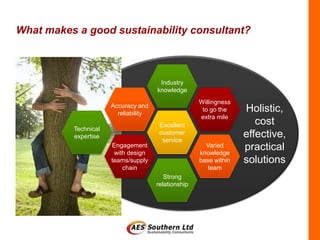
What makes a good sustainability consultant?


                                       Industry
                                      knowledge
                                                     Willingness
                      Accuracy and
                        reliability
                                                      to go the    Holistic,
                                                     extra mile
                                       Excellent                      cost
          Technical
          expertise
                                       customer
                                        service
                                                                   effective,
                      Engagement
                       with design
                                                       Varied
                                                     knowledge
                                                                   practical
                      teams/supply                   base within   solutions
                          chain                         team
                                         Strong
                                      relationship
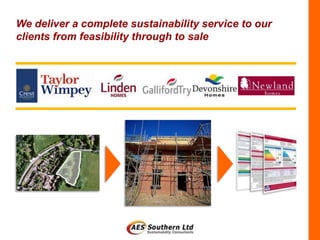
We deliver a complete sustainability service to our
clients from feasibility through to sale
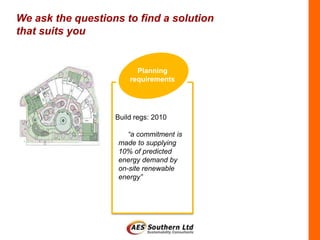
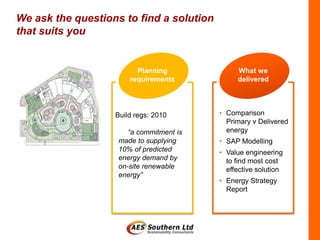
We ask the questions to find a solution
that suits you


                         Planning
                       requirements


                   Build regs: 2010

                       “a commitment is
                    made to supplying
                    10% of predicted
                    energy demand by
                    on-site renewable
                    energy”
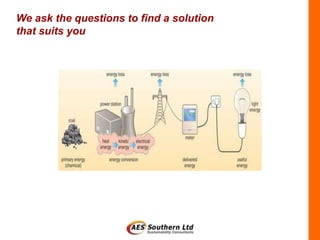
We ask the questions to find a solution
that suits you
We ask the questions to find a solution
that suits you


                         Planning              What we
                       requirements            delivered


                   Build regs: 2010       • Comparison
                                            Primary v Delivered
                       “a commitment is     energy
                    made to supplying     • SAP Modelling
                    10% of predicted      • Value engineering
                    energy demand by        to find most cost
                    on-site renewable       effective solution
                    energy”
                                          • Energy Strategy
                                            Report
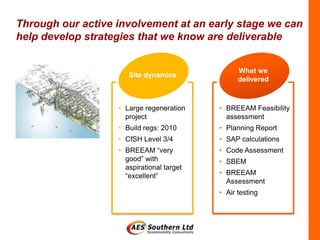
Through our active involvement at an early stage we can
help develop strategies that we know are deliverable


                                                 What we
                      Site dynamics
                                                 delivered


                   • Large regeneration    • BREEAM Feasibility
                     project                 assessment
                   • Build regs: 2010      • Planning Report
                   • CfSH Level 3/4        • SAP calculations
                   • BREEAM “very          • Code Assessment
                     good” with            • SBEM
                     aspirational target
                     “excellent”           • BREEAM
                                             Assessment
                                           • Air testing
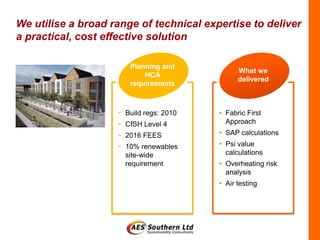
We utilise a broad range of technical expertise to deliver
a practical, cost effective solution

                       Planning and
                                               What we
                           HCA
                                               delivered
                       requirements


                    • Build regs: 2010   • Fabric First
                    • CfSH Level 4         Approach
                    • 2016 FEES          • SAP calculations
                    • 10% renewables     • Psi value
                      site-wide            calculations
                      requirement        • Overheating risk
                                           analysis
                                         • Air testing
We are fully accredited and are affiliated with industry
bodies
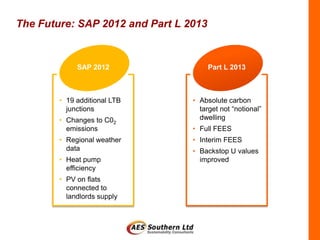
The Future: SAP 2012 and Part L 2013


             SAP 2012                  Part L 2013


        • 19 additional LTB      • Absolute carbon
          junctions                target not “notional”
        • Changes to C02           dwelling
          emissions              • Full FEES
        • Regional weather       • Interim FEES
          data                   • Backstop U values
        • Heat pump                improved
          efficiency
        • PV on flats
          connected to
          landlords supply
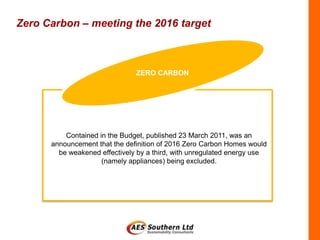
Zero Carbon – meeting the 2016 target


                               ZERO CARBON


          Contained in the Budget, published 23 March 2011, was an
      announcement that the definition of 2016 Zero Carbon Homes would
        be weakened effectively by a third, with unregulated energy use
                     (namely appliances) being excluded.
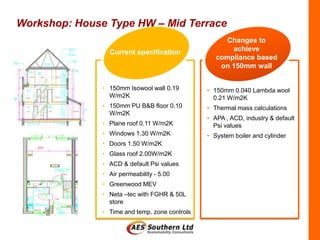
Workshop: House Type HW – Mid Terrace
                                                      Changes to
                 Current specification                 achieve
                                                   compliance based
                                                    on 150mm wall


               • 150mm Isowool wall 0.19        • 150mm 0.040 Lambda wool
                 W/m2K                            0.21 W/m2K
               • 150mm PU B&B floor 0.10        • Thermal mass calculations
                 W/m2K
                                                • APA , ACD, industry & default
               • Plane roof 0.11 W/m2K            Psi values
               • Windows 1.30 W/m2K             • System boiler and cylinder
               • Doors 1.50 W/m2K
               • Glass roof 2.00W/m2K
               • ACD & default Psi values
               • Air permeability - 5.00
               • Greenwood MEV
               • Neta –tec with FGHR & 50L
                 store
               • Time and temp. zone controls
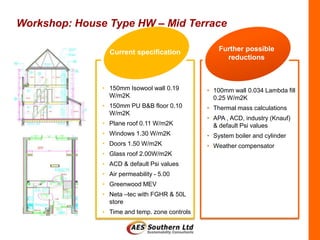
Workshop: House Type HW – Mid Terrace

                 Current specification              Further possible
                                                      reductions


               • 150mm Isowool wall 0.19        • 100mm wall 0.034 Lambda fill
                 W/m2K                            0.25 W/m2K
               • 150mm PU B&B floor 0.10        • Thermal mass calculations
                 W/m2K
                                                • APA , ACD, industry (Knauf)
               • Plane roof 0.11 W/m2K            & default Psi values
               • Windows 1.30 W/m2K             • System boiler and cylinder
               • Doors 1.50 W/m2K               • Weather compensator
               • Glass roof 2.00W/m2K
               • ACD & default Psi values
               • Air permeability - 5.00
               • Greenwood MEV
               • Neta –tec with FGHR & 50L
                 store
               • Time and temp. zone controls
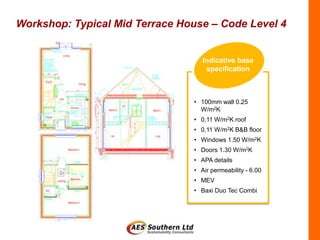
Workshop: Typical Mid Terrace House – Code Level 4


                                   Indicative base
                                    specification


                                • 100mm wall 0.25
                                  W/m2K
                                • 0.11 W/m2K roof
                                • 0.11 W/m2K B&B floor
                                • Windows 1.50 W/m2K
                                • Doors 1.30 W/m2K
                                • APA details
                                • Air permeability - 6.00
                                • MEV
                                • Baxi Duo Tec Combi
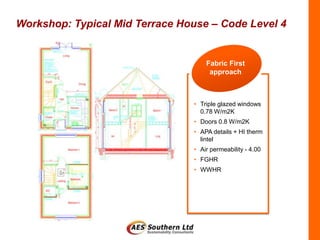
Workshop: Typical Mid Terrace House – Code Level 4


                                    Fabric First
                                     approach


                                • Triple glazed windows
                                  0.78 W/m2K
                                • Doors 0.8 W/m2K
                                • APA details + HI therm
                                  lintel
                                • Air permeability - 4.00
                                • FGHR
                                • WWHR
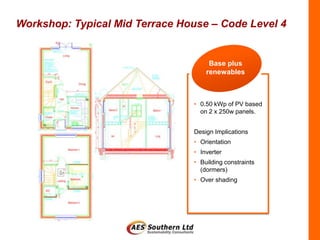
Workshop: Typical Mid Terrace House – Code Level 4


                                     Base plus
                                    renewables


                                • 0.50 kWp of PV based
                                  on 2 x 250w panels.


                                Design Implications
                                • Orientation
                                • Inverter
                                • Building constraints
                                  (dormers)
                                • Over shading

Aes southern presentation 7 nov 2012

  • 2.
    What makes agood sustainability consultant? Industry knowledge Willingness Accuracy and reliability to go the Holistic, extra mile Excellent cost Technical expertise customer service effective, Engagement with design Varied knowledge practical teams/supply base within solutions chain team Strong relationship
  • 3.
    We deliver acomplete sustainability service to our clients from feasibility through to sale
  • 4.
    We ask thequestions to find a solution that suits you Planning requirements Build regs: 2010 “a commitment is made to supplying 10% of predicted energy demand by on-site renewable energy”
  • 5.
    We ask thequestions to find a solution that suits you
  • 6.
    We ask thequestions to find a solution that suits you Planning What we requirements delivered Build regs: 2010 • Comparison Primary v Delivered “a commitment is energy made to supplying • SAP Modelling 10% of predicted • Value engineering energy demand by to find most cost on-site renewable effective solution energy” • Energy Strategy Report
  • 7.
    Through our activeinvolvement at an early stage we can help develop strategies that we know are deliverable What we Site dynamics delivered • Large regeneration • BREEAM Feasibility project assessment • Build regs: 2010 • Planning Report • CfSH Level 3/4 • SAP calculations • BREEAM “very • Code Assessment good” with • SBEM aspirational target “excellent” • BREEAM Assessment • Air testing
  • 8.
    We utilise abroad range of technical expertise to deliver a practical, cost effective solution Planning and What we HCA delivered requirements • Build regs: 2010 • Fabric First • CfSH Level 4 Approach • 2016 FEES • SAP calculations • 10% renewables • Psi value site-wide calculations requirement • Overheating risk analysis • Air testing
  • 9.
    We are fullyaccredited and are affiliated with industry bodies
  • 10.
    The Future: SAP2012 and Part L 2013 SAP 2012 Part L 2013 • 19 additional LTB • Absolute carbon junctions target not “notional” • Changes to C02 dwelling emissions • Full FEES • Regional weather • Interim FEES data • Backstop U values • Heat pump improved efficiency • PV on flats connected to landlords supply
  • 11.
    Zero Carbon –meeting the 2016 target ZERO CARBON Contained in the Budget, published 23 March 2011, was an announcement that the definition of 2016 Zero Carbon Homes would be weakened effectively by a third, with unregulated energy use (namely appliances) being excluded.
  • 12.
    Workshop: House TypeHW – Mid Terrace Changes to Current specification achieve compliance based on 150mm wall • 150mm Isowool wall 0.19 • 150mm 0.040 Lambda wool W/m2K 0.21 W/m2K • 150mm PU B&B floor 0.10 • Thermal mass calculations W/m2K • APA , ACD, industry & default • Plane roof 0.11 W/m2K Psi values • Windows 1.30 W/m2K • System boiler and cylinder • Doors 1.50 W/m2K • Glass roof 2.00W/m2K • ACD & default Psi values • Air permeability - 5.00 • Greenwood MEV • Neta –tec with FGHR & 50L store • Time and temp. zone controls
  • 13.
    Workshop: House TypeHW – Mid Terrace Current specification Further possible reductions • 150mm Isowool wall 0.19 • 100mm wall 0.034 Lambda fill W/m2K 0.25 W/m2K • 150mm PU B&B floor 0.10 • Thermal mass calculations W/m2K • APA , ACD, industry (Knauf) • Plane roof 0.11 W/m2K & default Psi values • Windows 1.30 W/m2K • System boiler and cylinder • Doors 1.50 W/m2K • Weather compensator • Glass roof 2.00W/m2K • ACD & default Psi values • Air permeability - 5.00 • Greenwood MEV • Neta –tec with FGHR & 50L store • Time and temp. zone controls
  • 14.
    Workshop: Typical MidTerrace House – Code Level 4 Indicative base specification • 100mm wall 0.25 W/m2K • 0.11 W/m2K roof • 0.11 W/m2K B&B floor • Windows 1.50 W/m2K • Doors 1.30 W/m2K • APA details • Air permeability - 6.00 • MEV • Baxi Duo Tec Combi
  • 15.
    Workshop: Typical MidTerrace House – Code Level 4 Fabric First approach • Triple glazed windows 0.78 W/m2K • Doors 0.8 W/m2K • APA details + HI therm lintel • Air permeability - 4.00 • FGHR • WWHR
  • 16.
    Workshop: Typical MidTerrace House – Code Level 4 Base plus renewables • 0.50 kWp of PV based on 2 x 250w panels. Design Implications • Orientation • Inverter • Building constraints (dormers) • Over shading

Editor's Notes

  • #2 Set up 6 years agoDemand from developers for independent, practical advice that they could rely on. This still remains the core foundation of our business.Now have a team of 15 consultants
  • #3 Technical: Passionate – ALLKnow SAP inside out, generate the optimum result, - understand calculations behind the calculations – varied backgrounds/training – architectural, engineering, industryAccuracy: Don’t just use default values – actual product data to deliver benefit – calculate psi valuesEngagement: DTMs, working with architects, contacting suppliers to gain product information, VALUE ENGINEERING working with manufacturers to help assess their products – presentations from manufacturers on latest developments to come to market – clients benefit straight awayIndustry: range of clients across the UK (developers & manufacturers, from one-off bespoke projects to large mixed use regeneration schemes, AIMC4 project, HBF (SAP and Jon as Vice Chair, Zero Carbon Hub, Part L consultation, SAP consultation etcCustomer service: fast turnaround, responsive to urgent queries, air test on site and produce EPCs on the same day, Client service reviews to gather feedback and make improvements, can pick up the phone to ask questionsRelationship:never advertised – business built on word of mouth Extra mile – suggesting new solutions, identifying risks (overheating), client workshopsKnowledge – Planning, SAP, Code, EcoHomes, BREEAM Domestic Refurbishment,, SBEM, BREEAM, Overheating Risk Analysis, Psi values, Passivhaus, Air testing (reduce re-tests)
  • #4 Range of clients – large national developers – small one-off builders (self-builders)Work with national technical/commercial directorsResponsible for national housetypes and specificationsChair Crest consultant panel – audited other consultants work
  • #5 58 units 2 + 2.5 storey housesIs it primary or delivered energy? (see next slide)Is it regulated or unregulated energy? (only regulated dealt with in SAP) Explanation of differenceWhat is the client’s preferred renewable? = PV
  • #6 Delivered: The amount of energy measured at the point it enters the home, building or establishment.SAP is interested in and reports delivered energy figures because these are the figures that relate to your bills and your EPC.Primary: The amount of delivered energy plus losses that occur in the generation, transmission, and distribution of energy. Primary Energy Factors in SAP: SAP 2005 SAP 2009 Mains gas 1.15 1.02 Main Elec 2.8 2.92Different results depending on whether using primary or delivered as to whether PV or Solar most cost effective so can choose which how you interpret “Energy” depending on client preferenceIf planners specify primary or delivered shows they understand the difference – difficult to argue preference
  • #7 Considered regulated energy only – Calculations based on primary energy – most cost-effective route if using PVPresented argument to planners regarding primary energy in strategy report
  • #8 Over 2000 resi units + non-resiincl, retail, library, nursery, healthcare facilitiesCode 3 to phases 1 & 2 Code 4 to later phases (phase 3)Feasibility reports for planning demonstrating that BREEAM excellent is not viable option - cost, buildability and marketability of the retail units (additional financial and practical burden to end user)Difficulty achieving BREEAM ENE 5 and POL 1 – carbon intensity and type of refrigerant systems in food storesDifficult to achieve POL 4 – external lighting req between 2300 and 0700
  • #9 Fabric First = to achieve FEESPsi value calcs to optimise the specRisk Identification – OverheatingEnglish partnership standards not applicable but pose risk to reputation of developer if occupiers suffer thermal discomfort in luxury apartmentsOther projects include: AIMC4 - Consortium research project to develop solutions to meet Code Level 4 (Energy) by optimising the fabric of the building. Partners include Stewart Milne Group, Crest Nicholson plc, Barratt Developments plc, H+H UK Ltd, BRE. Shortlisted for best low or zero carbon initiative at the 2012 Housebuilder Awards. Graylingwell Park – UK’s largest carbon neutral development (85 acres)
  • #10 Constantly adding new services in response to market demand and interests of the team – passion to learn new thingsAssessing as-built performance…?
  • #11 19 Extra junctions 2.5 StoreyInclude transportation of Fuel and are 3 year rather than 5 year avgNorth/southEfficiencies substantially lowerIndividual flats will get carbon benefit but no SAP benefit or cost saving on EPC.
  • #12 19 Extra junctions 2.5 StoreyInclude transportation of Fuel and are 3 year rather than 5 year avgNorth/southEfficiencies substantially lowerIndividual flats will get carbon benefit but no SAP benefit or cost saving on EPC.