IES Faculty – Part L, EPC’s & the VE
London– 7th March 2012
Overview
 Session 1 – Niall Gibson
 •From EPBD to the Present
 •Where are we now
 •What’s coming in the future

 •BREAK

 Session 2 – Michael Pollock
 •Evolution of the VE-Compliance Features
 •New VE-Compliance benefits
 •FAQ based ‘hints and tips’

 Q&A Session

© Integrated Environmental Solutions Ltd.
Session 1

                                            Niall Gibson


© Integrated Environmental Solutions Ltd.
From EPBD to Present


© Integrated Environmental Solutions Ltd.
The Origins of Part L
 •     First introduced in 1985 following 1984 Building Act: Regulated
       heating systems and Insulation of services
 •     Revised in 1990 and again in 1995 to regulate the “Conservation of
       Fuel and Power”
 •     2002:
         –    L1(Dwellings) & L2(Non-Dwellings)
         –    3 methods for Compliance
         –    Elemental, Whole Building Method or Carbon Emissions Calculation Method
         –    SAP used to calculate Carbon Emissions for dwellings
 •     2006:
         –    L1A and L2A (New Build) & L1B and L2B (Existing Buildings)
         –    Introduction of SBEM for Non-Dwelling Compliance
         –    1 Single method of compliance through 5 Criteria
         –    BER Vs TER or DER Vs TER
         –    Improved standards for U-Values and plant efficiency etc


© Integrated Environmental Solutions Ltd.
The Origins of EPC’s
 •     European performance of Buildings Directive (EPBD) state the
       requirements of Energy Performance Certificate (EPC) within:
         – Article 10
         – Article 11
         – Article 12


 •     EPC’s first appearance in the UK in 2008


© Integrated Environmental Solutions Ltd.
….and Today!
 •     Part L 2010…….


© Integrated Environmental Solutions Ltd.
Where Are We Now


© Integrated Environmental Solutions Ltd.
Part L2A 2010
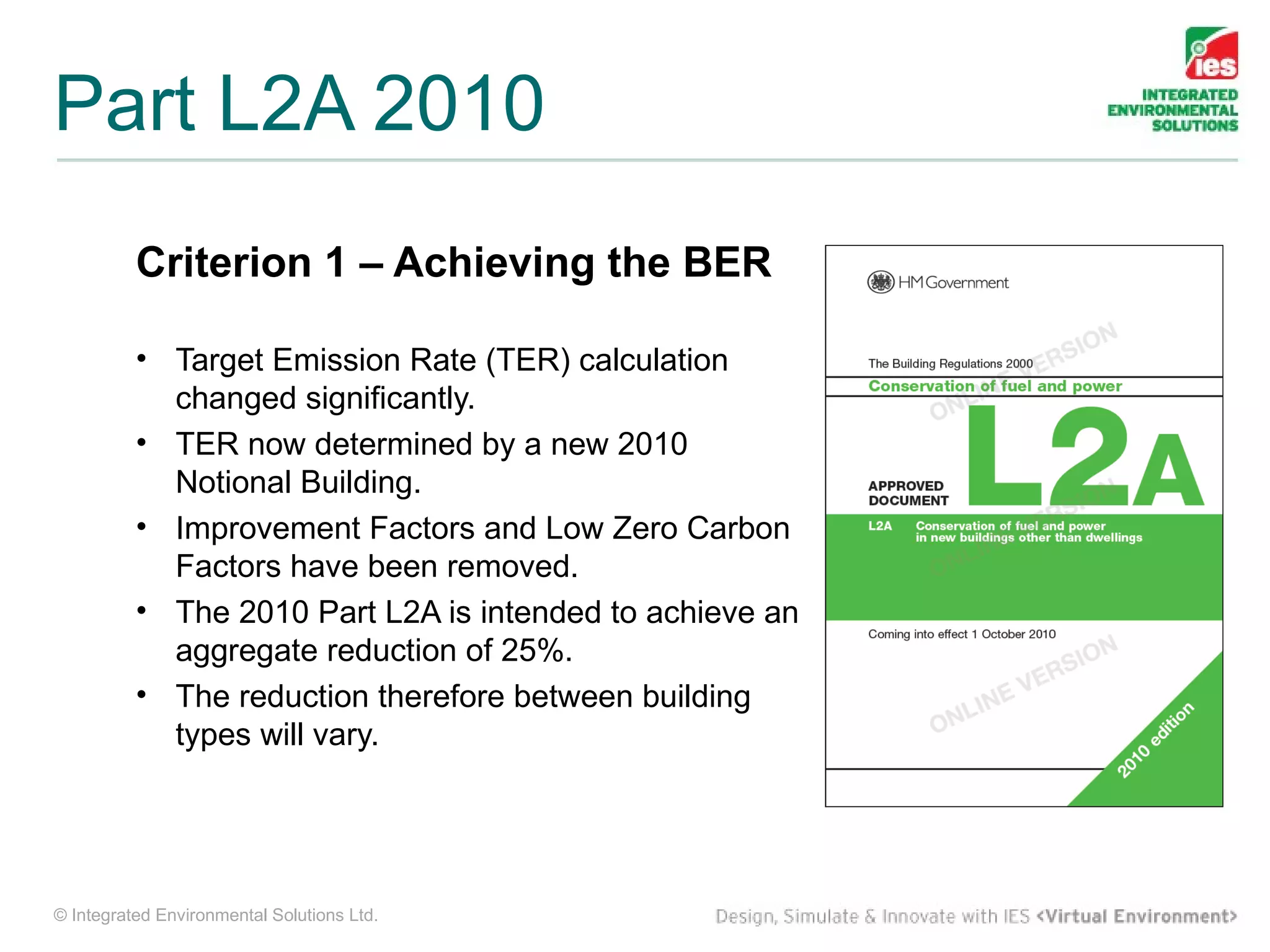
          Criterion 1 – Achieving the BER

          • Target Emission Rate (TER) calculation
            changed significantly.
          • TER now determined by a new 2010
            Notional Building.
          • Improvement Factors and Low Zero Carbon
            Factors have been removed.
          • The 2010 Part L2A is intended to achieve an
            aggregate reduction of 25%.
          • The reduction therefore between building
            types will vary.


© Integrated Environmental Solutions Ltd.
Part L2A 2010
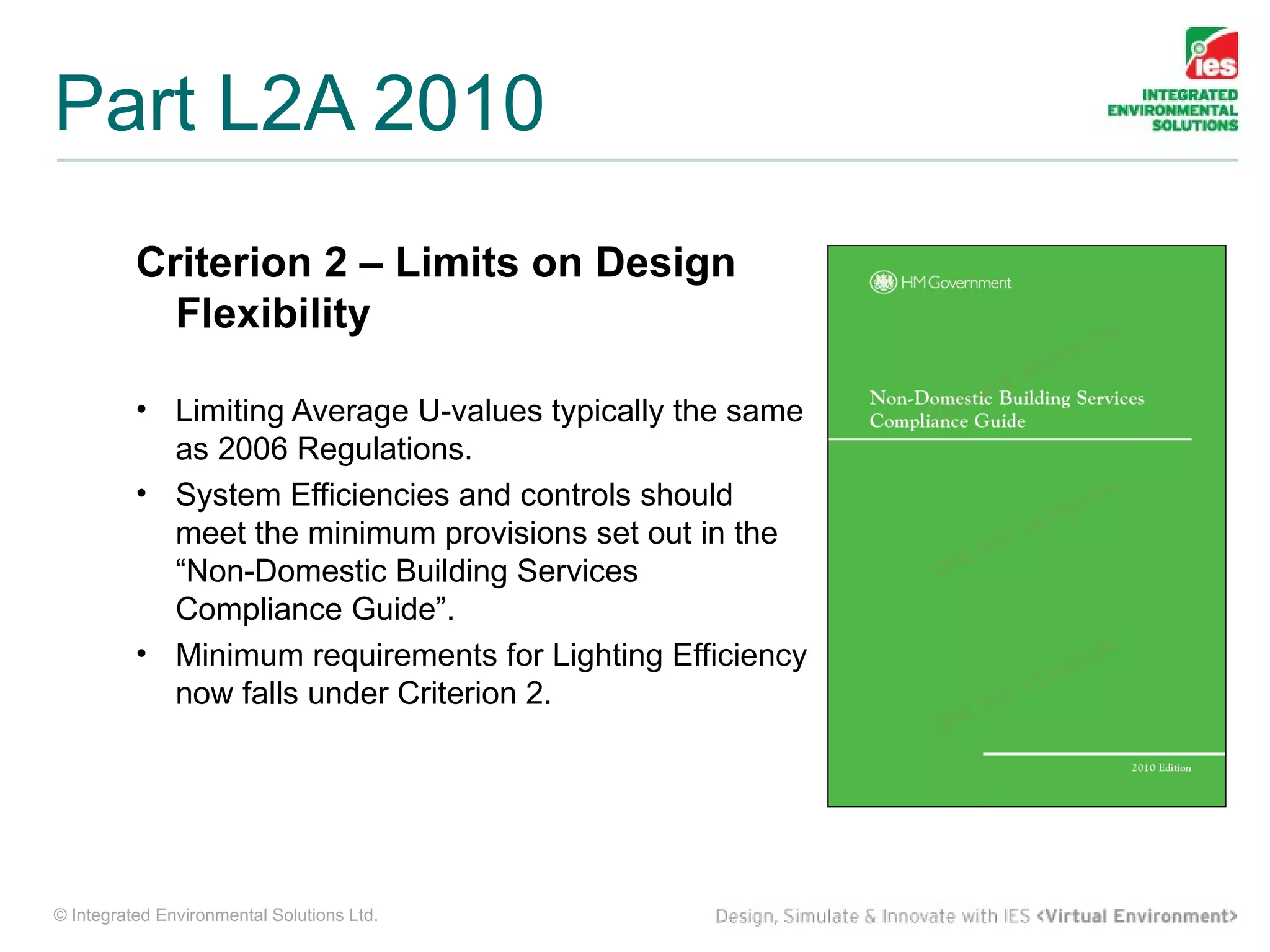
          Criterion 2 – Limits on Design
            Flexibility

          • Limiting Average U-values typically the same
            as 2006 Regulations.
          • System Efficiencies and controls should
            meet the minimum provisions set out in the
            “Non-Domestic Building Services
            Compliance Guide”.
          • Minimum requirements for Lighting Efficiency
            now falls under Criterion 2.


© Integrated Environmental Solutions Ltd.
Part L2A 2010
          Criterion 3 – Limiting the Effects of Solar Gains in
            Summer

          • Significant Change in Calculation Method from L2A 2006 Regulations
          • Now only one means to demonstrate compliance.
          • Compliance is met by showing that aggregated Solar Gain does not
            exceed a Benchmark level.
          • Applicable to all occupied, non transient spaces regardless of their
            conditioning level.
          • IESVE would always reiterate the importance of investigating
            overheating


© Integrated Environmental Solutions Ltd.
The 2010 Notional Building
          The Target Emission Rate

          • The TER is now the Notional Building Emission Rate
          • Improvement Factors and Low Zero Carbon Factors no longer exist in
            calculation
          • The 2010 NCM Modelling Guide details the properties for the 2010
            Notional Building.
          • This new approach has the advantage of allowing the Actual and
            Notional Buildings to be directly compared to identify key areas where
            improvement is required.


© Integrated Environmental Solutions Ltd.
Part L 2010
 2010 keys points:
 •25% improvement over 2006 standards for New Build (Aggregate
 Approach)
 •Minor Alterations to SBEM to reflect changes
 •Criterion 3 – Overheating calculations simplified calculations, onerous
 compliance
 •Thermal bridging constraints
 •Compliance required with Design Stage submission pre-start
 •25% proved challenging (Good Holistic design essential, vehicle for
 BIM?!)
 •2013 is around the corner and 2016 seems much closer…..
         – Zero carbon Homes & Schools by 2016
         – All Public Building stock by 2018
         – All new build by 2019


© Integrated Environmental Solutions Ltd.
Accreditation
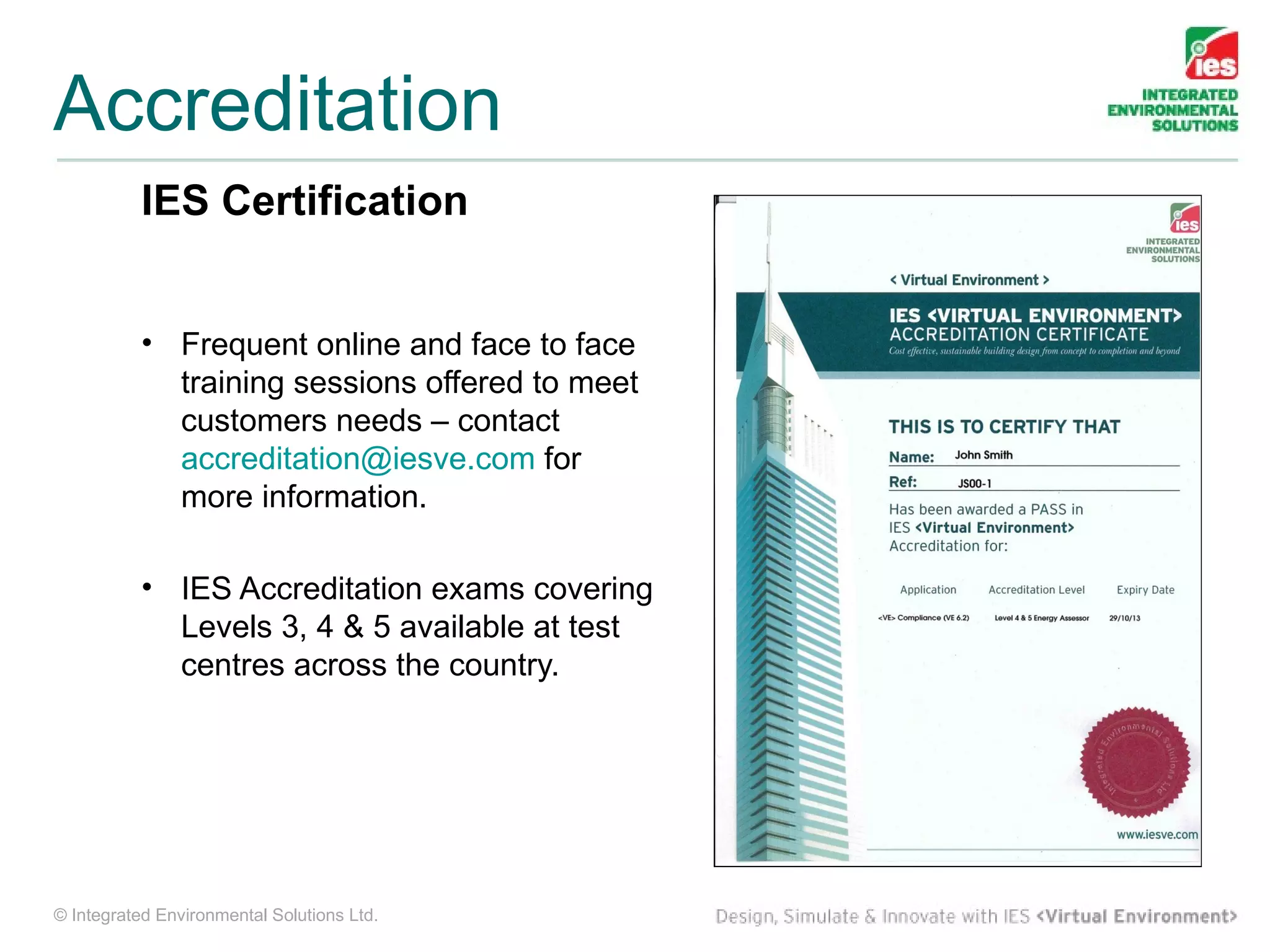
           IES Certification


           • Frequent online and face to face
             training sessions offered to meet
             customers needs – contact
             accreditation@iesve.com for
             more information.

           • IES Accreditation exams covering
             Levels 3, 4 & 5 available at test
             centres across the country.


© Integrated Environmental Solutions Ltd.
What’s Coming in the Future


© Integrated Environmental Solutions Ltd.
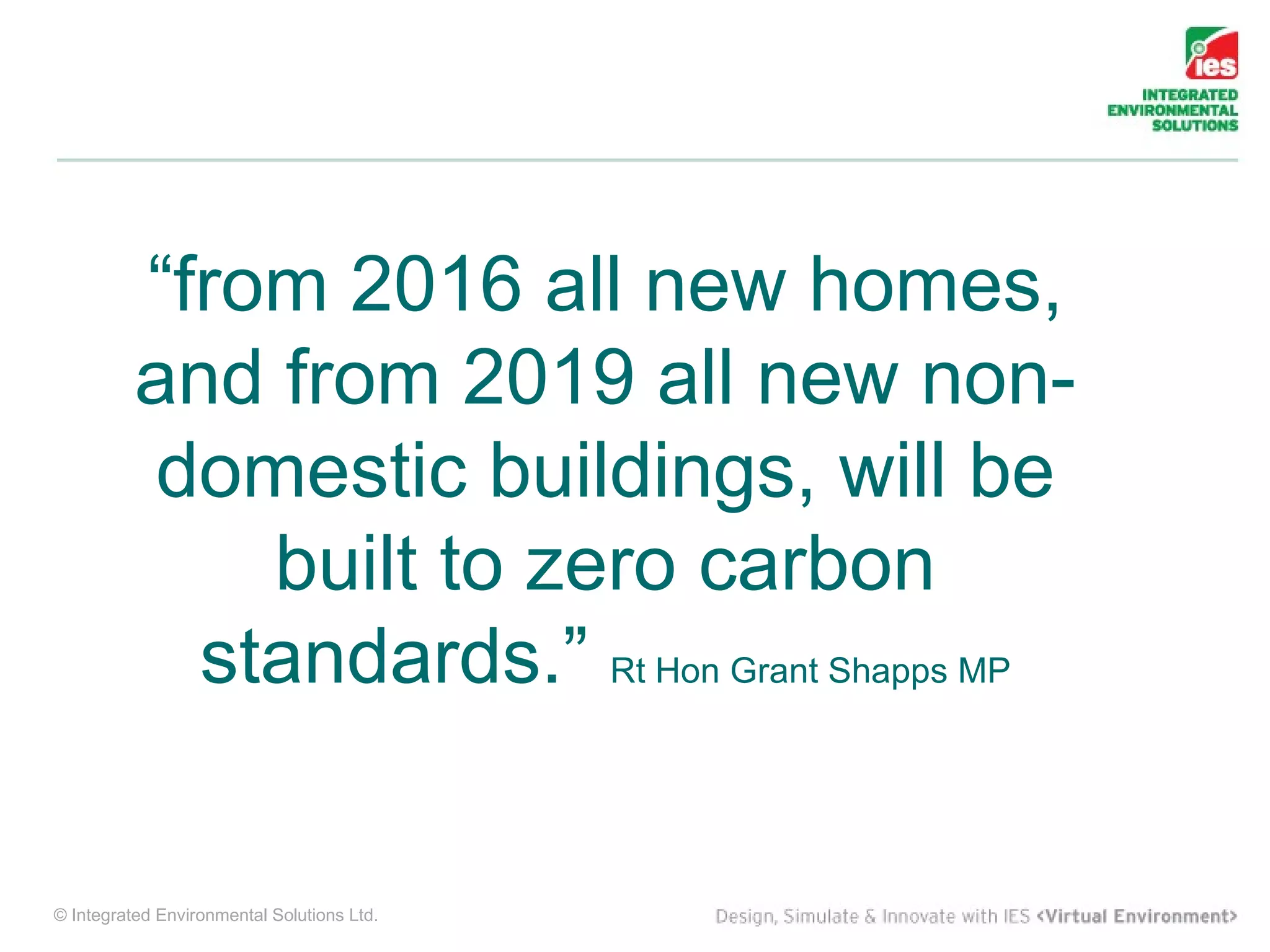
“from 2016 all new homes,
          and from 2019 all new non-
          domestic buildings, will be
              built to zero carbon
            standards.” Rt Hon Grant Shapps MP


© Integrated Environmental Solutions Ltd.
Zero Carbon Definition
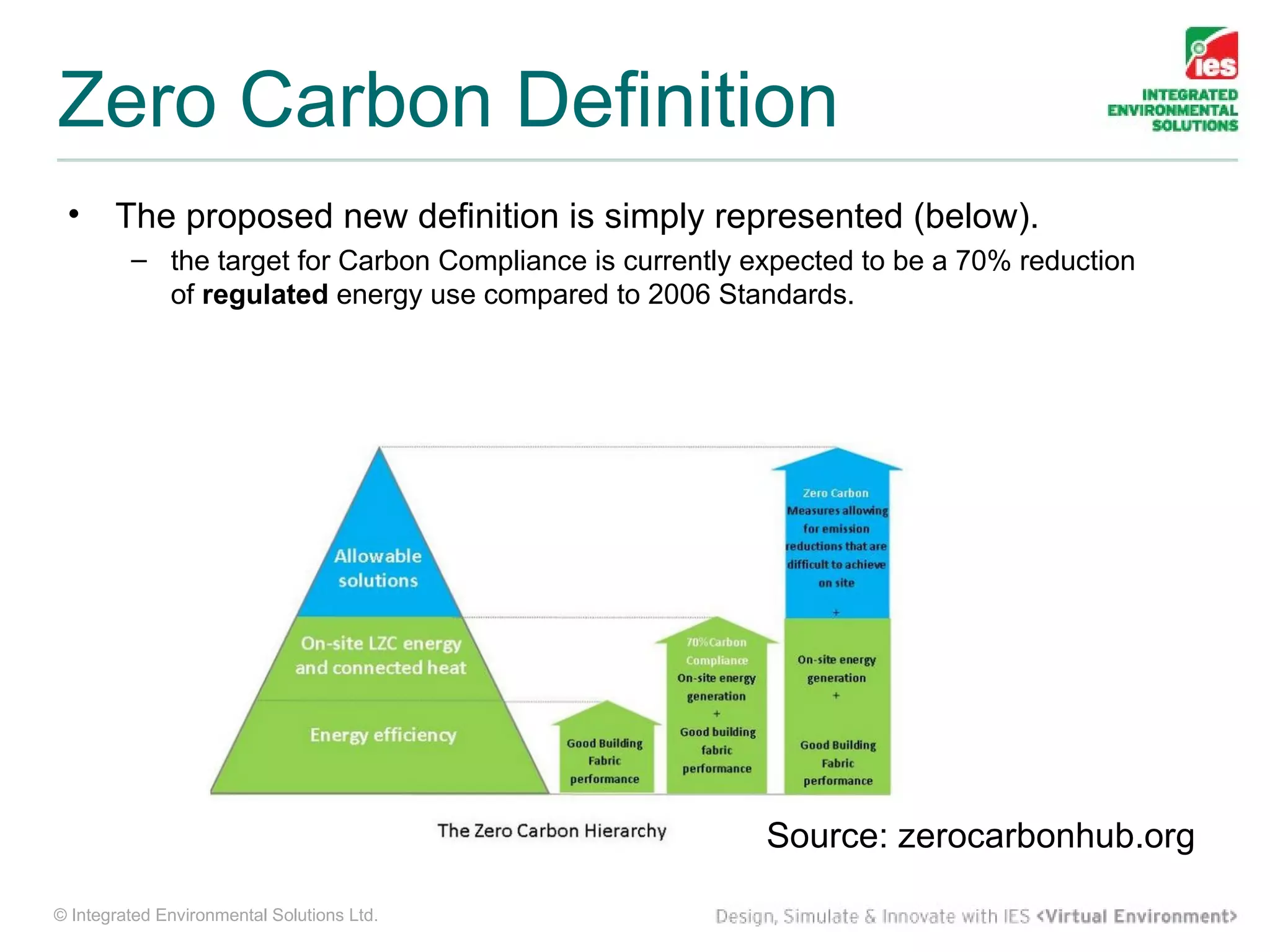
 •     The proposed new definition is simply represented (below).
         – the target for Carbon Compliance is currently expected to be a 70% reduction
           of regulated energy use compared to 2006 Standards.


                                            “


                                                          Source: zerocarbonhub.org

© Integrated Environmental Solutions Ltd.
The Green Deal
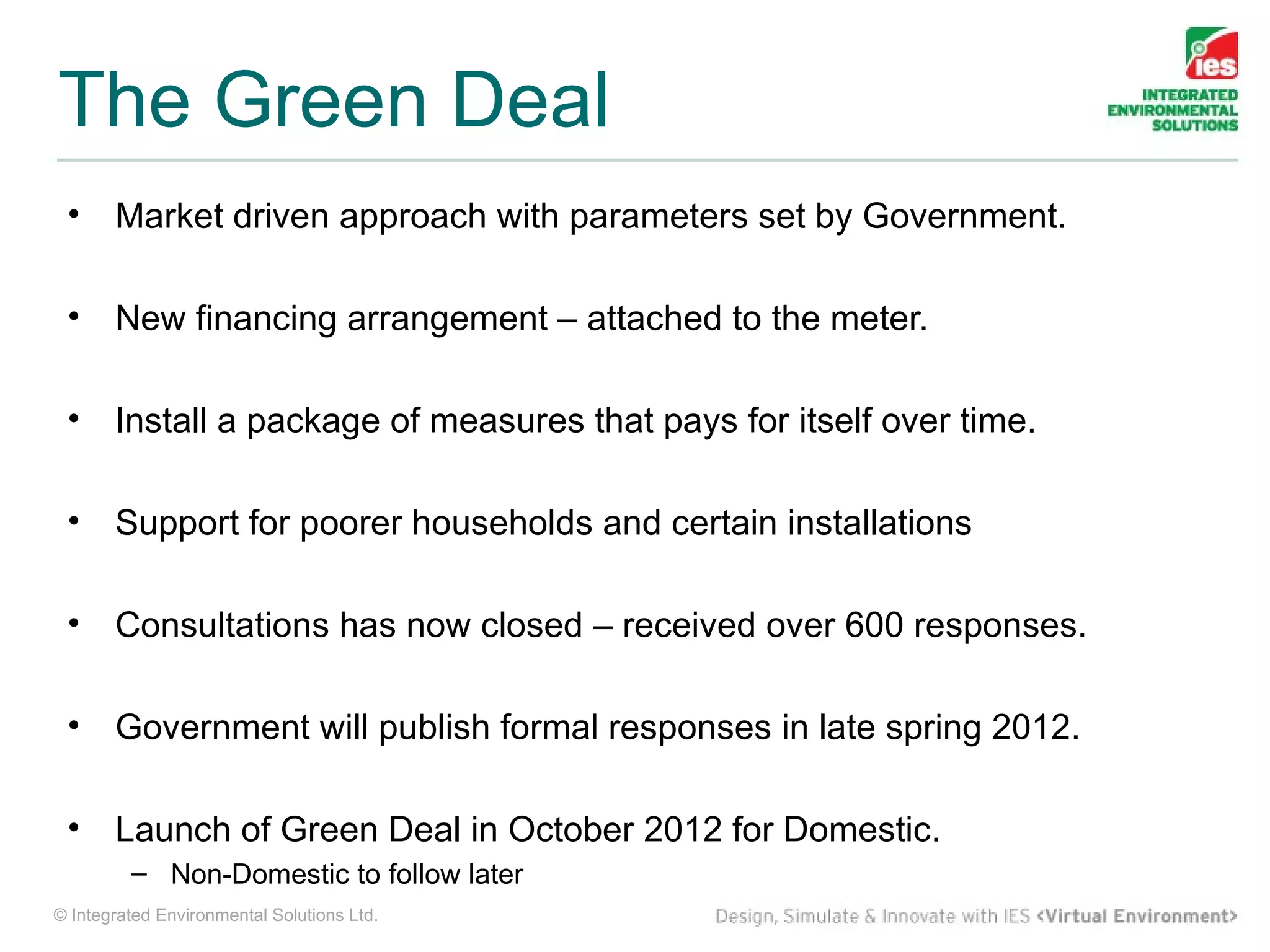
 •     Market driven approach with parameters set by Government.

 •     New financing arrangement – attached to the meter.

 •     Install a package of measures that pays for itself over time.

 •     Support for poorer households and certain installations

 •     Consultations has now closed – received over 600 responses.

 •     Government will publish formal responses in late spring 2012.

 •     Launch of Green Deal in October 2012 for Domestic.
         – Non-Domestic to follow later
© Integrated Environmental Solutions Ltd.
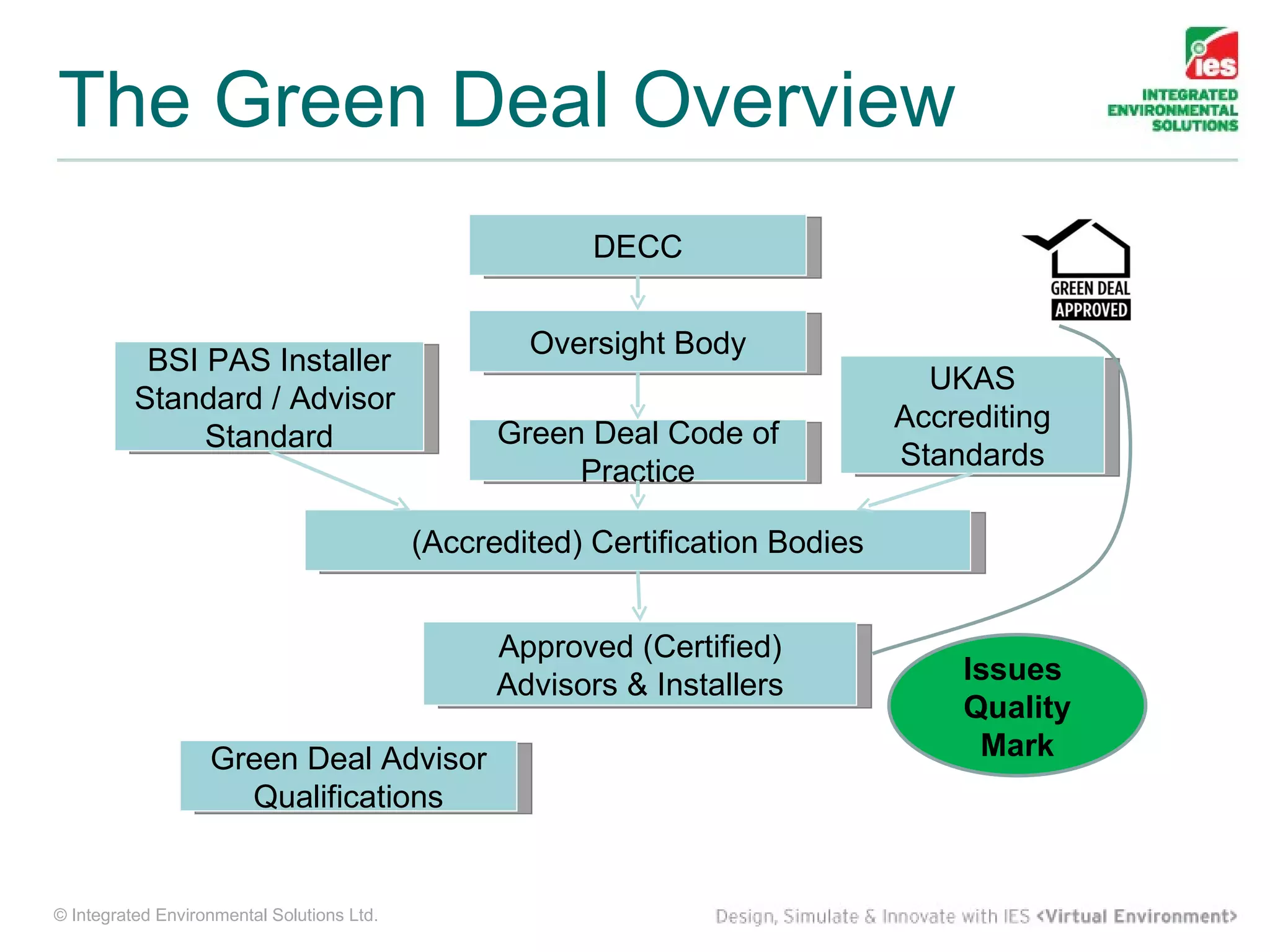
The Green Deal Overview
                                                         DECC


                                                    Oversight Body
           BSI PAS Installer
                                                                                  UKAS
          Standard / Advisor
                                                                                Accrediting
               Standard                           Green Deal Code of
                                                                                Standards
                                                       Practice

                                            (Accredited) Certification Bodies


                                                  Approved (Certified)
                                                  Advisors & Installers             Issues
                                                                                    Quality
                   Green Deal Advisor                                                Mark
                     Qualifications


© Integrated Environmental Solutions Ltd.
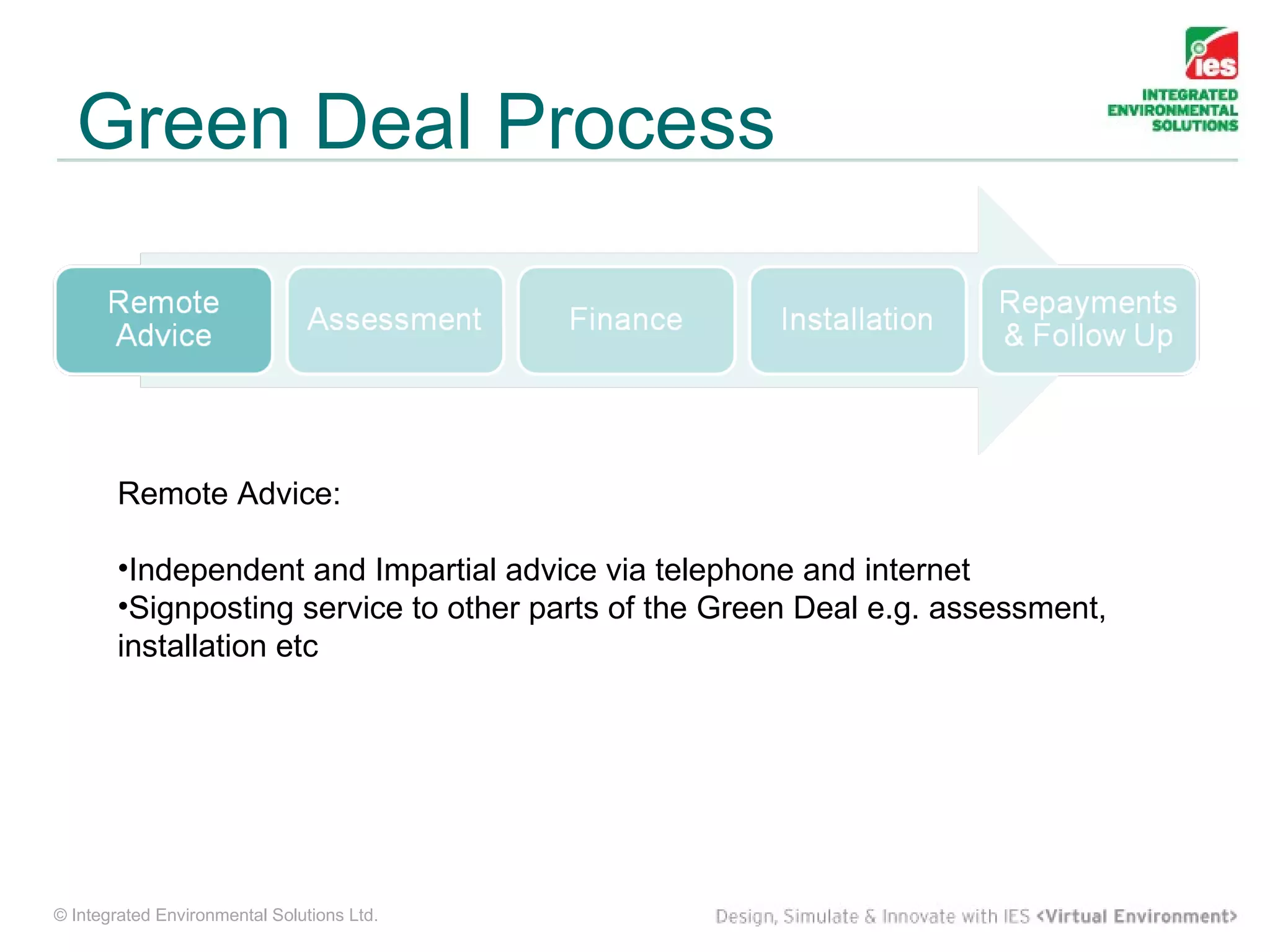
Green Deal Process


        Remote Advice:

        •Independent and Impartial advice via telephone and internet
        •Signposting service to other parts of the Green Deal e.g. assessment,
        installation etc


© Integrated Environmental Solutions Ltd.
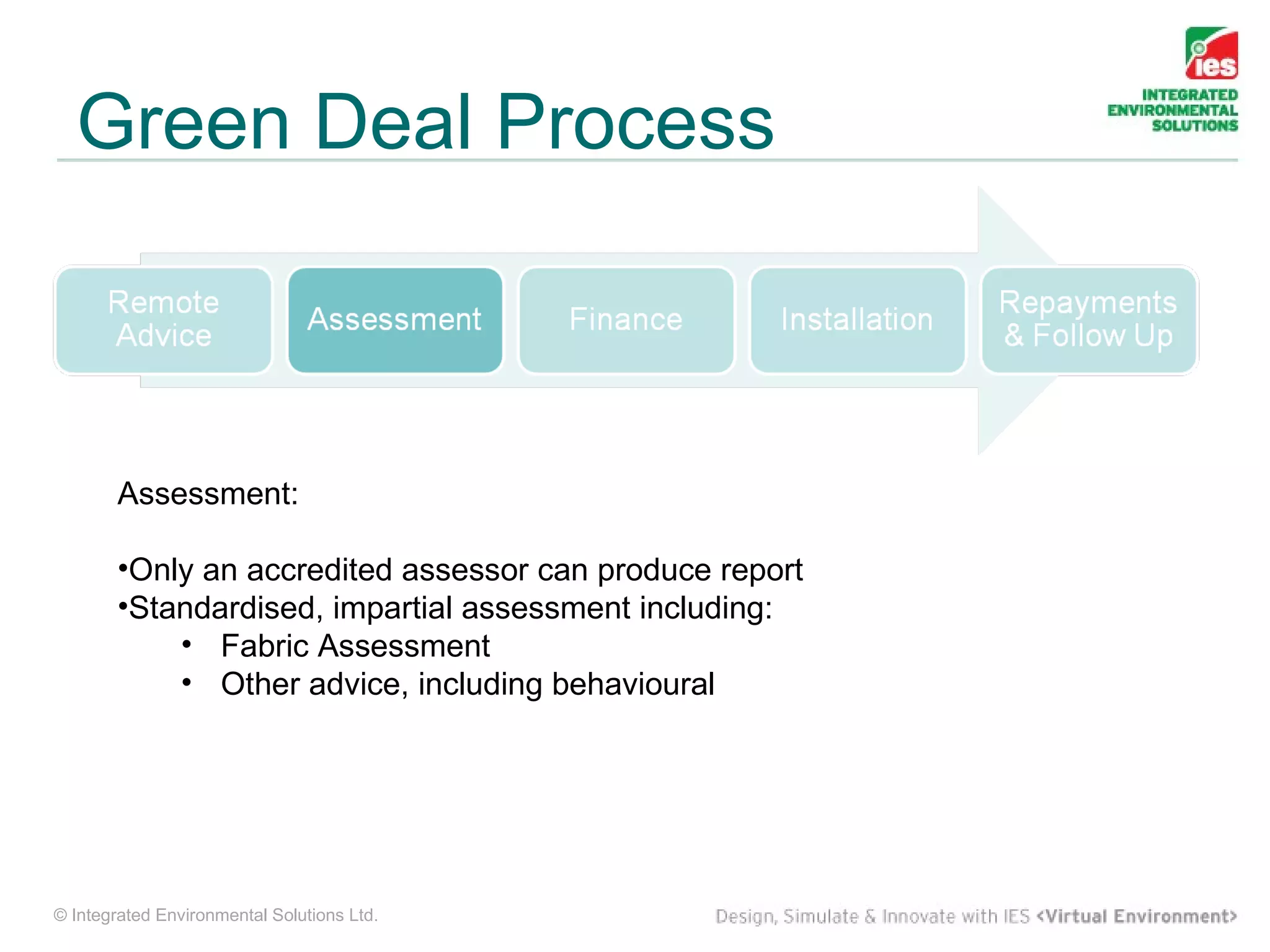
Green Deal Process


        Assessment:

        •Only an accredited assessor can produce report
        •Standardised, impartial assessment including:
            • Fabric Assessment
            • Other advice, including behavioural


© Integrated Environmental Solutions Ltd.
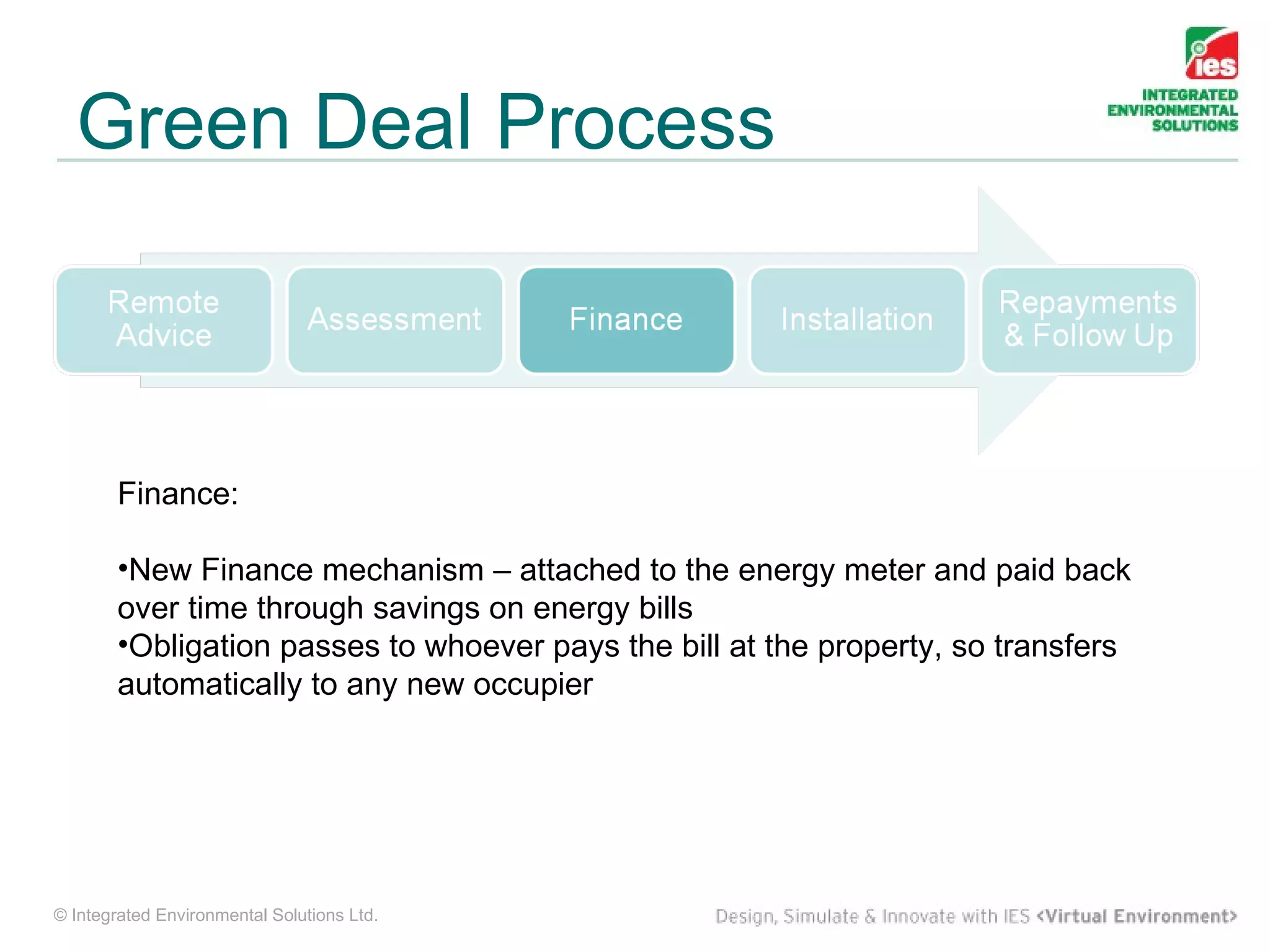
Green Deal Process


        Finance:

        •New Finance mechanism – attached to the energy meter and paid back
        over time through savings on energy bills
        •Obligation passes to whoever pays the bill at the property, so transfers
        automatically to any new occupier


© Integrated Environmental Solutions Ltd.
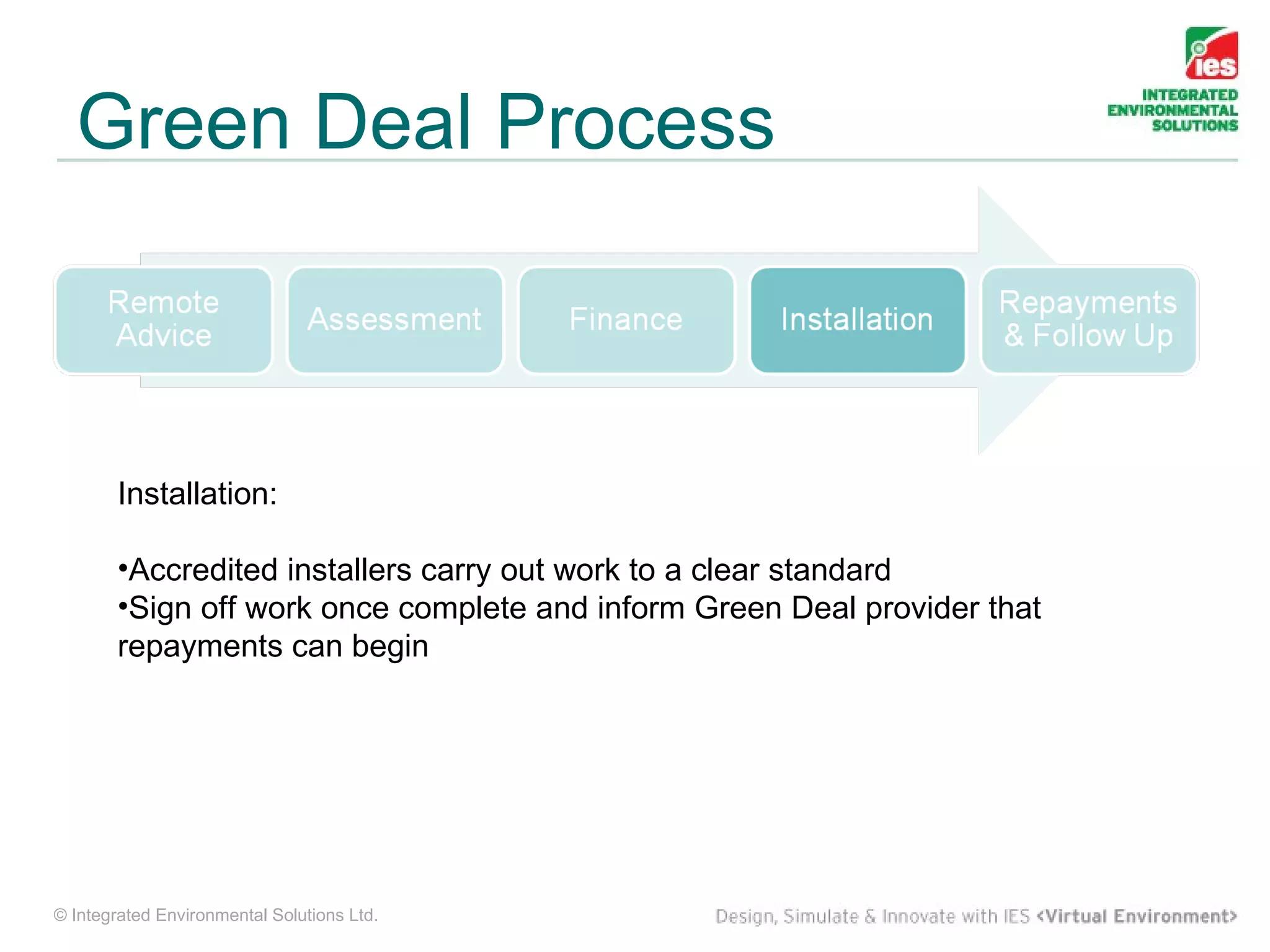
Green Deal Process


        Installation:

        •Accredited installers carry out work to a clear standard
        •Sign off work once complete and inform Green Deal provider that
        repayments can begin


© Integrated Environmental Solutions Ltd.
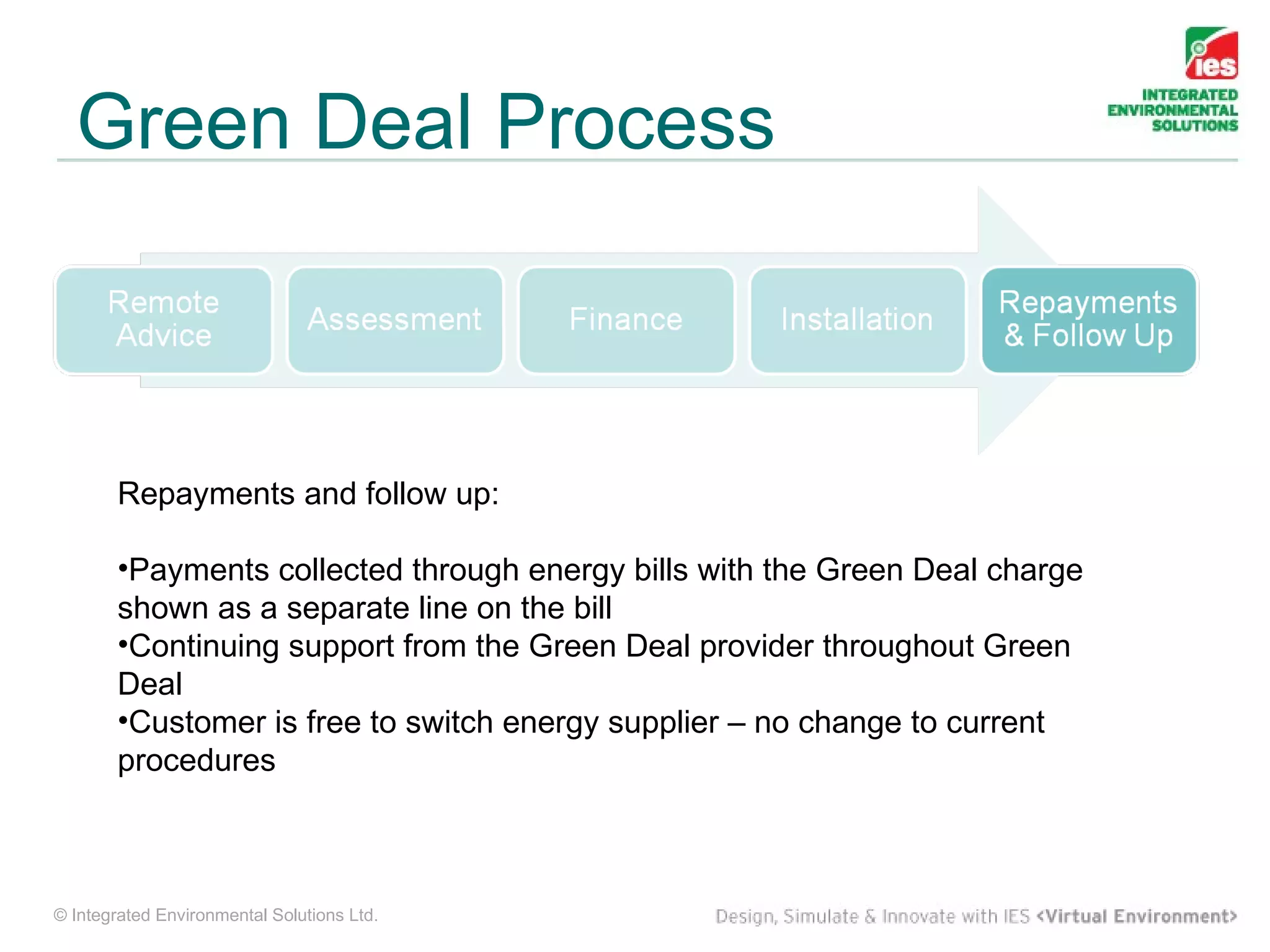
Green Deal Process


        Repayments and follow up:

        •Payments collected through energy bills with the Green Deal charge
        shown as a separate line on the bill
        •Continuing support from the Green Deal provider throughout Green
        Deal
        •Customer is free to switch energy supplier – no change to current
        procedures


© Integrated Environmental Solutions Ltd.
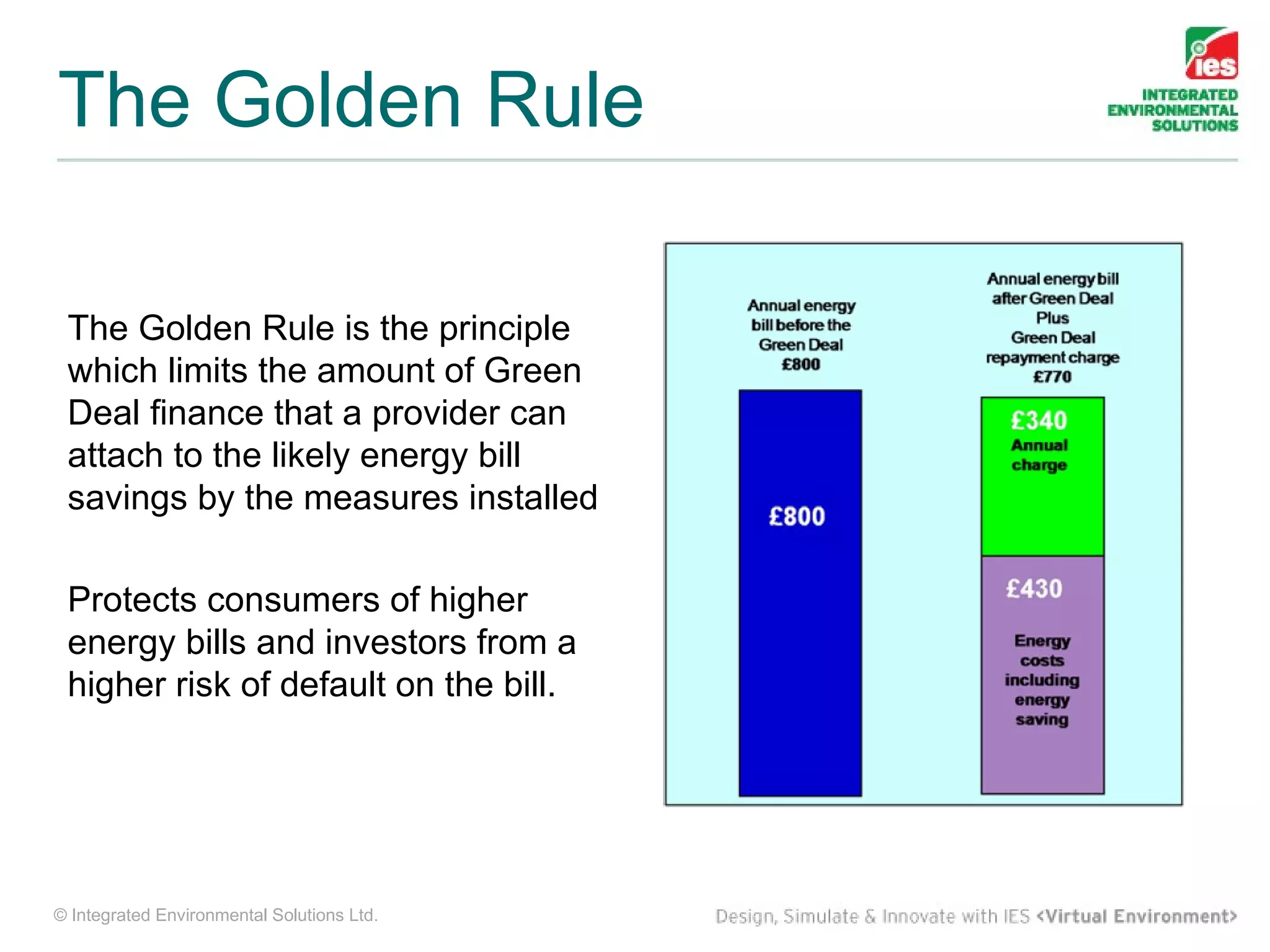
The Golden Rule

 The Golden Rule is the principle
 which limits the amount of Green
 Deal finance that a provider can
 attach to the likely energy bill
 savings by the measures installed

 Protects consumers of higher
 energy bills and investors from a
 higher risk of default on the bill.


© Integrated Environmental Solutions Ltd.
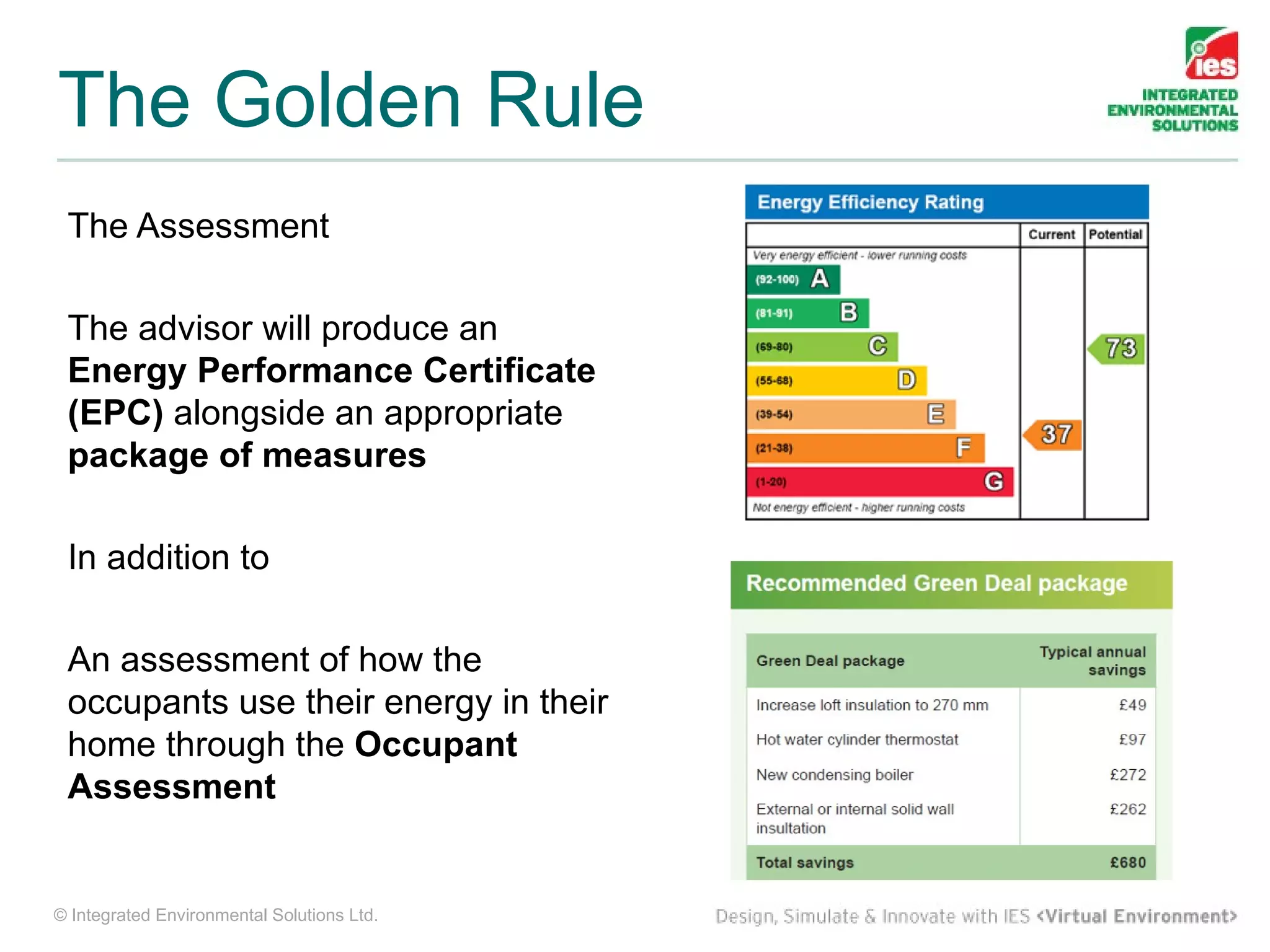
The Golden Rule
 The Assessment

 The advisor will produce an
 Energy Performance Certificate
 (EPC) alongside an appropriate
 package of measures

 In addition to

 An assessment of how the
 occupants use their energy in their
 home through the Occupant
 Assessment


© Integrated Environmental Solutions Ltd.
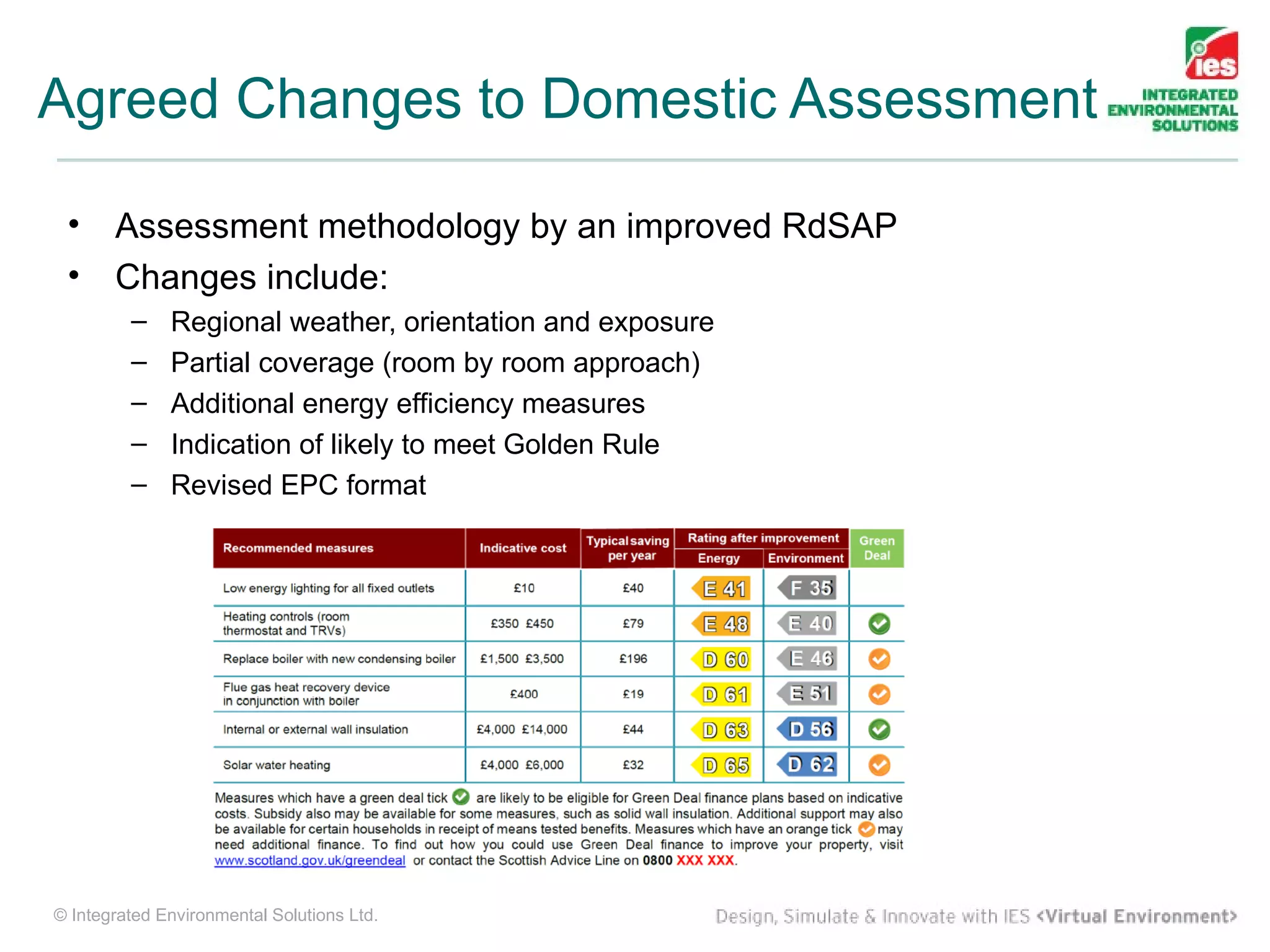
Agreed Changes to Domestic Assessment

 •     Assessment methodology by an improved RdSAP
 •     Changes include:
         –    Regional weather, orientation and exposure
         –    Partial coverage (room by room approach)
         –    Additional energy efficiency measures
         –    Indication of likely to meet Golden Rule
         –    Revised EPC format


© Integrated Environmental Solutions Ltd.
Non-Domestic Assessment

 •     Based on existing energy calculation tool SBEM.
 •     Currently in development and being piloted by BRE
 •     Additional functionalities to be expected:
         – Allow the assessor to tailor the model to the building occupiers actual operating
           regime
         – Enable the assessor to more easily explore and document the savings in energy
           use resulting from the installation of one or more energy efficiency measures, in
           one or more packages or measures.
         – Accept information on fuel costs, so as to calculate the approximate value of
           these energy savings.


© Integrated Environmental Solutions Ltd.
Energy Companies

 •     Fundamental concept is that the Green Deal payments will be
       collected as part of the energy bills
 •     This facilitates automatic transfer of charge between collectors if
       supplier is changed or properties change hands
 •     Supplier with less than 250,000 customers are not obliged to collect
 •     Electricity supplier will be collecting the Green Deal charge as an
       agent or trustee of the Green Deal provider
 •     Payments passed to the green Deal provider within 72hrs
 •     Ability to switch is not restricted assuming new supplier is
       participating in the payment collection mechanism


© Integrated Environmental Solutions Ltd.
Installers
 •     Only authorised Green Deal installers can undertake the works
 •     Will be able to use the ‘Green Deal Mark’
 •     Are certified by an accreditation body against the relevant Green
       Deal standards set out in the Code of Practice
 •     Are a member of the certification body which certifies them
 •     Agree to comply with the Code of Practice
 •     Possible top up training required against current industry
       recognised installation requirements
 •     Consumer could choose to go directly to Green Deal provider or an
       independent installer to carry out the work
 •     Complaints handled by Green Deal provider who may take the
       matter to the certification body
 •     There will be an over sight body.


© Integrated Environmental Solutions Ltd.
Green Deal Providers
 •     Responsible for the provision of Finance and Arranging energy
       efficiency works

 •     Offers a Green Deal Plan based on the recommendation from an
       accredited assessor

 •     Must include consumer protections such as warranties

 •     Arranges installations from an authorised installer

 •     Have a complaints handling procedure

 •     Provide information to new bill payer (must keep records)


© Integrated Environmental Solutions Ltd.
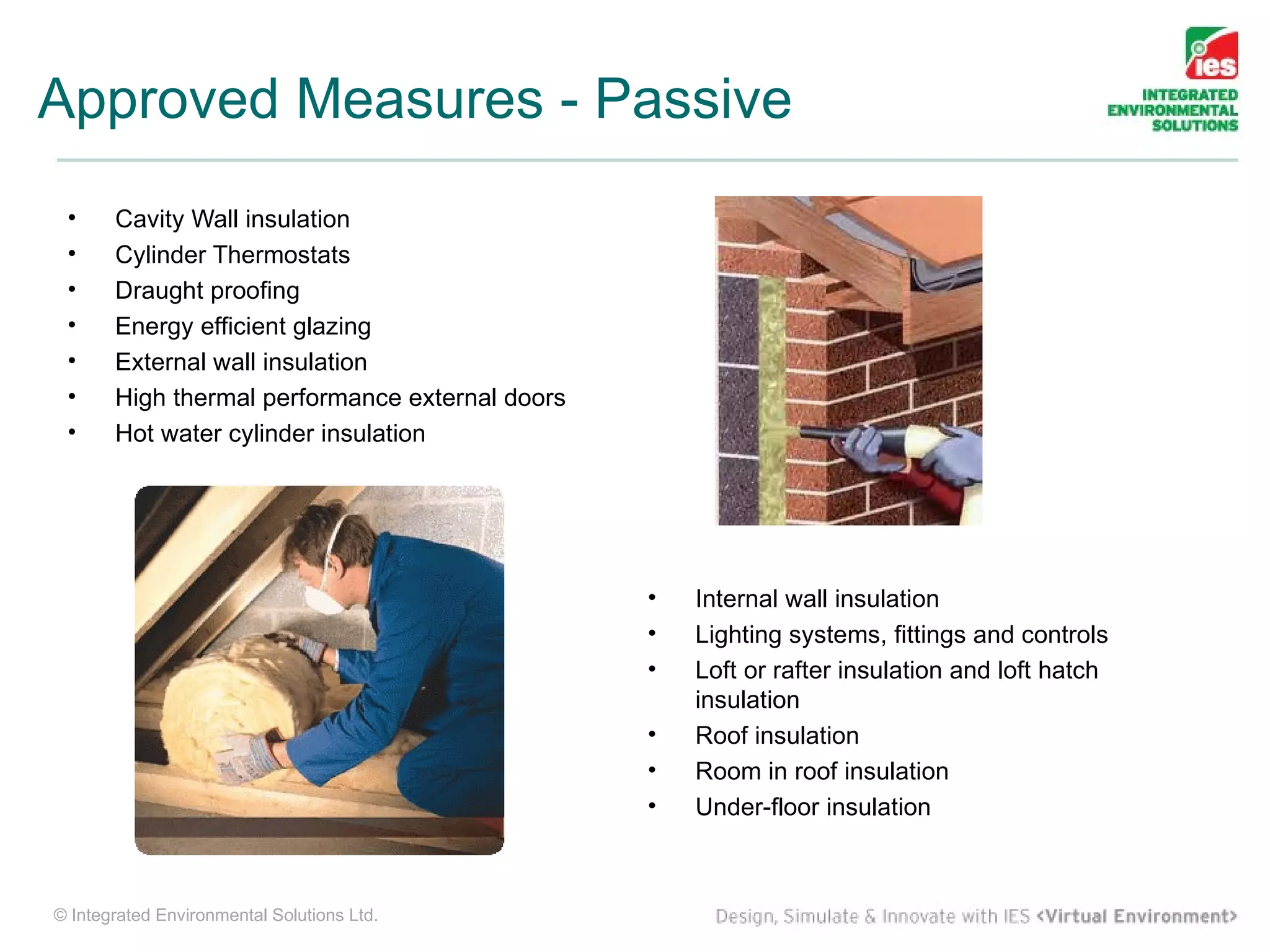
Approved Measures - Passive
 •     Cavity Wall insulation
 •     Cylinder Thermostats
 •     Draught proofing
 •     Energy efficient glazing
 •     External wall insulation
 •     High thermal performance external doors
 •     Hot water cylinder insulation


                                                 •   Internal wall insulation
                                                 •   Lighting systems, fittings and controls
                                                 •   Loft or rafter insulation and loft hatch
                                                     insulation
                                                 •   Roof insulation
                                                 •   Room in roof insulation
                                                 •   Under-floor insulation


© Integrated Environmental Solutions Ltd.
Approved Measures - LZC

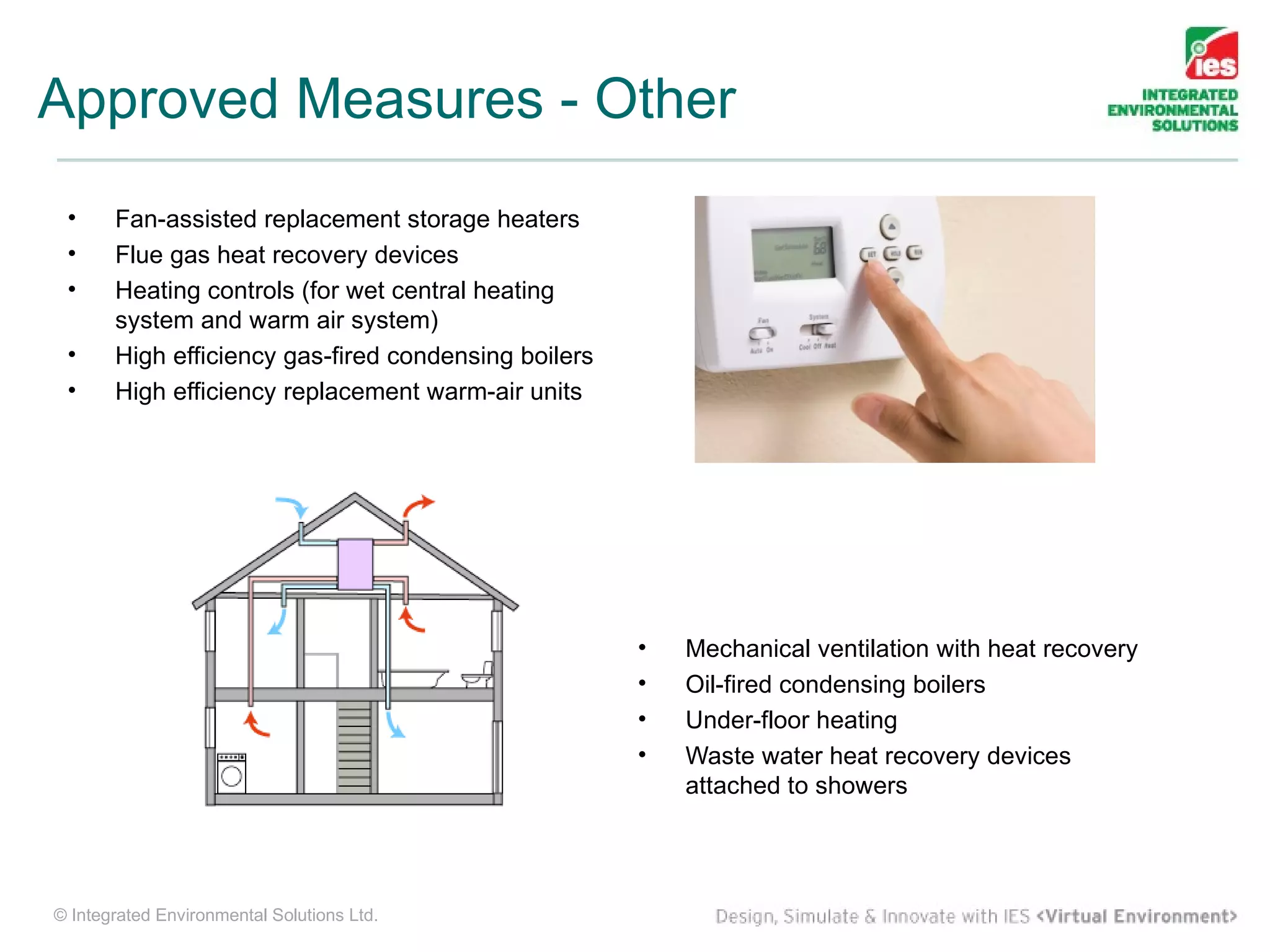
     •     Air source heat pumps
     •     Biomass Boilers
     •     Biomass room Heaters (with radiators)
     •     Ground Source heat pumps


                                                   •   Micro combined heat and power
                                                   •   Micro wind generation
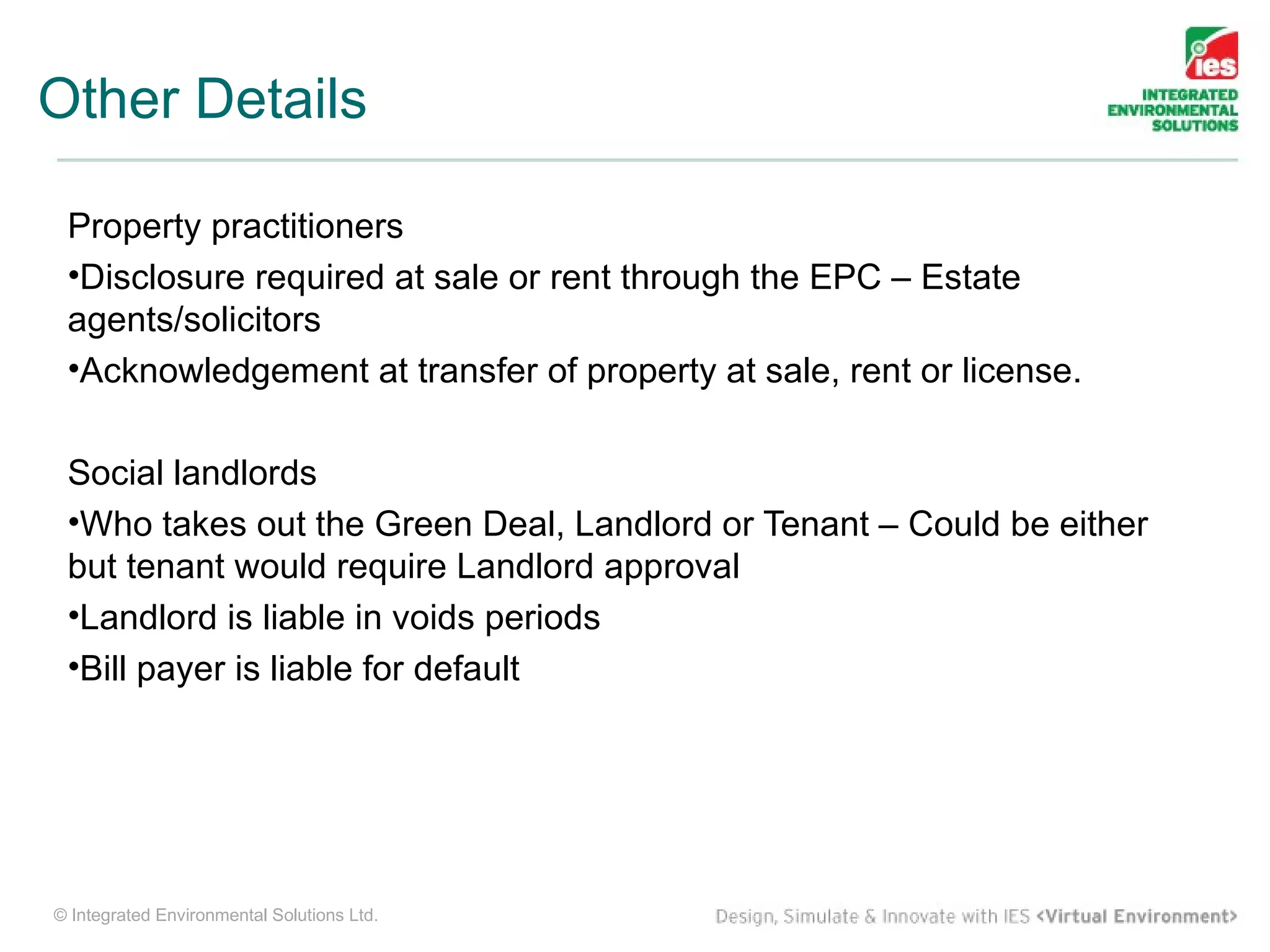
                                                   •   Photovoltaic’s
                                                   •   Solar water heating


© Integrated Environmental Solutions Ltd.
Approved Measures - Other
 •     Fan-assisted replacement storage heaters
 •     Flue gas heat recovery devices
 •     Heating controls (for wet central heating
       system and warm air system)
 •     High efficiency gas-fired condensing boilers
 •     High efficiency replacement warm-air units


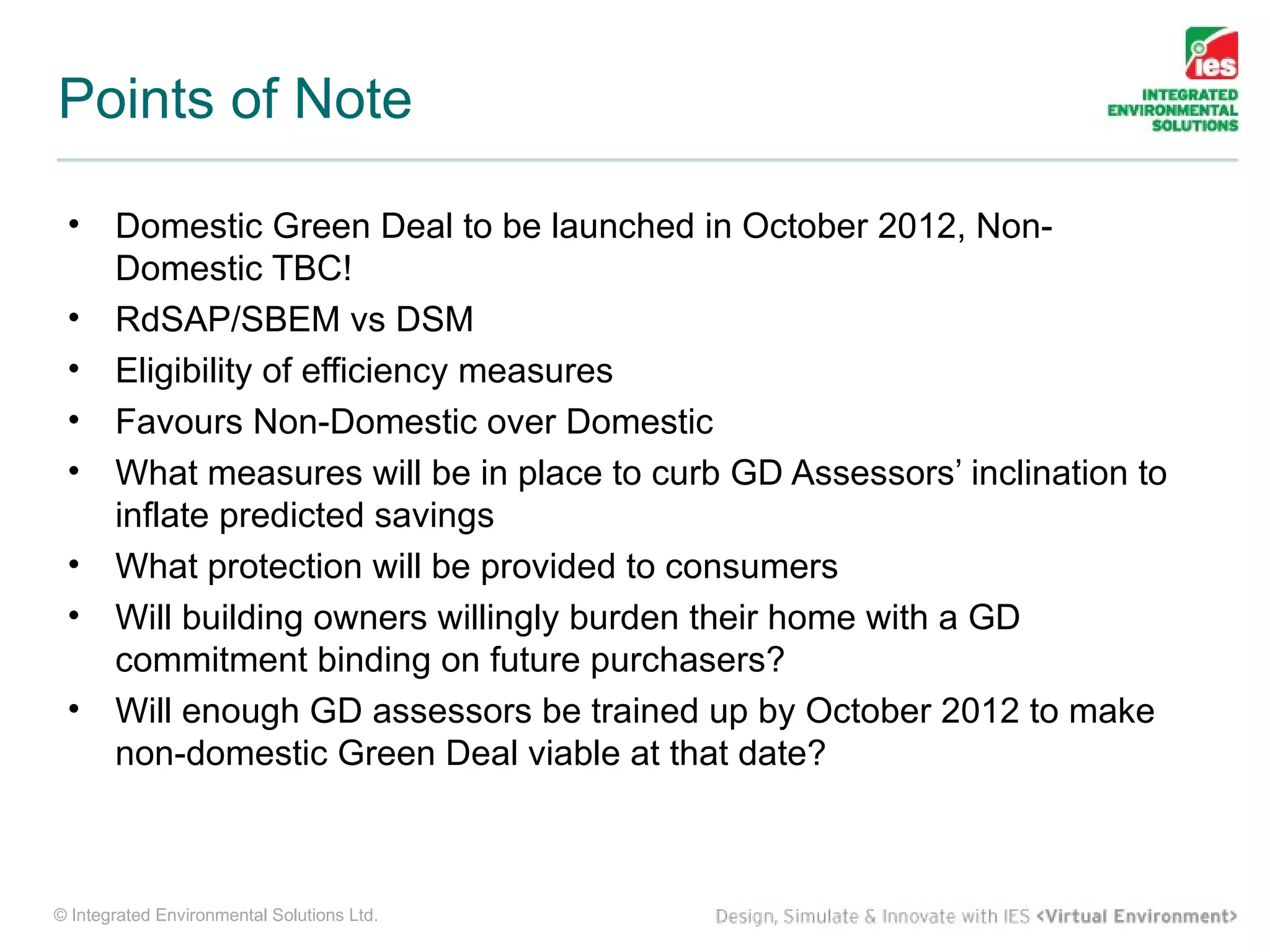
                                                      •   Mechanical ventilation with heat recovery
                                                      •   Oil-fired condensing boilers
                                                      •   Under-floor heating
                                                      •   Waste water heat recovery devices
                                                          attached to showers


© Integrated Environmental Solutions Ltd.
Other Details

 Property practitioners
 •Disclosure required at sale or rent through the EPC – Estate
 agents/solicitors
 •Acknowledgement at transfer of property at sale, rent or license.

 Social landlords
 •Who takes out the Green Deal, Landlord or Tenant – Could be either
 but tenant would require Landlord approval
 •Landlord is liable in voids periods
 •Bill payer is liable for default


© Integrated Environmental Solutions Ltd.
Points of Note

 •     Domestic Green Deal to be launched in October 2012, Non-
       Domestic TBC!
 •     RdSAP/SBEM vs DSM
 •     Eligibility of efficiency measures
 •     Favours Non-Domestic over Domestic
 •     What measures will be in place to curb GD Assessors’ inclination to
       inflate predicted savings
 •     What protection will be provided to consumers
 •     Will building owners willingly burden their home with a GD
       commitment binding on future purchasers?
 •     Will enough GD assessors be trained up by October 2012 to make
       non-domestic Green Deal viable at that date?


© Integrated Environmental Solutions Ltd.
EPC’s
 •     Government have decided that EPC’s should be made Publically
       available.

 •     To come into force from April 2012.

 •     Individual users will be able to access PDF EPC’s online directly
       from the EPC register – at no cost.

 •     Authorised Bulk users include, Public sector, FIT’s Licensees, Green
       Deal Providers, etc


© Integrated Environmental Solutions Ltd.
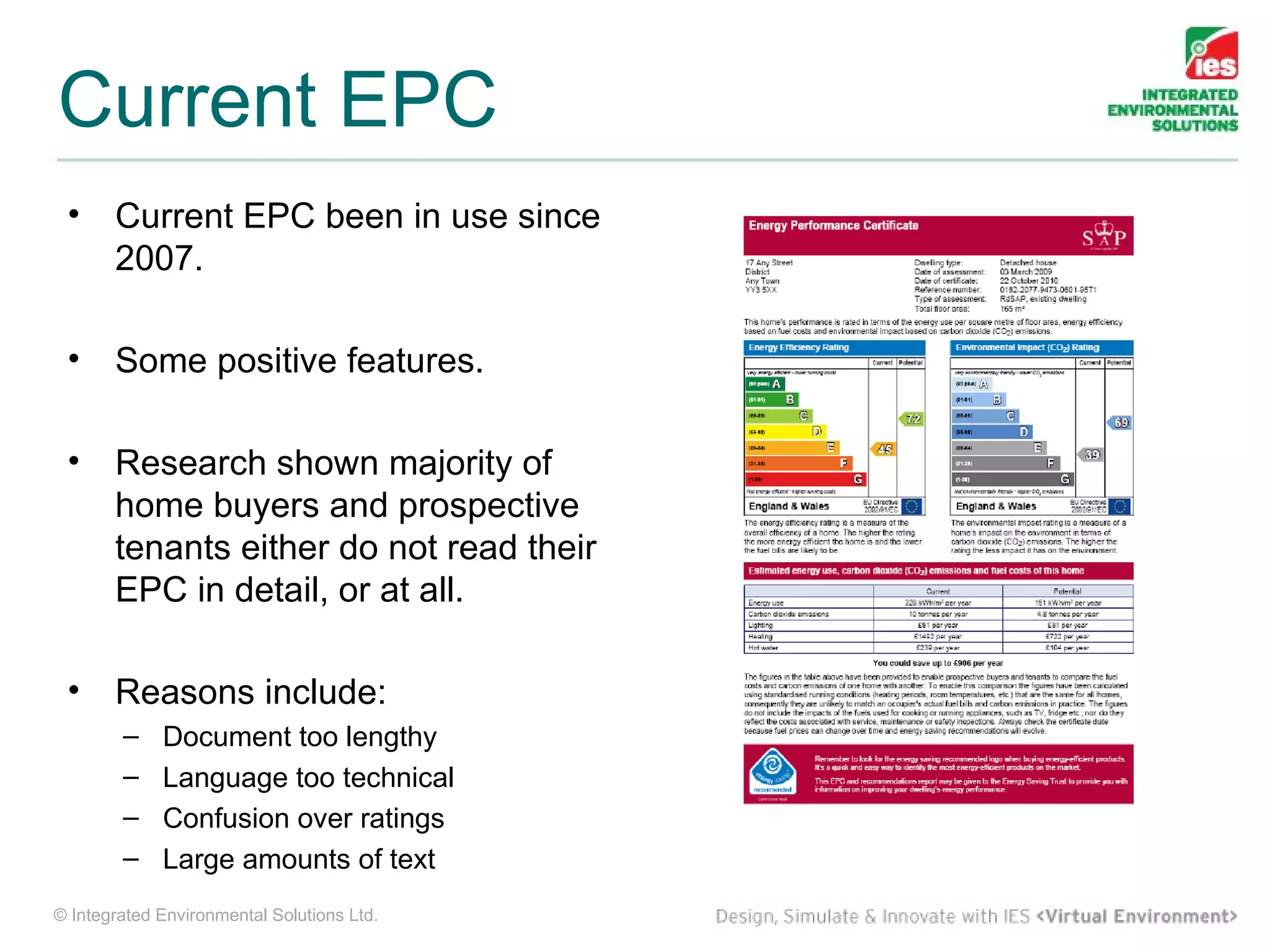
Current EPC
 •     Current EPC been in use since
       2007.

 •     Some positive features.

 •     Research shown majority of
       home buyers and prospective
       tenants either do not read their
       EPC in detail, or at all.

 •     Reasons include:
        –    Document too lengthy
        –    Language too technical
        –    Confusion over ratings
        –    Large amounts of text
© Integrated Environmental Solutions Ltd.
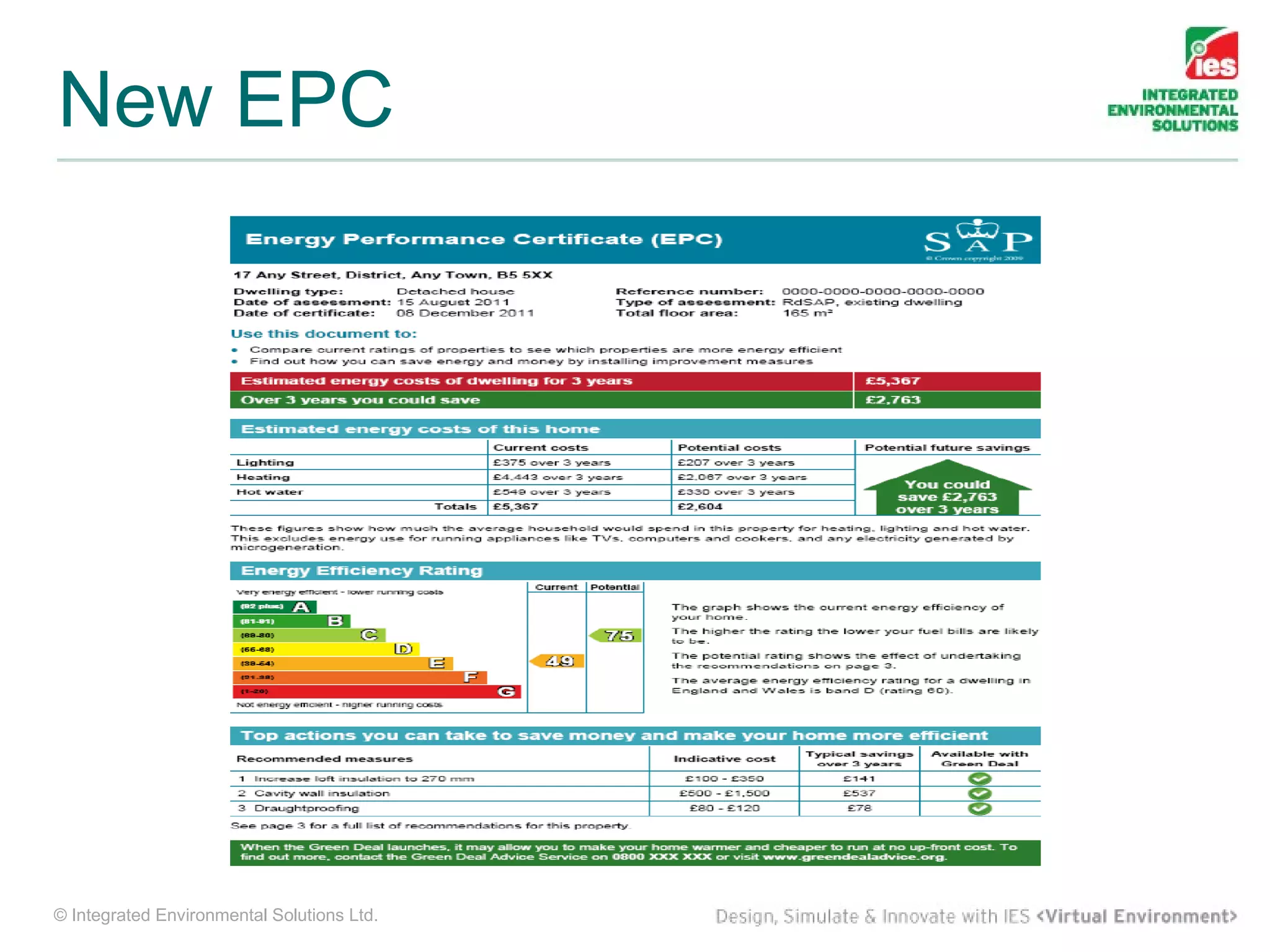
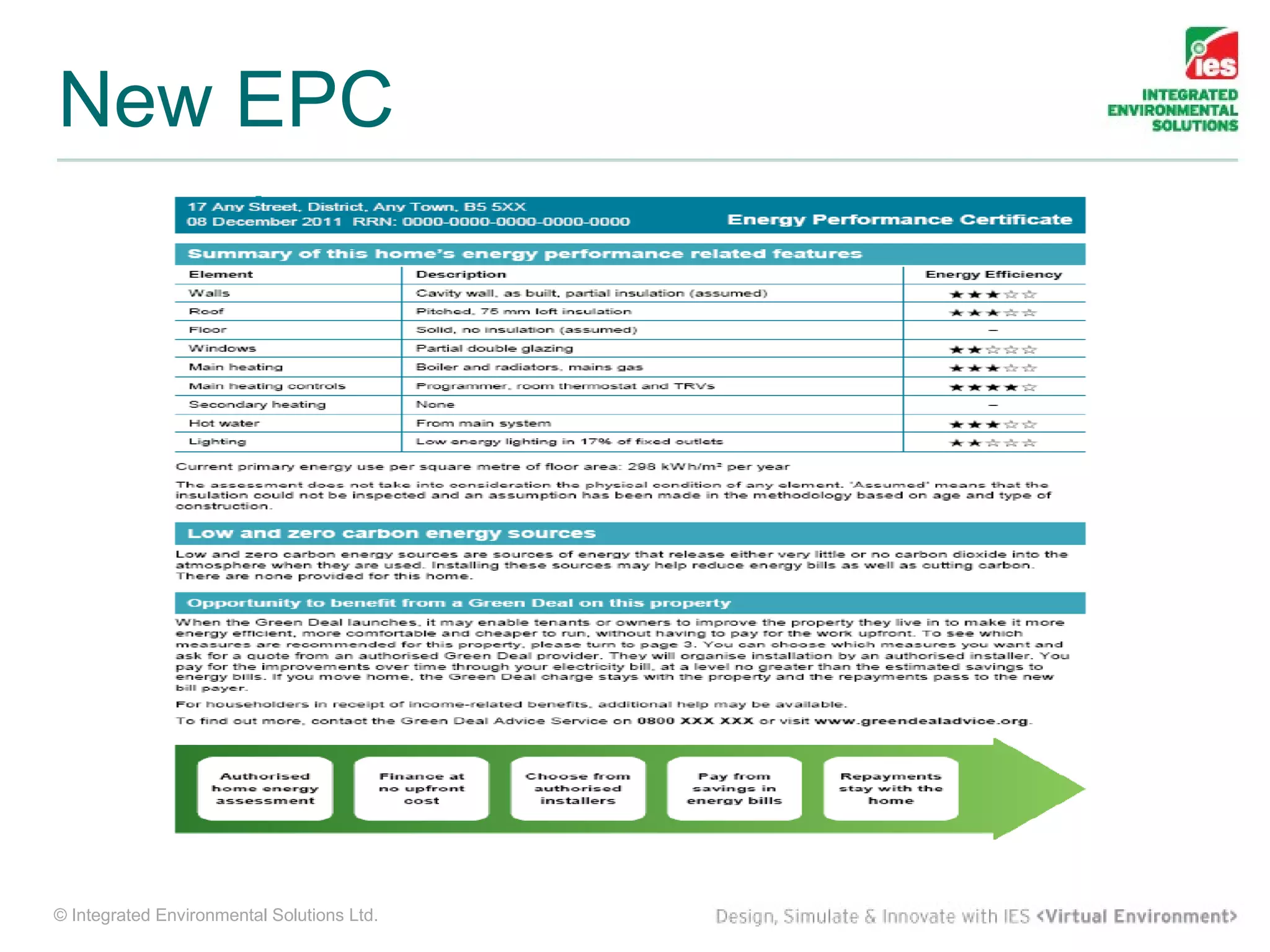
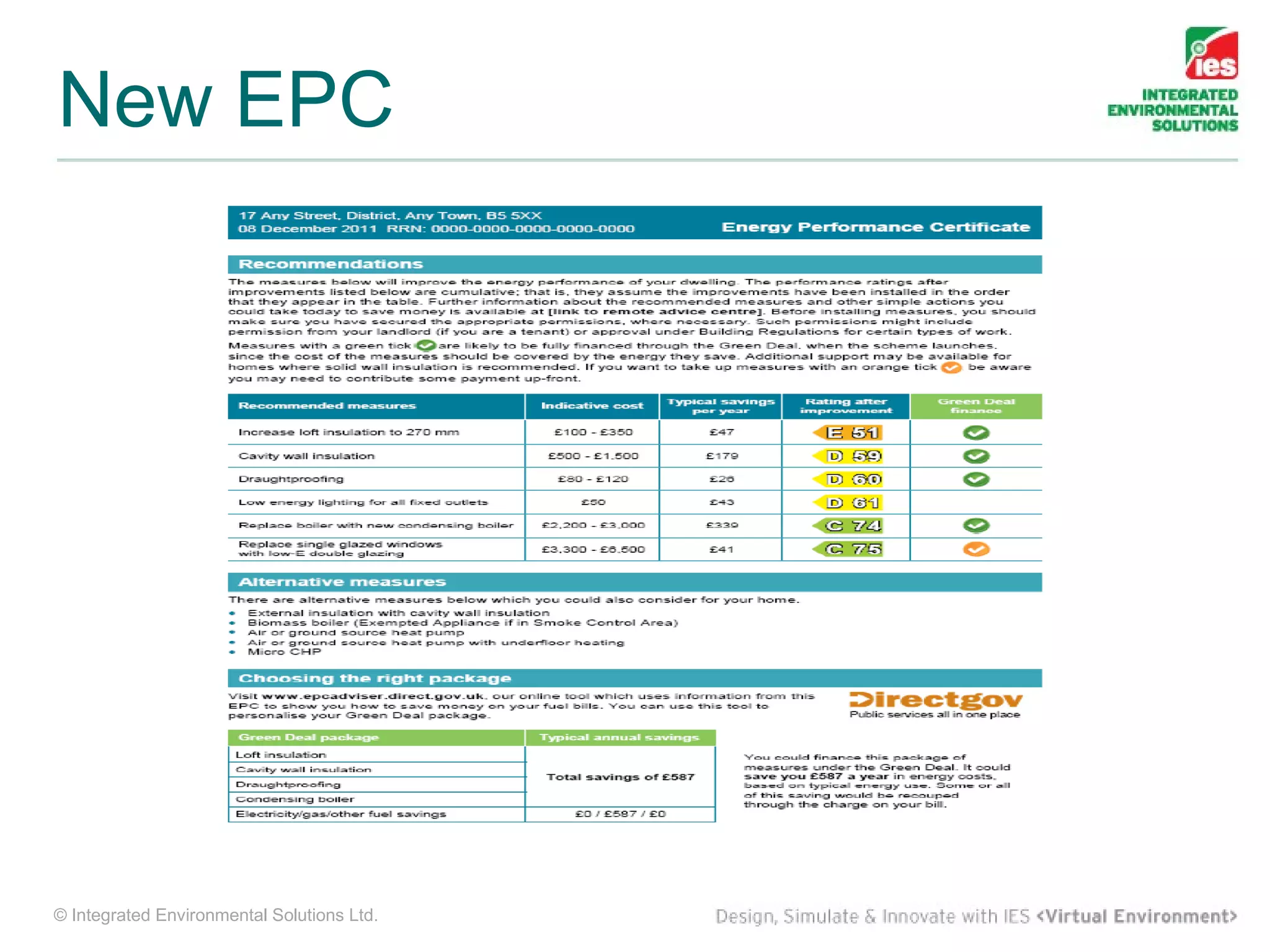
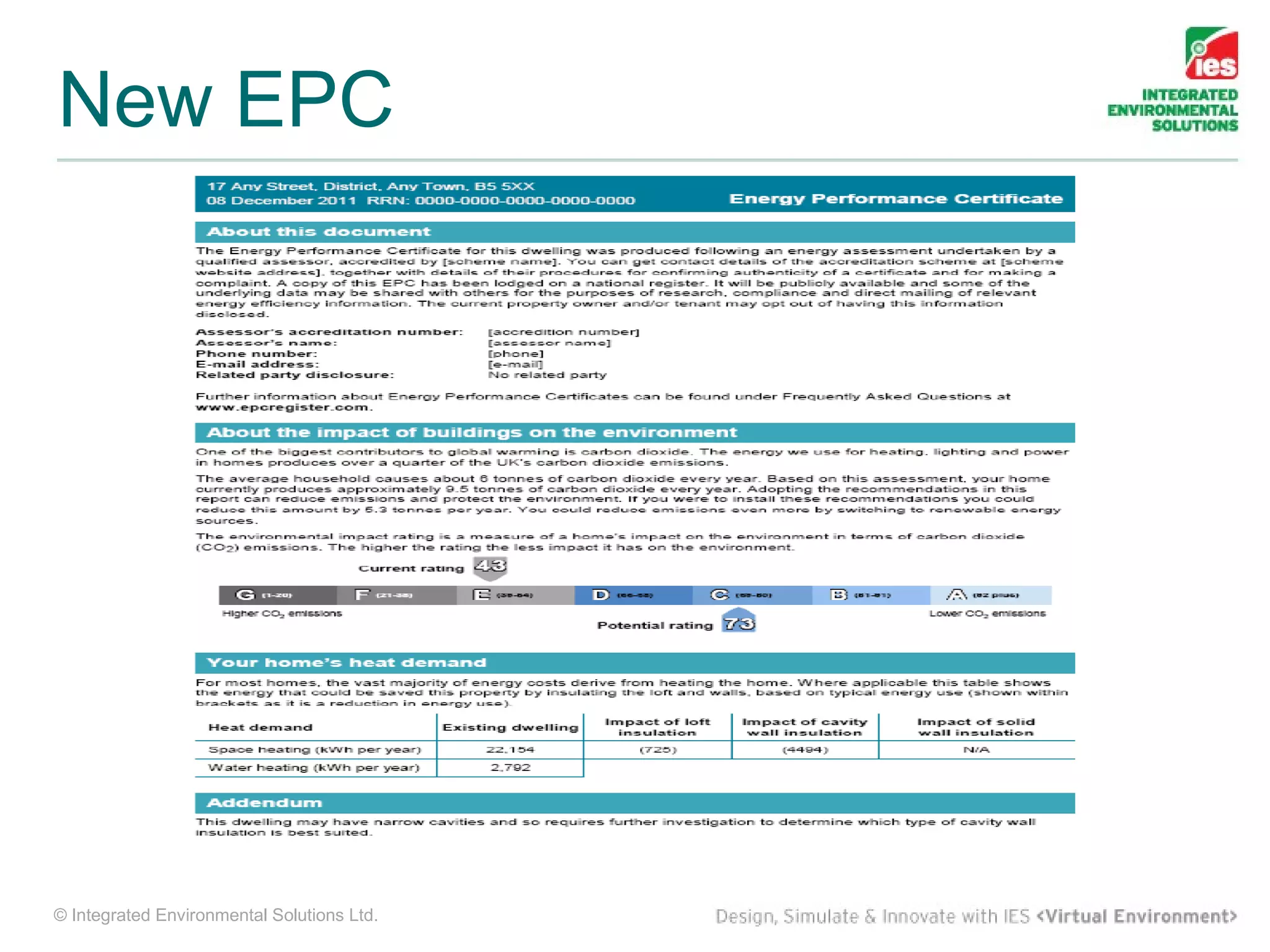
New EPC
 •     EPC has undergone a major redesign to ensure it gives consumers
       the information they need, including:

 •     A much more professional design with better use of graphics and
       white space.

 •     Getting rid of jargon and making it more consumer-friendly with plain
       English used throughout

 •     A very clear emphasis on the financial costs and benefits of various
       measures

 •     Clear signposting to the Green Deal and information on which
       measures qualify for Green Deal finance

© Integrated Environmental Solutions Ltd.
New EPC


© Integrated Environmental Solutions Ltd.
New EPC


© Integrated Environmental Solutions Ltd.
New EPC


© Integrated Environmental Solutions Ltd.
New EPC


© Integrated Environmental Solutions Ltd.
Part L 2013
 •     L2A: Notional Building: either 11% aggregate saving (likely) or 20%
       aggregate saving (Government preferred option)
         – Either way the challenge is real.


 •     Session 2 will cover the proposed changes in more detail.


© Integrated Environmental Solutions Ltd.
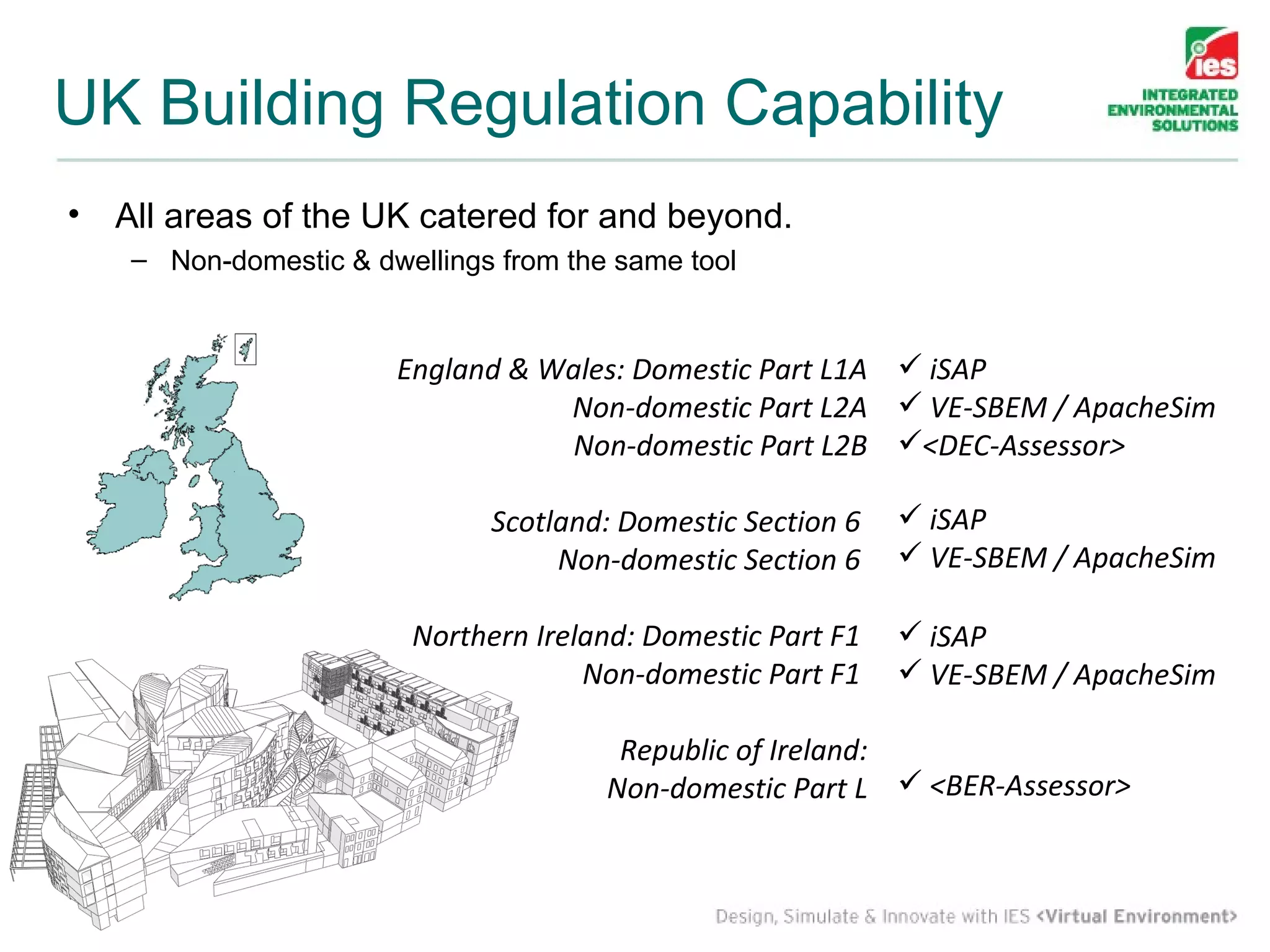
UK Building Regulation Capability
 •     All areas of the UK catered for and beyond.
         – Non-domestic & dwellings from the same tool


                                            England & Wales: Domestic Part L1A  iSAP
                                                       Non-domestic Part L2A  VE-SBEM / ApacheSim
                                                       Non-domestic Part L2B <DEC-Assessor>

                                                  Scotland: Domestic Section 6    iSAP
                                                       Non-domestic Section 6     VE-SBEM / ApacheSim

                                            Northern Ireland: Domestic Part F1    iSAP
                                                         Non-domestic Part F1     VE-SBEM / ApacheSim

                                                           Republic of Ireland:
                                                          Non-domestic Part L  <BER-Assessor>


© Integrated Environmental Solutions Ltd.
Hear the latest, as we do!
     •    www.iesve.com
     •    forums.iesve.com
     •    twitter.com/IESVE
     •    blog.iesve.com
     •    youtube.com/IESVE
     •    facebook.com/IESVE
     •    slideshare.net/IESVE

© Integrated Environmental Solutions Ltd.
References
          The Energy Performance of Buildings (Certificates and Inspections) (England and Wales)
              (Amendment) Regulations 2011
          http://www.legislation.gov.uk/uksi/2011/2452/introduction/made

          Information Update for Domestic Energy Assessors
          http://www.communities.gov.uk/publications/planningandbuilding/updatedomesticenergy

          2012 consultation on changes to the Building Regulations in England: Section two - Part L
              (Conservation of fuel and power)
          http://www.communities.gov.uk/documents/planningandbuilding/pdf/2077834.pdf

          The Green Deal
          http://www.decc.gov.uk/en/content/cms/tackling/green_deal/green_deal.aspx

          Approved Document L2A 2010
          http://www.planningportal.gov.uk/uploads/br/BR_PDF_ADL2A_2010.pdf


© Integrated Environmental Solutions Ltd.
Q&A


© Integrated Environmental Solutions Ltd.
Break


© Integrated Environmental Solutions Ltd.

IES Faculty – Part L, EPC’s & the VE (Part 1)

  • 1.
    IES Faculty –Part L, EPC’s & the VE London– 7th March 2012
  • 2.
    Overview Session 1– Niall Gibson •From EPBD to the Present •Where are we now •What’s coming in the future •BREAK Session 2 – Michael Pollock •Evolution of the VE-Compliance Features •New VE-Compliance benefits •FAQ based ‘hints and tips’ Q&A Session © Integrated Environmental Solutions Ltd.
  • 3.
    Session 1 Niall Gibson © Integrated Environmental Solutions Ltd.
  • 4.
    From EPBD toPresent © Integrated Environmental Solutions Ltd.
  • 5.
    The Origins ofPart L • First introduced in 1985 following 1984 Building Act: Regulated heating systems and Insulation of services • Revised in 1990 and again in 1995 to regulate the “Conservation of Fuel and Power” • 2002: – L1(Dwellings) & L2(Non-Dwellings) – 3 methods for Compliance – Elemental, Whole Building Method or Carbon Emissions Calculation Method – SAP used to calculate Carbon Emissions for dwellings • 2006: – L1A and L2A (New Build) & L1B and L2B (Existing Buildings) – Introduction of SBEM for Non-Dwelling Compliance – 1 Single method of compliance through 5 Criteria – BER Vs TER or DER Vs TER – Improved standards for U-Values and plant efficiency etc © Integrated Environmental Solutions Ltd.
  • 6.
    The Origins ofEPC’s • European performance of Buildings Directive (EPBD) state the requirements of Energy Performance Certificate (EPC) within: – Article 10 – Article 11 – Article 12 • EPC’s first appearance in the UK in 2008 © Integrated Environmental Solutions Ltd.
  • 7.
    ….and Today! • Part L 2010……. © Integrated Environmental Solutions Ltd.
  • 8.
    Where Are WeNow © Integrated Environmental Solutions Ltd.
  • 9.
    Part L2A 2010 Criterion 1 – Achieving the BER • Target Emission Rate (TER) calculation changed significantly. • TER now determined by a new 2010 Notional Building. • Improvement Factors and Low Zero Carbon Factors have been removed. • The 2010 Part L2A is intended to achieve an aggregate reduction of 25%. • The reduction therefore between building types will vary. © Integrated Environmental Solutions Ltd.
  • 10.
    Part L2A 2010 Criterion 2 – Limits on Design Flexibility • Limiting Average U-values typically the same as 2006 Regulations. • System Efficiencies and controls should meet the minimum provisions set out in the “Non-Domestic Building Services Compliance Guide”. • Minimum requirements for Lighting Efficiency now falls under Criterion 2. © Integrated Environmental Solutions Ltd.
  • 11.
    Part L2A 2010 Criterion 3 – Limiting the Effects of Solar Gains in Summer • Significant Change in Calculation Method from L2A 2006 Regulations • Now only one means to demonstrate compliance. • Compliance is met by showing that aggregated Solar Gain does not exceed a Benchmark level. • Applicable to all occupied, non transient spaces regardless of their conditioning level. • IESVE would always reiterate the importance of investigating overheating © Integrated Environmental Solutions Ltd.
  • 12.
    The 2010 NotionalBuilding The Target Emission Rate • The TER is now the Notional Building Emission Rate • Improvement Factors and Low Zero Carbon Factors no longer exist in calculation • The 2010 NCM Modelling Guide details the properties for the 2010 Notional Building. • This new approach has the advantage of allowing the Actual and Notional Buildings to be directly compared to identify key areas where improvement is required. © Integrated Environmental Solutions Ltd.
  • 13.
    Part L 2010 2010 keys points: •25% improvement over 2006 standards for New Build (Aggregate Approach) •Minor Alterations to SBEM to reflect changes •Criterion 3 – Overheating calculations simplified calculations, onerous compliance •Thermal bridging constraints •Compliance required with Design Stage submission pre-start •25% proved challenging (Good Holistic design essential, vehicle for BIM?!) •2013 is around the corner and 2016 seems much closer….. – Zero carbon Homes & Schools by 2016 – All Public Building stock by 2018 – All new build by 2019 © Integrated Environmental Solutions Ltd.
  • 14.
    Accreditation IES Certification • Frequent online and face to face training sessions offered to meet customers needs – contact accreditation@iesve.com for more information. • IES Accreditation exams covering Levels 3, 4 & 5 available at test centres across the country. © Integrated Environmental Solutions Ltd.
  • 15.
    What’s Coming inthe Future © Integrated Environmental Solutions Ltd.
  • 16.
    “from 2016 allnew homes, and from 2019 all new non- domestic buildings, will be built to zero carbon standards.” Rt Hon Grant Shapps MP © Integrated Environmental Solutions Ltd.
  • 17.
    Zero Carbon Definition • The proposed new definition is simply represented (below). – the target for Carbon Compliance is currently expected to be a 70% reduction of regulated energy use compared to 2006 Standards. “ Source: zerocarbonhub.org © Integrated Environmental Solutions Ltd.
  • 18.
    The Green Deal • Market driven approach with parameters set by Government. • New financing arrangement – attached to the meter. • Install a package of measures that pays for itself over time. • Support for poorer households and certain installations • Consultations has now closed – received over 600 responses. • Government will publish formal responses in late spring 2012. • Launch of Green Deal in October 2012 for Domestic. – Non-Domestic to follow later © Integrated Environmental Solutions Ltd.
  • 19.
    The Green DealOverview DECC Oversight Body BSI PAS Installer UKAS Standard / Advisor Accrediting Standard Green Deal Code of Standards Practice (Accredited) Certification Bodies Approved (Certified) Advisors & Installers Issues Quality Green Deal Advisor Mark Qualifications © Integrated Environmental Solutions Ltd.
  • 20.
    Green Deal Process Remote Advice: •Independent and Impartial advice via telephone and internet •Signposting service to other parts of the Green Deal e.g. assessment, installation etc © Integrated Environmental Solutions Ltd.
  • 21.
    Green Deal Process Assessment: •Only an accredited assessor can produce report •Standardised, impartial assessment including: • Fabric Assessment • Other advice, including behavioural © Integrated Environmental Solutions Ltd.
  • 22.
    Green Deal Process Finance: •New Finance mechanism – attached to the energy meter and paid back over time through savings on energy bills •Obligation passes to whoever pays the bill at the property, so transfers automatically to any new occupier © Integrated Environmental Solutions Ltd.
  • 23.
    Green Deal Process Installation: •Accredited installers carry out work to a clear standard •Sign off work once complete and inform Green Deal provider that repayments can begin © Integrated Environmental Solutions Ltd.
  • 24.
    Green Deal Process Repayments and follow up: •Payments collected through energy bills with the Green Deal charge shown as a separate line on the bill •Continuing support from the Green Deal provider throughout Green Deal •Customer is free to switch energy supplier – no change to current procedures © Integrated Environmental Solutions Ltd.
  • 25.
    The Golden Rule The Golden Rule is the principle which limits the amount of Green Deal finance that a provider can attach to the likely energy bill savings by the measures installed Protects consumers of higher energy bills and investors from a higher risk of default on the bill. © Integrated Environmental Solutions Ltd.
  • 26.
    The Golden Rule The Assessment The advisor will produce an Energy Performance Certificate (EPC) alongside an appropriate package of measures In addition to An assessment of how the occupants use their energy in their home through the Occupant Assessment © Integrated Environmental Solutions Ltd.
  • 27.
    Agreed Changes toDomestic Assessment • Assessment methodology by an improved RdSAP • Changes include: – Regional weather, orientation and exposure – Partial coverage (room by room approach) – Additional energy efficiency measures – Indication of likely to meet Golden Rule – Revised EPC format © Integrated Environmental Solutions Ltd.
  • 28.
    Non-Domestic Assessment • Based on existing energy calculation tool SBEM. • Currently in development and being piloted by BRE • Additional functionalities to be expected: – Allow the assessor to tailor the model to the building occupiers actual operating regime – Enable the assessor to more easily explore and document the savings in energy use resulting from the installation of one or more energy efficiency measures, in one or more packages or measures. – Accept information on fuel costs, so as to calculate the approximate value of these energy savings. © Integrated Environmental Solutions Ltd.
  • 29.
    Energy Companies • Fundamental concept is that the Green Deal payments will be collected as part of the energy bills • This facilitates automatic transfer of charge between collectors if supplier is changed or properties change hands • Supplier with less than 250,000 customers are not obliged to collect • Electricity supplier will be collecting the Green Deal charge as an agent or trustee of the Green Deal provider • Payments passed to the green Deal provider within 72hrs • Ability to switch is not restricted assuming new supplier is participating in the payment collection mechanism © Integrated Environmental Solutions Ltd.
  • 30.
    Installers • Only authorised Green Deal installers can undertake the works • Will be able to use the ‘Green Deal Mark’ • Are certified by an accreditation body against the relevant Green Deal standards set out in the Code of Practice • Are a member of the certification body which certifies them • Agree to comply with the Code of Practice • Possible top up training required against current industry recognised installation requirements • Consumer could choose to go directly to Green Deal provider or an independent installer to carry out the work • Complaints handled by Green Deal provider who may take the matter to the certification body • There will be an over sight body. © Integrated Environmental Solutions Ltd.
  • 31.
    Green Deal Providers • Responsible for the provision of Finance and Arranging energy efficiency works • Offers a Green Deal Plan based on the recommendation from an accredited assessor • Must include consumer protections such as warranties • Arranges installations from an authorised installer • Have a complaints handling procedure • Provide information to new bill payer (must keep records) © Integrated Environmental Solutions Ltd.
  • 32.
    Approved Measures -Passive • Cavity Wall insulation • Cylinder Thermostats • Draught proofing • Energy efficient glazing • External wall insulation • High thermal performance external doors • Hot water cylinder insulation • Internal wall insulation • Lighting systems, fittings and controls • Loft or rafter insulation and loft hatch insulation • Roof insulation • Room in roof insulation • Under-floor insulation © Integrated Environmental Solutions Ltd.
  • 33.
    Approved Measures -LZC • Air source heat pumps • Biomass Boilers • Biomass room Heaters (with radiators) • Ground Source heat pumps • Micro combined heat and power • Micro wind generation • Photovoltaic’s • Solar water heating © Integrated Environmental Solutions Ltd.
  • 34.
    Approved Measures -Other • Fan-assisted replacement storage heaters • Flue gas heat recovery devices • Heating controls (for wet central heating system and warm air system) • High efficiency gas-fired condensing boilers • High efficiency replacement warm-air units • Mechanical ventilation with heat recovery • Oil-fired condensing boilers • Under-floor heating • Waste water heat recovery devices attached to showers © Integrated Environmental Solutions Ltd.
  • 35.
    Other Details Propertypractitioners •Disclosure required at sale or rent through the EPC – Estate agents/solicitors •Acknowledgement at transfer of property at sale, rent or license. Social landlords •Who takes out the Green Deal, Landlord or Tenant – Could be either but tenant would require Landlord approval •Landlord is liable in voids periods •Bill payer is liable for default © Integrated Environmental Solutions Ltd.
  • 36.
    Points of Note • Domestic Green Deal to be launched in October 2012, Non- Domestic TBC! • RdSAP/SBEM vs DSM • Eligibility of efficiency measures • Favours Non-Domestic over Domestic • What measures will be in place to curb GD Assessors’ inclination to inflate predicted savings • What protection will be provided to consumers • Will building owners willingly burden their home with a GD commitment binding on future purchasers? • Will enough GD assessors be trained up by October 2012 to make non-domestic Green Deal viable at that date? © Integrated Environmental Solutions Ltd.
  • 37.
    EPC’s • Government have decided that EPC’s should be made Publically available. • To come into force from April 2012. • Individual users will be able to access PDF EPC’s online directly from the EPC register – at no cost. • Authorised Bulk users include, Public sector, FIT’s Licensees, Green Deal Providers, etc © Integrated Environmental Solutions Ltd.
  • 38.
    Current EPC • Current EPC been in use since 2007. • Some positive features. • Research shown majority of home buyers and prospective tenants either do not read their EPC in detail, or at all. • Reasons include: – Document too lengthy – Language too technical – Confusion over ratings – Large amounts of text © Integrated Environmental Solutions Ltd.
  • 39.
    New EPC • EPC has undergone a major redesign to ensure it gives consumers the information they need, including: • A much more professional design with better use of graphics and white space. • Getting rid of jargon and making it more consumer-friendly with plain English used throughout • A very clear emphasis on the financial costs and benefits of various measures • Clear signposting to the Green Deal and information on which measures qualify for Green Deal finance © Integrated Environmental Solutions Ltd.
  • 40.
    New EPC © IntegratedEnvironmental Solutions Ltd.
  • 41.
    New EPC © IntegratedEnvironmental Solutions Ltd.
  • 42.
    New EPC © IntegratedEnvironmental Solutions Ltd.
  • 43.
    New EPC © IntegratedEnvironmental Solutions Ltd.
  • 44.
    Part L 2013 • L2A: Notional Building: either 11% aggregate saving (likely) or 20% aggregate saving (Government preferred option) – Either way the challenge is real. • Session 2 will cover the proposed changes in more detail. © Integrated Environmental Solutions Ltd.
  • 45.
    UK Building RegulationCapability • All areas of the UK catered for and beyond. – Non-domestic & dwellings from the same tool England & Wales: Domestic Part L1A  iSAP Non-domestic Part L2A  VE-SBEM / ApacheSim Non-domestic Part L2B <DEC-Assessor> Scotland: Domestic Section 6  iSAP Non-domestic Section 6  VE-SBEM / ApacheSim Northern Ireland: Domestic Part F1  iSAP Non-domestic Part F1  VE-SBEM / ApacheSim Republic of Ireland: Non-domestic Part L  <BER-Assessor> © Integrated Environmental Solutions Ltd.
  • 46.
    Hear the latest,as we do! • www.iesve.com • forums.iesve.com • twitter.com/IESVE • blog.iesve.com • youtube.com/IESVE • facebook.com/IESVE • slideshare.net/IESVE © Integrated Environmental Solutions Ltd.
  • 47.
    References The Energy Performance of Buildings (Certificates and Inspections) (England and Wales) (Amendment) Regulations 2011 http://www.legislation.gov.uk/uksi/2011/2452/introduction/made Information Update for Domestic Energy Assessors http://www.communities.gov.uk/publications/planningandbuilding/updatedomesticenergy 2012 consultation on changes to the Building Regulations in England: Section two - Part L (Conservation of fuel and power) http://www.communities.gov.uk/documents/planningandbuilding/pdf/2077834.pdf The Green Deal http://www.decc.gov.uk/en/content/cms/tackling/green_deal/green_deal.aspx Approved Document L2A 2010 http://www.planningportal.gov.uk/uploads/br/BR_PDF_ADL2A_2010.pdf © Integrated Environmental Solutions Ltd.
  • 48.
  • 49.