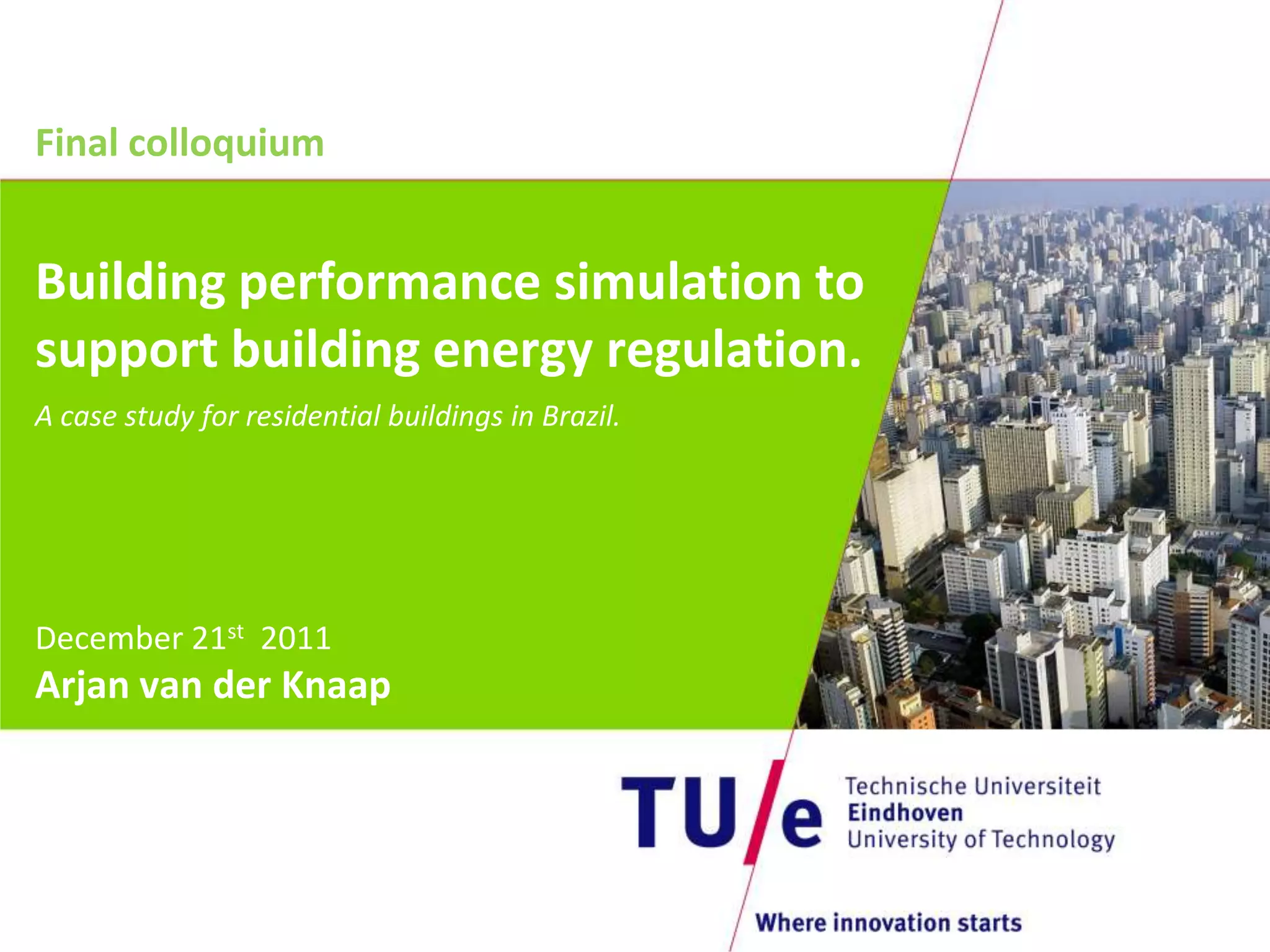
Final colloquium


Building performance simulation to
support building energy regulation.
A case study for residential buildings in Brazil.


December 21st 2011
Arjan van der Knaap
Outline


Introduction: Building Energy Regulation in Brazil

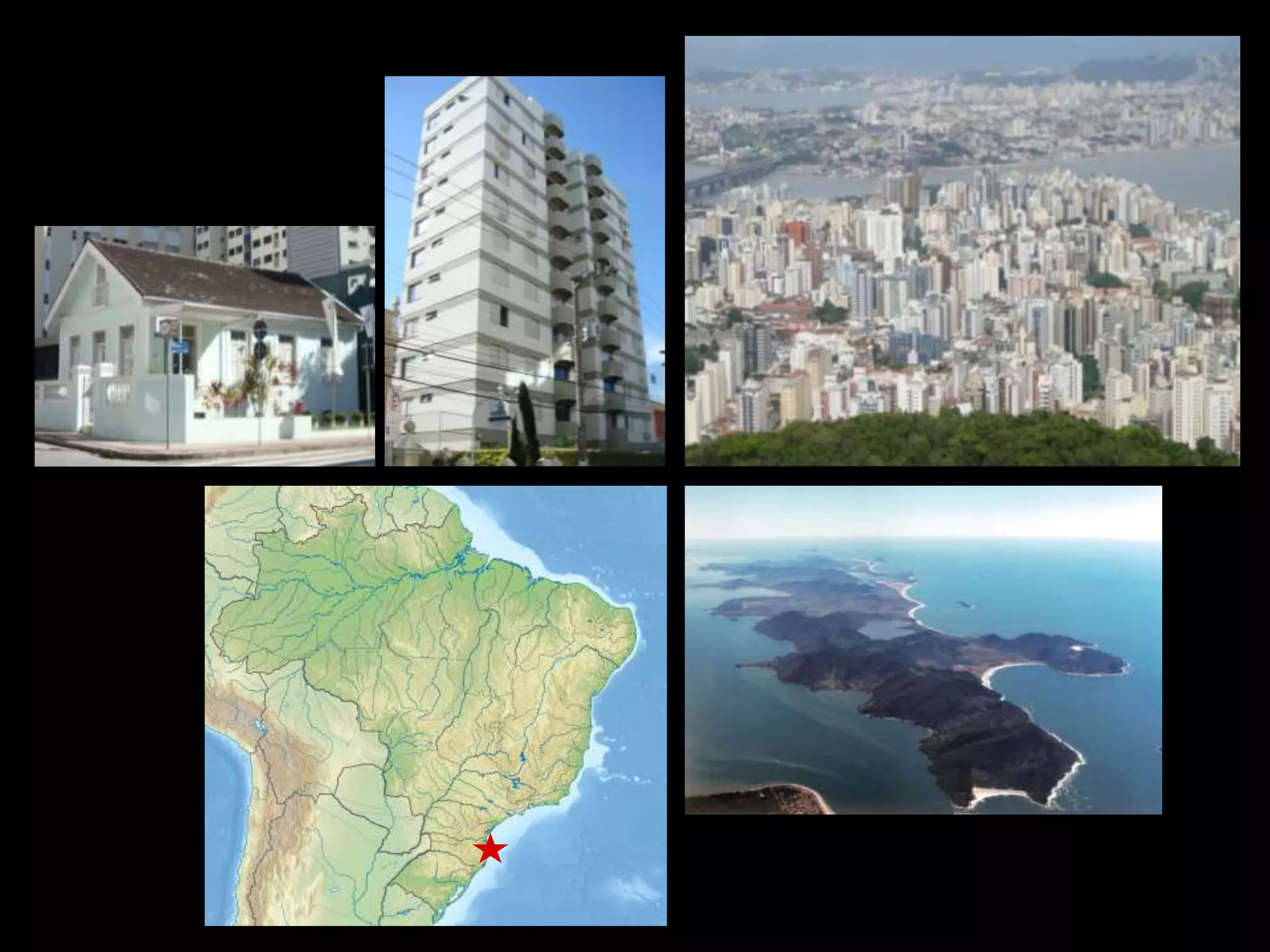
Methods: Evaluation with Building Performance Simulations

Results: Natural Ventilation & Air-Conditioning

Discussion: Effectiveness of Building Energy Regulation

Conclusions: Findings & Recommendations


                                                            3/5/2012   PAGE 1
Introduction


               3/5/2012   PAGE 2
Preface


          3/5/2012   PAGE 3
Introduction


               3/5/2012   PAGE 4
Supervisors:
                        prof. dr. ir. Jan Hensen
Introduction – Global   dr. ir. Marcel Loomans
                        dr. Daniel Cóstola


                                3/5/2012   PAGE 5
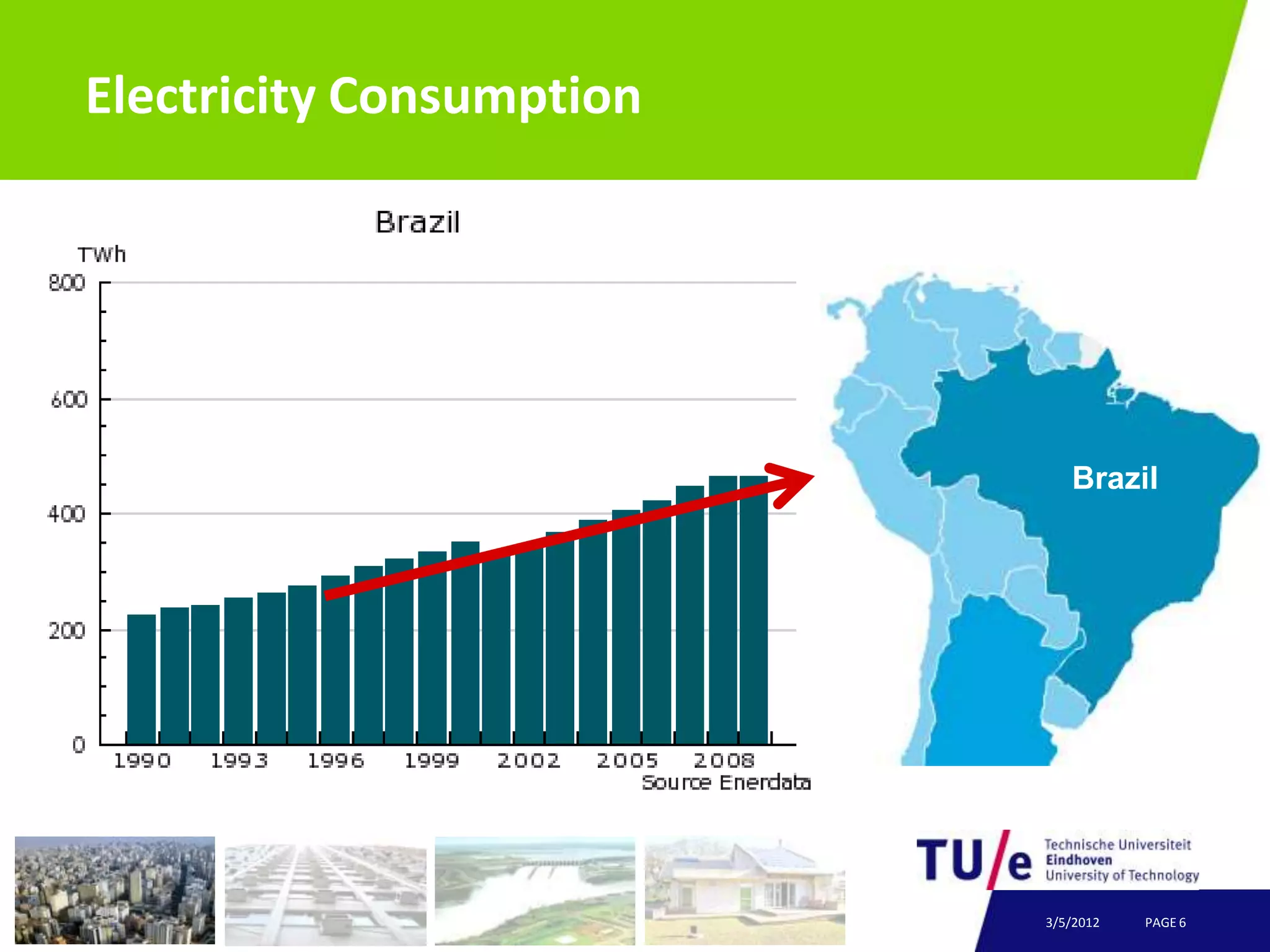
Electricity Consumption


                             Brazil


                          3/5/2012   PAGE 6
Supervisors:
                                                                                 prof. dr. ir. Jan Hensen
        Energy Consumption                                                       dr. ir. Marcel Loomans
                                                                                 dr. Daniel Cóstola


/ Building Physics and Systems / Computational Building Performance Simulation           3/5/2012   PAGE 7
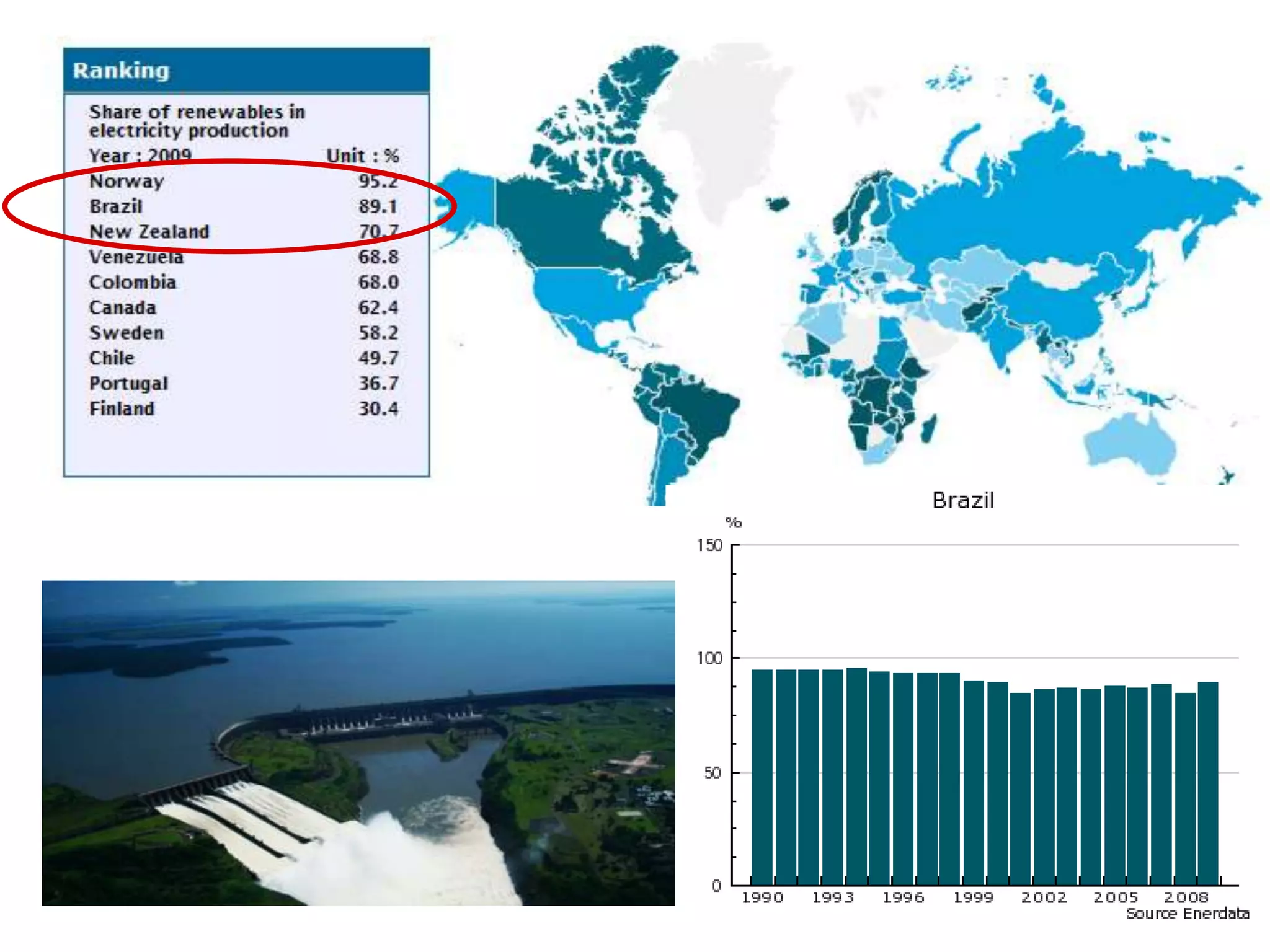
Renewable Energy


                   3/5/2012   PAGE 8
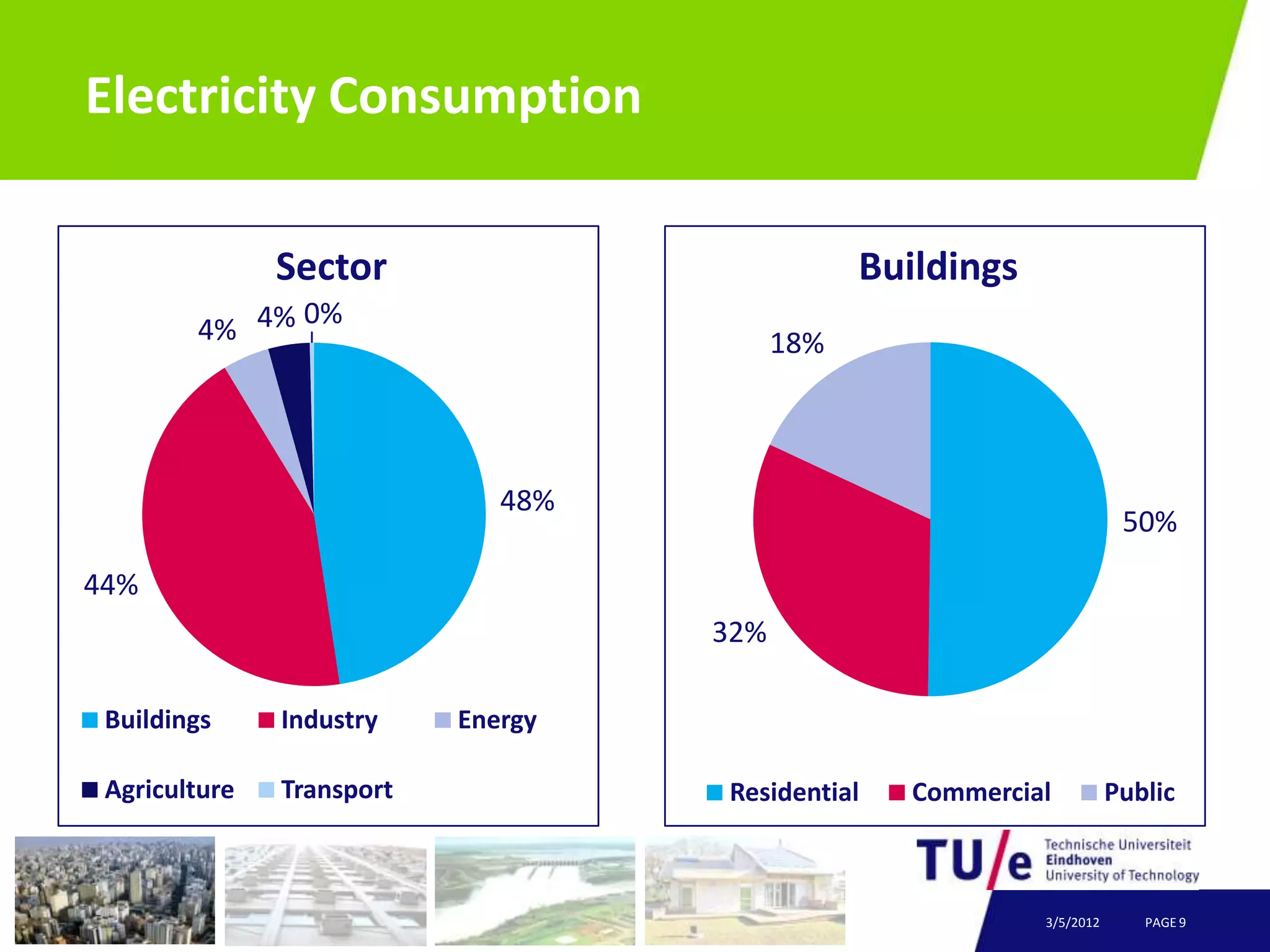
Electricity Consumption

               Sector                           Buildings
              0%
        4% 4%                             18%


                              48%
                                                                        50%
44%
                                    32%

 Buildings     Industry    Energy

 Agriculture   Transport            Residential    Commercial          Public


                                                            3/5/2012      PAGE 9
3/5/2012   PAGE 10
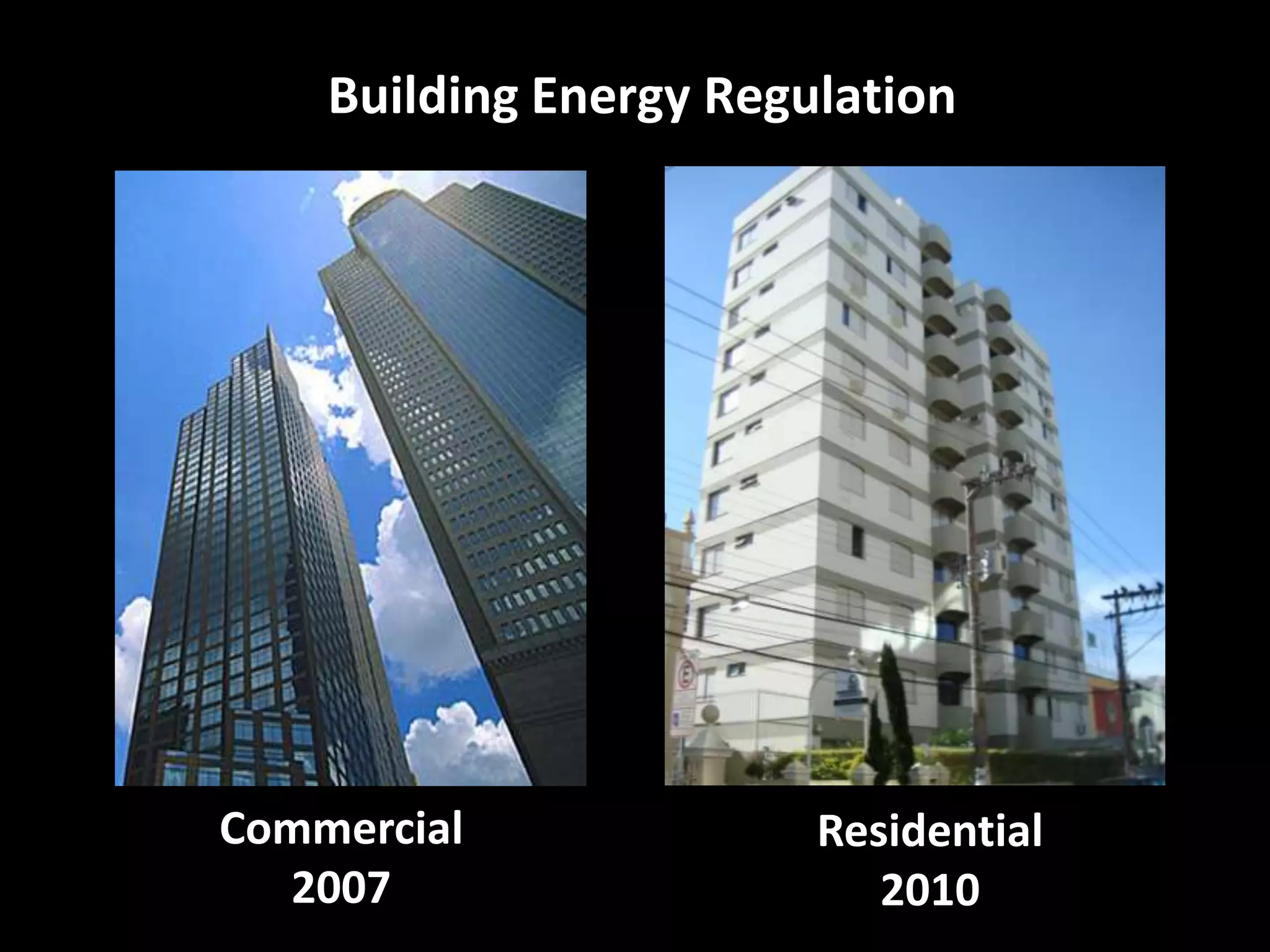
Building Energy Regulation


Commercial              Residential
  2007                     2010       3/5/2012   PAGE 11
Residential Buildings


                        3/5/2012   PAGE 12
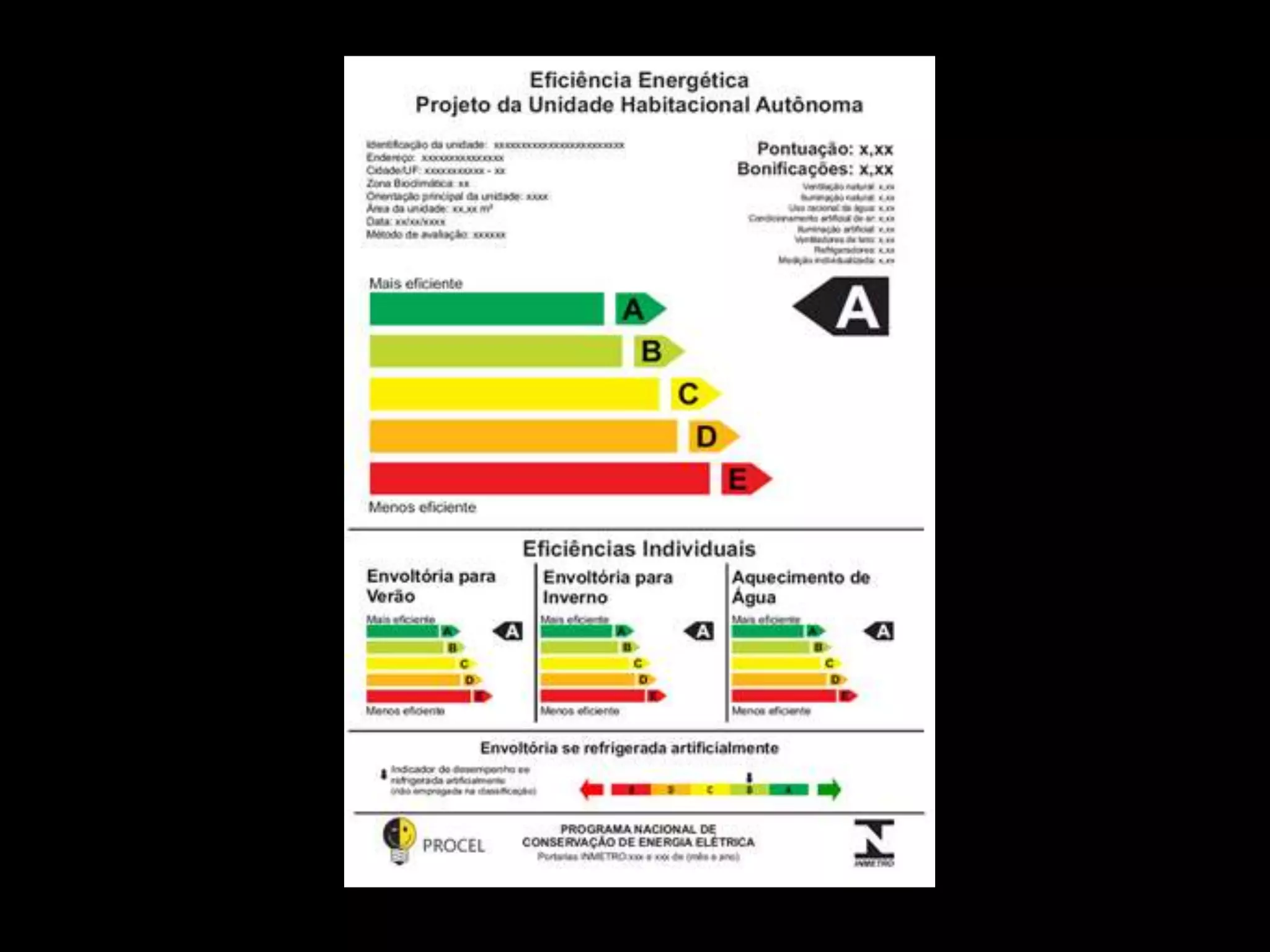
Energy Label
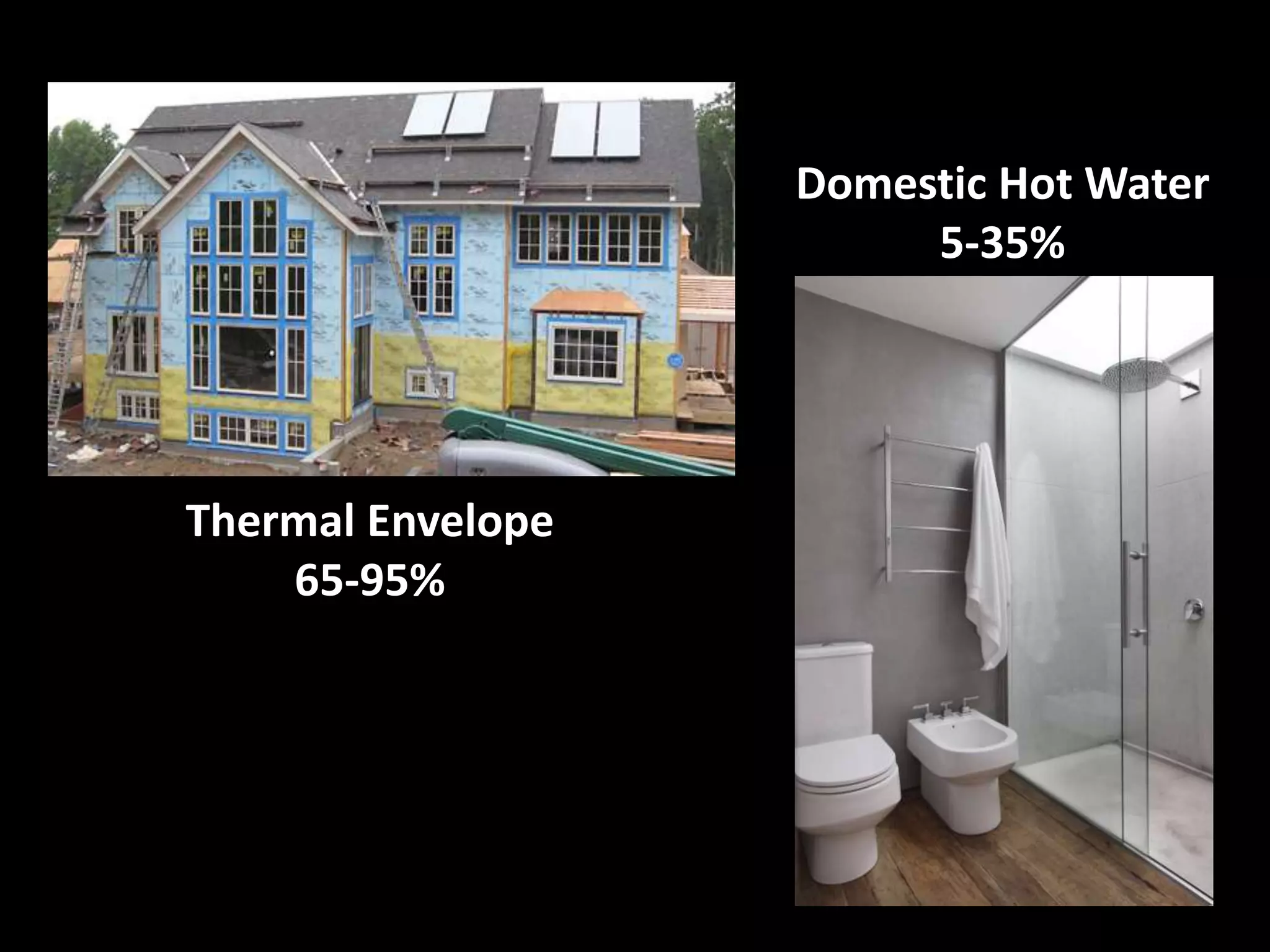
                       Domestic Hot Water
                            5-35%


    Thermal Envelope
        65-95%


                                 3/5/2012   PAGE 13
Efficiency Thermal Envelope

                   Performance
   Conditioning                      Method
                    Indicators

                   Overheating
      Natural       [Degree Hours]    Simplified
     Ventilation                       Method

                     Heating
                      [kWh/m²]
                                       Building
        Air-
                                     Performance
    Conditioning     Cooling         Simulations
                      [kWh/m²]


                                              3/5/2012   PAGE 14
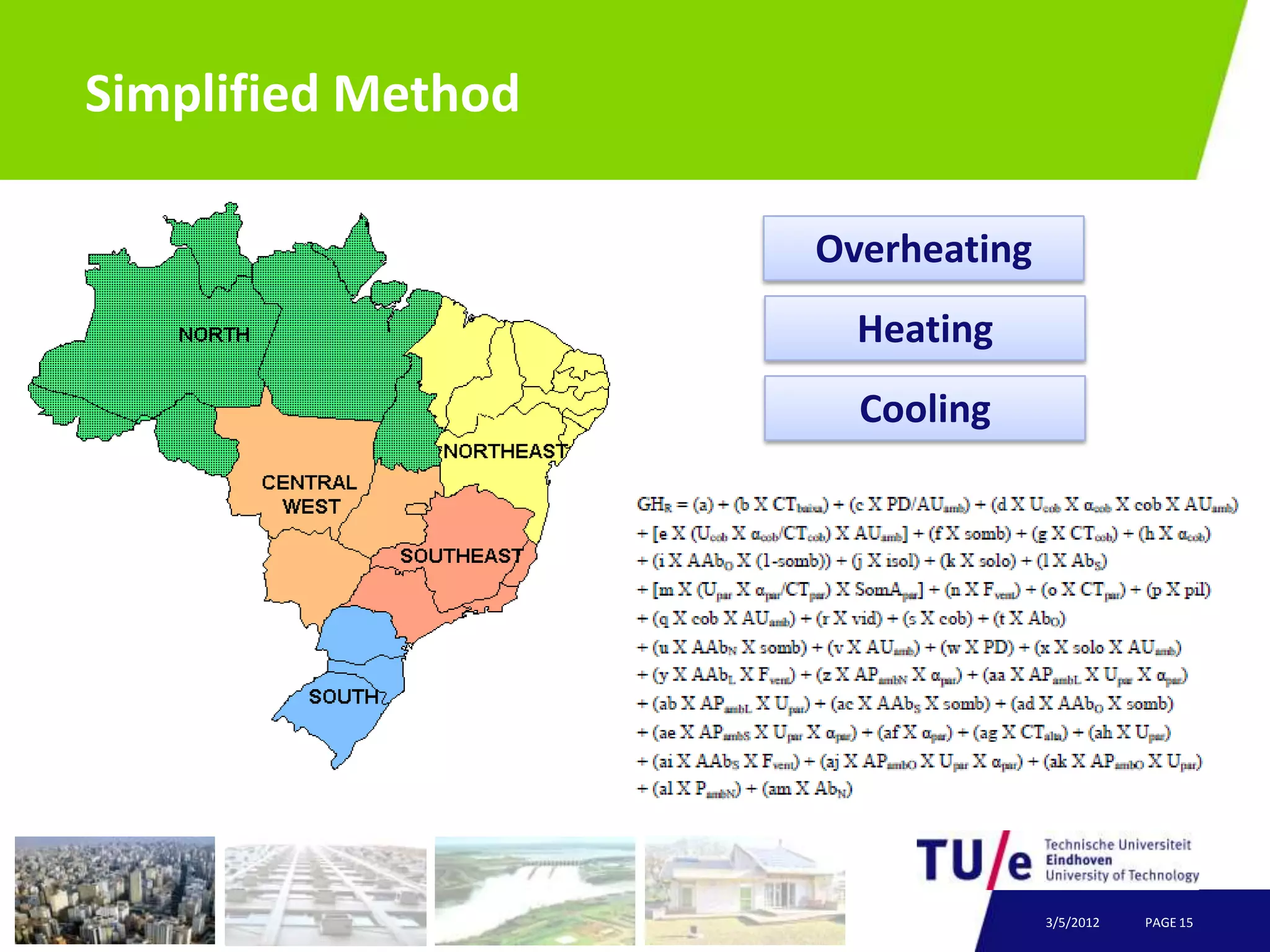
Simplified Method

                    Overheating
                      Heating
                      Cooling


                                  3/5/2012   PAGE 15
Literature - Performance Indicator

                           Assessment: Accuracy, scope, complexity, sensitivity[1]

                                Basic Elements[2]                                    Brazilian Standard

                               Thermal Envelope                                                   √
                                   HVAC-system                                                    √
                                   DHW-system                                                     √
                                       Lighting                                                   X
                                     Appliances                                                   X
[1 ] L. Pérez-Lombard, et al., A review of benchmarking, rating and labelling concepts within the framework of building energy certification
schemes, Energy and Buildings 41 (2009) 272-278
 [2] L. Pérez-Lombard, et al., A review of HVAC system requirements in building energy regulation, Energy and Buildings 43 (2011) 255-268


                                                                                                                          3/5/2012    PAGE 16
Literature - Effective Building Energy Regulation[3]

      Cost-effective


[3] L. Pérez-Lombard, et al., A review of
benchmarking, rating and labelling concepts within the
framework     of    building    energy    certification
schemes, Energy and Buildings 41 (2009) 272-278


                                                          3/5/2012   PAGE 17
Objective


 ‘To determine whether the Simplified Method
  is able to represent and assess energy
  efficiency of residential buildings.’


                                      3/5/2012   PAGE 18
Methods


          3/5/2012   PAGE 19
Methods


          3/5/2012   PAGE 20
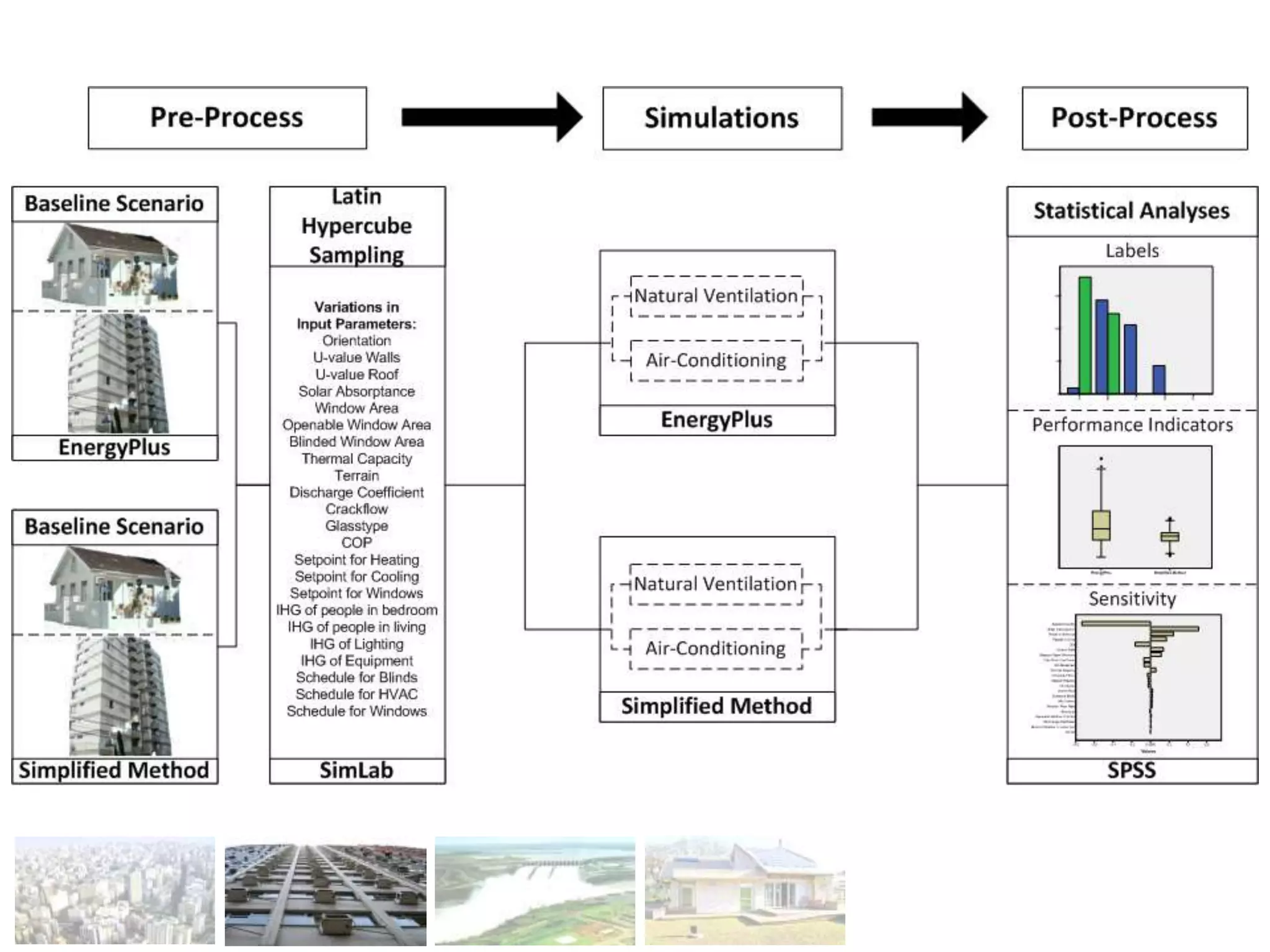
Overview


           3/5/2012   PAGE 21
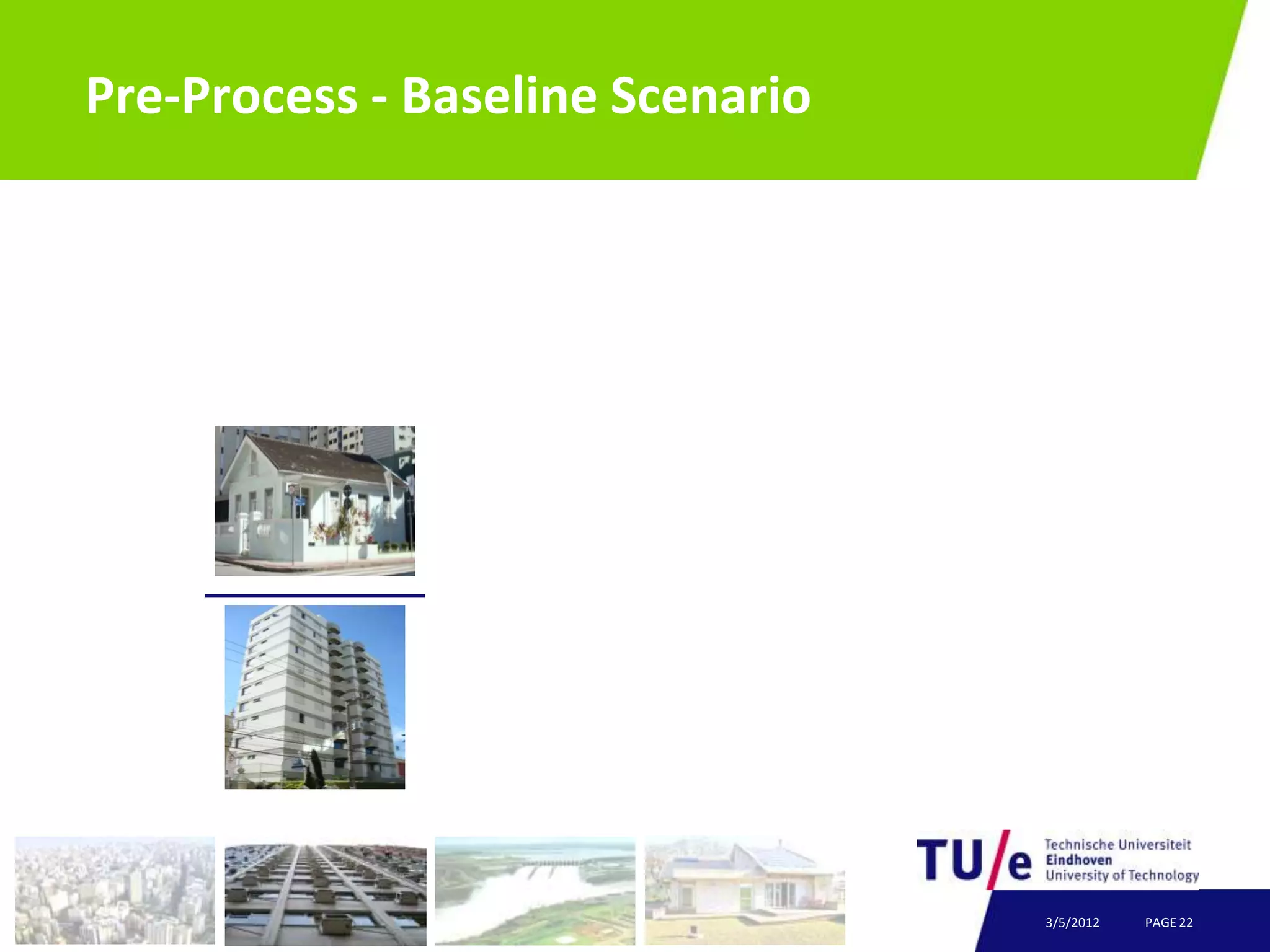
Pre-Process - Baseline Scenario


                                  3/5/2012   PAGE 22
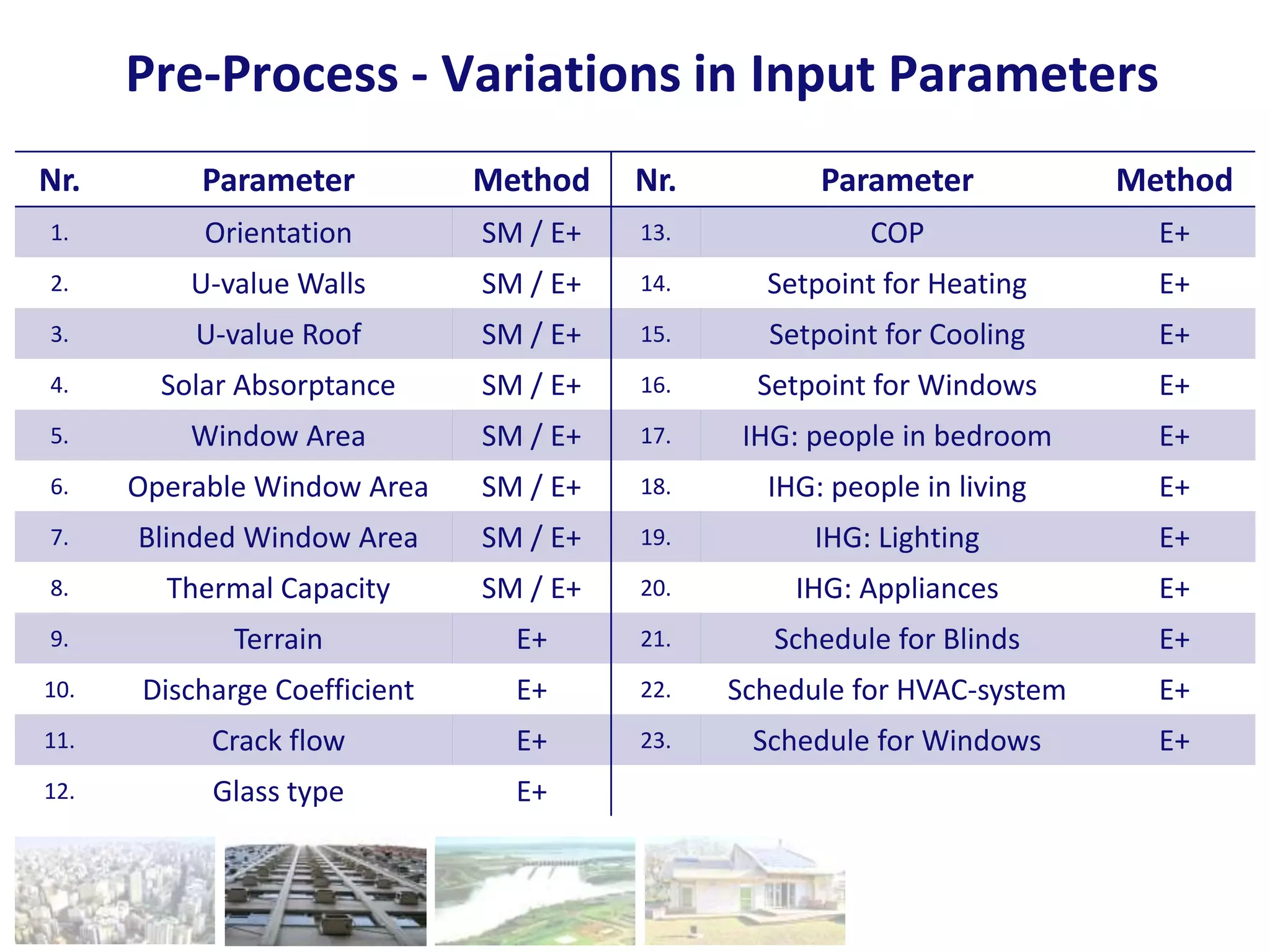
Pre-Process - Variations in Input Parameters
Nr.       Parameter           Method    Nr.         Parameter                      Method
1.         Orientation        SM / E+   13.             COP                          E+
2.        U-value Walls       SM / E+   14.     Setpoint for Heating                 E+
3.        U-value Roof        SM / E+   15.     Setpoint for Cooling                 E+
4.      Solar Absorptance     SM / E+   16.     Setpoint for Windows                 E+
5.        Window Area         SM / E+   17.    IHG: people in bedroom                E+
6.    Operable Window Area    SM / E+   18.     IHG: people in living                E+
7.    Blinded Window Area     SM / E+   19.         IHG: Lighting                    E+
8.      Thermal Capacity      SM / E+   20.       IHG: Appliances                    E+
9.           Terrain            E+      21.      Schedule for Blinds                 E+
10.   Discharge Coefficient     E+      22.   Schedule for HVAC-system               E+
11.        Crack flow           E+      23.    Schedule for Windows                  E+
12.        Glass type           E+


                                                                        3/5/2012    PAGE 23
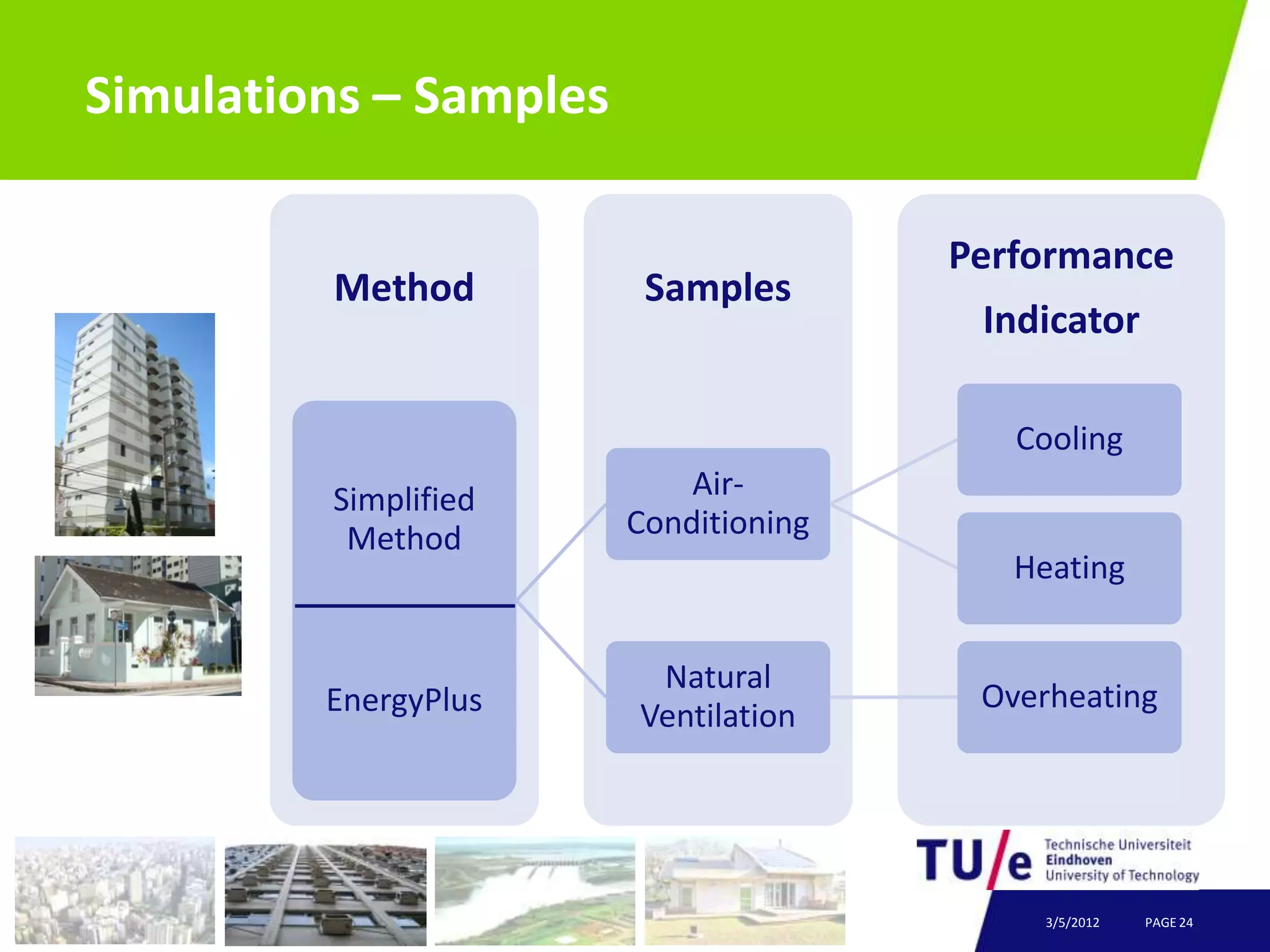
Simulations – Samples

                                       Performance
         Method          Samples
                                        Indicator

                                          Cooling
         Simplified         Air-
          Method        Conditioning
                                          Heating


                         Natural
         EnergyPlus                     Overheating
                        Ventilation


                                            3/5/2012   PAGE 24
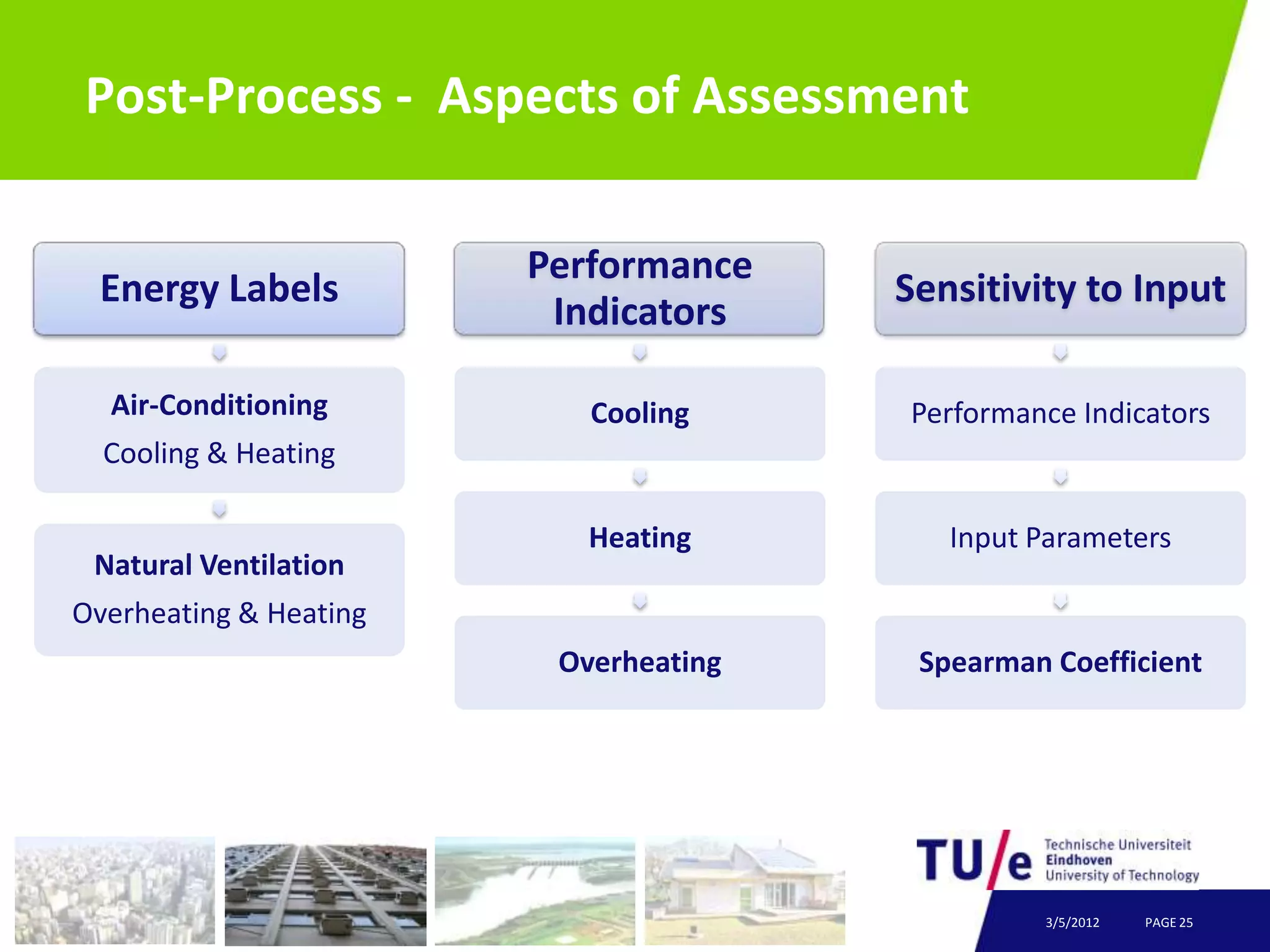
Post-Process - Aspects of Assessment

                        Performance
 Energy Labels                         Sensitivity to Input
                         Indicators

  Air-Conditioning         Cooling     Performance Indicators
  Cooling & Heating

                           Heating        Input Parameters
 Natural Ventilation
Overheating & Heating
                         Overheating    Spearman Coefficient


                                                3/5/2012   PAGE 25
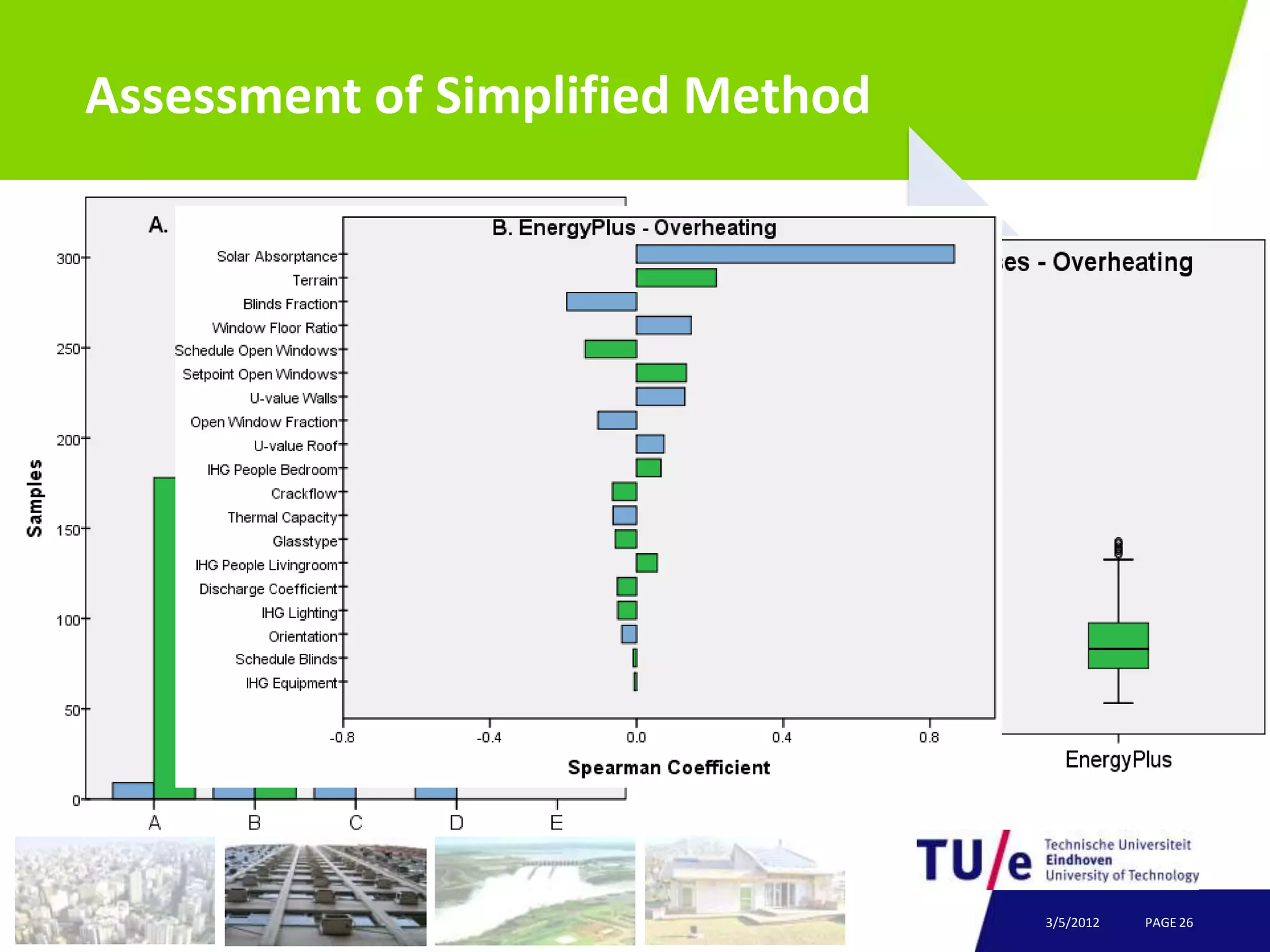
Assessment of Simplified Method


                 Performance      Sensitivity
 Energy Labels
                  Indicators       to Input


                                       3/5/2012   PAGE 26
Results
Natural Ventilation


                      3/5/2012   PAGE 27
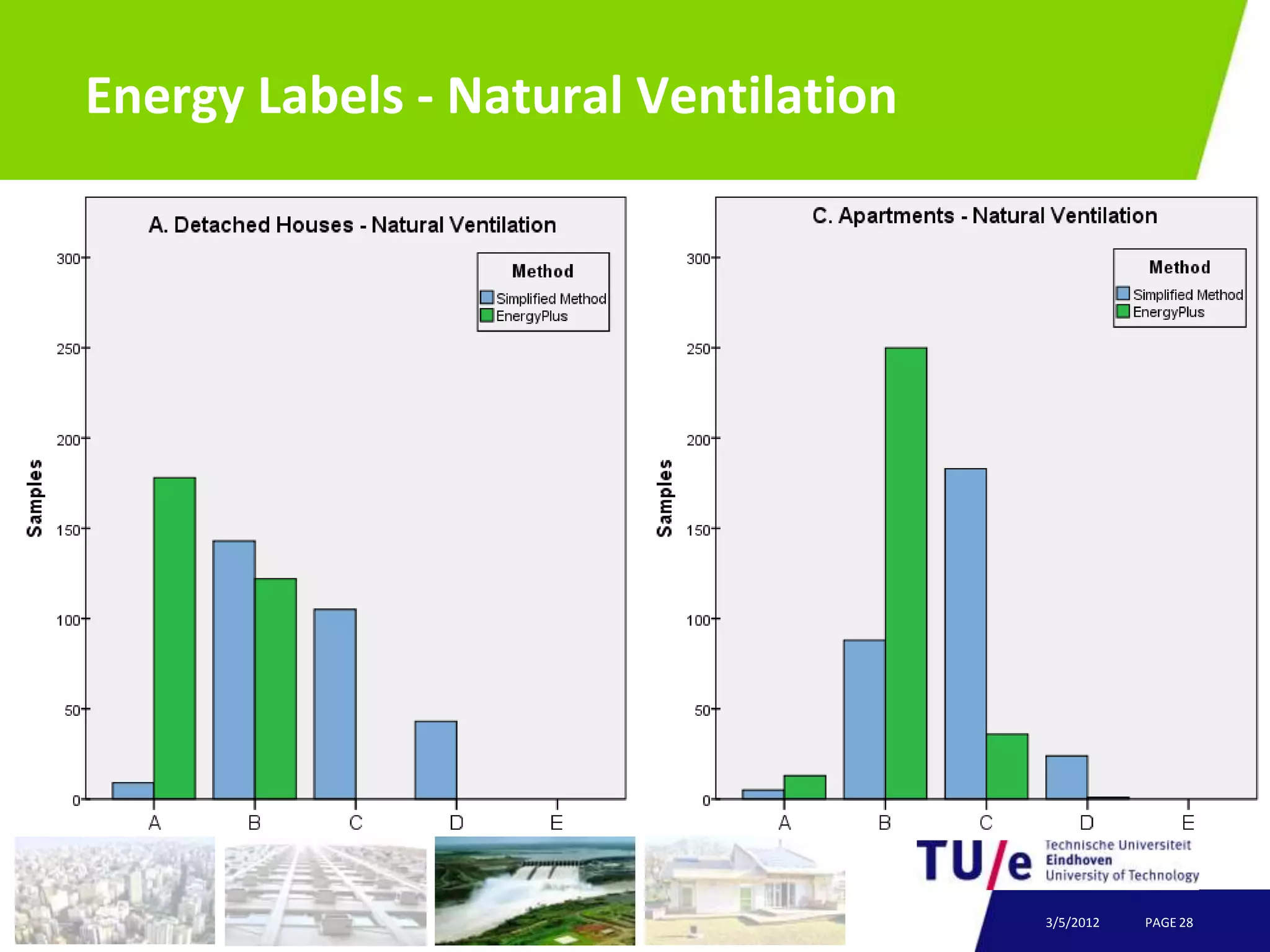
Energy Labels - Natural Ventilation


                                      3/5/2012   PAGE 28
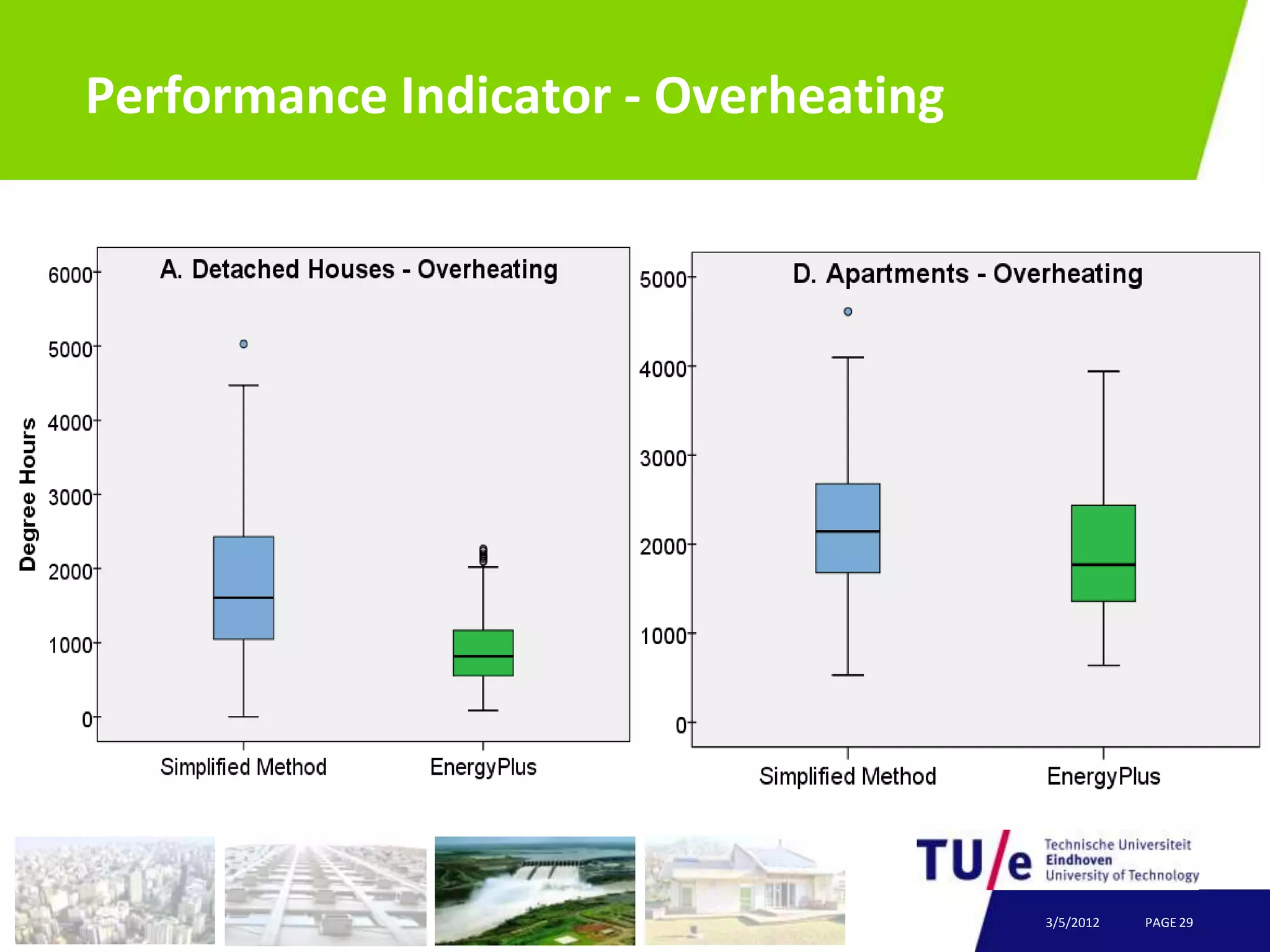
Performance Indicator - Overheating


                                      3/5/2012   PAGE 29
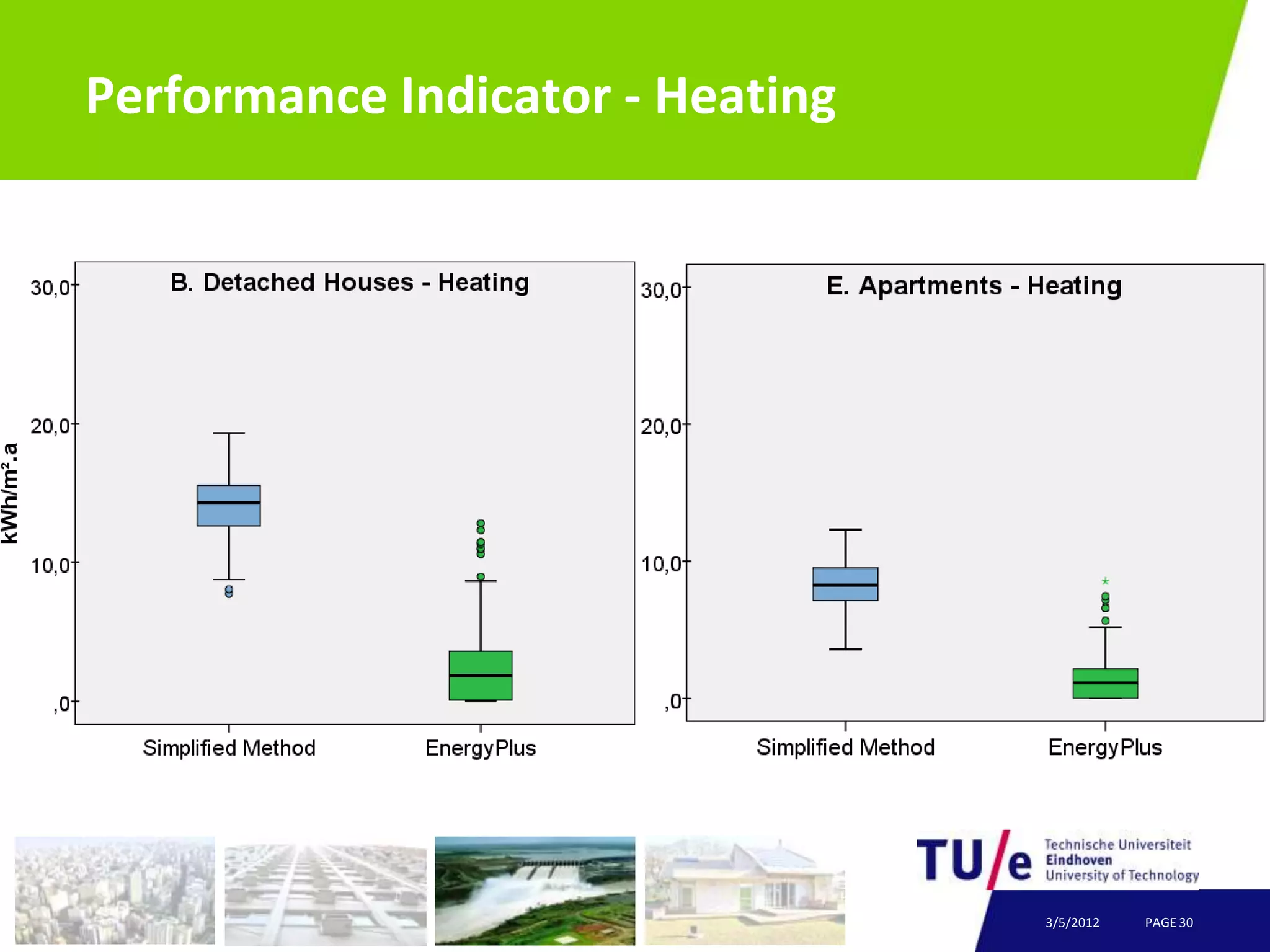
Performance Indicator - Heating


                                  3/5/2012   PAGE 30
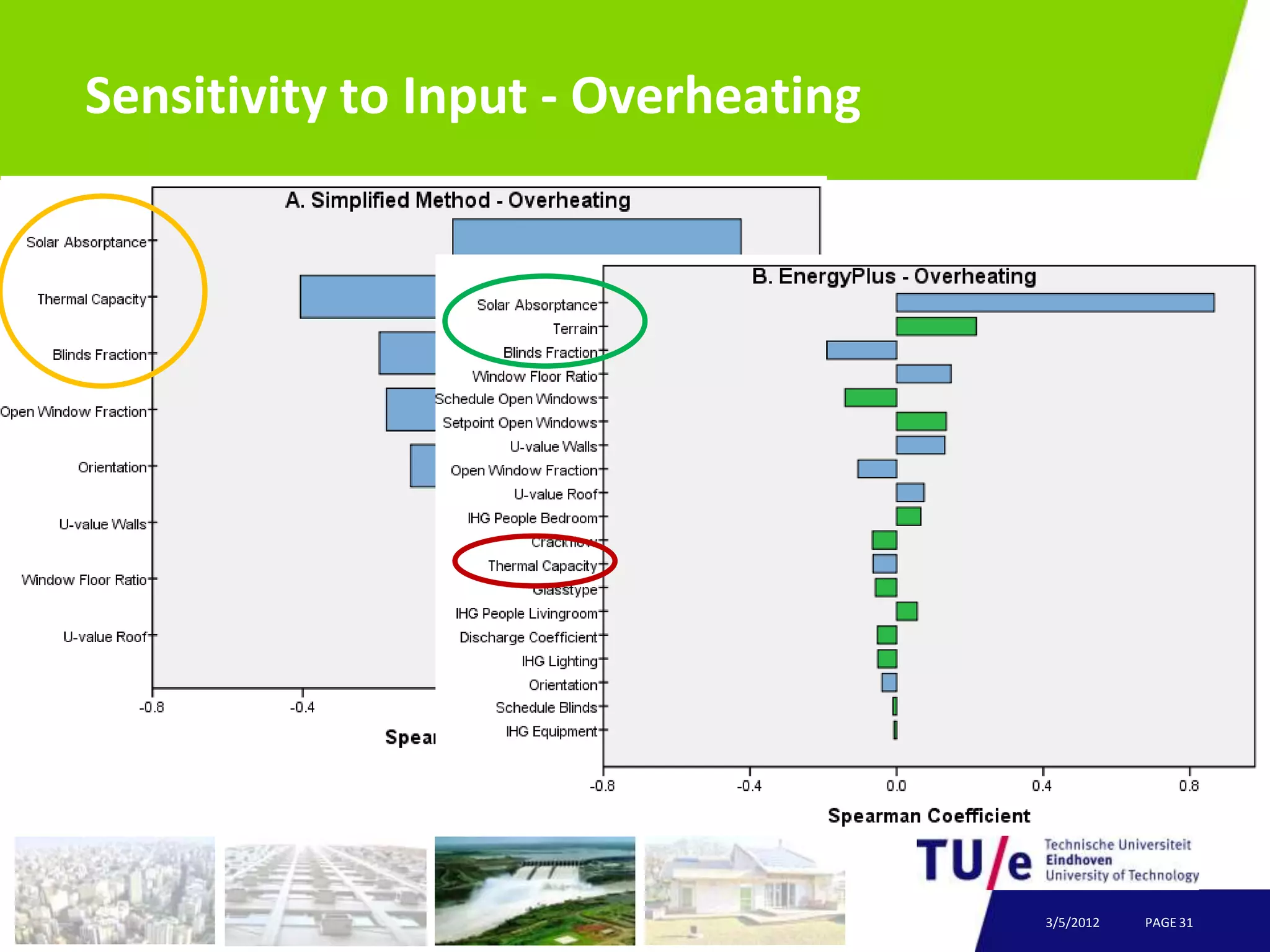
Sensitivity to Input - Overheating


                                     3/5/2012   PAGE 31
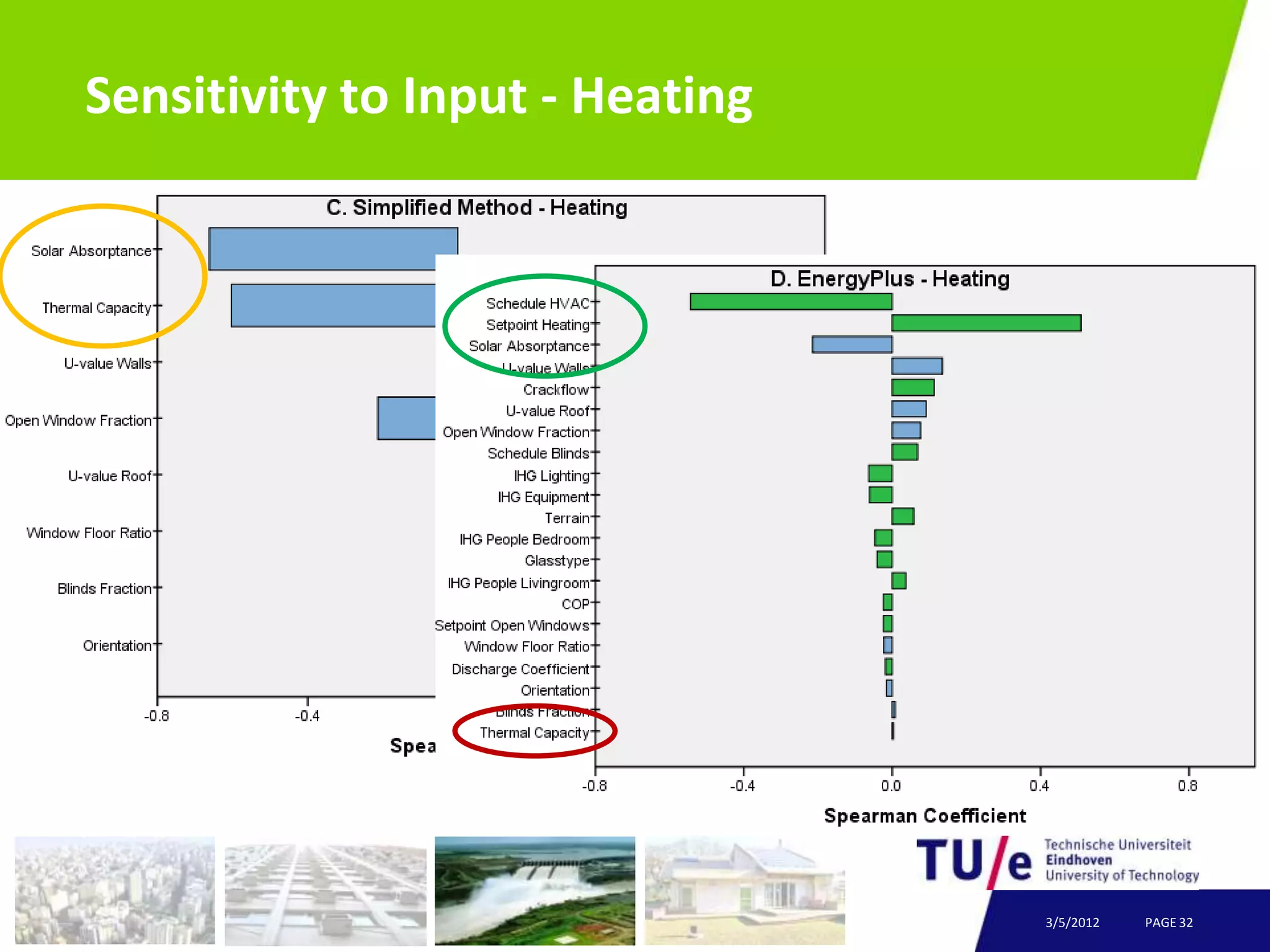
Sensitivity to Input - Heating


                                 3/5/2012   PAGE 32
Results
Air-Conditioning


                   3/5/2012   PAGE 33
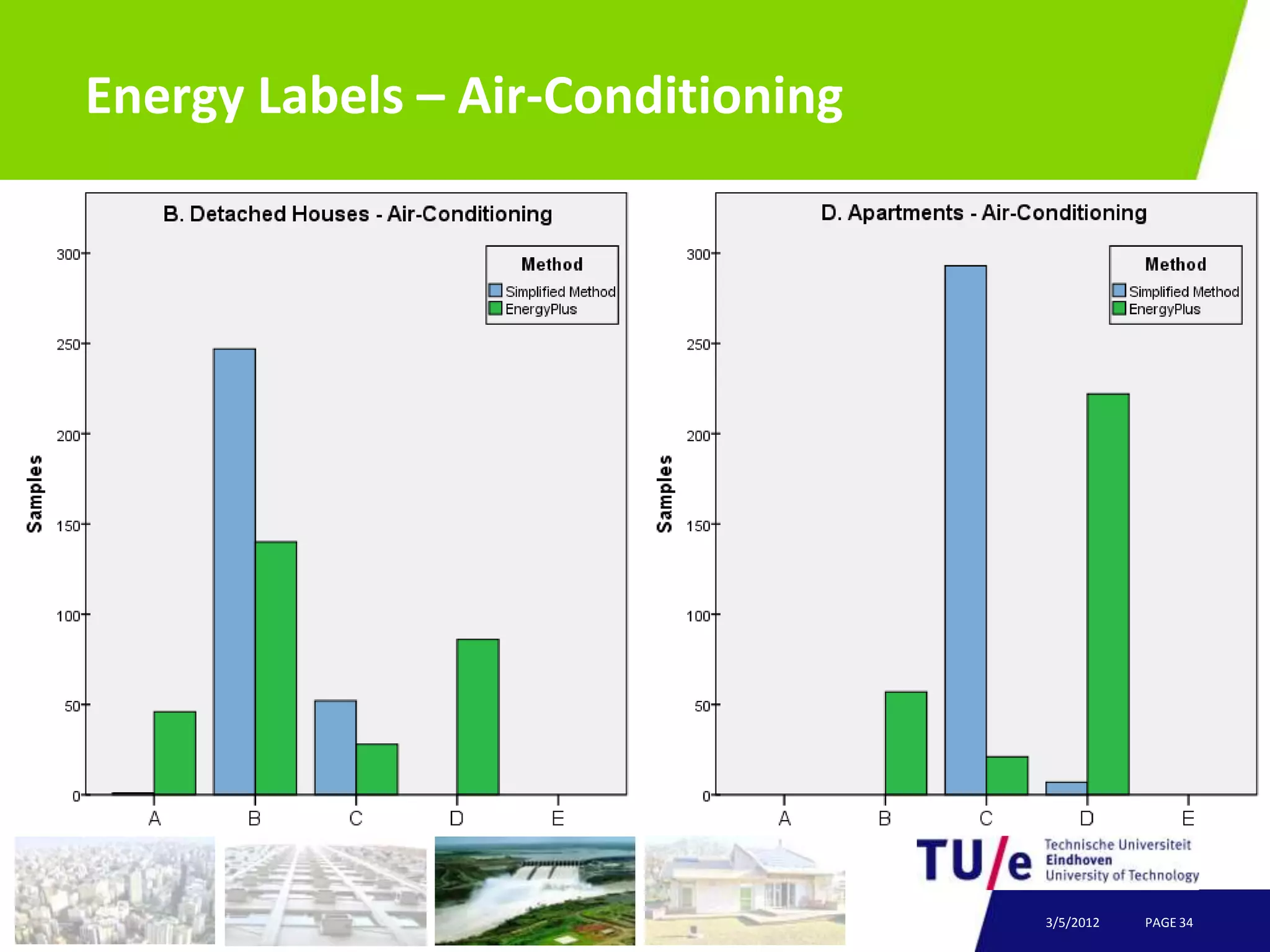
Energy Labels – Air-Conditioning


                                   3/5/2012   PAGE 34
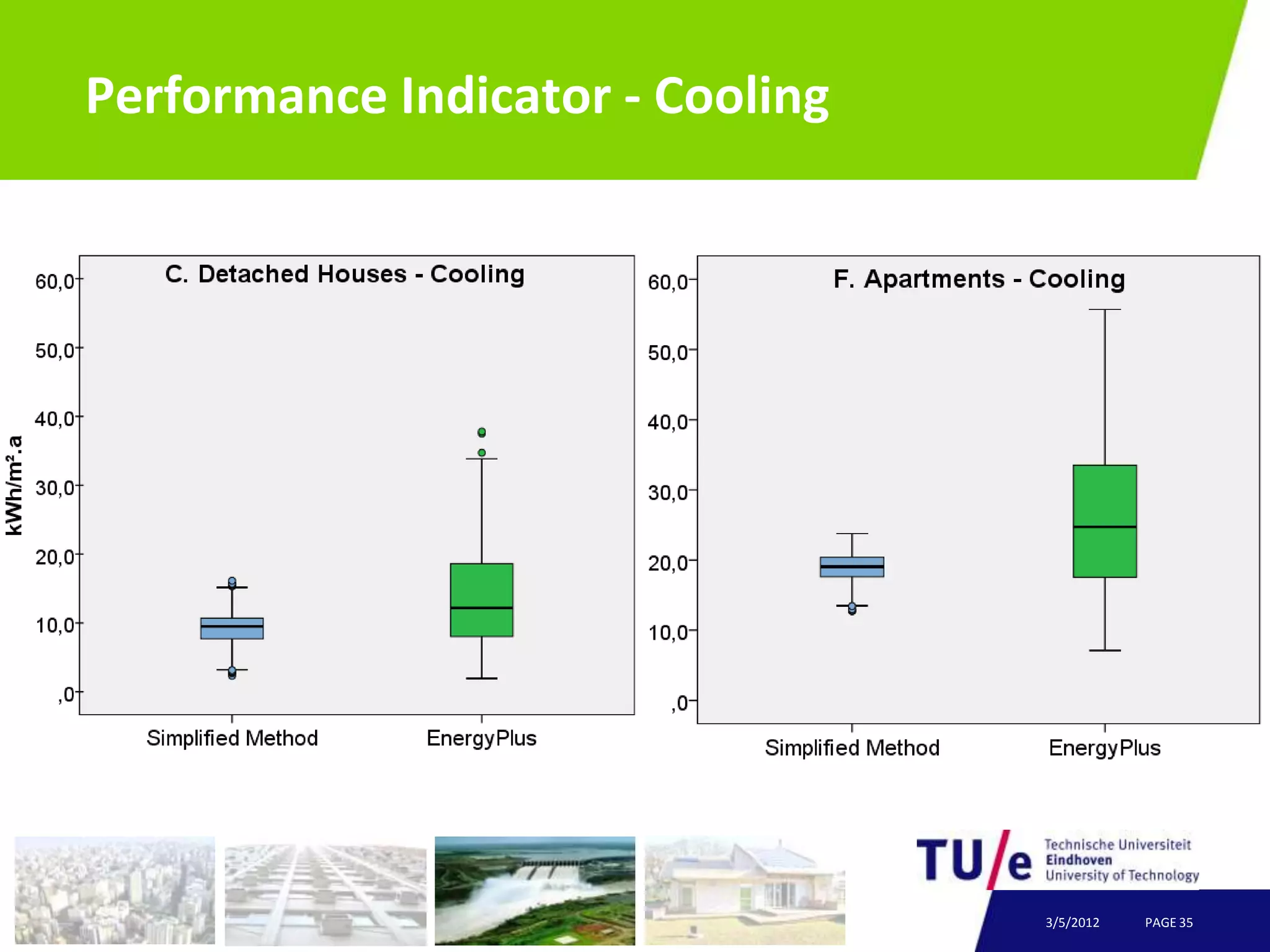
Performance Indicator - Cooling


                                  3/5/2012   PAGE 35
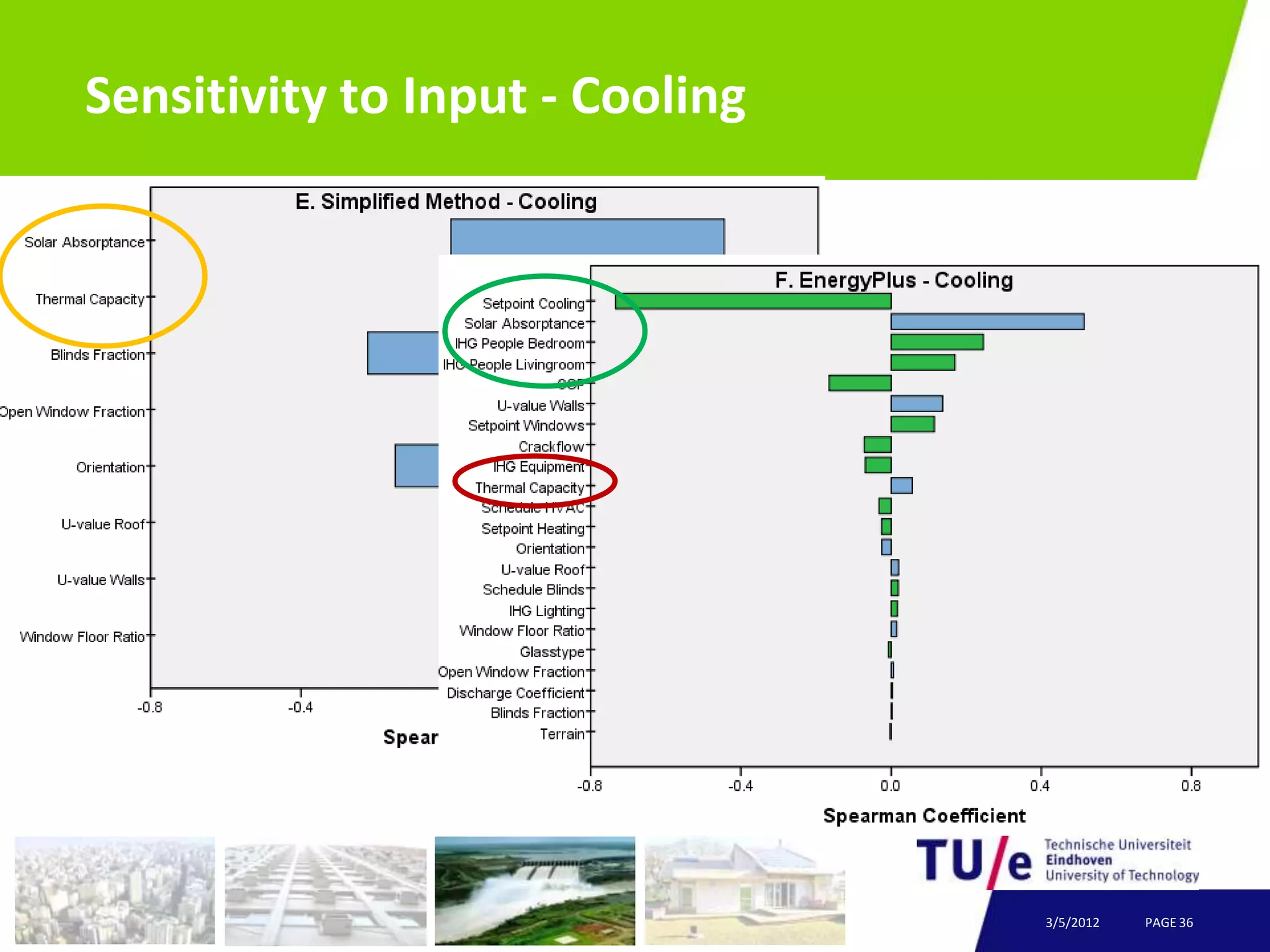
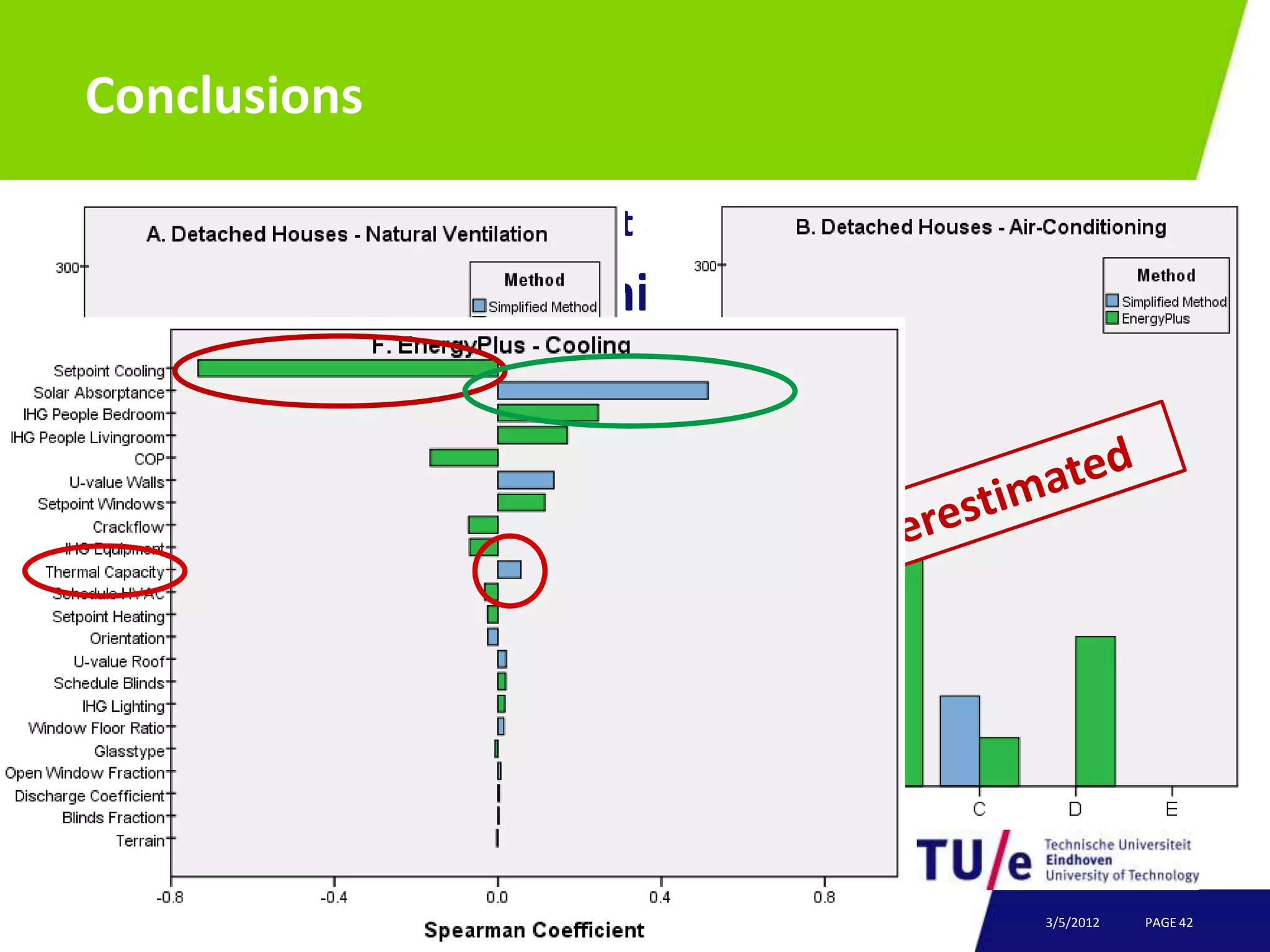
Sensitivity to Input - Cooling


                                 3/5/2012   PAGE 36
Discussion


             3/5/2012   PAGE 37
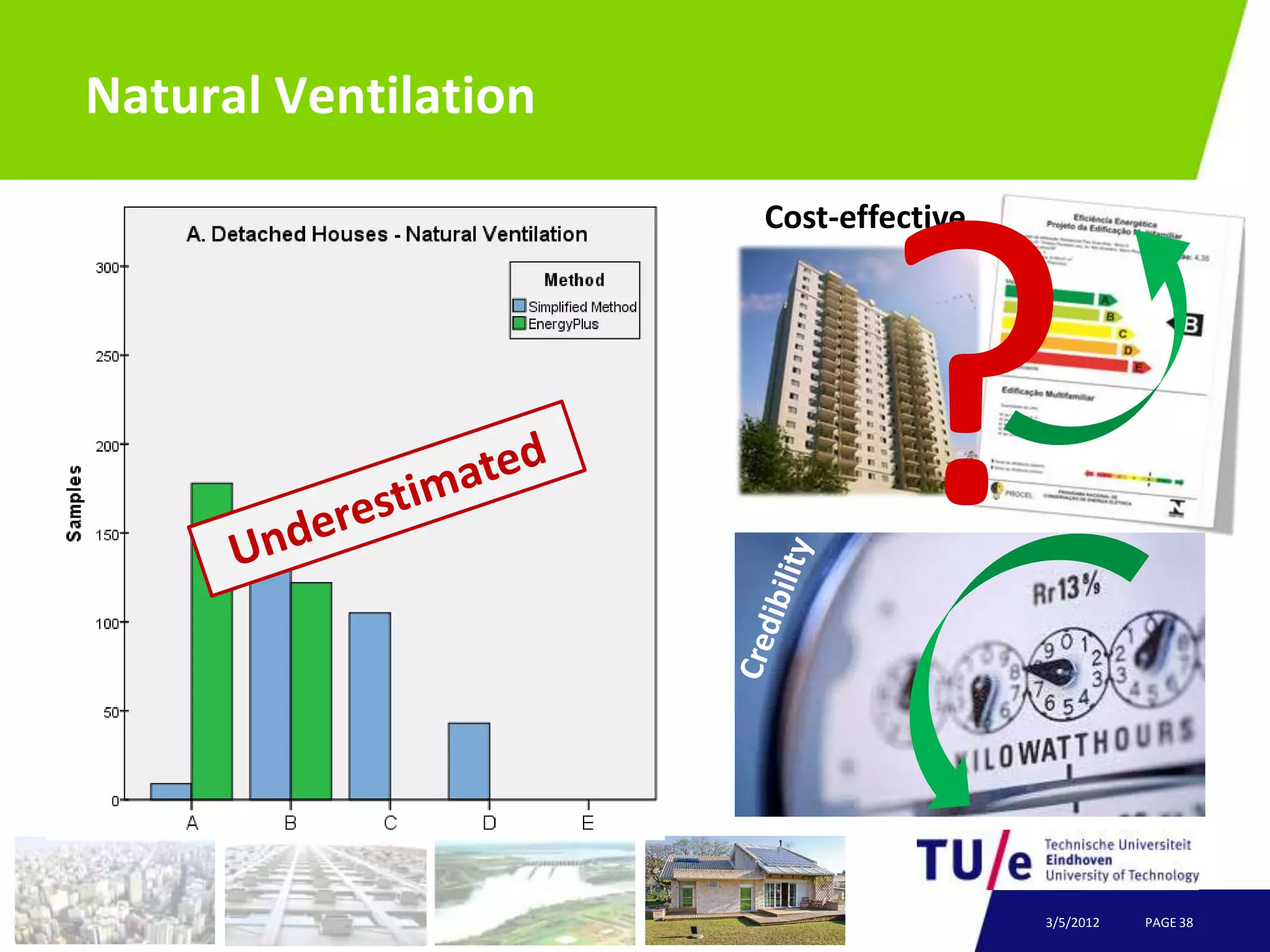
Natural Ventilation

                      Cost-effective


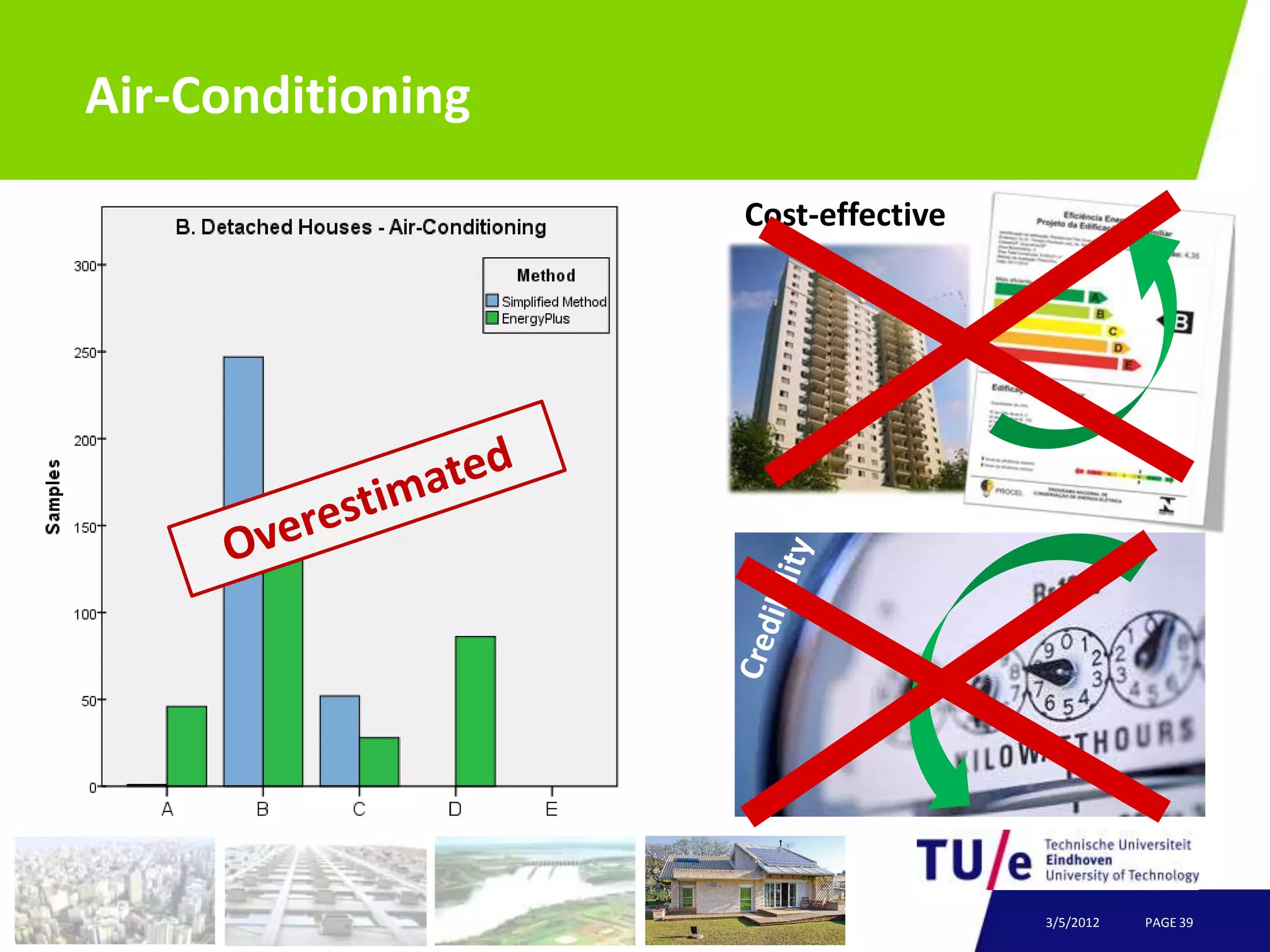
                                       3/5/2012   PAGE 38
Air-Conditioning
                   Cost-effective


                                    3/5/2012   PAGE 39
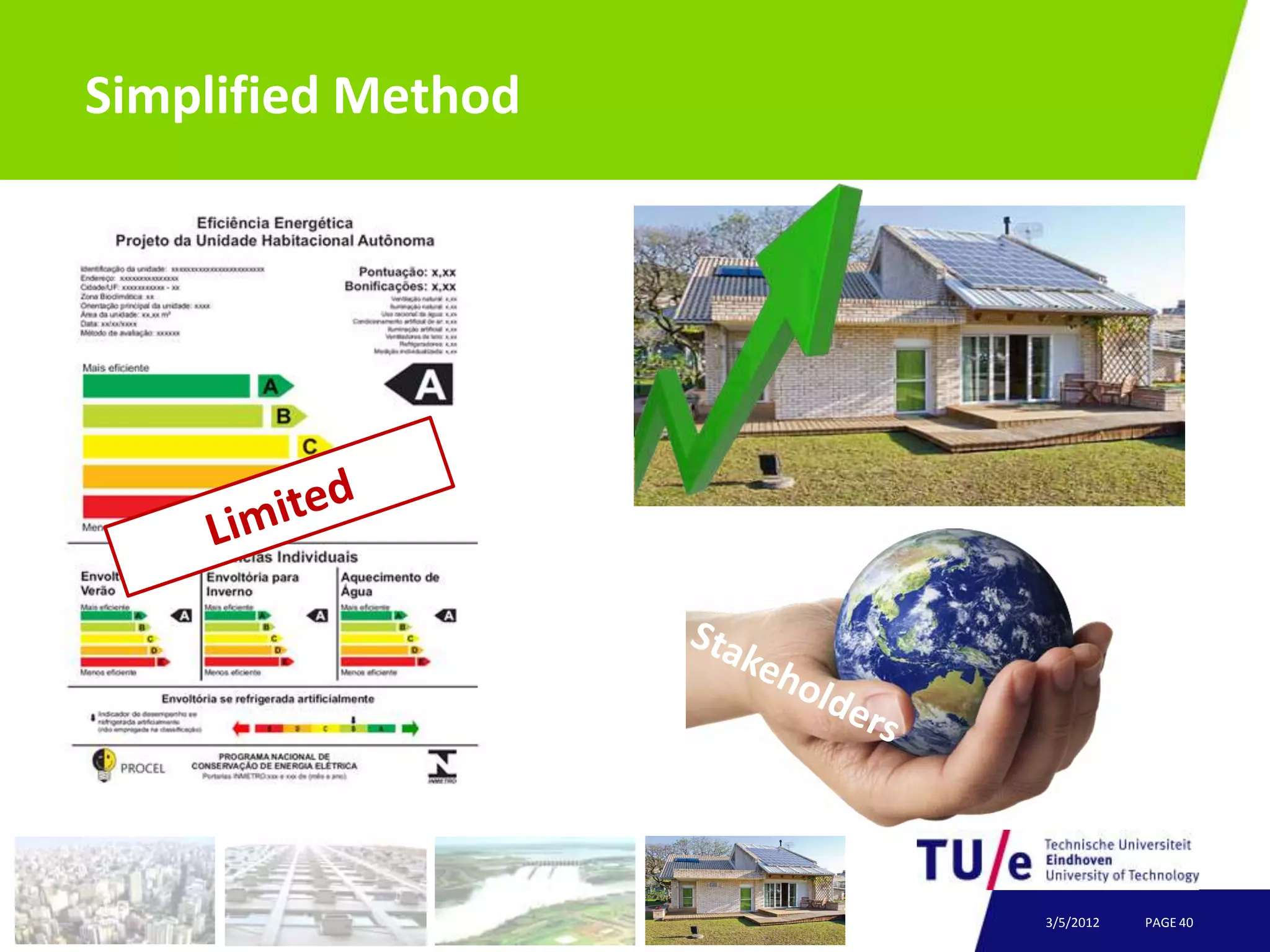
Simplified Method


                    3/5/2012   PAGE 40
Conclusions


              3/5/2012   PAGE 41
Conclusions

 Simplified Method Represent and Assess Energy Efficiency?
                        Limited


                                                    3/5/2012   PAGE 42
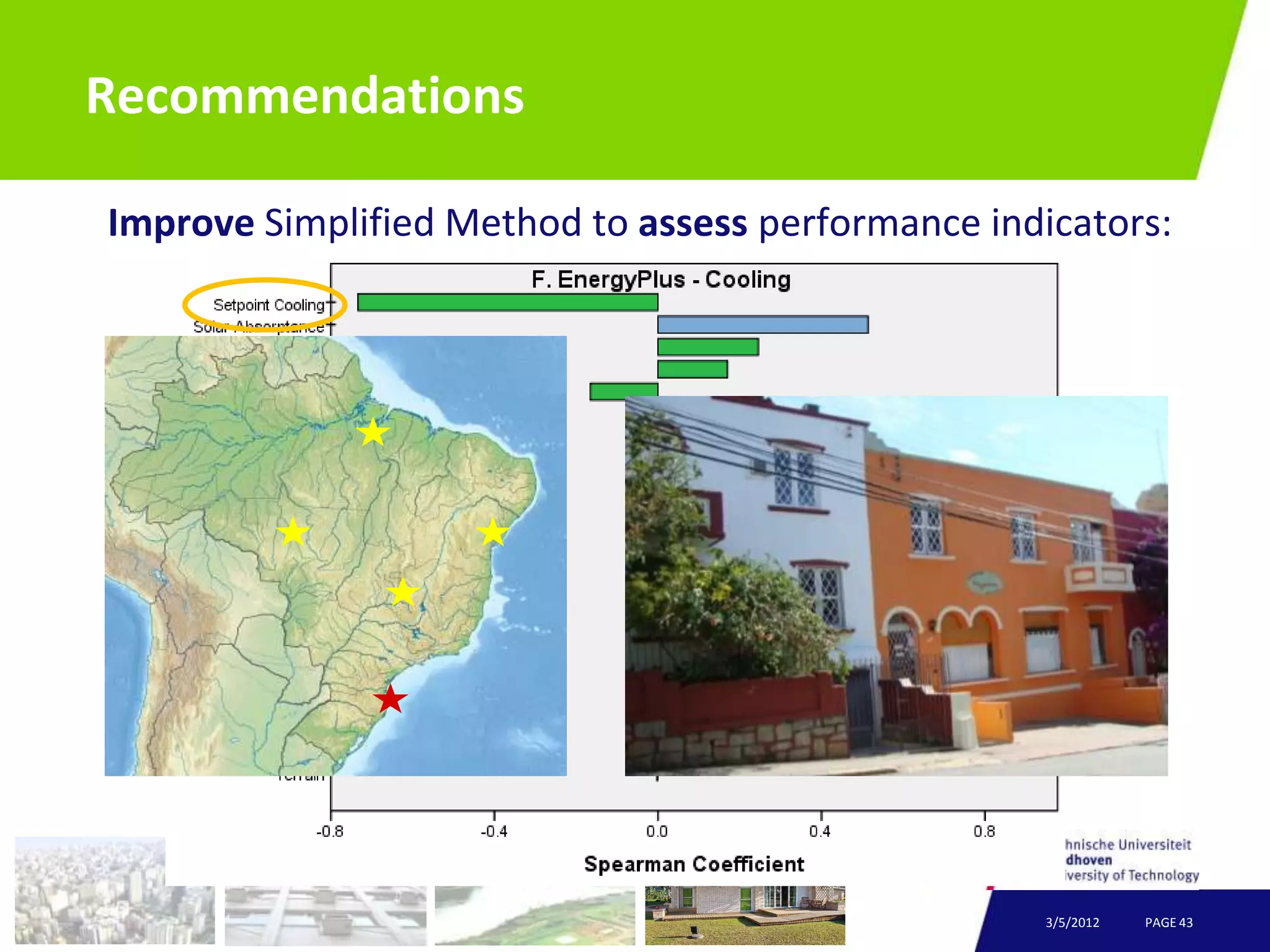
Recommendations

Improve Simplified Method to assess performance indicators:


                                                   3/5/2012   PAGE 43
Final colloquium


Building performance simulation to
support building energy regulation.
A case study for residential buildings in Brazil.


December 21st 2011
Arjan van der Knaap

Master Thesis

  • 1.
    Final colloquium Building performancesimulation to support building energy regulation. A case study for residential buildings in Brazil. December 21st 2011 Arjan van der Knaap
  • 2.
    Outline Introduction: Building EnergyRegulation in Brazil Methods: Evaluation with Building Performance Simulations Results: Natural Ventilation & Air-Conditioning Discussion: Effectiveness of Building Energy Regulation Conclusions: Findings & Recommendations 3/5/2012 PAGE 1
  • 3.
    Introduction 3/5/2012 PAGE 2
  • 4.
    Preface 3/5/2012 PAGE 3
  • 5.
    Introduction 3/5/2012 PAGE 4
  • 6.
    Supervisors: prof. dr. ir. Jan Hensen Introduction – Global dr. ir. Marcel Loomans dr. Daniel Cóstola 3/5/2012 PAGE 5
  • 7.
    Electricity Consumption Brazil 3/5/2012 PAGE 6
  • 8.
    Supervisors: prof. dr. ir. Jan Hensen Energy Consumption dr. ir. Marcel Loomans dr. Daniel Cóstola / Building Physics and Systems / Computational Building Performance Simulation 3/5/2012 PAGE 7
  • 9.
    Renewable Energy 3/5/2012 PAGE 8
  • 10.
    Electricity Consumption Sector Buildings 0% 4% 4% 18% 48% 50% 44% 32% Buildings Industry Energy Agriculture Transport Residential Commercial Public 3/5/2012 PAGE 9
  • 11.
    3/5/2012 PAGE 10
  • 12.
    Building Energy Regulation Commercial Residential 2007 2010 3/5/2012 PAGE 11
  • 13.
    Residential Buildings 3/5/2012 PAGE 12
  • 14.
    Energy Label Domestic Hot Water 5-35% Thermal Envelope 65-95% 3/5/2012 PAGE 13
  • 15.
    Efficiency Thermal Envelope Performance Conditioning Method Indicators Overheating Natural [Degree Hours] Simplified Ventilation Method Heating [kWh/m²] Building Air- Performance Conditioning Cooling Simulations [kWh/m²] 3/5/2012 PAGE 14
  • 16.
    Simplified Method Overheating Heating Cooling 3/5/2012 PAGE 15
  • 17.
    Literature - PerformanceIndicator Assessment: Accuracy, scope, complexity, sensitivity[1] Basic Elements[2] Brazilian Standard Thermal Envelope √ HVAC-system √ DHW-system √ Lighting X Appliances X [1 ] L. Pérez-Lombard, et al., A review of benchmarking, rating and labelling concepts within the framework of building energy certification schemes, Energy and Buildings 41 (2009) 272-278 [2] L. Pérez-Lombard, et al., A review of HVAC system requirements in building energy regulation, Energy and Buildings 43 (2011) 255-268 3/5/2012 PAGE 16
  • 18.
    Literature - EffectiveBuilding Energy Regulation[3] Cost-effective [3] L. Pérez-Lombard, et al., A review of benchmarking, rating and labelling concepts within the framework of building energy certification schemes, Energy and Buildings 41 (2009) 272-278 3/5/2012 PAGE 17
  • 19.
    Objective ‘To determinewhether the Simplified Method is able to represent and assess energy efficiency of residential buildings.’ 3/5/2012 PAGE 18
  • 20.
    Methods 3/5/2012 PAGE 19
  • 21.
    Methods 3/5/2012 PAGE 20
  • 22.
    Overview 3/5/2012 PAGE 21
  • 23.
    Pre-Process - BaselineScenario 3/5/2012 PAGE 22
  • 24.
    Pre-Process - Variationsin Input Parameters Nr. Parameter Method Nr. Parameter Method 1. Orientation SM / E+ 13. COP E+ 2. U-value Walls SM / E+ 14. Setpoint for Heating E+ 3. U-value Roof SM / E+ 15. Setpoint for Cooling E+ 4. Solar Absorptance SM / E+ 16. Setpoint for Windows E+ 5. Window Area SM / E+ 17. IHG: people in bedroom E+ 6. Operable Window Area SM / E+ 18. IHG: people in living E+ 7. Blinded Window Area SM / E+ 19. IHG: Lighting E+ 8. Thermal Capacity SM / E+ 20. IHG: Appliances E+ 9. Terrain E+ 21. Schedule for Blinds E+ 10. Discharge Coefficient E+ 22. Schedule for HVAC-system E+ 11. Crack flow E+ 23. Schedule for Windows E+ 12. Glass type E+ 3/5/2012 PAGE 23
  • 25.
    Simulations – Samples Performance Method Samples Indicator Cooling Simplified Air- Method Conditioning Heating Natural EnergyPlus Overheating Ventilation 3/5/2012 PAGE 24
  • 26.
    Post-Process - Aspectsof Assessment Performance Energy Labels Sensitivity to Input Indicators Air-Conditioning Cooling Performance Indicators Cooling & Heating Heating Input Parameters Natural Ventilation Overheating & Heating Overheating Spearman Coefficient 3/5/2012 PAGE 25
  • 27.
    Assessment of SimplifiedMethod Performance Sensitivity Energy Labels Indicators to Input 3/5/2012 PAGE 26
  • 28.
  • 29.
    Energy Labels -Natural Ventilation 3/5/2012 PAGE 28
  • 30.
    Performance Indicator -Overheating 3/5/2012 PAGE 29
  • 31.
    Performance Indicator -Heating 3/5/2012 PAGE 30
  • 32.
    Sensitivity to Input- Overheating 3/5/2012 PAGE 31
  • 33.
    Sensitivity to Input- Heating 3/5/2012 PAGE 32
  • 34.
    Results Air-Conditioning 3/5/2012 PAGE 33
  • 35.
    Energy Labels –Air-Conditioning 3/5/2012 PAGE 34
  • 36.
    Performance Indicator -Cooling 3/5/2012 PAGE 35
  • 37.
    Sensitivity to Input- Cooling 3/5/2012 PAGE 36
  • 38.
    Discussion 3/5/2012 PAGE 37
  • 39.
    Natural Ventilation Cost-effective 3/5/2012 PAGE 38
  • 40.
    Air-Conditioning Cost-effective 3/5/2012 PAGE 39
  • 41.
    Simplified Method 3/5/2012 PAGE 40
  • 42.
    Conclusions 3/5/2012 PAGE 41
  • 43.
    Conclusions Simplified MethodRepresent and Assess Energy Efficiency? Limited 3/5/2012 PAGE 42
  • 44.
    Recommendations Improve Simplified Methodto assess performance indicators: 3/5/2012 PAGE 43
  • 45.
    Final colloquium Building performancesimulation to support building energy regulation. A case study for residential buildings in Brazil. December 21st 2011 Arjan van der Knaap