Copyright © 2014, Canadian Cardiovascular Society
CCS Guidelines for the Diagnosis and Management of Stable Ischemia Heart Disease (2014)
Mancini GBJ, Gosselin G, et al., Can J Cardiol 2014
Canadian Cardiovascular Society
Guidelines for the Diagnosis and Management
of Stable Ischemic Heart Disease
Copyright © 2014, Canadian Cardiovascular SocietyCopyright © 2014, Canadian Cardiovascular Society
Disclaimer
The Canadian Cardiovascular Society (CCS) welcomes reuse of our
educational slide deck for medical institution internal education or training (i.e.
grand rounds, medical college/classroom education, etc.). However, if the
material is being used in an industry sponsored CME program, permission
must be sought through our publisher Elsevier (www.onlinecjc.com).
If your reuse qualifies as medical institution internal education, you may reuse
the material under the following conditions:
• You must cite the Canadian Journal of Cardiology and the Canadian
Cardiovascular Society as references.
• You may not use any Canadian Cardiovascular Society logos or
trademarks on any slides or anywhere in your presentation or
publications.
• Do not modify the slide content.
• If repeating recommendations from the published guideline, do not
modify the recommendation wording.
Copyright © 2014, Canadian Cardiovascular Society
CCS Guidelines for the Diagnosis and Management of Stable Ischemia Heart Disease (2014)
Mancini GBJ, Gosselin G, et al., Can J Cardiol 2014
Primary Panel
G.B. John Mancini MD, Co-chair; University of British Columbia
Gilbert Gosselin MD, Co-chair; Montreal Heart Institute, University of Montreal
Benjamin Chow MD; Ottawa Heart Institute
William Kostuk MD; University of Western Ontario
James Stone MD; University of Calgary
Kenneth J. Yvorchuk MD; Vancouver Island Health Authority, Victoria, British Columbia
Beth L. Abramson MD; St. Michael’s Hospital, University of Toronto
Raymond Cartier MD; Montreal Heart Institute, University of Montreal
Victor Huckell MD; University of British Columbia
Jean-Claude Tardif MD; Montreal Heart Institute, University of Montreal
Secondary Panel
Kim Connelly MD; St. Michael’s Hospital, University of Toronto
John Ducas MD; University of Manitoba
Michael E. Farkouh MD; University Health Network Hospitals, University of Toronto
Milan Gupta MD; McMaster University
Martin Juneau MD; Montreal Heart Institute, University of Montreal
Blair O’Neill MD; University of Alberta
Paolo Raggi MD; University of Alberta
Koon Teo MD; McMaster University
Subodh Verma MD; St. Michael’s Hospital, University of Toronto
Rodney Zimmermann MD; Regina Qu’Appelle Health Region, University of Saskatchewan
Copyright © 2014, Canadian Cardiovascular Society
CCS Guidelines for the Diagnosis and Management of Stable Ischemia Heart Disease (2014)
Mancini GBJ, Gosselin G, et al., Can J Cardiol 2014
Copyright © 2014, Canadian Cardiovascular Society
CCS Guidelines for the Diagnosis and Management of Stable Ischemia Heart Disease (2014)
Mancini GBJ, Gosselin G, et al., Can J Cardiol 2014
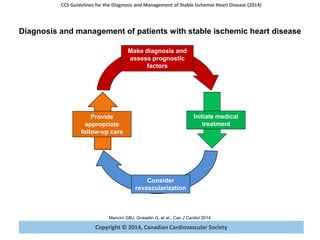
Make diagnosis and
assess prognostic
factors
Initiate medical
treatment
Consider
revascularization
Provide
appropriate
follow-up care
Diagnosis and management of patients with stable ischemic heart disease
Copyright © 2014, Canadian Cardiovascular Society
2014 CCS Guidelines on the Diagnosis and Management of Stable Ischemia Heart Disease
Mancini GBJ, Gosselin G, et al., Can J Cardiol 2014
Canadian Cardiovascular Society Guidelines
2014 Diagnosis and Management of Stable Ischemic Heart Disease
Establishing Diagnosis and Prognosis
Copyright © 2014, Canadian Cardiovascular Society
2014 CCS Guidelines on the Diagnosis and Management of Stable Ischemia Heart Disease
Mancini GBJ, Gosselin G, et al., Can J Cardiol 2014
Copyright © 2014, Canadian Cardiovascular Society
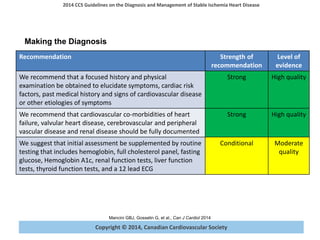
Recommendation Strength of
recommendation
Level of
evidence
We recommend that a focused history and physical
examination be obtained to elucidate symptoms, cardiac risk
factors, past medical history and signs of cardiovascular disease
or other etiologies of symptoms
Strong High quality
We recommend that cardiovascular co-morbidities of heart
failure, valvular heart disease, cerebrovascular and peripheral
vascular disease and renal disease should be fully documented
Strong High quality
We suggest that initial assessment be supplemented by routine
testing that includes hemoglobin, full cholesterol panel, fasting
glucose, Hemoglobin A1c, renal function tests, liver function
tests, thyroid function tests, and a 12 lead ECG
Conditional Moderate
quality
Making the Diagnosis
Copyright © 2014, Canadian Cardiovascular Society
2014 CCS Guidelines on the Diagnosis and Management of Stable Ischemia Heart Disease
Mancini GBJ, Gosselin G, et al., Can J Cardiol 2014
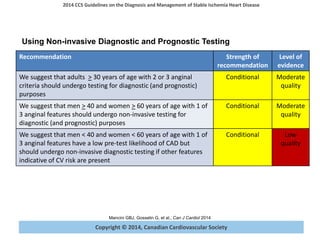
Recommendation Strength of
recommendation
Level of
evidence
We suggest that adults > 30 years of age with 2 or 3 anginal
criteria should undergo testing for diagnostic (and prognostic)
purposes
Conditional Moderate
quality
We suggest that men > 40 and women > 60 years of age with 1 of
3 anginal features should undergo non-invasive testing for
diagnostic (and prognostic) purposes
Conditional Moderate
quality
We suggest that men < 40 and women < 60 years of age with 1 of
3 anginal features have a low pre-test likelihood of CAD but
should undergo non-invasive diagnostic testing if other features
indicative of CV risk are present
Conditional Low
quality
Using Non-invasive Diagnostic and Prognostic Testing
Copyright © 2014, Canadian Cardiovascular Society
2014 CCS Guidelines on the Diagnosis and Management of Stable Ischemia Heart Disease
Mancini GBJ, Gosselin G, et al., Can J Cardiol 2014
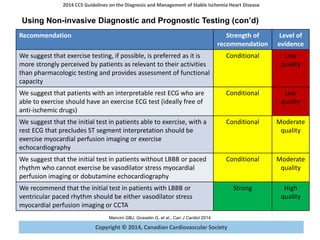
Recommendation Strength of
recommendation
Level of
evidence
We suggest that exercise testing, if possible, is preferred as it is
more strongly perceived by patients as relevant to their activities
than pharmacologic testing and provides assessment of functional
capacity
Conditional Low
quality
We suggest that patients with an interpretable rest ECG who are
able to exercise should have an exercise ECG test (ideally free of
anti-ischemic drugs)
Conditional Low
quality
We suggest that the initial test in patients able to exercise, with a
rest ECG that precludes ST segment interpretation should be
exercise myocardial perfusion imaging or exercise
echocardiography
Conditional Moderate
quality
We suggest that the initial test in patients without LBBB or paced
rhythm who cannot exercise be vasodilator stress myocardial
perfusion imaging or dobutamine echocardiography
Conditional Moderate
quality
We recommend that the initial test in patients with LBBB or
ventricular paced rhythm should be either vasodilator stress
myocardial perfusion imaging or CCTA
Strong High
quality
Using Non-invasive Diagnostic and Prognostic Testing (con’d)
Copyright © 2014, Canadian Cardiovascular Society
2014 CCS Guidelines on the Diagnosis and Management of Stable Ischemia Heart Disease
Mancini GBJ, Gosselin G, et al., Can J Cardiol 2014
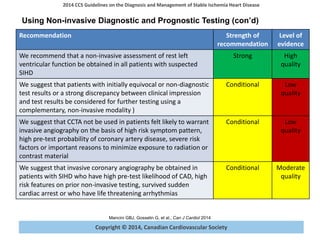
Recommendation Strength of
recommendation
Level of
evidence
We recommend that a non-invasive assessment of rest left
ventricular function be obtained in all patients with suspected
SIHD
Strong High
quality
We suggest that patients with initially equivocal or non-diagnostic
test results or a strong discrepancy between clinical impression
and test results be considered for further testing using a
complementary, non-invasive modality )
Conditional Low
quality
We suggest that CCTA not be used in patients felt likely to warrant
invasive angiography on the basis of high risk symptom pattern,
high pre-test probability of coronary artery disease, severe risk
factors or important reasons to minimize exposure to radiation or
contrast material
Conditional Low
quality
We suggest that invasive coronary angiography be obtained in
patients with SIHD who have high pre-test likelihood of CAD, high
risk features on prior non-invasive testing, survived sudden
cardiac arrest or who have life threatening arrhythmias
Conditional Moderate
quality
Using Non-invasive Diagnostic and Prognostic Testing (con’d)
Copyright © 2014, Canadian Cardiovascular Society
2014 CCS Guidelines on the Diagnosis and Management of Stable Ischemia Heart Disease
Mancini GBJ, Gosselin G, et al., Can J Cardiol 2014
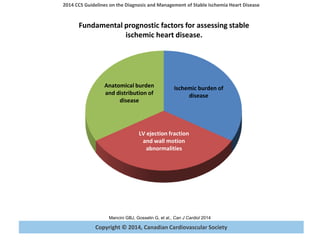
Anatomical burden
and distribution of
disease
Ischemic burden of
disease
LV ejection fraction
and wall motion
abnormalities
Fundamental prognostic factors for assessing stable
ischemic heart disease.
Copyright © 2014, Canadian Cardiovascular Society
2014 CCS Guidelines on the Diagnosis and Management of Stable Ischemia Heart Disease
Mancini GBJ, Gosselin G, et al., Can J Cardiol 2014
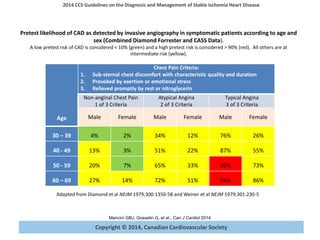
Age
Chest Pain Criteria:
1. Sub-sternal chest discomfort with characteristic quality and duration
2. Provoked by exertion or emotional stress
3. Relieved promptly by rest or nitroglycerin
Non-anginal Chest Pain
1 of 3 Criteria
Atypical Angina
2 of 3 Criteria
Typical Angina
3 of 3 Criteria
Male Female Male Female Male Female
30 – 39 4% 2% 34% 12% 76% 26%
40 - 49 13% 3% 51% 22% 87% 55%
50 - 59 20% 7% 65% 33% 93% 73%
60 – 69 27% 14% 72% 51% 94% 86%
Pretest likelihood of CAD as detected by invasive angiography in symptomatic patients according to age and
sex (Combined Diamond Forrester and CASS Data).
A low pretest risk of CAD is considered < 10% (green) and a high pretest risk is considered > 90% (red). All others are at
intermediate risk (yellow).
Adapted from Diamond et al NEJM 1979;300:1350-58 and Weiner et al NEJM 1979;301:230-5
Copyright © 2014, Canadian Cardiovascular Society
2014 CCS Guidelines on the Diagnosis and Management of Stable Ischemia Heart Disease
Mancini GBJ, Gosselin G, et al., Can J Cardiol 2014
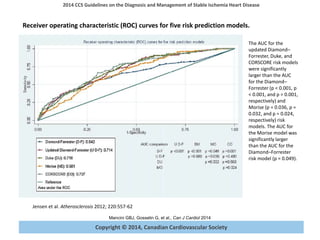
Receiver operating characteristic (ROC) curves for five risk prediction models.
Jensen et al. Atherosclerosis 2012; 220:557-62
The AUC for the
updated Diamond–
Forrester, Duke, and
CORSCORE risk models
were significantly
larger than the AUC
for the Diamond–
Forrester (p < 0.001, p
< 0.001, and p = 0.001,
respectively) and
Morise (p = 0.036, p =
0.032, and p = 0.024,
respectively) risk
models. The AUC for
the Morise model was
significantly larger
than the AUC for the
Diamond–Forrester
risk model (p = 0.049).
Copyright © 2014, Canadian Cardiovascular Society
2014 CCS Guidelines on the Diagnosis and Management of Stable Ischemia Heart Disease
Mancini GBJ, Gosselin G, et al., Can J Cardiol 2014
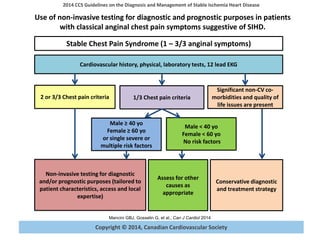
Assess for other
causes as
appropriate
Non-invasive testing for diagnostic
and/or prognostic purposes (tailored to
patient characteristics, access and local
expertise)
Conservative diagnostic
and treatment strategy
Male < 40 yo
Female < 60 yo
No risk factors
Male ≥ 40 yo
Female ≥ 60 yo
or single severe or
multiple risk factors
Significant non-CV co-
morbidities and quality of
life issues are present
1/3 Chest pain criteria2 or 3/3 Chest pain criteria
Cardiovascular history, physical, laboratory tests, 12 lead EKG
Stable Chest Pain Syndrome (1 – 3/3 anginal symptoms)
Use of non-invasive testing for diagnostic and prognostic purposes in patients
with classical anginal chest pain symptoms suggestive of SIHD.
Copyright © 2014, Canadian Cardiovascular Society
2014 CCS Guidelines on the Diagnosis and Management of Stable Ischemia Heart Disease
Mancini GBJ, Gosselin G, et al., Can J Cardiol 2014
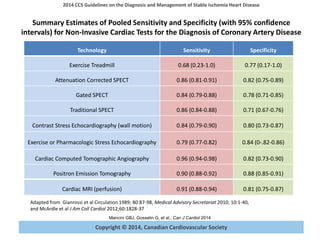
Summary Estimates of Pooled Sensitivity and Specificity (with 95% confidence
intervals) for Non-Invasive Cardiac Tests for the Diagnosis of Coronary Artery Disease
Technology Sensitivity Specificity
Exercise Treadmill 0.68 (0.23-1.0) 0.77 (0.17-1.0)
Attenuation Corrected SPECT 0.86 (0.81-0.91) 0.82 (0.75-0.89)
Gated SPECT 0.84 (0.79-0.88) 0.78 (0.71-0.85)
Traditional SPECT 0.86 (0.84-0.88) 0.71 (0.67-0.76)
Contrast Stress Echocardiography (wall motion) 0.84 (0.79-0.90) 0.80 (0.73-0.87)
Exercise or Pharmacologic Stress Echocardiography 0.79 (0.77-0.82) 0.84 (0-.82-0.86)
Cardiac Computed Tomographic Angiography 0.96 (0.94-0.98) 0.82 (0.73-0.90)
Positron Emission Tomography 0.90 (0.88-0.92) 0.88 (0.85-0.91)
Cardiac MRI (perfusion) 0.91 (0.88-0.94) 0.81 (0.75-0.87)
Adapted from Gianrossi et al Circulation 1989; 80:87-98, Medical Advisory Secretariat 2010; 10:1-40,
and McArdle et al J Am Coll Cardiol 2012;60:1828-37
Copyright © 2014, Canadian Cardiovascular Society
2014 CCS Guidelines on the Diagnosis and Management of Stable Ischemia Heart Disease
Mancini GBJ, Gosselin G, et al., Can J Cardiol 2014
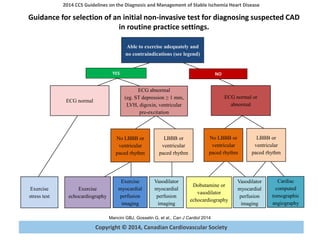
Able to exercise adequately and
no contraindications (see legend)
ECG normal
ECG abnormal
(eg. ST depression ≥ 1 mm,
LVH, digoxin, ventricular
pre-excitation
No LBBB or
ventricular
paced rhythm
LBBB or
ventricular
paced rhythm
No LBBB or
ventricular
paced rhythm
LBBB or
ventricular
paced rhythm
Exercise
stress test
Exercise
echocardiography
Dobutamine or
vasodilator
echocardiography
Exercise
myocardial
perfusion
imaging
Vasodilator
myocardial
perfusion
imaging
Vasodilator
myocardial
perfusion
imaging
Cardiac
computed
tomographic
angiography
ECG normal or
abnormal
YES NO
Guidance for selection of an initial non-invasive test for diagnosing suspected CAD
in routine practice settings.
Copyright © 2014, Canadian Cardiovascular Society
2014 CCS Guidelines on the Diagnosis and Management of Stable Ischemia Heart Disease
Mancini GBJ, Gosselin G, et al., Can J Cardiol 2014
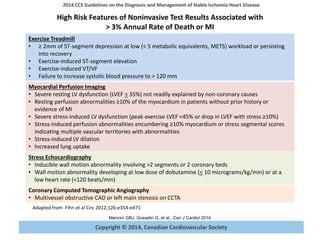
High Risk Features of Noninvasive Test Results Associated with
> 3% Annual Rate of Death or MI
Exercise Treadmill
• ≥ 2mm of ST-segment depression at low (< 5 metabolic equivalents, METS) workload or persisting
into recovery
• Exercise-induced ST-segment elevation
• Exercise-induced VT/VF
• Failure to increase systolic blood pressure to > 120 mm
Myocardial Perfusion Imaging
• Severe resting LV dysfunction (LVEF < 35%) not readily explained by non-coronary causes
• Resting perfusion abnormalities ≥10% of the myocardium in patients without prior history or
evidence of MI
• Severe stress-induced LV dysfunction (peak exercise LVEF <45% or drop in LVEF with stress ≥10%)
• Stress-induced perfusion abnormalities encumbering ≥10% myocardium or stress segmental scores
indicating multiple vascular territories with abnormalities
• Stress-induced LV dilation
• Increased lung uptake
Stress Echocardiography
• Inducible wall motion abnormality involving >2 segments or 2 coronary beds
• Wall motion abnormality developing at low dose of dobutamine (< 10 micrograms/kg/min) or at a
low heart rate (<120 beats/min)
Coronary Computed Tomographic Angiography
• Multivessel obstructive CAD or left main stenosis on CCTA
Adapted from Fihn et al Circ 2012;126:e354-e471
Copyright © 2014, Canadian Cardiovascular Society
2014 CCS Guidelines on the Diagnosis and Management of Stable Ischemia Heart Disease
Mancini GBJ, Gosselin G, et al., Can J Cardiol 2014
Canadian Cardiovascular Society Guidelines
2014 Diagnosis and Management of Stable Ischemic Heart Disease
Initiation of Medical Treatment in Patient
With Established CAD
Copyright © 2014, Canadian Cardiovascular Society
2014 CCS Guidelines on the Diagnosis and Management of Stable Ischemia Heart Disease
Mancini GBJ, Gosselin G, et al., Can J Cardiol 2014
Recommendation Strength of
recommendation
Level of
evidence
We recommend that all patients receive 81 mg of acetylsalicylic acid daily
indefinitely, unless contraindicated
Strong High
quality
We recommend that clopidogrel 75 mg daily be used in acetylsalicylic acid
intolerant individuals
Strong High
quality
We suggest that dual antiplatelet therapy should not be used in routine
management of SIHD or beyond the time period required as a result of stenting
Conditional Moderate
quality
We recommend that all patients receive a statin in accordance with CCS 2012
Dyslipidemia Guidelines
Strong High
quality
We recommend that all patients with SIHD who also have hypertension,
diabetes, a left ventricular ejection fraction of < 40%, or chronic kidney disease,
should receive an angiotensin-converting enzyme (ACE) inhibitor, unless
contraindicated
Strong High
quality
We recommend that it is also reasonable to consider treatment with an ACE
inhibitor in all patients with SIHD
Strong High
quality
We recommend that ARBs should be used for patients who are intolerant of
ACE inhibitors
Strong High
quality
We recommend that beta-blocker therapy be used in all patients with SIHD and
left ventricular systolic dysfunction (ejection fraction < 40%) with or without
heart failure, unless contraindicated, and continued indefinitely
Strong High
quality
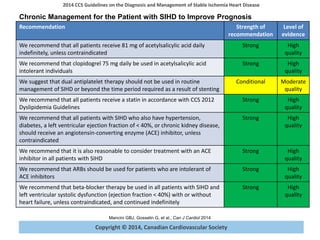
Chronic Management for the Patient with SIHD to Improve Prognosis
Copyright © 2014, Canadian Cardiovascular Society
2014 CCS Guidelines on the Diagnosis and Management of Stable Ischemia Heart Disease
Mancini GBJ, Gosselin G, et al., Can J Cardiol 2014
Recommendation Strength of
recommendation
Level of
evidence
We suggest that beta-blockers be used as first-line therapy for symptom relief,
with the dose titrated to reach a target resting heart rate of 55 to 60 bpm
Conditional Moderate
quality
We suggest that beta-blockers or long-acting calcium channel blockers be used
for chronic stable angina in uncomplicated patients
Conditional Moderate
quality
We suggest the addition of a long-acting nitrate when initial treatment with a
beta-blocker and/or long acting calcium channel blocker is not tolerated or
contraindicated or does not lead to adequate symptom control
Conditional Moderate
quality
We recommend avoiding non-dihydropyridine calcium channel blockers in
conjunction with beta-blockers if there is risk of AV block or excessive
bradycardia
Strong High
quality
We suggest that chelation therapy, allopurinol, magnesium supplementation,
coenzyme Q10, suxiao jiuxin wan or shenshao tablets and testosterone should
not be used to attempt to improve angina or exercise tolerance
Conditional Moderate
quality
We recommend that implementation and optimization of medical therapy
should be achieved within 12 to 16 weeks of an initial evaluation suggesting
presence of SIHD without high risk features during which adequacy of symptom
control and quality of life can be assessed prior to consideration of
revascularization therapy
Strong High
quality
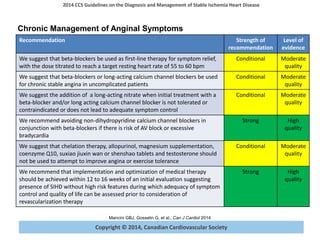
Chronic Management of Anginal Symptoms
Copyright © 2014, Canadian Cardiovascular Society
2014 CCS Guidelines on the Diagnosis and Management of Stable Ischemia Heart Disease
Mancini GBJ, Gosselin G, et al., Can J Cardiol 2014
Copyright © 2014, Canadian Cardiovascular Society
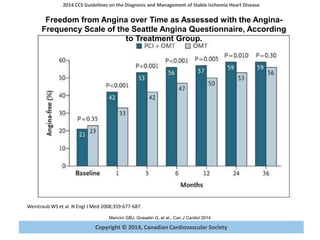
Freedom from Angina over Time as Assessed with the Angina-
Frequency Scale of the Seattle Angina Questionnaire, According
to Treatment Group.
Weintraub WS et al. N Engl J Med 2008;359:677-687.
Copyright © 2014, Canadian Cardiovascular Society
2014 CCS Guidelines on the Diagnosis and Management of Stable Ischemia Heart Disease
Mancini GBJ, Gosselin G, et al., Can J Cardiol 2014
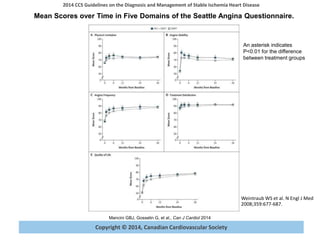
Mean Scores over Time in Five Domains of the Seattle Angina Questionnaire.
An asterisk indicates
P<0.01 for the difference
between treatment groups
Weintraub WS et al. N Engl J Med
2008;359:677-687.
Copyright © 2014, Canadian Cardiovascular Society
2014 CCS Guidelines on the Diagnosis and Management of Stable Ischemia Heart Disease
Mancini GBJ, Gosselin G, et al., Can J Cardiol 2014
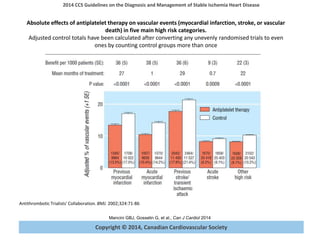
Antithrombotic Trialists' Collaboration. BMJ. 2002;324:71-86
Absolute effects of antiplatelet therapy on vascular events (myocardial infarction, stroke, or vascular
death) in five main high risk categories.
Adjusted control totals have been calculated after converting any unevenly randomised trials to even
ones by counting control groups more than once
Copyright © 2014, Canadian Cardiovascular Society
2014 CCS Guidelines on the Diagnosis and Management of Stable Ischemia Heart Disease
Mancini GBJ, Gosselin G, et al., Can J Cardiol 2014
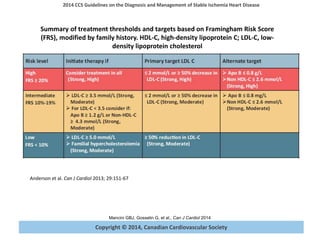
Summary of treatment thresholds and targets based on Framingham Risk Score
(FRS), modified by family history. HDL-C, high-density lipoprotein C; LDL-C, low-
density lipoprotein cholesterol
Anderson et al. Can J Cardiol 2013; 29:151-67
Copyright © 2014, Canadian Cardiovascular Society
2014 CCS Guidelines on the Diagnosis and Management of Stable Ischemia Heart Disease
Mancini GBJ, Gosselin G, et al., Can J Cardiol 2014; 30: 837-849
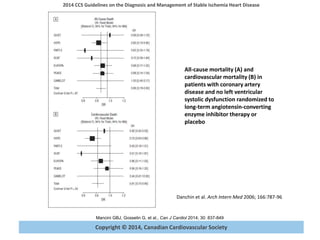
All-cause mortality (A) and
cardiovascular mortality (B) in
patients with coronary artery
disease and no left ventricular
systolic dysfunction randomized to
long-term angiotensin-converting
enzyme inhibitor therapy or
placebo
Danchin et al. Arch Intern Med 2006; 166:787-96
Copyright © 2014, Canadian Cardiovascular Society
2014 CCS Guidelines on the Diagnosis and Management of Stable Ischemia Heart Disease
Mancini GBJ, Gosselin G, et al., Can J Cardiol 2014
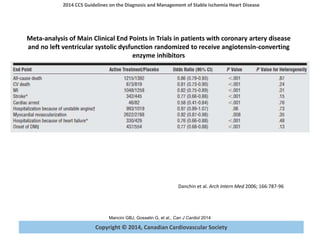
Meta-analysis of Main Clinical End Points in Trials in patients with coronary artery disease
and no left ventricular systolic dysfunction randomized to receive angiotensin-converting
enzyme inhibitors
Danchin et al. Arch Intern Med 2006; 166:787-96
Copyright © 2014, Canadian Cardiovascular Society
2014 CCS Guidelines on the Diagnosis and Management of Stable Ischemia Heart Disease
Mancini GBJ, Gosselin G, et al., Can J Cardiol 2014
Copyright © 2014, Canadian Cardiovascular Society
Meta regression analysis of the relationship of percentage of patients with
reperfusion therapy on the risk ratio of mortality with β-blockers.
• β-blockers reduced mortality in pre-
reperfusion[IRR=0.86, 95% CI=0.79-
0.94] but not in the reperfusion
era(IRR=0.98, 95% CI=0.92-1.05) where
there was reduction (short-term) in
myocardial infarction(IRR=0.72, 95%
CI=0.62-0.83) and angina(IRR=0.80,
95%CI=0.65-0.98) but increase in heart
failure(IRR=1.10, 95% CI=1.05-1.16),
cardiogenic shock(IRR=1.29, 95%
CI=1.18-1.41) and drug discontinuation.
• In contemporary treatment of MI, β-
blockers have no mortality benefit but
reduce myocardial infarction and
angina (short-term) with increase in
heart failure, cardiogenic shock and
drug discontinuation
Bangalore S, et al. The American Journal of Medicine, 2014 http://dx.doi.org/10.1016/j.amjmed.2014.05.032
Copyright © 2014, Canadian Cardiovascular Society
2014 CCS Guidelines on the Diagnosis and Management of Stable Ischemia Heart Disease
Mancini GBJ, Gosselin G, et al., Can J Cardiol 2014
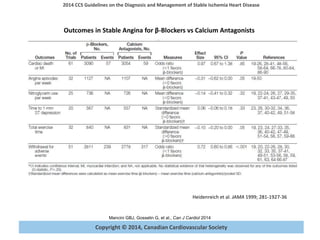
Heidenreich et al. JAMA 1999; 281-1927-36
Outcomes in Stable Angina for β-Blockers vs Calcium Antagonists
Copyright © 2014, Canadian Cardiovascular Society
2014 CCS Guidelines on the Diagnosis and Management of Stable Ischemia Heart Disease
Mancini GBJ, Gosselin G, et al., Can J Cardiol 2014
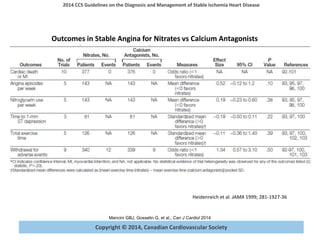
Outcomes in Stable Angina for Nitrates vs Calcium Antagonists
Heidenreich et al. JAMA 1999; 281-1927-36
Copyright © 2014, Canadian Cardiovascular Society
2014 CCS Guidelines on the Diagnosis and Management of Stable Ischemia Heart Disease
Mancini GBJ, Gosselin G, et al., Can J Cardiol 2014
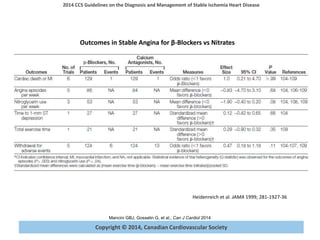
Heidenreich et al. JAMA 1999; 281-1927-36
Outcomes in Stable Angina for β-Blockers vs Nitrates
Copyright © 2014, Canadian Cardiovascular Society
2014 CCS Guidelines on the Diagnosis and Management of Stable Ischemia Heart Disease
Mancini GBJ, Gosselin G, et al., Can J Cardiol 2014
Canadian Cardiovascular Society Guidelines
2014 Diagnosis and Management of Stable Ischemic Heart Disease
Consideration of Revascularization Therapy
Copyright © 2014, Canadian Cardiovascular Society
2014 CCS Guidelines on the Diagnosis and Management of Stable Ischemia Heart Disease
Mancini GBJ, Gosselin G, et al., Can J Cardiol 2014
Recommendation Strength of
recommendation
Level of
evidence
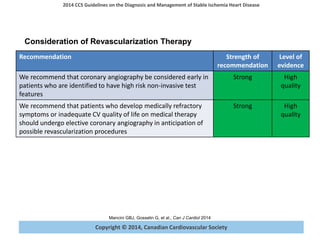
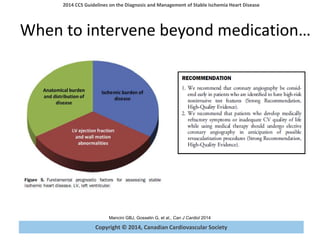
We recommend that coronary angiography be considered early in
patients who are identified to have high risk non-invasive test
features
Strong High
quality
We recommend that patients who develop medically refractory
symptoms or inadequate CV quality of life on medical therapy
should undergo elective coronary angiography in anticipation of
possible revascularization procedures
Strong High
quality
Consideration of Revascularization Therapy
Copyright © 2014, Canadian Cardiovascular Society
2014 CCS Guidelines on the Diagnosis and Management of Stable Ischemia Heart Disease
Mancini GBJ, Gosselin G, et al., Can J Cardiol 2014
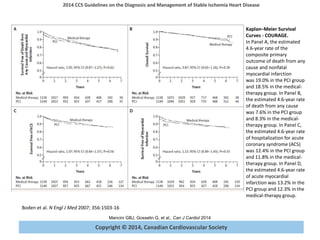
Kaplan–Meier Survival
Curves - COURAGE.
In Panel A, the estimated
4.6-year rate of the
composite primary
outcome of death from any
cause and nonfatal
myocardial infarction
was 19.0% in the PCI group
and 18.5% in the medical-
therapy group. In Panel B,
the estimated 4.6-year rate
of death from any cause
was 7.6% in the PCI group
and 8.3% in the medical-
therapy group. In Panel C,
the estimated 4.6-year rate
of hospitalization for acute
coronary syndrome (ACS)
was 12.4% in the PCI group
and 11.8% in the medical-
therapy group. In Panel D,
the estimated 4.6-year rate
of acute myocardial
infarction was 13.2% in the
PCI group and 12.3% in the
medical-therapy group.
Boden et al. N Engl J Med 2007; 356:1503-16
Copyright © 2014, Canadian Cardiovascular Society
2014 CCS Guidelines on the Diagnosis and Management of Stable Ischemia Heart Disease
Mancini GBJ, Gosselin G, et al., Can J Cardiol 2014
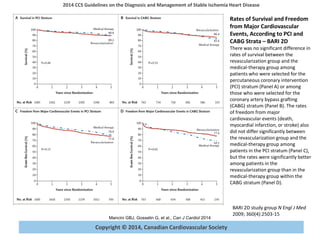
Rates of Survival and Freedom
from Major Cardiovascular
Events, According to PCI and
CABG Strata – BARI 2D
There was no significant difference in
rates of survival between the
revascularization group and the
medical-therapy group among
patients who were selected for the
percutaneous coronary intervention
(PCI) stratum (Panel A) or among
those who were selected for the
coronary artery bypass grafting
(CABG) stratum (Panel B). The rates
of freedom from major
cardiovascular events (death,
myocardial infarction, or stroke) also
did not differ significantly between
the revascularization group and the
medical-therapy group among
patients in the PCI stratum (Panel C),
but the rates were significantly better
among patients in the
revascularization group than in the
medical-therapy group within the
CABG stratum (Panel D).
BARI 2D study group N Engl J Med
2009; 360(4):2503-15
Copyright © 2014, Canadian Cardiovascular Society
2014 CCS Guidelines on the Diagnosis and Management of Stable Ischemia Heart Disease
Mancini GBJ, Gosselin G, et al., Can J Cardiol 2014
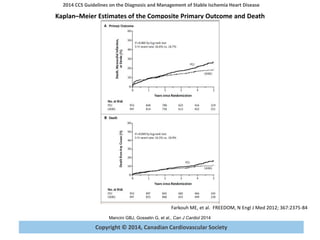
Kaplan–Meier Estimates of the Composite Primary Outcome and Death
Farkouh ME, et al. FREEDOM, N Engl J Med 2012; 367:2375-84
Copyright © 2014, Canadian Cardiovascular Society
2014 CCS Guidelines on the Diagnosis and Management of Stable Ischemia Heart Disease
Mancini GBJ, Gosselin G, et al., Can J Cardiol 2014
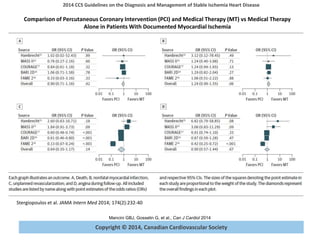
Stergiopoulos et al. JAMA Intern Med 2014; 174(2):232-40
Comparison of Percutaneous Coronary Intervention (PCI) and Medical Therapy (MT) vs Medical Therapy
Alone in Patients With Documented Myocardial Ischemia
Copyright © 2014, Canadian Cardiovascular Society
2014 CCS Guidelines on the Diagnosis and Management of Stable Ischemia Heart Disease
Mancini GBJ, Gosselin G, et al., Can J Cardiol 2014
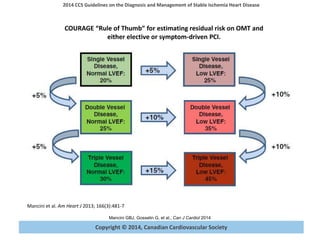
Mancini et al. Am Heart J 2013; 166(3):481-7
COURAGE “Rule of Thumb” for estimating residual risk on OMT and
either elective or symptom-driven PCI.
Copyright © 2014, Canadian Cardiovascular Society
2014 CCS Guidelines on the Diagnosis and Management of Stable Ischemia Heart Disease
Mancini GBJ, Gosselin G, et al., Can J Cardiol 2014
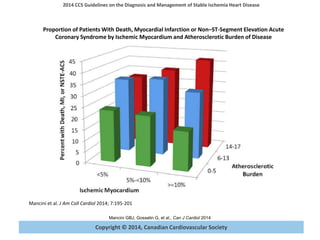
Proportion of Patients With Death, Myocardial Infarction or Non–ST-Segment Elevation Acute
Coronary Syndrome by Ischemic Myocardium and Atherosclerotic Burden of Disease
Mancini et al. J Am Coll Cardiol 2014; 7:195-201
Copyright © 2014, Canadian Cardiovascular Society
2014 CCS Guidelines on the Diagnosis and Management of Stable Ischemia Heart Disease
Mancini GBJ, Gosselin G, et al., Can J Cardiol 2014
When to intervene beyond medication…
Copyright © 2014, Canadian Cardiovascular Society
2014 CCS Guidelines on the Diagnosis and Management of Stable Ischemia Heart Disease
Mancini GBJ, Gosselin G, et al., Can J Cardiol 2014
Canadian Cardiovascular Society Guidelines
2014 Diagnosis and Management of Stable Ischemic Heart Disease
Provision of Appropriate Clinical Follow-up
Copyright © 2014, Canadian Cardiovascular Society
2014 CCS Guidelines on the Diagnosis and Management of Stable Ischemia Heart Disease
Mancini GBJ, Gosselin G, et al., Can J Cardiol 2014
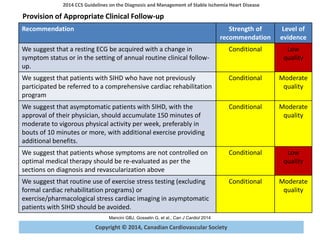
Provision of Appropriate Clinical Follow-up
Recommendation Strength of
recommendation
Level of
evidence
We suggest that a resting ECG be acquired with a change in
symptom status or in the setting of annual routine clinical follow-
up.
Conditional Low
quality
We suggest that patients with SIHD who have not previously
participated be referred to a comprehensive cardiac rehabilitation
program
Conditional Moderate
quality
We suggest that asymptomatic patients with SIHD, with the
approval of their physician, should accumulate 150 minutes of
moderate to vigorous physical activity per week, preferably in
bouts of 10 minutes or more, with additional exercise providing
additional benefits.
Conditional Moderate
quality
We suggest that patients whose symptoms are not controlled on
optimal medical therapy should be re-evaluated as per the
sections on diagnosis and revascularization above
Conditional Low
quality
We suggest that routine use of exercise stress testing (excluding
formal cardiac rehabilitation programs) or
exercise/pharmacological stress cardiac imaging in asymptomatic
patients with SIHD should be avoided.
Conditional Moderate
quality
Copyright © 2014, Canadian Cardiovascular Society
CCS Guidelines for the Diagnosis and Management of Stable Ischemia Heart Disease (2014)
Mancini GBJ, Gosselin G, et al., Can J Cardiol 2014
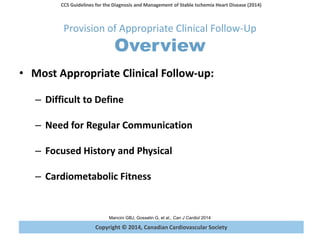
Provision of Appropriate Clinical Follow-Up
Overview
• Most Appropriate Clinical Follow-up:
– Difficult to Define
– Need for Regular Communication
– Focused History and Physical
– Cardiometabolic Fitness
Copyright © 2014, Canadian Cardiovascular Society
CCS Guidelines for the Diagnosis and Management of Stable Ischemia Heart Disease (2014)
Mancini GBJ, Gosselin G, et al., Can J Cardiol 2014
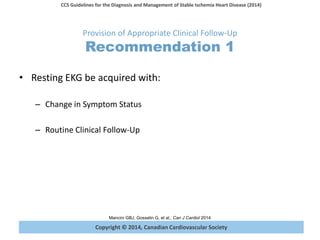
Provision of Appropriate Clinical Follow-Up
Recommendation 1
• Resting EKG be acquired with:
– Change in Symptom Status
– Routine Clinical Follow-Up
Copyright © 2014, Canadian Cardiovascular Society
CCS Guidelines for the Diagnosis and Management of Stable Ischemia Heart Disease (2014)
Mancini GBJ, Gosselin G, et al., Can J Cardiol 2014
Provision of Appropriate Clinical Follow-Up
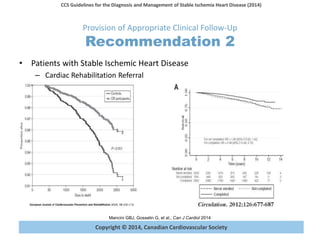
Recommendation 2
• Patients with Stable Ischemic Heart Disease
– Cardiac Rehabilitation Referral
Copyright © 2014, Canadian Cardiovascular Society
CCS Guidelines for the Diagnosis and Management of Stable Ischemia Heart Disease (2014)
Mancini GBJ, Gosselin G, et al., Can J Cardiol 2014
Provision of Appropriate Clinical Follow-Up
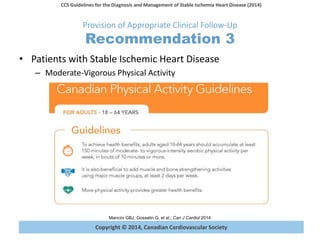
Recommendation 3
• Patients with Stable Ischemic Heart Disease
– Moderate-Vigorous Physical Activity
Copyright © 2014, Canadian Cardiovascular Society
CCS Guidelines for the Diagnosis and Management of Stable Ischemia Heart Disease (2014)
Mancini GBJ, Gosselin G, et al., Can J Cardiol 2014
Provision of Appropriate Clinical Follow-Up
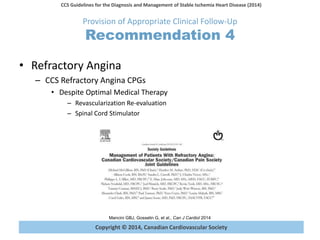
Recommendation 4
• Refractory Angina
– CCS Refractory Angina CPGs
• Despite Optimal Medical Therapy
– Revascularization Re-evaluation
– Spinal Cord Stimulator
Copyright © 2014, Canadian Cardiovascular Society
CCS Guidelines for the Diagnosis and Management of Stable Ischemia Heart Disease (2014)
Mancini GBJ, Gosselin G, et al., Can J Cardiol 2014
Provision of Appropriate Clinical Follow-Up
Recommendation 5
• In Asymptomatic SIHD Patients:
– Choose Wisely and Avoid Routine:
• Exercise Stress Testing
• Exercise Stress Cardiac Imaging
• Pharmacological Stress Cardiac Imaging
• Invasive Assessment
Copyright © 2014, Canadian Cardiovascular Society
CCS Guidelines for the Diagnosis and Management of Stable Ischemia Heart Disease (2014)
Mancini GBJ, Gosselin G, et al., Can J Cardiol 2014
Canadian Cardiovascular Society Guidelines
2014 Diagnosis and Management of Stable Ischemic Heart Disease
Applying the Guidelines Using
Sample Case Scenarios.
Victor Huckell
Supported by Beth Abramson and
Kenneth Yvorchuk
Copyright © 2014, Canadian Cardiovascular Society
CCS Guidelines for the Diagnosis and Management of Stable Ischemia Heart Disease (2014)
Mancini GBJ, Gosselin G, et al., Can J Cardiol 2014
PATIENT 1
52-year-old male patient with no previous cardiac history
Mild hypertension, only on hydrochlorothiazide 25mg once daily – not sure of BP
numbers
Presents with 6 month history of vague right sided chest pain most commonly
occurring while 10-pin bowling
Can continue bowling but has to slow down
Works as a truck driver
Not certain of family history but believes that father had a stroke at age 88 and
mother died of old age. No siblings.
Tends to avoid the medical profession
No laboratory work available.
Copyright © 2014, Canadian Cardiovascular Society
CCS Guidelines for the Diagnosis and Management of Stable Ischemia Heart Disease (2014)
Mancini GBJ, Gosselin G, et al., Can J Cardiol 2014
Based only on symptoms what is this patient’s
pre-test likelihood of coronary artery disease
that’s detected by invasive angiography
1. 20%
2. 65%
3. 93%
Copyright © 2014, Canadian Cardiovascular Society
Which would be an appropriate first non-
invasive investigation?
1. Exercise testing
2. Exercise myocardial perfusion imaging
3. Exercise echocardiography
4. Vasodilator stress myocardial perfusion imaging
Copyright © 2014, Canadian Cardiovascular Society
Which of the following is not a high RISK
feature for a non-invasive stress test?
1. Greater than 2mm ST segment depression at low workload
2. Rapid resolution of ST segment depression and recovery
3. Exercise induced ST segment elevation
4. Exercise induced VT/VF
5. Failure to increase systolic blood pressure to greater than 120 mmHg
Copyright © 2014, Canadian Cardiovascular Society
CCS Guidelines for the Diagnosis and Management of Stable Ischemia Heart Disease (2014)
Mancini GBJ, Gosselin G, et al., Can J Cardiol 2014
PATIENT 1 - continued
The patient undergoes exercise treadmill testing which is positive with 2mm horizontal
ST segment depression at 7 minutes of exercise.
There are no exercise provocable dysrhythmias. Blood pressure response is
appropriate.
The patient subsequently undergoes coronary arteriography. This confirms the
presence of atherosclerotic coronary artery disease with at least one lesion
exceeding 60% narrowing.
Left ventricular function is normal on echocardiography and angiography.
Diastolic pressures are normal.
Copyright © 2014, Canadian Cardiovascular Society
Which of the following medications improve
prognosis in chronic management for the
patient with SIHD?
1. Acetylsalicylic acid
2. Clopidogrel
3. Statins
4. ACE inhibitors
5. Beta blockers
Copyright © 2014, Canadian Cardiovascular Society
CCS Guidelines for the Diagnosis and Management of Stable Ischemia Heart Disease (2014)
Mancini GBJ, Gosselin G, et al., Can J Cardiol 2014
Which of the following tests or conditions
would not impact on decisions to treat with a
statin?
1. Rheumatoid arthritis
2. Elevated hsCRP
3. Elevated LP(a)
4. Hyperuricemia
5. Metabolic syndrome
Copyright © 2014, Canadian Cardiovascular Society
CCS Guidelines for the Diagnosis and Management of Stable Ischemia Heart Disease (2014)
Mancini GBJ, Gosselin G, et al., Can J Cardiol 2014
Medical therapy used to help with ischemic
heart disease should include:
1. Statins and anti-platelet agents
2. Chelation therapy
3. Co-enzyme Q10
4. Magnesium supplements and Vitamin E
Copyright © 2014, Canadian Cardiovascular Society
PATIENT 2
A 64-year-old female with classic angina and a positive treadmill test has
undergone angiography for verification of the diagnosis.
She has CCS Class II angina. She tends to be a therapeutic nihilist and is
reluctant to take medications. She notes, however, that her ongoing
symptoms are interfering with activities of daily living and quality of life.
She is a retired cardiology medical office assistant with some
understanding of biostatistics.
She asks which forms of therapy would improve quality of life for the
longest period of time.
She also asks which form of therapy would offer a mortality benefit
possibly without symptomatic relief. Following discussions she agrees to
take optimum medical therapy (OMT).
Copyright © 2014, Canadian Cardiovascular Society
Residual risk on optimum medical therapy for
single vessel disease and normal left
ventricular ejection fraction is:
1. 20%
2. 25%
3. 30%
Copyright © 2014, Canadian Cardiovascular Society
Residual risk on optimum medical therapy for
triple vessel disease with low left ventricular
ejection fraction:
1. 25%
2. 35%
3. 45%
Copyright © 2014, Canadian Cardiovascular Society
CCS Guidelines for the Diagnosis and Management of Stable Ischemia Heart Disease (2014)
Mancini GBJ, Gosselin G, et al., Can J Cardiol 2014
At 12 months following therapy which has a
greater freedom from angina?
1. Optimum medical therapy
2. PCI plus optimum medical therapy
Copyright © 2014, Canadian Cardiovascular Society
CCS Guidelines for the Diagnosis and Management of Stable Ischemia Heart Disease (2014)
Mancini GBJ, Gosselin G, et al., Can J Cardiol 2014
PATIENT 2 - continued
The patient has a significant reduction in symptomatology on optimum medical
therapy for risk factor management plus a beta-blocker.
She decides to postpone revascularization by either mechanical or surgical means.
The patient is interested in an exercise rehabilitation program but, unfortunately, lives
at a distance.
Copyright © 2014, Canadian Cardiovascular Society
CCS Guidelines for the Diagnosis and Management of Stable Ischemia Heart Disease (2014)
Mancini GBJ, Gosselin G, et al., Can J Cardiol 2014
We should recommend a minimum of _______
minutes of moderate to vigorous physical
activity per week.
1. 60
2. 90
3. 120
4. 150
5. 180
Copyright © 2014, Canadian Cardiovascular Society
CCS Guidelines for the Diagnosis and Management of Stable Ischemia Heart Disease (2014)
Mancini GBJ, Gosselin G, et al., Can J Cardiol 2014
Routine exercise stress testing should be
carried out on a yearly basis
1. Yes
2. No
Copyright © 2014, Canadian Cardiovascular Society
CCS Guidelines for the Diagnosis and Management of Stable Ischemia Heart Disease (2014)
Mancini GBJ, Gosselin G, et al., Can J Cardiol 2014
Which of the following is NOT a primary goal of
therapy for patients with chronic stable angina?
1. Reduce coronary perfusion pressure.
2. Increase quality of life by reducing ischemia and preventing symptoms.
3. Increase quantity of life by disease modification and prevention of
myocardial infarction and death.
Copyright © 2014, Canadian Cardiovascular Society
CCS Guidelines for the Diagnosis and Management of Stable Ischemia Heart Disease (2014)
Mancini GBJ, Gosselin G, et al., Can J Cardiol 2014
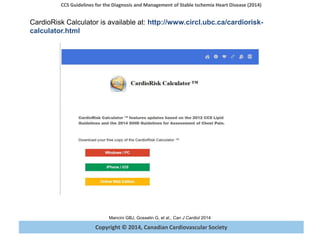
CardioRisk Calculator is available at: http://www.circl.ubc.ca/cardiorisk-
calculator.html

Stable Ischemic Heart Disease Guideline

  • 1.
    Copyright © 2014,Canadian Cardiovascular Society CCS Guidelines for the Diagnosis and Management of Stable Ischemia Heart Disease (2014) Mancini GBJ, Gosselin G, et al., Can J Cardiol 2014 Canadian Cardiovascular Society Guidelines for the Diagnosis and Management of Stable Ischemic Heart Disease
  • 2.
    Copyright © 2014,Canadian Cardiovascular SocietyCopyright © 2014, Canadian Cardiovascular Society Disclaimer The Canadian Cardiovascular Society (CCS) welcomes reuse of our educational slide deck for medical institution internal education or training (i.e. grand rounds, medical college/classroom education, etc.). However, if the material is being used in an industry sponsored CME program, permission must be sought through our publisher Elsevier (www.onlinecjc.com). If your reuse qualifies as medical institution internal education, you may reuse the material under the following conditions: • You must cite the Canadian Journal of Cardiology and the Canadian Cardiovascular Society as references. • You may not use any Canadian Cardiovascular Society logos or trademarks on any slides or anywhere in your presentation or publications. • Do not modify the slide content. • If repeating recommendations from the published guideline, do not modify the recommendation wording.
  • 3.
    Copyright © 2014,Canadian Cardiovascular Society CCS Guidelines for the Diagnosis and Management of Stable Ischemia Heart Disease (2014) Mancini GBJ, Gosselin G, et al., Can J Cardiol 2014 Primary Panel G.B. John Mancini MD, Co-chair; University of British Columbia Gilbert Gosselin MD, Co-chair; Montreal Heart Institute, University of Montreal Benjamin Chow MD; Ottawa Heart Institute William Kostuk MD; University of Western Ontario James Stone MD; University of Calgary Kenneth J. Yvorchuk MD; Vancouver Island Health Authority, Victoria, British Columbia Beth L. Abramson MD; St. Michael’s Hospital, University of Toronto Raymond Cartier MD; Montreal Heart Institute, University of Montreal Victor Huckell MD; University of British Columbia Jean-Claude Tardif MD; Montreal Heart Institute, University of Montreal Secondary Panel Kim Connelly MD; St. Michael’s Hospital, University of Toronto John Ducas MD; University of Manitoba Michael E. Farkouh MD; University Health Network Hospitals, University of Toronto Milan Gupta MD; McMaster University Martin Juneau MD; Montreal Heart Institute, University of Montreal Blair O’Neill MD; University of Alberta Paolo Raggi MD; University of Alberta Koon Teo MD; McMaster University Subodh Verma MD; St. Michael’s Hospital, University of Toronto Rodney Zimmermann MD; Regina Qu’Appelle Health Region, University of Saskatchewan
  • 4.
    Copyright © 2014,Canadian Cardiovascular Society CCS Guidelines for the Diagnosis and Management of Stable Ischemia Heart Disease (2014) Mancini GBJ, Gosselin G, et al., Can J Cardiol 2014
  • 5.
    Copyright © 2014,Canadian Cardiovascular Society CCS Guidelines for the Diagnosis and Management of Stable Ischemia Heart Disease (2014) Mancini GBJ, Gosselin G, et al., Can J Cardiol 2014 Make diagnosis and assess prognostic factors Initiate medical treatment Consider revascularization Provide appropriate follow-up care Diagnosis and management of patients with stable ischemic heart disease
  • 6.
    Copyright © 2014,Canadian Cardiovascular Society 2014 CCS Guidelines on the Diagnosis and Management of Stable Ischemia Heart Disease Mancini GBJ, Gosselin G, et al., Can J Cardiol 2014 Canadian Cardiovascular Society Guidelines 2014 Diagnosis and Management of Stable Ischemic Heart Disease Establishing Diagnosis and Prognosis
  • 7.
    Copyright © 2014,Canadian Cardiovascular Society 2014 CCS Guidelines on the Diagnosis and Management of Stable Ischemia Heart Disease Mancini GBJ, Gosselin G, et al., Can J Cardiol 2014 Copyright © 2014, Canadian Cardiovascular Society Recommendation Strength of recommendation Level of evidence We recommend that a focused history and physical examination be obtained to elucidate symptoms, cardiac risk factors, past medical history and signs of cardiovascular disease or other etiologies of symptoms Strong High quality We recommend that cardiovascular co-morbidities of heart failure, valvular heart disease, cerebrovascular and peripheral vascular disease and renal disease should be fully documented Strong High quality We suggest that initial assessment be supplemented by routine testing that includes hemoglobin, full cholesterol panel, fasting glucose, Hemoglobin A1c, renal function tests, liver function tests, thyroid function tests, and a 12 lead ECG Conditional Moderate quality Making the Diagnosis
  • 8.
    Copyright © 2014,Canadian Cardiovascular Society 2014 CCS Guidelines on the Diagnosis and Management of Stable Ischemia Heart Disease Mancini GBJ, Gosselin G, et al., Can J Cardiol 2014 Recommendation Strength of recommendation Level of evidence We suggest that adults > 30 years of age with 2 or 3 anginal criteria should undergo testing for diagnostic (and prognostic) purposes Conditional Moderate quality We suggest that men > 40 and women > 60 years of age with 1 of 3 anginal features should undergo non-invasive testing for diagnostic (and prognostic) purposes Conditional Moderate quality We suggest that men < 40 and women < 60 years of age with 1 of 3 anginal features have a low pre-test likelihood of CAD but should undergo non-invasive diagnostic testing if other features indicative of CV risk are present Conditional Low quality Using Non-invasive Diagnostic and Prognostic Testing
  • 9.
    Copyright © 2014,Canadian Cardiovascular Society 2014 CCS Guidelines on the Diagnosis and Management of Stable Ischemia Heart Disease Mancini GBJ, Gosselin G, et al., Can J Cardiol 2014 Recommendation Strength of recommendation Level of evidence We suggest that exercise testing, if possible, is preferred as it is more strongly perceived by patients as relevant to their activities than pharmacologic testing and provides assessment of functional capacity Conditional Low quality We suggest that patients with an interpretable rest ECG who are able to exercise should have an exercise ECG test (ideally free of anti-ischemic drugs) Conditional Low quality We suggest that the initial test in patients able to exercise, with a rest ECG that precludes ST segment interpretation should be exercise myocardial perfusion imaging or exercise echocardiography Conditional Moderate quality We suggest that the initial test in patients without LBBB or paced rhythm who cannot exercise be vasodilator stress myocardial perfusion imaging or dobutamine echocardiography Conditional Moderate quality We recommend that the initial test in patients with LBBB or ventricular paced rhythm should be either vasodilator stress myocardial perfusion imaging or CCTA Strong High quality Using Non-invasive Diagnostic and Prognostic Testing (con’d)
  • 10.
    Copyright © 2014,Canadian Cardiovascular Society 2014 CCS Guidelines on the Diagnosis and Management of Stable Ischemia Heart Disease Mancini GBJ, Gosselin G, et al., Can J Cardiol 2014 Recommendation Strength of recommendation Level of evidence We recommend that a non-invasive assessment of rest left ventricular function be obtained in all patients with suspected SIHD Strong High quality We suggest that patients with initially equivocal or non-diagnostic test results or a strong discrepancy between clinical impression and test results be considered for further testing using a complementary, non-invasive modality ) Conditional Low quality We suggest that CCTA not be used in patients felt likely to warrant invasive angiography on the basis of high risk symptom pattern, high pre-test probability of coronary artery disease, severe risk factors or important reasons to minimize exposure to radiation or contrast material Conditional Low quality We suggest that invasive coronary angiography be obtained in patients with SIHD who have high pre-test likelihood of CAD, high risk features on prior non-invasive testing, survived sudden cardiac arrest or who have life threatening arrhythmias Conditional Moderate quality Using Non-invasive Diagnostic and Prognostic Testing (con’d)
  • 11.
    Copyright © 2014,Canadian Cardiovascular Society 2014 CCS Guidelines on the Diagnosis and Management of Stable Ischemia Heart Disease Mancini GBJ, Gosselin G, et al., Can J Cardiol 2014 Anatomical burden and distribution of disease Ischemic burden of disease LV ejection fraction and wall motion abnormalities Fundamental prognostic factors for assessing stable ischemic heart disease.
  • 12.
    Copyright © 2014,Canadian Cardiovascular Society 2014 CCS Guidelines on the Diagnosis and Management of Stable Ischemia Heart Disease Mancini GBJ, Gosselin G, et al., Can J Cardiol 2014 Age Chest Pain Criteria: 1. Sub-sternal chest discomfort with characteristic quality and duration 2. Provoked by exertion or emotional stress 3. Relieved promptly by rest or nitroglycerin Non-anginal Chest Pain 1 of 3 Criteria Atypical Angina 2 of 3 Criteria Typical Angina 3 of 3 Criteria Male Female Male Female Male Female 30 – 39 4% 2% 34% 12% 76% 26% 40 - 49 13% 3% 51% 22% 87% 55% 50 - 59 20% 7% 65% 33% 93% 73% 60 – 69 27% 14% 72% 51% 94% 86% Pretest likelihood of CAD as detected by invasive angiography in symptomatic patients according to age and sex (Combined Diamond Forrester and CASS Data). A low pretest risk of CAD is considered < 10% (green) and a high pretest risk is considered > 90% (red). All others are at intermediate risk (yellow). Adapted from Diamond et al NEJM 1979;300:1350-58 and Weiner et al NEJM 1979;301:230-5
  • 13.
    Copyright © 2014,Canadian Cardiovascular Society 2014 CCS Guidelines on the Diagnosis and Management of Stable Ischemia Heart Disease Mancini GBJ, Gosselin G, et al., Can J Cardiol 2014 Receiver operating characteristic (ROC) curves for five risk prediction models. Jensen et al. Atherosclerosis 2012; 220:557-62 The AUC for the updated Diamond– Forrester, Duke, and CORSCORE risk models were significantly larger than the AUC for the Diamond– Forrester (p < 0.001, p < 0.001, and p = 0.001, respectively) and Morise (p = 0.036, p = 0.032, and p = 0.024, respectively) risk models. The AUC for the Morise model was significantly larger than the AUC for the Diamond–Forrester risk model (p = 0.049).
  • 14.
    Copyright © 2014,Canadian Cardiovascular Society 2014 CCS Guidelines on the Diagnosis and Management of Stable Ischemia Heart Disease Mancini GBJ, Gosselin G, et al., Can J Cardiol 2014 Assess for other causes as appropriate Non-invasive testing for diagnostic and/or prognostic purposes (tailored to patient characteristics, access and local expertise) Conservative diagnostic and treatment strategy Male < 40 yo Female < 60 yo No risk factors Male ≥ 40 yo Female ≥ 60 yo or single severe or multiple risk factors Significant non-CV co- morbidities and quality of life issues are present 1/3 Chest pain criteria2 or 3/3 Chest pain criteria Cardiovascular history, physical, laboratory tests, 12 lead EKG Stable Chest Pain Syndrome (1 – 3/3 anginal symptoms) Use of non-invasive testing for diagnostic and prognostic purposes in patients with classical anginal chest pain symptoms suggestive of SIHD.
  • 15.
    Copyright © 2014,Canadian Cardiovascular Society 2014 CCS Guidelines on the Diagnosis and Management of Stable Ischemia Heart Disease Mancini GBJ, Gosselin G, et al., Can J Cardiol 2014 Summary Estimates of Pooled Sensitivity and Specificity (with 95% confidence intervals) for Non-Invasive Cardiac Tests for the Diagnosis of Coronary Artery Disease Technology Sensitivity Specificity Exercise Treadmill 0.68 (0.23-1.0) 0.77 (0.17-1.0) Attenuation Corrected SPECT 0.86 (0.81-0.91) 0.82 (0.75-0.89) Gated SPECT 0.84 (0.79-0.88) 0.78 (0.71-0.85) Traditional SPECT 0.86 (0.84-0.88) 0.71 (0.67-0.76) Contrast Stress Echocardiography (wall motion) 0.84 (0.79-0.90) 0.80 (0.73-0.87) Exercise or Pharmacologic Stress Echocardiography 0.79 (0.77-0.82) 0.84 (0-.82-0.86) Cardiac Computed Tomographic Angiography 0.96 (0.94-0.98) 0.82 (0.73-0.90) Positron Emission Tomography 0.90 (0.88-0.92) 0.88 (0.85-0.91) Cardiac MRI (perfusion) 0.91 (0.88-0.94) 0.81 (0.75-0.87) Adapted from Gianrossi et al Circulation 1989; 80:87-98, Medical Advisory Secretariat 2010; 10:1-40, and McArdle et al J Am Coll Cardiol 2012;60:1828-37
  • 16.
    Copyright © 2014,Canadian Cardiovascular Society 2014 CCS Guidelines on the Diagnosis and Management of Stable Ischemia Heart Disease Mancini GBJ, Gosselin G, et al., Can J Cardiol 2014 Able to exercise adequately and no contraindications (see legend) ECG normal ECG abnormal (eg. ST depression ≥ 1 mm, LVH, digoxin, ventricular pre-excitation No LBBB or ventricular paced rhythm LBBB or ventricular paced rhythm No LBBB or ventricular paced rhythm LBBB or ventricular paced rhythm Exercise stress test Exercise echocardiography Dobutamine or vasodilator echocardiography Exercise myocardial perfusion imaging Vasodilator myocardial perfusion imaging Vasodilator myocardial perfusion imaging Cardiac computed tomographic angiography ECG normal or abnormal YES NO Guidance for selection of an initial non-invasive test for diagnosing suspected CAD in routine practice settings.
  • 17.
    Copyright © 2014,Canadian Cardiovascular Society 2014 CCS Guidelines on the Diagnosis and Management of Stable Ischemia Heart Disease Mancini GBJ, Gosselin G, et al., Can J Cardiol 2014 High Risk Features of Noninvasive Test Results Associated with > 3% Annual Rate of Death or MI Exercise Treadmill • ≥ 2mm of ST-segment depression at low (< 5 metabolic equivalents, METS) workload or persisting into recovery • Exercise-induced ST-segment elevation • Exercise-induced VT/VF • Failure to increase systolic blood pressure to > 120 mm Myocardial Perfusion Imaging • Severe resting LV dysfunction (LVEF < 35%) not readily explained by non-coronary causes • Resting perfusion abnormalities ≥10% of the myocardium in patients without prior history or evidence of MI • Severe stress-induced LV dysfunction (peak exercise LVEF <45% or drop in LVEF with stress ≥10%) • Stress-induced perfusion abnormalities encumbering ≥10% myocardium or stress segmental scores indicating multiple vascular territories with abnormalities • Stress-induced LV dilation • Increased lung uptake Stress Echocardiography • Inducible wall motion abnormality involving >2 segments or 2 coronary beds • Wall motion abnormality developing at low dose of dobutamine (< 10 micrograms/kg/min) or at a low heart rate (<120 beats/min) Coronary Computed Tomographic Angiography • Multivessel obstructive CAD or left main stenosis on CCTA Adapted from Fihn et al Circ 2012;126:e354-e471
  • 18.
    Copyright © 2014,Canadian Cardiovascular Society 2014 CCS Guidelines on the Diagnosis and Management of Stable Ischemia Heart Disease Mancini GBJ, Gosselin G, et al., Can J Cardiol 2014 Canadian Cardiovascular Society Guidelines 2014 Diagnosis and Management of Stable Ischemic Heart Disease Initiation of Medical Treatment in Patient With Established CAD
  • 19.
    Copyright © 2014,Canadian Cardiovascular Society 2014 CCS Guidelines on the Diagnosis and Management of Stable Ischemia Heart Disease Mancini GBJ, Gosselin G, et al., Can J Cardiol 2014 Recommendation Strength of recommendation Level of evidence We recommend that all patients receive 81 mg of acetylsalicylic acid daily indefinitely, unless contraindicated Strong High quality We recommend that clopidogrel 75 mg daily be used in acetylsalicylic acid intolerant individuals Strong High quality We suggest that dual antiplatelet therapy should not be used in routine management of SIHD or beyond the time period required as a result of stenting Conditional Moderate quality We recommend that all patients receive a statin in accordance with CCS 2012 Dyslipidemia Guidelines Strong High quality We recommend that all patients with SIHD who also have hypertension, diabetes, a left ventricular ejection fraction of < 40%, or chronic kidney disease, should receive an angiotensin-converting enzyme (ACE) inhibitor, unless contraindicated Strong High quality We recommend that it is also reasonable to consider treatment with an ACE inhibitor in all patients with SIHD Strong High quality We recommend that ARBs should be used for patients who are intolerant of ACE inhibitors Strong High quality We recommend that beta-blocker therapy be used in all patients with SIHD and left ventricular systolic dysfunction (ejection fraction < 40%) with or without heart failure, unless contraindicated, and continued indefinitely Strong High quality Chronic Management for the Patient with SIHD to Improve Prognosis
  • 20.
    Copyright © 2014,Canadian Cardiovascular Society 2014 CCS Guidelines on the Diagnosis and Management of Stable Ischemia Heart Disease Mancini GBJ, Gosselin G, et al., Can J Cardiol 2014 Recommendation Strength of recommendation Level of evidence We suggest that beta-blockers be used as first-line therapy for symptom relief, with the dose titrated to reach a target resting heart rate of 55 to 60 bpm Conditional Moderate quality We suggest that beta-blockers or long-acting calcium channel blockers be used for chronic stable angina in uncomplicated patients Conditional Moderate quality We suggest the addition of a long-acting nitrate when initial treatment with a beta-blocker and/or long acting calcium channel blocker is not tolerated or contraindicated or does not lead to adequate symptom control Conditional Moderate quality We recommend avoiding non-dihydropyridine calcium channel blockers in conjunction with beta-blockers if there is risk of AV block or excessive bradycardia Strong High quality We suggest that chelation therapy, allopurinol, magnesium supplementation, coenzyme Q10, suxiao jiuxin wan or shenshao tablets and testosterone should not be used to attempt to improve angina or exercise tolerance Conditional Moderate quality We recommend that implementation and optimization of medical therapy should be achieved within 12 to 16 weeks of an initial evaluation suggesting presence of SIHD without high risk features during which adequacy of symptom control and quality of life can be assessed prior to consideration of revascularization therapy Strong High quality Chronic Management of Anginal Symptoms
  • 21.
    Copyright © 2014,Canadian Cardiovascular Society 2014 CCS Guidelines on the Diagnosis and Management of Stable Ischemia Heart Disease Mancini GBJ, Gosselin G, et al., Can J Cardiol 2014 Copyright © 2014, Canadian Cardiovascular Society Freedom from Angina over Time as Assessed with the Angina- Frequency Scale of the Seattle Angina Questionnaire, According to Treatment Group. Weintraub WS et al. N Engl J Med 2008;359:677-687.
  • 22.
    Copyright © 2014,Canadian Cardiovascular Society 2014 CCS Guidelines on the Diagnosis and Management of Stable Ischemia Heart Disease Mancini GBJ, Gosselin G, et al., Can J Cardiol 2014 Mean Scores over Time in Five Domains of the Seattle Angina Questionnaire. An asterisk indicates P<0.01 for the difference between treatment groups Weintraub WS et al. N Engl J Med 2008;359:677-687.
  • 23.
    Copyright © 2014,Canadian Cardiovascular Society 2014 CCS Guidelines on the Diagnosis and Management of Stable Ischemia Heart Disease Mancini GBJ, Gosselin G, et al., Can J Cardiol 2014 Antithrombotic Trialists' Collaboration. BMJ. 2002;324:71-86 Absolute effects of antiplatelet therapy on vascular events (myocardial infarction, stroke, or vascular death) in five main high risk categories. Adjusted control totals have been calculated after converting any unevenly randomised trials to even ones by counting control groups more than once
  • 24.
    Copyright © 2014,Canadian Cardiovascular Society 2014 CCS Guidelines on the Diagnosis and Management of Stable Ischemia Heart Disease Mancini GBJ, Gosselin G, et al., Can J Cardiol 2014 Summary of treatment thresholds and targets based on Framingham Risk Score (FRS), modified by family history. HDL-C, high-density lipoprotein C; LDL-C, low- density lipoprotein cholesterol Anderson et al. Can J Cardiol 2013; 29:151-67
  • 25.
    Copyright © 2014,Canadian Cardiovascular Society 2014 CCS Guidelines on the Diagnosis and Management of Stable Ischemia Heart Disease Mancini GBJ, Gosselin G, et al., Can J Cardiol 2014; 30: 837-849 All-cause mortality (A) and cardiovascular mortality (B) in patients with coronary artery disease and no left ventricular systolic dysfunction randomized to long-term angiotensin-converting enzyme inhibitor therapy or placebo Danchin et al. Arch Intern Med 2006; 166:787-96
  • 26.
    Copyright © 2014,Canadian Cardiovascular Society 2014 CCS Guidelines on the Diagnosis and Management of Stable Ischemia Heart Disease Mancini GBJ, Gosselin G, et al., Can J Cardiol 2014 Meta-analysis of Main Clinical End Points in Trials in patients with coronary artery disease and no left ventricular systolic dysfunction randomized to receive angiotensin-converting enzyme inhibitors Danchin et al. Arch Intern Med 2006; 166:787-96
  • 27.
    Copyright © 2014,Canadian Cardiovascular Society 2014 CCS Guidelines on the Diagnosis and Management of Stable Ischemia Heart Disease Mancini GBJ, Gosselin G, et al., Can J Cardiol 2014 Copyright © 2014, Canadian Cardiovascular Society Meta regression analysis of the relationship of percentage of patients with reperfusion therapy on the risk ratio of mortality with β-blockers. • β-blockers reduced mortality in pre- reperfusion[IRR=0.86, 95% CI=0.79- 0.94] but not in the reperfusion era(IRR=0.98, 95% CI=0.92-1.05) where there was reduction (short-term) in myocardial infarction(IRR=0.72, 95% CI=0.62-0.83) and angina(IRR=0.80, 95%CI=0.65-0.98) but increase in heart failure(IRR=1.10, 95% CI=1.05-1.16), cardiogenic shock(IRR=1.29, 95% CI=1.18-1.41) and drug discontinuation. • In contemporary treatment of MI, β- blockers have no mortality benefit but reduce myocardial infarction and angina (short-term) with increase in heart failure, cardiogenic shock and drug discontinuation Bangalore S, et al. The American Journal of Medicine, 2014 http://dx.doi.org/10.1016/j.amjmed.2014.05.032
  • 28.
    Copyright © 2014,Canadian Cardiovascular Society 2014 CCS Guidelines on the Diagnosis and Management of Stable Ischemia Heart Disease Mancini GBJ, Gosselin G, et al., Can J Cardiol 2014 Heidenreich et al. JAMA 1999; 281-1927-36 Outcomes in Stable Angina for β-Blockers vs Calcium Antagonists
  • 29.
    Copyright © 2014,Canadian Cardiovascular Society 2014 CCS Guidelines on the Diagnosis and Management of Stable Ischemia Heart Disease Mancini GBJ, Gosselin G, et al., Can J Cardiol 2014 Outcomes in Stable Angina for Nitrates vs Calcium Antagonists Heidenreich et al. JAMA 1999; 281-1927-36
  • 30.
    Copyright © 2014,Canadian Cardiovascular Society 2014 CCS Guidelines on the Diagnosis and Management of Stable Ischemia Heart Disease Mancini GBJ, Gosselin G, et al., Can J Cardiol 2014 Heidenreich et al. JAMA 1999; 281-1927-36 Outcomes in Stable Angina for β-Blockers vs Nitrates
  • 31.
    Copyright © 2014,Canadian Cardiovascular Society 2014 CCS Guidelines on the Diagnosis and Management of Stable Ischemia Heart Disease Mancini GBJ, Gosselin G, et al., Can J Cardiol 2014 Canadian Cardiovascular Society Guidelines 2014 Diagnosis and Management of Stable Ischemic Heart Disease Consideration of Revascularization Therapy
  • 32.
    Copyright © 2014,Canadian Cardiovascular Society 2014 CCS Guidelines on the Diagnosis and Management of Stable Ischemia Heart Disease Mancini GBJ, Gosselin G, et al., Can J Cardiol 2014 Recommendation Strength of recommendation Level of evidence We recommend that coronary angiography be considered early in patients who are identified to have high risk non-invasive test features Strong High quality We recommend that patients who develop medically refractory symptoms or inadequate CV quality of life on medical therapy should undergo elective coronary angiography in anticipation of possible revascularization procedures Strong High quality Consideration of Revascularization Therapy
  • 33.
    Copyright © 2014,Canadian Cardiovascular Society 2014 CCS Guidelines on the Diagnosis and Management of Stable Ischemia Heart Disease Mancini GBJ, Gosselin G, et al., Can J Cardiol 2014 Kaplan–Meier Survival Curves - COURAGE. In Panel A, the estimated 4.6-year rate of the composite primary outcome of death from any cause and nonfatal myocardial infarction was 19.0% in the PCI group and 18.5% in the medical- therapy group. In Panel B, the estimated 4.6-year rate of death from any cause was 7.6% in the PCI group and 8.3% in the medical- therapy group. In Panel C, the estimated 4.6-year rate of hospitalization for acute coronary syndrome (ACS) was 12.4% in the PCI group and 11.8% in the medical- therapy group. In Panel D, the estimated 4.6-year rate of acute myocardial infarction was 13.2% in the PCI group and 12.3% in the medical-therapy group. Boden et al. N Engl J Med 2007; 356:1503-16
  • 34.
    Copyright © 2014,Canadian Cardiovascular Society 2014 CCS Guidelines on the Diagnosis and Management of Stable Ischemia Heart Disease Mancini GBJ, Gosselin G, et al., Can J Cardiol 2014 Rates of Survival and Freedom from Major Cardiovascular Events, According to PCI and CABG Strata – BARI 2D There was no significant difference in rates of survival between the revascularization group and the medical-therapy group among patients who were selected for the percutaneous coronary intervention (PCI) stratum (Panel A) or among those who were selected for the coronary artery bypass grafting (CABG) stratum (Panel B). The rates of freedom from major cardiovascular events (death, myocardial infarction, or stroke) also did not differ significantly between the revascularization group and the medical-therapy group among patients in the PCI stratum (Panel C), but the rates were significantly better among patients in the revascularization group than in the medical-therapy group within the CABG stratum (Panel D). BARI 2D study group N Engl J Med 2009; 360(4):2503-15
  • 35.
    Copyright © 2014,Canadian Cardiovascular Society 2014 CCS Guidelines on the Diagnosis and Management of Stable Ischemia Heart Disease Mancini GBJ, Gosselin G, et al., Can J Cardiol 2014 Kaplan–Meier Estimates of the Composite Primary Outcome and Death Farkouh ME, et al. FREEDOM, N Engl J Med 2012; 367:2375-84
  • 36.
    Copyright © 2014,Canadian Cardiovascular Society 2014 CCS Guidelines on the Diagnosis and Management of Stable Ischemia Heart Disease Mancini GBJ, Gosselin G, et al., Can J Cardiol 2014 Stergiopoulos et al. JAMA Intern Med 2014; 174(2):232-40 Comparison of Percutaneous Coronary Intervention (PCI) and Medical Therapy (MT) vs Medical Therapy Alone in Patients With Documented Myocardial Ischemia
  • 37.
    Copyright © 2014,Canadian Cardiovascular Society 2014 CCS Guidelines on the Diagnosis and Management of Stable Ischemia Heart Disease Mancini GBJ, Gosselin G, et al., Can J Cardiol 2014 Mancini et al. Am Heart J 2013; 166(3):481-7 COURAGE “Rule of Thumb” for estimating residual risk on OMT and either elective or symptom-driven PCI.
  • 38.
    Copyright © 2014,Canadian Cardiovascular Society 2014 CCS Guidelines on the Diagnosis and Management of Stable Ischemia Heart Disease Mancini GBJ, Gosselin G, et al., Can J Cardiol 2014 Proportion of Patients With Death, Myocardial Infarction or Non–ST-Segment Elevation Acute Coronary Syndrome by Ischemic Myocardium and Atherosclerotic Burden of Disease Mancini et al. J Am Coll Cardiol 2014; 7:195-201
  • 39.
    Copyright © 2014,Canadian Cardiovascular Society 2014 CCS Guidelines on the Diagnosis and Management of Stable Ischemia Heart Disease Mancini GBJ, Gosselin G, et al., Can J Cardiol 2014 When to intervene beyond medication…
  • 40.
    Copyright © 2014,Canadian Cardiovascular Society 2014 CCS Guidelines on the Diagnosis and Management of Stable Ischemia Heart Disease Mancini GBJ, Gosselin G, et al., Can J Cardiol 2014 Canadian Cardiovascular Society Guidelines 2014 Diagnosis and Management of Stable Ischemic Heart Disease Provision of Appropriate Clinical Follow-up
  • 41.
    Copyright © 2014,Canadian Cardiovascular Society 2014 CCS Guidelines on the Diagnosis and Management of Stable Ischemia Heart Disease Mancini GBJ, Gosselin G, et al., Can J Cardiol 2014 Provision of Appropriate Clinical Follow-up Recommendation Strength of recommendation Level of evidence We suggest that a resting ECG be acquired with a change in symptom status or in the setting of annual routine clinical follow- up. Conditional Low quality We suggest that patients with SIHD who have not previously participated be referred to a comprehensive cardiac rehabilitation program Conditional Moderate quality We suggest that asymptomatic patients with SIHD, with the approval of their physician, should accumulate 150 minutes of moderate to vigorous physical activity per week, preferably in bouts of 10 minutes or more, with additional exercise providing additional benefits. Conditional Moderate quality We suggest that patients whose symptoms are not controlled on optimal medical therapy should be re-evaluated as per the sections on diagnosis and revascularization above Conditional Low quality We suggest that routine use of exercise stress testing (excluding formal cardiac rehabilitation programs) or exercise/pharmacological stress cardiac imaging in asymptomatic patients with SIHD should be avoided. Conditional Moderate quality
  • 42.
    Copyright © 2014,Canadian Cardiovascular Society CCS Guidelines for the Diagnosis and Management of Stable Ischemia Heart Disease (2014) Mancini GBJ, Gosselin G, et al., Can J Cardiol 2014 Provision of Appropriate Clinical Follow-Up Overview • Most Appropriate Clinical Follow-up: – Difficult to Define – Need for Regular Communication – Focused History and Physical – Cardiometabolic Fitness
  • 43.
    Copyright © 2014,Canadian Cardiovascular Society CCS Guidelines for the Diagnosis and Management of Stable Ischemia Heart Disease (2014) Mancini GBJ, Gosselin G, et al., Can J Cardiol 2014 Provision of Appropriate Clinical Follow-Up Recommendation 1 • Resting EKG be acquired with: – Change in Symptom Status – Routine Clinical Follow-Up
  • 44.
    Copyright © 2014,Canadian Cardiovascular Society CCS Guidelines for the Diagnosis and Management of Stable Ischemia Heart Disease (2014) Mancini GBJ, Gosselin G, et al., Can J Cardiol 2014 Provision of Appropriate Clinical Follow-Up Recommendation 2 • Patients with Stable Ischemic Heart Disease – Cardiac Rehabilitation Referral
  • 45.
    Copyright © 2014,Canadian Cardiovascular Society CCS Guidelines for the Diagnosis and Management of Stable Ischemia Heart Disease (2014) Mancini GBJ, Gosselin G, et al., Can J Cardiol 2014 Provision of Appropriate Clinical Follow-Up Recommendation 3 • Patients with Stable Ischemic Heart Disease – Moderate-Vigorous Physical Activity
  • 46.
    Copyright © 2014,Canadian Cardiovascular Society CCS Guidelines for the Diagnosis and Management of Stable Ischemia Heart Disease (2014) Mancini GBJ, Gosselin G, et al., Can J Cardiol 2014 Provision of Appropriate Clinical Follow-Up Recommendation 4 • Refractory Angina – CCS Refractory Angina CPGs • Despite Optimal Medical Therapy – Revascularization Re-evaluation – Spinal Cord Stimulator
  • 47.
    Copyright © 2014,Canadian Cardiovascular Society CCS Guidelines for the Diagnosis and Management of Stable Ischemia Heart Disease (2014) Mancini GBJ, Gosselin G, et al., Can J Cardiol 2014 Provision of Appropriate Clinical Follow-Up Recommendation 5 • In Asymptomatic SIHD Patients: – Choose Wisely and Avoid Routine: • Exercise Stress Testing • Exercise Stress Cardiac Imaging • Pharmacological Stress Cardiac Imaging • Invasive Assessment
  • 48.
    Copyright © 2014,Canadian Cardiovascular Society CCS Guidelines for the Diagnosis and Management of Stable Ischemia Heart Disease (2014) Mancini GBJ, Gosselin G, et al., Can J Cardiol 2014 Canadian Cardiovascular Society Guidelines 2014 Diagnosis and Management of Stable Ischemic Heart Disease Applying the Guidelines Using Sample Case Scenarios. Victor Huckell Supported by Beth Abramson and Kenneth Yvorchuk
  • 49.
    Copyright © 2014,Canadian Cardiovascular Society CCS Guidelines for the Diagnosis and Management of Stable Ischemia Heart Disease (2014) Mancini GBJ, Gosselin G, et al., Can J Cardiol 2014 PATIENT 1 52-year-old male patient with no previous cardiac history Mild hypertension, only on hydrochlorothiazide 25mg once daily – not sure of BP numbers Presents with 6 month history of vague right sided chest pain most commonly occurring while 10-pin bowling Can continue bowling but has to slow down Works as a truck driver Not certain of family history but believes that father had a stroke at age 88 and mother died of old age. No siblings. Tends to avoid the medical profession No laboratory work available.
  • 50.
    Copyright © 2014,Canadian Cardiovascular Society CCS Guidelines for the Diagnosis and Management of Stable Ischemia Heart Disease (2014) Mancini GBJ, Gosselin G, et al., Can J Cardiol 2014 Based only on symptoms what is this patient’s pre-test likelihood of coronary artery disease that’s detected by invasive angiography 1. 20% 2. 65% 3. 93%
  • 51.
    Copyright © 2014,Canadian Cardiovascular Society Which would be an appropriate first non- invasive investigation? 1. Exercise testing 2. Exercise myocardial perfusion imaging 3. Exercise echocardiography 4. Vasodilator stress myocardial perfusion imaging
  • 52.
    Copyright © 2014,Canadian Cardiovascular Society Which of the following is not a high RISK feature for a non-invasive stress test? 1. Greater than 2mm ST segment depression at low workload 2. Rapid resolution of ST segment depression and recovery 3. Exercise induced ST segment elevation 4. Exercise induced VT/VF 5. Failure to increase systolic blood pressure to greater than 120 mmHg
  • 53.
    Copyright © 2014,Canadian Cardiovascular Society CCS Guidelines for the Diagnosis and Management of Stable Ischemia Heart Disease (2014) Mancini GBJ, Gosselin G, et al., Can J Cardiol 2014 PATIENT 1 - continued The patient undergoes exercise treadmill testing which is positive with 2mm horizontal ST segment depression at 7 minutes of exercise. There are no exercise provocable dysrhythmias. Blood pressure response is appropriate. The patient subsequently undergoes coronary arteriography. This confirms the presence of atherosclerotic coronary artery disease with at least one lesion exceeding 60% narrowing. Left ventricular function is normal on echocardiography and angiography. Diastolic pressures are normal.
  • 54.
    Copyright © 2014,Canadian Cardiovascular Society Which of the following medications improve prognosis in chronic management for the patient with SIHD? 1. Acetylsalicylic acid 2. Clopidogrel 3. Statins 4. ACE inhibitors 5. Beta blockers
  • 55.
    Copyright © 2014,Canadian Cardiovascular Society CCS Guidelines for the Diagnosis and Management of Stable Ischemia Heart Disease (2014) Mancini GBJ, Gosselin G, et al., Can J Cardiol 2014 Which of the following tests or conditions would not impact on decisions to treat with a statin? 1. Rheumatoid arthritis 2. Elevated hsCRP 3. Elevated LP(a) 4. Hyperuricemia 5. Metabolic syndrome
  • 56.
    Copyright © 2014,Canadian Cardiovascular Society CCS Guidelines for the Diagnosis and Management of Stable Ischemia Heart Disease (2014) Mancini GBJ, Gosselin G, et al., Can J Cardiol 2014 Medical therapy used to help with ischemic heart disease should include: 1. Statins and anti-platelet agents 2. Chelation therapy 3. Co-enzyme Q10 4. Magnesium supplements and Vitamin E
  • 57.
    Copyright © 2014,Canadian Cardiovascular Society PATIENT 2 A 64-year-old female with classic angina and a positive treadmill test has undergone angiography for verification of the diagnosis. She has CCS Class II angina. She tends to be a therapeutic nihilist and is reluctant to take medications. She notes, however, that her ongoing symptoms are interfering with activities of daily living and quality of life. She is a retired cardiology medical office assistant with some understanding of biostatistics. She asks which forms of therapy would improve quality of life for the longest period of time. She also asks which form of therapy would offer a mortality benefit possibly without symptomatic relief. Following discussions she agrees to take optimum medical therapy (OMT).
  • 58.
    Copyright © 2014,Canadian Cardiovascular Society Residual risk on optimum medical therapy for single vessel disease and normal left ventricular ejection fraction is: 1. 20% 2. 25% 3. 30%
  • 59.
    Copyright © 2014,Canadian Cardiovascular Society Residual risk on optimum medical therapy for triple vessel disease with low left ventricular ejection fraction: 1. 25% 2. 35% 3. 45%
  • 60.
    Copyright © 2014,Canadian Cardiovascular Society CCS Guidelines for the Diagnosis and Management of Stable Ischemia Heart Disease (2014) Mancini GBJ, Gosselin G, et al., Can J Cardiol 2014 At 12 months following therapy which has a greater freedom from angina? 1. Optimum medical therapy 2. PCI plus optimum medical therapy
  • 61.
    Copyright © 2014,Canadian Cardiovascular Society CCS Guidelines for the Diagnosis and Management of Stable Ischemia Heart Disease (2014) Mancini GBJ, Gosselin G, et al., Can J Cardiol 2014 PATIENT 2 - continued The patient has a significant reduction in symptomatology on optimum medical therapy for risk factor management plus a beta-blocker. She decides to postpone revascularization by either mechanical or surgical means. The patient is interested in an exercise rehabilitation program but, unfortunately, lives at a distance.
  • 62.
    Copyright © 2014,Canadian Cardiovascular Society CCS Guidelines for the Diagnosis and Management of Stable Ischemia Heart Disease (2014) Mancini GBJ, Gosselin G, et al., Can J Cardiol 2014 We should recommend a minimum of _______ minutes of moderate to vigorous physical activity per week. 1. 60 2. 90 3. 120 4. 150 5. 180
  • 63.
    Copyright © 2014,Canadian Cardiovascular Society CCS Guidelines for the Diagnosis and Management of Stable Ischemia Heart Disease (2014) Mancini GBJ, Gosselin G, et al., Can J Cardiol 2014 Routine exercise stress testing should be carried out on a yearly basis 1. Yes 2. No
  • 64.
    Copyright © 2014,Canadian Cardiovascular Society CCS Guidelines for the Diagnosis and Management of Stable Ischemia Heart Disease (2014) Mancini GBJ, Gosselin G, et al., Can J Cardiol 2014 Which of the following is NOT a primary goal of therapy for patients with chronic stable angina? 1. Reduce coronary perfusion pressure. 2. Increase quality of life by reducing ischemia and preventing symptoms. 3. Increase quantity of life by disease modification and prevention of myocardial infarction and death.
  • 65.
    Copyright © 2014,Canadian Cardiovascular Society CCS Guidelines for the Diagnosis and Management of Stable Ischemia Heart Disease (2014) Mancini GBJ, Gosselin G, et al., Can J Cardiol 2014 CardioRisk Calculator is available at: http://www.circl.ubc.ca/cardiorisk- calculator.html

Editor's Notes

  • #14 Diamond-Forrester - age, sex and symptoms of angina pectoris in order to calculate the likelihood of a significant coronary artery stenosis >50%. Updated Diamond-Forrester – similar to Diamond-Forrester, but extended to include patients older than 69 years old. Duke – based on sex, age, tobacco use, diabetes, history of myocardial infarction, symptoms of angina pectoris, hypercholesterolemia, and ECG changes, and calculates the pre-test probability of at least one coronary artery stenosis≥75% lumen diameter reduction at coronary angiography. Morise - based on sex, age, tobacco use, diabetes, symptoms of angina pectoris, hypercholesterolemia, hypertension, family history of CAD, BMI, obesity (defined as BMI >27), and oestrogen status. The Morise risk score calculates the pre-test probability of stenosis at coronary angiography >50% in one or more coronary arteries. CORSCORE - age, sex, tobacco use, history of myocardial infarction, CCS angina class, medically treated hypercholesterolemia, and medically treated hypertension. The model calculates the probability of at least one coronary artery stenosis >50% at coronary angiography.
  • #36 Shown are rates of the composite primary outcome of death, myocardial infarction, or stroke (Panel A) and death from any cause (Panel B) truncated at 5 years after randomization. The P value was calculated by means of the log-rank test on the basis of all available follow-up data.