Seminar presentation
on
SEP: Stable Election Protocol
1
Submitted To:
Deepak Agarwal
Abhishek Jain
Guided By:
Nidhi Gupta(Asst. Prof)
CSE
Presented By:
Apurva Pareek
Content
 Overview: Wireless Sensor Network
 Application
 Need of SEP
 SEP Method
 Algorithm
 References
 Conclusion
2
Sensor
 Sensor are used to sense the information from
the environment and compute, store and
transmit ,interested data from the
environment in which they deployed.
3
Wireless Sensor Network
 A Wireless Sensor Network (WSN) consists
of base stations and a number of wireless
sensors (nodes).
4
Application
 Military and national security application
 Environment monitoring
 Medical application
 Nearly anything you can imagine
5
Problem
 Due to small size a big size battery source can
not be embedded into them therefore sensor
need an effective mechanism for maximum
energy utilization. some amount of energy is
consumed during sensing as well as
transmission of data. practically this is not
possible to replace or recharge batteries of
nodes once node are deployed in a field or
zone.
6
Application…
Great Duck Island
7
Method
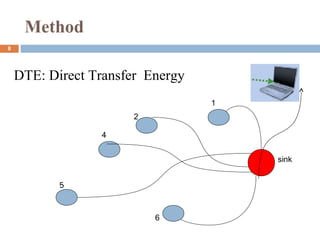
DTE: Direct Transfer Energy
8
5
4
2
1
sink
6
MTE: Minimal Transfer Energy
9
sink
10
Clustering Hierarchy
In wsn nodes are not always homogeneous they might be
heterogeneous which increase network complexity. To
increase stability and reduce the energy consumption
clustering is key technique in WSN.
Genetic Algorithm
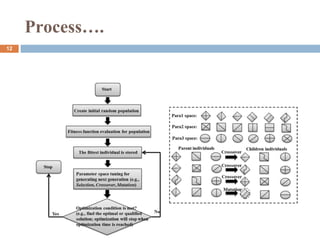
Genetic Algorithm is used to create cluster
member, cluster head and next cluster
dynamically, which is used to calculate
average fitness and increase life time of the
network
11
Process….
12
Population
A population is collection of several
chromosomes and the best chromosome is
used to generate the next population. Initially
the GA starts with a population of predefined
number of chromosomes and randomly
selected cluster heads. each chromosome
is evaluated by GA by calculating its
fitness. After evaluating the fitness GA
selects best suitable chromosome and then
applies crossover and mutation.
13
Fitness
 The fitness of a chromosome is its ability
to pass on its genetic material & also its
quality to survive. The fitness of the
chromosome is designed to minimize the
energy consumption and to increase the network
lifetime.
14
Selection
 Selection is the process of determining
which two chromosomes will mate to
form a new chromosome.
 The chromosomes with higher fitness values
have more chances to of matting.
15
Crossover
 Crossover is a binary genetic operation
applied on two chromosomes. Crossover
recombines the genetic materials of two parent
chromosomes to produce a child chromosome. The
results of the crossover depend on the selection
procedure.
16
Mutation
 In mutation the genetic material of
individual changes of its own. The mutation
adds variations in the next generation.
17
Conclusion
It conclude that SEP is most suitable when
deal with network lifetime and stability. It
found that SEP yields longer stability region
for higher values of extra energy brought by
more powerful nodes.
18
References
 G. Smaragdakis and I. Matta, “SEP: A
Stable Election protocol for clustered
heterogeneous Wireless sensor Networks”,
Boston University Computer Science Department,
2004.
 Akkaya, K., & Younis, M. (2005). "A survey on
routing protocol for wireless sensor networks". Ad
hoc Networks 3 , 325-349.
19
20
Thank you
Any Queries???
21

stable election protocol

  • 1.
    Seminar presentation on SEP: StableElection Protocol 1 Submitted To: Deepak Agarwal Abhishek Jain Guided By: Nidhi Gupta(Asst. Prof) CSE Presented By: Apurva Pareek
  • 2.
    Content  Overview: WirelessSensor Network  Application  Need of SEP  SEP Method  Algorithm  References  Conclusion 2
  • 3.
    Sensor  Sensor areused to sense the information from the environment and compute, store and transmit ,interested data from the environment in which they deployed. 3
  • 4.
    Wireless Sensor Network A Wireless Sensor Network (WSN) consists of base stations and a number of wireless sensors (nodes). 4
  • 5.
    Application  Military andnational security application  Environment monitoring  Medical application  Nearly anything you can imagine 5
  • 6.
    Problem  Due tosmall size a big size battery source can not be embedded into them therefore sensor need an effective mechanism for maximum energy utilization. some amount of energy is consumed during sensing as well as transmission of data. practically this is not possible to replace or recharge batteries of nodes once node are deployed in a field or zone. 6
  • 7.
  • 8.
    Method DTE: Direct TransferEnergy 8 5 4 2 1 sink 6
  • 9.
    MTE: Minimal TransferEnergy 9 sink
  • 10.
    10 Clustering Hierarchy In wsnnodes are not always homogeneous they might be heterogeneous which increase network complexity. To increase stability and reduce the energy consumption clustering is key technique in WSN.
  • 11.
    Genetic Algorithm Genetic Algorithmis used to create cluster member, cluster head and next cluster dynamically, which is used to calculate average fitness and increase life time of the network 11
  • 12.
  • 13.
    Population A population iscollection of several chromosomes and the best chromosome is used to generate the next population. Initially the GA starts with a population of predefined number of chromosomes and randomly selected cluster heads. each chromosome is evaluated by GA by calculating its fitness. After evaluating the fitness GA selects best suitable chromosome and then applies crossover and mutation. 13
  • 14.
    Fitness  The fitnessof a chromosome is its ability to pass on its genetic material & also its quality to survive. The fitness of the chromosome is designed to minimize the energy consumption and to increase the network lifetime. 14
  • 15.
    Selection  Selection isthe process of determining which two chromosomes will mate to form a new chromosome.  The chromosomes with higher fitness values have more chances to of matting. 15
  • 16.
    Crossover  Crossover isa binary genetic operation applied on two chromosomes. Crossover recombines the genetic materials of two parent chromosomes to produce a child chromosome. The results of the crossover depend on the selection procedure. 16
  • 17.
    Mutation  In mutationthe genetic material of individual changes of its own. The mutation adds variations in the next generation. 17
  • 18.
    Conclusion It conclude thatSEP is most suitable when deal with network lifetime and stability. It found that SEP yields longer stability region for higher values of extra energy brought by more powerful nodes. 18
  • 19.
    References  G. Smaragdakisand I. Matta, “SEP: A Stable Election protocol for clustered heterogeneous Wireless sensor Networks”, Boston University Computer Science Department, 2004.  Akkaya, K., & Younis, M. (2005). "A survey on routing protocol for wireless sensor networks". Ad hoc Networks 3 , 325-349. 19
  • 20.
  • 21.

Editor's Notes

  • #9 ADC - Analog-Digital Converter