
Architectural Reference Model
for the
Internet of Things
Presented by:
Suvendu Kumar Dash (VtP 1492)
M.Tech in ECE (VLSI & ESD)
Vel Tech University (C-DAC, Pune), India
30-10-2015 suvendu.15292@gmail.com 1
Overview
• Introduction
• Introduction to the ARM – Vision
• The ARM Rationale
• Benefits of using the ARM
• Process and Architecture Methodology
• Overall process
• Fields of Application
• Conclusions
• Reference
30-10-2015 suvendu.15292@gmail.com 2
Introduction
• This Introduction to the Architectural Reference Model (ARM) for the Internet of
Things which is currently developed by the project partners of the European FP7
Research Project IoT-A.
• "Internet of Things" (IoT) is used as a catchphrase by many sources.
• Moreover, as the IoT umbrella covers totally different application fields,
development cycles and technologies used vary enormously, thus implementing
vertical solutions that can be labelled as "INTRAnet of Things", rather than
"INTERnet of Things".
30-10-2015 suvendu.15292@gmail.com 3
Cont…
• In vision of the Internet of Things, the interoperability of solutions at the
communication level, as well as at the service level, has to be ensured across
various platforms.
• The IoT-A project was to base its work on the current state of the art, rather than
using a clean-slate approach. Due to this choice, common traits are derived to
form the base line of the Architectural Reference Model (ARM).
• This work was conducted according to established architecture methodology.
30-10-2015 suvendu.15292@gmail.com 4
Introduction to the ARM – Vision
• In the vision of the Internet of Things IoT-A wants to promote, a high level of
interoperability needs to be reached at the communication level as well as at the
service and the information level, going across different platforms, but established
on a common grounding.
• First of all in establishing a common understanding of the IoT domain and second
in providing to IoT system developers a common foundation for building
interoperable IoT system architectures.
• A Reference Architecture (RA) can be visualised as the “Matrix” that eventually
gives birth ideally to all concrete architectures.
30-10-2015 suvendu.15292@gmail.com 5
Introduction to the ARM – Vision
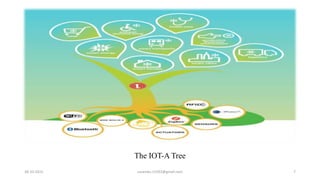
• For establishing such Matrix we need to envisage the superset of all possible
functionalities, mechanisms and protocols that can be used for building such
concrete architecture and to show how interconnections could take place between
selected ones.
• The main aim of IoT-A can be explained using the pictorial representation shown
in next slide.
30-10-2015 suvendu.15292@gmail.com 6
The IOT-A Tree
30-10-2015 suvendu.15292@gmail.com 7
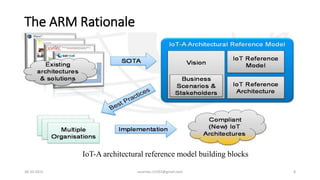
The ARM Rationale
30-10-2015 suvendu.15292@gmail.com 8
IoT-A architectural reference model building blocks
Benefits of using the ARM
• Using the IoT-AARM can provide many benefits. List here the most important
ones.
• Cognitive aid
• IOT‐A Reference Model as a common ground
• Generation of architectures
• Identifying differences
• Benchmarking
30-10-2015 suvendu.15292@gmail.com 9
Process and Architecture Methodology
• This Section provides a meta-perspective of IoT-A process, viz. a look at how the
IoT ARM model was derived.
• It also explains the basic process how concrete systems can be developed by
using the ARM First.
• This understanding is commonly provided in the form of a reference model.
30-10-2015 suvendu.15292@gmail.com 10
30-10-2015 suvendu.15292@gmail.com 11
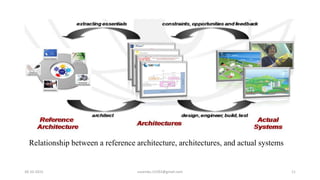
Relationship between a reference architecture, architectures, and actual systems
30-10-2015 suvendu.15292@gmail.com 12
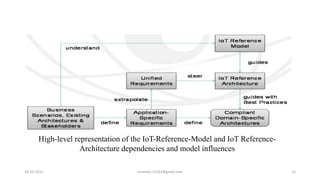
High-level representation of the IoT-Reference-Model and IoT Reference-
Architecture dependencies and model influences
30-10-2015 suvendu.15292@gmail.com 13
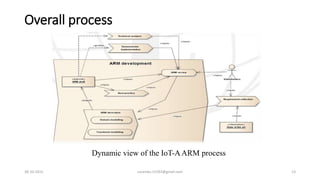
Dynamic view of the IoT-AARM process
Overall process
Fields of Application
• Transportation/ Logistics
• Smart home
• Smart city
• Smart factory
• Retail
• e‐Health
• Environment
30-10-2015 suvendu.15292@gmail.com 14
Conclusions & Outlook
• Substantial economic benefits can emerge from the modular and component-based
approach to building IoT systems that are compliant with the IoT-A Reference
Architecture.
• Providing much more than just the Reference Architecture itself and an economic
validation.
• It will provide best practices for the various modules that the ARM comprises and
will discuss design choices that academics and practitioners alike will be faced
with when implementing concrete systems based on IoT-A.
30-10-2015 suvendu.15292@gmail.com 15
Reference
• Architectural Reference Model for the IoT - (ARM) Introduction Booklet, http://www.iot-
a.eu/public/public-documents/copy_of_d1.2/at_download/file
30-10-2015 suvendu.15292@gmail.com 16
30-10-2015 suvendu.15292@gmail.com 17

Architectural reference model

  • 1.
    Architectural Reference Model forthe Internet of Things Presented by: Suvendu Kumar Dash (VtP 1492) M.Tech in ECE (VLSI & ESD) Vel Tech University (C-DAC, Pune), India 30-10-2015 suvendu.15292@gmail.com 1
  • 2.
    Overview • Introduction • Introductionto the ARM – Vision • The ARM Rationale • Benefits of using the ARM • Process and Architecture Methodology • Overall process • Fields of Application • Conclusions • Reference 30-10-2015 suvendu.15292@gmail.com 2
  • 3.
    Introduction • This Introductionto the Architectural Reference Model (ARM) for the Internet of Things which is currently developed by the project partners of the European FP7 Research Project IoT-A. • "Internet of Things" (IoT) is used as a catchphrase by many sources. • Moreover, as the IoT umbrella covers totally different application fields, development cycles and technologies used vary enormously, thus implementing vertical solutions that can be labelled as "INTRAnet of Things", rather than "INTERnet of Things". 30-10-2015 suvendu.15292@gmail.com 3
  • 4.
    Cont… • In visionof the Internet of Things, the interoperability of solutions at the communication level, as well as at the service level, has to be ensured across various platforms. • The IoT-A project was to base its work on the current state of the art, rather than using a clean-slate approach. Due to this choice, common traits are derived to form the base line of the Architectural Reference Model (ARM). • This work was conducted according to established architecture methodology. 30-10-2015 suvendu.15292@gmail.com 4
  • 5.
    Introduction to theARM – Vision • In the vision of the Internet of Things IoT-A wants to promote, a high level of interoperability needs to be reached at the communication level as well as at the service and the information level, going across different platforms, but established on a common grounding. • First of all in establishing a common understanding of the IoT domain and second in providing to IoT system developers a common foundation for building interoperable IoT system architectures. • A Reference Architecture (RA) can be visualised as the “Matrix” that eventually gives birth ideally to all concrete architectures. 30-10-2015 suvendu.15292@gmail.com 5
  • 6.
    Introduction to theARM – Vision • For establishing such Matrix we need to envisage the superset of all possible functionalities, mechanisms and protocols that can be used for building such concrete architecture and to show how interconnections could take place between selected ones. • The main aim of IoT-A can be explained using the pictorial representation shown in next slide. 30-10-2015 suvendu.15292@gmail.com 6
  • 7.
    The IOT-A Tree 30-10-2015suvendu.15292@gmail.com 7
  • 8.
    The ARM Rationale 30-10-2015suvendu.15292@gmail.com 8 IoT-A architectural reference model building blocks
  • 9.
    Benefits of usingthe ARM • Using the IoT-AARM can provide many benefits. List here the most important ones. • Cognitive aid • IOT‐A Reference Model as a common ground • Generation of architectures • Identifying differences • Benchmarking 30-10-2015 suvendu.15292@gmail.com 9
  • 10.
    Process and ArchitectureMethodology • This Section provides a meta-perspective of IoT-A process, viz. a look at how the IoT ARM model was derived. • It also explains the basic process how concrete systems can be developed by using the ARM First. • This understanding is commonly provided in the form of a reference model. 30-10-2015 suvendu.15292@gmail.com 10
  • 11.
    30-10-2015 suvendu.15292@gmail.com 11 Relationshipbetween a reference architecture, architectures, and actual systems
  • 12.
    30-10-2015 suvendu.15292@gmail.com 12 High-levelrepresentation of the IoT-Reference-Model and IoT Reference- Architecture dependencies and model influences
  • 13.
    30-10-2015 suvendu.15292@gmail.com 13 Dynamicview of the IoT-AARM process Overall process
  • 14.
    Fields of Application •Transportation/ Logistics • Smart home • Smart city • Smart factory • Retail • e‐Health • Environment 30-10-2015 suvendu.15292@gmail.com 14
  • 15.
    Conclusions & Outlook •Substantial economic benefits can emerge from the modular and component-based approach to building IoT systems that are compliant with the IoT-A Reference Architecture. • Providing much more than just the Reference Architecture itself and an economic validation. • It will provide best practices for the various modules that the ARM comprises and will discuss design choices that academics and practitioners alike will be faced with when implementing concrete systems based on IoT-A. 30-10-2015 suvendu.15292@gmail.com 15
  • 16.
    Reference • Architectural ReferenceModel for the IoT - (ARM) Introduction Booklet, http://www.iot- a.eu/public/public-documents/copy_of_d1.2/at_download/file 30-10-2015 suvendu.15292@gmail.com 16
  • 17.