STABILITY STUDIES & ASSESSMENT
Subject: Product Development
Session : 2023-24
DEPARTMENT OF PHARMACEUTICAL SCIENCES
Dr. HARISINGH GOUR VISHWAVIDYALAYA
Sagar (M.P)-470003,India
(A Central University)
SUBMITTED BY SUBMITTED TO
MOHD ZEESHAN PROF. S.K.JAIN
M.PHARM 1st Semester (Professor, DOPS)
(Y22254017) DR.DHARMENDRA JAIN
(Assistant Professor, DOPS)
CONTENTS
 INTRODUCTION
 OBJECTIVE
 WHY STABILITY STUDIES ARE NECESSARY ?
 SHELF-LIFE
 REGULATORY GUIDELINES
 DISTRUBUTION ZONES
 TYPES OF STABILITY
 FREQUENCY OF ANALYSIS
 INTERPRETATION OF RESULTS
 CONCLUSION
 REFERENCES
INTRODUCTION
 Stability studies ensuring the maintenance of product quality, safety and efficacy through
out the shelf-life are considered as pre-requisite for the acceptance and approval of any
pharmaceutical product.
 STABILITY- The capacity or the capability of a particular formulation in a specific
container/closure system to remain within particular physical, chemical, microbiological,
therapeutically and toxicological specifications.
 According to USP, “Stability of pharmaceutical product as extent to which a product
retains within specified limits and through out its period of storage & use”.
 These studies are required to be conducted in a planned way following the guidelines
issued by ICH, WHO and other regulatory agencies.
OBJECTIVES
 To determine maximum expiration date/shelf-life.
 To provide better storage condition.
 To ensure that product comply predetermined quality parameters through out the shelf
life.
 To gather information during preformulation stage to produce a stable product.
 To access quality impact on the product due to any sort of deviation in material, process
and equipment.
WHY STABILITY STUDIES ARE NECESSARY?
1. Chemical degradation of the product leads to lowering of the concentration of the drug
in the dosage form.
2. Toxic products may be formed, due to chemical degradation of the active ingredients.
SHELF-LIFE
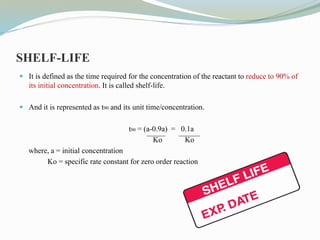
 It is defined as the time required for the concentration of the reactant to reduce to 90% of
its initial concentration. It is called shelf-life.
 And it is represented as t90 and its unit time/concentration.
t90 = (a-0.9a) = 0.1a
Ko Ko
where, a = initial concentration
Ko = specific rate constant for zero order reaction
REGULATORY GUIDELINES
Some important guidelines are -
 Food and Drug Administration (FDA)
 International Conference on Harmonization (ICH)
 European Union Guidelines (EU)
 Japanese Guidelines (MHW)
 World Health Organization (WHO) Guidelines
 ICH(April 1990) have been adopted in the European Union, the United States and
Japan.
REGULATORY GUIDELINES
ICH GUIDELINES:
 Q1A(R2) Stability Testing of New Drug Substances & Products.
 Q1B Stability Testing Photo stability Testing of New Drug Substances & Products.
 Q1C Stability Testing for New Dosage Forms
 Q1D Bracketing and Matrixing Designs for Stability Testing of New Drug Substances
and Products.
 Q1E Evaluation of Stability Data.
 Q1F Stability Data Package for Registration Applications in climatic Zones III and IV.
DISTERIBUTION OF ZONES
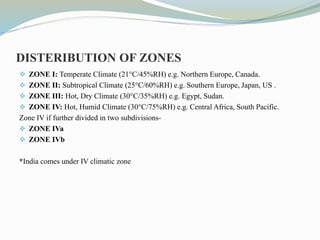
 ZONE I: Temperate Climate (21°C/45%RH) e.g. Northern Europe, Canada.
 ZONE II: Subtropical Climate (25°C/60%RH) e.g. Southern Europe, Japan, US .
 ZONE III: Hot, Dry Climate (30°C/35%RH) e.g. Egypt, Sudan.
 ZONE IV: Hot, Humid Climate (30°C/75%RH) e.g. Central Africa, South Pacific.
Zone IV if further divided in two subdivisions-
 ZONE IVa
 ZONE IVb
*India comes under IV climatic zone
TYPES OF STABILITY STUDIES
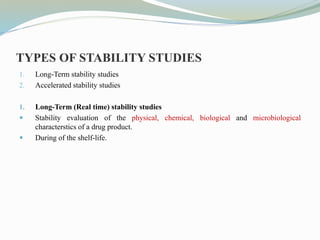
1. Long-Term stability studies
2. Accelerated stability studies
1. Long-Term (Real time) stability studies
 Stability evaluation of the physical, chemical, biological and microbiological
characterstics of a drug product.
 During of the shelf-life.
2. Accelerated stability studies
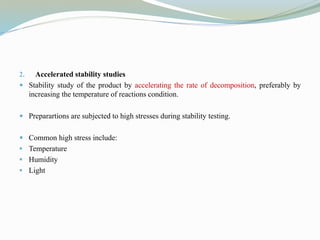
 Stability study of the product by accelerating the rate of decomposition, preferably by
increasing the temperature of reactions condition.
 Preparartions are subjected to high stresses during stability testing.
 Common high stress include:
 Temperature
 Humidity
 Light
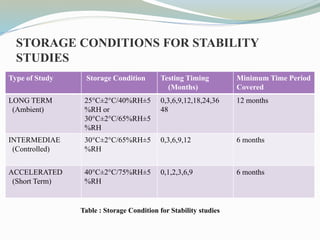
STORAGE CONDITIONS FOR STABILITY
STUDIES
Type of Study Storage Condition Testing Timing
(Months)
Minimum Time Period
Covered
LONG TERM
(Ambient)
25°C±2°C/40%RH±5
%RH or
30°C±2°C/65%RH±5
%RH
0,3,6,9,12,18,24,36
48
12 months
INTERMEDIAE
(Controlled)
30°C±2°C/65%RH±5
%RH
0,3,6,9,12 6 months
ACCELERATED
(Short Term)
40°C±2°C/75%RH±5
%RH
0,1,2,3,6,9 6 months
Table : Storage Condition for Stability studies
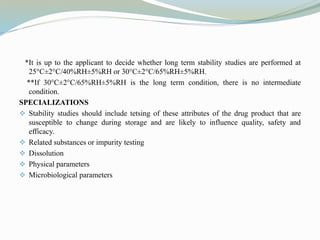
*It is up to the applicant to decide whether long term stability studies are performed at
25°C±2°C/40%RH±5%RH or 30°C±2°C/65%RH±5%RH.
**If 30°C±2°C/65%RH±5%RH is the long term condition, there is no intermediate
condition.
SPECIALIZATIONS
 Stability studies should include tetsing of these attributes of the drug product that are
susceptible to change during storage and are likely to influence quality, safety and
efficacy.
 Related substances or impurity testing
 Dissolution
 Physical parameters
 Microbiological parameters
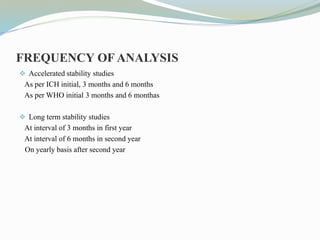
FREQUENCY OF ANALYSIS
 Accelerated stability studies
As per ICH initial, 3 months and 6 months
As per WHO initial 3 months and 6 monthas
 Long term stability studies
At interval of 3 months in first year
At interval of 6 months in second year
On yearly basis after second year
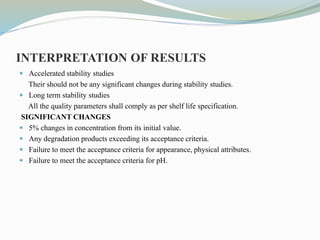
INTERPRETATION OF RESULTS
 Accelerated stability studies
Their should not be any significant changes during stability studies.
 Long term stability studies
All the quality parameters shall comply as per shelf life specification.
SIGNIFICANT CHANGES
 5% changes in concentration from its initial value.
 Any degradation products exceeding its acceptance criteria.
 Failure to meet the acceptance criteria for appearance, physical attributes.
 Failure to meet the acceptance criteria for pH.
CONCLUSION
 Stability testing is now the key procedural component in the pharmaceutical development
program for a new drug as well as new formulation. Stability studies are carried out so
recommended storage conditions and shelf life can be included on the label to ensure that
the product is safe and effective through out its shelf life.
REFERENCES
 Jain N.K ,“Pharmaceutical Product Development”, 3rdedition 2018, CBS Publishers &
Distributers Pvt., Ltd., page no.348-381.
 Bajaj S, Singla D and Sakhuja N, “Stability Testing of Pharmaceutical Products”, Journal
of Applied Pharmaceutical Science 2(03),2012, page no.129-138.
 Arunachalam.A, Shankar.M , “Stability Studies: A Review”, Asian Journal of
Pharmaceutical Analysis 1(4),2013, page no.184-195.
STABILITY STUDIES & ASSESMENT.pptx

STABILITY STUDIES & ASSESMENT.pptx

  • 1.
    STABILITY STUDIES &ASSESSMENT Subject: Product Development Session : 2023-24 DEPARTMENT OF PHARMACEUTICAL SCIENCES Dr. HARISINGH GOUR VISHWAVIDYALAYA Sagar (M.P)-470003,India (A Central University) SUBMITTED BY SUBMITTED TO MOHD ZEESHAN PROF. S.K.JAIN M.PHARM 1st Semester (Professor, DOPS) (Y22254017) DR.DHARMENDRA JAIN (Assistant Professor, DOPS)
  • 2.
    CONTENTS  INTRODUCTION  OBJECTIVE WHY STABILITY STUDIES ARE NECESSARY ?  SHELF-LIFE  REGULATORY GUIDELINES  DISTRUBUTION ZONES  TYPES OF STABILITY  FREQUENCY OF ANALYSIS  INTERPRETATION OF RESULTS  CONCLUSION  REFERENCES
  • 3.
    INTRODUCTION  Stability studiesensuring the maintenance of product quality, safety and efficacy through out the shelf-life are considered as pre-requisite for the acceptance and approval of any pharmaceutical product.  STABILITY- The capacity or the capability of a particular formulation in a specific container/closure system to remain within particular physical, chemical, microbiological, therapeutically and toxicological specifications.  According to USP, “Stability of pharmaceutical product as extent to which a product retains within specified limits and through out its period of storage & use”.  These studies are required to be conducted in a planned way following the guidelines issued by ICH, WHO and other regulatory agencies.
  • 4.
    OBJECTIVES  To determinemaximum expiration date/shelf-life.  To provide better storage condition.  To ensure that product comply predetermined quality parameters through out the shelf life.  To gather information during preformulation stage to produce a stable product.  To access quality impact on the product due to any sort of deviation in material, process and equipment.
  • 5.
    WHY STABILITY STUDIESARE NECESSARY? 1. Chemical degradation of the product leads to lowering of the concentration of the drug in the dosage form. 2. Toxic products may be formed, due to chemical degradation of the active ingredients.
  • 6.
    SHELF-LIFE  It isdefined as the time required for the concentration of the reactant to reduce to 90% of its initial concentration. It is called shelf-life.  And it is represented as t90 and its unit time/concentration. t90 = (a-0.9a) = 0.1a Ko Ko where, a = initial concentration Ko = specific rate constant for zero order reaction
  • 7.
    REGULATORY GUIDELINES Some importantguidelines are -  Food and Drug Administration (FDA)  International Conference on Harmonization (ICH)  European Union Guidelines (EU)  Japanese Guidelines (MHW)  World Health Organization (WHO) Guidelines  ICH(April 1990) have been adopted in the European Union, the United States and Japan.
  • 8.
    REGULATORY GUIDELINES ICH GUIDELINES: Q1A(R2) Stability Testing of New Drug Substances & Products.  Q1B Stability Testing Photo stability Testing of New Drug Substances & Products.  Q1C Stability Testing for New Dosage Forms  Q1D Bracketing and Matrixing Designs for Stability Testing of New Drug Substances and Products.  Q1E Evaluation of Stability Data.  Q1F Stability Data Package for Registration Applications in climatic Zones III and IV.
  • 9.
    DISTERIBUTION OF ZONES ZONE I: Temperate Climate (21°C/45%RH) e.g. Northern Europe, Canada.  ZONE II: Subtropical Climate (25°C/60%RH) e.g. Southern Europe, Japan, US .  ZONE III: Hot, Dry Climate (30°C/35%RH) e.g. Egypt, Sudan.  ZONE IV: Hot, Humid Climate (30°C/75%RH) e.g. Central Africa, South Pacific. Zone IV if further divided in two subdivisions-  ZONE IVa  ZONE IVb *India comes under IV climatic zone
  • 10.
    TYPES OF STABILITYSTUDIES 1. Long-Term stability studies 2. Accelerated stability studies 1. Long-Term (Real time) stability studies  Stability evaluation of the physical, chemical, biological and microbiological characterstics of a drug product.  During of the shelf-life.
  • 11.
    2. Accelerated stabilitystudies  Stability study of the product by accelerating the rate of decomposition, preferably by increasing the temperature of reactions condition.  Preparartions are subjected to high stresses during stability testing.  Common high stress include:  Temperature  Humidity  Light
  • 12.
    STORAGE CONDITIONS FORSTABILITY STUDIES Type of Study Storage Condition Testing Timing (Months) Minimum Time Period Covered LONG TERM (Ambient) 25°C±2°C/40%RH±5 %RH or 30°C±2°C/65%RH±5 %RH 0,3,6,9,12,18,24,36 48 12 months INTERMEDIAE (Controlled) 30°C±2°C/65%RH±5 %RH 0,3,6,9,12 6 months ACCELERATED (Short Term) 40°C±2°C/75%RH±5 %RH 0,1,2,3,6,9 6 months Table : Storage Condition for Stability studies
  • 13.
    *It is upto the applicant to decide whether long term stability studies are performed at 25°C±2°C/40%RH±5%RH or 30°C±2°C/65%RH±5%RH. **If 30°C±2°C/65%RH±5%RH is the long term condition, there is no intermediate condition. SPECIALIZATIONS  Stability studies should include tetsing of these attributes of the drug product that are susceptible to change during storage and are likely to influence quality, safety and efficacy.  Related substances or impurity testing  Dissolution  Physical parameters  Microbiological parameters
  • 14.
    FREQUENCY OF ANALYSIS Accelerated stability studies As per ICH initial, 3 months and 6 months As per WHO initial 3 months and 6 monthas  Long term stability studies At interval of 3 months in first year At interval of 6 months in second year On yearly basis after second year
  • 15.
    INTERPRETATION OF RESULTS Accelerated stability studies Their should not be any significant changes during stability studies.  Long term stability studies All the quality parameters shall comply as per shelf life specification. SIGNIFICANT CHANGES  5% changes in concentration from its initial value.  Any degradation products exceeding its acceptance criteria.  Failure to meet the acceptance criteria for appearance, physical attributes.  Failure to meet the acceptance criteria for pH.
  • 16.
    CONCLUSION  Stability testingis now the key procedural component in the pharmaceutical development program for a new drug as well as new formulation. Stability studies are carried out so recommended storage conditions and shelf life can be included on the label to ensure that the product is safe and effective through out its shelf life.
  • 17.
    REFERENCES  Jain N.K,“Pharmaceutical Product Development”, 3rdedition 2018, CBS Publishers & Distributers Pvt., Ltd., page no.348-381.  Bajaj S, Singla D and Sakhuja N, “Stability Testing of Pharmaceutical Products”, Journal of Applied Pharmaceutical Science 2(03),2012, page no.129-138.  Arunachalam.A, Shankar.M , “Stability Studies: A Review”, Asian Journal of Pharmaceutical Analysis 1(4),2013, page no.184-195.